
Revision Notes
AQA A-Level Business: Human resource management (7132) – Revision Notes
Condensed AQA A-level Business 7132 revision notes on section 3.6 human resource management: formulas, models, distinctions and a self-test.
- Subject
- Business
- Level
- A LEVELS
- Topic
- Human resource management
- Author
- Marlbridge Academic Team
- Updated
- Reviewed by
- Salman Ahmad (what this means)
Aligned to AQA A Level Business (7132), For first teaching from September 2023. Official specification .
Syllabus page (what it covers and how it is assessed): AQA A Level Business.
Syllabus points this page covers
7132
- 6 Human resource management (whole topic)
Found an error? Report a correction.
Need help with this topic? Request a free trial class for A Level Business (7132).
These notes condense section 3.6, Decision making to improve human resource performance, of the AQA A-level Business specification (7132). Full explanations and worked examples are in the study guide. Test yourself with the practice questions. Course hub: AQA A-level Business. Printable list: checklist. Find weak spots with the free diagnostics. Related: managers, leadership and decision making.
Section checklist
| Section | You must be able to |
|---|---|
| 3.6.1 | Explain the value of HR objectives; list and apply the six named objectives; explain internal and external influences, including soft and hard HRM |
| 3.6.2 | Calculate and interpret four HR measures; use HR data in decisions and planning |
| 3.6.3 | Apply Hackman and Oldham; explain the five organisational design decisions; judge changes in design; explain the five parts of the HR flow |
| 3.6.4 | Explain benefits of motivation; use Taylor, Maslow and Herzberg; judge four financial methods and non-financial methods |
| 3.6.5 | Explain influences on involvement; compare trade unions and works councils; improve communication |
HR objectives (3.6.1)
- Value: gives direction, allows planning and lets managers judge success.
- Named objectives: employee engagement and involvement; talent development; training; diversity; alignment of values; number, skills and location of employees.
- Internal influences: corporate objectives, finance, culture, leadership style, workforce skills.
- External influences: labour market, competitors, technology, ethics and society.
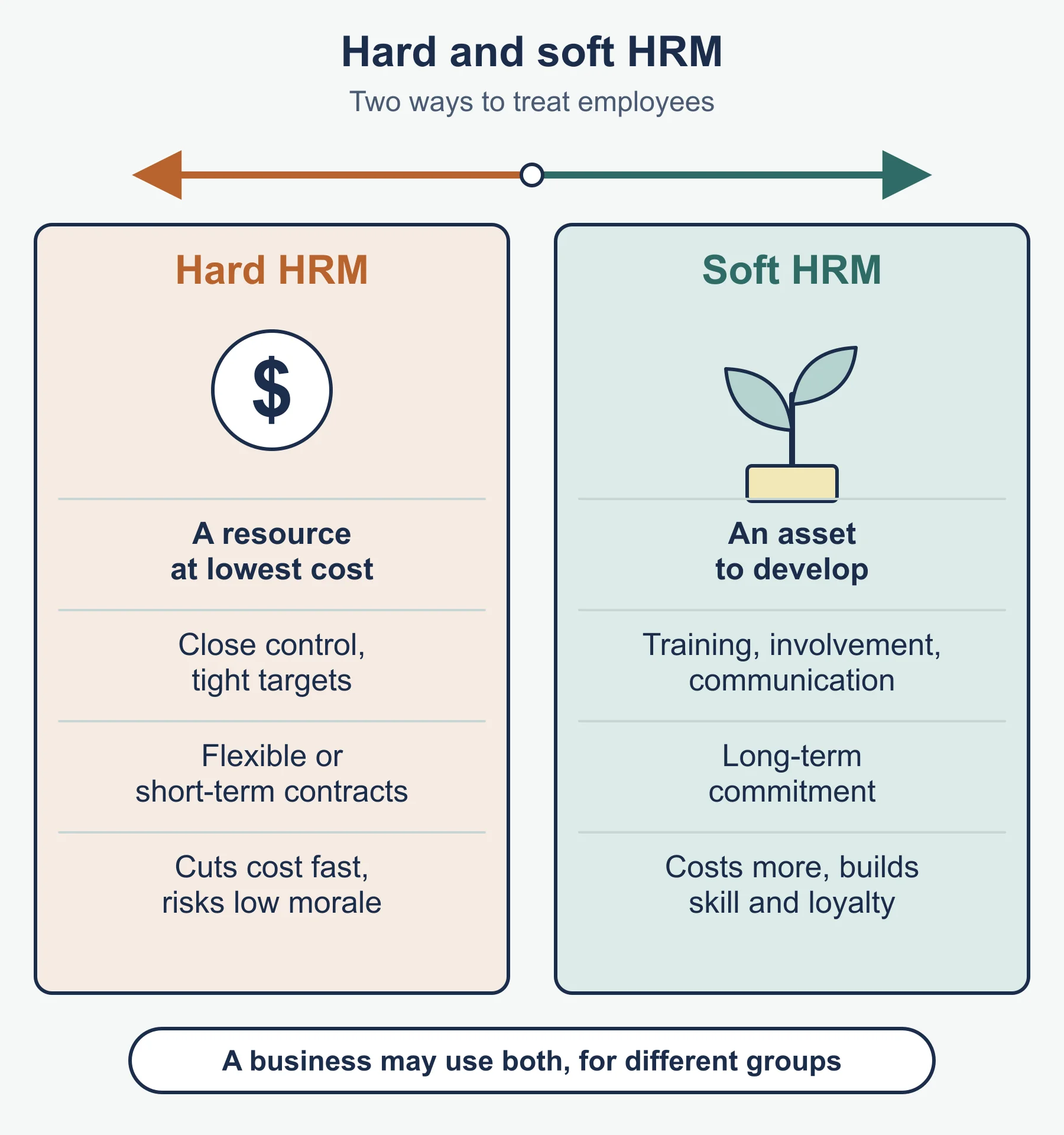
| Hard HRM | Soft HRM | |
|---|---|---|
| View of staff | A cost to control | An asset to develop |
| Typical methods | Flexible contracts, output pay, tight supervision | Training, involvement, communication |
| Objectives favoured | Numbers, location, cost | Engagement, talent development, values |
HR data (3.6.2)
The specification names the measures but not the formulas. These are the standard forms.
| Measure | Formula |
|---|---|
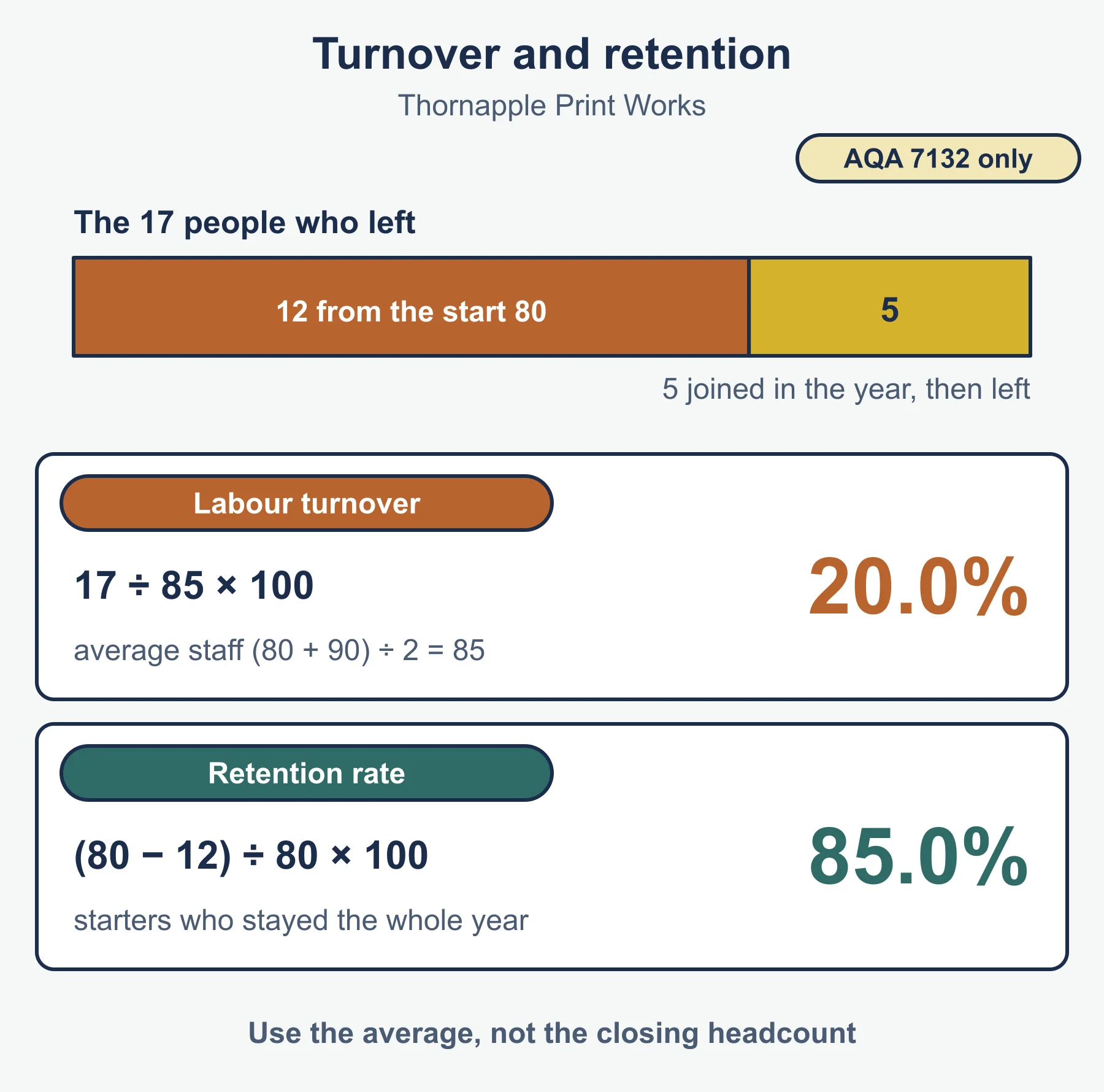
| Labour turnover (%) | leavers / average number employed x 100 |
| Retention rate (%) | staff who stayed all period / staff at start x 100 |
| Labour productivity | output / number of employees |
| Employee costs as % of turnover | employee costs / turnover x 100 |
| Labour cost per unit | total labour cost / units produced |
Method in steps. Write the formula. Substitute with units. Calculate. Interpret: compare with an earlier period or a rival, give one cause, give one decision that follows.
Worked reminder. Rothwick Bakery had 36 staff at the start of the year and 44 at the end, so the average was 40. Six left: 6 / 40 x 100 = 15%.
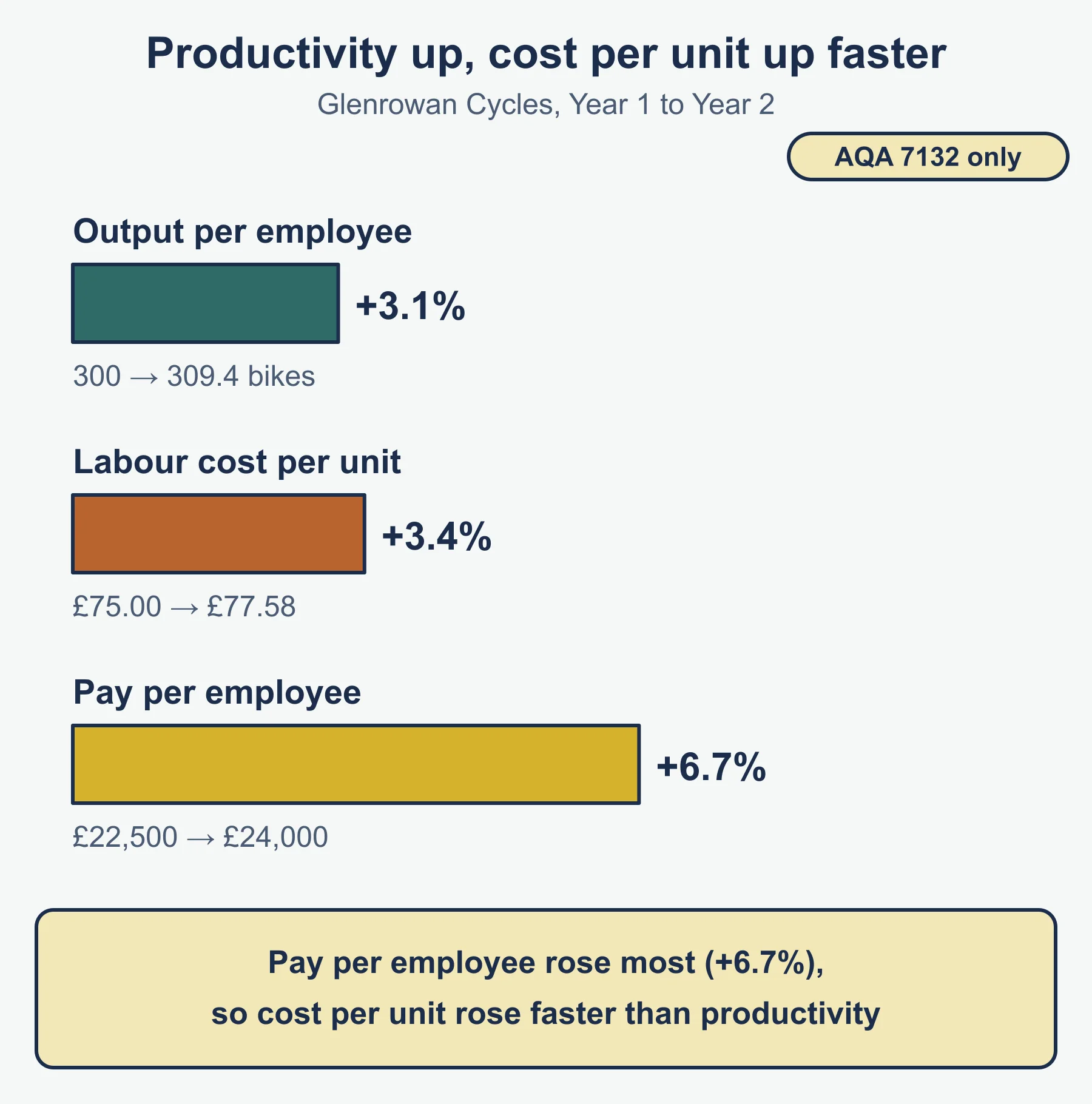
Second reminder. Rothwick made 84,000 loaves with 28 bakers and paid £210,000 in wages on turnover of £1,400,000. Productivity is 3,000 loaves per baker. Employee costs are 15% of turnover. Labour cost per unit is £2.50. If wages rise 10% and output stays the same, cost per unit rises to £2.75, so the business must raise productivity or price to protect profit.
Data helps decisions on hiring, training, pay, staffing levels and working patterns. It tells you what happened, not why.
Job design: Hackman and Oldham (3.6.3)
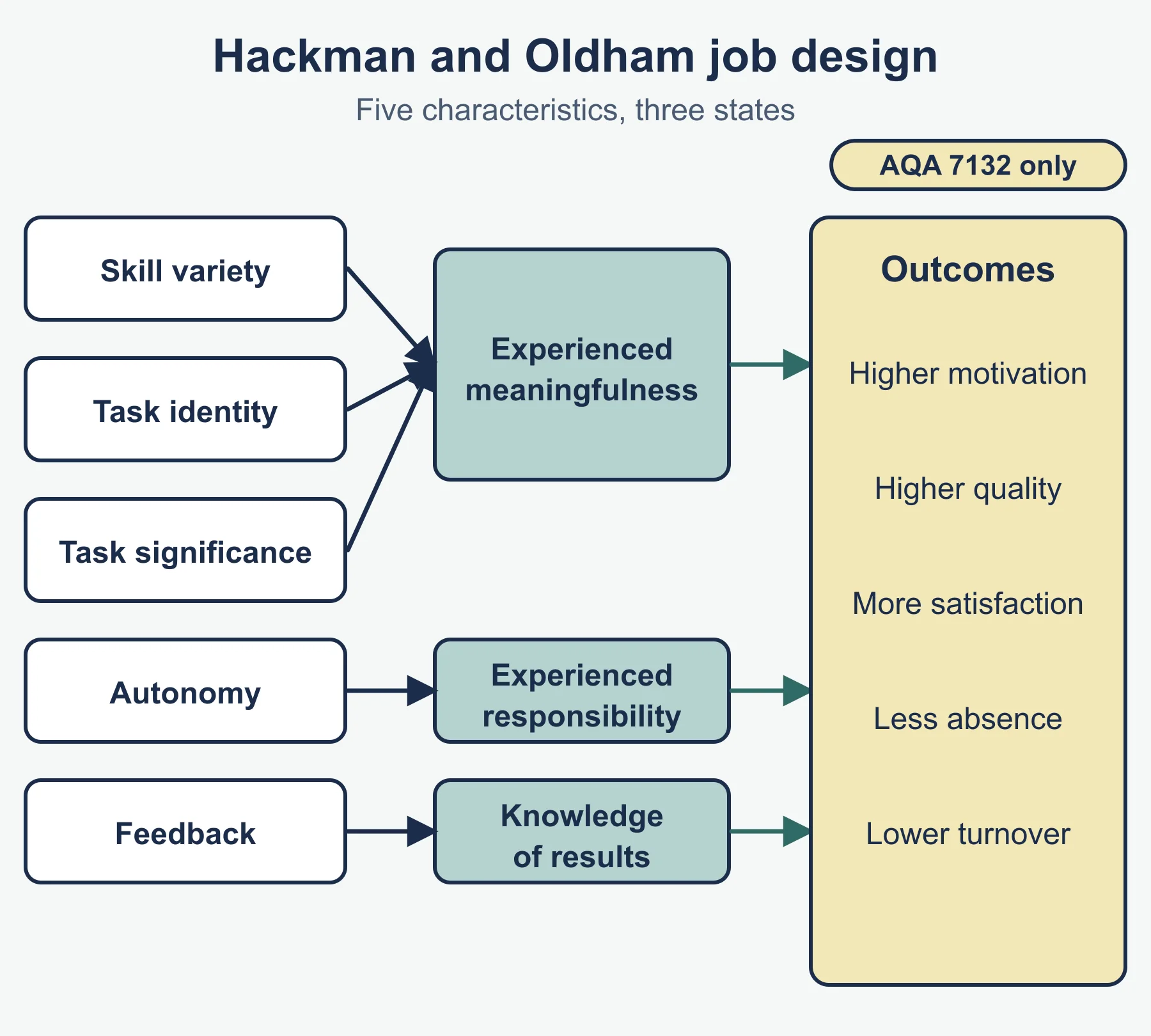
| Core job characteristic | Leads to psychological state |
|---|---|
| Skill variety, task identity, task significance | Experienced meaningfulness of the work |
| Autonomy | Experienced responsibility for outcomes |
| Feedback | Knowledge of results |
Outcomes: higher motivation, quality and satisfaction; lower absence and turnover. To apply it, name the characteristic in the case, say what a redesign would change and say what it would cost.
Organisational design (3.6.3)
| Term | Meaning |
|---|---|
| Authority | The right to make decisions and instruct |
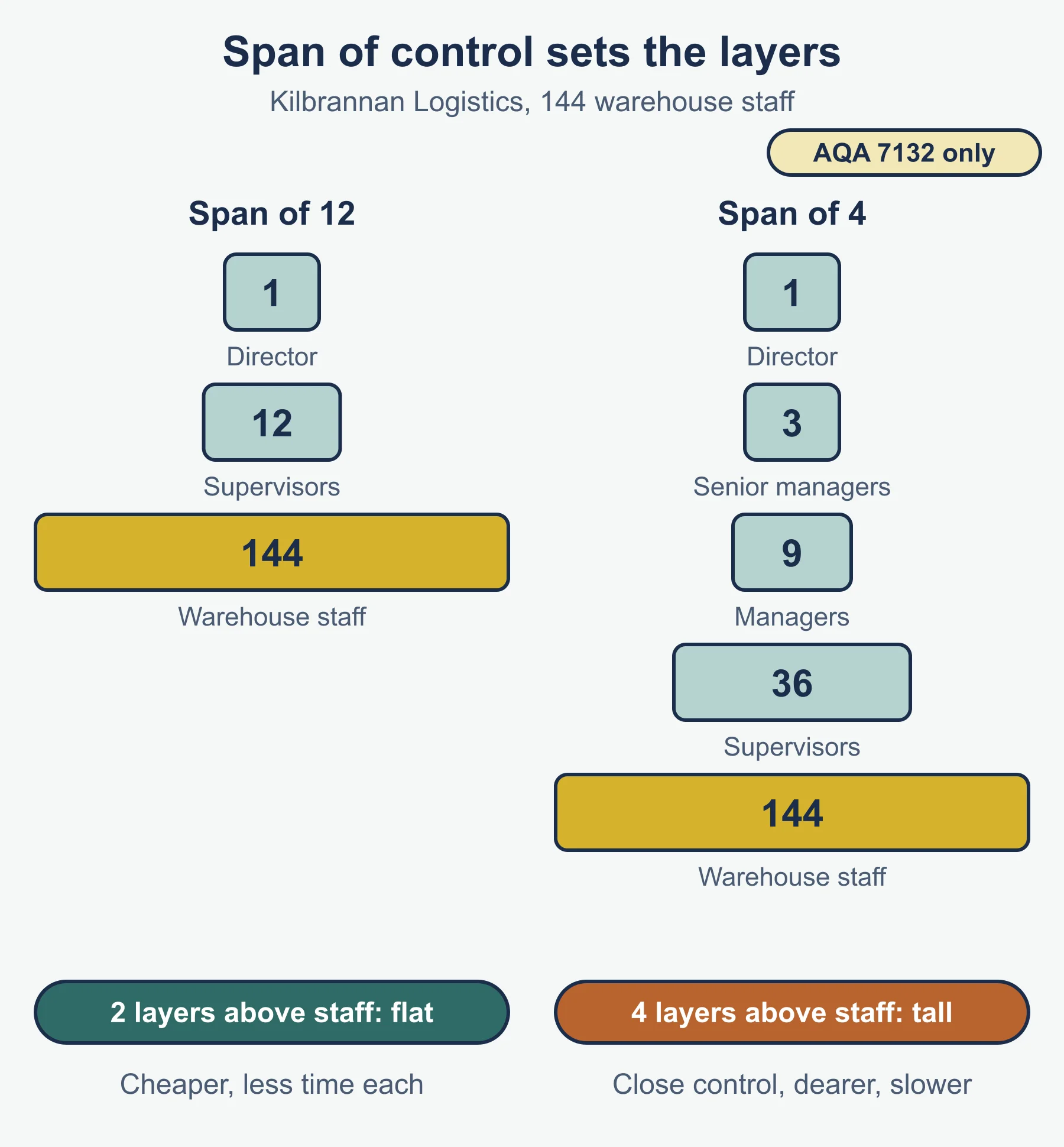
| Span | People a manager directly supervises |
| Hierarchy | Levels of authority |
| Delegation | Passing authority down; accountability stays above |
| Centralised | Decisions taken at the top |
| Decentralised | Decisions passed down to branches or teams |
Span and layers. Divide the number of staff by the span, round up, repeat until you reach one. For 90 staff and a span of 6: 15 supervisors, 3 managers, 1 director. That is three layers above the staff. A narrower span adds layers.
- Delegation, centralisation and decentralisation depend on trust, skills, risk, size, spread of sites and the need for consistency or local knowledge.
- Changing design: possible gains in speed, cost, motivation and fit with technology; possible costs in disruption, redundancy and resistance.
Human resource flow (3.6.3)
- Human resource plan: forecast need, compare with supply, plan the gap.
- Recruitment.
- Training.
- Redeployment.
- Redundancy.
Each helps meet objectives on the number, skills and location of employees. Redeployment and training keep skills; redundancy cuts cost fast but has financial and morale costs.
Motivation (3.6.4)
| Theory | Core idea | Implication |
|---|---|---|
| Taylor | People work mainly for pay | Simple tasks, training, supervision, output-based pay |
| Maslow | Five-level hierarchy: physiological, safety, social, esteem, self-actualisation | Satisfy whichever level is still unmet |
| Herzberg | Hygiene factors prevent dissatisfaction; motivators create satisfaction | Enrich jobs and give recognition |
| Financial method | How it works | Main risk |
|---|---|---|
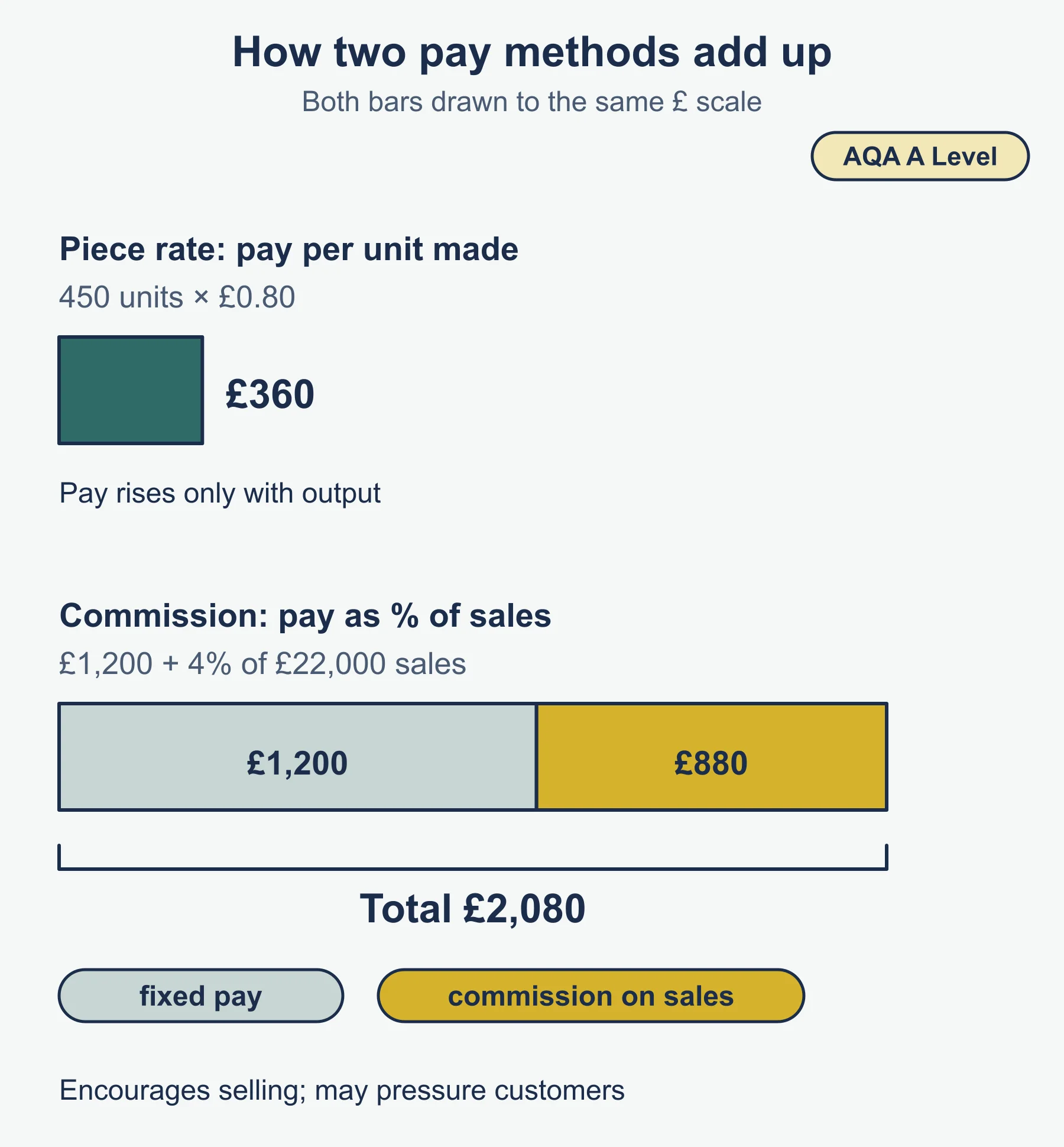
| Piece rate | Pay per unit | Quality falls |
| Commission | Percentage of sales | Pressure on customers |
| Salary | Fixed annual sum | Weak link to effort |
| Performance-related pay | Reward for targets | Unfair or poorly set targets |
Non-financial methods: job enrichment and rotation, empowerment, teamworking, training, recognition, flexible working, career paths.
Choose and judge a reward system by the type of work, budget, rivals’ pay, culture and staff preferences, then by turnover, absence, productivity, unit cost and surveys, set against cost.
Employer-employee relations (3.6.5)
- Extent and method of involvement depend on leadership style, workforce size, skills and expectations, and speed of decision.
- Trade union: independent body representing members; bargains on pay and conditions.
- Works council: employee and management representatives who share information and consult inside the business.
- Better communication: two-way channels, early and honest information, consultation before decisions.
- Value: fewer disputes, less absence, easier change.
Answering extended questions
- Define or apply the key term in one sentence tied to the case.
- Give a developed point: cause, effect on the business, link to an objective.
- Give a counter-point: a cost, risk or limit in this context.
- Weigh them using the case facts: size, labour market, finances, urgency, culture.
- Reach a judgement that answers the question set, and say what it depends on.
For “evaluate” and “justify”, the judgement matters as much as the analysis. Mention a factor such as time scale (short-run savings against long-run loyalty) or the strength of competitors’ offers.
Themes to weave in
Technology and ways of working such as tele-working; ethics and environment; labour market and competition; competitiveness; links to finance, operations and marketing.
Must-know distinctions
- Delegation (passing a task) versus decentralisation (a structure where decisions sit lower down).
- Retention rate versus labour turnover: one counts staying, the other counts leaving, and they use different bases.
- Productivity (output per employee) versus labour cost per unit (money per item).
- Hygiene factors versus motivators.
- Job rotation (moving between tasks) versus job enrichment (more responsibility in one job).
Quick self-test
- A business had an average of 50 staff and 8 leavers. Calculate labour turnover.
- 50 staff were employed at the start of the year and 44 of them stayed throughout. Calculate the retention rate.
- Output is 12,600 units from 28 employees. Calculate labour productivity.
- Employee costs are £210,000 and turnover is £1,400,000. Calculate employee costs as a percentage of turnover.
- Labour costs of £210,000 produce 84,000 units. Calculate labour cost per unit.
- A worker is paid £1.25 per unit and makes 360 units. State the pay.
- Name the three critical psychological states in Hackman and Oldham’s model.
- 90 staff, span of 6: how many layers of management sit above the staff?
- State one difference between a trade union and a works council.
- Is pay a hygiene factor or a motivator in Herzberg’s theory?
Answers
- 8 / 50 x 100 = 16%.
- 44 / 50 x 100 = 88%.
- 12,600 / 28 = 450 units per employee.
- 210,000 / 1,400,000 x 100 = 15%.
- 210,000 / 84,000 = £2.50.
- 1.25 x 360 = £450.
- Experienced meaningfulness, experienced responsibility and knowledge of results.
- Three (15 supervisors, 3 managers, 1 director).
- A union is independent of the employer and bargains for members; a works council sits inside the business and mainly consults and shares information.
- A hygiene factor.
Where marks are usually lost
- Using the closing headcount rather than the average in labour turnover.
- Giving a figure without interpreting it or comparing it.
- Listing Maslow’s levels without linking them to the case.
- Saying a method is good without a context-based reason or a drawback.
- Confusing delegation with decentralisation.
- Treating redundancy as only a cost saving, with no mention of morale, payments or lost skills.
- Ignoring the labour market or competition when judging a pay scheme.
- Giving a long conclusion that repeats the points without a judgement.
Frequently asked questions
What is the difference between labour turnover and retention rate? Labour turnover counts staff leaving as a percentage of the average number employed, while retention rate counts the staff who stayed as a percentage of those employed at the start. They measure opposite things and use different bases.
How do you work out the number of management layers from a span of control? Divide the number of staff by the span, round up, and repeat until you reach one. For 90 staff and a span of 6, that gives 15 supervisors, 3 managers and 1 director: three layers.
What is the difference between a trade union and a works council? A trade union is independent of the employer and bargains for its members on pay and conditions. A works council sits inside the business, with employee and management representatives who share information and consult.
What is the difference between delegation and decentralisation? Delegation is passing a task or decision to someone lower down, while decentralisation is a structure in which decisions are taken lower down the organisation. Confusing the two is a common error.
Official syllabus
AQA, AS and A-level Business (7131 and 7132) specification, section 3.6 Decision making to improve human resource performance, for first teaching from September 2023. The formulas are standard forms, since the specification gives none.
Get free revision emails (optional)
Occasional emails with practice questions, worked explanations and links to free resources for the qualification and subjects you choose. No spam, and you can unsubscribe from any email. The free tools on this site never need an email.
Related resources
-
Study guides
AQA A-Level Business: Human resource management (7132)
Study guide to AQA A-level Business 7132 section 3.6: HR objectives, HR data, job and organisational design, motivation and employer-employee relations.
Business · AQA · A Level
Read guide -
Practice questions
AQA A-Level Business: Human resource management (7132) – Practice Questions
Ten original AQA A-level Business questions on section 3.6 human resource management, with worked answers, examiner insights and short case studies.
Business · AQA · A Level
Try questions -
Study guides
AQA A-Level Business: Managers, Leadership and Decision Making (7132)
Study guide to Topic 2 Managers, leadership and decision making for AQA A-level Business 7132: leadership styles, decision trees and stakeholder mapping.
Business · AQA · A Level
Read guide
Related articles
-
teaching
A Level tuition in Dubai: Cambridge or Pearson Edexcel International A Level?
Schools in Dubai and Abu Dhabi teach either Cambridge International AS & A Level or Pearson Edexcel International A Level. How the two are structured, why it matters for tuition, and how online classes from Lahore work.
9 October 2026
-
curriculum guides
Choosing subjects at IGCSE and A Level
How subject choices at 14 and 16 affect university options later, and how to keep pathways open without overloading a timetable.
28 July 2026
Studying this with a teacher
Working through Business A LEVELS?
This page is free and stays free. If you would rather be taught it, Marlbridge runs Business classes one-to-one and in small groups of up to 15, online in your own time zone. The first trial class is free. WhatsApp replies within an hour (8am–11pm Pakistan time, every day); email the same day.
AQA Business teachers at Marlbridge
