
Study Guides
AQA A-Level Business: Human resource management (7132)
Study guide to AQA A-level Business 7132 section 3.6: HR objectives, HR data, job and organisational design, motivation and employer-employee relations.
- Subject
- Business
- Level
- A LEVELS
- Topic
- Human resource management
- Author
- Marlbridge Academic Team
- Updated
- Reviewed by
- Salman Ahmad (what this means)
Aligned to AQA A Level Business (7132), For first teaching from September 2023. Official specification .
Syllabus page (what it covers and how it is assessed): AQA A Level Business.
Syllabus points this page covers
7132
- 6 Human resource management (whole topic)
Found an error? Report a correction.
Need help with this topic? Request a free trial class for A Level Business (7132).
This guide covers section 3.6, Decision making to improve human resource performance, of the AQA A-level Business specification (7132). It follows the official text point by point. All businesses and figures are invented. Related reading: managers, leadership and decision making. Course hub: AQA A-level Business. Printable list: checklist. Pair it with the revision notes and the practice questions, and see where you stand with the free diagnostics.
Map of the topic
| Section | Focus |
|---|---|
| 3.6.1 Setting human resource objectives | Objectives, influences, soft and hard HRM |
| 3.6.2 Analysing human resource performance | The four measures and using HR data |
| 3.6.3 Improving organisational design and managing the human resource flow | Job and organisational design, the human resource flow |
| 3.6.4 Improving motivation and engagement | Theories, financial and non-financial methods, reward systems |
| 3.6.5 Improving employer-employee relations | Involvement, representation, communication |
The specification also asks you to consider five themes throughout the section. They are: technology (its effect on what work involves, which skills are needed and how people work, for example tele-working); ethical and environmental influences; market conditions, including the labour market, and competition; how HR decisions improve competitiveness; and the links between HR decisions and other functions. Section 8 deals with them together.
1. Setting human resource objectives (3.6.1)
Human resource objectives are targets that make the workforce support corporate objectives. Their value is direction and measurement: managers plan against a stated target and later judge whether it was met.
The specification lists these objectives:
- Employee engagement and involvement: employees who care about the work and have a say in it.
- Talent development: growing future managers and specialists from within.
- Training: building the skills the business needs now.
- Diversity: a workforce that reflects a wide range of people and perspectives.
- Alignment of values: employees who share the business’s values and culture.
- Number, skills and location of employees: having the right people in the right place.
Influences. Internal influences include corporate objectives, finance available, culture, workforce skills and leadership style. External influences include the labour market (how many suitable people are available and what they expect to be paid), competitors’ pay and conditions, technology, and ethical expectations in society.
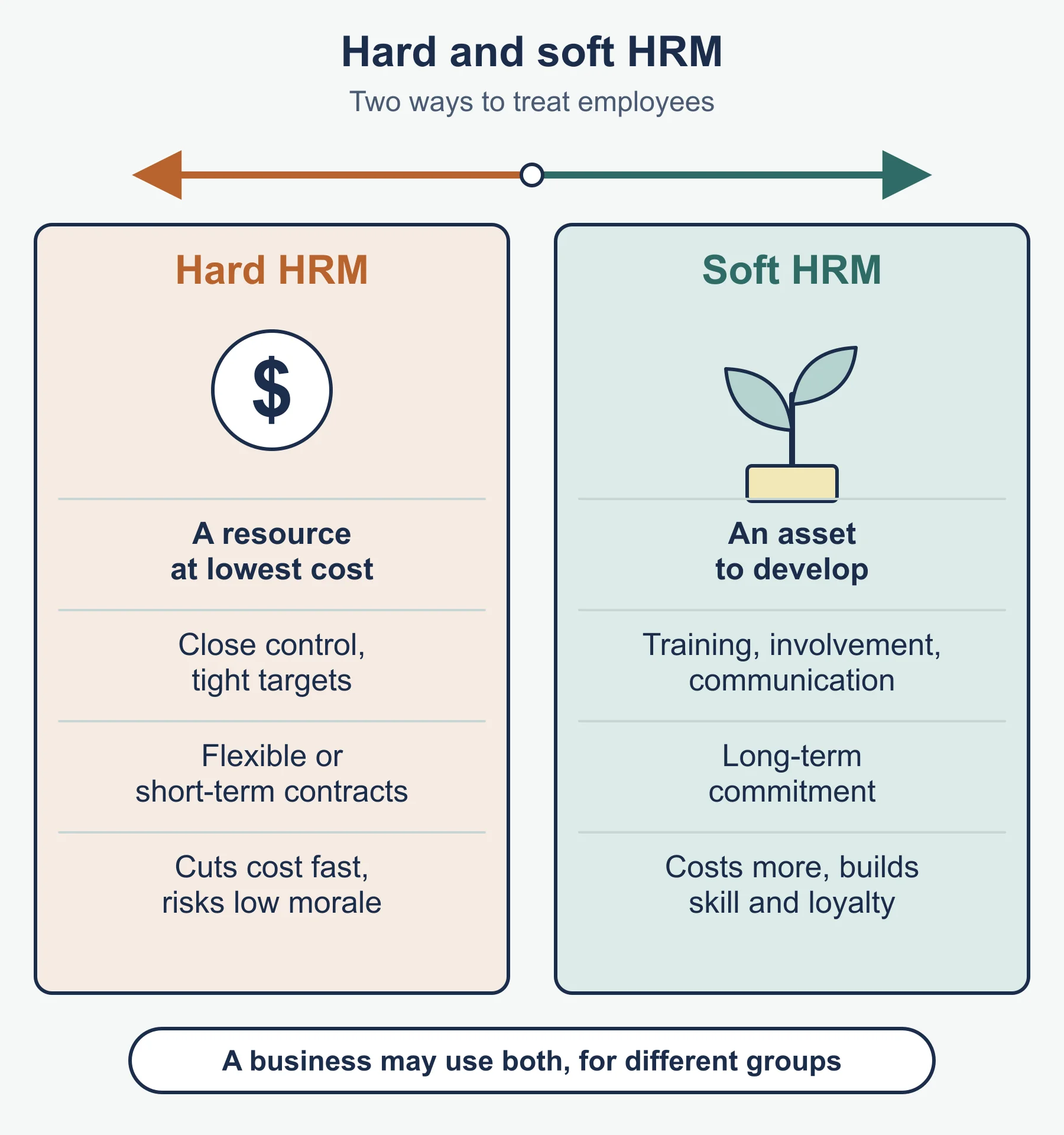
Soft and hard HRM. A hard approach treats employees as a cost and a resource to be used efficiently: tight control, flexible contracts, pay linked to output, workforce numbers adjusted quickly to demand. A soft approach treats employees as an asset to be developed: investment in training, involvement in decisions, strong communication and commitment. The approach a business takes influences which objectives it sets. A soft approach points towards engagement and talent development. A hard approach points towards numbers, costs and location.
2. Analysing human resource performance (3.6.2)
The specification requires you to calculate and interpret four measures. The official text names them but gives no formulas, so the forms below are the standard ones.
| Measure | Standard form |
|---|---|
| Labour turnover | (number of leavers in the period / average number employed) x 100 |
| Retention rate | (number of employees who stayed for the whole period / number employed at the start) x 100 |
| Labour productivity | output in a period / number of employees |
| Employee costs as a percentage of turnover | (employee costs / turnover) x 100 |
| Labour cost per unit | total labour cost / number of units produced |
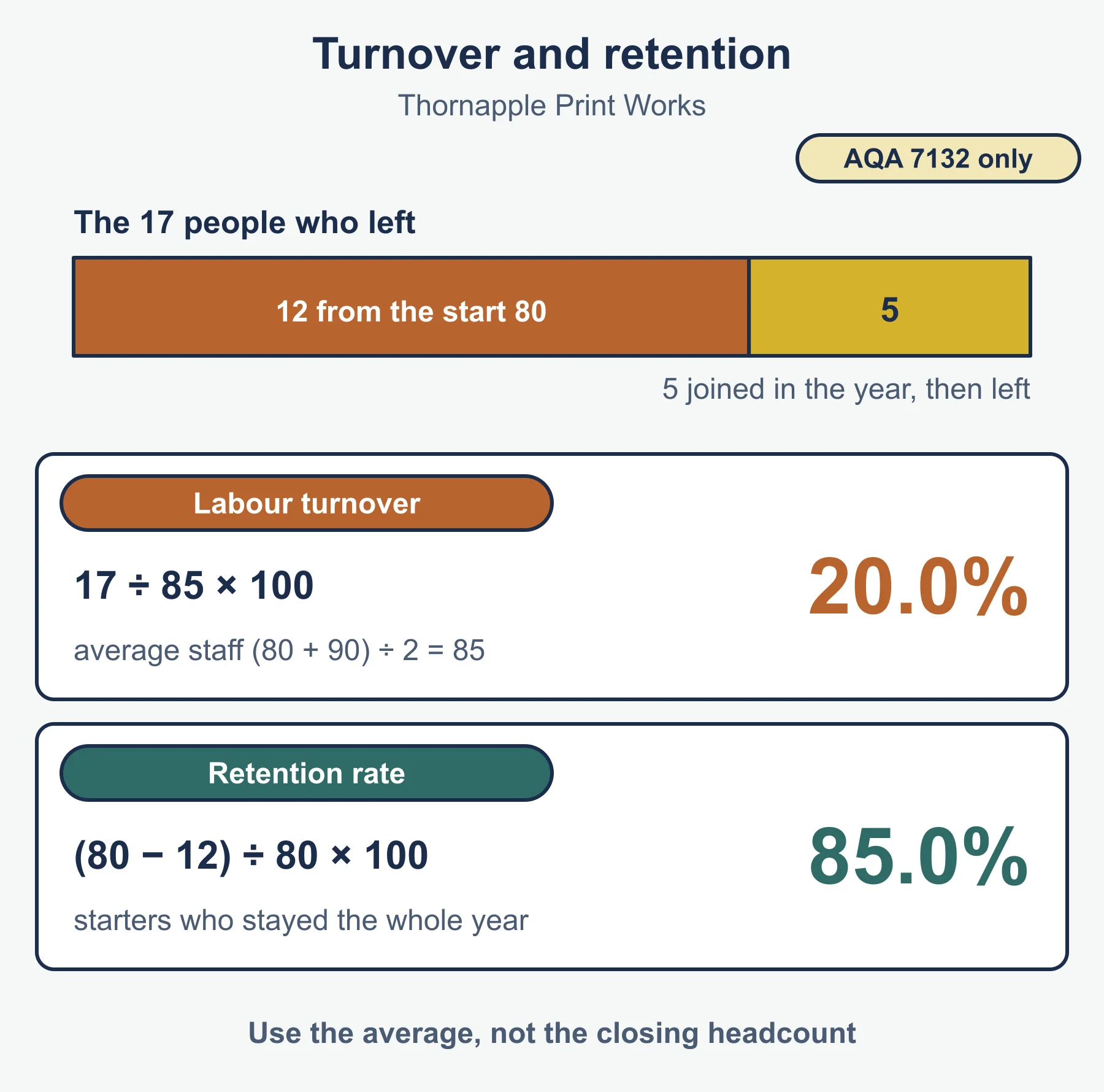
Worked example 1: turnover and retention. Thornapple Print Works employed 80 people at the start of the year and 90 at the end. In total 17 people left, of whom 12 were in the starting 80.
- Average employed = (80 + 90) / 2 = 85.
- Labour turnover = 17 / 85 x 100 = 20.0%.
- Retention rate = (80 - 12) / 80 x 100 = 85.0%.
Interpretation: a fifth of the workforce was replaced in a year, which brings recruitment and training costs. But 20% means little alone. Compare it with earlier years and local employers, and find out who is leaving and why.
Worked example 2: productivity and costs. Glenrowan Cycles sells every bike it makes at £250.
| Year 1 | Year 2 | |
|---|---|---|
| Output (bikes) | 18,000 | 19,800 |
| Employees | 60 | 64 |
| Turnover | £4,500,000 | £4,950,000 |
| Employee costs | £1,350,000 | £1,536,000 |
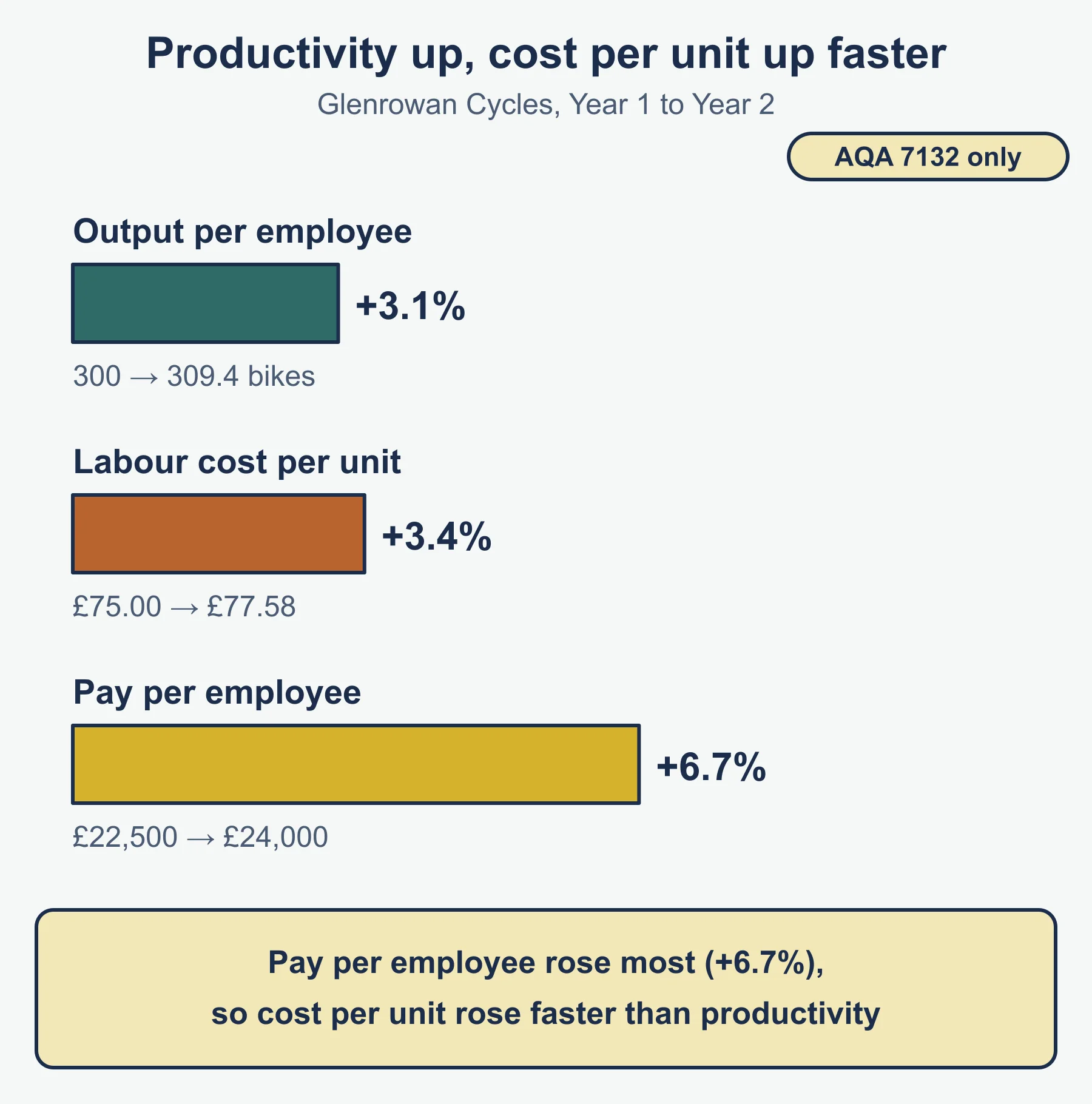
- Labour productivity: 300 bikes per employee in Year 1; 309.4 in Year 2, up 3.1%.
- Employee costs as a percentage of turnover: 30.0%, then 31.0%.
- Labour cost per unit: £75.00, then £77.58, up 3.4%.
Productivity improved, yet cost per unit rose faster because pay per employee rose more. A manager would ask whether the pay rise is justified and whether training could lift productivity further.
Using data for decisions and planning. HR data supports decisions on recruitment (a high turnover suggests more hiring is needed), training (low productivity may point to a skills gap), pay (cost per unit against rivals), workforce size (numbers needed for forecast demand) and working patterns. Data shows what has happened, not why, so read it with qualitative evidence such as exit interviews.
3. Job design (3.6.3, first part)
Job design is deciding what tasks a job contains and how much control the post-holder has. Influences include technology, workforce skills, cost control, culture and the effect on motivation.
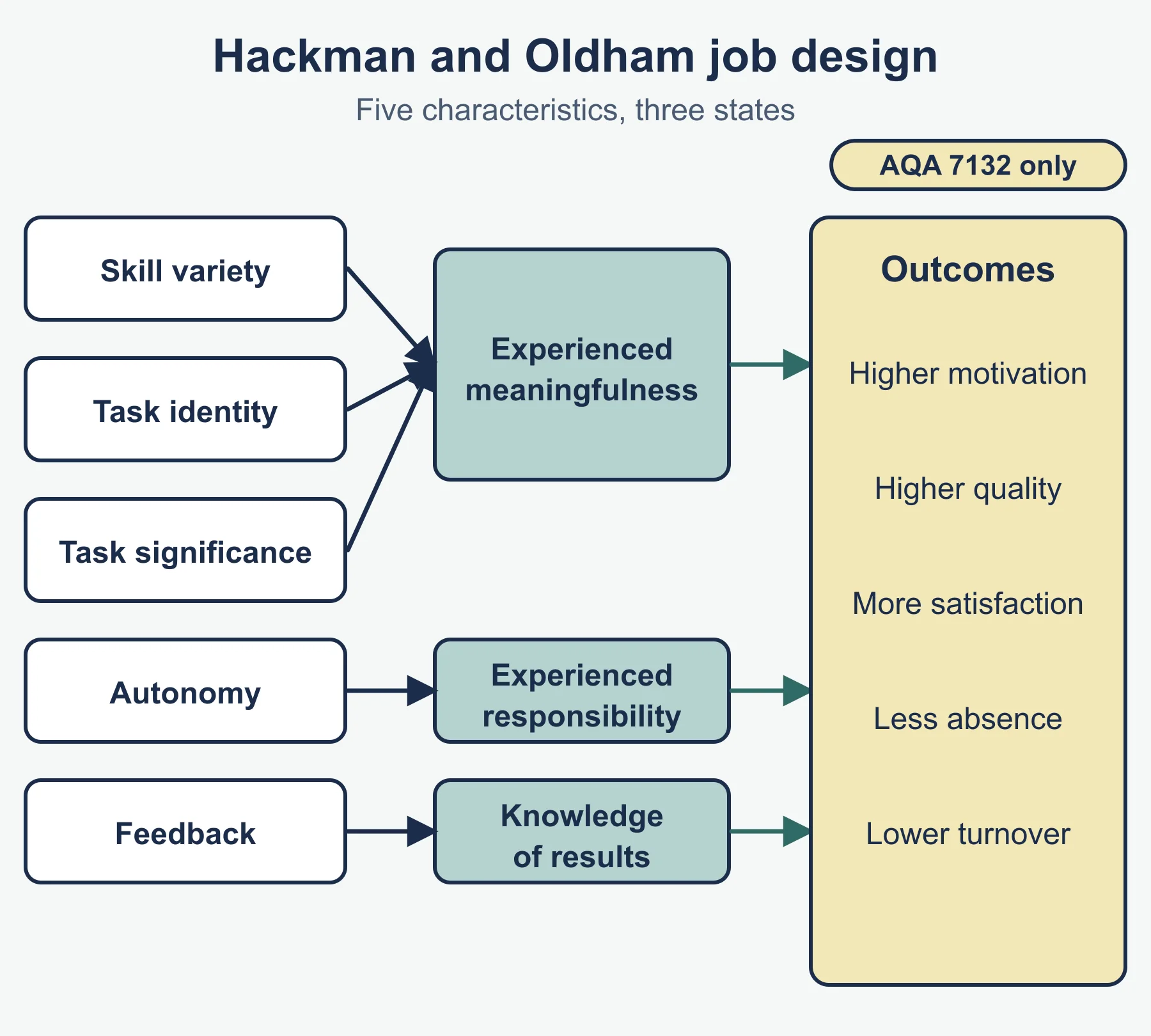
Hackman and Oldham’s model argues that five core job characteristics lead to three critical psychological states, which in turn produce better outcomes.
| Core characteristic | Meaning |
|---|---|
| Skill variety | The job uses a range of skills |
| Task identity | The worker completes a whole, identifiable piece of work |
| Task significance | The work matters to others |
| Autonomy | Freedom to decide how and when to do the work |
| Feedback | Clear information on how well the work is going |
The first three produce experienced meaningfulness, autonomy produces experienced responsibility, and feedback produces knowledge of results. The outcomes include higher motivation, quality and satisfaction, and lower absenteeism and turnover.
Worked example 3. At Linnet Hollow Dental, receptionists only answer the phone, and a separate team books treatments and chases payments. Redesign could let each receptionist handle a patient from first call to final payment (task identity, skill variety), set their own daily order of work (autonomy), and show them monthly patient-satisfaction scores (feedback). The cost is training time; the benefit is lower turnover.
4. Organisational design (3.6.3, second part)
Organisational design is how the business is structured. The specification lists five decisions.
- Authority: the right to make decisions and instruct others.
- Span: the number of people a manager directly supervises.
- Hierarchy: the levels of authority between the top and the bottom.
- Delegation: passing authority for a task or decision to someone lower down while the manager stays accountable for the outcome.
- Centralisation and decentralisation: whether decisions are taken at the top or passed down.
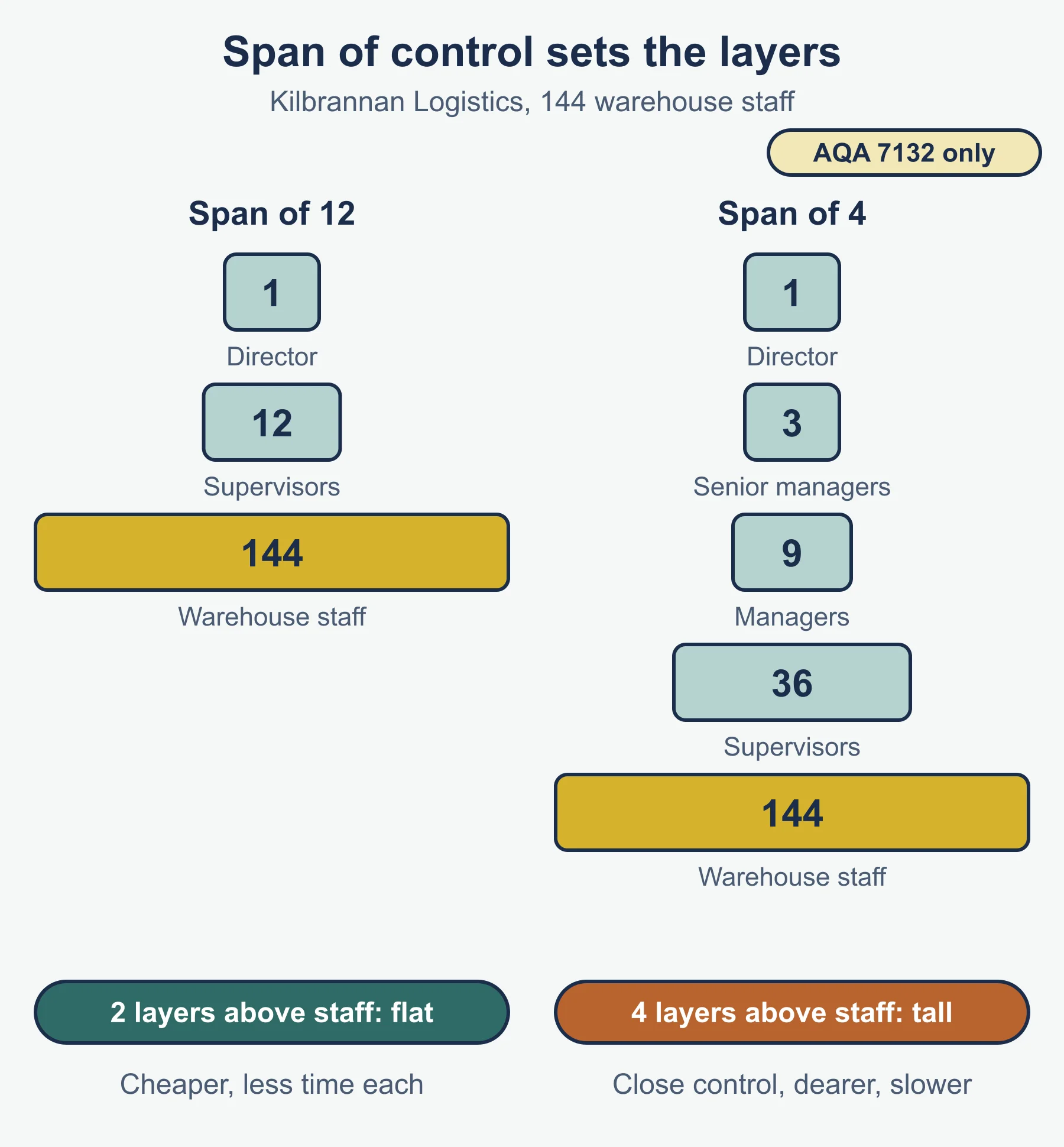
Worked example 4. Kilbrannan Logistics has 144 warehouse staff. With a span of 12, there are 12 supervisors and then one director: two layers above the warehouse staff, a flat structure. With a span of 4, there are 36 supervisors, 9 managers, 3 senior managers and a director: four layers, a tall structure. The wider span cuts management cost but gives each manager less time per person. The narrow span allows close supervision but costs more and slows messages.
Influences on delegation, centralisation and decentralisation. Delegation is more likely where managers trust skilled staff and the decision is low-risk. Centralisation suits a business that needs consistent standards, tight cost control, or fast crisis decisions, or one in which the owner prefers control. Decentralisation suits large, spread-out or diverse businesses where local knowledge matters and where empowered staff are more motivated.
The value of changing job and organisational design. Benefits can be faster decisions, lower overheads, better motivation and a better fit with new technology. Costs include disruption, redundancy costs, resistance and retraining. The change is worth it where the long-term gain exceeds these costs.
5. Managing the human resource flow (3.6.3, third part)
Human resource flow is the movement of people into, through and out of the business. Managing it helps meet HR objectives by matching the number, skills and location of employees to need. The specification lists five elements.
- Human resource plan: forecasts the workforce needed, compares it with the workforce available and sets out how to close the gap, using sales forecasts and expected leavers.
- Recruitment: attracting and selecting people, internally or externally.
- Training: developing skills, on the job or off the job.
- Redeployment: moving employees to different roles or locations inside the business.
- Redundancy: ending jobs that are no longer needed.
Redeployment and training keep knowledge but take time. Redundancy cuts cost quickly, yet it brings payments and damages trust.
6. Improving motivation and engagement (3.6.4)
Motivated and engaged employees tend to show higher productivity, better quality, lower absenteeism and turnover, and more ideas, which lower unit costs.
Theories (the specification names Taylor, Maslow and Herzberg).
- Taylor (scientific management): people work mainly for money, so break work into simple tasks, train for the best method, supervise closely and pay by output. It suits repetitive work but ignores other needs.
- Maslow: needs form a hierarchy: physiological, safety, social, esteem, self-actualisation. A need motivates only until it is met, and the next level then matters. People do not always move up in order.
- Herzberg: hygiene factors (pay, conditions, supervision, company policy) prevent dissatisfaction but do not motivate. Motivators (achievement, recognition, the work itself, responsibility, advancement) create satisfaction. Job enrichment is the main implication.
The theories give managers a framework, but people differ, so the right method depends on the job and person.
Financial methods (the specification lists four).
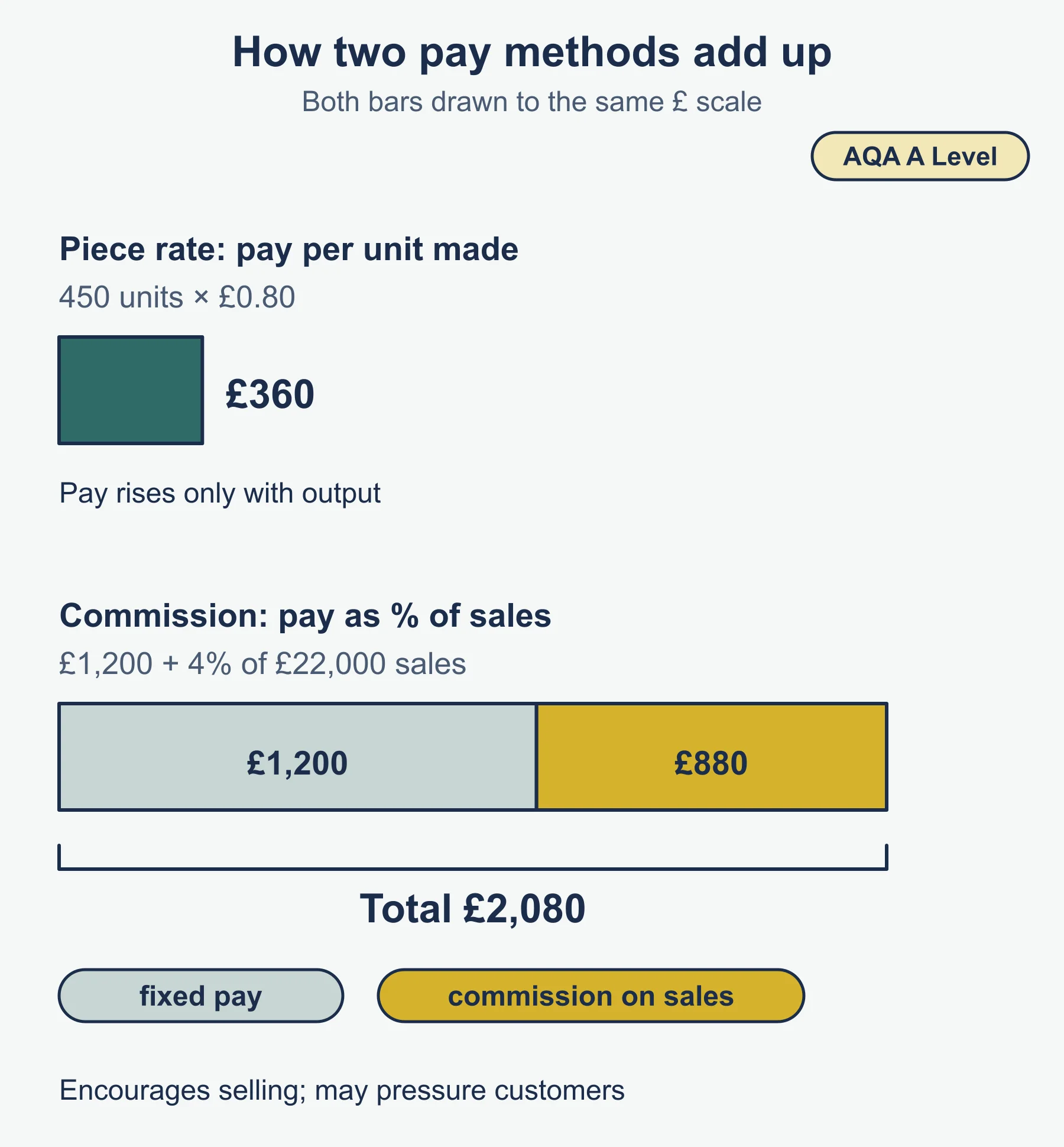
- Piece rate: pay per unit made. At £0.80 per unit, 450 units earn £360. Quality can fall.
- Commission: pay as a percentage of sales. A salesperson on £1,200 a month plus 4% of £22,000 sales earns £1,200 + £880 = £2,080. It encourages selling but may pressure customers.
- Salary schemes: a fixed annual amount. It gives security but no direct link to effort.
- Performance-related pay: a reward for meeting agreed targets. It focuses effort but can be seen as unfair if targets are poorly set.
Non-financial methods include job enrichment, job rotation, empowerment, teamworking, training and development, recognition, flexible working and a clear career path.
Choosing and assessing reward systems. Influences include whether the work is measurable, the budget, rivals’ pay, the culture and employee preferences. Assess effectiveness using labour turnover, absenteeism, productivity, labour cost per unit and employee surveys, and compare gains with the scheme’s cost.
7. Improving employer-employee relations (3.6.5)
Good relations mean fewer disputes, less absence and more cooperation in times of change.
Employee involvement. The extent and method depend on leadership style, workforce size, employee skills and expectations, and how quickly decisions must be taken.
Employee representation. A trade union represents its members, bargaining over pay and conditions and supporting individuals. A works council is a group of employee and management representatives that meets to share information and consult on workplace matters. Unions are independent of the employer. Councils are set up within the business.
Communication. Improve relations with two-way channels (team meetings, suggestion schemes, surveys, intranet, direct access to managers), timely and honest information about changes, and consultation before decisions rather than after.
8. The five themes across the section
- Technology changes the nature of work and skills needed, enables tele-working, and can replace jobs.
- Ethical and environmental influences: fair pay, treatment in redundancy, and less commuting through tele-working.
- Market conditions: a tight labour market raises pay and the cost of replacing staff, while a loose one eases recruitment. Competition pushes businesses to improve productivity.
- Competitiveness: lower unit costs, better service and more innovation come from skilled, motivated people.
- Other functions: HR decisions affect finance (cost), operations (output and quality) and marketing (service quality). Their budgets and plans also constrain HR.
Common errors
- Using the closing headcount rather than the average in labour turnover.
- Forgetting that, with a fixed workforce, a wider span means fewer layers.
- Saying money is the only motivator, or dismissing it.
Frequently asked questions
What is the difference between soft and hard HRM? A hard approach treats employees as a cost and a resource to be used efficiently, with tight control and flexible contracts. A soft approach treats them as an asset to be developed, through training, involvement in decisions and strong communication.
What are the five core job characteristics in Hackman and Oldham’s model? Skill variety, task identity, task significance, autonomy and feedback. They lead to three critical psychological states: experienced meaningfulness, experienced responsibility and knowledge of results.
What are the stages of human resource flow? A human resource plan forecasts the workforce needed and how to close any gap, followed by recruitment, training, redeployment and redundancy as needed to match the number, skills and location of employees.
Which financial motivation methods are named in AQA 7132? The specification lists four: piece rate, commission, salary schemes and performance-related pay. Each has drawbacks, such as quality falling under piece rate.
Which section of the AQA Business specification covers human resource management? Section 3.6, Decision making to improve human resource performance, covering HR objectives, HR data, job and organisational design, motivation and employer-employee relations.
Official syllabus
AQA, AS and A-level Business (7131 and 7132) specification, section 3.6 Decision making to improve human resource performance, for first teaching from September 2023. The formulas in section 2 are the standard forms, as the specification gives none.
Get free revision emails (optional)
Occasional emails with practice questions, worked explanations and links to free resources for the qualification and subjects you choose. No spam, and you can unsubscribe from any email. The free tools on this site never need an email.
Related resources
-
Practice questions
AQA A-Level Business: Human resource management (7132) – Practice Questions
Ten original AQA A-level Business questions on section 3.6 human resource management, with worked answers, examiner insights and short case studies.
Business · AQA · A Level
Try questions -
Revision notes
AQA A-Level Business: Human resource management (7132) – Revision Notes
Condensed AQA A-level Business 7132 revision notes on section 3.6 human resource management: formulas, models, distinctions and a self-test.
Business · AQA · A Level
Revise topic -
Study guides
AQA A-Level Business: Managers, Leadership and Decision Making (7132)
Study guide to Topic 2 Managers, leadership and decision making for AQA A-level Business 7132: leadership styles, decision trees and stakeholder mapping.
Business · AQA · A Level
Read guide
Related articles
-
teaching
A Level tuition in Dubai: Cambridge or Pearson Edexcel International A Level?
Schools in Dubai and Abu Dhabi teach either Cambridge International AS & A Level or Pearson Edexcel International A Level. How the two are structured, why it matters for tuition, and how online classes from Lahore work.
9 October 2026
-
curriculum guides
Choosing subjects at IGCSE and A Level
How subject choices at 14 and 16 affect university options later, and how to keep pathways open without overloading a timetable.
28 July 2026
Studying this with a teacher
Working through Business A LEVELS?
This page is free and stays free. If you would rather be taught it, Marlbridge runs Business classes one-to-one and in small groups of up to 15, online in your own time zone. The first trial class is free. WhatsApp replies within an hour (8am–11pm Pakistan time, every day); email the same day.
AQA Business teachers at Marlbridge
