
Study Guides
AQA A-Level Business: Managing strategic change (7132)
Study guide to AQA A-Level Business (7132) Managing strategic change: force field analysis, culture, structures, network analysis and why strategies fail.
- Subject
- Business
- Level
- A LEVELS
- Topic
- Managing strategic change
- Author
- Marlbridge Academic Team
- Updated
- Reviewed by
- Salman Ahmad (what this means)
Aligned to AQA A Level Business (7132), For first teaching from September 2023. Official specification .
Syllabus page (what it covers and how it is assessed): AQA A Level Business.
Syllabus points this page covers
7132
- 10 Managing strategic change (whole topic)
Found an error? Report a correction.
Need help with this topic? Request a free trial class for A Level Business (7132).
This guide covers section 3.10 Managing strategic change of the AQA AS and A-level Business specification (7132), for first teaching from September 2023. The specification marks it A-level only, and the guide follows its four parts in order. For the wider course see the AQA A-level Business hub and the printable checklist. Leadership styles are in the managers and leadership guide. Companion pages: revision notes and practice questions. Weak spots: diagnostics.
Map of the topic
| Section | What you must cover |
|---|---|
| 3.10.1 Managing change | Causes of and pressures for change; internal, external, incremental and disruptive change; Lewin’s force field analysis; the value of change; flexible organisations; managing information and knowledge; barriers to change and how to overcome them (Kotter and Schlesinger) |
| 3.10.2 Managing organisational culture | Importance of culture; Handy’s four cultures; Hofstede’s national cultures; influences on culture; reasons for and problems of changing it |
| 3.10.3 Managing strategic implementation | Implementing strategy effectively; leadership; communications; structures (functional, product based, regional, matrix); network analysis |
| 3.10.4 Problems with strategy | Difficulties of decision making and implementing; planned v emergent; strategic drift; ownership and control and corporate governance; evaluating performance; strategic and contingency planning |
3.10.1 Managing change
Causes, pressures and types of change
The causes and pressures can sit outside the business (new technology, a competitor’s move, a shift in laws, changing customer tastes, a recession) or inside it (a new chief executive, poor results, a merger, new owners, falling staff morale).
The four types of change are:
- Internal change starts inside the business, such as a restructure or a new production system.
- External change starts in the environment, such as a new rival or a tax change.
- Incremental change is a series of small, steady steps. It is lower risk but may be too slow in a fast market.
- Disruptive change is sudden and large, often caused by new technology or a shock. It forces a rapid response and can overturn the old way of working.
Lewin’s force field analysis
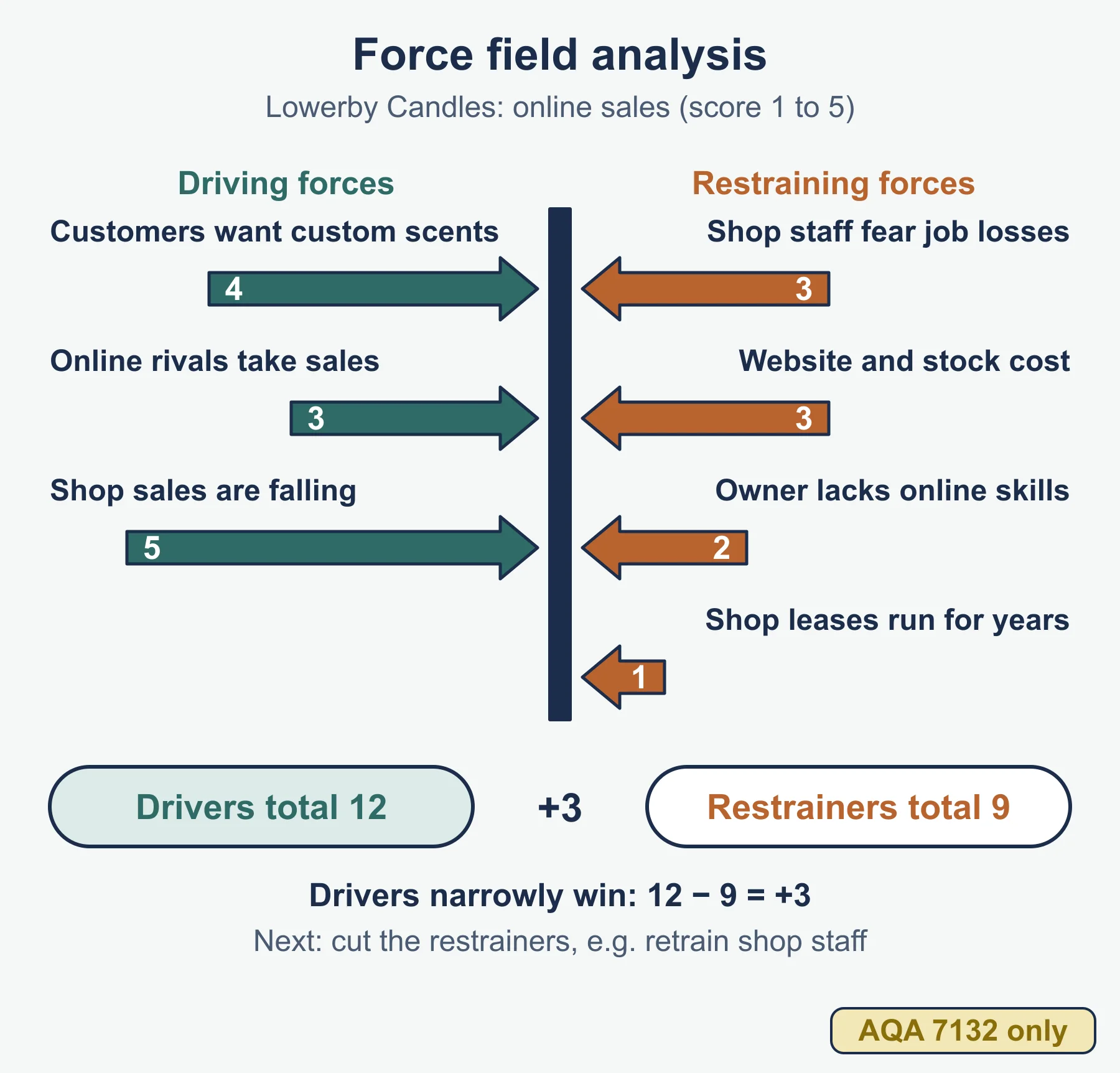
Lewin’s force field analysis lists the driving forces that push for a change and the restraining forces that hold it back. You score each force, add the two sides and compare. If drivers outweigh restrainers, change is more likely to succeed. You can then plan to strengthen drivers or, often more effectively, reduce restrainers.
Worked example. Lowerby Candles sells through three shops and wants to move to online made-to-order sales. Forces are scored 1 (weak) to 5 (strong).
| Driving forces | Score | Restraining forces | Score |
|---|---|---|---|
| Customers ask for personalised scents | 4 | Shop staff fear job losses | 3 |
| Online rivals are taking sales | 3 | Cost of new website and stock system | 3 |
| Shop sales are falling | 5 | Owner’s lack of online experience | 2 |
| Existing shop leases run for years | 1 | ||
| Total | 12 | Total | 9 |
Net score is 12 − 9 = +3, so drivers narrowly win. The business should not just push harder. It could reduce the strongest restrainers, for example by promising shop staff retraining for online roles. The scores are subjective, so the analysis supports a decision rather than making it.
The value of change and of a flexible organisation
Change can keep a business competitive, open new markets, cut costs and answer threats. It also costs money, unsettles staff and may fail, so its value depends on benefit against cost and risk.
A flexible organisation can adapt quickly. The specification lists these features:
- Restructuring: reorganising departments, divisions or reporting lines to fit new strategy.
- Delayering: removing layers of hierarchy. This shortens the chain of command, widens spans of control and cuts wage costs, but can overload managers.
- Flexible employment contracts: part-time, temporary, zero-hours and freelance arrangements let a business match staffing to demand. They lower fixed costs but can reduce commitment.
- Organic versus mechanistic structures: a mechanistic structure has a rigid hierarchy, narrow tasks, formal rules and top-down decisions. It suits stable conditions. An organic structure has fewer rules, wider roles, shared decisions and sideways communication. It suits fast-changing conditions but is harder to control.
- Knowledge and information management: capturing, storing and sharing what the business knows.
The value of managing information and knowledge
Information is organised data. Knowledge is what people understand and can do, including know-how held in staff heads. Managed well, it avoids duplicated work, speeds decisions, helps new staff learn and protects the business when experienced people leave. Costs are system expense, recording time and the risk of overload or leaks.
Barriers to change: Kotter and Schlesinger
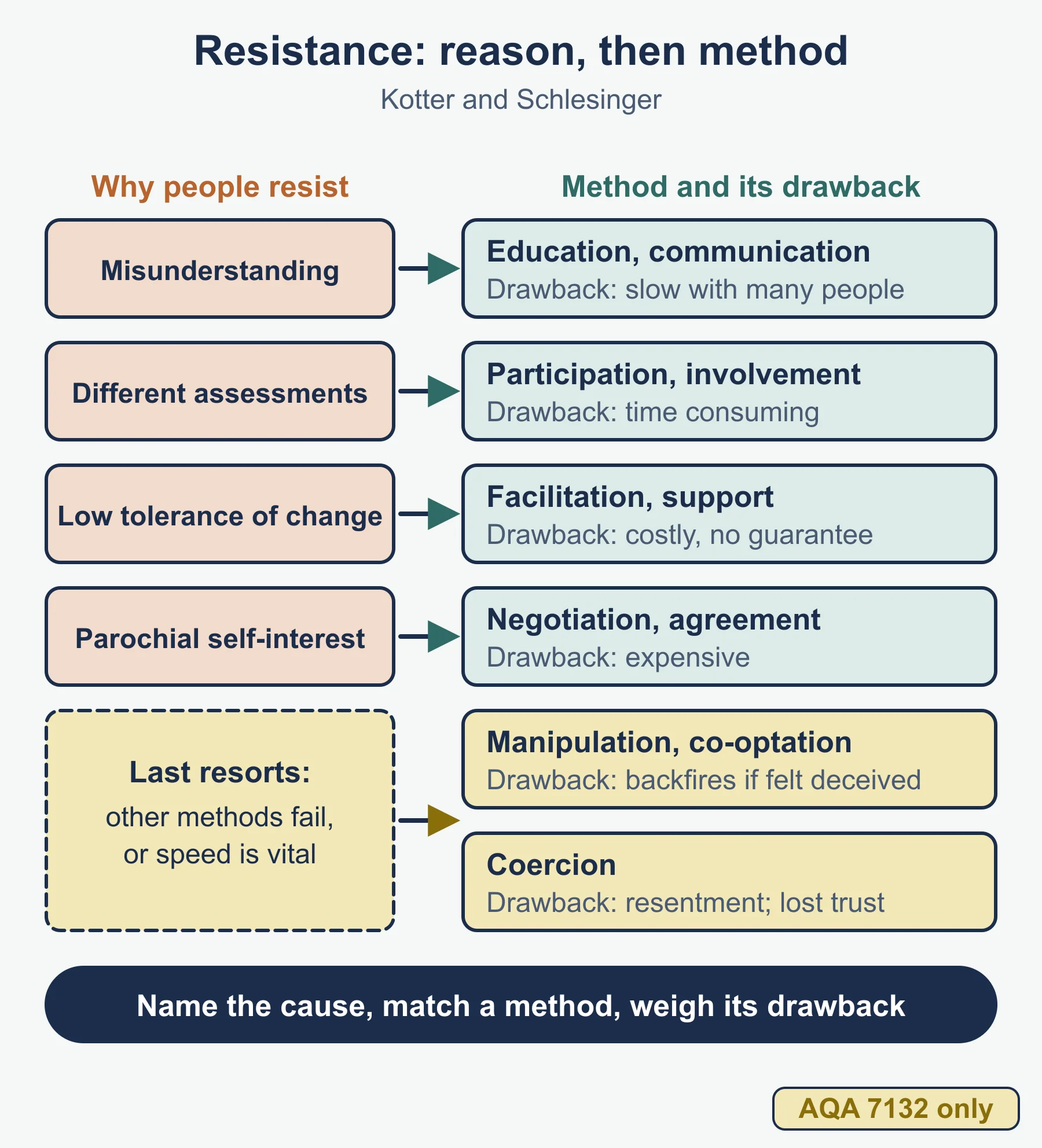
Kotter and Schlesinger give four reasons for resistance to change:
- Parochial self-interest: people fear losing status, pay, power or jobs.
- Misunderstanding: people lack information or do not trust the reasons given.
- Low tolerance of change: people value security and stability, and fear they cannot learn new skills.
- Different assessments of the situation: people honestly believe the change is wrong, for example because they see costs the managers do not.
They also give six ways of overcoming resistance, each with a cost and a best use:
| Method | Best used when | Drawback |
|---|---|---|
| Education and communication | Misunderstanding or poor information | Slow with many people |
| Participation and involvement | Staff have useful knowledge or power to resist | Time consuming |
| Facilitation and support | People struggle to adjust (training, counselling) | Costly, no guarantee |
| Negotiation and agreement | A powerful group would clearly lose out | Expensive; invites other demands |
| Manipulation and co-optation | Other methods are too costly or fail | Backfires if staff feel deceived |
| Explicit and implicit coercion | Speed is vital and managers hold power | Resentment; damages trust |
In an answer, name the reason for resistance shown in the case, then match a method to it and weigh the drawback.
3.10.2 Managing organisational culture
Organisational culture is the shared values, beliefs and “way we do things” that shape behaviour in a business. It matters because it affects motivation, decision making, customer service and how easily change is accepted. A culture that matches strategy helps; one that conflicts with it blocks it.
Handy’s four cultures
| Culture | Features | Fits | Risk |
|---|---|---|---|
| Power | Control with one person or a small group; fast decisions | Small, owner-led firms | Depends on the leader |
| Role | Clear job descriptions, rules, procedures | Large, stable firms | Rigid, slow to change |
| Task | Project teams; expertise over position | Project or consultancy work | Hard to control |
| Person | The individual comes first | Small professional partnerships | Hard to direct |
Hofstede’s national cultures
Hofstede compared national cultures along dimensions. The standard dimensions include power distance (the degree to which a society accepts unequal power), individualism versus collectivism, masculinity versus femininity (competition and achievement versus care and quality of life), and uncertainty avoidance (how uncomfortable people are with risk and ambiguity). Later work adds long-term orientation and indulgence. A management style that works in one country may fail in another: a flat, informal firm may struggle where staff expect firm direction.
Influences, and reasons for and problems of changing culture
Influences on culture include the founder and leaders, the firm’s history, size and structure, its industry, its staff and their national background, reward systems, and past successes or failures.
Reasons for changing culture: a new strategy, a merger, poor performance, new technology, or values that no longer suit the market. Problems: culture is deep and slow to shift, long-serving staff may resist, mixed messages from leaders destroy credibility, and morale may fall or staff leave before benefits appear.
3.10.3 Managing strategic implementation
Implementing strategy effectively
Effective implementation needs clear objectives, enough resources, agreed responsibilities, deadlines, monitoring, and a structure and culture that fit. Managers check progress and adjust.
Leadership and communications
Leadership gives direction, sets the vision and builds commitment. In change it matters most when leaders explain the case, visibly back it and deal with doubts. An autocratic style may suit a crisis; a democratic one may build commitment in slower change.
Communications matter because misunderstanding is a cause of resistance. Good communication is clear, consistent, two-way and timely; weak communication spreads rumours.
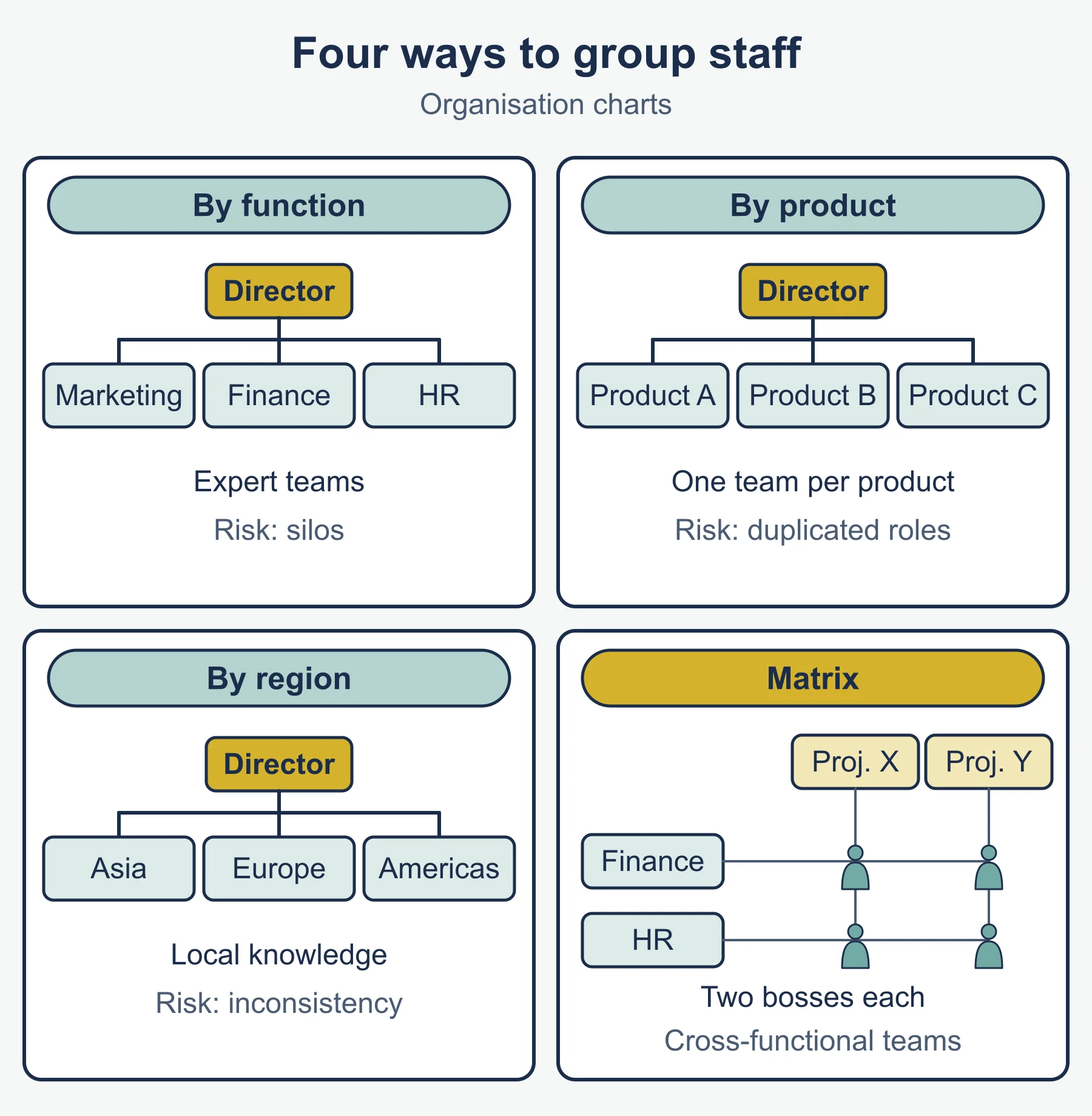
Organisational structure
| Structure | Grouped by | Strength | Weakness |
|---|---|---|---|
| Functional | Specialist activity (marketing, finance) | Clear expertise and control | Departments pursue own goals |
| Product based | Each product line | Product focus; clear profit responsibility | Duplicated resources |
| Regional | Geographic area | Local knowledge, quick decisions | Duplication; inconsistency |
| Matrix | Staff report to a function and a project manager | Shares skills across teams | Two bosses; conflicting priorities |
Network analysis
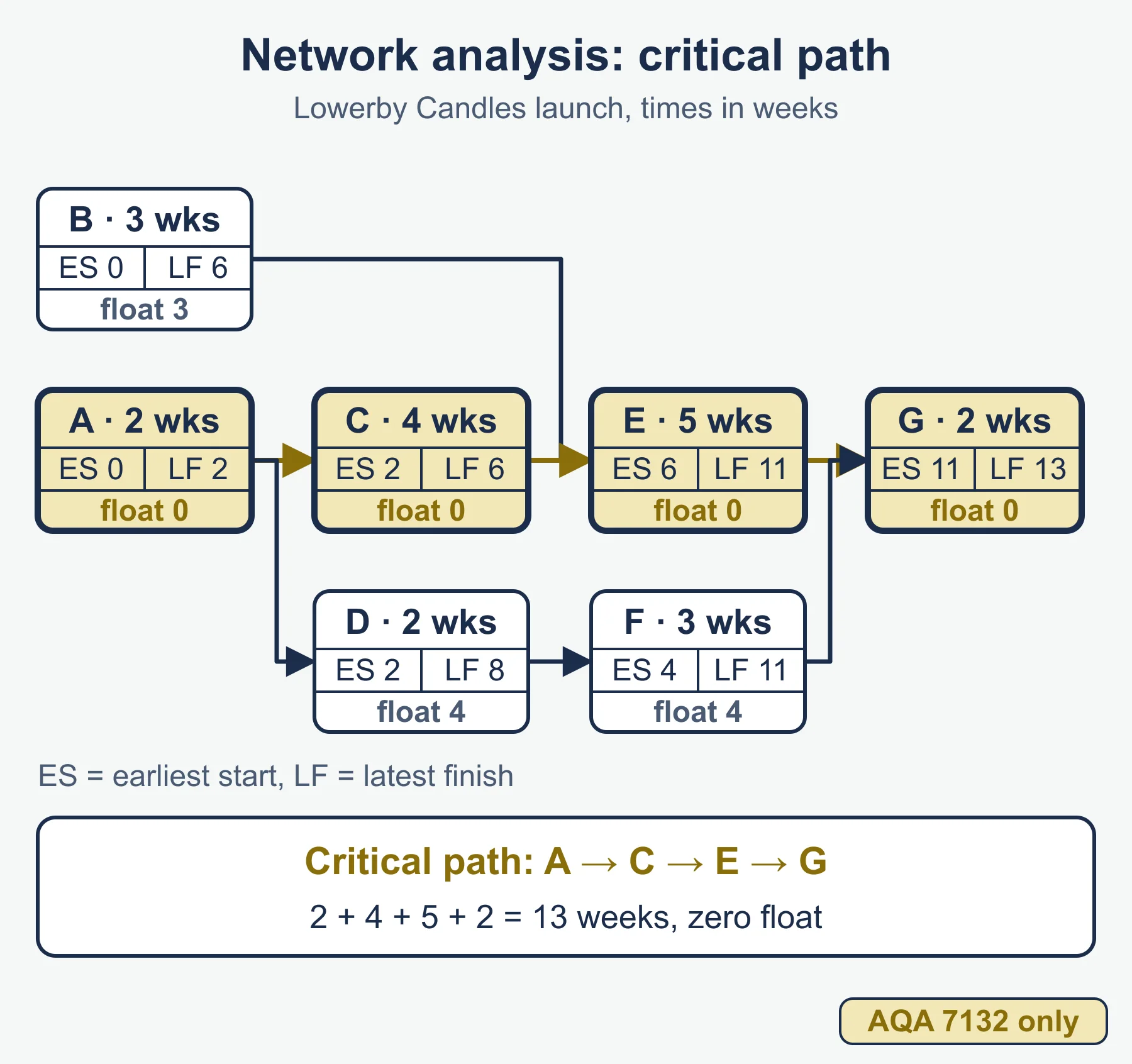
Network analysis plans a project. It shows activities, their durations and the order in which they must happen. Each activity has an earliest start time and a latest finish time. You work forwards to find earliest times and backwards to find latest times. The critical path is the longest route through the network; activities on it have no spare time and any delay delays the whole project. Total float is the time an activity can be delayed without delaying the project: latest finish − duration − earliest start.
Worked example. Lowerby Candles plans its online launch (weeks).
| Activity | Duration | Needs first |
|---|---|---|
| A Design site | 2 | none |
| B Hire courier | 3 | none |
| C Build site | 4 | A |
| D Photograph stock | 2 | A |
| E Test and train staff | 5 | B, C |
| F Write product pages | 3 | D |
| G Launch | 2 | E, F |
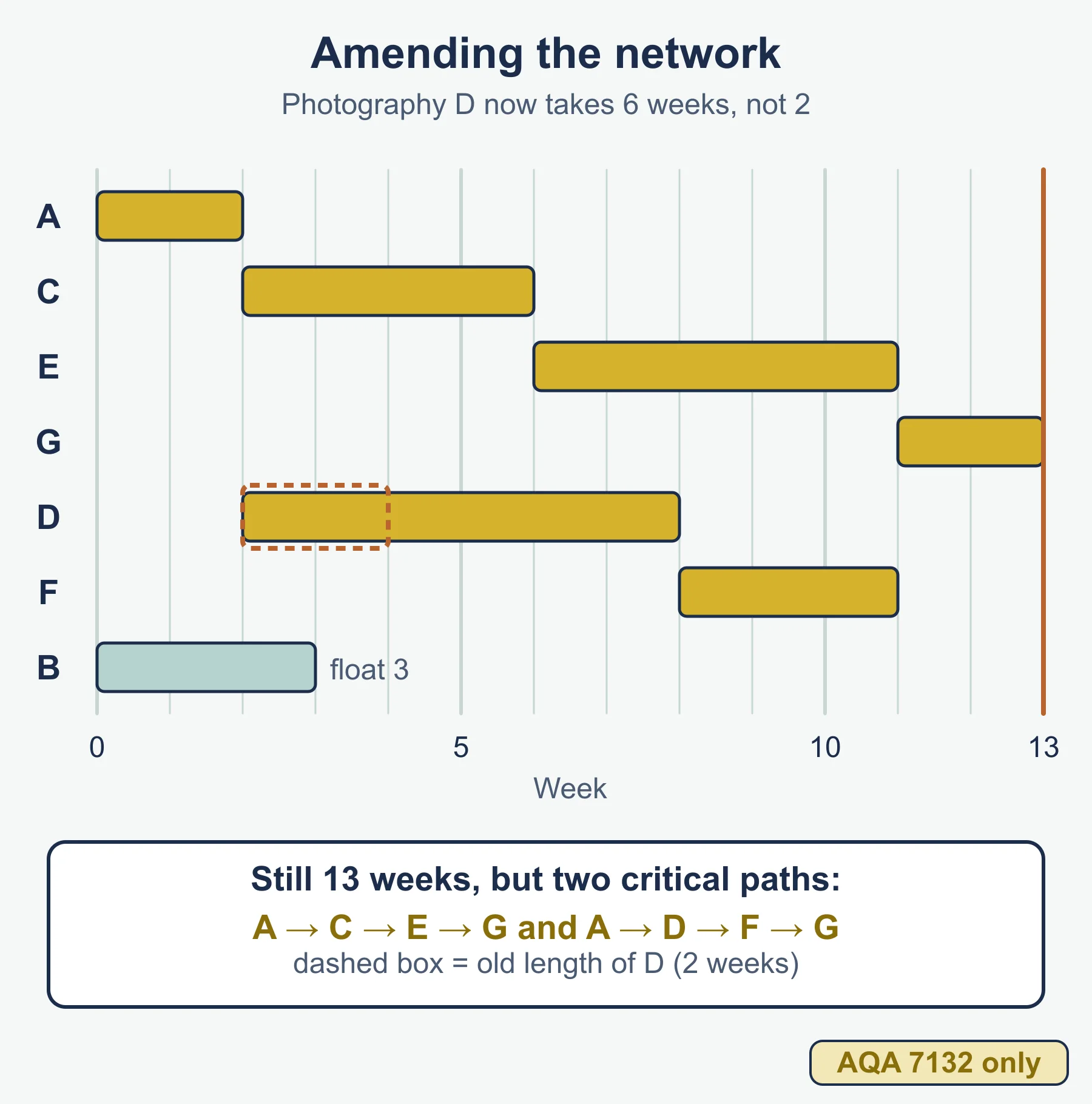
Forward pass: A ends week 2, B week 3, C week 6, D week 4, E starts week 6 (it waits for C) and ends week 11, F ends week 7, G starts week 11 and ends week 13. The project takes 13 weeks. Critical path: A, C, E, G (2 + 4 + 5 + 2 = 13). Backward pass gives total float: B has 3 weeks, D has 4 weeks, F has 4 weeks; A, C, E and G have none.
Amending the network. Suppose D takes 6 weeks, not 2. D now ends in week 8 and F in week 11, still in time for G. The project stays at 13 weeks, but D and F now have no float, so there are two critical paths (A, C, E, G and A, D, F, G). Rework the times whenever an activity is added, removed, lengthened or re-sequenced.
Value: it shows which tasks need close control, where resources can move from non-critical tasks, and the shortest completion time. Limit: durations are only estimates.
3.10.4 Problems with strategy and why strategies fail
Difficulties include uncertain information, an unpredictable environment, conflicting stakeholder goals, limited resources and managers’ bias. Implementation can fail through poor communication, weak leadership, resistance, a poor-fitting culture or structure, or unrealistic targets.
Planned versus emergent strategy. A planned (deliberate) strategy is set in advance by senior managers through analysis. An emergent strategy develops over time from day-to-day decisions and responses to events. Planned strategy gives direction and control; emergent strategy gives flexibility and uses front-line knowledge.
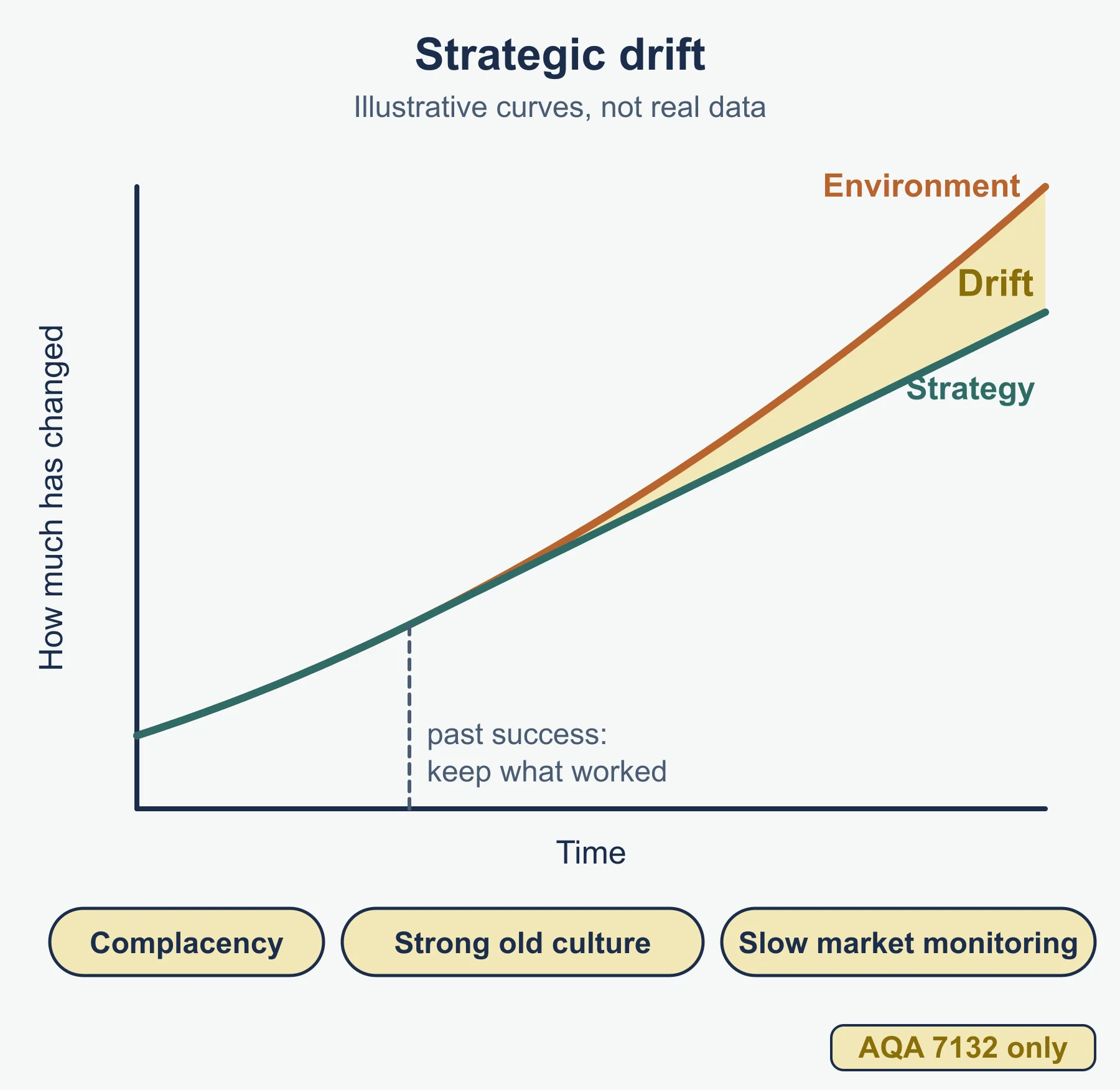
Strategic drift is when a business’s strategy gradually moves out of line with its changing environment, often after past success, so managers keep using what worked before. Reasons include complacency, a strong existing culture and slow market monitoring.
Ownership and control. In a large company, shareholders (owners) are separate from managers (control). Managers may pursue their own aims, such as bonuses or empire building, rather than shareholder returns. Corporate governance is the set of systems and rules that direct and check a company: a board with independent non-executive directors, committees, transparent reporting, and shareholder voting rights. It aims to reduce this divorce between ownership and control.
Evaluating strategic performance. Compare results with objectives, past performance and rivals, using financial measures (profit, market share) and non-financial ones (customer satisfaction, staff turnover). Find why gaps arose before acting.
Strategic planning gives direction, aligns departments, guides resources and allows later comparison; but it costs time, can become rigid and relies on forecasts. Contingency planning prepares responses to events that might happen, such as a supplier failure or a cyber attack. It speeds reaction and reduces panic, but costs time and money and cannot cover every event.
Common errors
- Describing Lewin’s model without scoring or comparing the forces.
- Listing Kotter and Schlesinger’s methods without matching one to the cause of resistance.
- Treating delayering as always good.
- Calling the longest activity, not the longest route, the critical path.
Frequently asked questions
What is the difference between incremental and disruptive change? Incremental change is a series of small, steady steps, lower in risk but possibly too slow in a fast market. Disruptive change is sudden and large, often caused by new technology or a shock, and forces a rapid response.
What is the difference between organic and mechanistic structures? A mechanistic structure has a rigid hierarchy, narrow tasks, formal rules and top-down decisions, and suits stable conditions. An organic structure has fewer rules, wider roles and shared decisions, and suits fast-changing conditions but is harder to control.
What is strategic drift? Strategic drift is when a business’s strategy gradually moves out of line with its changing environment, often after past success.
What is the critical path? The critical path is the longest route through the network, joining the activities with zero float, and it sets the shortest possible project duration. Calling the longest single activity the critical path is a common error.
Which section of the AQA Business specification covers managing strategic change? Section 3.10, Managing strategic change (A-level only), covering managing change, organisational culture, strategic implementation and problems with strategy.
Official syllabus
AQA AS and A-level Business (7131 and 7132) specification, published by AQA: section 3.10 Managing strategic change (A-level only).
Get free revision emails (optional)
Occasional emails with practice questions, worked explanations and links to free resources for the qualification and subjects you choose. No spam, and you can unsubscribe from any email. The free tools on this site never need an email.
Related resources
-
Practice questions
AQA A-Level Business: Managing strategic change (7132) – Practice Questions
Twelve original practice questions with worked answers on AQA A-Level Business (7132) Managing strategic change, including a network analysis calculation.
Business · AQA · A Level
Try questions -
Revision notes
AQA A-Level Business: Managing strategic change (7132) – Revision Notes
Condensed AQA A-Level Business (7132) revision notes on managing strategic change: models, tables, network analysis steps, self-test and common slips.
Business · AQA · A Level
Revise topic -
Study guides
AQA A-Level Business: Marketing management (7132)
Study guide to marketing management for AQA A-Level Business (7132): objectives, market data, segmentation and the 7Ps, with worked examples.
Business · AQA · A Level
Read guide
Related articles
-
teaching
A Level tuition in Dubai: Cambridge or Pearson Edexcel International A Level?
Schools in Dubai and Abu Dhabi teach either Cambridge International AS & A Level or Pearson Edexcel International A Level. How the two are structured, why it matters for tuition, and how online classes from Lahore work.
9 October 2026
-
curriculum guides
Choosing subjects at IGCSE and A Level
How subject choices at 14 and 16 affect university options later, and how to keep pathways open without overloading a timetable.
28 July 2026
Studying this with a teacher
Working through Business A LEVELS?
This page is free and stays free. If you would rather be taught it, Marlbridge runs Business classes one-to-one and in small groups of up to 15, online in your own time zone. The first trial class is free. WhatsApp replies within an hour (8am–11pm Pakistan time, every day); email the same day.
AQA Business teachers at Marlbridge
