
Study Guides
AQA A-Level Business: Understanding the nature and purpose of business and Understanding different business forms (7132)
Study guide to why businesses exist, mission and objectives, profit measurement, business forms, shares and ownership for AQA A-Level Business.
- Subject
- Business
- Level
- A LEVELS
- Topic
- What is business?
- Author
- Marlbridge Academic Team
- Updated
- Reviewed by
- Salman Ahmad (what this means)
Aligned to AQA A Level Business (7132), For first teaching from September 2023. Official specification .
Syllabus page (what it covers and how it is assessed): AQA A Level Business.
Syllabus points this page covers
7132
- 3.1.1 Understanding the nature and purpose of business
- 3.1.2 Understanding different business forms
Found an error? Report a correction.
Need help with this topic? Request a free trial class for A Level Business (7132).
This guide covers sections 3.1.1 (Understanding the nature and purpose of business) and 3.1.2 (Understanding different business forms) of the AQA A-level Business (7132) specification, for first teaching from September 2023. The specification says all content is assessed across the three A-level papers, so this material can appear anywhere. See the course hub and the printable checklist.
Other pages for this topic: the broader What is Business? study guide, the topic-level revision notes and the topic-level practice questions. This guide’s own companions are the revision notes and the practice set. Not sure where you stand? Try the free diagnostics.
What the specification asks you to know
| Section | Content you must be able to handle |
|---|---|
| 3.1.1 | Why businesses exist; the relationship between mission and objectives; common business objectives; why businesses set objectives; the measurement and importance of profit (revenue, fixed costs, variable costs, total costs) |
| 3.1.2 | Reasons for choosing different forms of business and for changing form; sole traders, private limited and public limited companies, private and public sector, non-profit organisations such as charities and mutuals; unlimited and limited liability; ordinary share capital; market capitalisation; dividends; the role of shareholders and why they invest; influences on share price and what changes mean; the effects of ownership on mission, objectives, decisions and performance |
3.1.1 Why businesses exist
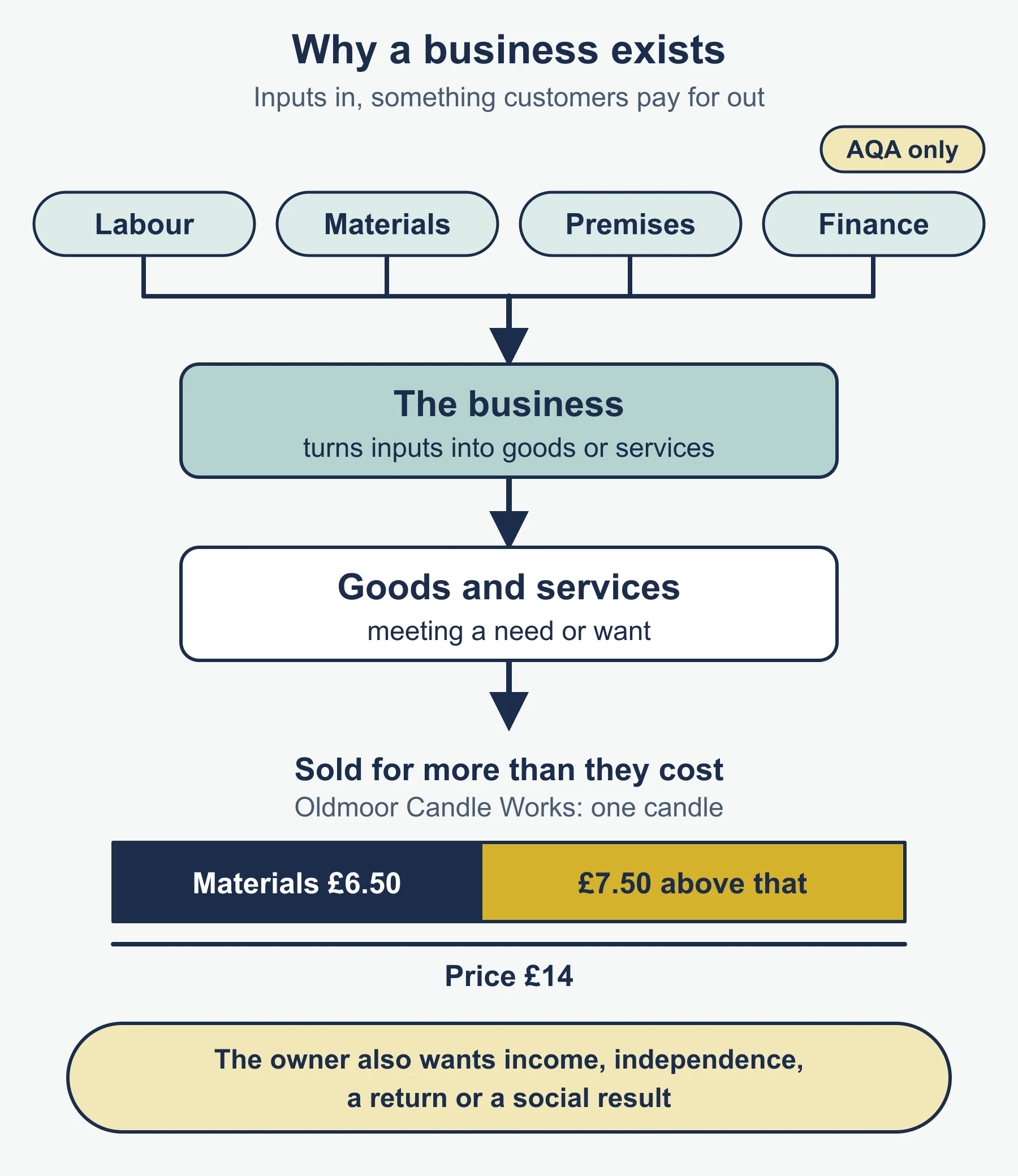
A business exists to meet a need or want that customers will pay for. It takes inputs (labour, materials, premises, finance), turns them into goods or services, and sells them for more than they cost. Owners usually also want something personal from it: an income, independence, a return on money invested, or a social result they care about. Name the customer need and the owner’s motive, not just “to make a profit”.
Mission and objectives
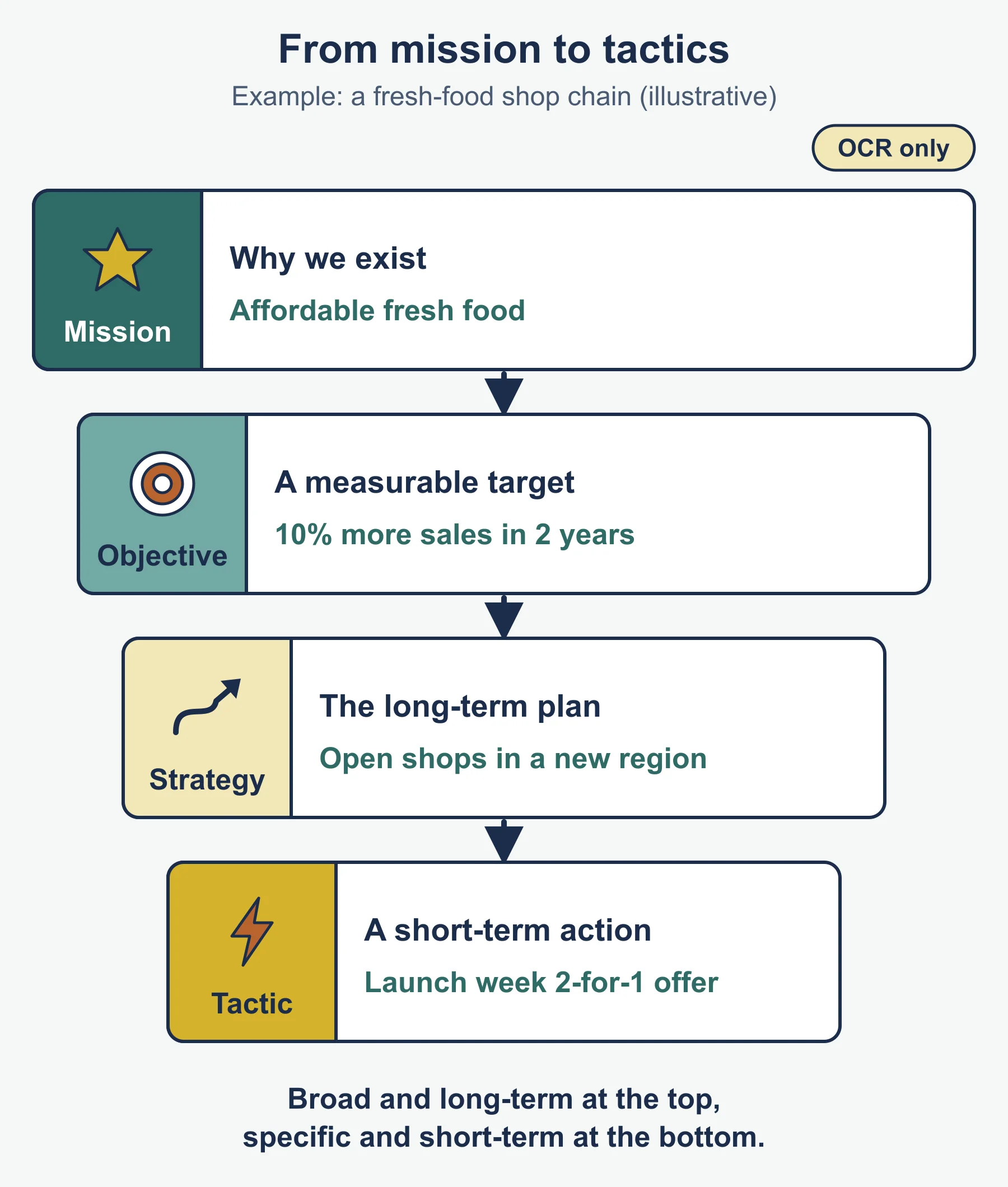
A mission (or mission statement) is the business’s overall purpose: why it exists and what it is trying to be. It is broad, long-term and rarely numerical. Objectives are the specific targets the business sets to move towards that mission. They are measurable and have a time limit.
The relationship runs in one direction: the mission gives the aim, the objectives turn it into targets, and decisions are then judged by whether they move the business towards the objectives. Suppose a bakery’s mission is to be the village’s favourite place to buy bread. A matching objective might be to increase weekly customers by 15% within a year. The mission says what; the objective says how far and by when.
Common business objectives
The specification names these:
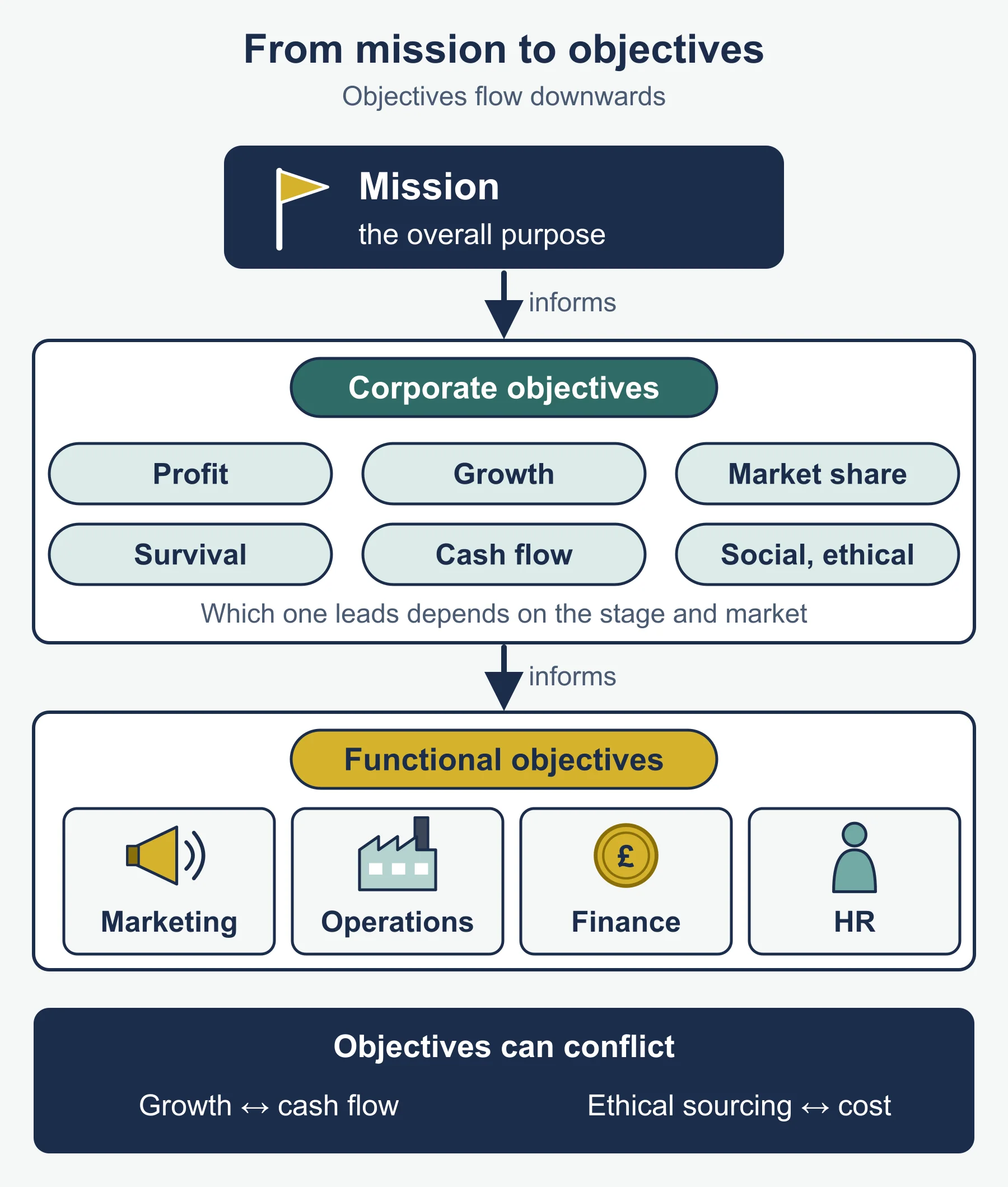
- Profit: revenue above total costs. Some owners aim to maximise it; others aim for a satisfactory level.
- Growth: more sales, more customers, a bigger share of the market or more outlets.
- Survival: staying in business, typical for new firms or in a recession.
- Cash flow: having enough money moving in to pay bills when they fall due.
- Social and ethical objectives: for example employing local people, cutting waste, or sourcing materials fairly.
Objectives can conflict. Growth often uses up cash. Ethical sourcing can raise costs and cut short-run profit. Which objective matters most usually depends on the firm’s age, its finances, the market and who owns it.
Why businesses set objectives
- They give everyone a common direction, so departments pull the same way.
- They motivate employees and managers, who have something to aim at.
- They allow performance to be measured by comparing results with targets.
- They help decision making, because options can be ranked by how well they meet the objective.
- They make managers accountable to owners and investors.
Measuring profit and why it matters
The specification lists the pieces: revenue (also called turnover or sales), fixed costs, variable costs and total costs.
- Revenue = selling price × quantity sold.
- Fixed costs stay the same however much is made or sold in the short run (rent, insurance, salaried staff).
- Variable costs change with output (materials, packaging, piece-rate pay).
- Total costs = fixed costs + variable costs.
- Profit = revenue − total costs. A negative answer is a loss.
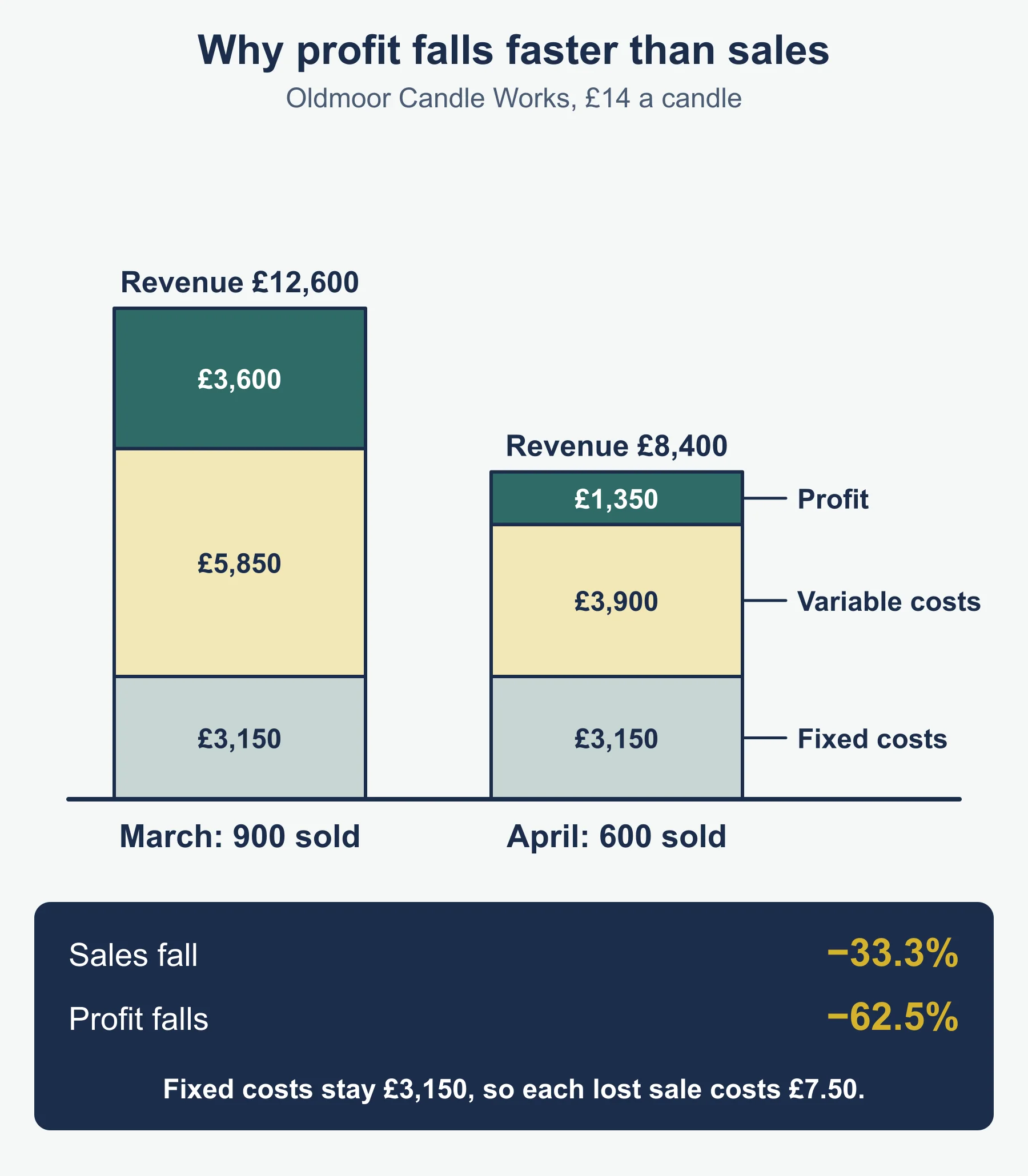
Worked example. Oldmoor Candle Works is run by a sole trader, Ruairi Dunleavy. He sells each candle for £14. Materials and packaging cost £6.50 a candle. Rent, insurance and software come to £3,150 a month. In March he sells 900 candles; in April he sells 600.
March: revenue        = 900 x 14      = £12,600
       variable costs = 900 x 6.50    = £5,850
       total costs    = 5,850 + 3,150 = £9,000
       profit         = 12,600 - 9,000 = £3,600

April: revenue        = 600 x 14      = £8,400
       variable costs = 600 x 6.50    = £3,900
       total costs    = 3,900 + 3,150 = £7,050
       profit         = 8,400 - 7,050 = £1,350
Sales fell by one third, but profit fell by 62.5% (from £3,600 to £1,350). Fixed costs did not fall, so each lost sale cost him its whole £7.50 contribution over variable cost. That gearing effect is a useful analysis point.
Profit matters because it:
- rewards owners for the risk they take;
- is a source of finance, as retained profit can fund growth without borrowing;
- signals success and attracts lenders and investors;
- helps survival by building a cushion against bad months;
- is the basis for dividends to shareholders.
Profit is not cash flow. Ruairi’s March profit is only useful for paying bills if customers have actually paid. A profitable firm can still run out of cash if it is paid late or buys too much stock.
3.1.2 Different business forms
The forms the specification names
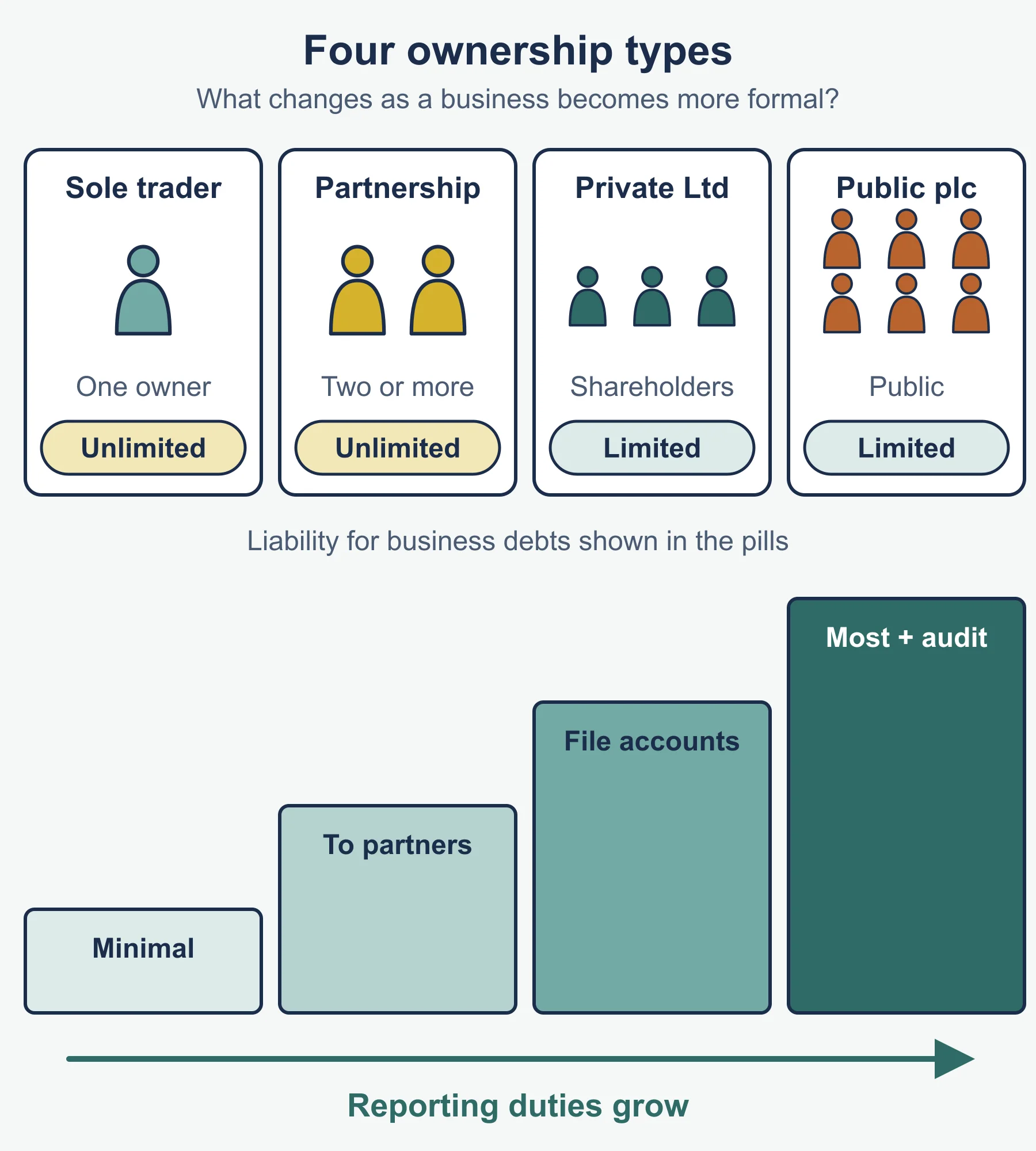
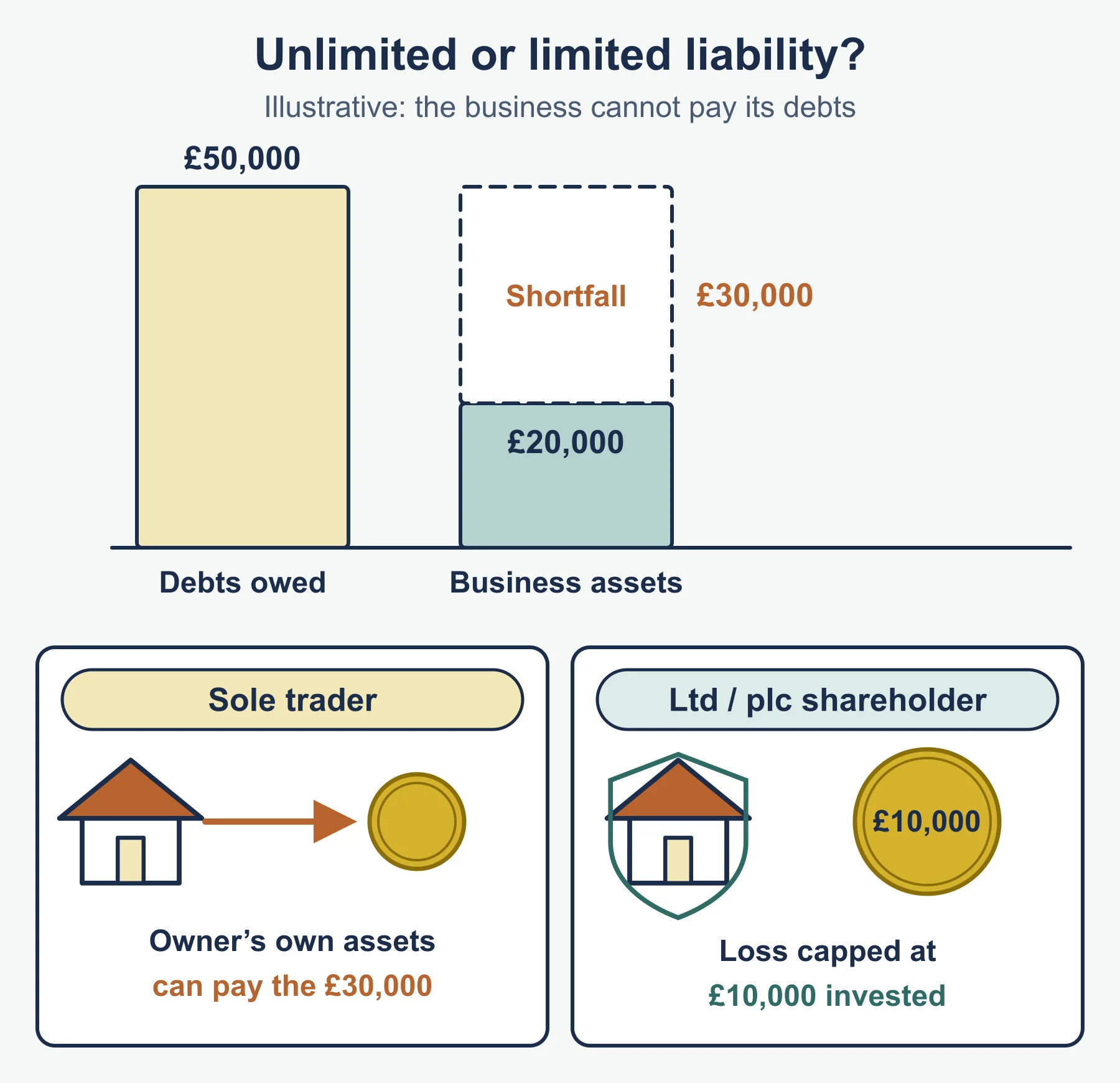
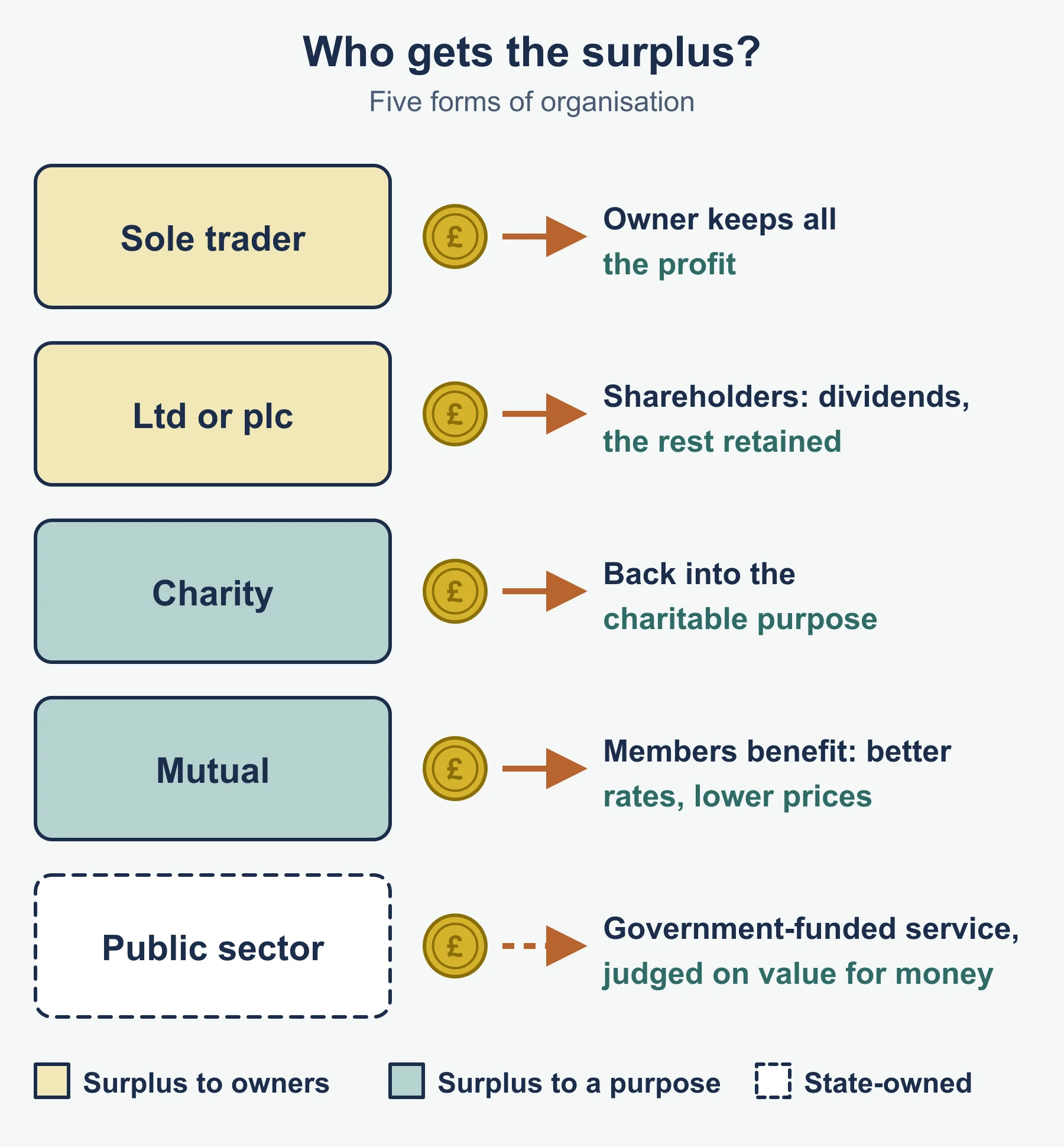
Sole trader. One person owns and runs the business. The owner keeps all the profit and takes all the decisions. The owner has unlimited liability: the business has no separate legal identity from them, so personal assets can be used to pay business debts. Capital is limited to the owner’s savings, loans and retained profit.
Private limited company (Ltd). It is a separate legal entity owned by shareholders. Shares are not offered to the general public and are usually sold only with the agreement of existing owners. Shareholders have limited liability: they can lose what they invested, but not their personal belongings. Owners can raise finance by selling shares to people they choose, and the business carries on if an owner leaves. Disclosure requirements are greater than for a sole trader.
Public limited company (plc). Shares can be bought and sold on a stock exchange by anyone. Limited liability applies. A plc can raise very large sums, but ownership spreads widely, directors can lose control, the firm is open to takeover, and reporting duties are heavy.
Private sector organisations are owned by individuals or shareholders, not the state. Public sector organisations are owned and funded by government (central or local). They exist to provide services, and their success is judged by service quality and value for money rather than profit.
Non-profit organisations exist to pursue a purpose other than profit for owners.
- A charity works for a charitable purpose. Surpluses are put back into that purpose rather than shared out. Funding comes from donations, grants and trading.
- A mutual is owned by its members, who are its customers or savers (building societies and co-operatives are examples). Any surplus is used for member benefit, such as better rates or lower prices, not for outside shareholders.
Reasons for choosing a form, and for changing it
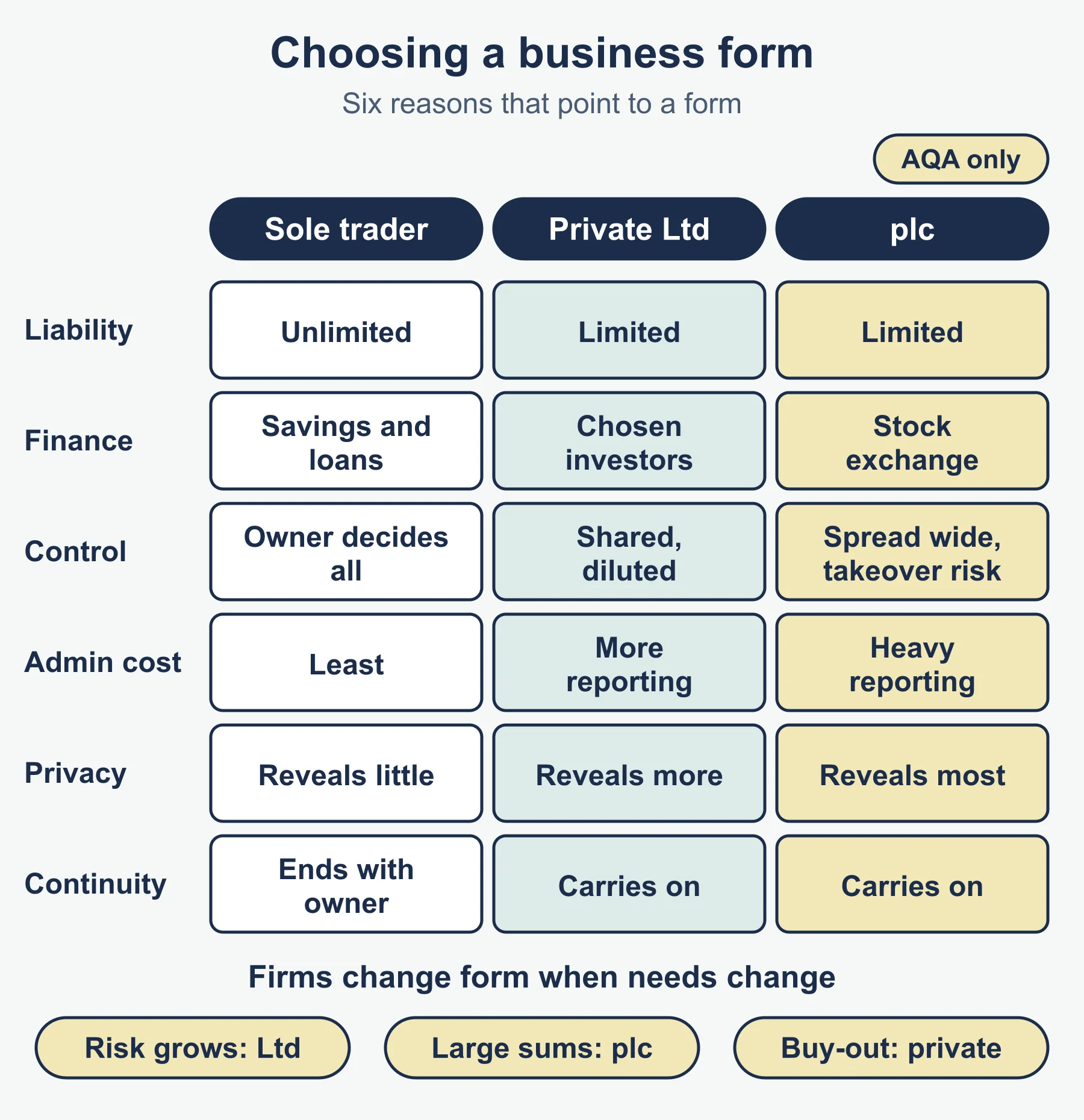
| Factor | Why it matters |
|---|---|
| Liability | Owners with homes or savings to protect may prefer limited liability |
| Finance | Selling shares opens routes to capital that a sole trader cannot use |
| Control | Selling shares dilutes the original owner’s say |
| Objectives | A social aim may fit a charity or mutual better than a company |
| Cost and admin | Companies face more reporting and set-up cost |
| Privacy | A larger company must reveal more information |
| Continuity | A company continues if an owner leaves; a sole trader’s business ends with them |
| Size and growth plans | Rapid expansion often needs outside capital |
Businesses change form when circumstances change. A sole trader may become a private limited company when risk grows. A private limited company may become a plc to raise large sums and give shareholders a way to sell. A plc may be bought out and made private, to escape stock market pressure.
Shares, shareholders and market capitalisation
Ordinary share capital is money raised by issuing ordinary shares. Ordinary shareholders own part of the company and usually get a vote. They are the last to be paid if the firm fails, so they carry the most risk.
Dividends are the part of profit paid to shareholders, usually quoted per share. Profit not paid out is retained for the business to use.
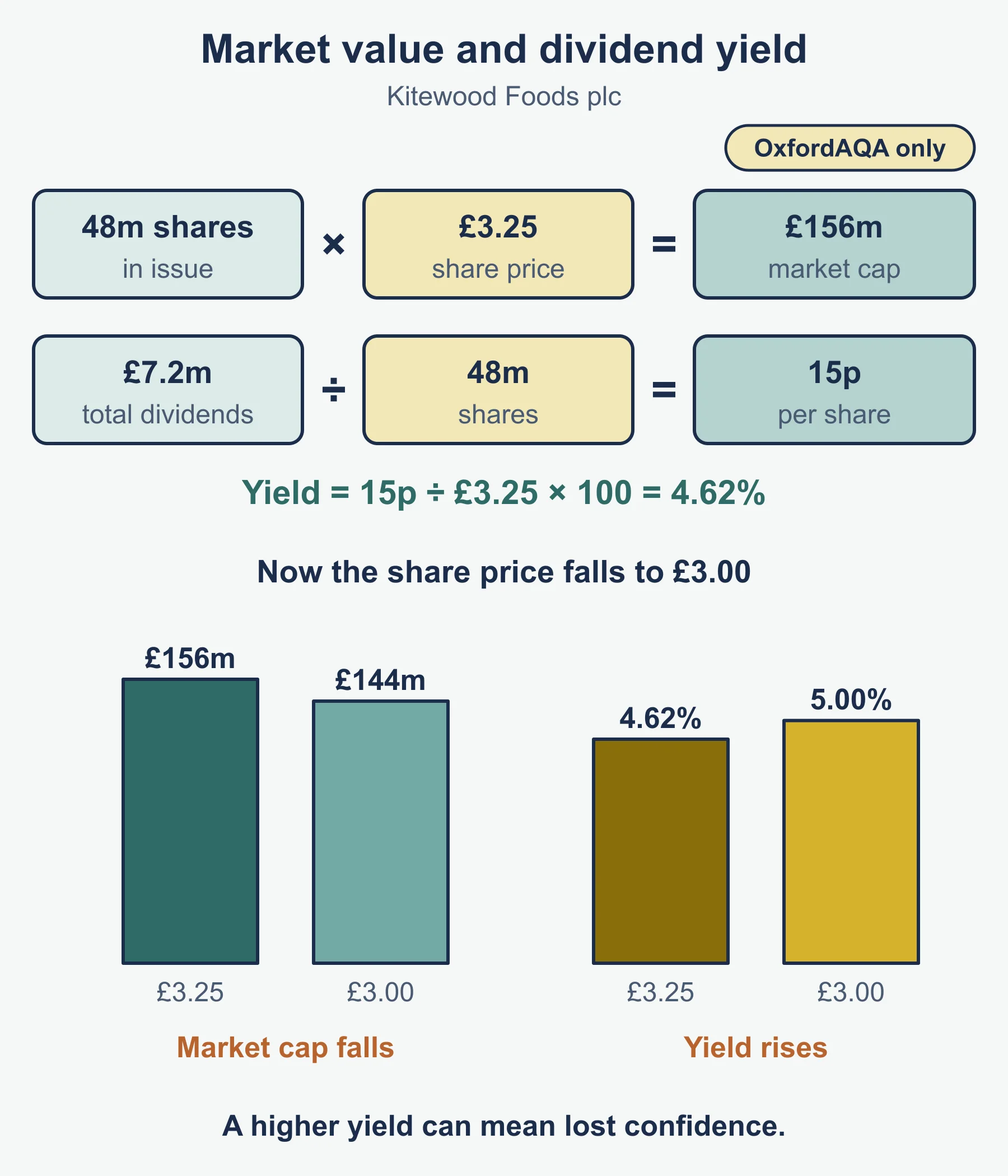
Market capitalisation = share price × number of shares in issue. It is the stock market’s current value of the whole company’s shares.
Why shareholders invest: dividend income; capital growth if the share price rises; sometimes a say in how the company is run; and the chance to spread risk across several companies. Limited liability makes it acceptable to risk money.
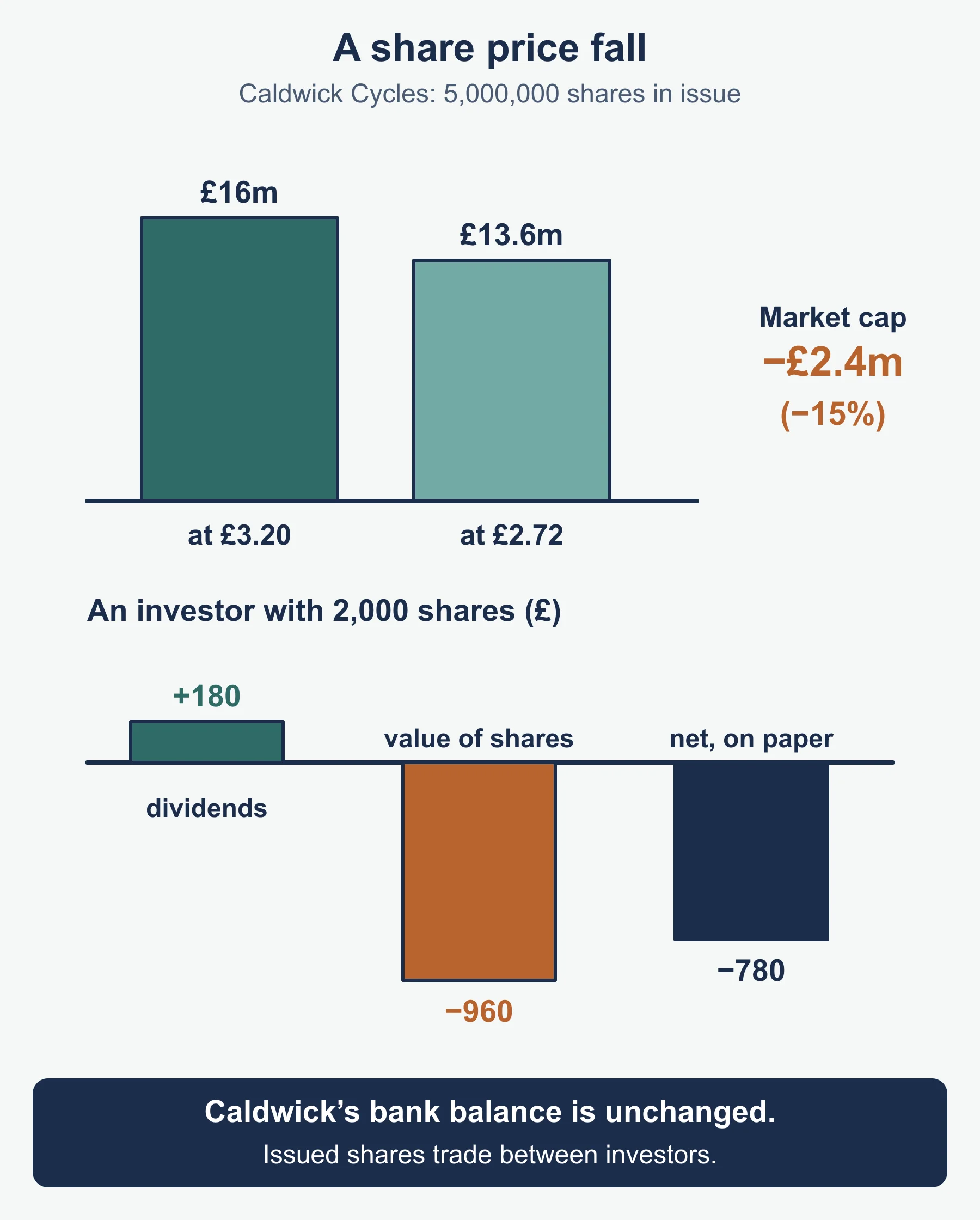
Worked example. Caldwick Cycles has 5,000,000 shares in issue at £3.20 and pays a dividend of 9p a share.
Market capitalisation = 5,000,000 x 3.20 = £16,000,000
Total dividend        = 5,000,000 x 0.09 = £450,000
Share price falls to £2.72:
  new market cap      = 5,000,000 x 2.72 = £13,600,000
  fall                = £2,400,000, which is 15%
An investor with 2,000 shares:
  dividends received  = 2,000 x 0.09     = £180
  fall in value       = 2,000 x 0.48     = £960
  net result          = 180 - 960        = a £780 loss on paper
The fall does not reduce Caldwick’s bank balance. Shares already issued trade between investors. The company receives money only when it issues new shares.
Influences on share price and why changes matter
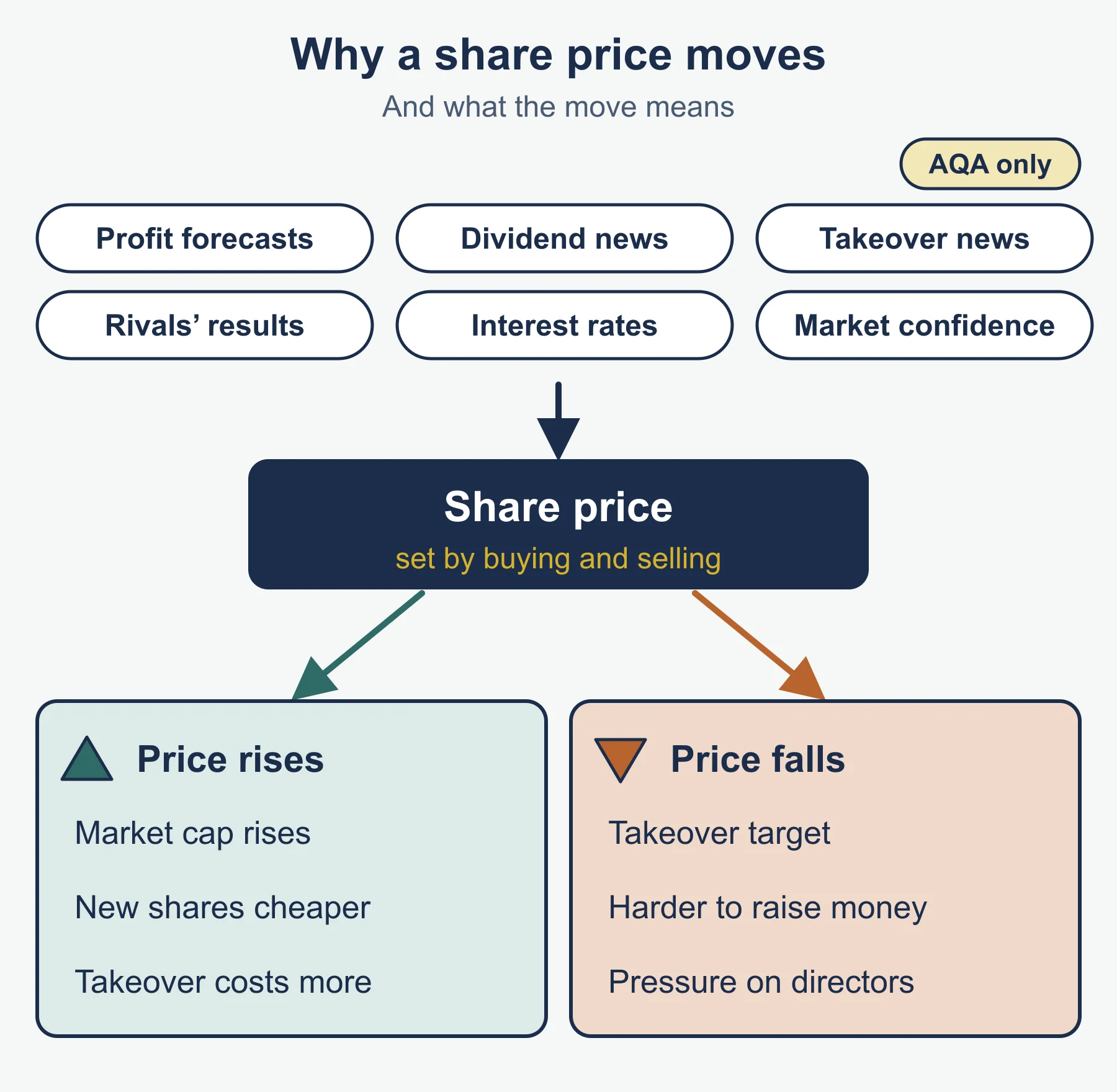
Share price is set by buying and selling. It rises when more people want to buy than sell. Influences include:
- results and forecasts of profit;
- dividend announcements;
- news of takeovers, new products, scandals or leadership changes;
- competitors’ performance;
- interest rates and the wider economy (higher rates can make shares less attractive than saving);
- general market confidence.
A rising price raises market capitalisation, makes new share issues cheaper, rewards shareholders and managers with share options, and makes a takeover more expensive. A falling price does the opposite: it can make the firm a takeover target, make raising finance harder, and put pressure on directors.
Effects of ownership on mission, objectives, decisions and performance
| Owner type | Likely effect |
|---|---|
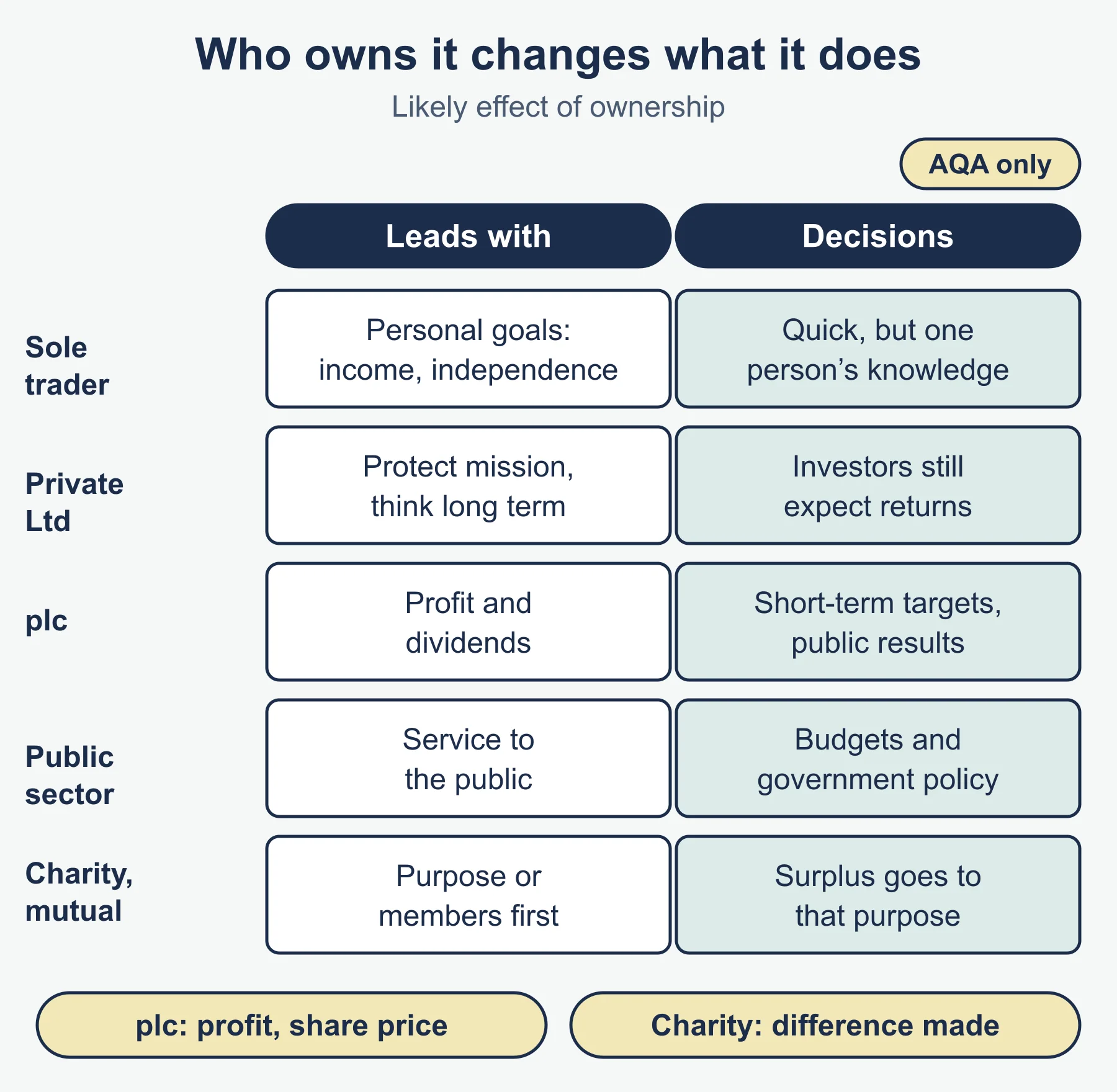
| Sole trader | Personal goals (income, independence, lifestyle) may outweigh growth; decisions are quick but limited by one person’s knowledge |
| Private limited | Founders or family may protect a mission and think long term, though investors still expect returns |
| plc | Pressure for profit and dividends, short-term targets and results announced publicly; ownership and control may diverge |
| Public sector | Mission is service; decisions are shaped by budgets and government policy |
| Charity or mutual | Surplus goes to the purpose or members, so social or member objectives lead |
Performance is judged differently too. A plc is judged on profit and share price; a charity on the difference it makes with its funds.
Common errors
- Writing “limited liability means limited debts”. The business can owe what it owes; the shareholder’s loss is limited.
- Mixing up revenue and profit, or calling fixed costs “overheads that never change”.
- Treating market capitalisation as money held by the company.
- Saying a charity cannot make a surplus. It can; it does not distribute it to owners.
- Describing forms without linking them to an owner’s need or situation.
Next steps
Move on to the revision notes and then the practice set.
Frequently asked questions
What is the difference between a mission and an objective? A mission is the business’s overall purpose: why it exists and what it is trying to be. Objectives turn that purpose into specific targets, and decisions are then judged by whether they meet them.
What is the difference between fixed and variable costs? Fixed costs stay the same however much is made or sold in the short run, such as rent and insurance. Variable costs change with output, such as materials and packaging.
How do you calculate market capitalisation? Market capitalisation = share price × number of shares in issue. It is the stock market’s current value of the company’s shares, not money held by the company.
What is the difference between a private limited company and a plc? Both are separate legal entities owned by shareholders with limited liability. A private limited company’s shares are not offered to the general public, while a plc’s shares can be bought and sold on a stock exchange by anyone, so it can raise very large sums.
Which sections of the AQA Business specification cover the nature of business and business forms? Sections 3.1.1, Understanding the nature and purpose of business, and 3.1.2, Understanding different business forms, in AQA AS and A-level Business (7131 and 7132).
Official syllabus
AQA, AS and A-level Business (7131 and 7132) specification, sections 3.1.1 and 3.1.2.
Get free revision emails (optional)
Occasional emails with practice questions, worked explanations and links to free resources for the qualification and subjects you choose. No spam, and you can unsubscribe from any email. The free tools on this site never need an email.
Related resources
-
Practice questions
AQA A-Level Business: Understanding the nature and purpose of business and Understanding different business forms (7132) – Practice Questions
Original practice questions with worked answers on objectives, profit, business forms, liability, shares and ownership for AQA A-Level Business.
Business · AQA · A Level
Try questions -
Revision notes
AQA A-Level Business: Understanding the nature and purpose of business and Understanding different business forms (7132) – Revision Notes
Condensed AQA A-Level Business revision notes on objectives, profit, business forms, liability, shares, dividends and market cap, with a self-test.
Business · AQA · A Level
Revise topic -
Study guides
AQA A-Level Business: What Is Business? (7132)
Study guide to Topic 1 What is business? for AQA A-level Business 7132: the nature and purpose of business, business forms and the external environment.
Business · AQA · A Level
Read guide
Related articles
-
teaching
A Level tuition in Dubai: Cambridge or Pearson Edexcel International A Level?
Schools in Dubai and Abu Dhabi teach either Cambridge International AS & A Level or Pearson Edexcel International A Level. How the two are structured, why it matters for tuition, and how online classes from Lahore work.
9 October 2026
-
curriculum guides
Choosing subjects at IGCSE and A Level
How subject choices at 14 and 16 affect university options later, and how to keep pathways open without overloading a timetable.
28 July 2026
Studying this with a teacher
Working through Business A LEVELS?
This page is free and stays free. If you would rather be taught it, Marlbridge runs Business classes one-to-one and in small groups of up to 15, online in your own time zone. The first trial class is free. WhatsApp replies within an hour (8am–11pm Pakistan time, every day); email the same day.
AQA Business teachers at Marlbridge
