
Revision Notes
AQA A-Level Business: Understanding the nature and purpose of business and Understanding different business forms (7132) – Revision Notes
Condensed AQA A-Level Business revision notes on objectives, profit, business forms, liability, shares, dividends and market cap, with a self-test.
- Subject
- Business
- Level
- A LEVELS
- Topic
- What is business?
- Author
- Marlbridge Academic Team
- Updated
- Reviewed by
- Salman Ahmad (what this means)
Aligned to AQA A Level Business (7132), For first teaching from September 2023. Official specification .
Syllabus page (what it covers and how it is assessed): AQA A Level Business.
Syllabus points this page covers
7132
- 3.1.1 Understanding the nature and purpose of business
- 3.1.2 Understanding different business forms
Found an error? Report a correction.
Need help with this topic? Request a free trial class for A Level Business (7132).
Quick recall for AQA A-level Business (7132), sections 3.1.1 and 3.1.2, for first teaching from September 2023. For full explanations use the study guide. When you are ready to test yourself, use the practice set, the course hub, the printable checklist and the free diagnostics. The wider topic also has topic-level revision notes.
3.1.1 Nature and purpose of business
Key definitions
| Term | Meaning |
|---|---|
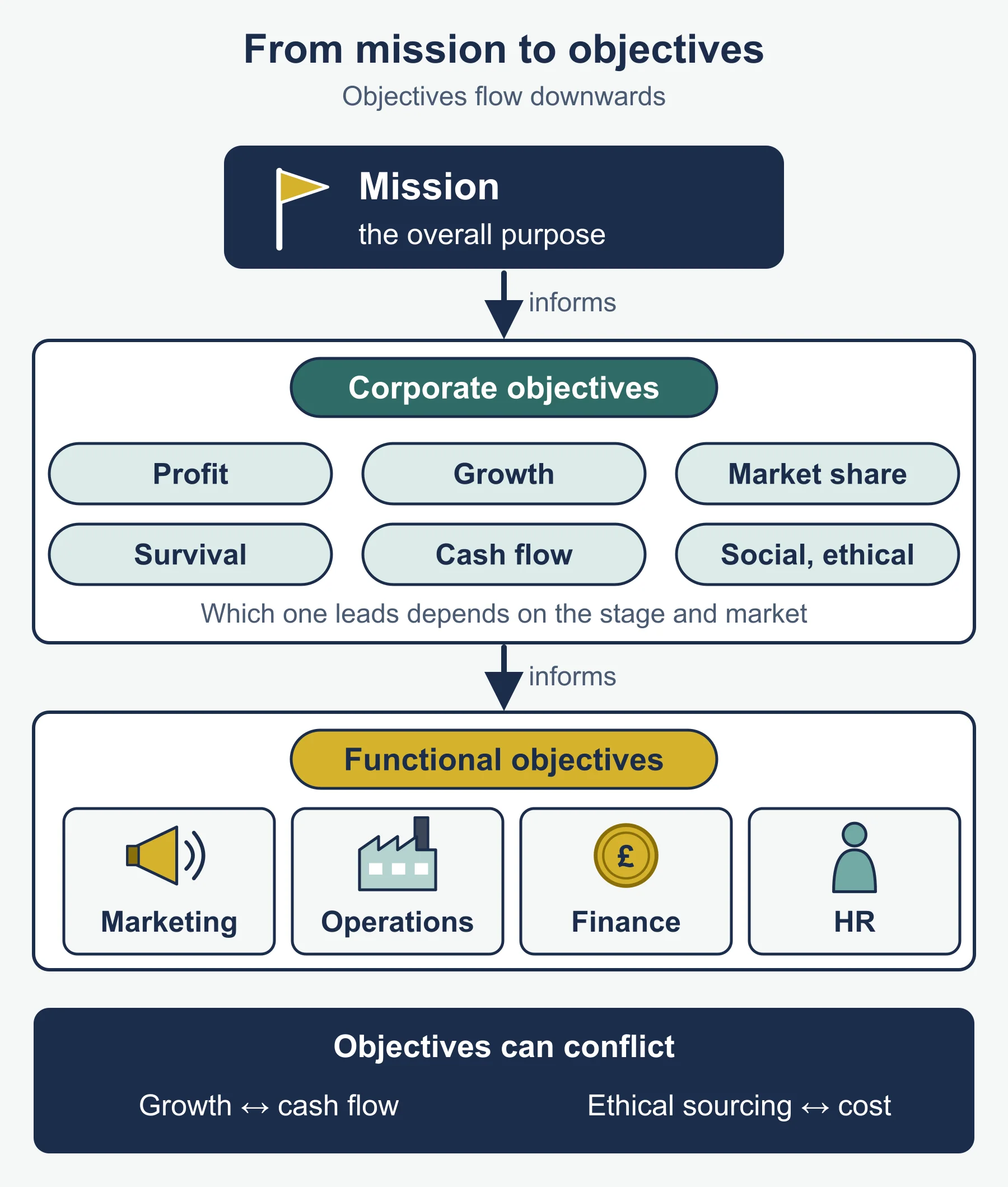
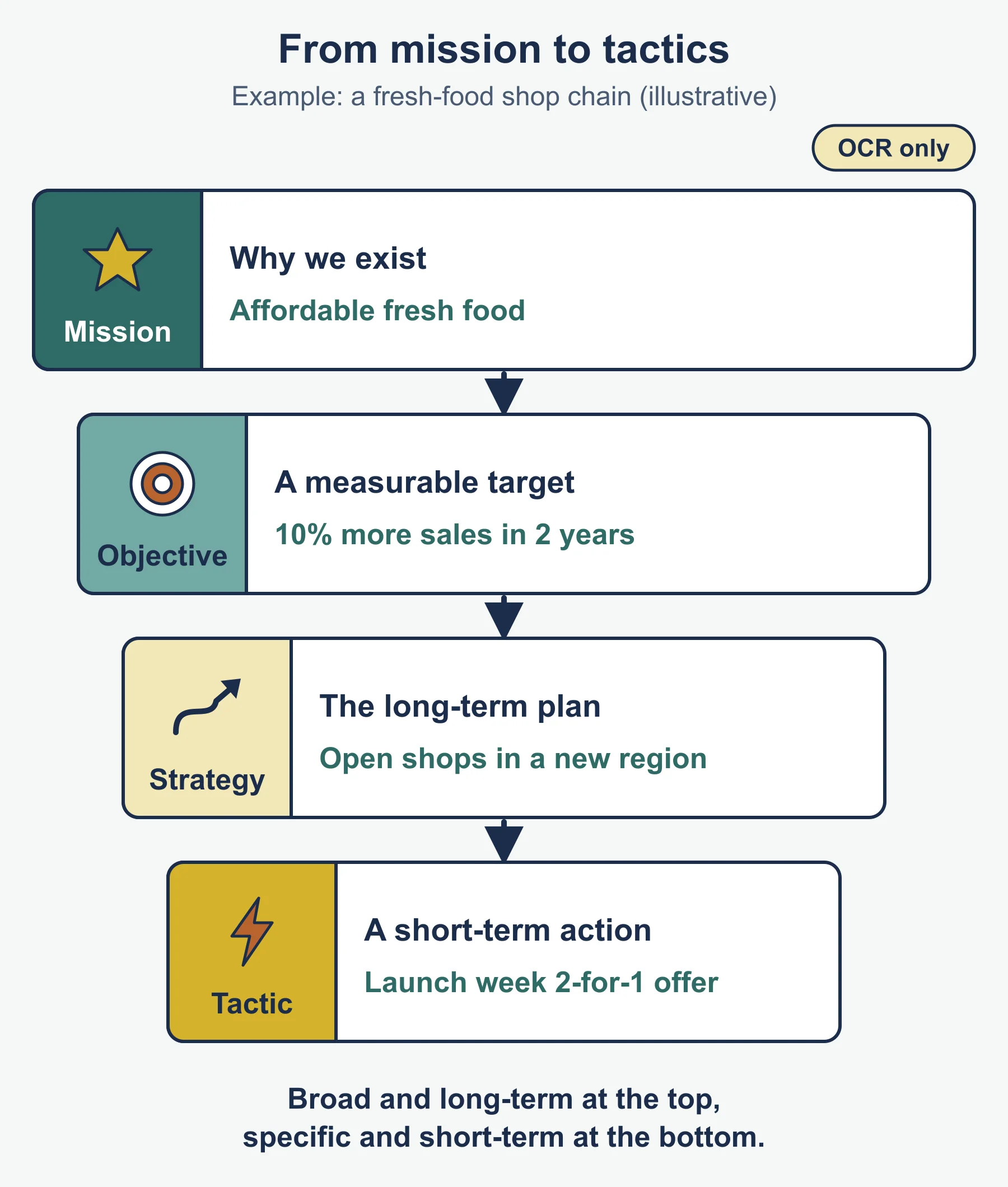
| Mission | The overall purpose of the business: why it exists. Broad, long-term, not usually numerical |
| Objective | A specific, measurable target, with a time limit, that moves the business towards its mission |
| Revenue (turnover, sales) | Selling price × quantity sold |
| Fixed costs | Costs that stay the same however much is produced in the short run |
| Variable costs | Costs that change with output |
| Total costs | Fixed costs + variable costs |
| Profit | Revenue − total costs |
Objectives named in the specification
- Profit
- Growth
- Survival
- Cash flow
- Social and ethical objectives
Link: mission gives the purpose, objectives give the targets, decisions are judged against the objectives.
Why businesses set objectives
- Common direction for all departments.
- Motivation: a target to aim at.
- Performance can be measured against targets.
- Choices between options can be ranked.
- Managers become accountable to owners.
Method: working out profit
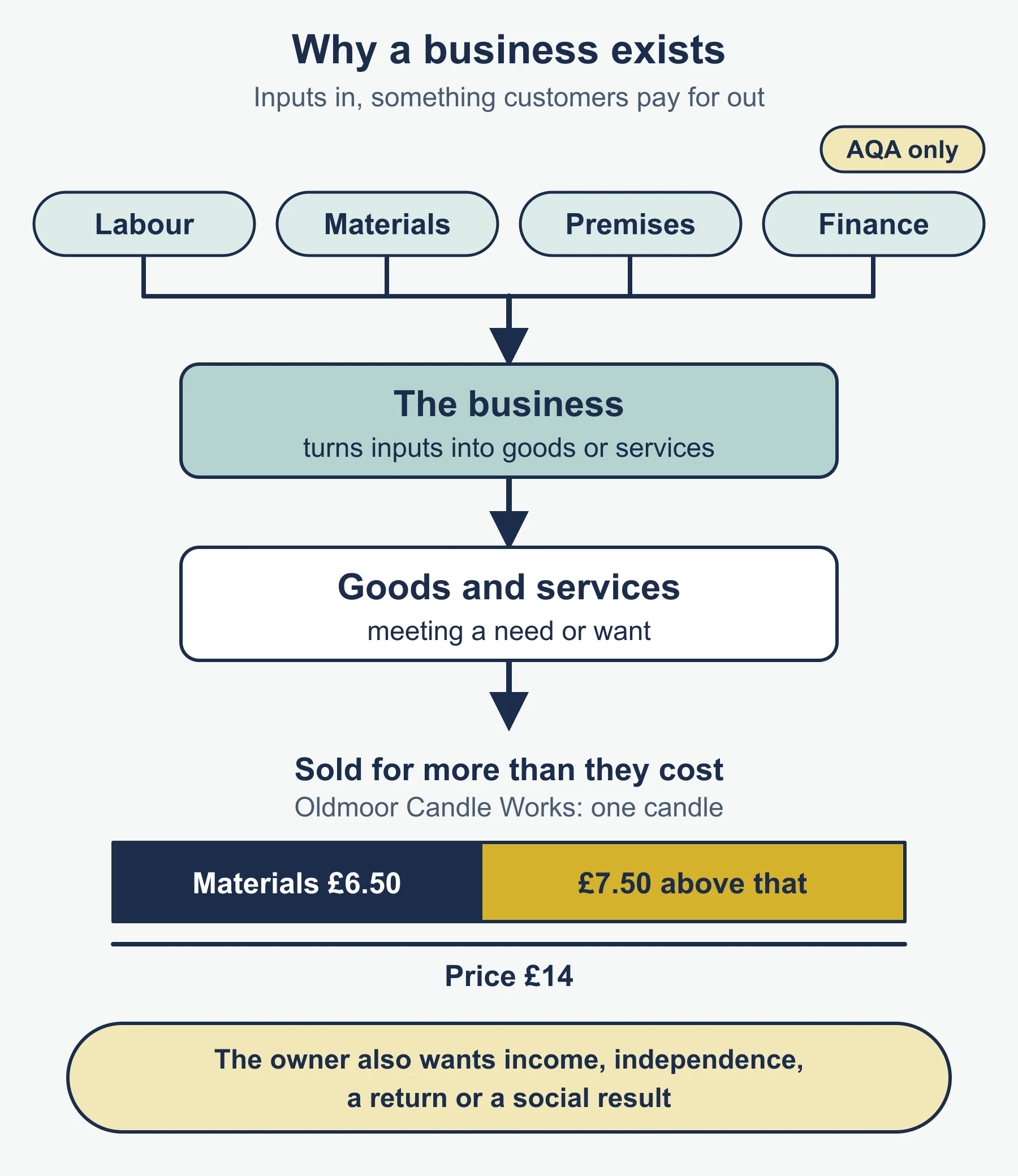
- Revenue = price × units.
- Variable costs = cost per unit × units.
- Total costs = variable costs + fixed costs.
- Profit = revenue − total costs.
- State the unit and the period (for example, £ per month).
Why profit is important
- Reward for risk taken by owners.
- Retained profit is a cheap source of finance.
- Attracts lenders and investors.
- Builds a cushion for survival.
- Pays dividends.
Worked reminder: profit and the effect of a cost change
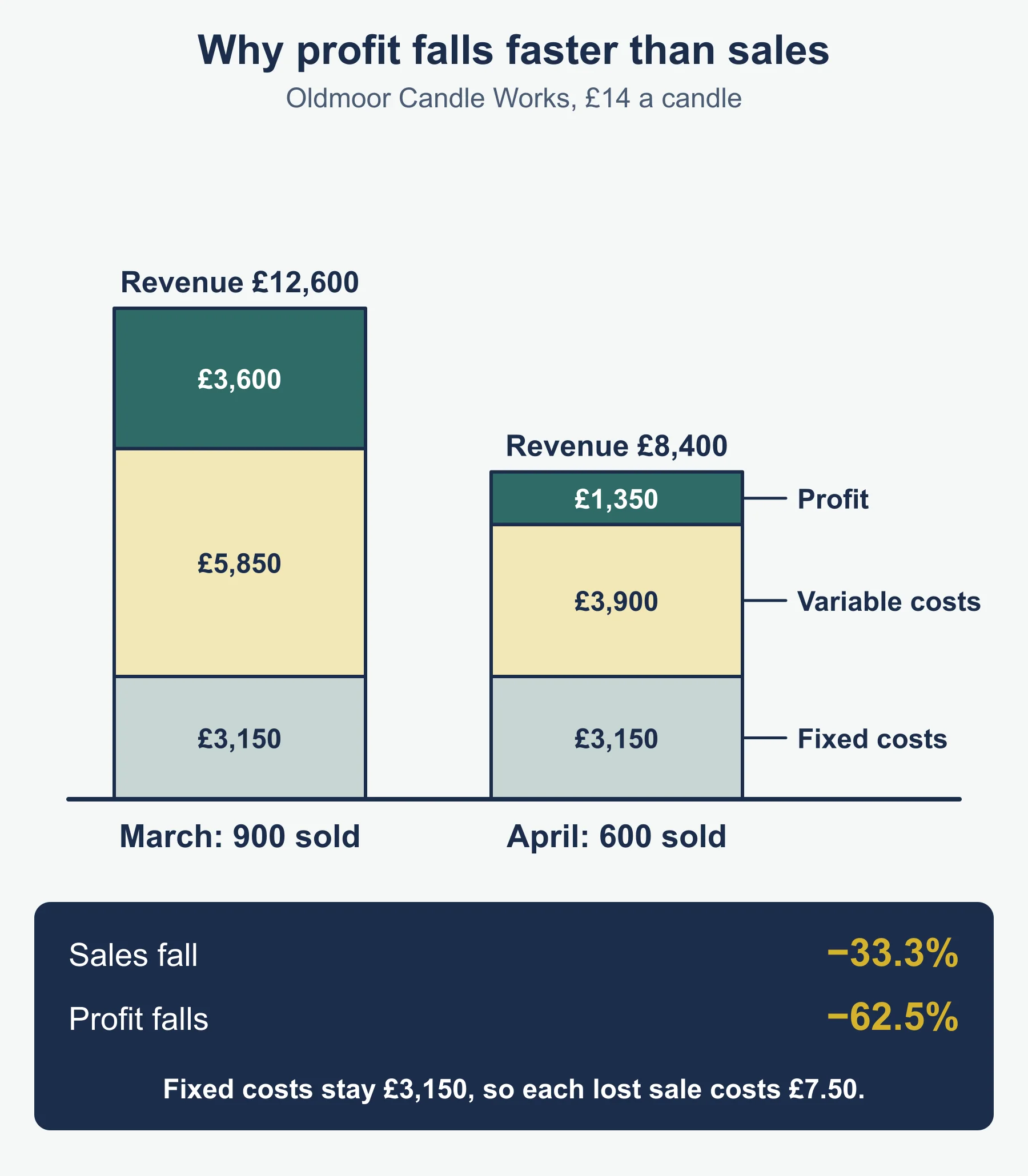
A workshop sells 500 items at £20. Variable cost is £8 an item. Fixed costs are £4,000.
Revenue = 500 x 20 = £10,000
Total costs = (500 x 8) + 4,000 = £8,000
Profit = £2,000
If fixed costs rise by £500: profit = £1,500 (a 25% fall)
A change in fixed cost passes straight to profit. A change in variable cost depends on how many units are sold.
Mission to objective: a model chain
Mission: “to give every customer a healthy, affordable lunch”. Objective: “to raise lunchtime sales by 10% in 12 months while keeping average ingredient cost per meal below £2.20”. Decision: “add a second serving counter”. Test the decision against the objective, not against the mission alone. Then ask whether another objective, such as cash flow, is put at risk.
Must-know distinctions
- Profit versus cash flow: profit is revenue minus total costs over a period; cash flow is money actually moving in and out. A profitable firm can still run out of cash.
- Mission versus objective: mission is purpose; objective is a target.
- Fixed versus variable: a cost is fixed or variable according to whether it changes with output, not according to how big it is.
- Revenue versus profit: revenue ignores costs.
- Objectives can conflict: growth can use up cash; ethical sourcing can cut short-run profit.
3.1.2 Different business forms
Forms at a glance
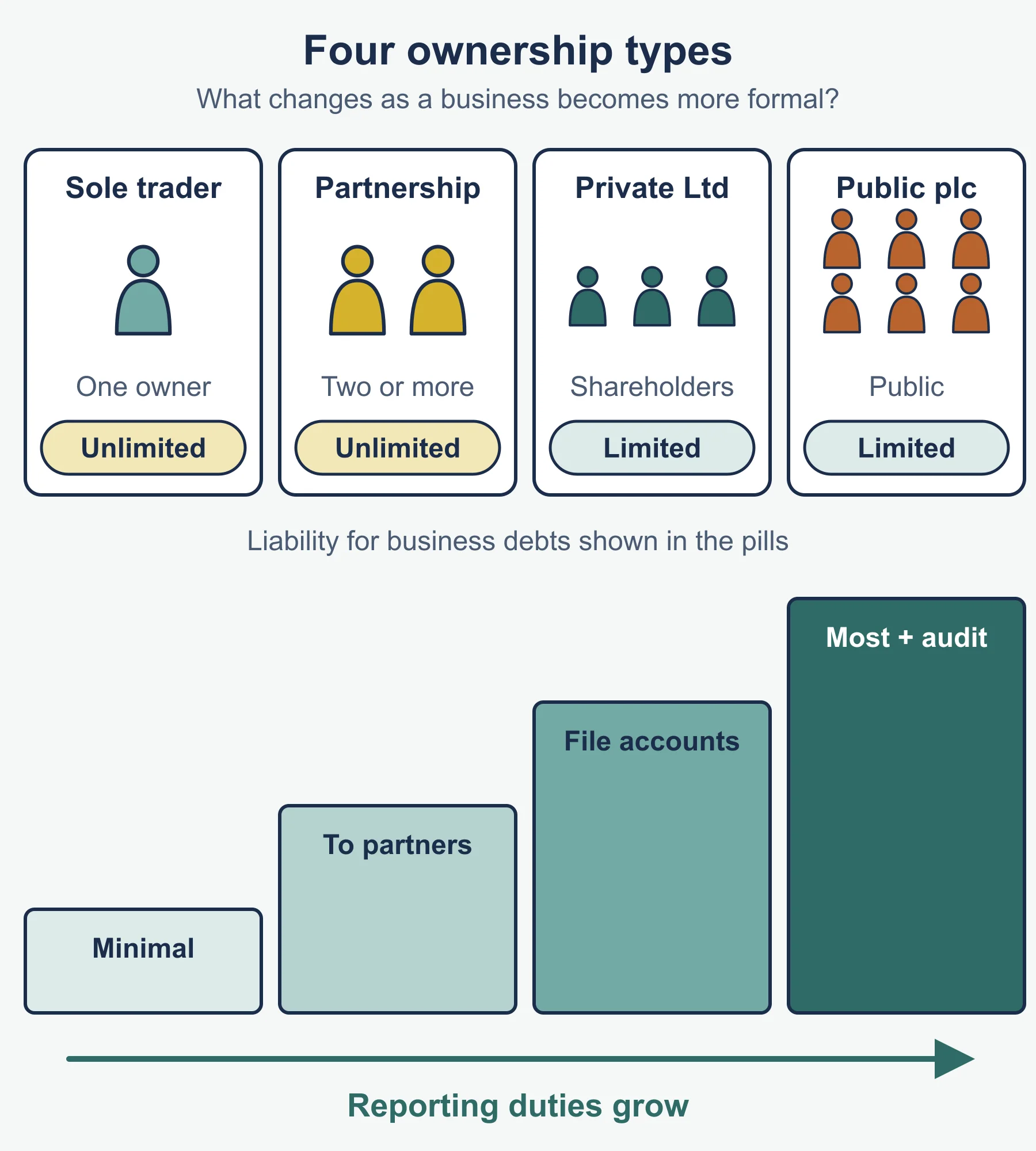
| Form | Owner(s) | Liability | Source of finance | Main drawback |
|---|---|---|---|---|
| Sole trader | One person | Unlimited | Owner’s funds, loans, retained profit | Personal risk; limited capital |
| Private limited company (Ltd) | Shareholders, shares not offered to public | Limited | Owners, selected investors, loans | Shares hard to sell; control diluted |
| Public limited company (plc) | Shareholders, shares traded on a stock exchange | Limited | Sale of shares to the public, loans | Takeover risk; short-term pressure; heavy reporting |
| Public sector | Government | Not applicable (state funded) | Taxes and government budgets | Constrained by budgets and policy |
| Charity | Governed for a purpose | Varies | Donations, grants, trading | Dependence on funders |
| Mutual | Its members (customers or savers) | Varies | Members, trading surplus | Narrower sources of capital |
Private sector means owned by individuals or shareholders. Public sector means owned and funded by the state.
Unlimited versus limited liability
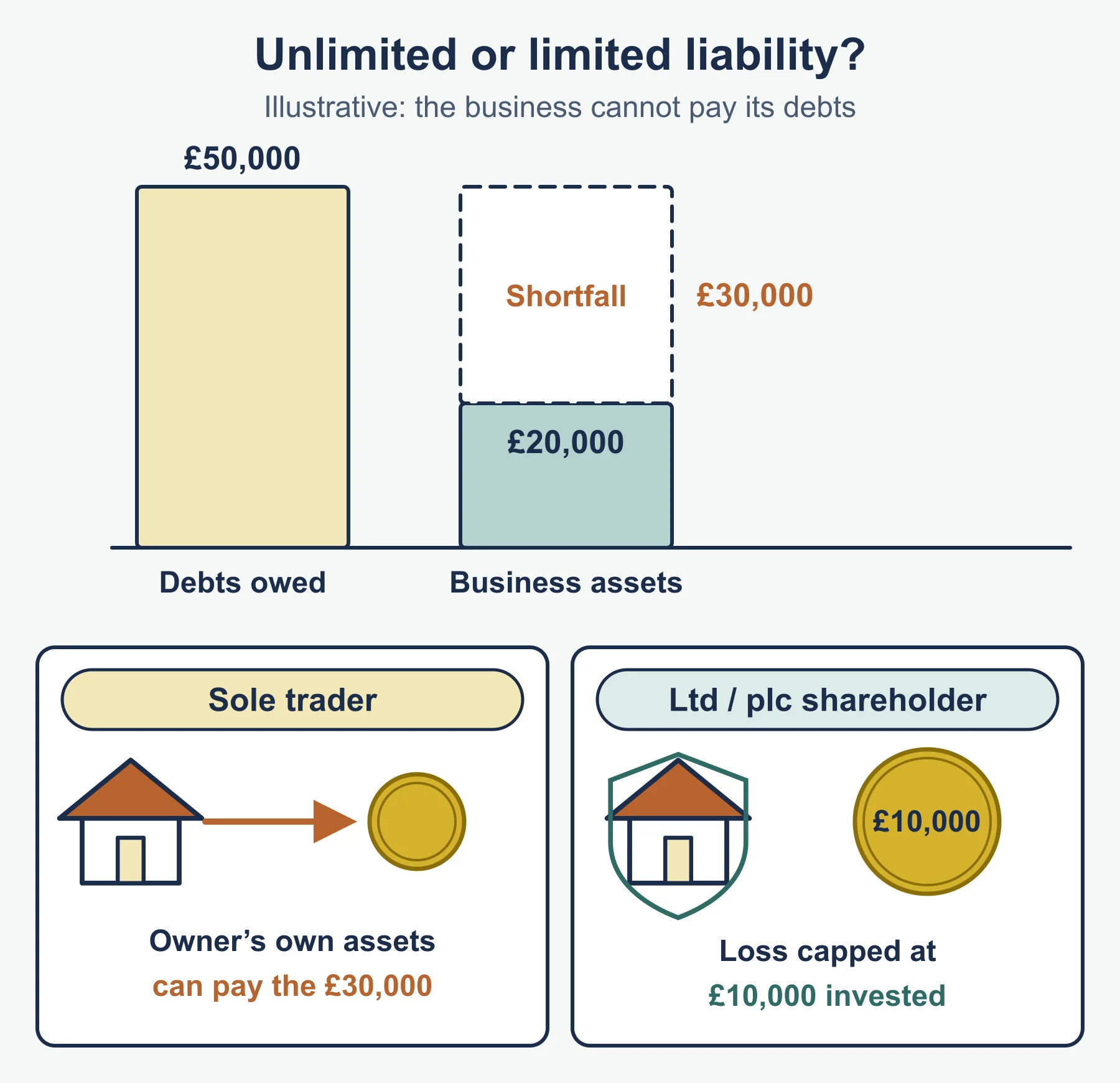
- Unlimited: personal assets can be used to pay business debts. Sole traders.
- Limited: the shareholder can lose only the amount invested. Ltd and plc.
- Do not say that the company’s debts are limited.
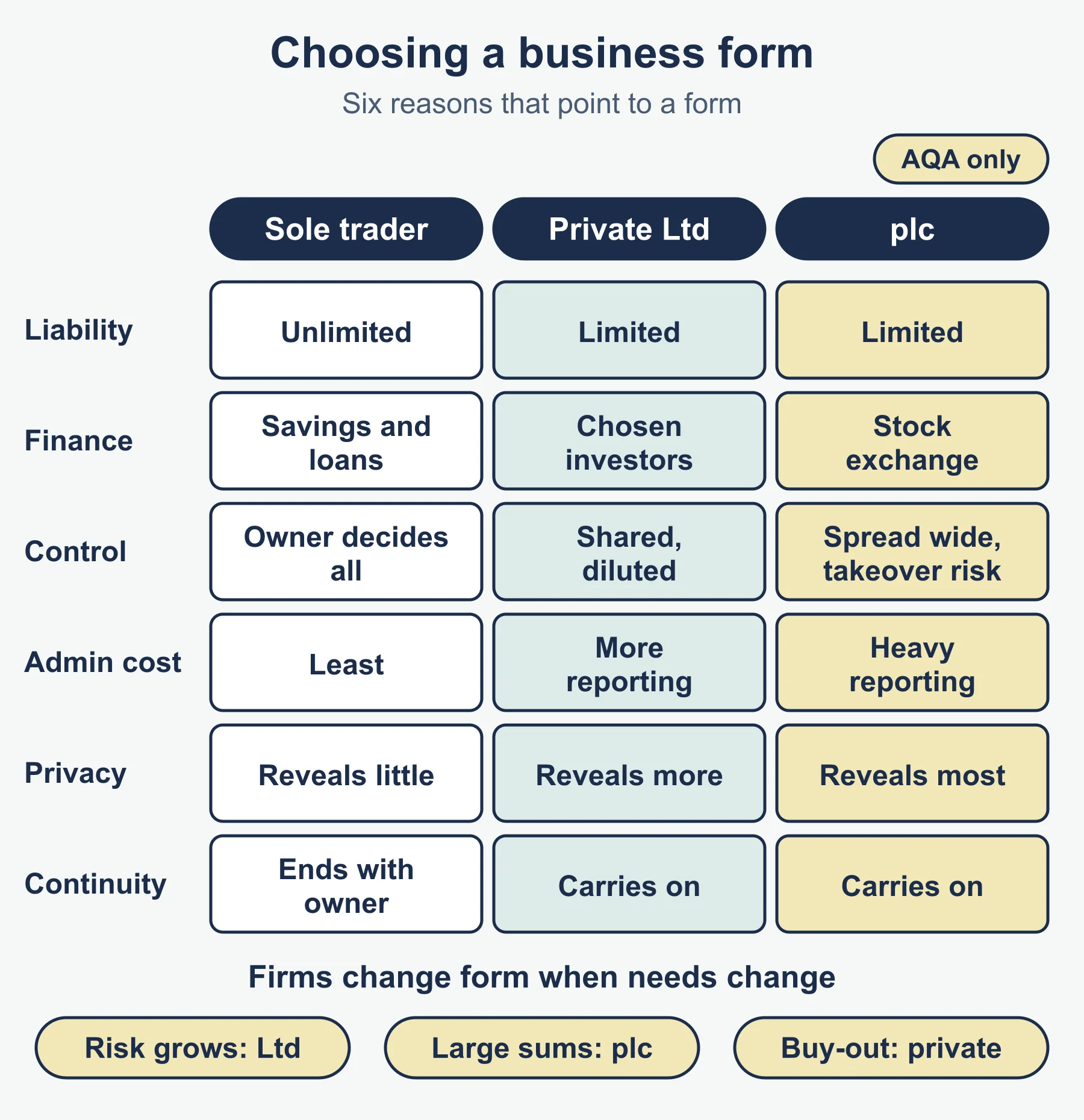
Reasons to choose or change form
- Protect personal assets.
- Raise more capital.
- Keep or give up control.
- Match a social aim.
- Cost and amount of reporting.
- Privacy of information.
- Continuity if an owner leaves.
- Planned growth.
Typical changes: sole trader to Ltd (risk and funding); Ltd to plc (large funds, a way for owners to sell); plc to private (long-term thinking, away from the stock market).
Shares: formulas
| Term | Meaning or formula |
|---|---|
| Ordinary share capital | Money raised by issuing ordinary shares |
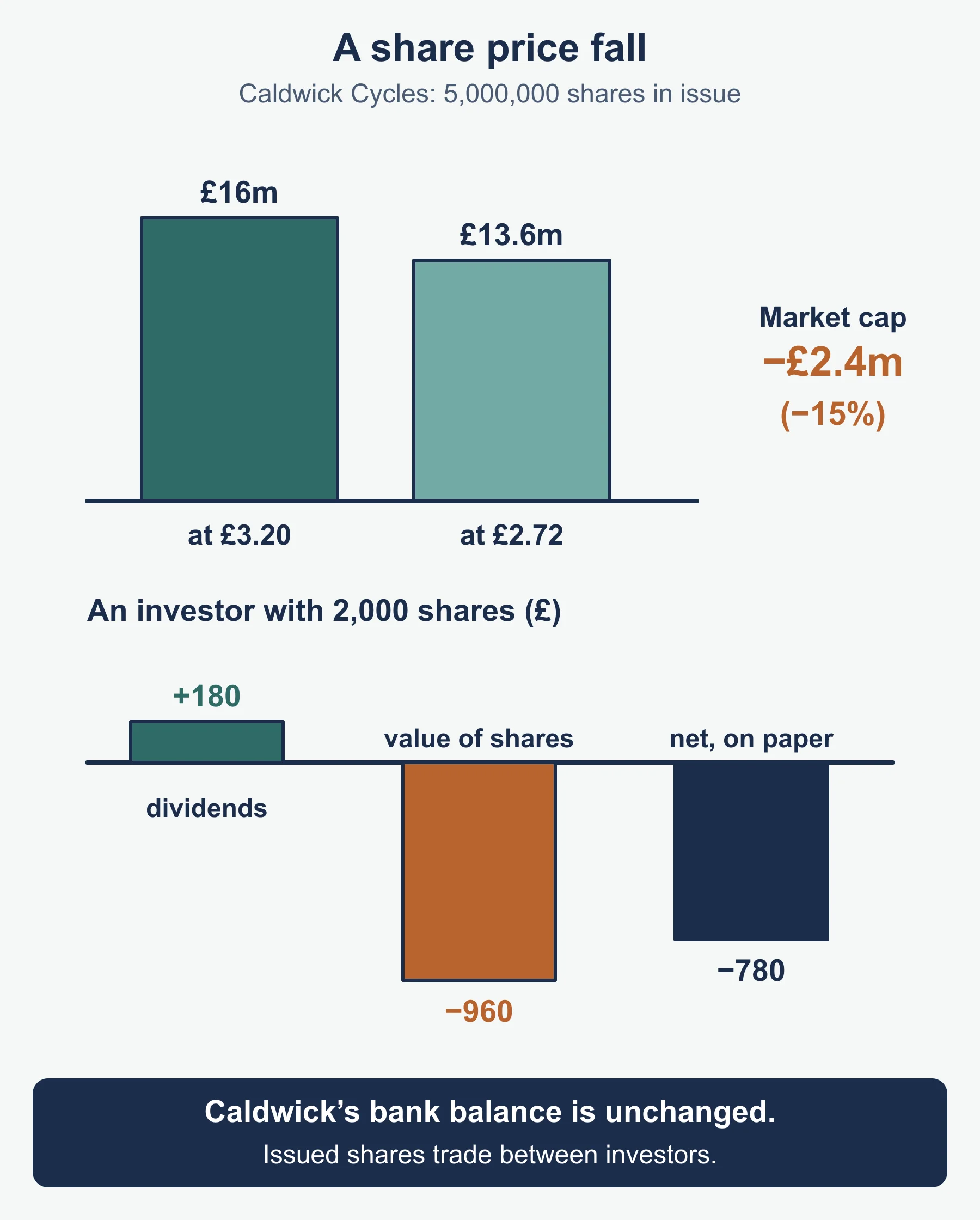
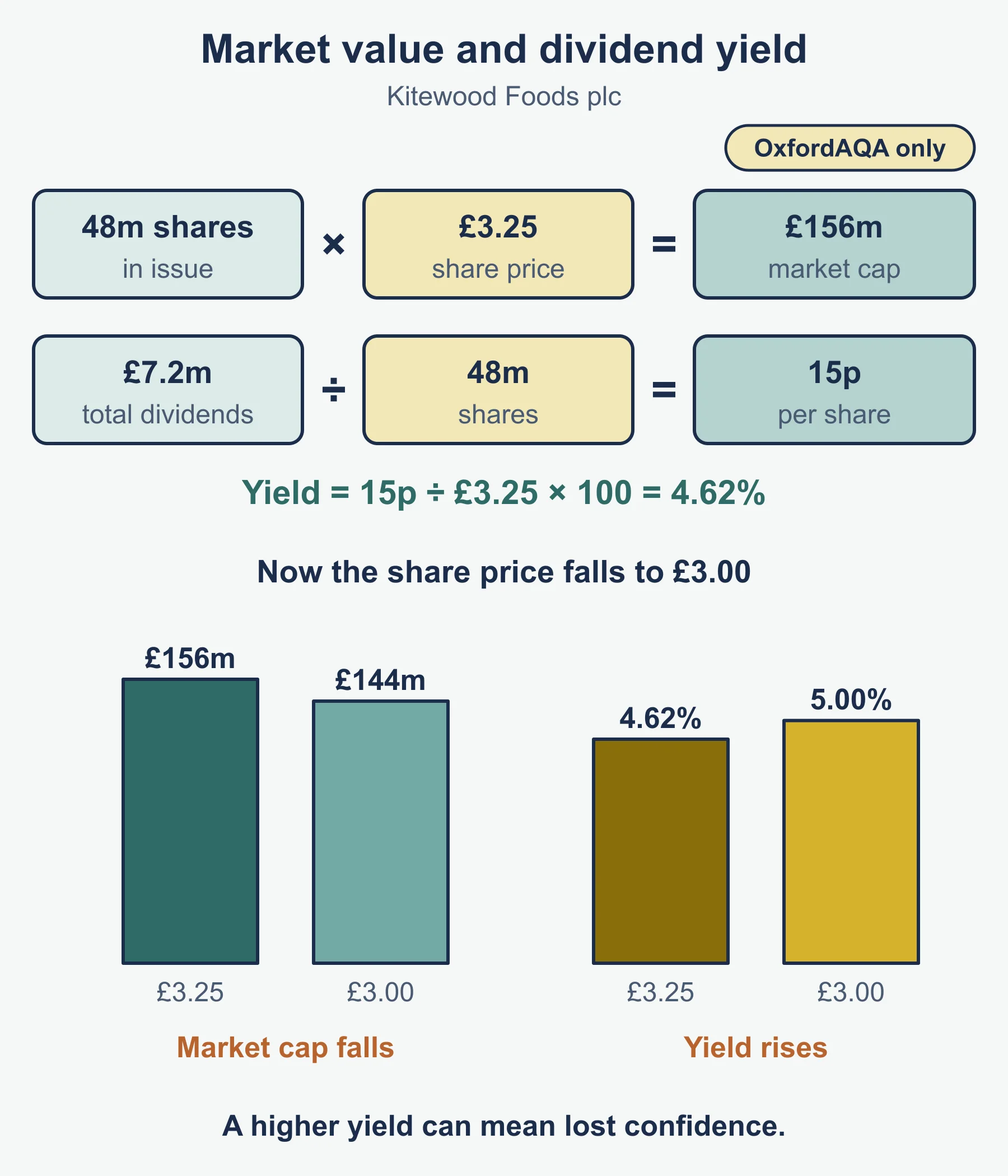
| Market capitalisation | Share price × number of shares in issue |
| Dividend | Part of profit paid to shareholders, usually quoted per share |
| Total dividend | Dividend per share × shares in issue |
| Percentage change | (new − old) ÷ old × 100 |
Why shareholders invest: dividends, capital growth, voting rights, spreading risk.
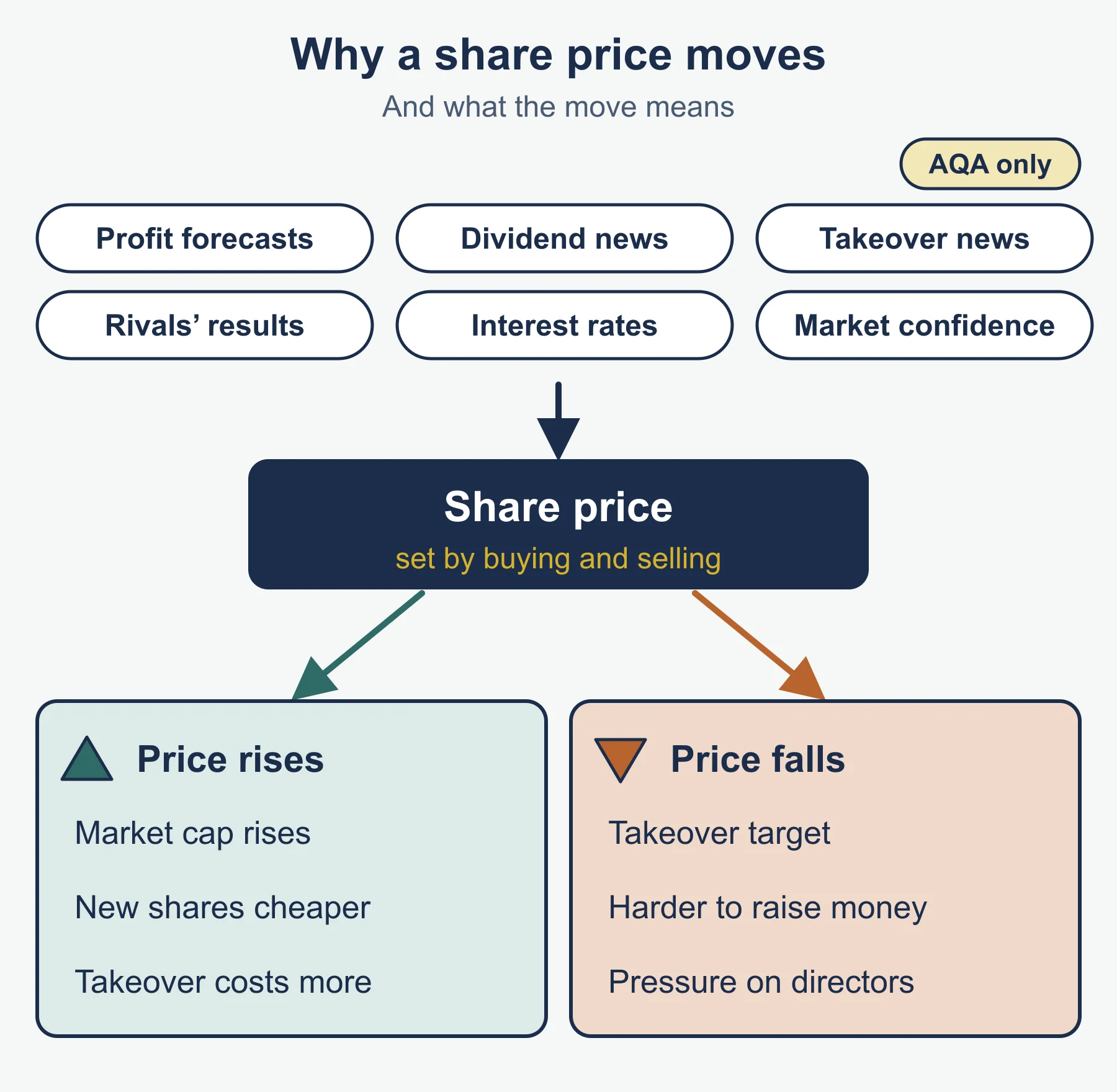
Influences on share price: profit results and forecasts, dividend news, takeovers and scandals, competitors, interest rates and the economy, market confidence.
Significance of a change: a rise makes new share issues cheaper and takeover costlier; a fall raises takeover risk and pressure on directors. Trading between investors does not give the company cash.
Private sector versus public sector
- Owner: shareholders or individuals, against the state.
- Main aim: usually profit, against providing a service within a budget.
- Success measure: profit, growth or share price, against service quality and value for money.
- Funding: sales and investors, against taxation and government grants.
- Pressure: owners and competitors, against government policy and public scrutiny.
Neither sector has a single objective. A private firm can have strong social aims, and a public body must still control its costs.
Worked reminder: shares
A company has 600,000 shares at £2.00 and pays a dividend of 5p per share.
Market capitalisation = 600,000 x 2.00 = £1,200,000
Total dividend = 600,000 x 0.05 = £30,000
Price rises to £2.30: new market cap = £1,380,000, a 15% rise
The company gains cash only if it issues new shares. An investor with 1,000 shares receives £50 in dividends and gains £300 on paper.
Model analysis chain: changing form
Use this pattern for any “change of form” question:
- Name the feature (for example, limited liability).
- Say what it changes for this owner (personal home no longer at risk).
- Say what that allows or prevents (willing to bid for a larger contract).
- Weigh the cost (more reporting, less privacy).
- Judge: which matters more, given the size of the risk and the owner’s attitude to control?
Effects of ownership
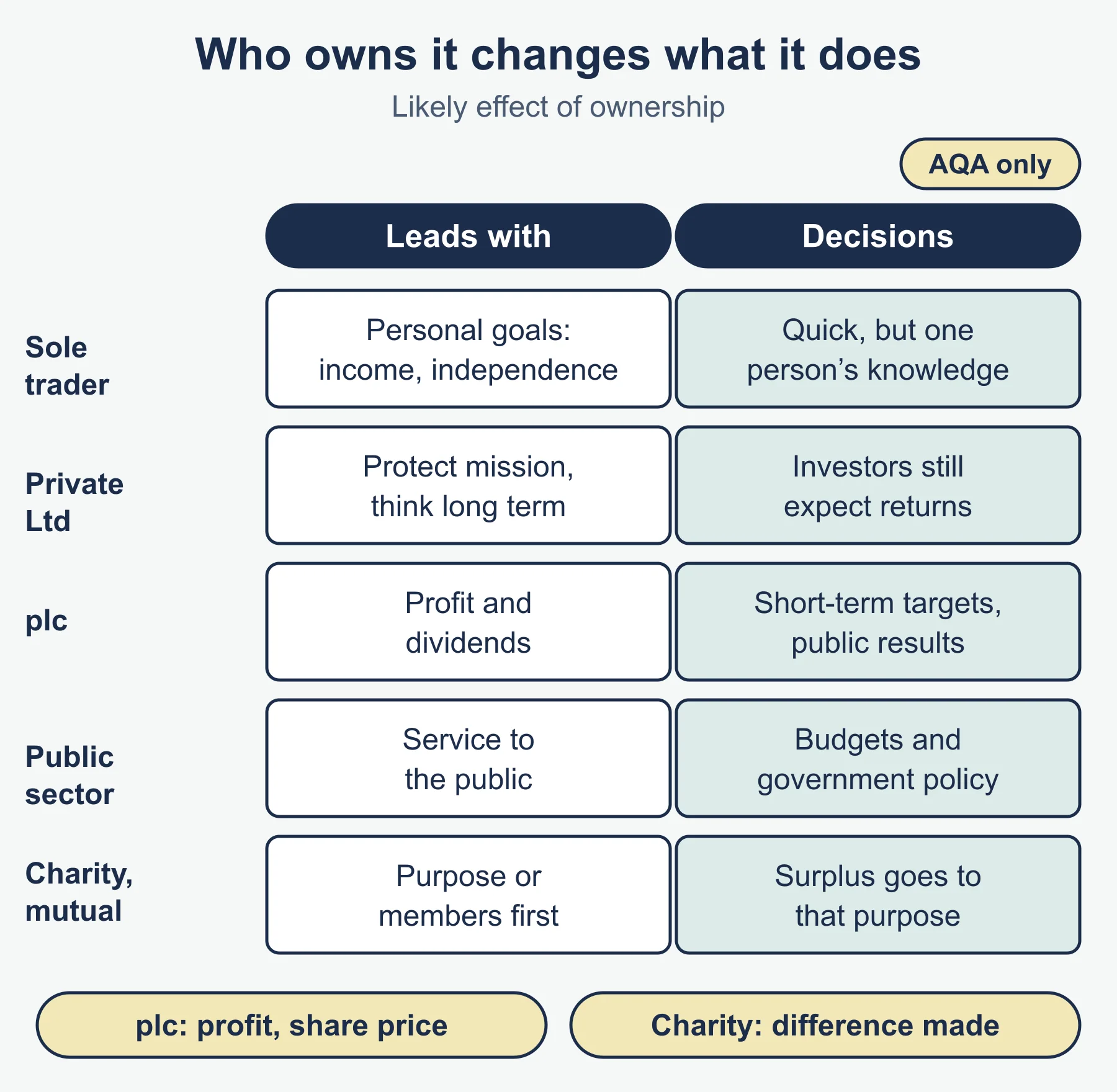
- Sole trader: personal goals; fast decisions; limited knowledge.
- Ltd: mission may be protected; investors still expect returns.
- plc: pressure for profit and dividends; ownership separate from control.
- Public sector: service and budgets lead.
- Charity or mutual: purpose or member benefit leads.
Quick self-test
- Define “mission”.
- Name three objectives from the specification list.
- A business sells 1,200 units at £8.50. Variable cost is £3.10 per unit and fixed costs are £4,200. Calculate profit.
- What does unlimited liability mean?
- A company has 800,000 shares priced at £4.50. Calculate market capitalisation. If the price rises to £4.95, find the percentage change.
- A company with 250,000 shares pays 12p a share. Calculate the total dividend.
- What is a mutual?
- Give two reasons why a sole trader might become a private limited company.
- When one investor sells shares to another, does the company receive the money?
- Why might a shareholder accept a low dividend?
Answers
- The overall purpose of the business: why it exists.
- Any three of profit, growth, survival, cash flow, social and ethical objectives.
- Revenue £10,200; variable costs £3,720; total costs £7,920; profit £2,280.
- Personal assets of the owner can be used to pay the business’s debts.
- £3,600,000. New value £3,960,000, a 10% rise.
- £30,000.
- An organisation owned by its members (its customers or savers), whose surplus is used for their benefit.
- Limited liability protects personal assets; shares let it raise finance from outside investors (also continuity).
- No. The money passes between the two investors.
- Because they expect the share price to rise (capital growth), or the retained profit to fund growth.
Where marks are usually lost
- Writing “profit” when the question asks for revenue, or the reverse.
- Forgetting fixed costs when finding total costs.
- Defining limited liability as limits on the company’s debts.
- Treating market capitalisation as cash in the company’s bank.
- Listing features of a form without saying why they matter to this owner.
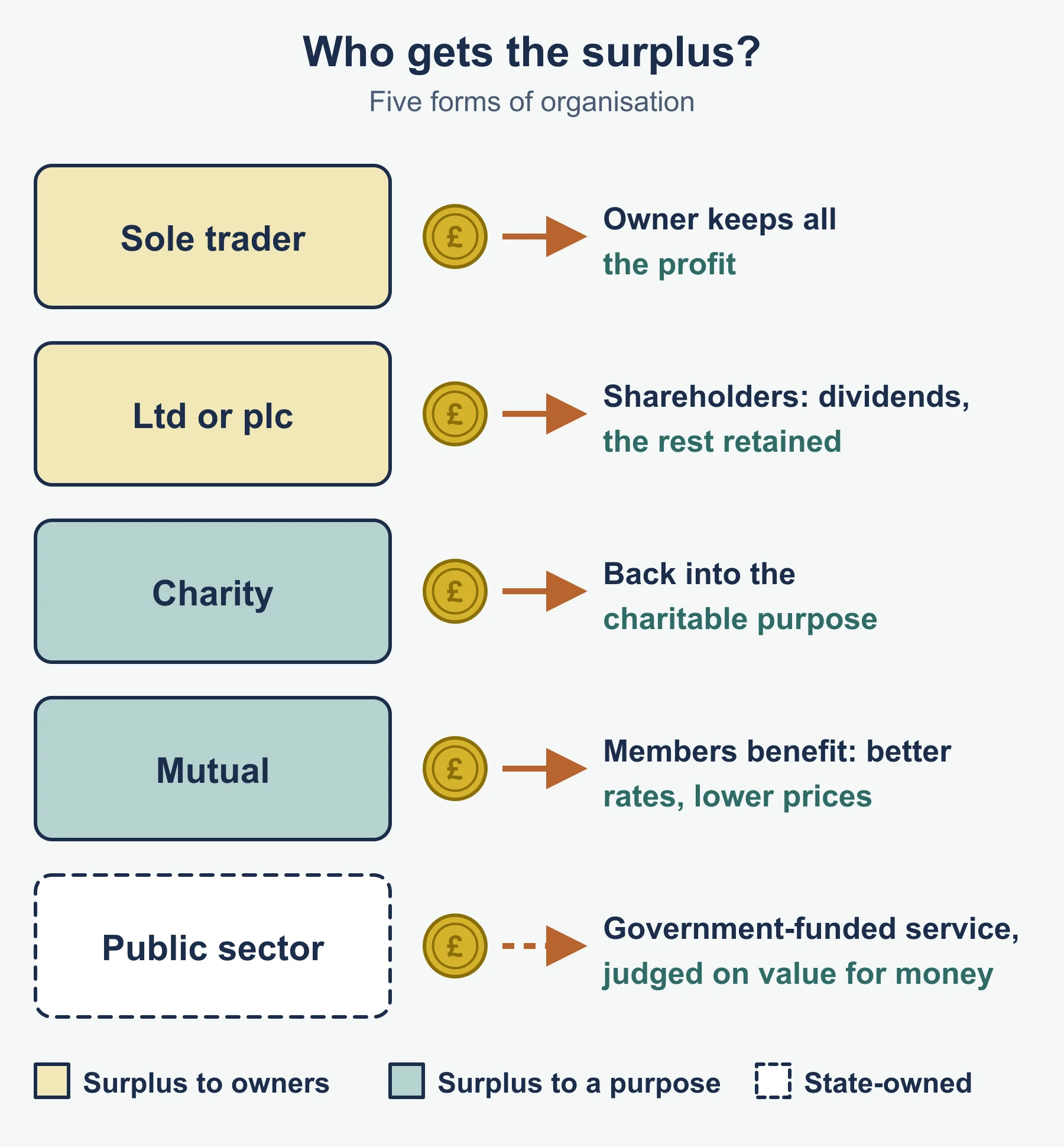
- Calling a mutual or charity “non-profit” and stopping, without saying what happens to surplus.
- Giving advantages of a plc without the cost: loss of control and takeover risk.
- Stating a change in share price without saying who it affects.
- Judging that one form is “best” without a condition based on the case.
Frequently asked questions
What objectives are named in AQA 3.1.1? Profit, growth, survival, cash flow, and social and ethical objectives.
What is a mutual? A mutual is an organisation owned by its members, its customers or savers, whose surplus is used for their benefit.
Does a company receive money when its shares are sold between investors? No. When one investor sells shares to another, the money passes between the two investors. The company gains cash only if it issues new shares.
What does limited liability mean? With limited liability a shareholder can lose only the amount they invested; the company’s debts are not limited. Sole traders have unlimited liability, so their personal assets can be used to pay business debts.
Official syllabus
AQA, AS and A-level Business (7131 and 7132) specification, sections 3.1.1 and 3.1.2.
Get free revision emails (optional)
Occasional emails with practice questions, worked explanations and links to free resources for the qualification and subjects you choose. No spam, and you can unsubscribe from any email. The free tools on this site never need an email.
Related resources
-
Study guides
AQA A-Level Business: What Is Business? (7132)
Study guide to Topic 1 What is business? for AQA A-level Business 7132: the nature and purpose of business, business forms and the external environment.
Business · AQA · A Level
Read guide -
Practice questions
AQA A Level Business: What is Business — Practice Questions
Original exam-style practice questions with full worked answers on business purpose, objectives, ownership and decision making for AQA A Level Business.
Business · AQA · A Level
Try questions -
Revision notes
AQA A Level Business: What is Business — Revision Notes
Condensed recall notes on business purpose, ownership, stakeholders and the external environment for AQA A Level Business 7132.
Business · AQA · A Level
Revise topic
Related articles
-
teaching
A Level tuition in Dubai: Cambridge or Pearson Edexcel International A Level?
Schools in Dubai and Abu Dhabi teach either Cambridge International AS & A Level or Pearson Edexcel International A Level. How the two are structured, why it matters for tuition, and how online classes from Lahore work.
9 October 2026
-
curriculum guides
Choosing subjects at IGCSE and A Level
How subject choices at 14 and 16 affect university options later, and how to keep pathways open without overloading a timetable.
28 July 2026
Studying this with a teacher
Working through Business A LEVELS?
This page is free and stays free. If you would rather be taught it, Marlbridge runs Business classes one-to-one and in small groups of up to 15, online in your own time zone. The first trial class is free. WhatsApp replies within an hour (8am–11pm Pakistan time, every day); email the same day.
AQA Business teachers at Marlbridge
