
Study Guides
AQA A-Level Business: Understanding that businesses operate within an external environment (7132)
Study guide to how competition, market conditions, incomes, interest rates, demographics and green issues shape costs and demand, for AQA A-level Business.
- Subject
- Business
- Level
- A LEVELS
- Topic
- What is business?
- Author
- Marlbridge Academic Team
- Updated
- Reviewed by
- Salman Ahmad (what this means)
Aligned to AQA A Level Business (7132), For first teaching from September 2023. Official specification .
Syllabus page (what it covers and how it is assessed): AQA A Level Business.
Syllabus points this page covers
7132
- 3.1.3 Understanding that businesses operate within an external environment
Found an error? Report a correction.
Need help with this topic? Request a free trial class for A Level Business (7132).
This study guide covers section 3.1.3, Understanding that businesses operate within an external environment, of the AQA AS and A-level Business specification (7131 and 7132). It is written for A-level Business 7132. It sits inside Topic 1, What is business?, and the specification lists all content as assessable in each A-level paper.
The specification gives this section one content point: how the external environment can affect costs and demand. It then lists six factors that must be covered. This guide teaches each one, with worked calculations, and shows how to turn a list of factors into an argument. Practice is in the practice questions and quick recall is in the revision notes. The wider topic is covered in the What is business? study guide, the topic revision notes and the topic practice questions. The course hub is AQA A-level Business, the printable list is the Business checklist, and you can test yourself with the free diagnostics.
What the specification asks for
| Content | What you must be able to do |
|---|---|
| How the external environment can affect costs and demand | Explain how each outside factor changes what a business pays or what customers buy |
| Competition | Link rivals’ actions to prices, volumes, marketing spend and staff or supplier costs |
| Market conditions | Link the state of the market to demand, supply of inputs and input prices |
| Incomes | Link customers’ spending power to the products they buy and the wages a business pays |
| Interest rates | Link the cost of borrowing to a business’s finance costs and its customers’ spending |
| Demographic factors | Link the size and make-up of the population to customers and to the workforce |
| Environmental issues and fair trade | Link green and ethical expectations to input, compliance and production costs and to customer choice |
Remember costs and demand: say which moves, in which direction, and why. The business cannot control these factors, so they are external.
A way to build every answer
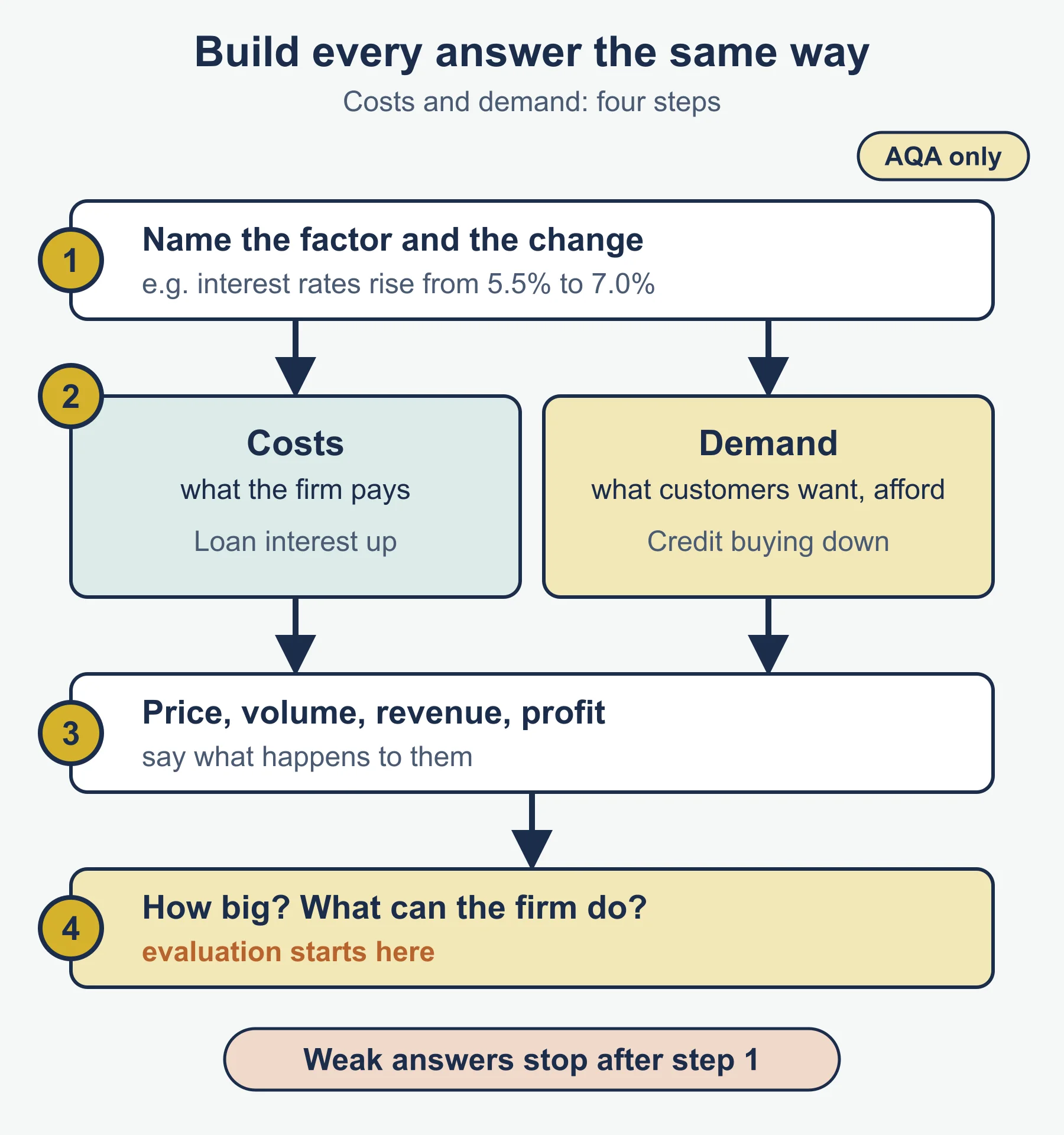
Use the same chain each time:
- Name the factor and say what has changed.
- Say how that change reaches the business: does it alter what the business pays (costs) or what customers want and can afford (demand)?
- Say what happens to price, volume, revenue or profit.
- Say how big the effect is likely to be for this business, and what the business could do about it.
Step 4 is where evaluation starts. Weak answers stop after step 1 and just state “interest rates went up”.
Competition
Competition means rival businesses selling similar products to the same customers. A change in competition can hit demand directly. It can also raise costs.
- Demand. A new rival, or a rival price cut, gives customers an alternative. Your volume falls, or you must cut price to hold it.
- Costs. You may spend more on advertising and promotions to stay visible. Rivals may also bid for the same skilled staff, so you pay higher wages, and for the same suppliers, so input prices rise.
Worked example: a rival opens nearby
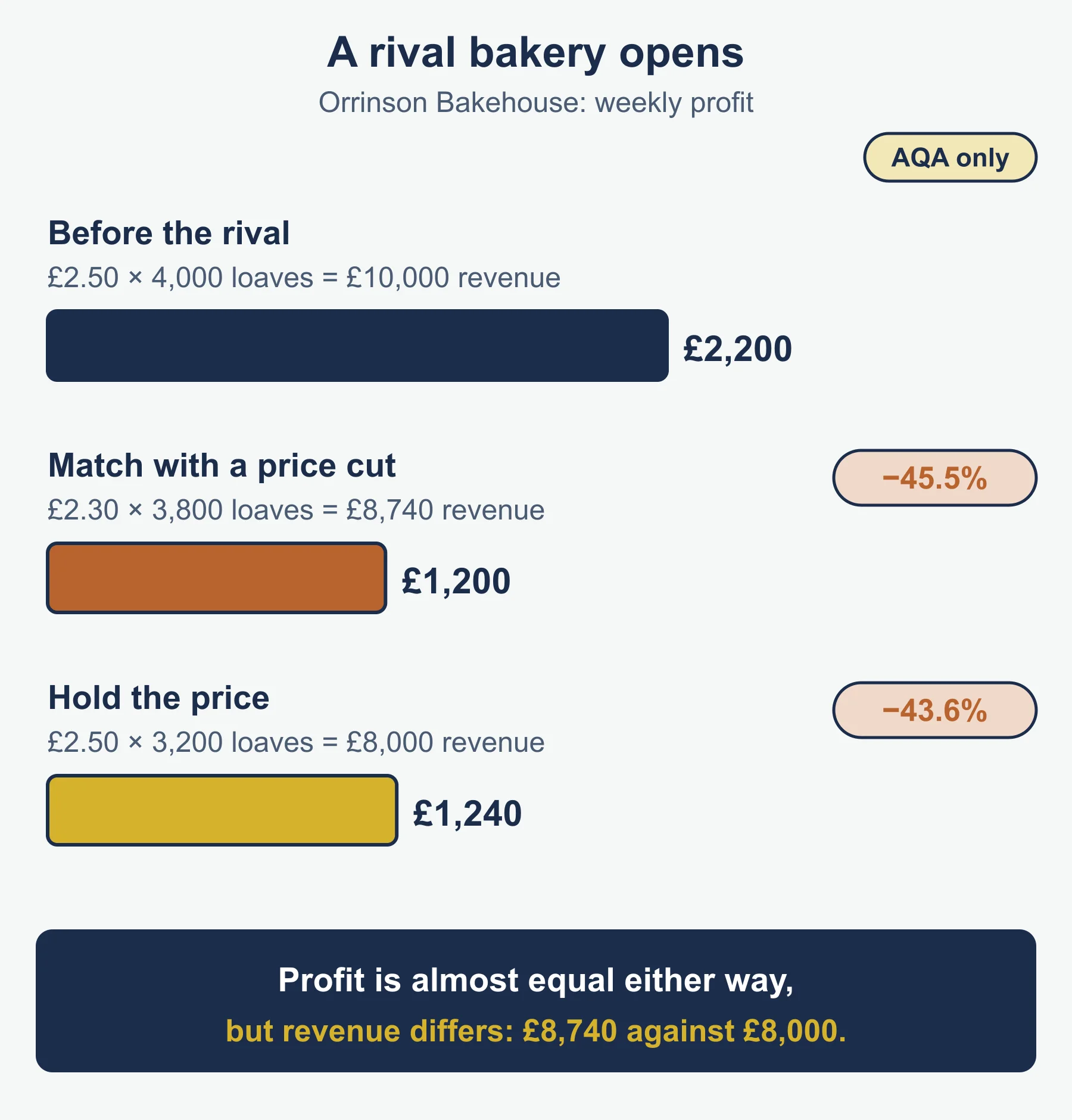
Orrinson Bakehouse sells 4,000 loaves a week at £2.50. Variable cost is £1.30 a loaf and fixed costs are £2,600 a week. A supermarket opens an in-store bakery. The owner has two choices.
| Option | Price | Weekly volume | Contribution per loaf | Weekly profit |
|---|---|---|---|---|
| Before the rival | £2.50 | 4,000 | £1.20 | 4,000 × £1.20 − £2,600 = £2,200 |
| Match with a price cut | £2.30 | 3,800 | £1.00 | 3,800 × £1.00 − £2,600 = £1,200 |
| Hold the price | £2.50 | 3,200 | £1.20 | 3,200 × £1.20 − £2,600 = £1,240 |
Profit falls by 45.5% if the bakery cuts its price and by 43.6% if it holds. The two responses end up almost identical in profit, but the revenue differs: £8,740 with the cut against £8,000 when holding. The better choice depends on things the numbers do not show, such as whether lost customers return.
Market conditions
Market conditions describe the state of the market a business sells in and buys in. Think of two sides.
- On the selling side: is the market growing, mature or shrinking? Is demand steady or seasonal? A growing market lifts demand for everyone. A shrinking one forces rivals to fight over a smaller total. Seasonal demand means idle capacity in quiet months.
- On the buying side: is the supply of the business’s inputs plentiful or short? A poor harvest, a shortage of components or a rise in a commodity price pushes input prices up. A glut pulls them down.
Worked example: an input price rises
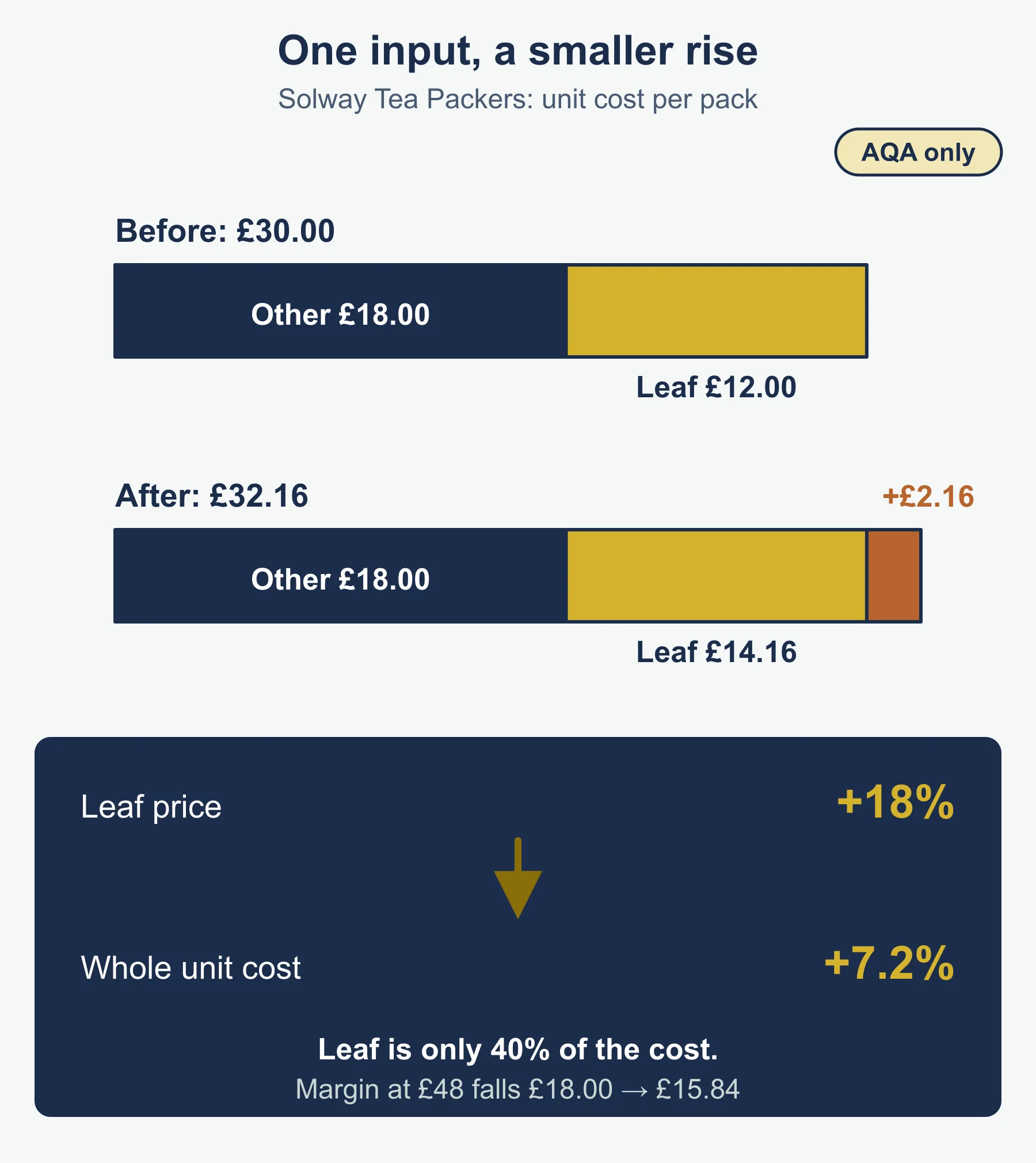
Solway Tea Packers has a unit cost of £30, of which 40% is the tea leaf itself and the rest is labour, packing and overheads. A poor harvest lifts leaf prices by 18%.
Leaf cost per unit before   = 40% × £30        = £12.00
Leaf cost per unit after    = £12.00 × 1.18     = £14.16
Other costs                 = £30 − £12         = £18.00
New unit cost               = £18.00 + £14.16   = £32.16
Rise in unit cost           = 2.16 ÷ 30         = 7.2%
An 18% rise in one input becomes a 7.2% rise in total unit cost, because the input is only part of the cost. At a selling price of £48 the margin per unit falls from £18.00 (37.5% of price) to £15.84 (33.0%). To restore a 37.5% margin the price would need to rise to £51.46. Whether Solway can do that depends on how rivals and customers react. A higher price may then lose sales, so the effect moves from costs to demand.
Incomes
Incomes are the money households have to spend. Changes in income alter demand, and they also alter costs.
- Demand. When incomes rise, spending on most products rises. For some products, called normal goods, demand rises with income, and often faster for luxuries such as holidays, premium brands and eating out. For inferior goods, such as budget own-label products, demand can fall as incomes rise because customers trade up. When incomes fall, premium lines suffer and budget lines can gain.
- Costs. Rising incomes across the economy usually mean employers face pressure to raise pay to recruit and keep staff. Stagnant incomes ease that pressure.
The ratio of the percentage change in demand to the percentage change in income is called income elasticity of demand. It belongs to the marketing section (3.3.2) of the specification. For now, you only need the idea: some products react strongly to income and others hardly at all.
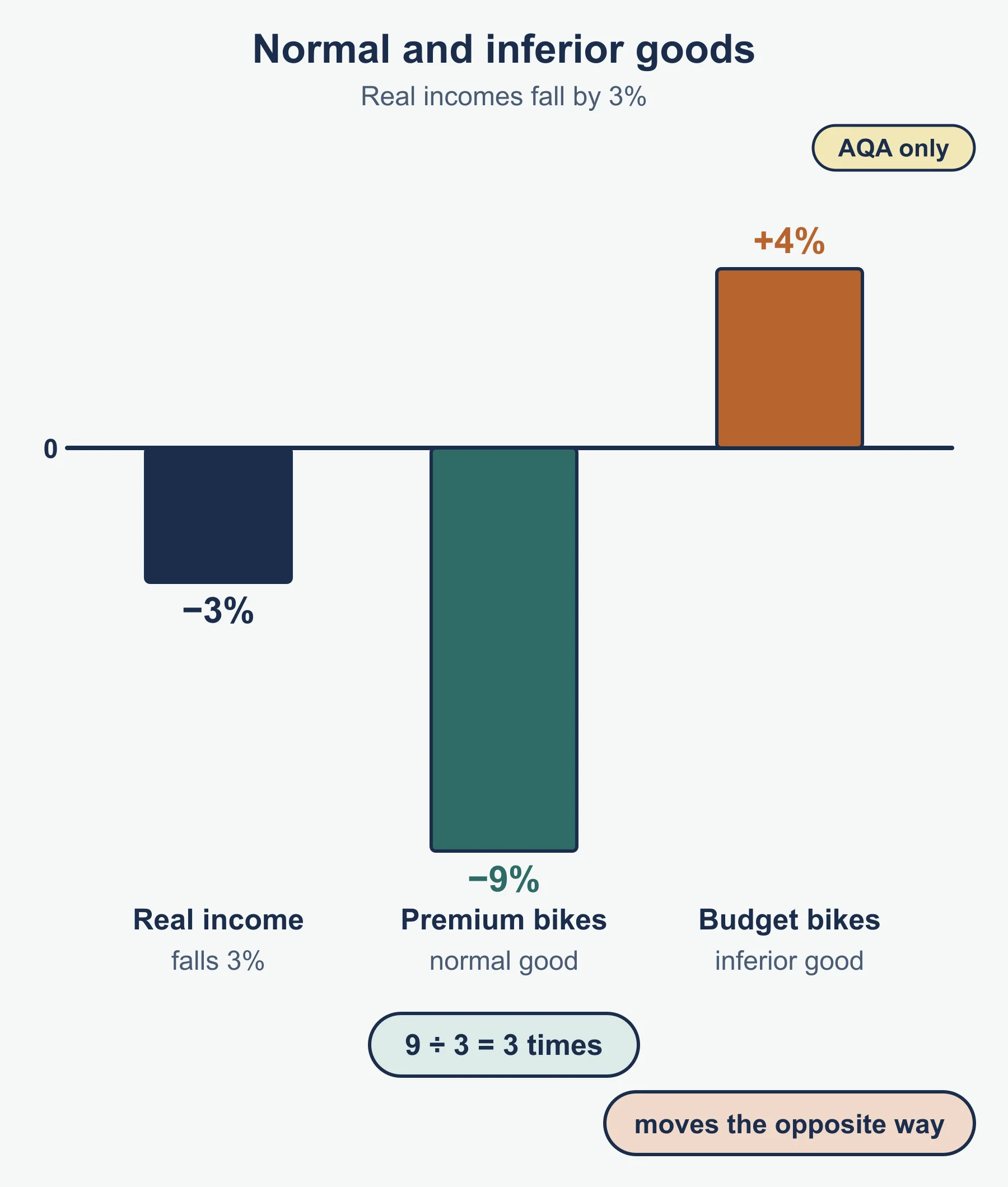
Take a business selling premium and budget bicycles. If real incomes fall by 3% and premium sales fall by 9%, premium demand moved three times as far as income (9 ÷ 3 = 3). If budget sales rise by 4%, the budget bicycle behaves like an inferior good. Showing both effects is stronger than saying “lower incomes reduce sales”.
Interest rates
An interest rate is the price of borrowing money (and the reward for saving). Changes reach businesses in two ways.
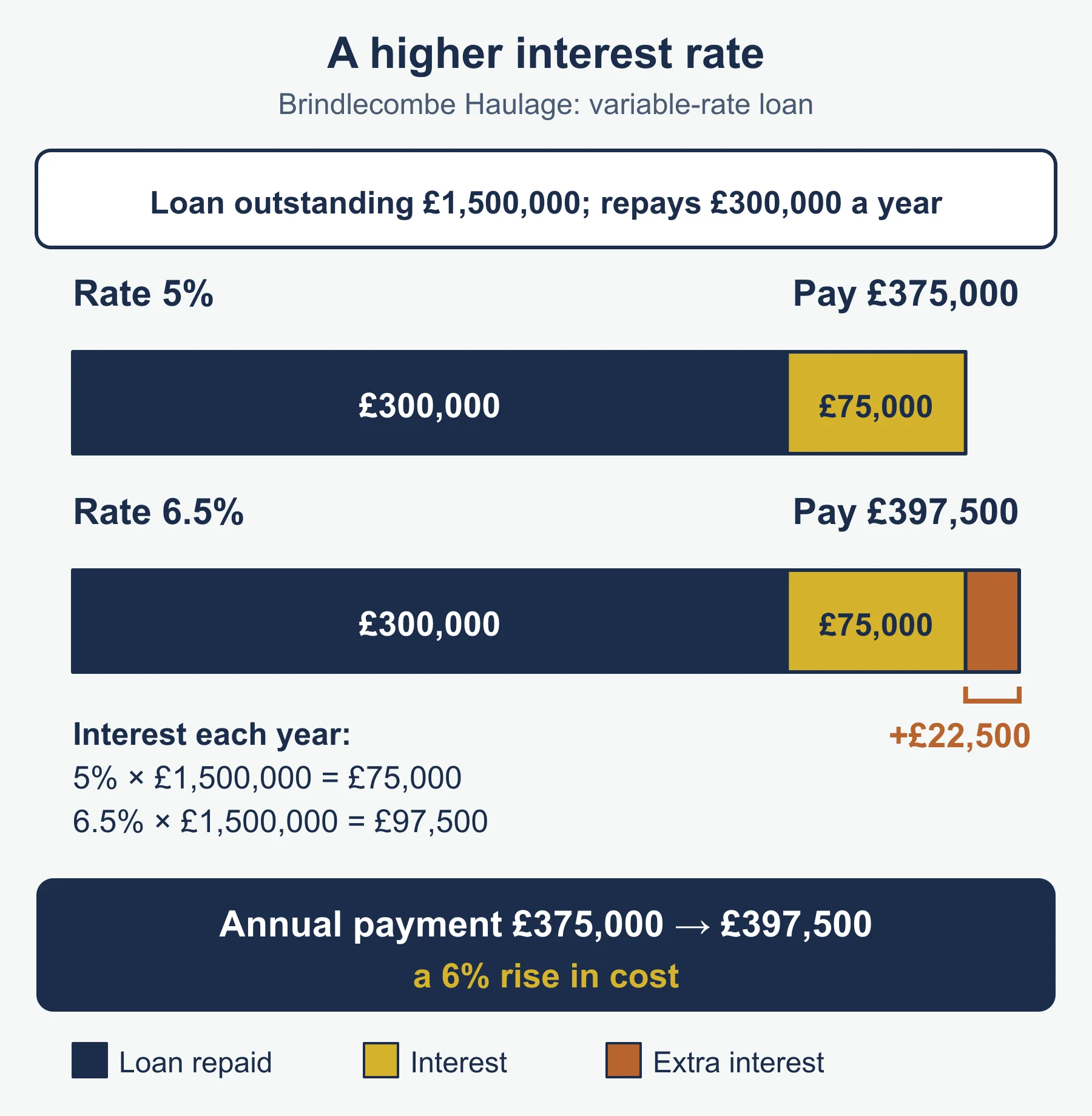
- Costs. A business with a variable-rate loan or overdraft pays more when rates rise. This reduces profit and cash flow. A business with a fixed-rate loan is protected until the fixed period ends.
- Demand. Higher rates make borrowing dearer for households, so spending on items bought with credit (cars, kitchens, houses and the products that go with them) tends to fall. Saving becomes more attractive, so households spend less. Lower rates do the opposite.
Worked example: a loan repriced
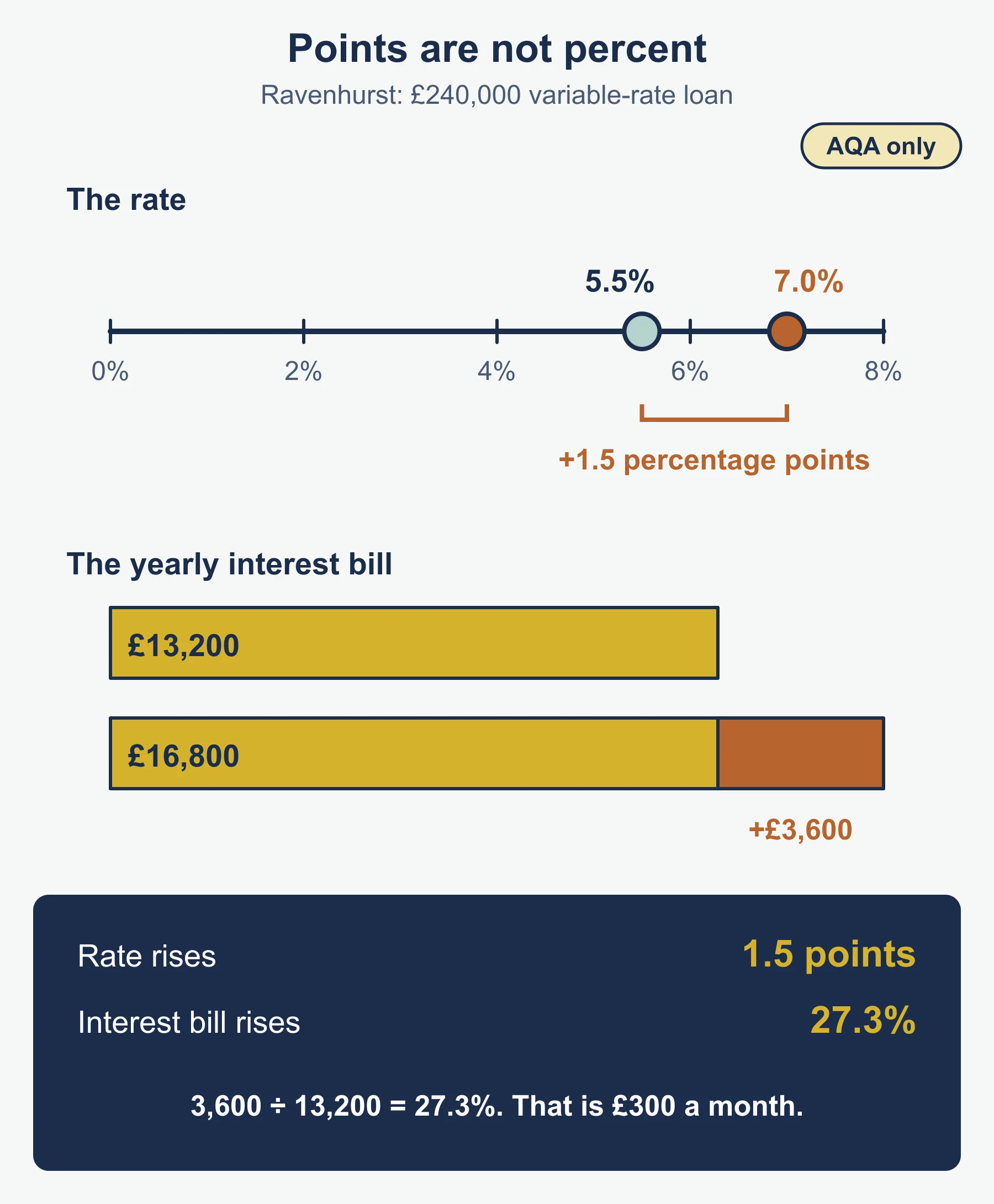
Ravenhurst Garden Rooms has a £240,000 variable-rate loan. The rate rises from 5.5% to 7.0%.
Interest before = £240,000 × 5.5% = £13,200 a year
Interest after  = £240,000 × 7.0% = £16,800 a year
Increase        = £3,600 a year (£300 a month)
Percentage rise = 3,600 ÷ 13,200 = 27.3%
A rise of 1.5 percentage points in the rate is a 27.3% rise in the interest bill. A percentage point change is not a percentage change. Ravenhurst’s customers may also finance a garden room with a loan, so it can be hit twice.
Demographic factors
Demographic factors are features of the population: its size, age structure, where people live, household size and how it is changing through births, deaths and migration.
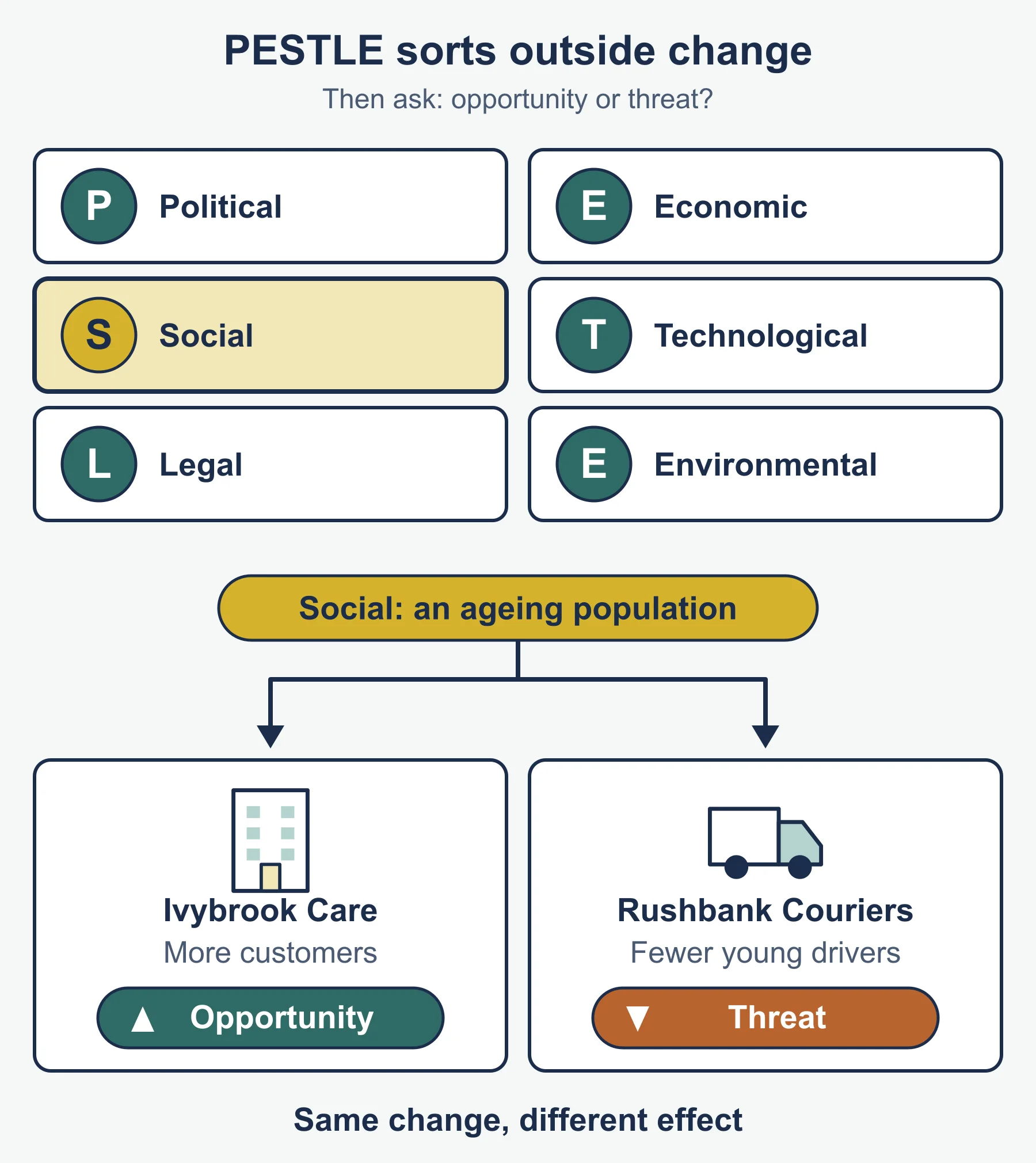
- Demand. An ageing population raises demand for healthcare, care homes, mobility products and leisure aimed at older people. It may reduce demand for products aimed at children. A growing young population raises demand for education and starter homes. Growth in a town expands local demand, while population loss shrinks it.
- Costs. The age and size of the workforce affect recruitment. If fewer young people enter work, employers may pay more. Migration can increase the supply of labour and ease wage pressure.
“The population is ageing” earns little. Say which products or workers it affects, as in “more over-80s means more potential care home residents but fewer nurses to hire”.
Environmental issues and fair trade
This factor combines two ideas that often appear together.
- Environmental issues include pollution, waste, carbon emissions, resource scarcity and pressure from customers, pressure groups and government to behave responsibly.
- Fair trade means buying from producers, usually in developing countries, on terms that give them a fair and stable price. A fair trade product normally costs the buyer more to source.
Effects on costs:
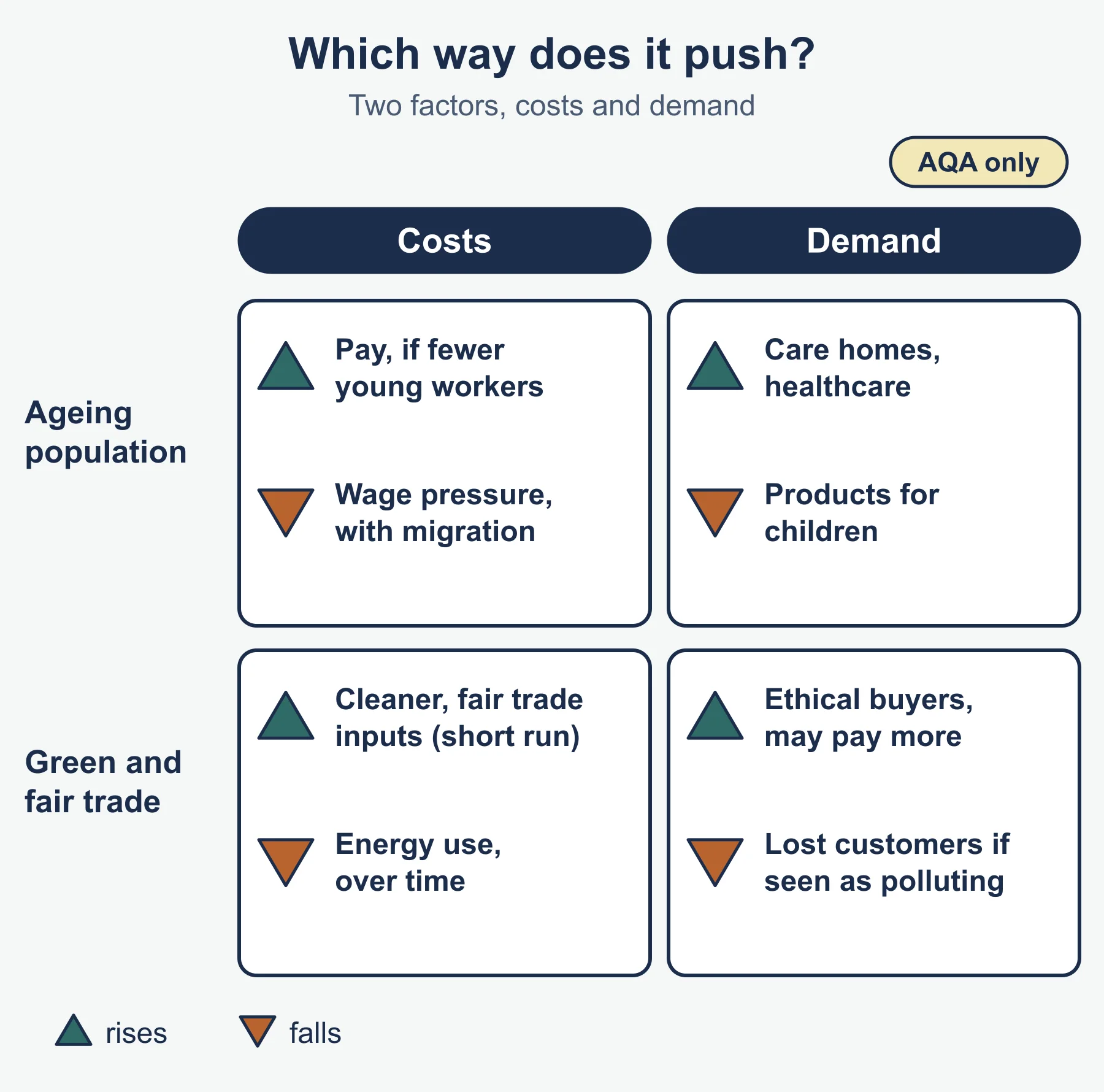
- Cleaner production, recycling, sustainable packaging and certified suppliers often raise costs, at least in the short run.
- Some changes cut costs over time, such as lower energy use.
Effects on demand:
- Customers who value ethical or green products may prefer a business that uses fair trade or sustainable inputs, and may pay a higher price. This can raise demand or allow a higher margin.
- A business that is seen as polluting or exploiting suppliers can lose customers and reputation.
Where laws are involved, keep to the general point: compliance can cost money.
Worked example: the net effect of several factors
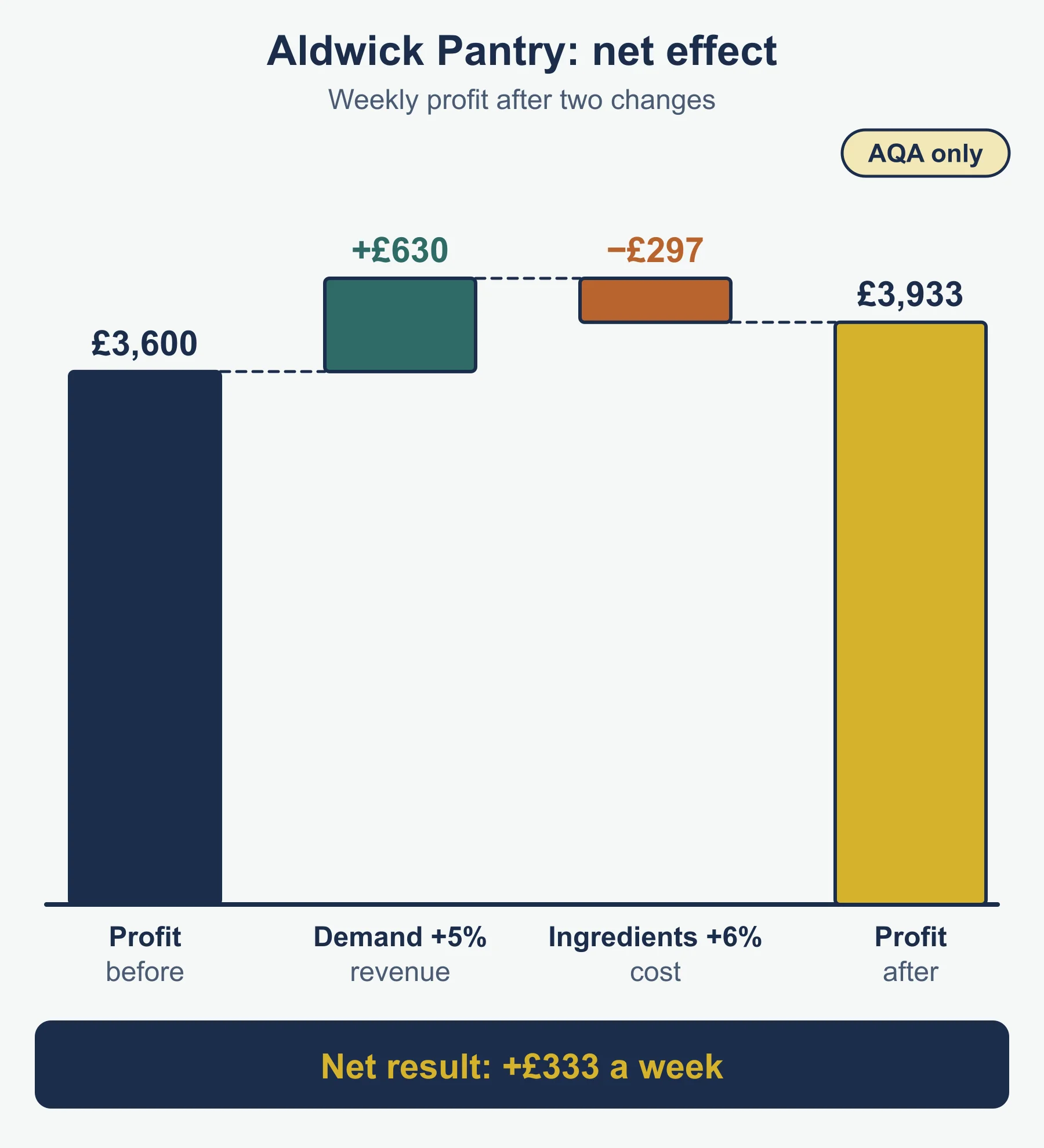
Aldwick Pantry sells 900 jars a week at £14.00, giving weekly revenue of £12,600. Weekly costs are £9,000, of which 55% (£4,950) is ingredients. Two changes arrive together: a local population increase lifts demand by 5%, and ingredient prices rise by 6%.
Revenue after demand rise = £12,600 × 1.05           = £13,230
Ingredient cost after     = £4,950 × 1.06            = £5,247
Total cost after          = £9,000 − £4,950 + £5,247 = £9,297
Profit before = £12,600 − £9,000 = £3,600
Profit after  = £13,230 − £9,297 = £3,933
This assumes costs rise only through the ingredient price, not through the extra jars sold. One factor helped demand, another raised costs, and the net result is a small gain. Add the effects together before calling a factor “good” or “bad”.
Putting the factors together
The factors interact. Rising incomes can bring higher demand and higher wage costs. Higher interest rates can reduce demand and raise finance costs at once.
To evaluate, judge the size of each effect (how large a share of costs or sales it touches), its timing (a fixed-rate loan delays the effect), the type of business (a business selling necessities is less exposed to income falls than one selling luxuries) and the response open to the business (cutting costs, changing price, finding new suppliers or markets). A judgement such as “competition is the bigger threat because it hits sales volume directly, while the interest rise adds a smaller, predictable cost” is stronger than a balanced list.
Common errors
- Listing factors without saying whether costs or demand change.
- Treating a percentage change in one input as the same percentage change in total unit cost.
- Confusing a percentage point change in an interest rate with a percentage change in the interest paid.
- Describing the factor in general terms and not applying it to the business in the case.
- Treating fair trade or green changes as only a cost.
Frequently asked questions
How do interest rates affect a business? Higher rates raise finance costs on variable-rate loans and overdrafts, reducing profit and cash flow. They also make borrowing dearer for households, so demand falls for products often bought on credit.
How can an ageing population affect a business? It can raise demand for healthcare, care homes, mobility products and leisure aimed at older people, and it can raise costs if fewer young people enter work and employers must pay more to recruit.
What is fair trade? Fair trade means buying from producers, usually in developing countries, on terms that give them a fair and stable price. It often raises costs but may raise demand from customers who value ethical products.
How do you evaluate several external factors together? Judge the size of each effect, its timing, such as a fixed-rate loan delaying a cost rise, and how the specific business is exposed, then say which factor matters most and why.
Which section of the AQA Business specification covers the external environment? Section 3.1.3, Understanding that businesses operate within an external environment, which has one content point: how the external environment can affect costs and demand.
Official syllabus
AQA, AS and A-level Business (7131 and 7132) specification, section 3.1.3, Understanding that businesses operate within an external environment, as listed under 3.1 What is business?
Get free revision emails (optional)
Occasional emails with practice questions, worked explanations and links to free resources for the qualification and subjects you choose. No spam, and you can unsubscribe from any email. The free tools on this site never need an email.
Related resources
-
Practice questions
AQA A-Level Business: Businesses and the external environment (7132) – Practice Questions
Original practice questions with worked answers on how the external environment affects costs and demand, for AQA A-level Business.
Business · AQA · A Level
Try questions -
Revision notes
AQA A-Level Business: Businesses and the external environment (7132) – Revision Notes
Condensed revision notes on how the external environment affects costs and demand, with short calculations and a self-test for AQA A-level Business.
Business · AQA · A Level
Revise topic -
Study guides
AQA A-Level Business: Understanding the nature and purpose of business and Understanding different business forms (7132)
Study guide to why businesses exist, mission and objectives, profit measurement, business forms, shares and ownership for AQA A-Level Business.
Business · AQA · A Level
Read guide
Related articles
-
teaching
A Level tuition in Dubai: Cambridge or Pearson Edexcel International A Level?
Schools in Dubai and Abu Dhabi teach either Cambridge International AS & A Level or Pearson Edexcel International A Level. How the two are structured, why it matters for tuition, and how online classes from Lahore work.
9 October 2026
-
curriculum guides
Choosing subjects at IGCSE and A Level
How subject choices at 14 and 16 affect university options later, and how to keep pathways open without overloading a timetable.
28 July 2026
Studying this with a teacher
Working through Business A LEVELS?
This page is free and stays free. If you would rather be taught it, Marlbridge runs Business classes one-to-one and in small groups of up to 15, online in your own time zone. The first trial class is free. WhatsApp replies within an hour (8am–11pm Pakistan time, every day); email the same day.
AQA Business teachers at Marlbridge
