
Revision Notes
AQA A-Level Business: Understanding the role and importance of stakeholders (7132) – Revision Notes
Condensed AQA A-level Business revision notes on 3.2.3 stakeholders: mapping, needs, conflict, influences, communication, consultation, self-test.
- Subject
- Business
- Level
- A LEVELS
- Topic
- Managers, leadership and decision making
- Author
- Marlbridge Academic Team
- Updated
- Reviewed by
- Salman Ahmad (what this means)
Aligned to AQA A Level Business (7132), For first teaching from September 2023. Official specification .
Syllabus page (what it covers and how it is assessed): AQA A Level Business.
Syllabus points this page covers
7132
- 3.2.3 Understanding the role and importance of stakeholders
Found an error? Report a correction.
Need help with this topic? Request a free trial class for A Level Business (7132).
These notes condense section 3.2.3 (Understanding the role and importance of stakeholders) of the AQA A-level Business specification (7132) for the final weeks of revision. For full explanations and the main worked example, use the study guide, then test yourself with the practice questions. Wider topic revision is in the Managers, leadership and decision making notes. Course hub: AQA A-level Business. Printable list: checklist. Not sure what to revise first? Take a free diagnostic.
The four points to recall
| Specification point | One-line summary |
|---|---|
| Need to consider stakeholder needs when making decisions | Support, ethics, reputation and information; weigh against cost and delay. Mapping uses power and interest. |
| Stakeholder needs, overlap and conflict | Groups want different things; some decisions serve several, some pit one against another. |
| Influences on the relationship | Power and dependence, size, leadership style, mission and ethics, history, competition, media, the decision. |
| Managing the relationship | Includes communication and consultation, matched to each group. |
Definitions
- Stakeholder: an individual or group with an interest in a business, or affected by what it does.
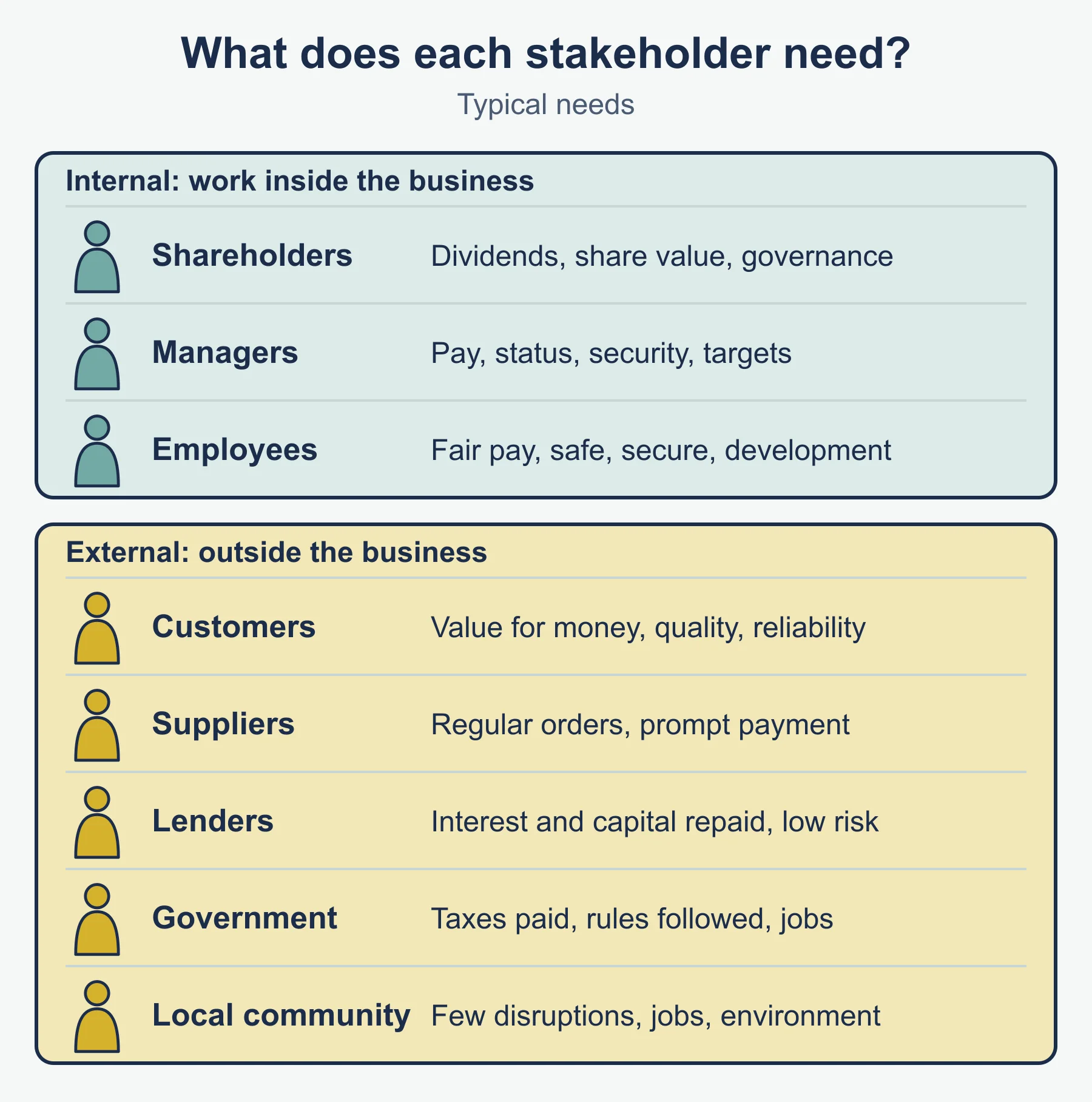
- Internal stakeholders: owners, managers, employees.
- External stakeholders: customers, suppliers, lenders, government, local community, pressure groups.
- Power: ability to influence the business or a decision.
- Interest: how much a group is affected by, or cares about, the outcome.
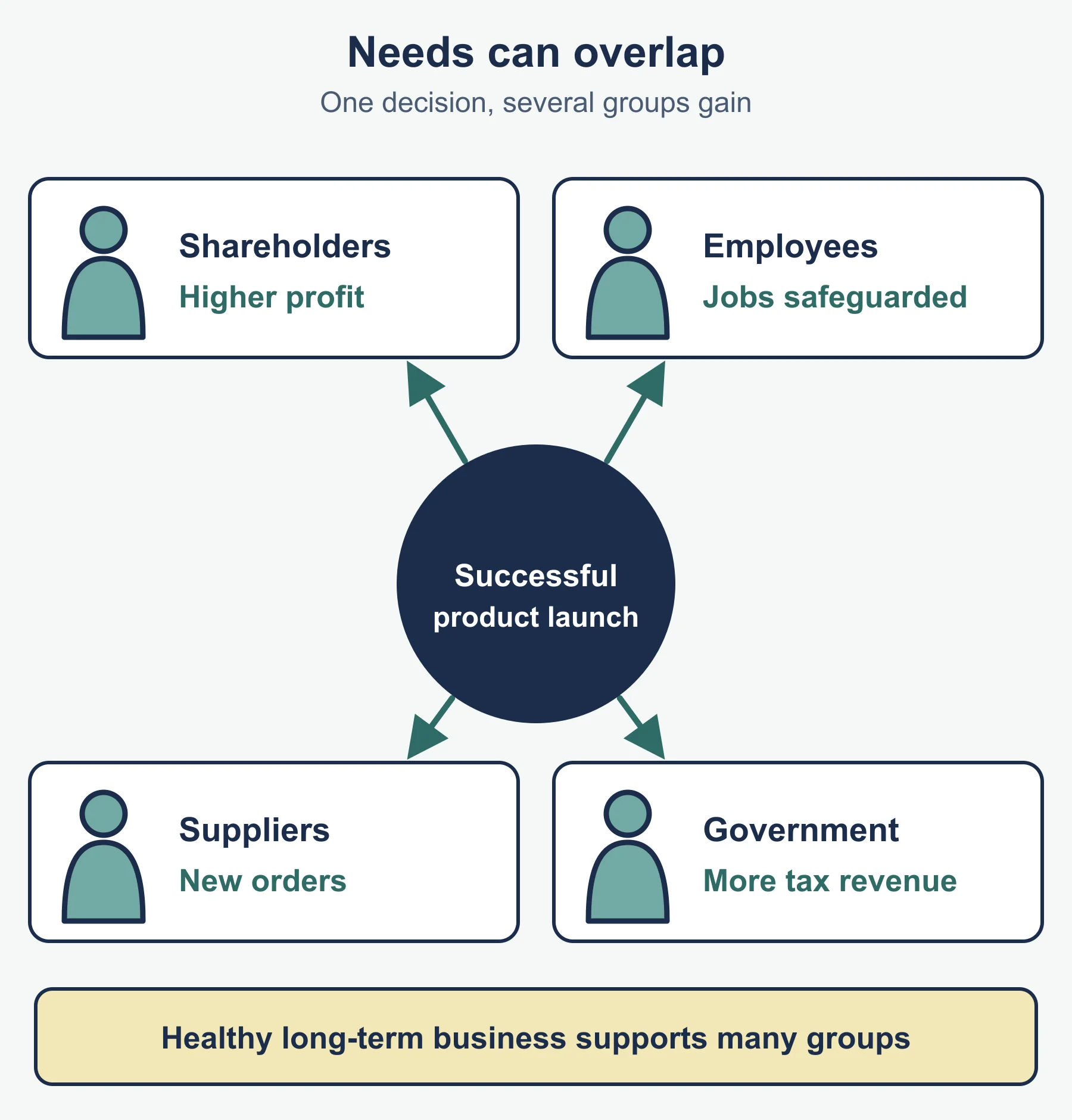
- Overlap of needs: one decision benefits several groups.
- Conflict of needs: helping one group reduces another group’s outcome.
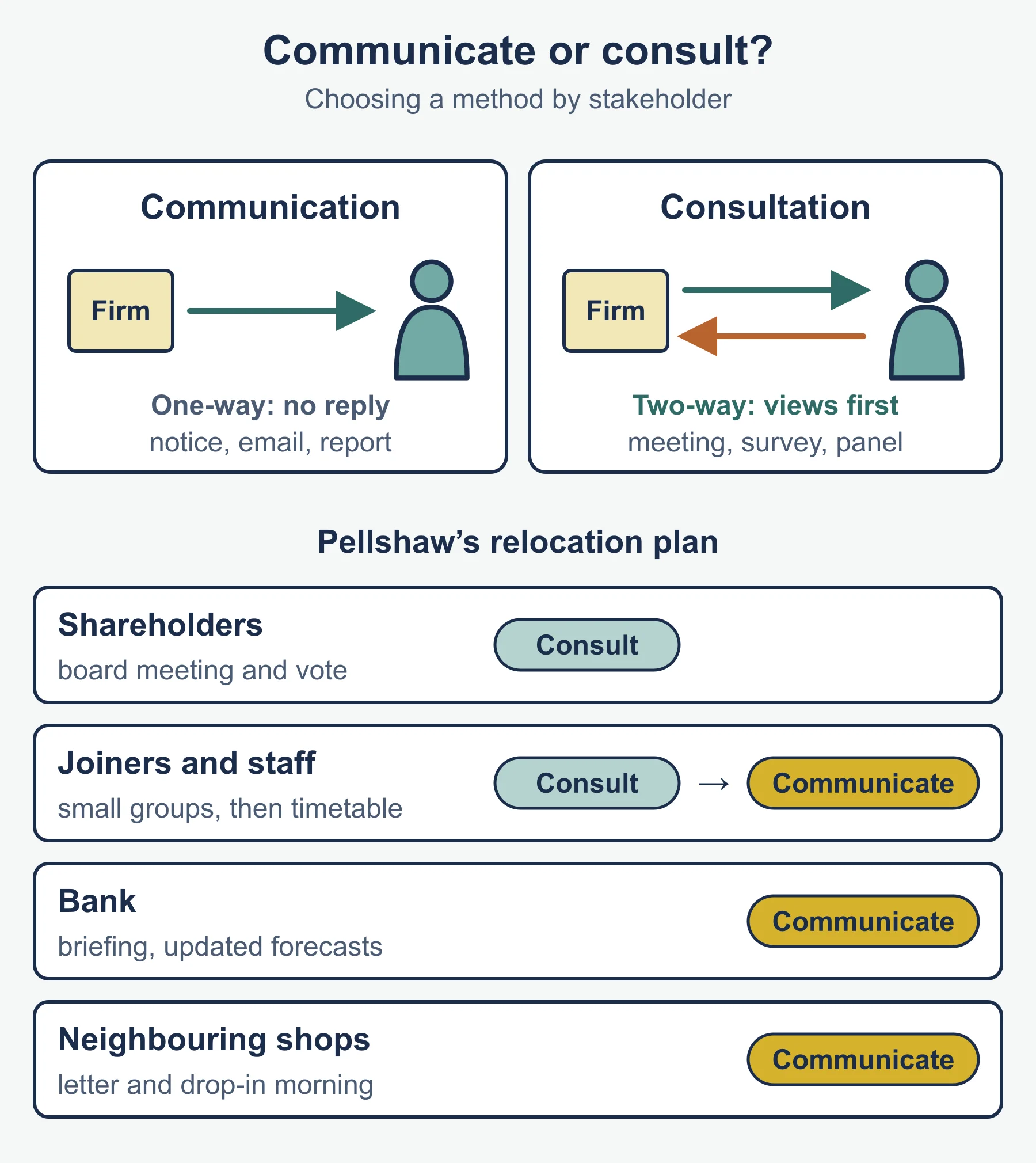
- Communication: passing on information, usually one-way.
- Consultation: seeking views before deciding, two-way.
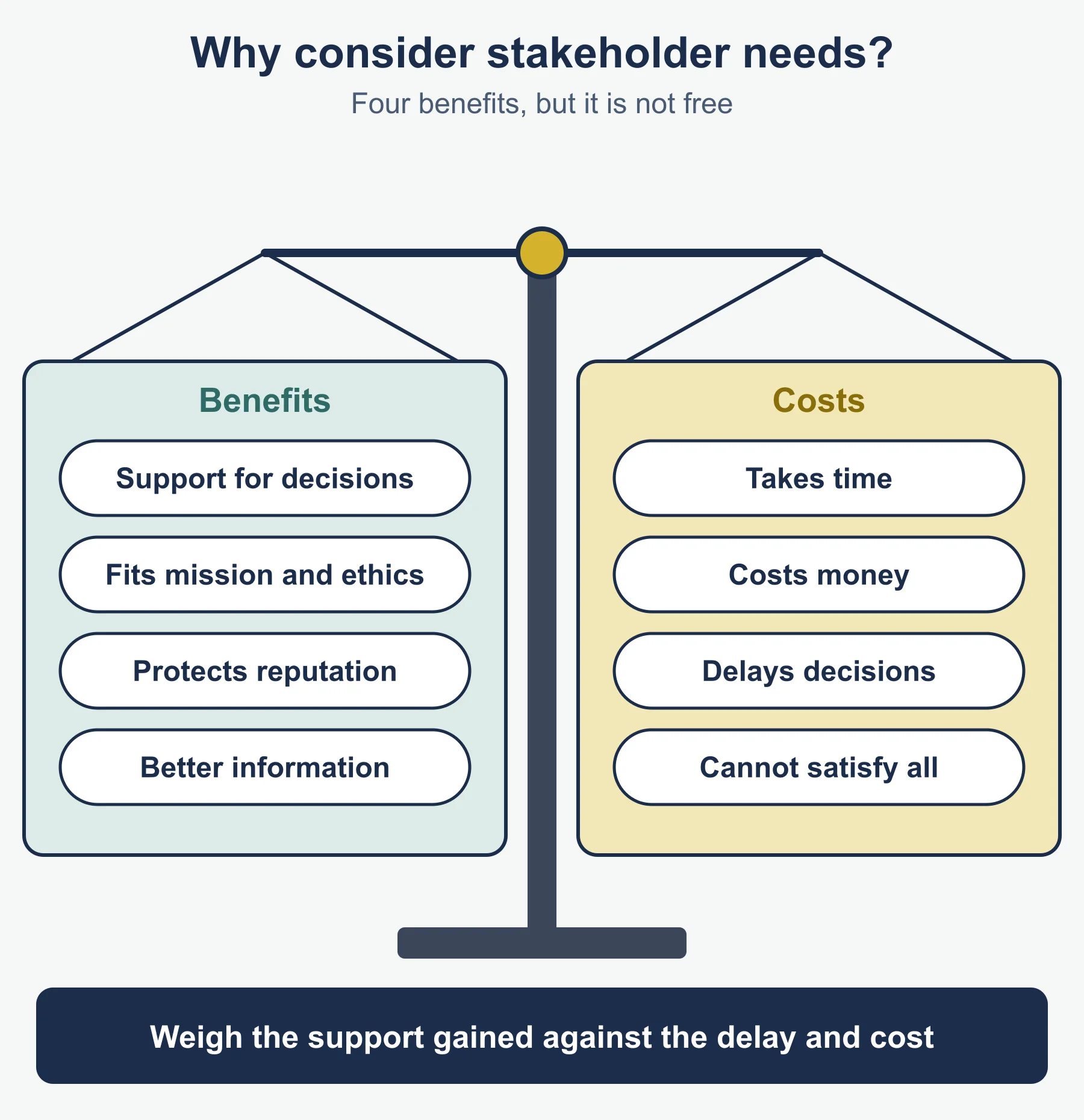
Why consider stakeholder needs
Remember SMRI: Support for the decision, Mission and ethics, Reputation and long-run performance, Information from those affected.
Counter-points: time, cost, delay, and no way to satisfy every conflicting need.
Mapping power and interest
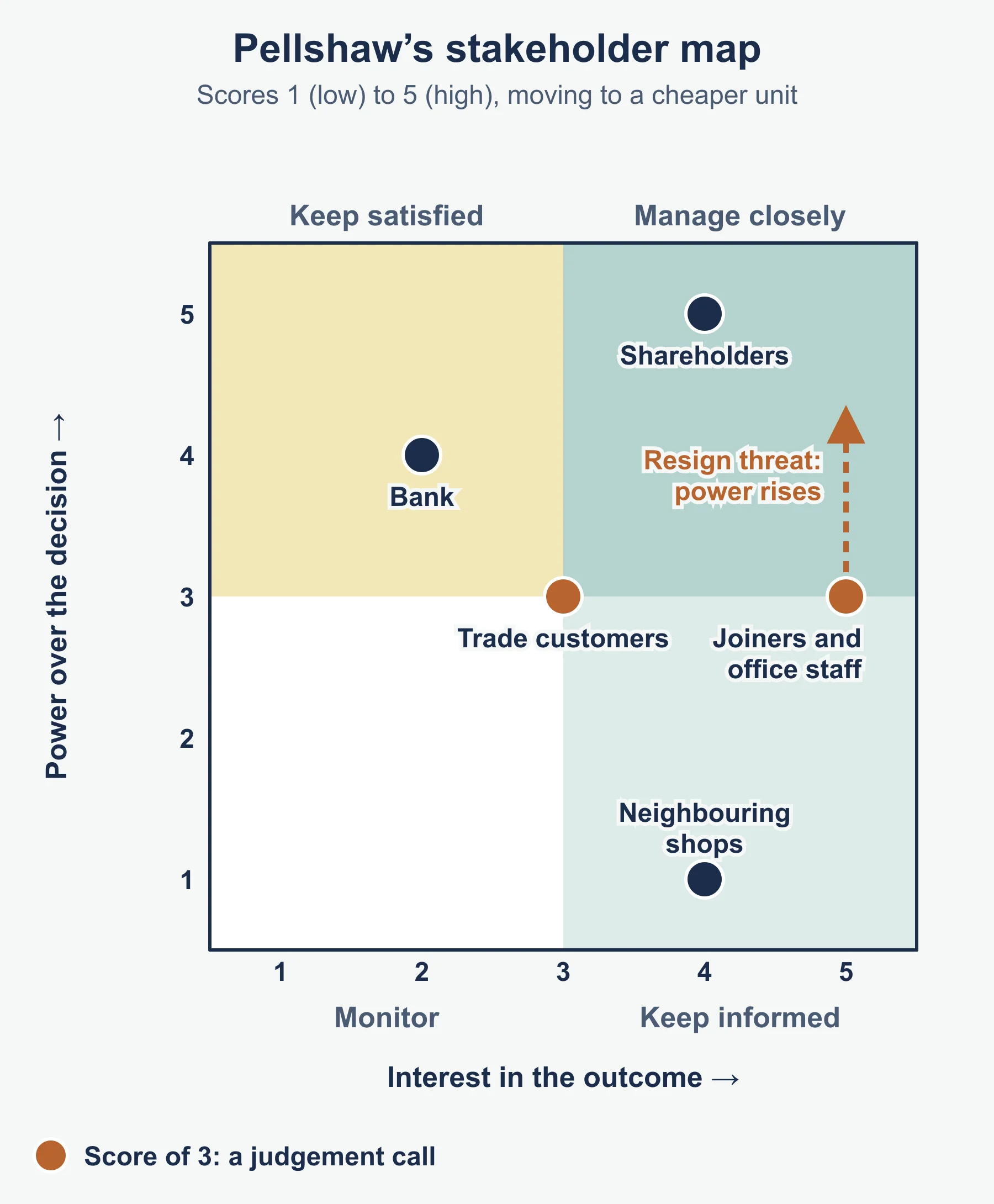
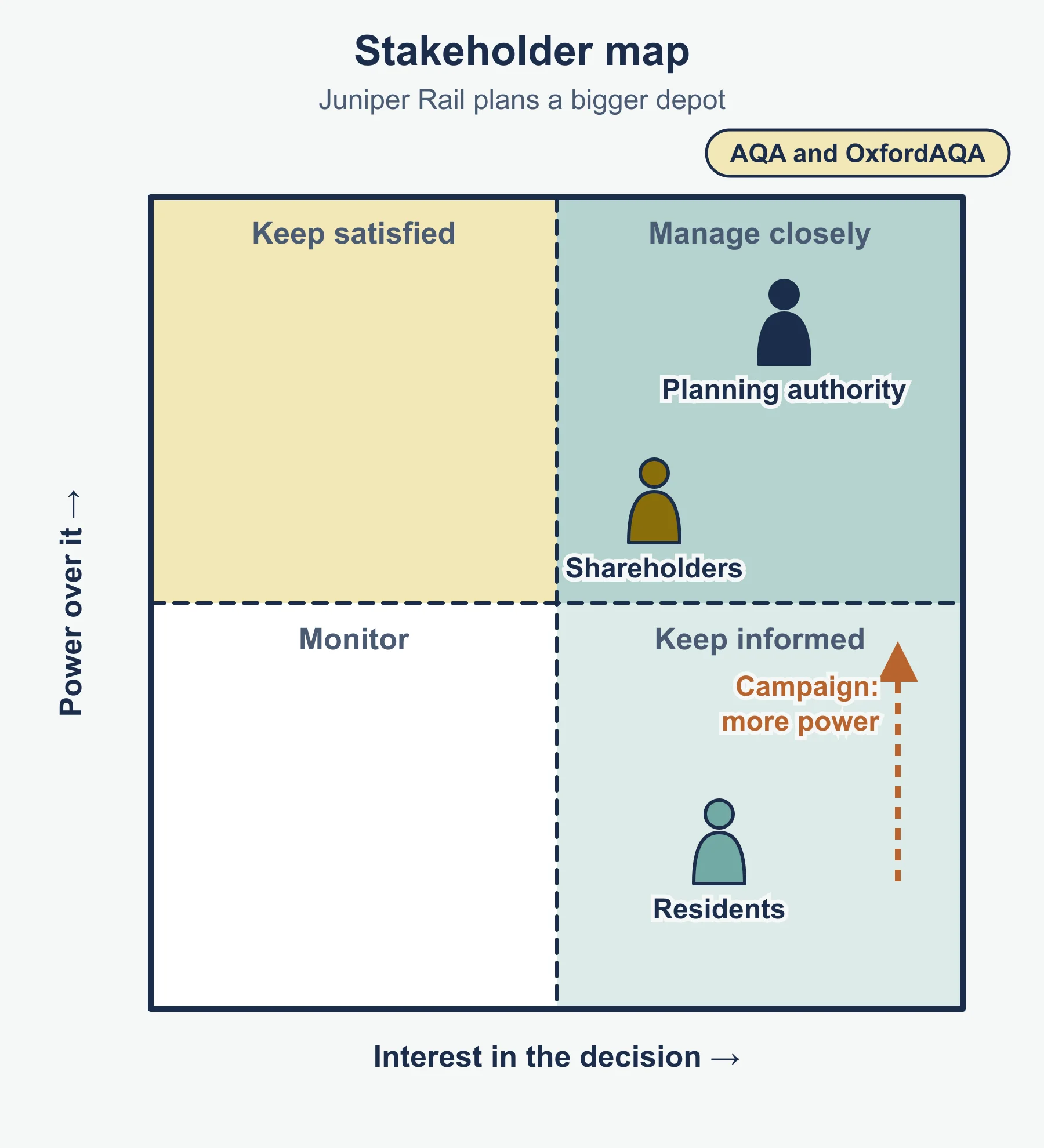
The grid below is the standard form. The specification names the two dimensions, not the box titles.
| Low interest | High interest | |
|---|---|---|
| High power | Keep satisfied | Manage closely |
| Low power | Monitor | Keep informed |
Method in steps
- List the stakeholders affected by this decision (not by the business in general).
- Score or judge power and interest for each, using evidence from the case.
- Place each in a box and say how you would treat it.
- Note any group likely to move, and what would make it move.
- Use the map to decide where to spend effort, then argue the decision itself.
Worked reminder
Harkstone Dairy plans to cut its prices by 2.5% for a year to keep a large supermarket customer. Revenue is £4.2m, and the cut on unchanged volume would lose 2.5% x £4.2m = £105,000 of revenue.
- The supermarket buyer: high power, high interest. Manage closely.
- Dairy farmers who supply milk: moderate power, high interest because the price cut limits what Harkstone can pay them. Consult.
- A local radio station: low power, low interest. Monitor, until a farmers’ protest raises its interest.
Needs: quick reference
| Group | Wants from decisions |
|---|---|
| Shareholders | Dividends, share value |
| Managers | Pay, targets, security |
| Employees | Pay, security, conditions, development |
| Customers | Value, quality, service |
| Suppliers | Orders, prompt payment |
| Lenders | Safe repayment |
| Government | Taxes, compliance |
| Community | Jobs, low disruption, environment |
Overlap or conflict?
| Decision | Likely overlap | Likely conflict |
|---|---|---|
| New product launch | Profit, jobs, supplier orders, tax | Funding competes with dividends |
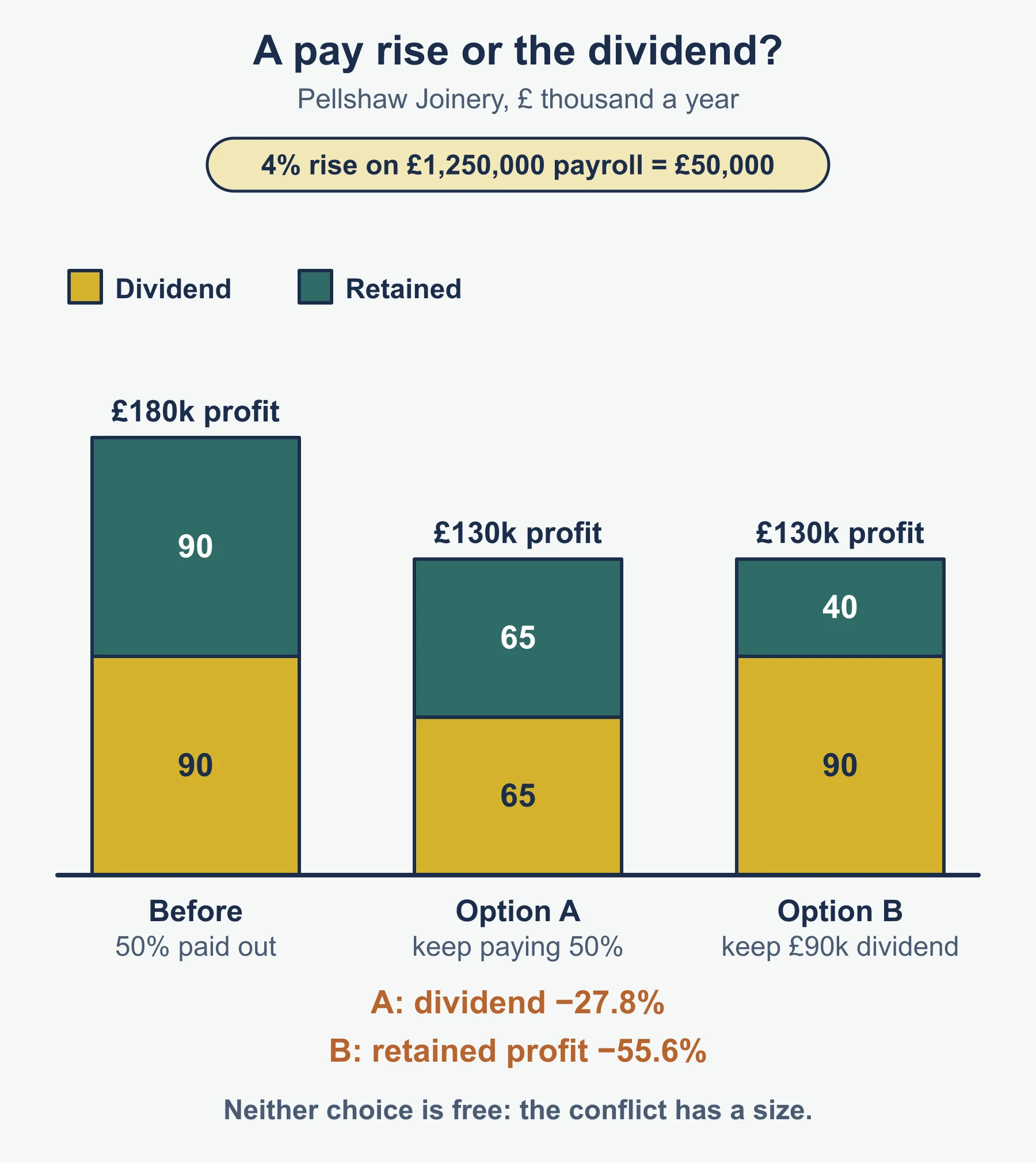
| Pay rise | Staff, customers (better service) | Owners, if margins fall |
| Price cut | Customers | Shareholders, suppliers |
| Depot extension | Employment, customers | Neighbours (noise, traffic) |
Resolving conflict
Compromise, delay, alternative option, or explained priority. Choice is shaped by mission, objectives, power, size of decision and long-run effect. Say which and why.
Influences on the relationship
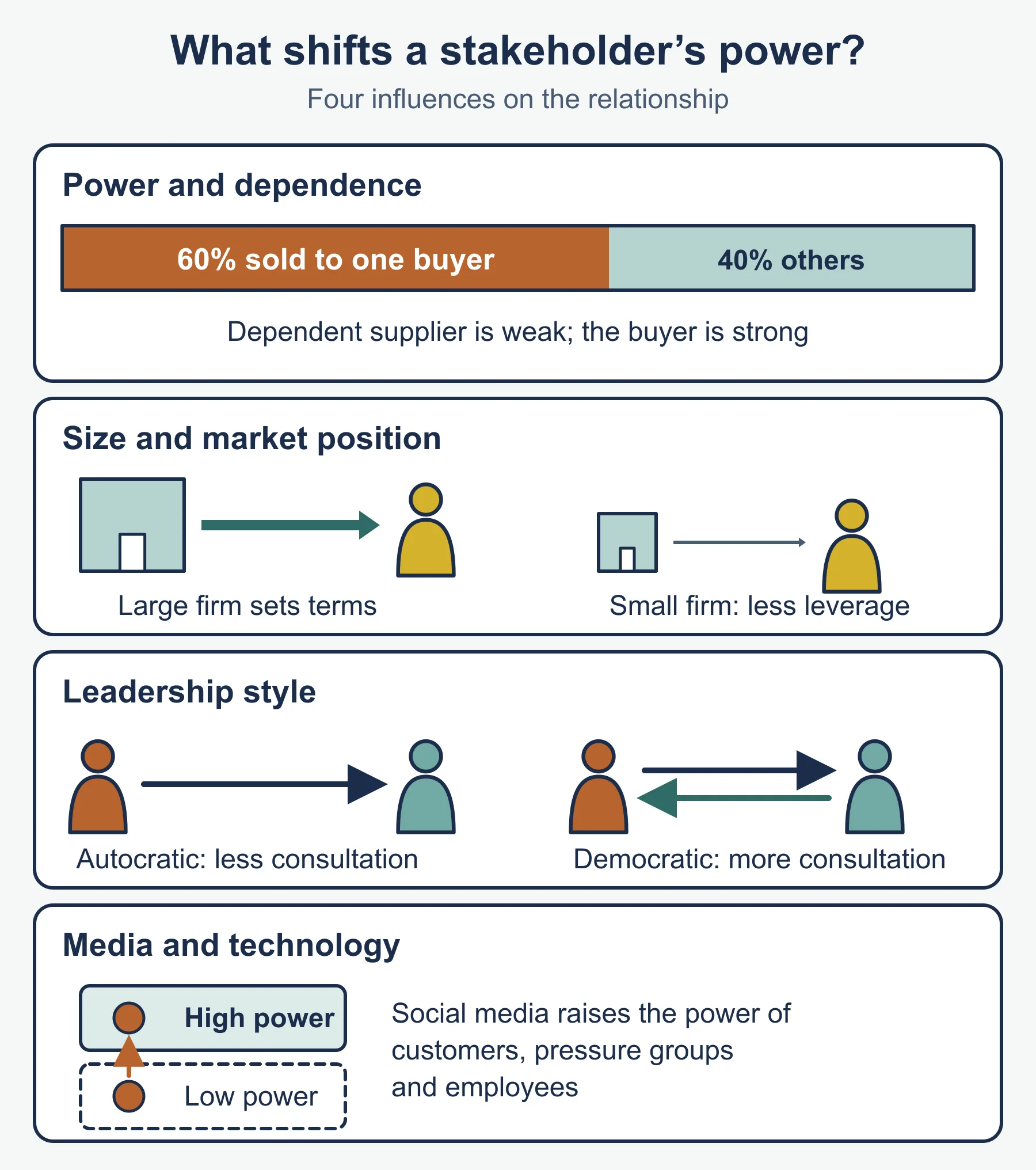
- Power and dependence (who needs whom more).
- Business size and market position.
- Leadership style and culture.
- Mission, objectives and ethics.
- History and trust.
- Competition and the external environment (labour market, economic conditions).
- Media and technology, especially social media.
- The scale of the decision.
The specification does not list these influences, so treat them as developed points and always tie them to the case.
Managing the relationship
| Communication | Consultation | |
|---|---|---|
| Direction | Mostly one-way | Two-way |
| Examples | Newsletter, email, notice, press release, social media post | Meeting, survey, staff representative, customer panel, community session |
| Advantages | Fast, cheap, consistent | Better decisions, less resistance, builds trust |
| Disadvantages | Little feedback, may seem dismissive | Slow, raises expectations, may expose opposition |
| Best for | Low-power, high-interest groups; keeping others informed | High-power, high-interest groups; major decisions |
Building an evaluative answer
Use this chain for any “analyse” or “evaluate” question on stakeholders.
- Point: name the stakeholder and what they want from this decision.
- Evidence: quote a figure or fact from the case.
- Effect: say what happens to the stakeholder and to the business.
- Counter: say why the effect may be smaller, slower or reversed.
- Judgement: decide which stakeholders matter most here, and why, given the mission, the time horizon and the power of each group.
Useful judgement anchors: how much power the group holds, whether it can easily leave, how big the decision is, whether the effect is short or long run, and whether the need can be partly met through compromise.
Worked reminder: a conflict with numbers
Harkstone Dairy earns £150,000 profit and pays 30% as a dividend (£45,000). Its farmers ask for 2p more per litre on 1,500,000 litres a year.
- Extra cost: 2p x 1,500,000 = £30,000.
- Profit falls to £120,000.
- Dividend at 30% becomes £36,000, a fall of £9,000, which is 20%.
Use the figures like this: the farmers gain £30,000, shareholders lose £9,000, and the remaining £21,000 of the cost comes out of retained profit. A quantified answer can then ask whether the farmers’ loyalty, which keeps the milk supply steady, is worth that cost.
Must-know distinctions
- Stakeholder v shareholder: shareholders are one stakeholder group.
- Power v interest: power is ability to influence; interest is how affected a group is. A group can have either without the other.
- Overlap v conflict: both can exist in one decision.
- Communication v consultation: informing is not asking.
- Short run v long run: a group’s loss now can turn into a gain later if the business is stronger.
Quick self-test
- Define “stakeholder”.
- Give two external stakeholders and one need each.
- Which two dimensions does stakeholder mapping use?
- Where would a group with high power and low interest sit on the grid, and how should it be treated?
- Give one example of overlapping stakeholder needs.
- Harkstone Dairy has a wage bill of £640,000. Calculate the cost of a 3% pay rise.
- State one reason why a low-power group’s position on the map might change.
- Explain one difference between communication and consultation.
- Give one influence on a business’s relationship with its suppliers.
- A company pays a dividend of 30% of its £150,000 profit. Calculate the dividend.
- Explain why consulting employees before a major change might delay a decision yet still be worthwhile.
- In the Harkstone example above, state who gains and who loses if the farmers’ request is met in full.
Answers
- An individual or group with an interest in a business or affected by its decisions.
- For example, customers want value for money; lenders want safe repayment of the loan.
- Power and interest.
- High power, low interest: keep satisfied.
- For example, a successful product launch raises profit for shareholders and secures jobs for employees.
- 3% x £640,000 = £19,200.
- For example, media coverage or social media campaigns can raise its effective power.
- Communication passes information, often one-way. Consultation asks for views before a decision, so it is two-way.
- For example, how dependent the supplier is on that business for its sales.
- 30% x £150,000 = £45,000.
- Consultation takes time to arrange and to hear views, and may reveal opposition. It can still be worthwhile if it improves the plan, reduces resistance or stops key staff leaving, so the delay is outweighed by a smoother, better-supported decision.
- The farmers gain £30,000 a year. Shareholders lose £9,000 of dividend, and the business loses a further £21,000 of retained profit, which reduces its ability to reinvest.
Where marks are usually lost
- Listing stakeholders without saying what they want from this decision.
- Writing that a group has “power” without saying what it could do with it.
- Treating the map as permanent, and not stating what could shift a group.
- Describing every group as “keep informed” without reference to the case.
- Stating that needs conflict without showing the size, cause or consequence.
- Naming communication or consultation without describing the method and its effect.
- Reaching a conclusion that simply restates the points made, with no weighing.
- Forgetting the cost of consultation, such as delay, when evaluating it.
Frequently asked questions
What are internal and external stakeholders? Internal stakeholders are owners, managers and employees. External stakeholders include customers, suppliers, lenders, government, the local community and pressure groups.
How should a high-power, low-interest group be treated on a stakeholder map? A group with high power but low interest should be kept satisfied.
What is the difference between power and interest in stakeholder mapping? Power is the ability to influence the business or a decision, while interest is how much a group is affected by, or cares about, the outcome. A group can have either without the other.
How can a business resolve conflicting stakeholder needs? It can compromise, delay, find an alternative option or explain its priority. The choice is shaped by mission, objectives, the groups’ power, the size of the decision and the long-run effects.
Official syllabus
AQA, AS and A-level Business (7131 and 7132) specification, subject content 3.2.3 Understanding the role and importance of stakeholders.
Get free revision emails (optional)
Occasional emails with practice questions, worked explanations and links to free resources for the qualification and subjects you choose. No spam, and you can unsubscribe from any email. The free tools on this site never need an email.
Related resources
-
Study guides
AQA A-Level Business: Managers, Leadership and Decision Making (7132)
Study guide to Topic 2 Managers, leadership and decision making for AQA A-level Business 7132: leadership styles, decision trees and stakeholder mapping.
Business · AQA · A Level
Read guide -
Practice questions
AQA A-Level Business: Managers, Leadership and Decision Making — Practice Questions (7132)
Practice paper in the AQA A-level Business 7132 Paper 1 layout, with worked answers on Topic 2: leadership styles, decision trees and stakeholder mapping.
Business · AQA · A Level
Try questions -
Revision notes
AQA A-Level Business: Managers, Leadership and Decision Making — Revision Notes (7132)
Condensed notes on management and leadership, leadership styles, scientific and intuitive decisions and stakeholder mapping for AQA A-level Business 7132.
Business · AQA · A Level
Revise topic
Related articles
-
teaching
A Level tuition in Dubai: Cambridge or Pearson Edexcel International A Level?
Schools in Dubai and Abu Dhabi teach either Cambridge International AS & A Level or Pearson Edexcel International A Level. How the two are structured, why it matters for tuition, and how online classes from Lahore work.
9 October 2026
-
curriculum guides
Choosing subjects at IGCSE and A Level
How subject choices at 14 and 16 affect university options later, and how to keep pathways open without overloading a timetable.
28 July 2026
Studying this with a teacher
Working through Business A LEVELS?
This page is free and stays free. If you would rather be taught it, Marlbridge runs Business classes one-to-one and in small groups of up to 15, online in your own time zone. The first trial class is free. WhatsApp replies within an hour (8am–11pm Pakistan time, every day); email the same day.
AQA Business teachers at Marlbridge
