
Study Guides
AQA A-Level Business: Understanding the role and importance of stakeholders (7132)
Study guide to AQA A-level Business section 3.2.3: stakeholder needs, power and interest mapping, conflict, influences and managing relationships.
- Subject
- Business
- Level
- A LEVELS
- Topic
- Managers, leadership and decision making
- Author
- Marlbridge Academic Team
- Updated
- Reviewed by
- Salman Ahmad (what this means)
Aligned to AQA A Level Business (7132), For first teaching from September 2023. Official specification .
Syllabus page (what it covers and how it is assessed): AQA A Level Business.
Syllabus points this page covers
7132
- 3.2.3 Understanding the role and importance of stakeholders
Found an error? Report a correction.
Need help with this topic? Request a free trial class for A Level Business (7132).
This guide teaches section 3.2.3 (Understanding the role and importance of stakeholders) of the AQA A-level Business specification (7132), which sits inside subject content 3.2, Managers, leadership and decision making. The specification lists four content points and one piece of additional information for each of two of them: stakeholder mapping using power and interest, and communication and consultation. All four points are covered below, with invented businesses in every example. Content from every section can be assessed in each of the three A-level papers, so expect stakeholders to appear alongside marketing, finance, operations and strategy questions.
Before you start, you may want the wider topic pages: Managers, leadership and decision making study guide, its revision notes and its practice questions. This guide goes deeper on stakeholders only. Companion pages: revision notes and practice questions. Course hub: AQA A-level Business. Printable list: checklist. To find weak spots first, try the free diagnostics.
What the section asks you to know
| Specification content (3.2.3) | Additional information | Where in this guide |
|---|---|---|
| The need to consider stakeholder needs when making decisions | Stakeholder mapping: stakeholder power and interest | Sections 1 and 2 |
| Stakeholder needs and the possible overlap and conflict of these needs | None listed | Section 3 |
| Influences on the relationship with stakeholders | None listed | Section 4 |
| How to manage the relationship with different stakeholders | Includes communication and consultation | Section 5 |
1. Why stakeholder needs matter in decisions
A stakeholder is any person or group that has a stake in what a business does, or is affected by its decisions. Internal stakeholders (owners, managers, employees) work inside the business. External stakeholders (customers, suppliers, lenders, government, the local community, pressure groups) do not. The same person can sit in two groups: an employee who owns shares and lives next to the site is three stakeholders at once.
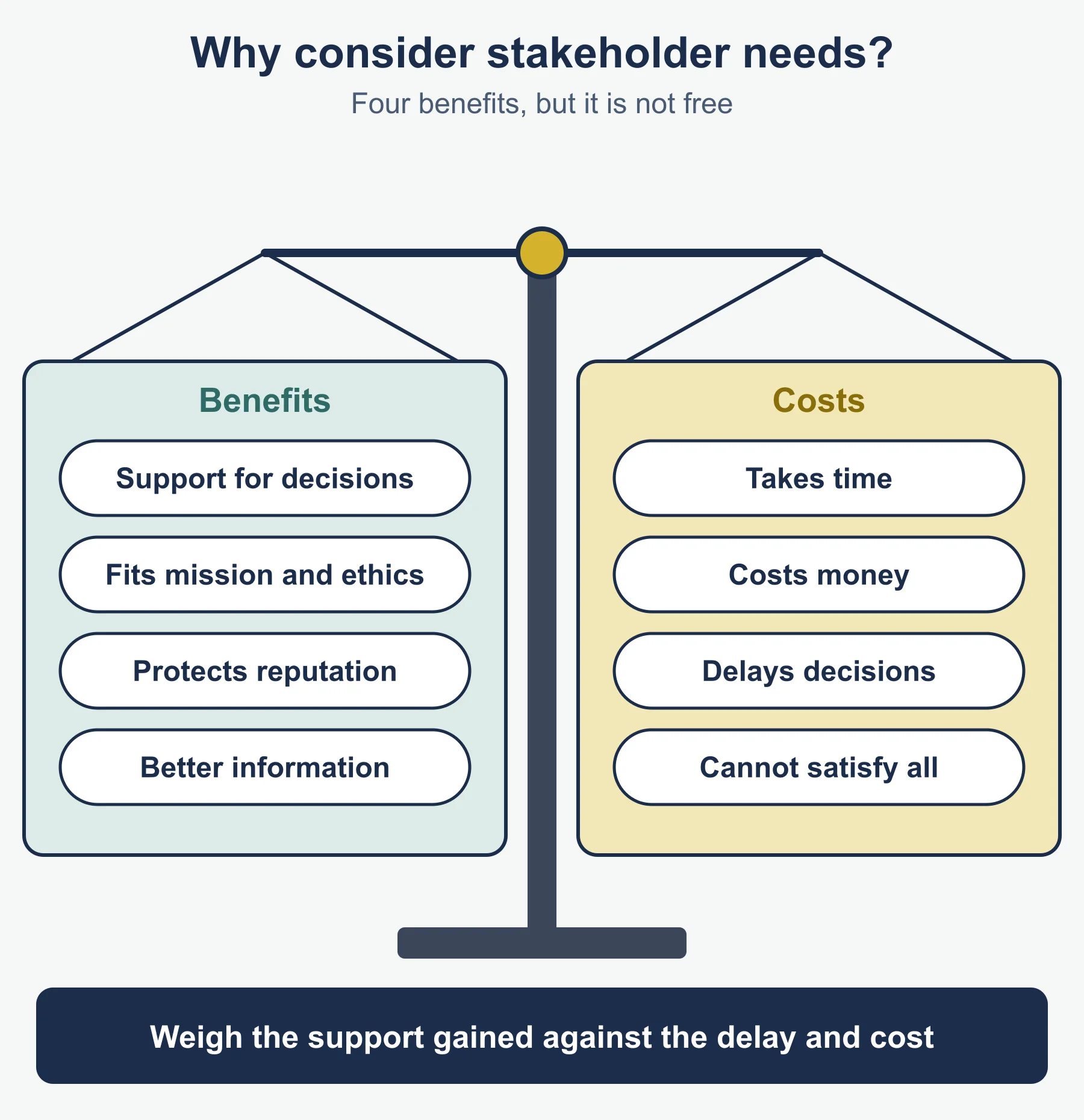
The specification says the need to consider stakeholder needs applies “when making decisions”. That makes this a decision-making topic, not a list of who is who. There are four main reasons to consider them.
- Decisions need support to work. A move, redundancy or price rise can be blocked, slowed or undermined by people with power. Staff can leave or work to rule. Lenders can refuse more credit. Customers can switch.
- Mission and ethics. If a business says it values fairness or sustainability, ignoring affected groups contradicts its own stated aims.
- Reputation and long-run performance. Bad treatment of a group can spread by word of mouth and social media, damaging the brand and the ability to recruit or borrow.
- Better information. Stakeholders often know things managers do not, such as a supplier knowing a material is about to rise in price.
There is a counter-argument you must be ready to use. Considering every need costs time and money, can delay decisions, and cannot satisfy groups whose needs conflict. A good answer weighs the benefit of support against the cost of delay and compromise.
2. Stakeholder mapping: power and interest
The specification names two dimensions. Power is the ability to influence the business or the decision. Interest is how much the stakeholder is affected by, or cares about, the outcome. The standard way to show them is a two-by-two grid with power on one axis and interest on the other. The four-box treatment below is the standard form; the specification does not prescribe box names.
| Low interest | High interest | |
|---|---|---|
| High power | Keep satisfied: do not ignore, but do not overload with detail | Manage closely: involve early, consult, and expect to adjust the plan |
| Low power | Monitor: minimal effort, watch for change | Keep informed: communicate clearly, listen for concerns |
Worked example: mapping a relocation
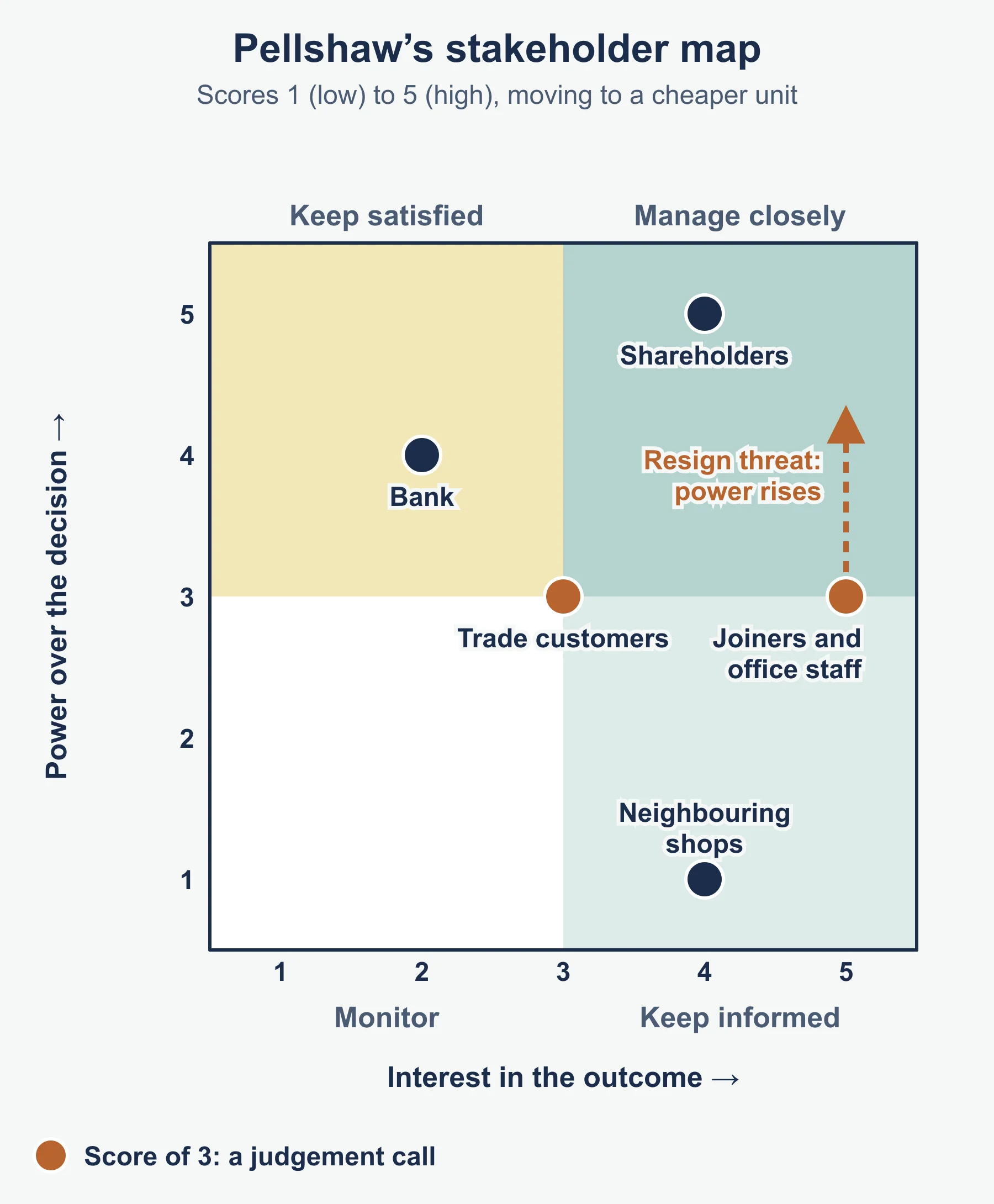
Pellshaw Joinery Ltd makes kitchen units in a rented town-centre workshop. Its board proposes moving to a cheaper unit nine miles away. Each stakeholder is scored from 1 (low) to 5 (high). The 1 to 5 scoring is this guide’s own device for showing judgement, not something the specification sets. Treat 4 and 5 as high, 1 and 2 as low, and use judgement for 3.
| Stakeholder | Power | Interest | Position |
|---|---|---|---|
| Shareholders | 5 | 4 | Manage closely |
| Joiners and office staff | 3 | 5 | High interest, power rising if they leave |
| Bank | 4 | 2 | Keep satisfied |
| Neighbouring shop owners | 1 | 4 | Keep informed |
| Occasional trade customers | 3 | 3 | Borderline; monitor, then reassess |
Three points make the map useful rather than decorative.
- Scores are judgements. Justify them from the case. The joiners’ power of 3 reflects that Pellshaw cannot easily replace skilled staff, but they have no formal vote.
- Positions change. If several joiners threaten to resign, their power moves up and they join the manage-closely box. If a local newspaper runs a story, neighbours with low power may gain influence through publicity.
- The map suggests a method, not an answer. It tells you how much effort to spend on each group. It does not tell you whether to go ahead with the move.
3. Stakeholder needs, overlap and conflict
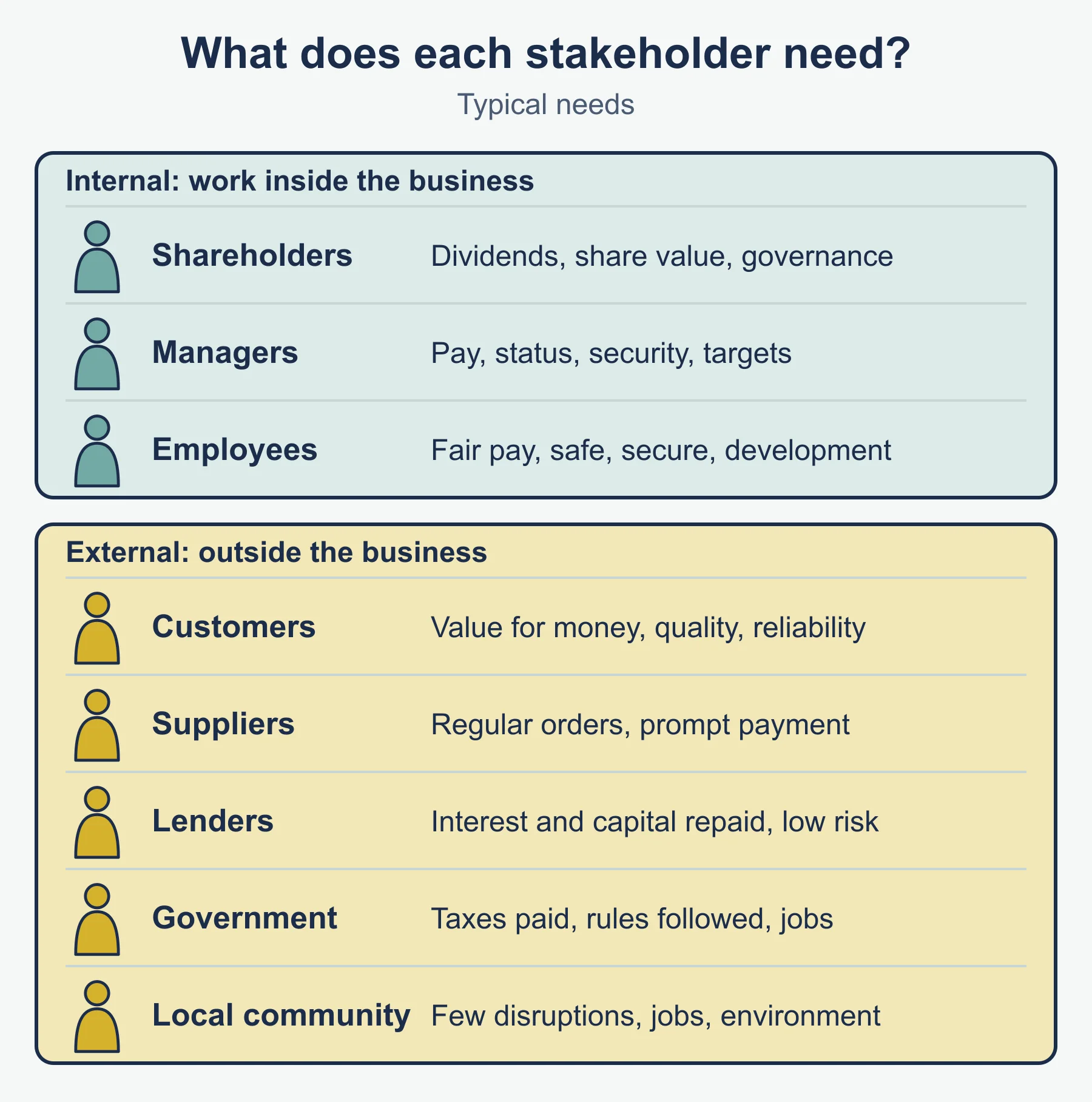
Different groups want different things from the same decision. Typical needs are below.
| Stakeholder | Typical needs |
|---|---|
| Shareholders | Dividends, rising share value, good governance |
| Managers | Pay, status, job security, meeting targets |
| Employees | Fair pay, secure work, safe conditions, development |
| Customers | Value for money, quality, reliable service |
| Suppliers | Regular orders, prompt payment, fair prices |
| Lenders | Repayment of interest and capital, low risk |
| Government | Taxes paid, rules followed, jobs |
| Local community | Few disruptions, employment, environmental care |
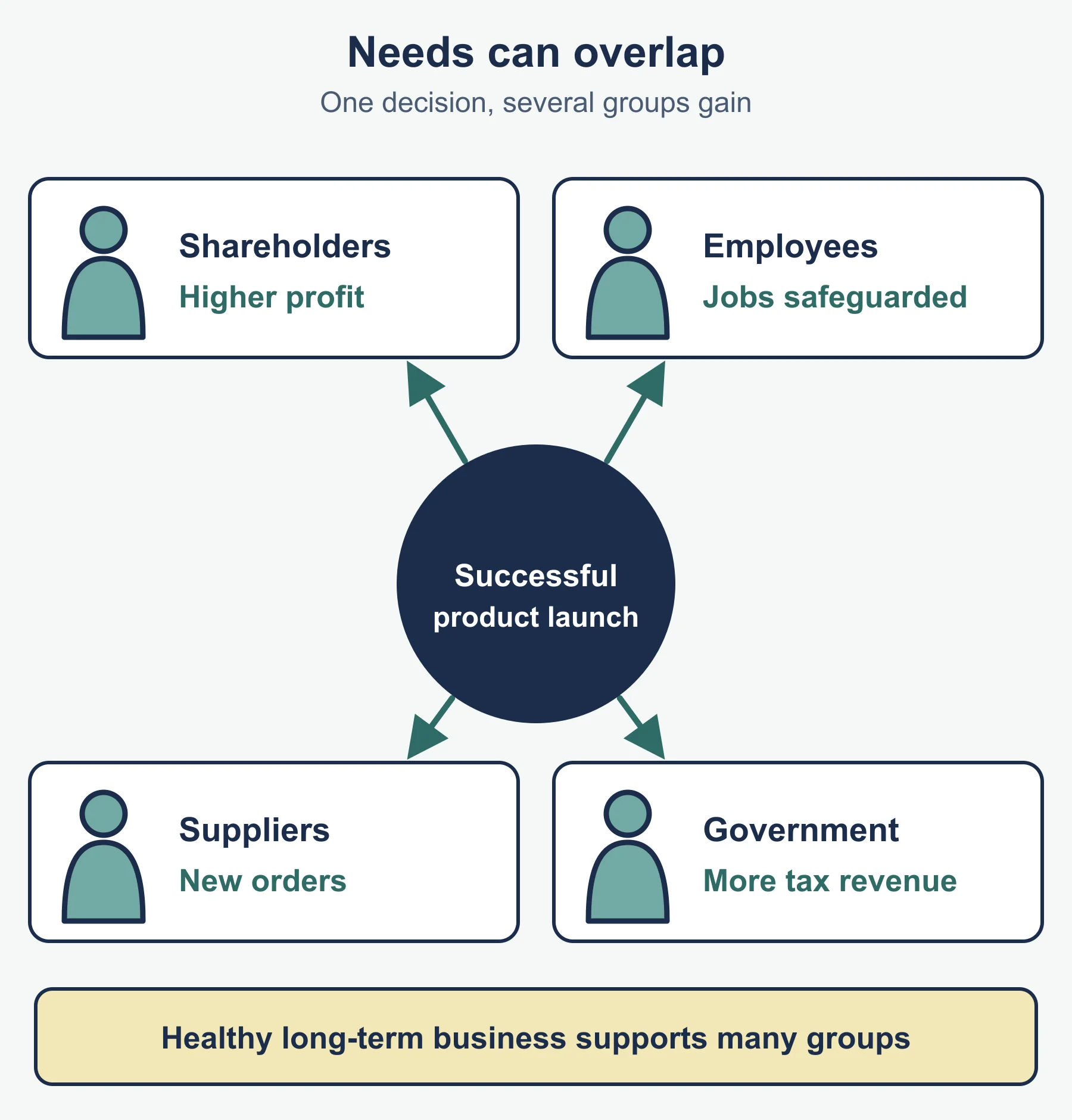
Overlap happens when one decision serves several groups. A successful product launch can raise profit (shareholders), safeguard jobs (employees), create orders (suppliers) and add tax revenue (government). Overlap is most common over the long term, where a healthy business supports many groups. Look for it when a question asks whether stakeholders must always lose out.
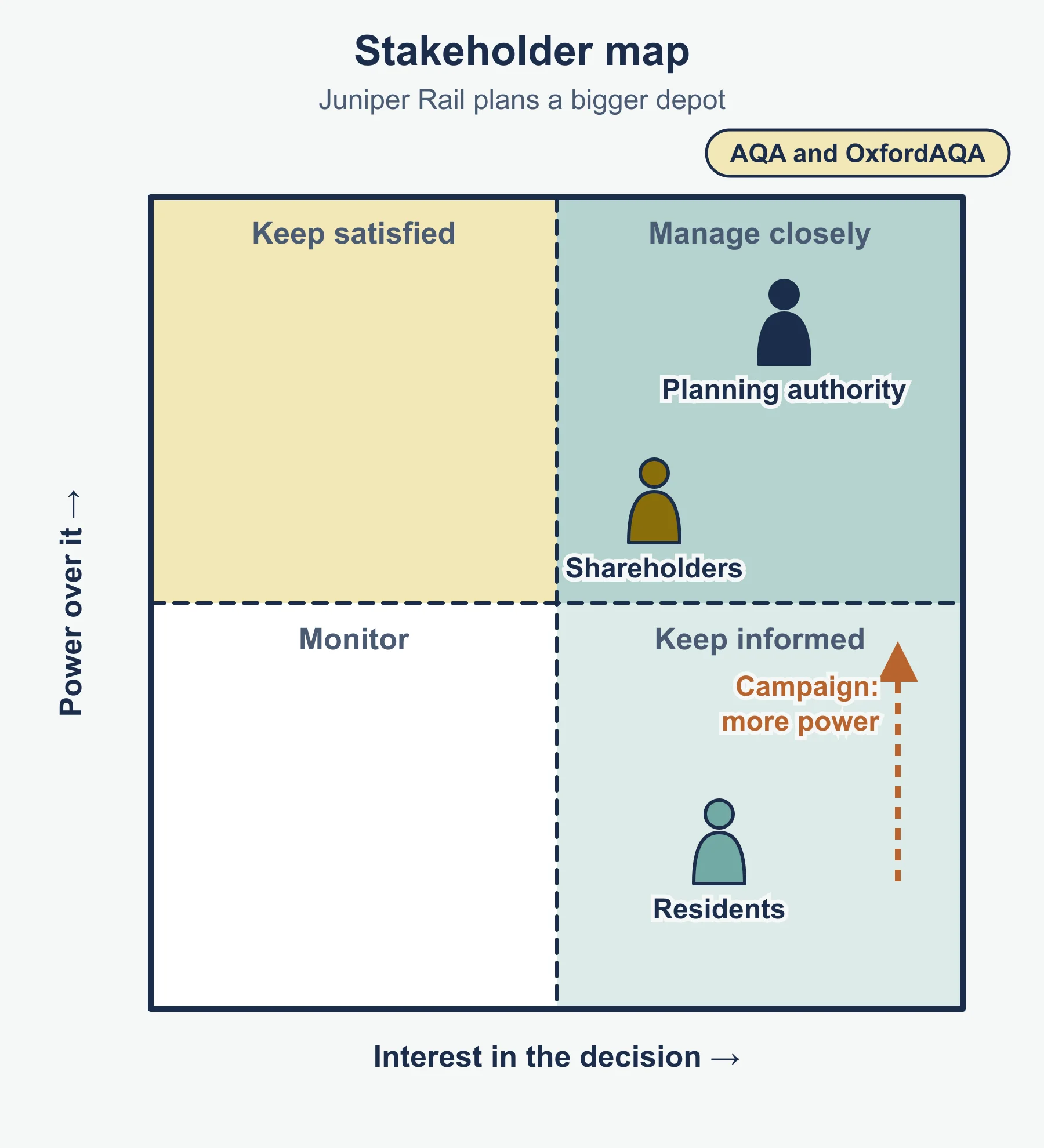
Conflict happens when meeting one need reduces another group’s outcome. Customers want lower prices while shareholders want higher margins. Employees want higher pay while owners want higher profit. A community wants a quiet neighbourhood while the business wants a larger depot.
Worked example: quantifying a conflict
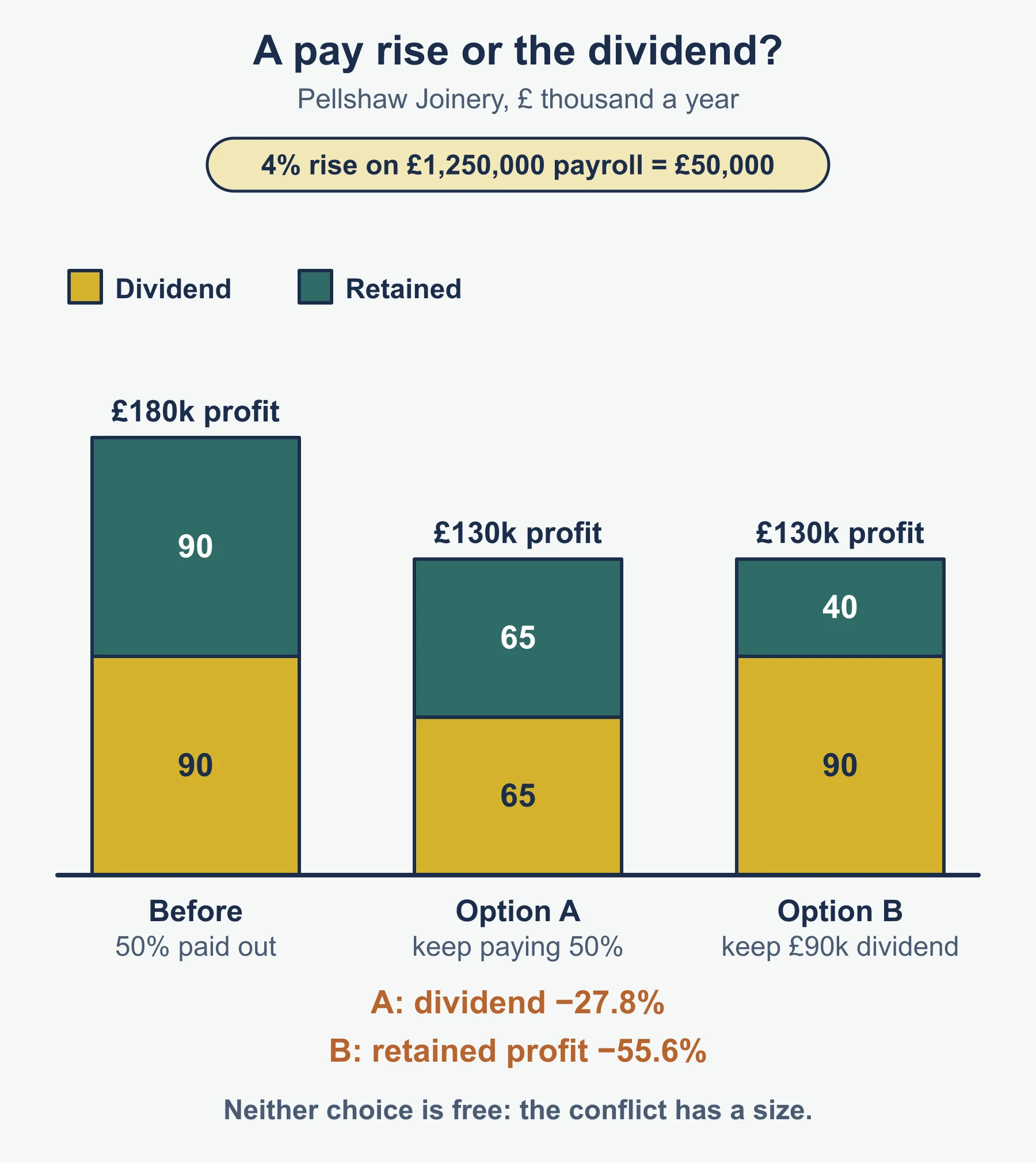
Pellshaw makes a profit after tax of £180,000 and pays out 50% as a dividend, so shareholders receive £90,000 and £90,000 is retained. The 25 staff have a combined payroll of £1,250,000 and ask for a 4% rise.
- Cost of the rise: 4% of £1,250,000 = £50,000.
- Profit falls to £180,000 − £50,000 = £130,000, ignoring tax effects to keep the arithmetic simple.
The board has two broad options.
| Option | Dividend | Retained profit | Effect |
|---|---|---|---|
| A: keep paying 50% of profit | £65,000 (down £25,000, a fall of 27.8%) | £65,000 | Shareholders lose; staff and reinvestment protected |
| B: keep the £90,000 dividend | £90,000 | £40,000 (down from £90,000, a fall of 55.6%) | Shareholders protected; less money for new machinery or a cash buffer |
Neither choice is free. Option B also leaves the 4% rise paid for by the business’s own future. The calculation shows that the conflict has a size, which you can use in an answer. Rather than saying “profit would fall”, say that retained profit would fall by more than half.
Resolving conflict
Managers do not have to pick a winner every time. They can compromise (a smaller rise, a smaller dividend cut), delay, find a different option, or give one group priority and explain why. Their choice is influenced by the business’s mission and objectives, the power of the groups involved, the size of the decision and its long-run effect. A strong evaluation points out that the least powerful group should not automatically lose if the cost of ignoring them is high.
4. Influences on the relationship with stakeholders
The specification lists this content point without naming specific influences, so the points below are the ones you can reasonably develop in an answer.
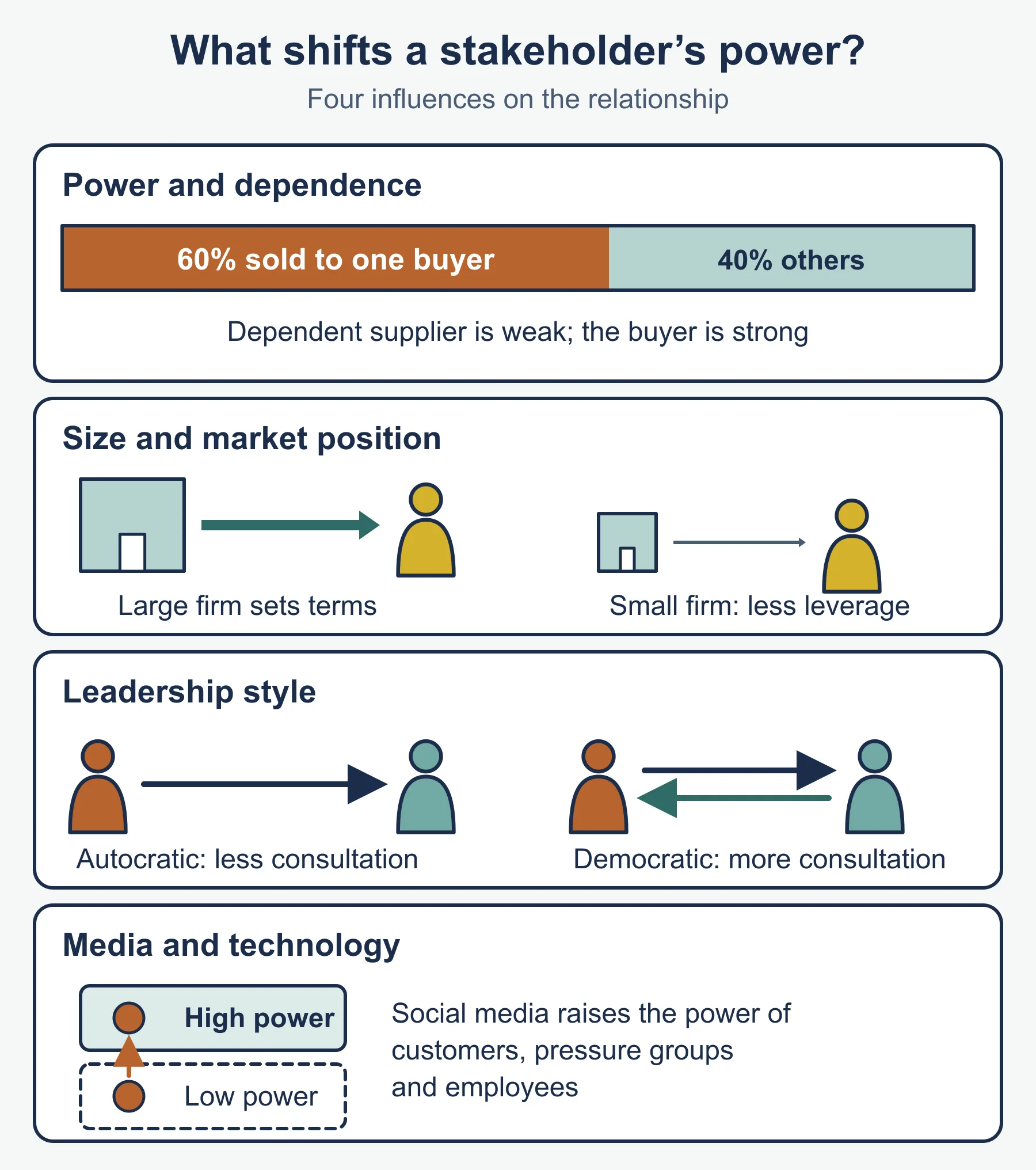
- Relative power and dependence. A supplier that sells 60% of its output to one buyer has a weak position, and the buyer has a strong one. A business that relies on one lender is also dependent.
- Business size and market position. A large firm with many suppliers or employees can often set terms. A small firm usually has less leverage.
- Leadership style and culture. An autocratic style is likely to mean less consultation, a democratic or participative one more.
- Mission, objectives and ethics. A business with ethical aims will treat suppliers, staff and the community differently from one focused only on short-term profit.
- History and trust. Past promises kept or broken change how groups respond now.
- Competition and the external environment. In a tight labour market, employees gain power. In a recession, customers may be harder to satisfy and suppliers keener for orders.
- Media and technology. Social media can quickly raise the effective power of customers, pressure groups and employees.
- The decision itself. A small change affects a group’s interest less than a closure.
5. Managing the relationship: communication and consultation
The specification names communication and consultation as part of managing relationships.
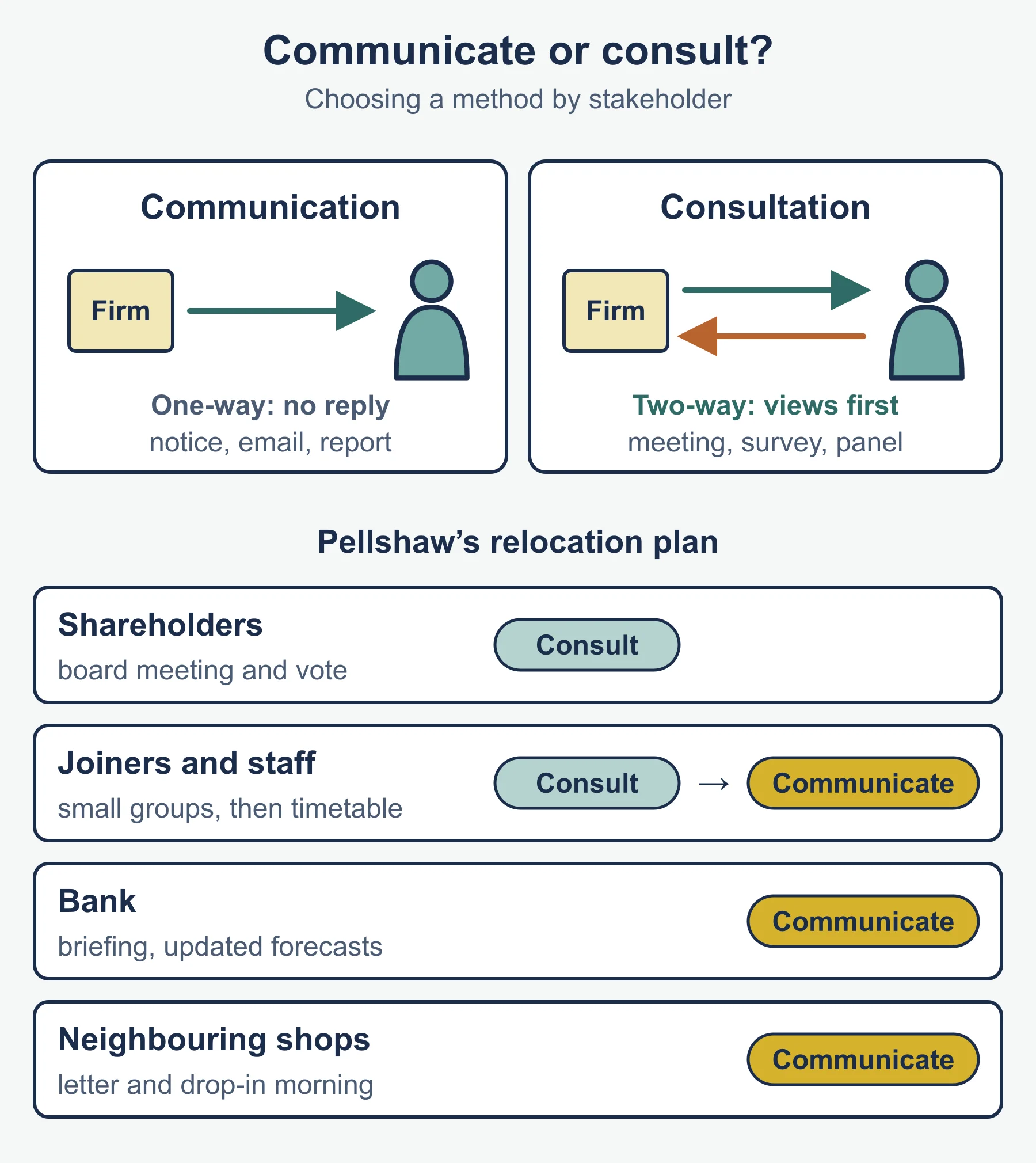
- Communication passes information. It is often one-way: a notice, newsletter, email, annual report, press release, website update or social media post. It is quick and cheap, but gives the stakeholder no chance to reply.
- Consultation asks for views before a decision is final. It is two-way: meetings, surveys, staff representatives, customer panels, community drop-in sessions. It takes longer and raises expectations, because people expect their views to count. It can improve the decision and reduce resistance.
Match the method to the map. High-power, high-interest groups usually need consultation and early involvement. High-interest, low-power groups need clear communication and a way to raise concerns. Low-interest groups can often be monitored.
Worked example: choosing methods
Pellshaw’s board decides on these steps for its relocation.
- Shareholders: a board meeting with a full costed proposal and a vote, which is consultation with high-power owners.
- Joiners and office staff: small-group meetings before any announcement, so questions can be heard, followed by a written timetable (consultation, then communication).
- Bank: a short briefing and updated forecasts (communication) so the lender stays satisfied.
- Neighbouring shop owners: a letter and a drop-in morning (communication with a chance to respond).
When you evaluate this plan, consider the costs. Consulting staff delays the announcement and may reveal opposition, but may also stop a damaging resignation by key joiners. The right judgement depends on how essential staff skills are and how fast the decision must be made.
Common errors
- Listing stakeholders without saying what each wants from this decision.
- Treating the map as fixed. Say when and why a group’s power or interest might change.
- Assuming conflict is permanent. Show where needs overlap.
- Writing “communicate” as a method for every group. Name the method and what it achieves.
- Concluding that shareholders always come first. Argue from the case, weighing power, mission and long-run effects.
Frequently asked questions
What is the difference between communication and consultation? Communication passes information and is often one-way, such as a newsletter or press release. Consultation asks for views before a decision is final and is two-way, such as meetings, surveys or staff representatives.
Why should a business consider stakeholder needs when making decisions? Decisions need support to work, ignoring affected groups can contradict the business’s mission and ethics, poor treatment can damage reputation, and stakeholders often have useful information. Against this, considering every need costs time and money.
What is the difference between overlap and conflict of stakeholder needs? Overlap happens when one decision serves several groups, such as a product launch raising profit and securing jobs. Conflict happens when meeting one group’s need reduces another’s outcome, such as lower prices for customers against higher margins for shareholders.
Do shareholders always come first? No. Concluding that shareholders always come first is a common error; argue from the case, weighing power, mission and long-run effects.
Which section of the AQA Business specification covers stakeholders? Section 3.2.3, Understanding the role and importance of stakeholders, in AQA AS and A-level Business (7131 and 7132).
Official syllabus
AQA, AS and A-level Business (7131 and 7132) specification, subject content 3.2.3 Understanding the role and importance of stakeholders. A-level Business is assessed on three papers, each covering all content.
Get free revision emails (optional)
Occasional emails with practice questions, worked explanations and links to free resources for the qualification and subjects you choose. No spam, and you can unsubscribe from any email. The free tools on this site never need an email.
Related resources
-
Practice questions
AQA A-Level Business: Understanding the role and importance of stakeholders (7132) – Practice Questions
Ten original AQA A-level Business questions on 3.2.3 stakeholders, with worked answers, examiner insights and short case studies.
Business · AQA · A Level
Try questions -
Revision notes
AQA A-Level Business: Understanding the role and importance of stakeholders (7132) – Revision Notes
Condensed AQA A-level Business revision notes on 3.2.3 stakeholders: mapping, needs, conflict, influences, communication, consultation, self-test.
Business · AQA · A Level
Revise topic -
Study guides
AQA A-Level Business: Managers, Leadership and Decision Making (7132)
Study guide to Topic 2 Managers, leadership and decision making for AQA A-level Business 7132: leadership styles, decision trees and stakeholder mapping.
Business · AQA · A Level
Read guide
Related articles
-
teaching
A Level tuition in Dubai: Cambridge or Pearson Edexcel International A Level?
Schools in Dubai and Abu Dhabi teach either Cambridge International AS & A Level or Pearson Edexcel International A Level. How the two are structured, why it matters for tuition, and how online classes from Lahore work.
9 October 2026
-
curriculum guides
Choosing subjects at IGCSE and A Level
How subject choices at 14 and 16 affect university options later, and how to keep pathways open without overloading a timetable.
28 July 2026
Studying this with a teacher
Working through Business A LEVELS?
This page is free and stays free. If you would rather be taught it, Marlbridge runs Business classes one-to-one and in small groups of up to 15, online in your own time zone. The first trial class is free. WhatsApp replies within an hour (8am–11pm Pakistan time, every day); email the same day.
AQA Business teachers at Marlbridge
