
Revision Notes
AQA A-Level Business: Understanding management decision making (7132) – Revision Notes
Condensed AQA A-Level Business revision notes for 3.2.2: data versus intuition, decision trees, net gain, risk, opportunity cost and influences.
- Subject
- Business
- Level
- A LEVELS
- Topic
- Managers, leadership and decision making
- Author
- Marlbridge Academic Team
- Updated
- Reviewed by
- Salman Ahmad (what this means)
Aligned to AQA A Level Business (7132), For first teaching from September 2023. Official specification .
Syllabus page (what it covers and how it is assessed): AQA A Level Business.
Syllabus points this page covers
7132
- 3.2.2 Understanding management decision making
Found an error? Report a correction.
Need help with this topic? Request a free trial class for A Level Business (7132).
These notes condense section 3.2.2, Understanding management decision making, of the AQA AS and A-level Business specification (7132, A-level). For full explanations and longer worked examples, read the study guide first. Then try the practice questions. Wider topic pages: topic revision notes and topic study guide. Course links: Business hub, checklist and diagnostics. Businesses and figures are invented.
Definitions to know
| Term | Meaning |
|---|---|
| Scientific decision making | Choosing on the basis of data and analysis, such as decision trees, expected value and net gain |
| Intuition | Choosing on judgement, experience and instinct, with no formal analysis |
| Risk | A chance of an unfavourable outcome that can be estimated |
| Reward | The benefit if the decision goes well |
| Uncertainty | Outcomes or probabilities cannot be reliably estimated |
| Opportunity cost | Value of the next-best alternative given up |
| Decision tree | Diagram of options, chance events, probabilities and payoffs |
| Expected value (EV) | Sum of probability × payoff across the outcomes of one option |
| Net gain | EV − cost of the option |
The specification names these ideas but does not define them, so the wording above is the standard usage.
Data versus intuition at a glance
| Data-based | Intuition | |
|---|---|---|
| For | Explicit assumptions, comparable options, defensible to others | Quick, cheap, works with no data, uses experience |
| Against | Costs time and money; only as good as the inputs; misses what cannot be measured | Biased, hard to justify, may not fit new conditions |
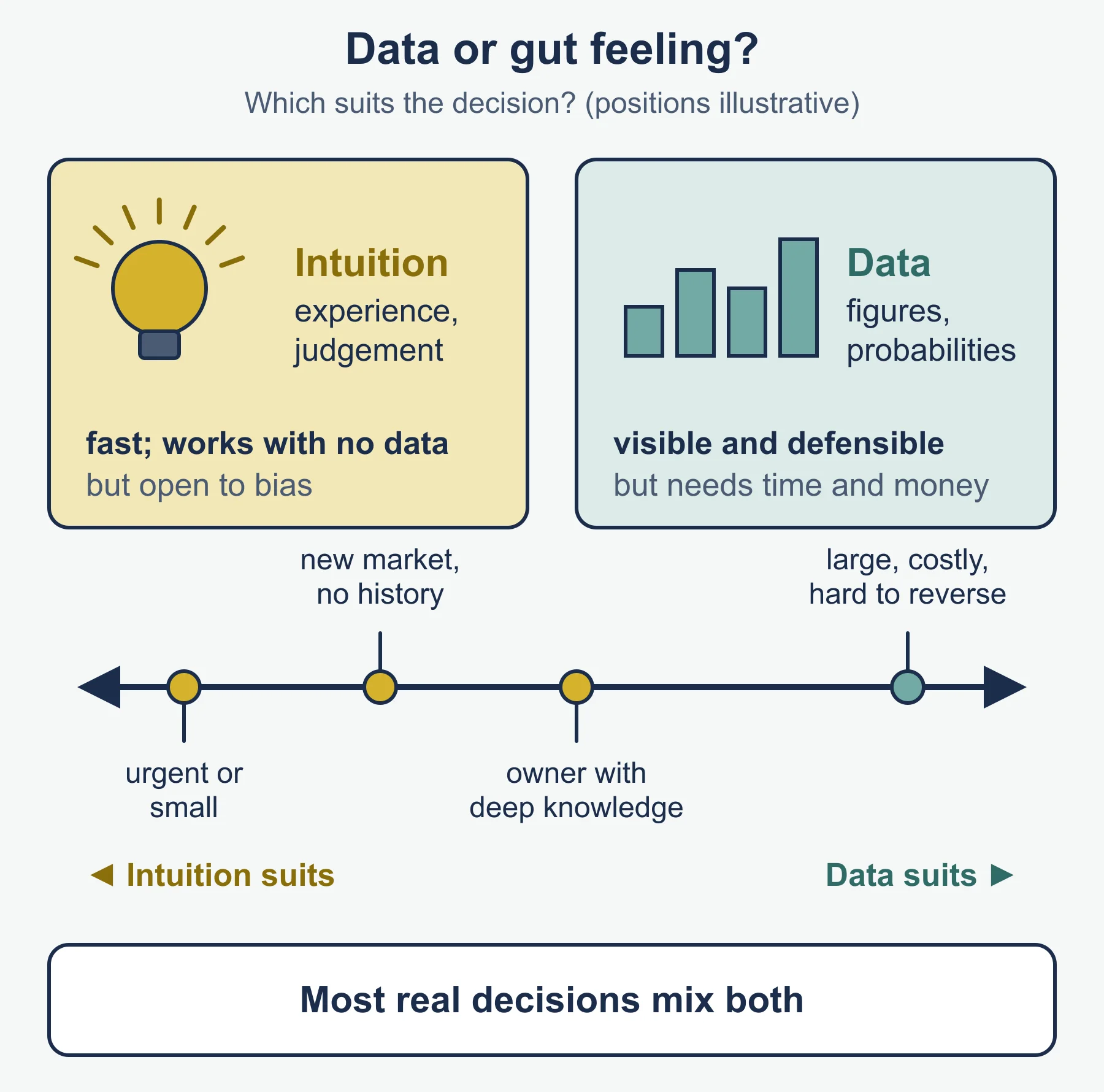
| Best when | Big, costly, hard-to-reverse choices with data available | Urgent, small or unprecedented choices; experienced decision-maker |
Link them: a manager can use data, then apply judgement to what the data leave out.
Decision tree rules
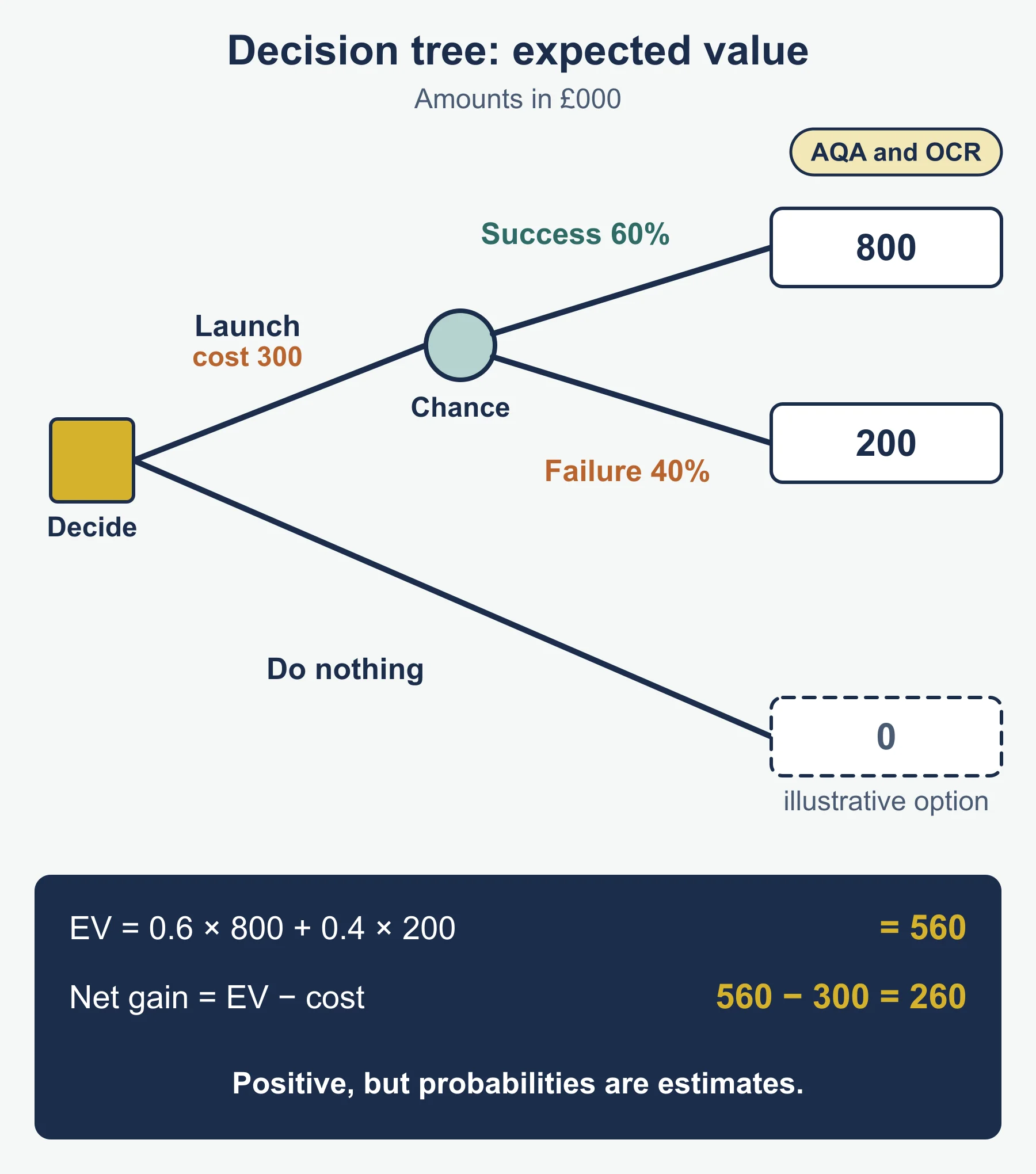
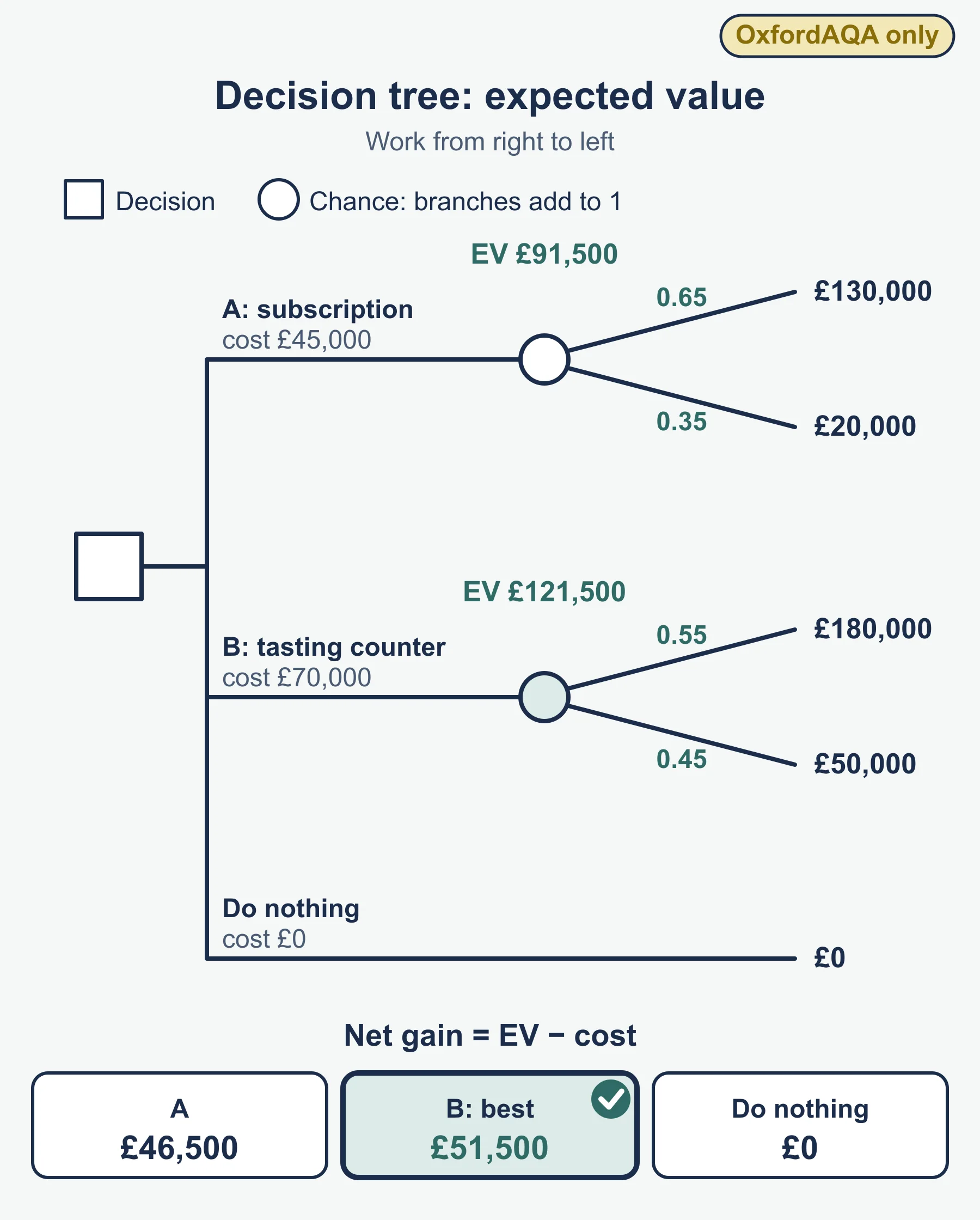
- Read and build left to right; calculate right to left.
- Square = decision node (business chooses). Circle = chance node (events decide).
- Probabilities from one chance node sum to 1.
- EV = Σ (probability × payoff). Net gain = EV − cost.
- Compare net gains; the highest is the numerical choice.
- Standard form: these are the usual forms, not formulas printed by the specification.
Method in steps
- Write down each option and its cost.
- List the outcomes of each option with probabilities (check they sum to 1).
- Multiply each probability by its payoff and add: EV.
- Subtract the cost: net gain.
- Rank the options.
- Check risk (worst case), resources, ethics and the market before recommending.
Worked reminder
Merrick Glass can buy a furnace for £20,000. There is a 0.5 chance of a £60,000 return and a 0.5 chance of £10,000.
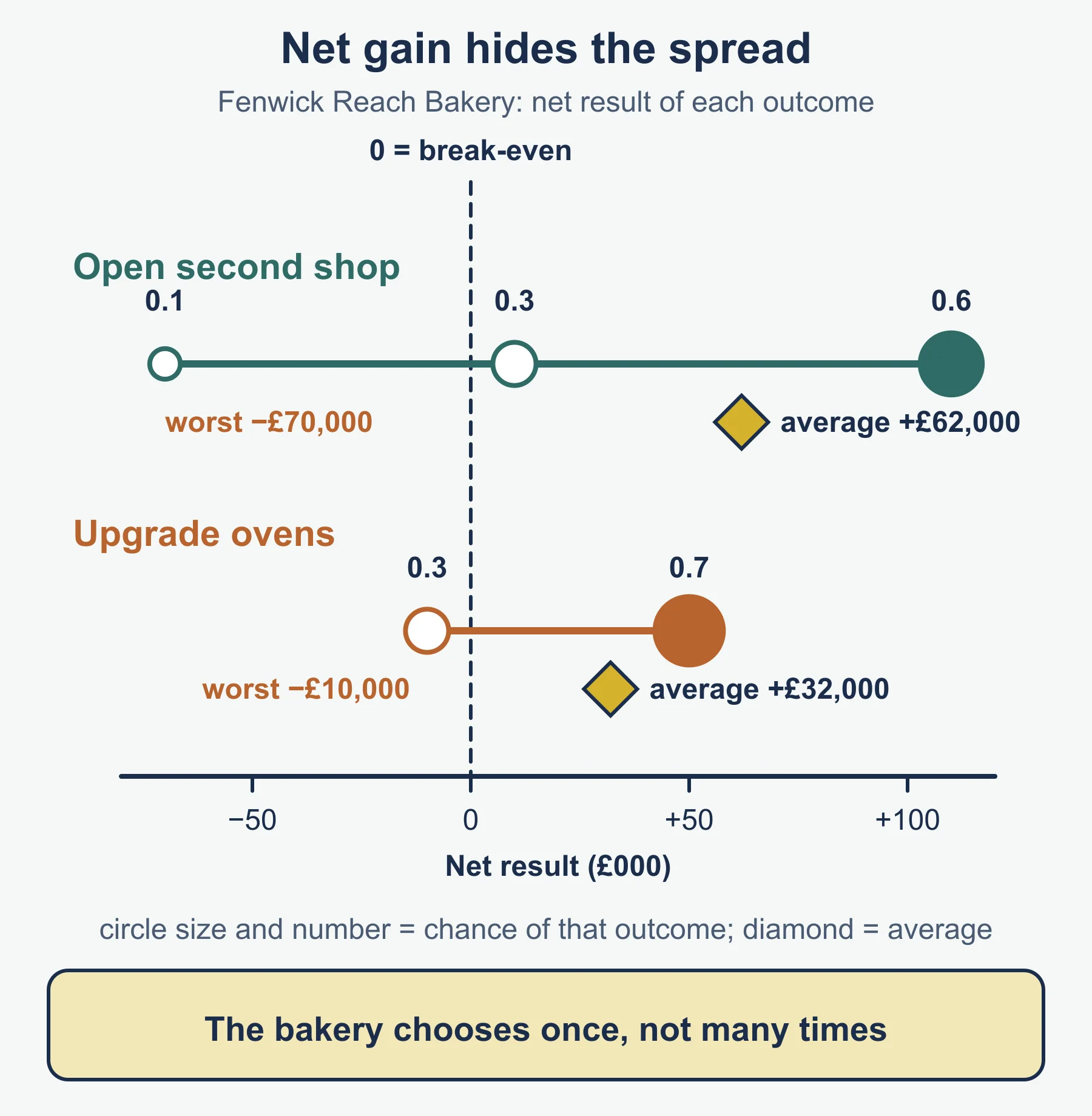
EV = (0.5 × 60,000) + (0.5 × 10,000) = 30,000 + 5,000 = £35,000. Net gain = 35,000 − 20,000 = £15,000. The worst case is a £10,000 loss (10,000 − 20,000), so the average hides a real downside.
Break-even probability
To test how sensitive a choice is, let the probability be p and solve for the value at which two options tie, or at which net gain is zero. If the estimate of p is close to that value, the decision is fragile and more evidence is worth gathering. If it is far from it, the choice is robust to errors in the estimate.
Two-stage trees
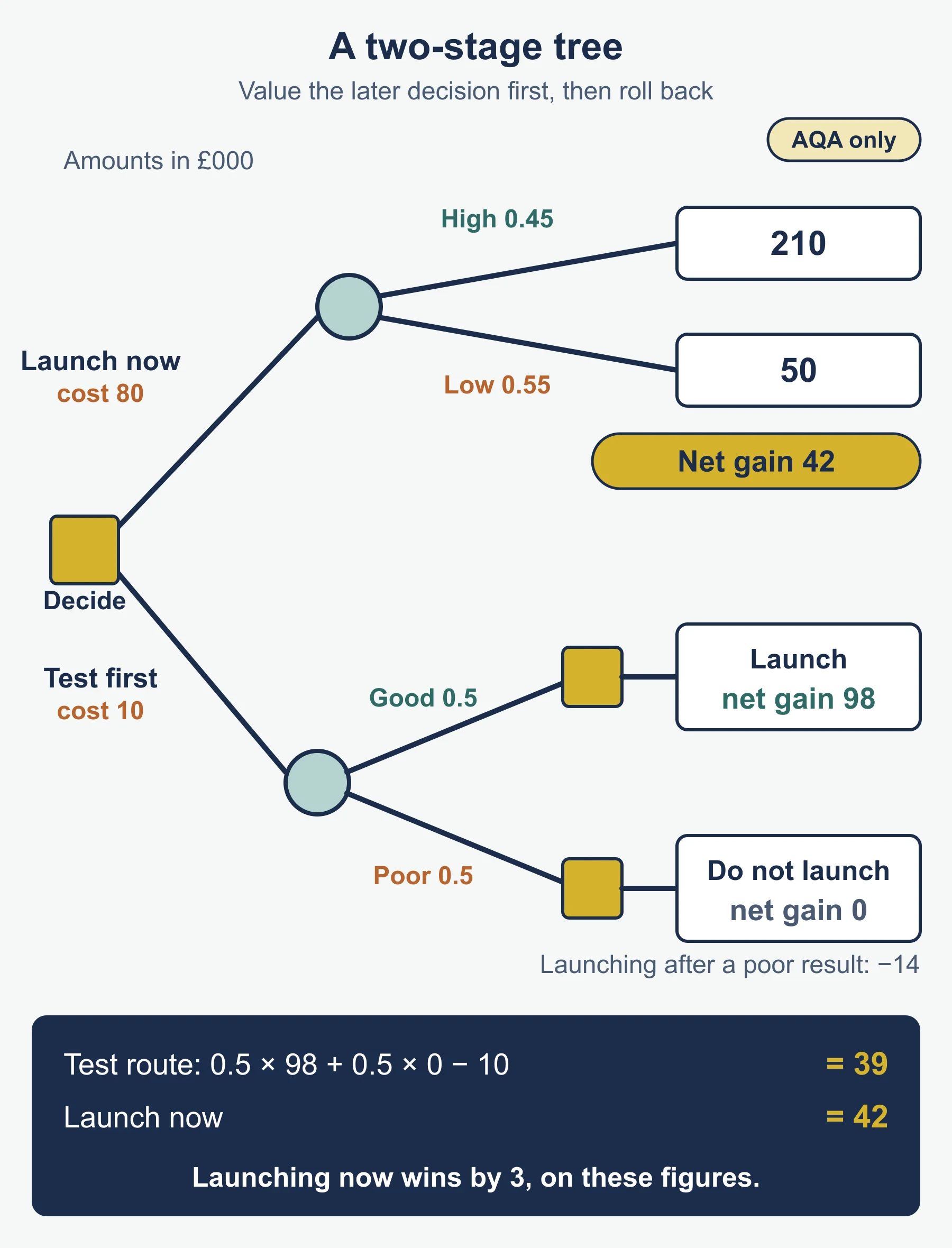
Value the last decisions first. At a decision node, take the best branch. At a chance node, take the probability-weighted average. Subtract costs on the way back. A test or survey is worth paying for only if the improvement it brings exceeds its cost.
Value and limits of trees
| Value | Limit |
|---|---|
| Forces a clear list of options | Probabilities and payoffs are estimates |
| One measure for comparison | A small change in a probability can reverse the ranking |
| Shows downside as well as average | Ignores timing of returns |
| Gives a record of reasoning | Ignores non-financial factors |
| Reduces reliance on guesswork | Poor for uncertainty; costs time to gather data |
Risk, uncertainty, opportunity cost: must-know distinctions
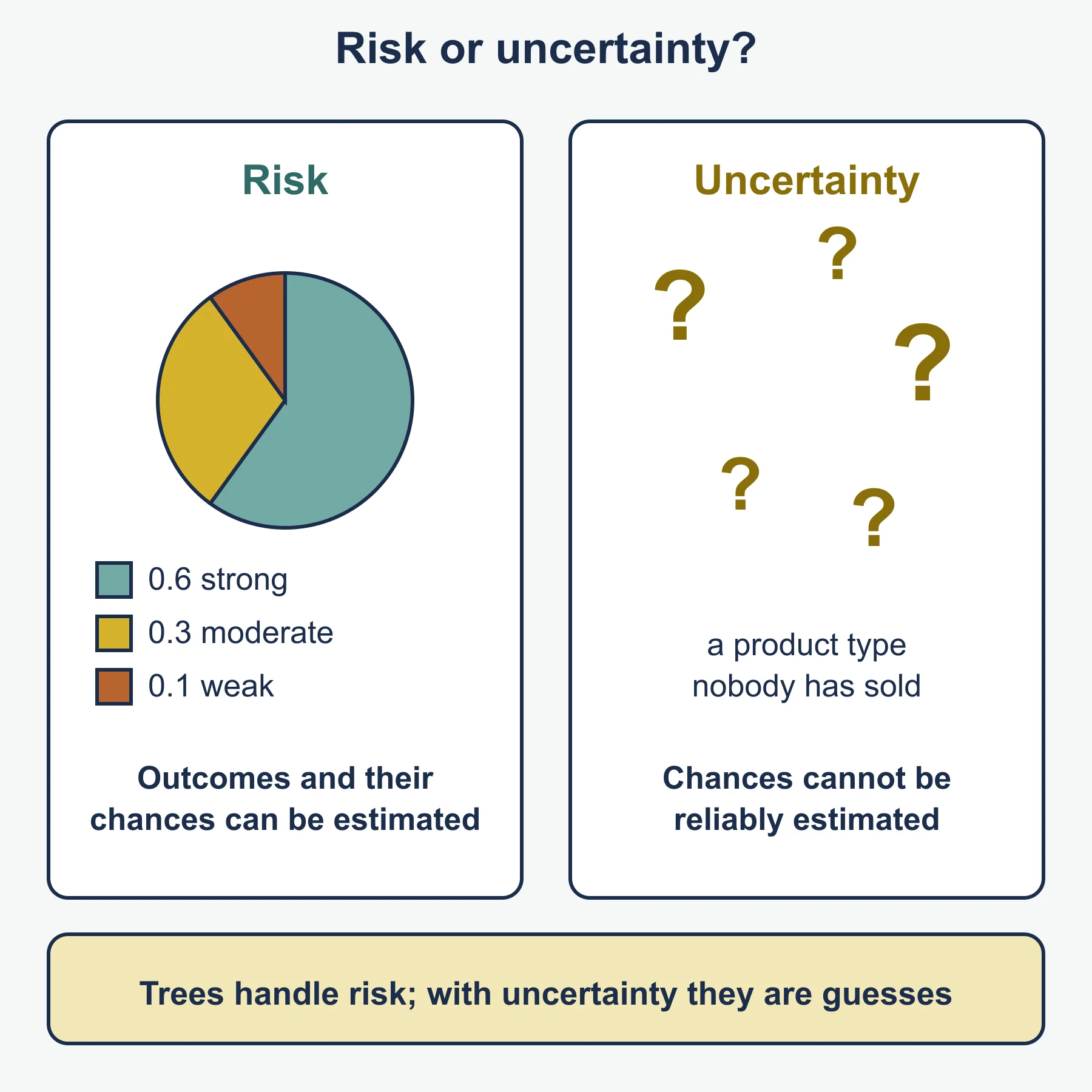
- Risk versus uncertainty: risk can be given probabilities; uncertainty cannot. Trees deal with risk.
- Risk versus reward: higher possible reward usually brings higher risk.
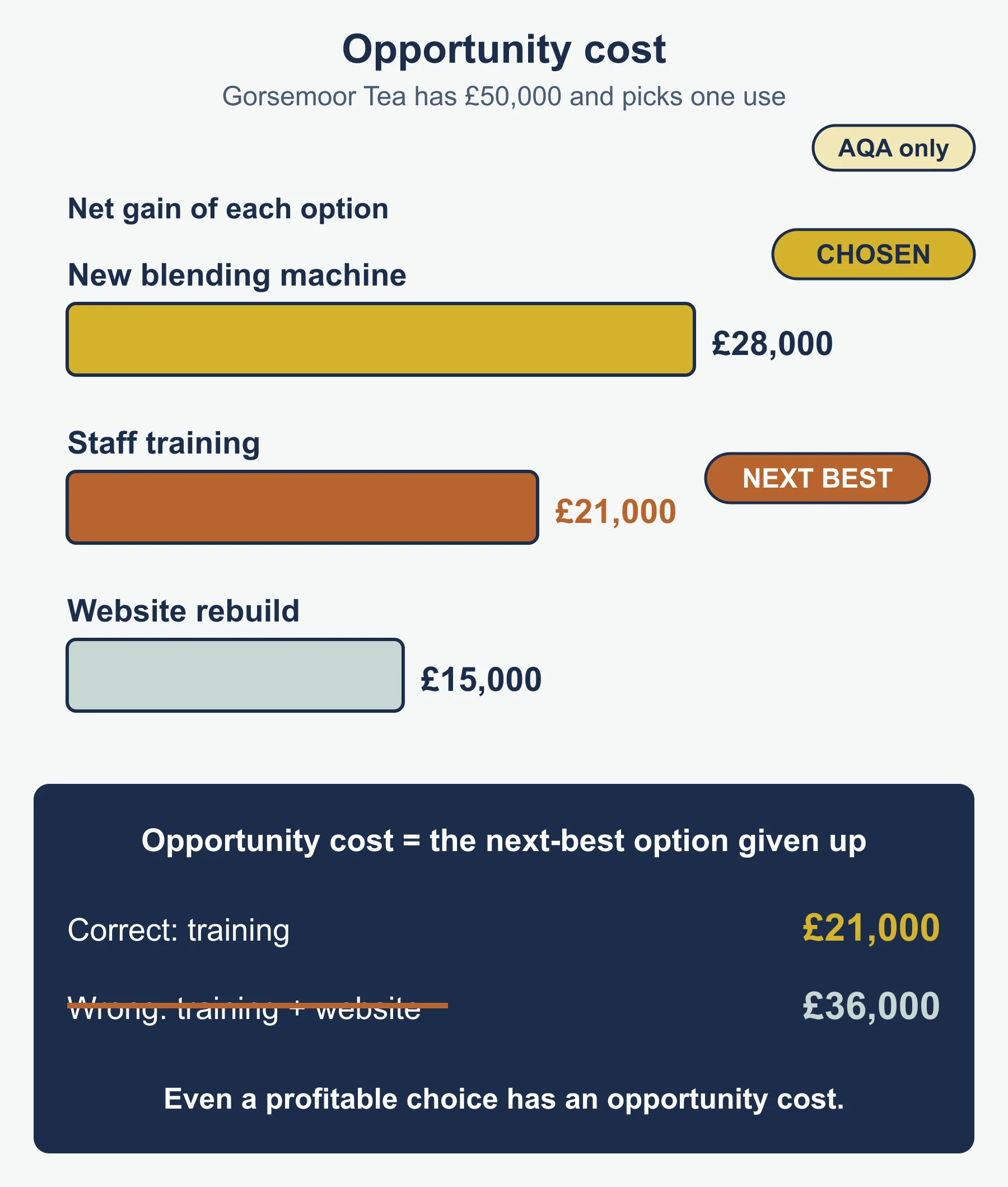
- Opportunity cost versus cost: cost is what you pay; opportunity cost is the best alternative you forgo. With net gains of £12,000, £9,000 and £7,000, choosing the first has an opportunity cost of £9,000, not £16,000.
- EV versus net gain: EV ignores what the option costs.
- Average versus outcome: a one-off decision gets one outcome, never the average.
Influences on decision making
| Influence | Key point | Example effect |
|---|---|---|
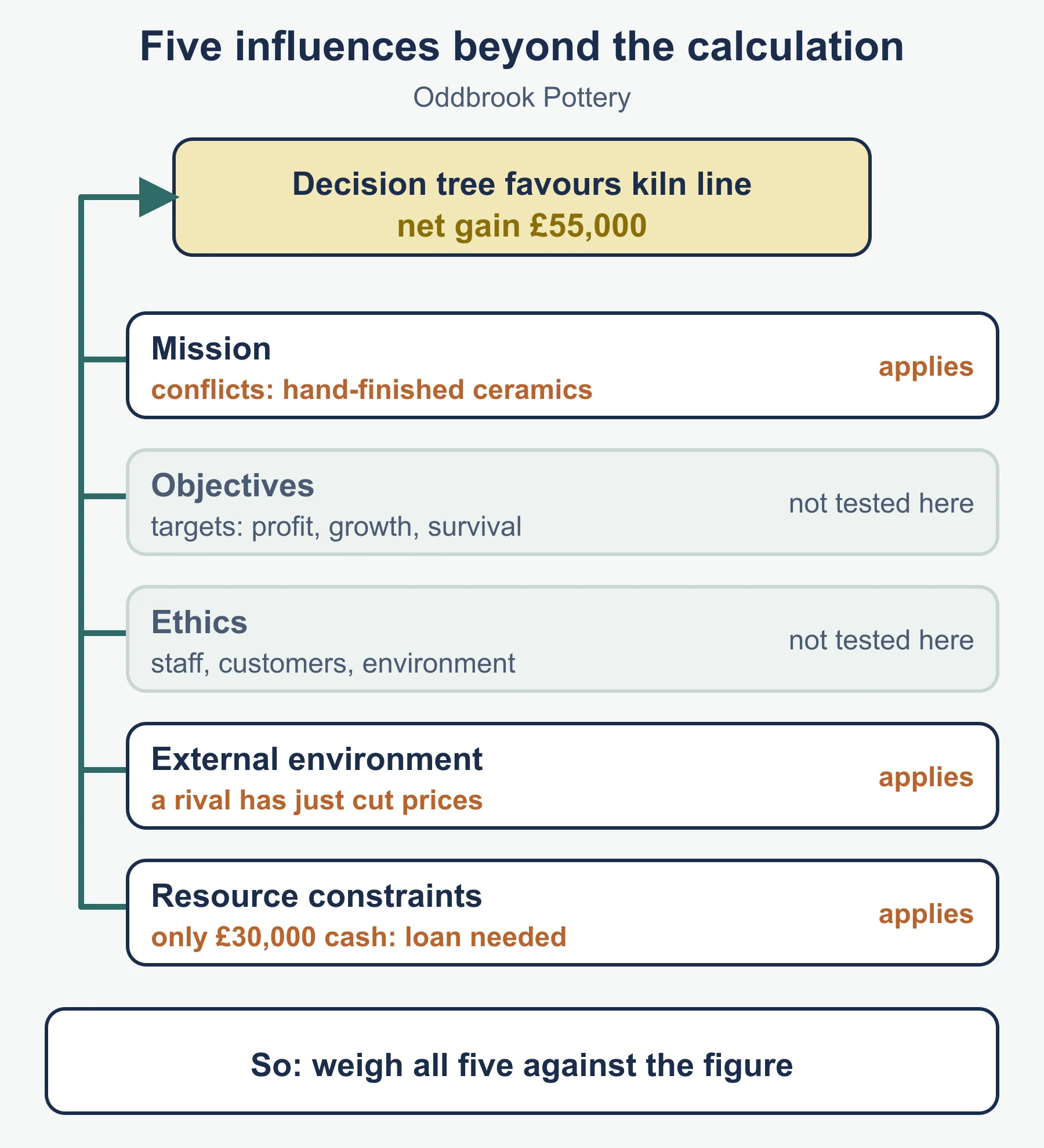
| Mission | Purpose and values narrow the options | A “locally made” mission rules out overseas production |
| Objectives | Targets define success | A survival objective favours the lower-risk option |
| Ethics | Moral principles about people and planet | Rejecting a cheap supplier with poor labour practice |
| External environment, including competition | Rivals, economy, technology, regulation | A rival’s price cut lowers probabilities of strong sales |
| Resource constraints | Money, staff, time, space, equipment | A business cannot fund a £90,000 option with £30,000 |
Always link the influence to the business in the question, then say whether it strengthens or weakens the case for the numerically best option.
Command words in this topic
| Command word | What earns credit |
|---|---|
| State, identify, define | A short, exact answer: the term, or the precise meaning |
| Calculate | Working shown, then the answer with its unit (£) |
| Explain | A point, then the reason or consequence, tied to the business |
| Analyse | A chain of reasoning: cause, effect, then why it matters to this decision |
| Evaluate, justify | Both sides weighed, then a judgement that says what it depends on |
| Recommend | A clear choice backed by figures and at least one non-numerical factor |
Evaluation checklist
Use these prompts when a question asks you to weigh a decision.
- Data: are the probabilities based on evidence or opinion? Is the information up to date?
- Scale and reversibility: the larger and less reversible the choice, the more a formal tree is worth.
- Time: urgent decisions favour intuition; slow ones allow data collection.
- Worst case: can the business survive it? A modest net gain with no chance of a big loss may beat a larger one with a heavy downside.
- Influences: does mission, ethics, competition or a resource constraint change the ranking?
- Judgement: finish with “it depends on…” and name the one or two factors that decide it.
Quick self-test
- Define opportunity cost.
- Option cost £25,000: 0.25 chance of £80,000, 0.75 chance of £16,000. Calculate the expected value.
- Using question 2, calculate the net gain.
- What does a square node on a tree show?
- A chance node has branches with probabilities 0.35, 0.45 and one more. What is it?
- Give one difference between risk and uncertainty.
- Give one strength of intuition and one weakness.
- Name the five influences on decision making listed in 3.2.2.
- An option costs £40,000 and returns £100,000 with probability p, otherwise £20,000. Find p for which net gain is zero.
- A decision node offers expand (net gain £70,000) or hold (£55,000). What value goes on the node?
- Why might a business reject the option with the highest net gain?
- Why can a test market be poor value even if it improves the decision?
Answers
- The value of the next-best alternative given up when a choice is made.
- (0.25 × 80,000) + (0.75 × 16,000) = 20,000 + 12,000 = £32,000.
- 32,000 − 25,000 = £7,000.
- A decision the business makes (a choice between options).
- 1 − 0.35 − 0.45 = 0.2.
- Risk can be given probabilities from data or experience; uncertainty cannot be reliably estimated.
- Strength: fast, or usable without data. Weakness: hard to justify, or open to bias.
- Mission, objectives, ethics, the external environment (including competition), resource constraints.
- EV = 100,000p + 20,000(1 − p) = 20,000 + 80,000p. Net gain zero when 20,000 + 80,000p = 40,000, so p = 0.25.
- £70,000, the higher branch.
- Its worst case is too costly, it breaks the mission or ethics, it needs funds the business lacks, or the estimates are unreliable.
- Its cost may exceed the extra net gain it brings, as the study guide’s e-bike example shows.
Where marks are usually lost
- Stopping at EV and not subtracting the cost.
- Using probabilities that do not sum to 1.
- Defining opportunity cost as the total of all rejected options.
- Calling every uncertain situation “risk”.
- Praising data without questioning its quality, or praising intuition without saying when it works.
- Writing a list of the five influences with no link to the business.
- Recommending the highest net gain without discussing worst case or constraints.
- Reaching no judgement, or one that does not say what it depends on.
Frequently asked questions
What do the square and circle nodes on a decision tree mean? A square is a decision node, where the business chooses between options. A circle is a chance node, where events decide the outcome; the probabilities leaving one chance node must sum to 1.
How do you calculate expected value and net gain? Expected value = the sum of (probability × payoff) for each outcome of an option, and net gain = expected value − cost of the option. Calculate right to left across the tree.
What is the opportunity cost of a decision? Opportunity cost is the value of the next-best alternative given up. It is that one alternative, not the total of all the rejected options.
What are the five influences on decision making in AQA 3.2.2? Mission, objectives, ethics, the external environment (including competition) and resource constraints.
Official syllabus
AQA AS and A-level Business specification (7131 and 7132), subject content section 3.2.2 Understanding management decision making, published by AQA.
Get free revision emails (optional)
Occasional emails with practice questions, worked explanations and links to free resources for the qualification and subjects you choose. No spam, and you can unsubscribe from any email. The free tools on this site never need an email.
Related resources
-
Study guides
AQA A-Level Business: Understanding management, leadership and decision making (7132)
A full study guide to AQA A-Level Business (7132) section 3.2.1: management and leadership, styles, Tannenbaum Schmidt and judging style effectiveness.
Business · AQA · A Level
Read guide -
Practice questions
AQA A-Level Business: Understanding management, leadership and decision making (7132) – Practice Questions
Original practice questions with worked answers on AQA A-Level Business (7132) 3.2.1: Tannenbaum Schmidt, leadership styles and their effectiveness.
Business · AQA · A Level
Try questions -
Revision notes
AQA A-Level Business: Understanding management, leadership and decision making (7132) – Revision Notes
Condensed revision notes for AQA A-Level Business (7132) 3.2.1: management and leadership, styles, Tannenbaum Schmidt, style influences and a self-test.
Business · AQA · A Level
Revise topic
Related articles
-
teaching
A Level tuition in Dubai: Cambridge or Pearson Edexcel International A Level?
Schools in Dubai and Abu Dhabi teach either Cambridge International AS & A Level or Pearson Edexcel International A Level. How the two are structured, why it matters for tuition, and how online classes from Lahore work.
9 October 2026
-
curriculum guides
Choosing subjects at IGCSE and A Level
How subject choices at 14 and 16 affect university options later, and how to keep pathways open without overloading a timetable.
28 July 2026
Studying this with a teacher
Working through Business A LEVELS?
This page is free and stays free. If you would rather be taught it, Marlbridge runs Business classes one-to-one and in small groups of up to 15, online in your own time zone. The first trial class is free. WhatsApp replies within an hour (8am–11pm Pakistan time, every day); email the same day.
AQA Business teachers at Marlbridge
