
Revision Notes
AQA A-Level Business: Understanding management, leadership and decision making (7132) – Revision Notes
Condensed revision notes for AQA A-Level Business (7132) 3.2.1: management and leadership, styles, Tannenbaum Schmidt, style influences and a self-test.
- Subject
- Business
- Level
- A LEVELS
- Topic
- Managers, leadership and decision making
- Author
- Marlbridge Academic Team
- Updated
- Reviewed by
- Salman Ahmad (what this means)
Aligned to AQA A Level Business (7132), For first teaching from September 2023. Official specification .
Syllabus page (what it covers and how it is assessed): AQA A Level Business.
Syllabus points this page covers
7132
- 3.2.1 Understanding management, leadership and decision making
Found an error? Report a correction.
Need help with this topic? Request a free trial class for A Level Business (7132).
These are condensed notes for section 3.2.1, Understanding management, leadership and decision making, in the AQA AS and A-level Business specification (7131/7132), for A-level Business (7132). For full explanations and worked examples, read the study guide first. When you are ready to test yourself, use the practice questions.
Related pages: the topic study guide, the topic revision notes and the topic practice paper. Course links: the AQA A-level Business hub, the checklist and the free diagnostics.
The content points
The current specification (version 2.0, June 2023) no longer lists the role of managers or the Blake Mouton grid. Both are kept below as background only.
| Point | One-line summary |
|---|---|
| Management and leadership | Distinguish the two; the five manager activities are background |
| Types of styles and influences | Autocratic to laissez-faire; shaped by task, people, culture, time, risk |
| Named theory | Tannenbaum Schmidt continuum (Blake Mouton grid is background only) |
| Effectiveness | Judge each style against the context and against evidence |
What managers do (background)
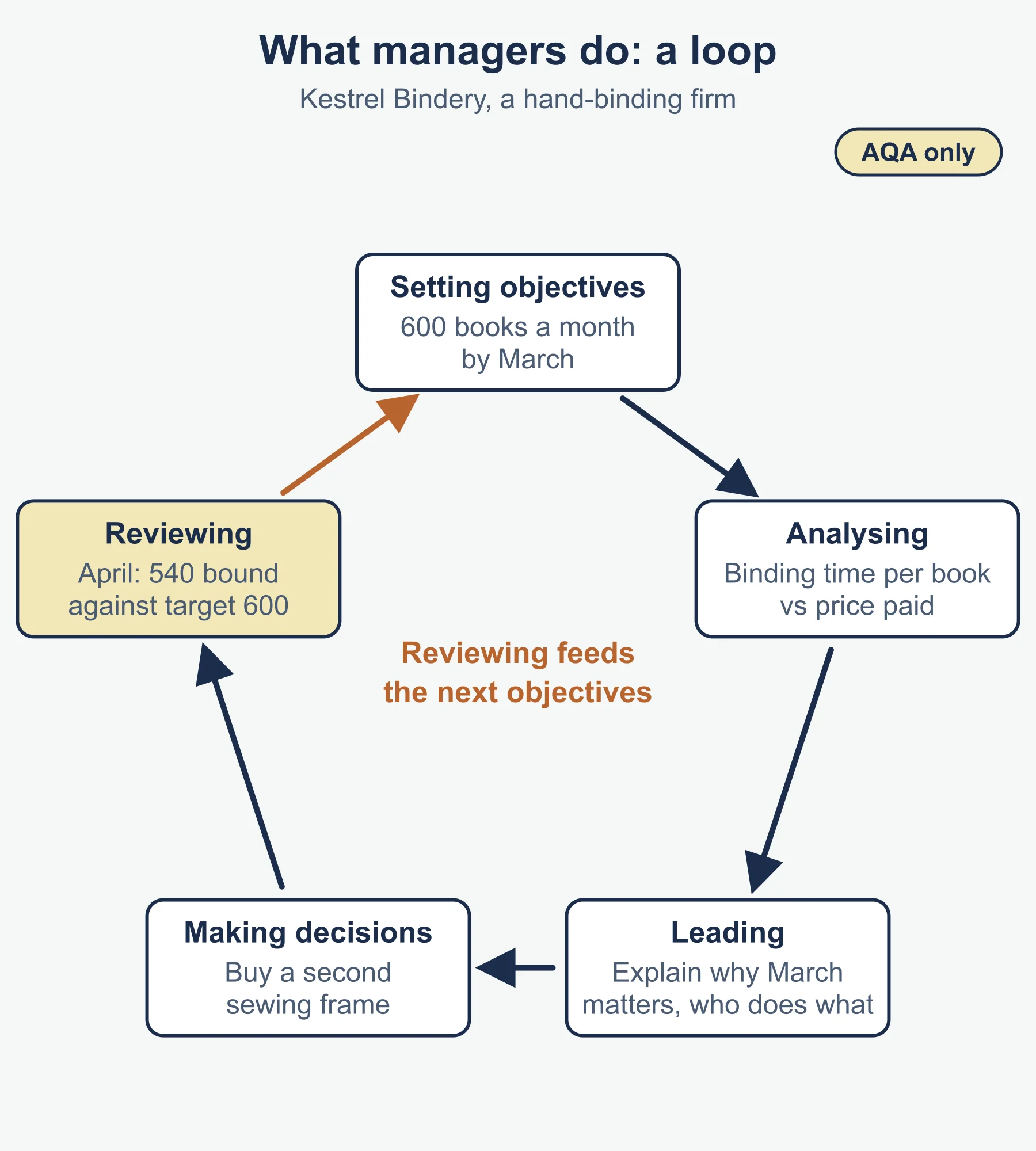
Not a listed content point in the current specification, but a standard way to describe the role of managers. It helps when you distinguish management from leadership.
- Setting objectives: decide what is to be achieved, with measurable targets.
- Analysing: examine information about the market, the team and past results.
- Leading: guide, motivate and direct people towards the objectives.
- Making decisions: choose between options.
- Reviewing: compare results with objectives, then feed the lessons into the next round of objectives.
Reminder for answers: link each activity to the case. “The manager reviews sales” scores less than “reviewing the second-quarter sales against the target showed the new menu was not working”.
Styles: definitions to recall
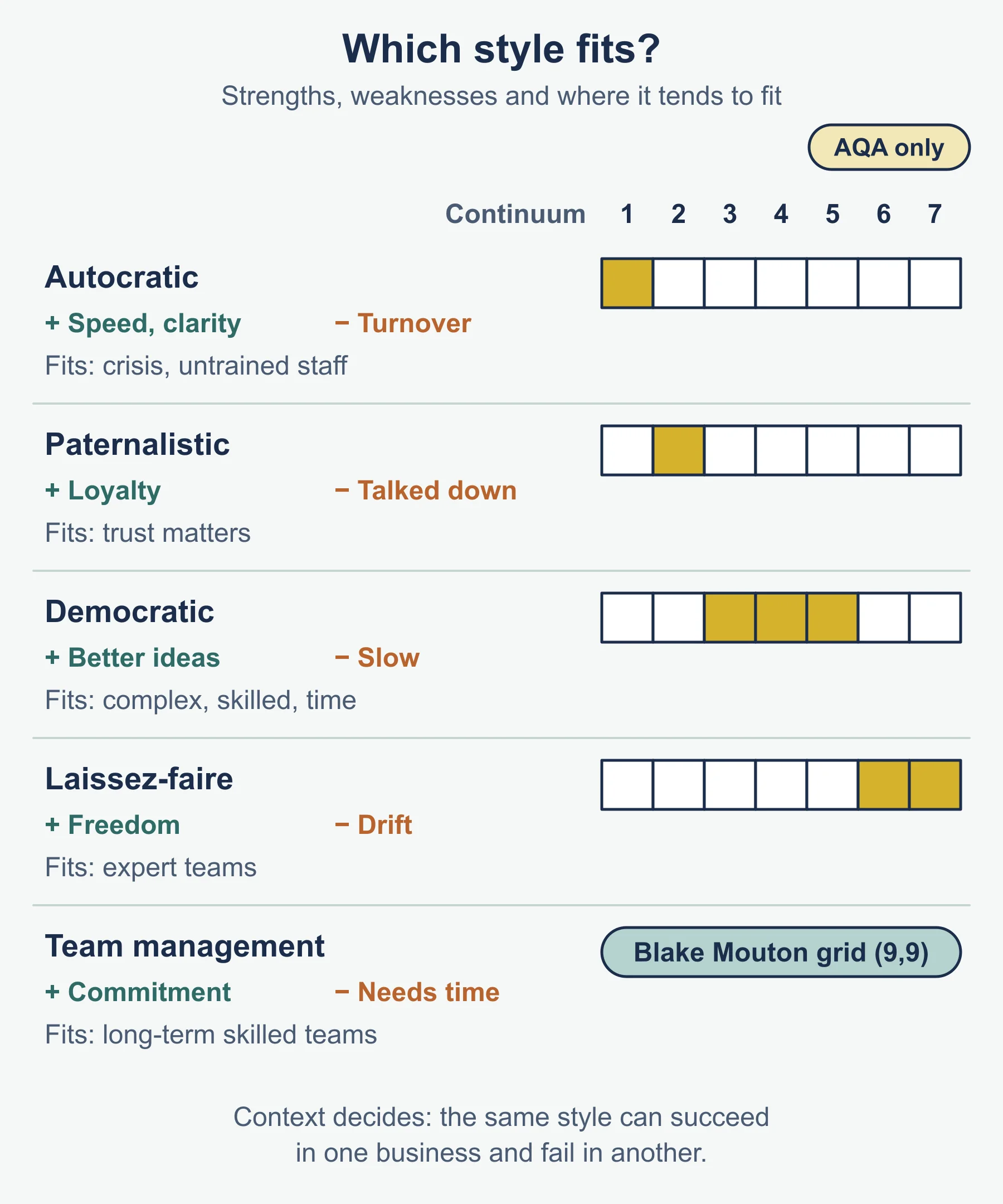
| Style | Who decides | Communication | Typical risk |
|---|---|---|---|
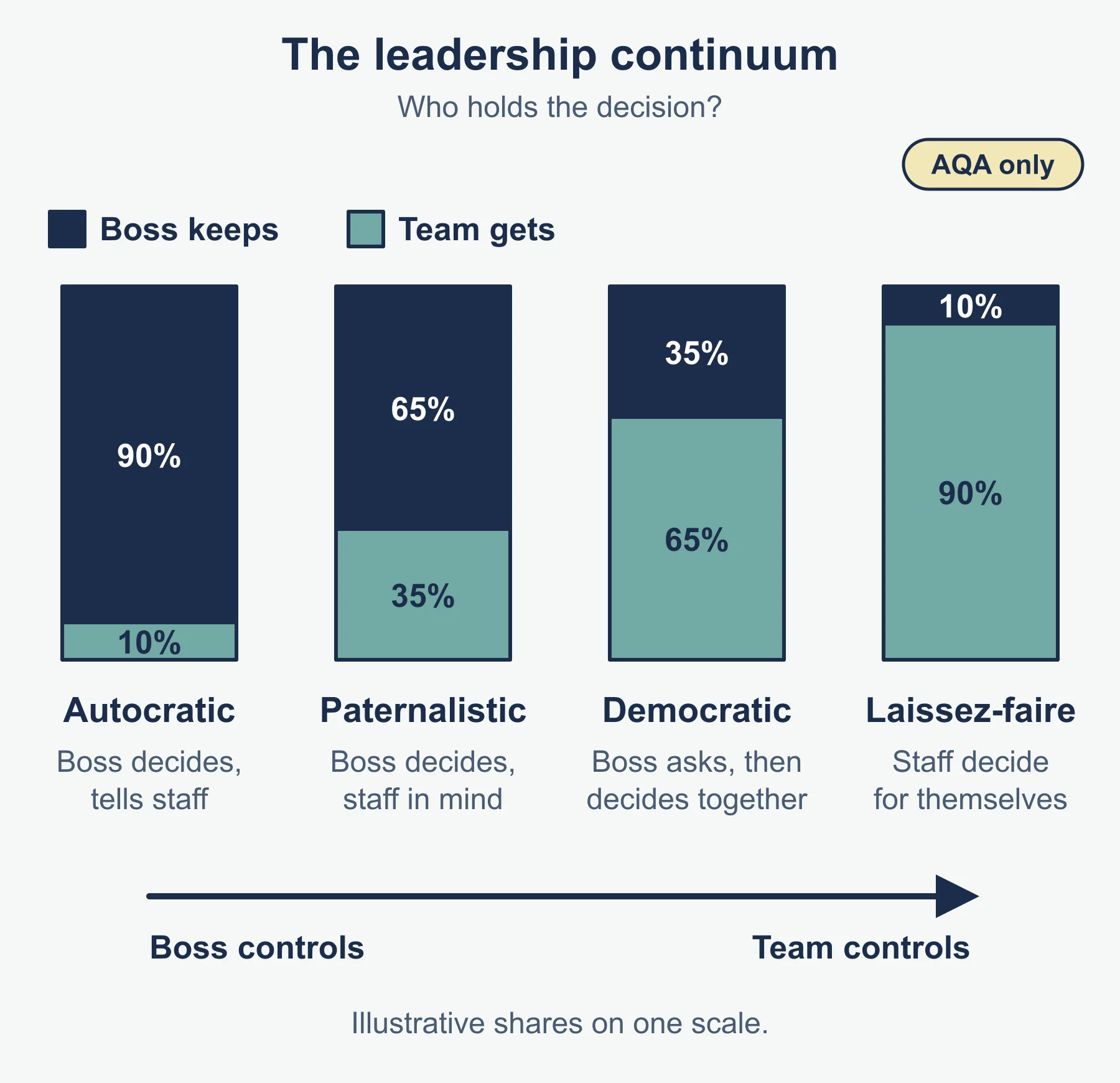
| Autocratic | Manager alone | One way, downward | Staff disengage and leave |
| Paternalistic | Manager, in staff’s perceived interest | Mostly downward, with explanation | Staff feel treated like children |
| Democratic | Manager with staff input, or the group | Two way | Slow, compromise |
| Laissez-faire | Staff, within limits | Little from the manager | Drift, lack of direction |
The specification names these four styles, and the Tannenbaum Schmidt continuum is its named theory.
Tannenbaum Schmidt continuum
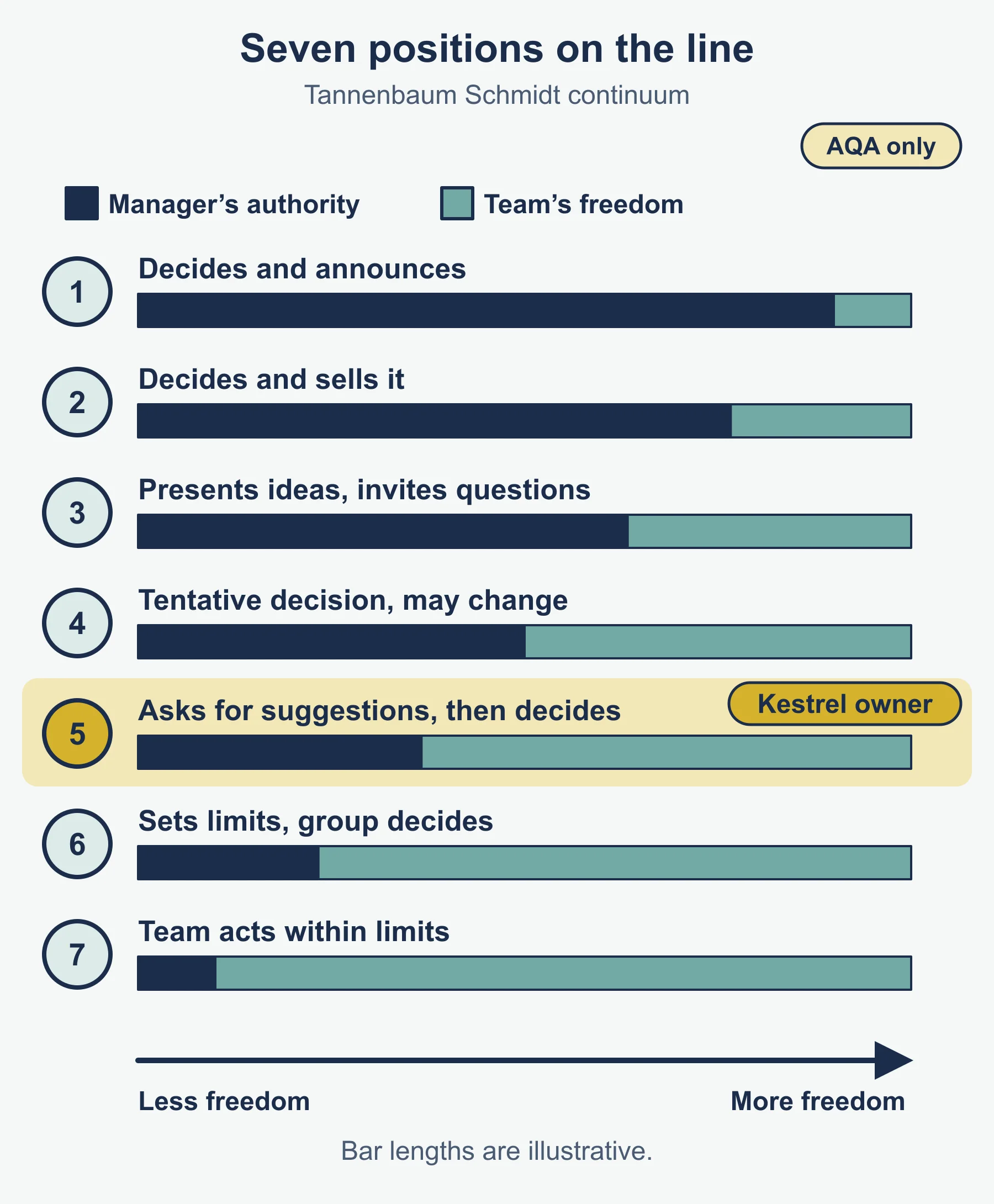
- A line, not boxes. At one end the manager uses authority and decides alone. At the other the team has freedom to decide within limits.
- As freedom for the team rises, the manager’s use of authority falls.
- The theory says the right position depends on the manager, the team and the situation.
Standard seven-position summary (not a quotation):
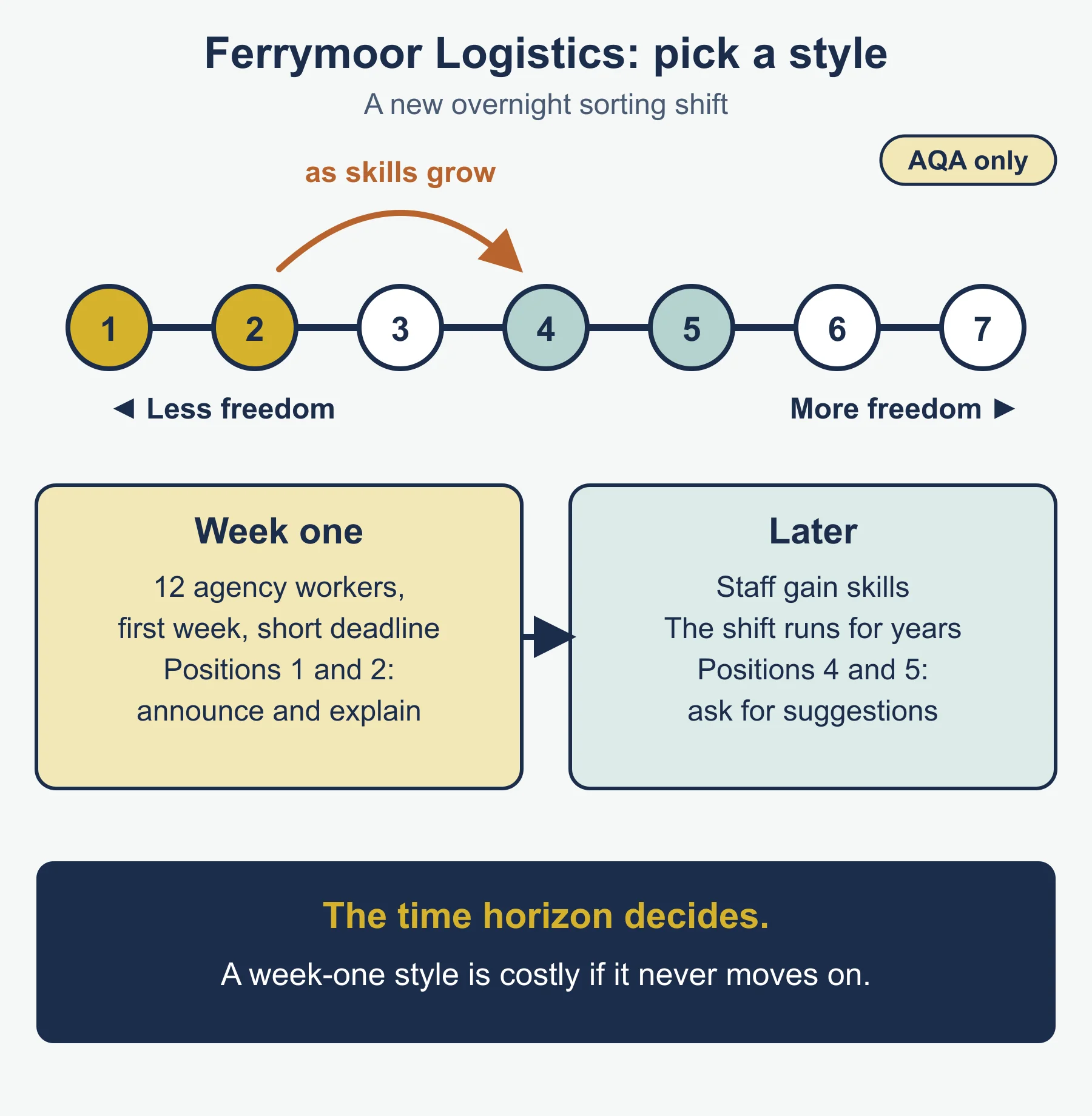
| Position | Manager behaviour |
|---|---|
| 1 | Decides and announces |
| 2 | Decides and persuades (“sells”) |
| 3 | Presents ideas, invites questions |
| 4 | Presents a tentative decision open to change |
| 5 | Presents the problem, takes suggestions, then decides |
| 6 | Sets the limits, the group decides |
| 7 | Team acts freely within defined limits |
Quick method for placing a manager
- Ask: who makes the final decision?
- Ask: was the staff view sought before or after the decision?
- Ask: how much freedom is left to the team?
- Name the position (or range) and quote the evidence.
Blake Mouton grid (background, not in the current specification)
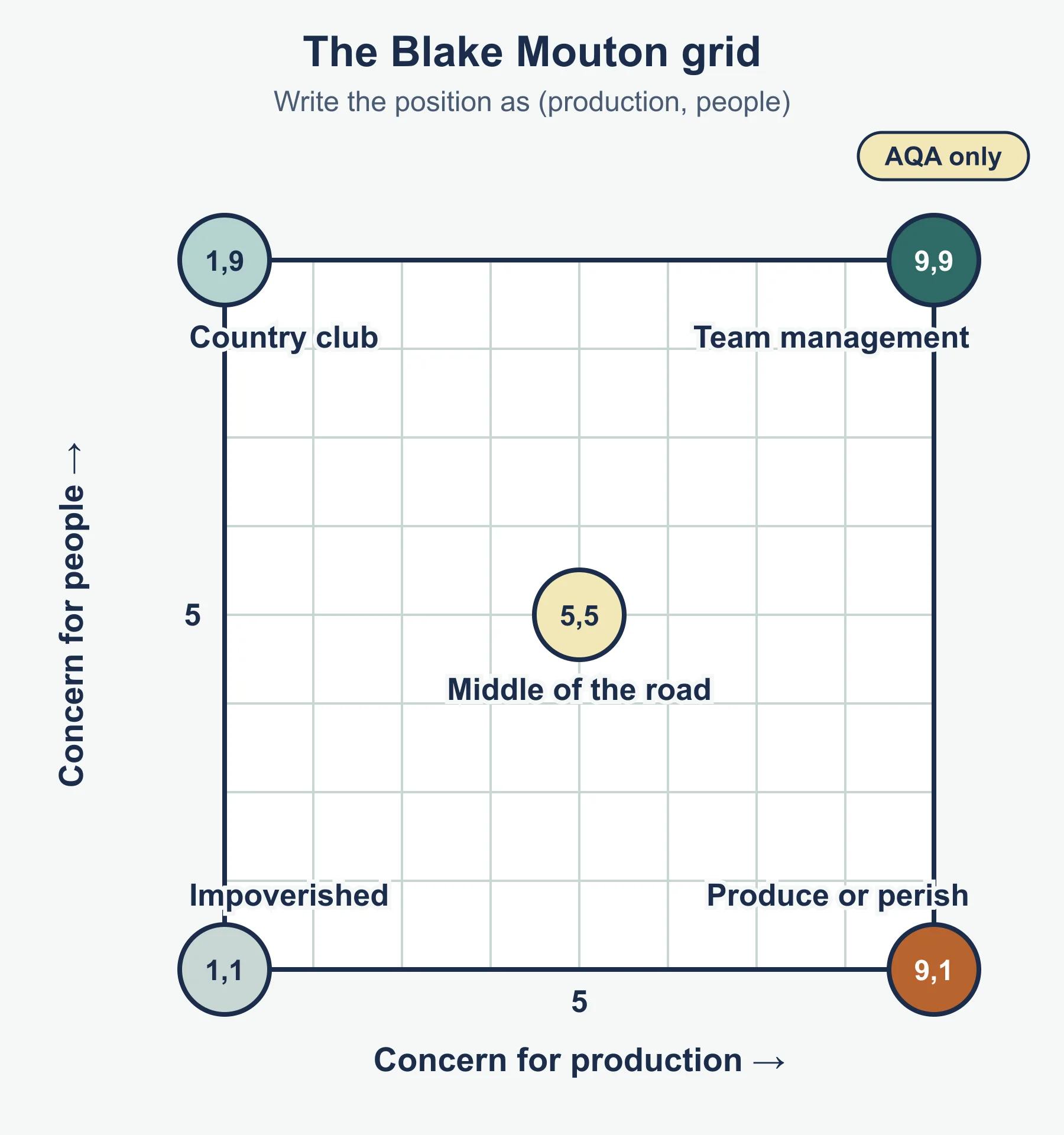
- Two axes, each scored 1 to 9: concern for production and concern for people.
- Write the score as (production, people). The order matters: (9,1) is not (1,9).
| Position | Name (standard form) | Meaning |
|---|---|---|
| (1,1) | Impoverished | Minimal effort on both |
| (9,1) | Produce or perish | Task first, people as a means |
| (1,9) | Country club | People first, results weak |
| (5,5) | Middle of the road | Compromise, neither fully met |
| (9,9) | Team management | High on both |
Quick method for scoring a manager
- Collect evidence on the task: targets, monitoring, deadlines.
- Collect evidence on people: training, listening, support.
- Give each a score from 1 to 9 and write them in the right order.
- Check the evidence is enough. A single email is thin evidence.
Continuum against grid
| Tannenbaum Schmidt continuum | Blake Mouton grid | |
|---|---|---|
| Focus | Who decides, and how much freedom the team has | How much the manager cares about the task and the people |
| Shape | One line | Two scales |
| Question answered | How should decisions be made here? | What is the manager’s orientation? |
| Link | A (9,9) manager can sit anywhere along the continuum, depending on the decision |
A good answer can use both. For example: a manager at position 2 on the continuum who spends time on people’s welfare may fit (7,6), not (9,1).
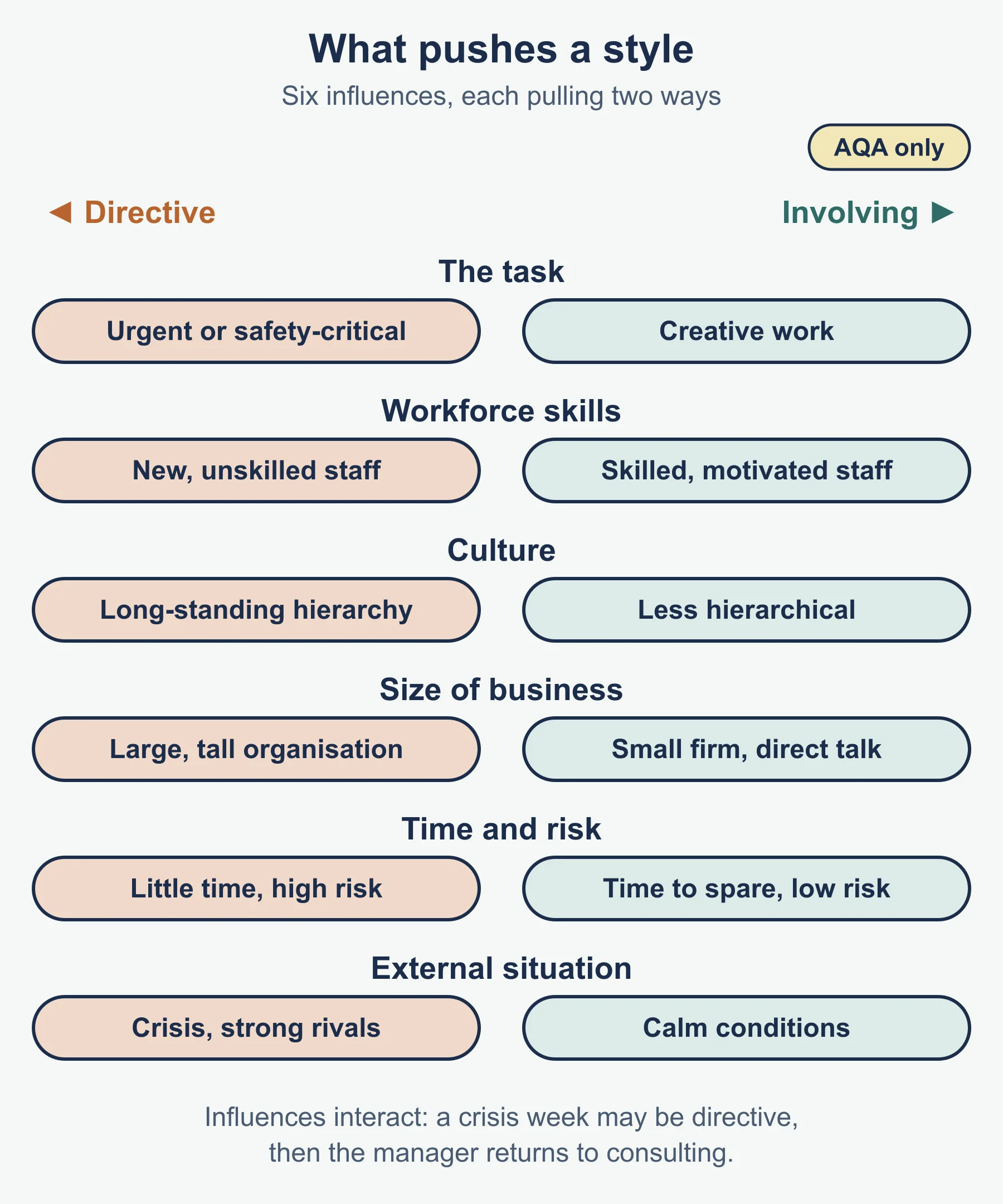
Influences on style
Group them to remember them.
- The task: urgency, risk, complexity, safety.
- The people: skills, experience, motivation, size of the team.
- The manager: personality, beliefs about people, own skills.
- The organisation: culture, size, structure, history.
- The situation: crisis, competition, labour market, time available.
Effectiveness: a ready-made argument frame
- Define the measure: output, quality, turnover, speed of decision, staff motivation.
- Give the case for the style, using case evidence.
- Give the case against, using case evidence.
- Add the context: skills of staff, time available, risk, culture.
- Judge: which style, for which period, because of which factor.
Small reminders, with checked calculations in the standard forms:
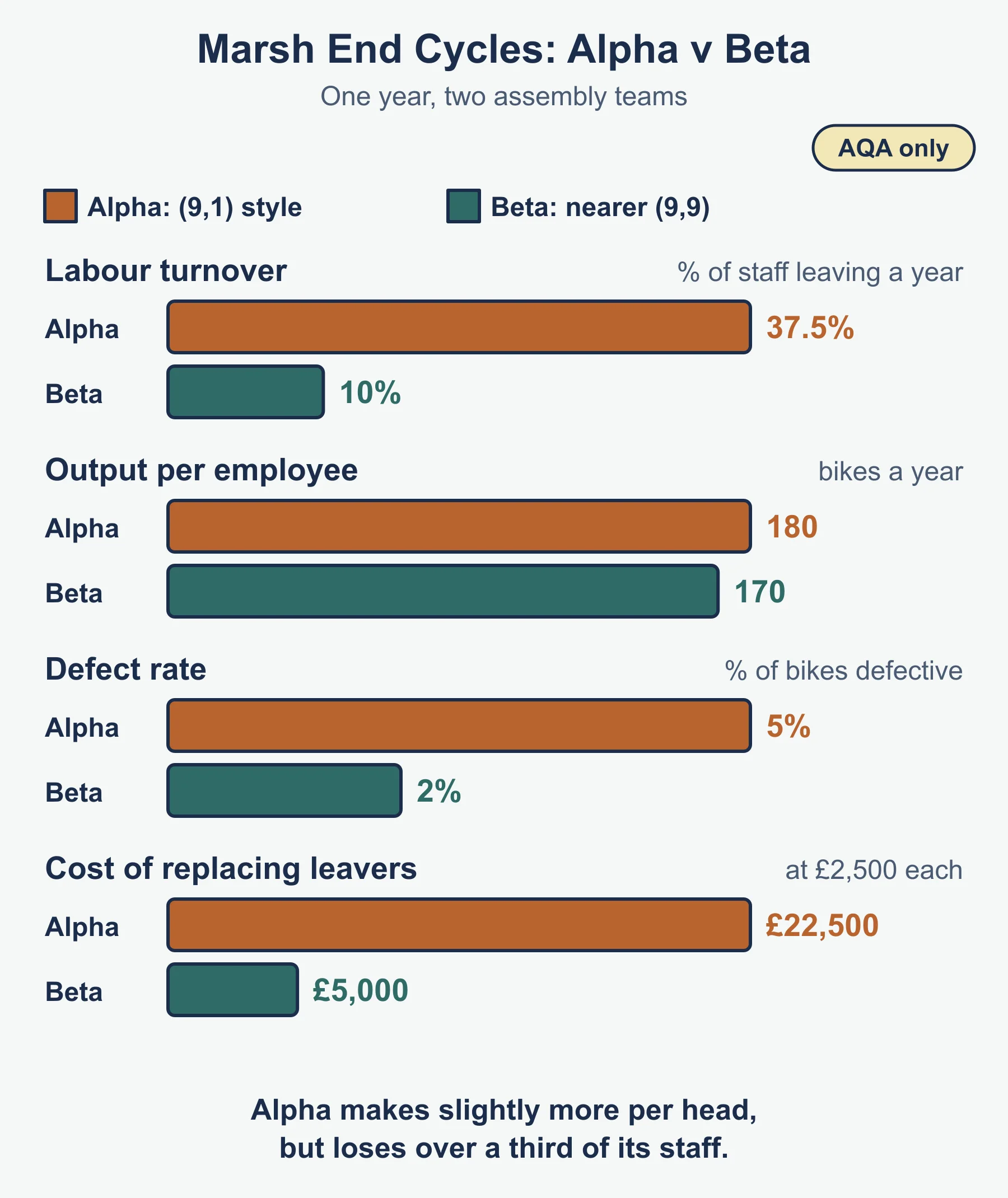
- Labour turnover = leavers ÷ average staff × 100. Example: 6 leavers from an average of 30 staff = 20%.
- Output per employee = output ÷ average staff. Example: 5,400 units from 30 staff = 180 units each.
Worked reminder: one case, three tools
Bexley Reach Print has a new production manager. In her first month she sets weekly output targets, checks them daily, holds a ten-minute briefing each morning, and asks the press operators which jobs jam the machines before she rewrites the schedule. She keeps the final say on the schedule.
- Manager’s role. Setting objectives (weekly targets), analysing (asking about jams), leading (the briefings), making decisions (the new schedule), reviewing (the daily check).
- Continuum. She asks for suggestions and then decides, so position 5.
- Grid. High concern for production (targets, daily checks), fairly high concern for people (briefings, listening), so roughly (8,6) on the evidence given. Say “roughly”, because one month is little evidence.
- Effectiveness. Likely strengths: the operators’ knowledge shapes the schedule, and the targets stay clear. A risk is that the daily checks feel like pressure. A fair judgement is that the style suits a skilled press crew, and a month is too soon to call it effective until turnover and output have been tracked over time.
Must-know distinctions
| Idea A | Idea B | The difference |
|---|---|---|
| Autocratic | Paternalistic | Both decide alone, but the paternalistic leader explains and acts for staff welfare |
| Democratic | Laissez-faire | The democratic leader joins in the decision. The laissez-faire leader steps back |
| Concern for production | Concern for people | Task results against staff needs |
| Continuum | Grid | Decision sharing against manager orientation |
| Management | Leadership | The specification asks you to distinguish management from leadership |
Quick self-test
- State one difference between management and leadership.
- At which end of the Tannenbaum Schmidt continuum does the manager use most authority?
- What do the two axes of the Blake Mouton grid measure?
- Which grid position is “country club”?
- A manager announces a new shift pattern and then explains the reasons to staff. Which continuum position is closest?
- Give two influences on the style a manager uses.
- A team has an average of 40 staff and 6 leavers in the year. Calculate labour turnover.
- A depot sorts 31,200 parcels with an average of 26 staff. Calculate output per employee.
- Give one reason an autocratic style might be effective.
- Why is “democratic is best” a weak evaluative statement?
Answers
- Management is about planning, organising and controlling resources to meet objectives; leadership is about setting direction and inspiring people to follow it.
- The end where the manager decides alone and announces (positions 1 and 2 in the standard seven-position form).
- Concern for production (the task) and concern for people.
- (1,9).
- Position 2, where the manager decides and then persuades or explains.
- Any two from: urgency of the task, skills of the workforce, the manager’s personality, organisational culture, size of the business, time available, level of risk.
- 6 ÷ 40 × 100 = 15%.
- 31,200 ÷ 26 = 1,200 parcels per employee.
- It is quick and clear, which helps in a crisis or with new staff who need instruction.
- It ignores the context. Effectiveness depends on staff skills, time, risk and what the business is trying to achieve.
Where marks are usually lost
- Treating management and leadership as the same thing when a question asks for the distinction.
- Describing a style but never judging whether it suits this case.
- Writing a grid score in the wrong order, or giving only one number.
- Treating the continuum as four styles instead of a line.
- Claiming (9,9) is always best, without considering time, skills and cost.
- Using the words “motivated” or “demotivated” with no evidence from the case, such as turnover or output.
- Mixing up the authority held by the manager with the freedom held by the team, and so reading the continuum backwards.
- Drawing a conclusion from one measure only, such as output per employee, and ignoring quality and turnover.
- Writing a conclusion that repeats the points made and does not reach a judgement.
Frequently asked questions
What do the two axes of the Blake Mouton grid measure? One axis measures concern for production (the task) and the other measures concern for people, each scored from 1 to 9.
Which Blake Mouton position is “country club”? (1,9): low concern for production and high concern for people.
What influences a manager’s style? The task (urgency, risk, complexity), the people (skills, experience, team size), the manager (personality and beliefs), the organisation (culture, size, structure) and the situation (crisis, competition, time available).
Why is “democratic is best” a weak evaluative statement? It ignores the context. Whether a style is effective depends on staff skills, the time available, the risk involved and what the business is trying to achieve.
Official syllabus
AQA AS and A-level Business specification (7131/7132), section 3.2.1 Understanding management, leadership and decision making. For first teaching from September 2023 (A-level 7132).
Get free revision emails (optional)
Occasional emails with practice questions, worked explanations and links to free resources for the qualification and subjects you choose. No spam, and you can unsubscribe from any email. The free tools on this site never need an email.
Related resources
-
Study guides
AQA A-Level Business: Understanding the role and importance of stakeholders (7132)
Study guide to AQA A-level Business section 3.2.3: stakeholder needs, power and interest mapping, conflict, influences and managing relationships.
Business · AQA · A Level
Read guide -
Practice questions
AQA A-Level Business: Understanding the role and importance of stakeholders (7132) – Practice Questions
Ten original AQA A-level Business questions on 3.2.3 stakeholders, with worked answers, examiner insights and short case studies.
Business · AQA · A Level
Try questions -
Revision notes
AQA A-Level Business: Understanding the role and importance of stakeholders (7132) – Revision Notes
Condensed AQA A-level Business revision notes on 3.2.3 stakeholders: mapping, needs, conflict, influences, communication, consultation, self-test.
Business · AQA · A Level
Revise topic
Related articles
-
teaching
A Level tuition in Dubai: Cambridge or Pearson Edexcel International A Level?
Schools in Dubai and Abu Dhabi teach either Cambridge International AS & A Level or Pearson Edexcel International A Level. How the two are structured, why it matters for tuition, and how online classes from Lahore work.
9 October 2026
-
curriculum guides
Choosing subjects at IGCSE and A Level
How subject choices at 14 and 16 affect university options later, and how to keep pathways open without overloading a timetable.
28 July 2026
Studying this with a teacher
Working through Business A LEVELS?
This page is free and stays free. If you would rather be taught it, Marlbridge runs Business classes one-to-one and in small groups of up to 15, online in your own time zone. The first trial class is free. WhatsApp replies within an hour (8am–11pm Pakistan time, every day); email the same day.
AQA Business teachers at Marlbridge
