
Study Guides
AQA A-Level Business: Understanding management, leadership and decision making (7132)
A full study guide to AQA A-Level Business (7132) section 3.2.1: management and leadership, styles, Tannenbaum Schmidt and judging style effectiveness.
- Subject
- Business
- Level
- A LEVELS
- Topic
- Managers, leadership and decision making
- Author
- Marlbridge Academic Team
- Updated
- Reviewed by
- Salman Ahmad (what this means)
Aligned to AQA A Level Business (7132), For first teaching from September 2023. Official specification .
Syllabus page (what it covers and how it is assessed): AQA A Level Business.
Syllabus points this page covers
7132
- 3.2.1 Understanding management, leadership and decision making
Found an error? Report a correction.
Need help with this topic? Request a free trial class for A Level Business (7132).
This guide covers section 3.2.1, Understanding management, leadership and decision making, from the AQA AS and A-level Business specification (7131/7132) for AQA A-level Business (7132). It teaches the content the section lists: the distinction between management and leadership, types of management and leadership styles (autocratic, paternalistic, democratic and laissez-faire) and the influences on them, the named theory (the Tannenbaum Schmidt continuum), and the effectiveness of different styles. The current specification (version 2.0, June 2023) no longer lists the role of managers or the Blake Mouton grid, which the 2015 version did. Both are kept below as background only and are marked as such.
Use it with the revision notes and the practice questions. Earlier pages on the wider topic are the topic study guide, the topic revision notes and the topic practice paper. The course home is the AQA A-level Business hub and the printable list is the Business checklist. To find weak spots first, take a free diagnostic.
What this section covers
| Content point in 3.2.1 | What you need to be able to do |
|---|---|
| Management and leadership | Distinguish management from leadership (the five manager activities below are background, not a listed content point) |
| Types of management and leadership styles and influences on these | Describe styles and explain what pushes a business towards one |
| Theory of styles | Use the Tannenbaum Schmidt continuum (the Blake Mouton grid is background only) |
| Effectiveness of different styles | Judge which style works best in a given situation |
What managers do (background)
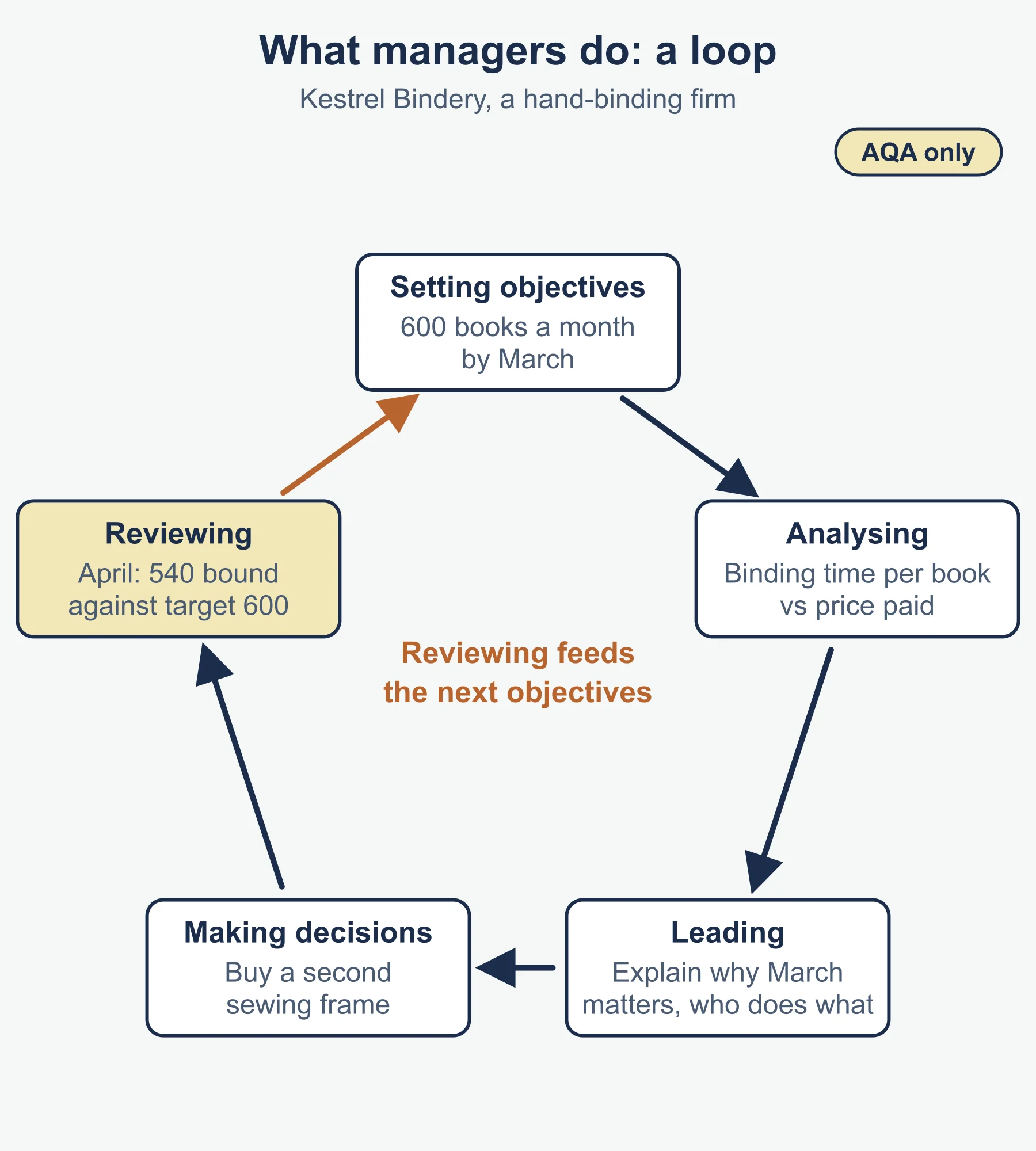
The current specification does not list the role of managers; the 2015 version did. The five activities below are a standard way of describing it and help when you distinguish management from leadership. They form a loop, not a list. Reviewing feeds back into the next round of objectives.
| Activity | What it means | Example in a small firm |
|---|---|---|
| Setting objectives | Deciding what the team or business is trying to achieve, with targets that can be measured | Kestrel Bindery, a hand-binding firm, aims to bind 600 books a month by March |
| Analysing | Examining information to understand the situation and the options | The manager compares binding time per book with the price customers will pay |
| Leading | Guiding, motivating and directing people towards the objectives | Explaining why the March target matters and who does which task |
| Making decisions | Choosing between courses of action | Choosing to buy a second sewing frame rather than hire another binder |
| Reviewing | Checking results against objectives and learning from the gap | In April, comparing 540 books bound against the target of 600 and asking why |
Two points help in exam answers. First, the activities overlap. A manager who reviews results is also analysing. Second, “leading” is one of the five, so leadership is part of management in this model. When a question asks you to analyse a manager’s role, link each activity to the case rather than listing the five words.
Management and leadership styles
A style is the typical way a manager or leader behaves towards the people they work with: how much they decide alone, how much they involve others, and how much they focus on the task compared with the people. The specification asks for types of style, and the two named theories describe them from different angles.
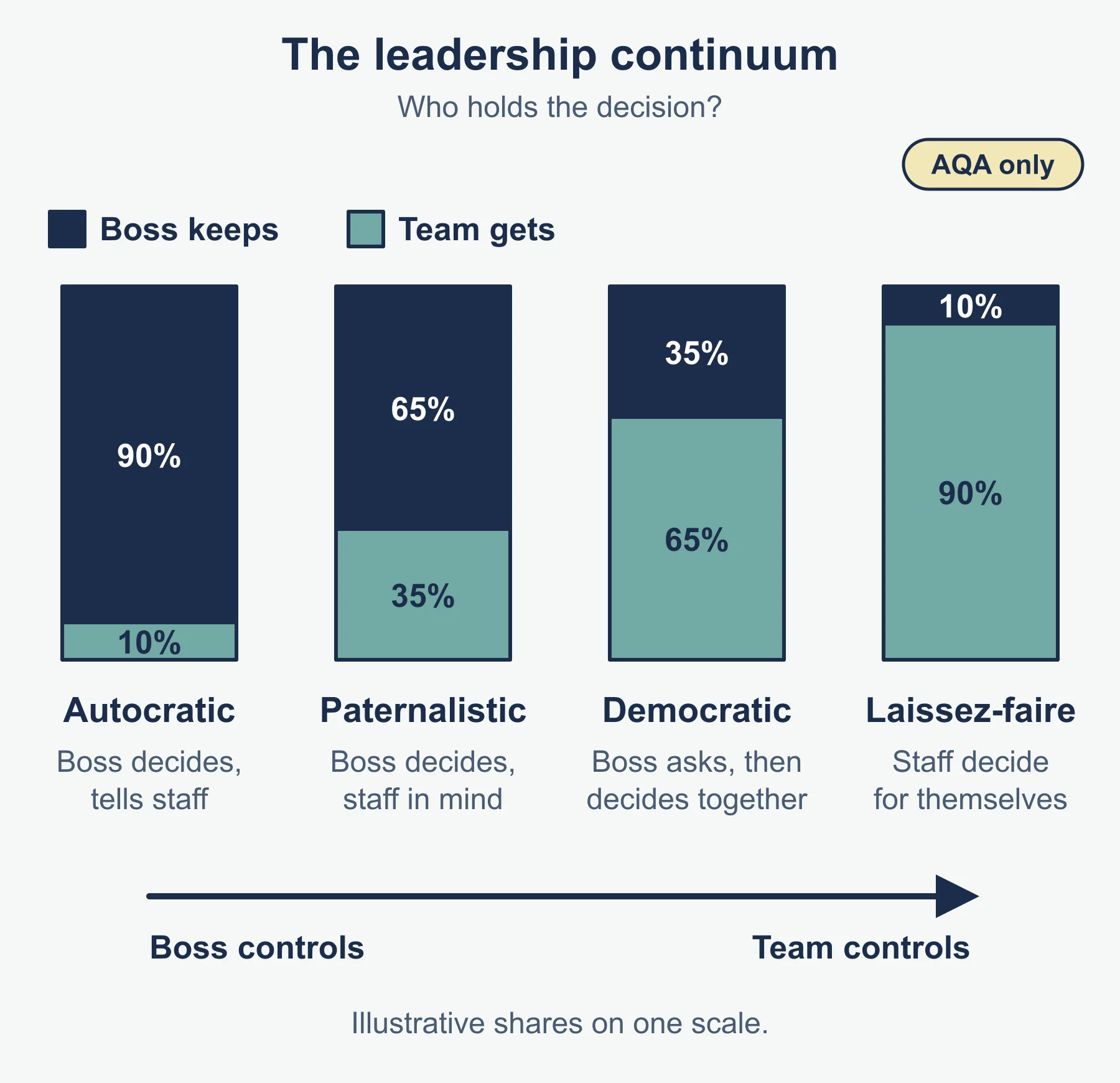
The specification names four styles.
- Autocratic: the manager decides and expects instructions to be followed. Fast and clear, but little involvement.
- Paternalistic: the manager decides but explains the decision and acts in what they believe is the employees’ interest.
- Democratic: the manager involves staff in the decision and may go with the group view. Slower, but draws on more ideas.
- Laissez-faire: the manager sets limits and leaves staff to decide how to work. Suits capable, self-directed people.
You will see how these map on to the theories below.
The Tannenbaum Schmidt continuum
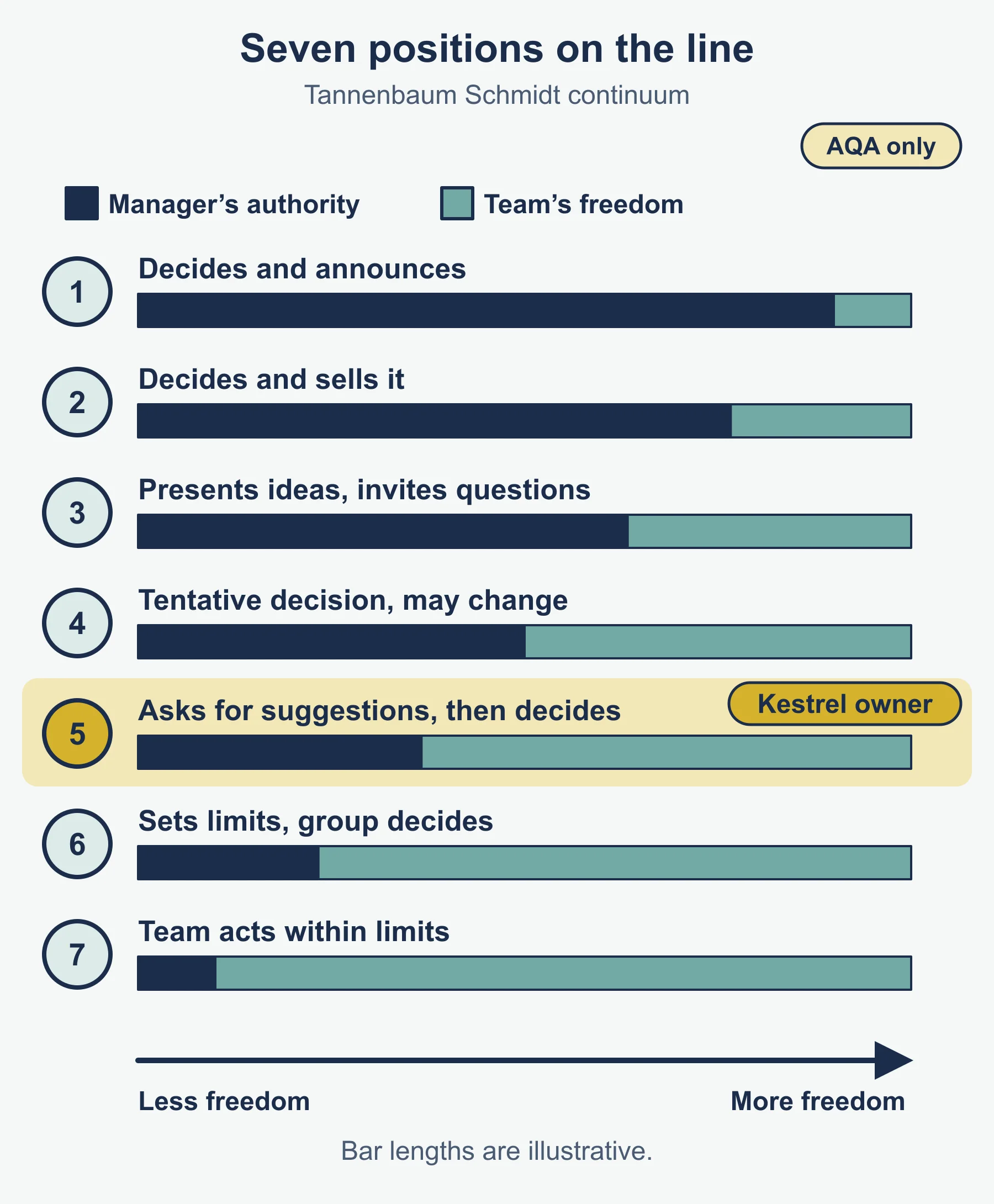
The continuum shows leadership behaviour as a line, not as separate boxes. At one end the manager uses authority and makes the decision alone. At the other end the team has freedom to decide within limits the manager sets. As the manager moves along the line, the manager uses less authority and the team has more freedom.
The standard form of the continuum has seven positions. The wording below is a standard summary, not a quotation.
| Position | Manager behaviour |
|---|---|
| 1 | Makes the decision and announces it |
| 2 | Makes the decision and “sells” it, persuading staff it is right |
| 3 | Presents ideas and invites questions |
| 4 | Presents a tentative decision that may be changed |
| 5 | Presents the problem, gets suggestions, then decides |
| 6 | States the limits and asks the group to decide |
| 7 | Lets the team act within limits the manager has defined |
Positions 1 and 2 sit close to autocratic and paternalistic behaviour. Positions 3 to 5 are consultative and shade into democratic. Positions 6 and 7 move towards laissez-faire, though still within limits. The theory also stresses that the right position depends on the manager, the team and the situation. There is no single best point on the line.
Worked example: placing a manager on the continuum
At Kestrel Bindery the owner needs to change the weekend working pattern. She tells the three binders: “Here are three possible rotas and the cost of each. Tell me what you think, then I will choose.” Where does this sit?
- She has not decided in advance, so she is not at position 1 or 2.
- She presents the options and asks for views (this is position 5, since she asks for suggestions or opinions).
- She keeps the final decision, so she is not at position 6 or 7.
So this is position 5, a consultative style that keeps authority with the owner. A suitable evaluation point: it uses the binders’ knowledge of the workshop but takes longer than announcing a rota.
The Blake Mouton grid (background, not in the current specification)
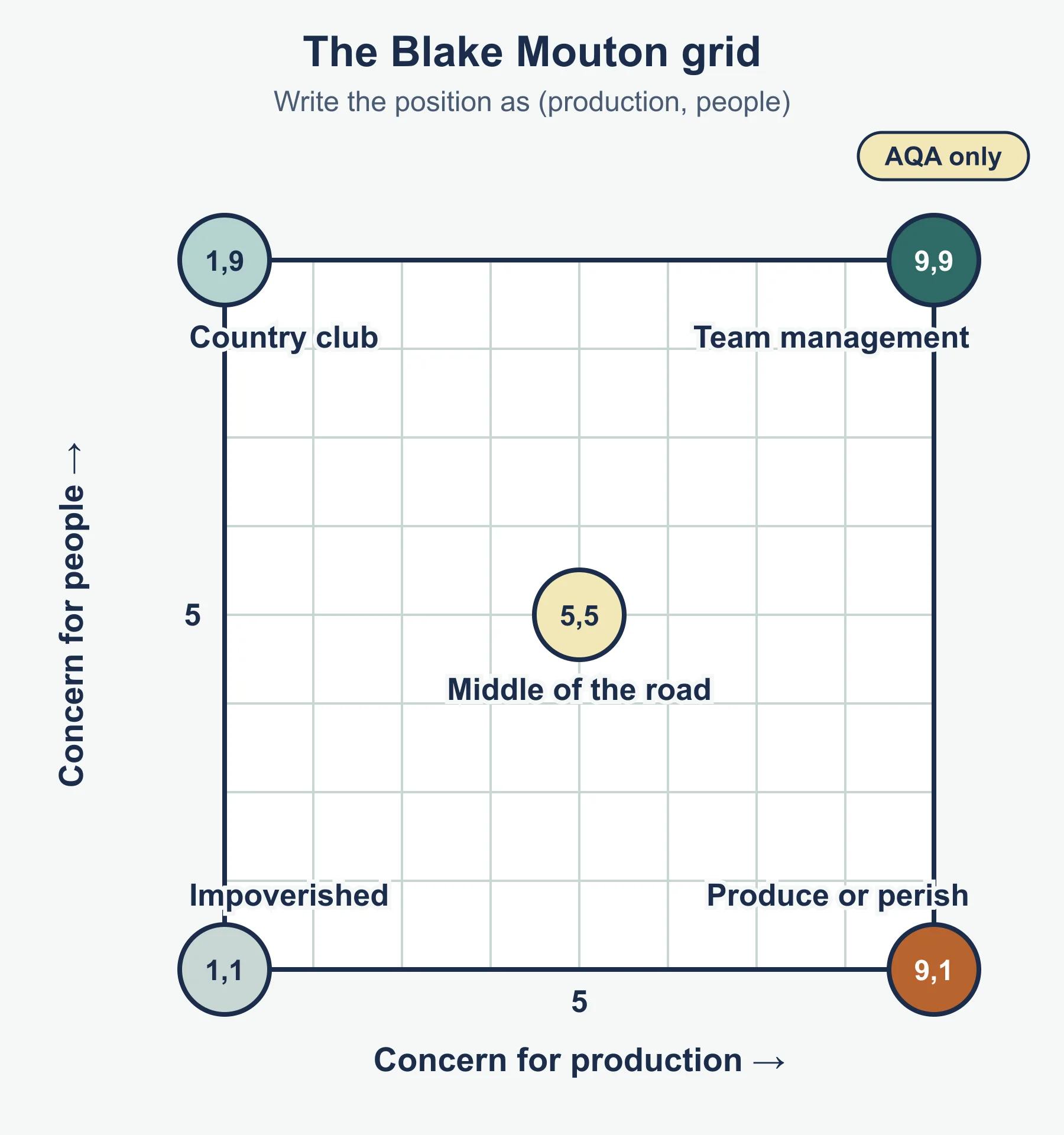
The current specification names only the Tannenbaum Schmidt continuum, so you will not be asked about this grid directly. It can still support an evaluation of style. The grid plots a manager on two scales, each running from 1 (low) to 9 (high): concern for production (the task, output and results) and concern for people (the needs, relationships and morale of staff). A position is written as (production, people).
| Grid position | Name (standard form) | Behaviour |
|---|---|---|
| (1,1) | Impoverished | Little concern for either. The manager does the minimum |
| (9,1) | Produce or perish (authority-compliance) | High task focus, people treated as a means to output |
| (1,9) | Country club | High concern for people, little pressure on results |
| (5,5) | Middle of the road | Balances the two by compromise, with neither fully met |
| (9,9) | Team management | High on both, with commitment built through shared goals |
The theory suggests (9,9) as the style to aim for, but a good answer treats this as a claim to test, not a fact. Reaching high scores on both takes time, skilled managers and a team that wants to engage.
Worked example: reading the grid from evidence
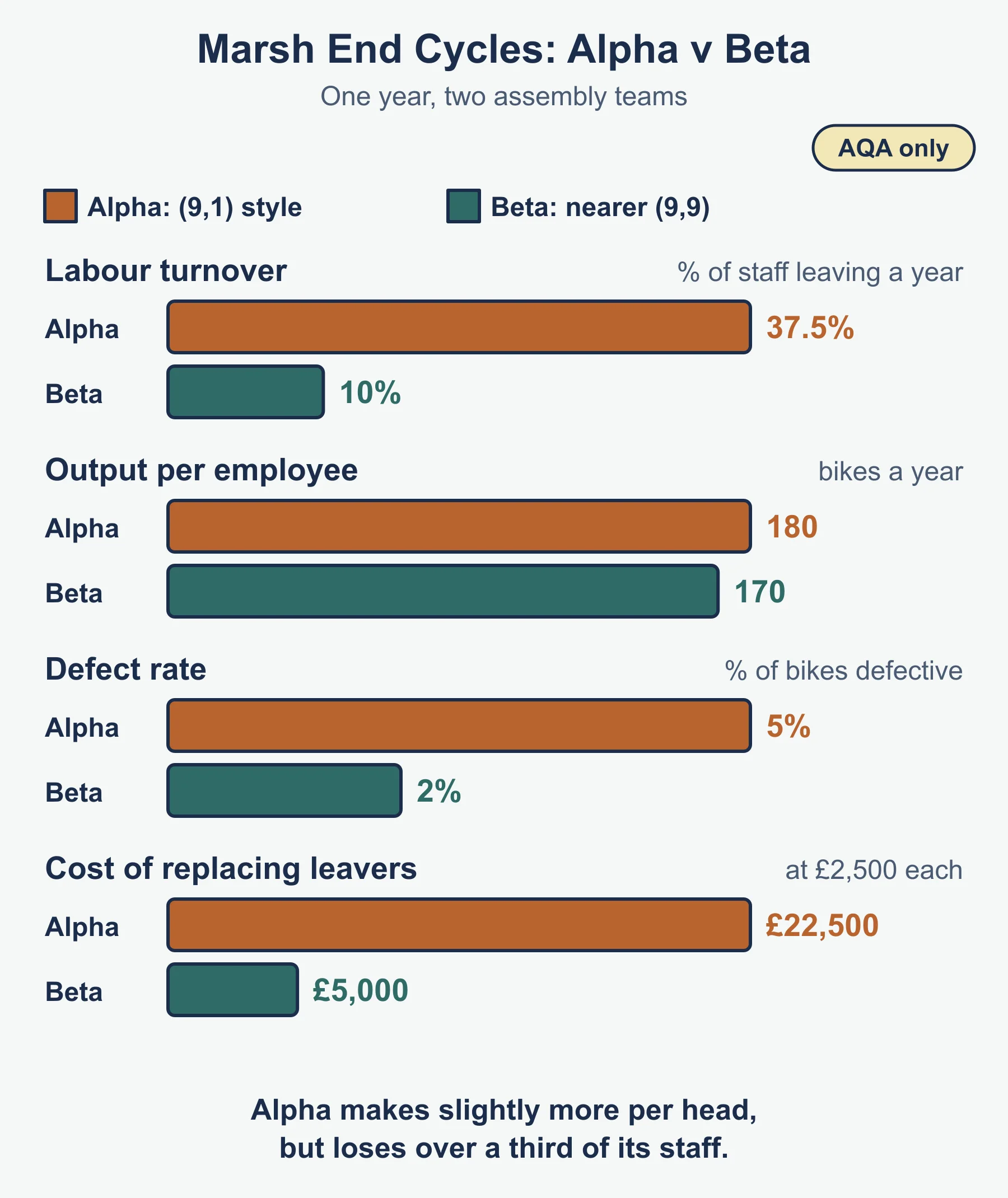
Marsh End Cycles has two assembly teams. Team Alpha’s manager checks hourly output, rarely speaks to staff about anything else, and has never held a team meeting. Team Beta’s manager sets monthly targets with the team and spends time on training and problems.
| Measure for the year | Alpha | Beta |
|---|---|---|
| Average staff | 24 | 20 |
| Leavers | 9 | 2 |
| Bikes assembled | 4,320 | 3,400 |
| Defective bikes | 216 | 68 |
Calculations (formulae are the standard forms):
- Labour turnover = leavers ÷ average staff × 100. Alpha: 9 ÷ 24 × 100 = 37.5%. Beta: 2 ÷ 20 × 100 = 10%.
- Output per employee = bikes ÷ average staff. Alpha: 4,320 ÷ 24 = 180. Beta: 3,400 ÷ 20 = 170.
- Defect rate = defective ÷ total × 100. Alpha: 216 ÷ 4,320 × 100 = 5%. Beta: 68 ÷ 3,400 × 100 = 2%.
- Good bikes per employee: Alpha (4,320 − 216) ÷ 24 = 171. Beta (3,400 − 68) ÷ 20 = 166.6.
Alpha looks like (9,1) and Beta nearer (9,9). Alpha produces slightly more per employee, and the gap shrinks once defects are removed (171 against 166.6). But Alpha loses more than a third of its staff each year. If replacing a leaver costs £2,500, Alpha spends £22,500 on replacement against £5,000 for Beta. The evidence supports Beta’s style for the long term. It does not prove it, since one year and two teams is thin evidence, and the teams may do different work.
Influences on management and leadership styles
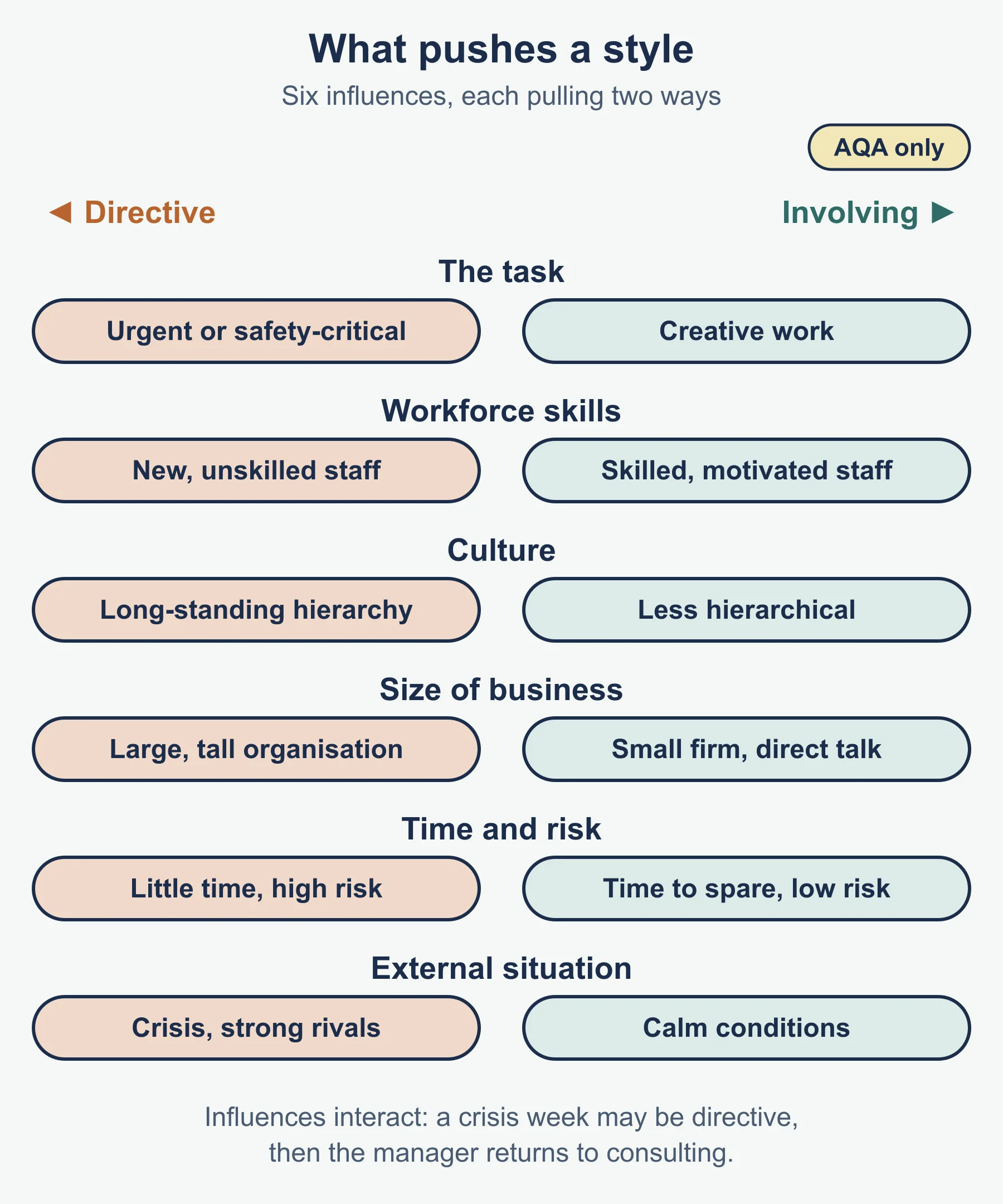
The specification asks for the influences on styles. These are the main ones, with the direction each pushes in.
- The task and its urgency. A safety-critical or time-pressed task pushes towards a directive style. A creative task favours involvement.
- Skills and experience of the workforce. Skilled, motivated staff can be trusted with more freedom. New staff may need clear instructions.
- The manager’s own personality, beliefs and skills. A manager who trusts people tends to delegate, while one who doubts staff tends to control.
- The culture of the business. A long-standing hierarchical culture makes a democratic style hard to introduce.
- Size and structure of the business. A tall, large organisation makes consultation costly. A small firm allows direct conversation.
- Time and the risk involved. Higher risk or less time pushes decisions up to the manager.
- The external situation, such as a crisis, strong competition or a labour market where staff can easily leave.
Influences interact. A strong manager in a skilled team facing a crisis may use a directive style for a week, then return to consultation.
The effectiveness of different styles
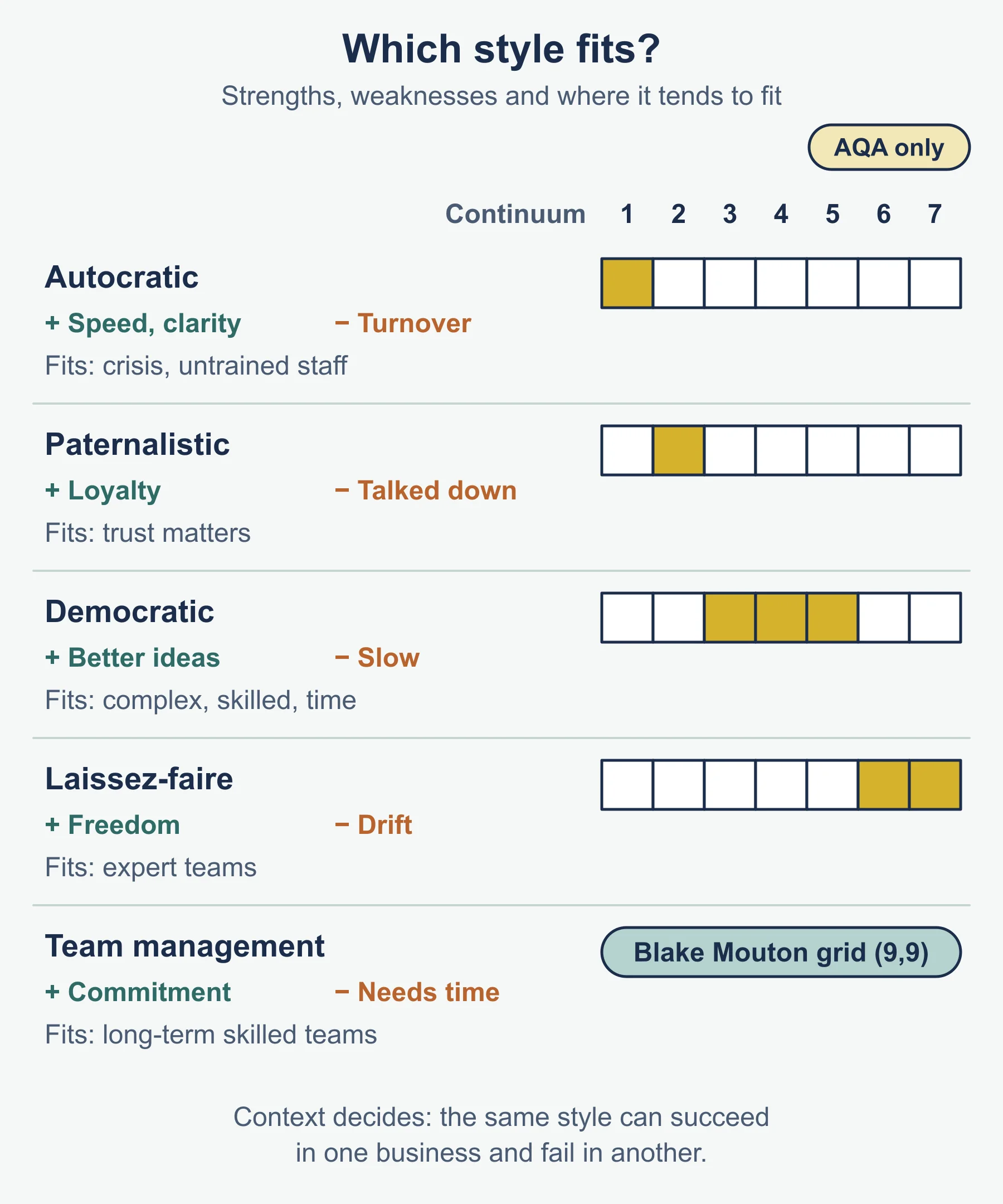
Effectiveness means how far a style helps the business meet its objectives. Judge it against evidence, not against what sounds pleasant. Useful measures are output, quality, labour turnover, absenteeism, speed of decisions and staff motivation.
| Style | Likely strengths | Likely weaknesses | Where it tends to fit |
|---|---|---|---|
| Autocratic (continuum 1, grid 9,1) | Speed, clarity, control | Low motivation, ideas unused, turnover | Crisis, untrained staff, simple routine work |
| Paternalistic (continuum 2) | Loyalty, a sense of being cared for | Staff may feel talked down to | Where trust matters and staff look for guidance |
| Democratic (continuum 3 to 5) | Better ideas, commitment to the decision | Slow, risk of compromise | Complex problems with skilled staff and time |
| Laissez-faire (continuum 6 to 7) | Freedom, creativity, development | Drift, inconsistent standards | Expert teams with clear objectives |
| Team management (grid 9,9) | High commitment and results | Needs time, skill and trust | Long-term, skilled teams |
Evaluation draws on several lines of argument.
- Context decides. The same style can succeed in one business and fail in another.
- Time matters. An autocratic style may bring quick results and costly turnover later.
- Mixed styles. Many managers move along the continuum depending on the decision.
- Measures are limited. Output may rise because of demand, not style.
Worked example: judging a style for a case
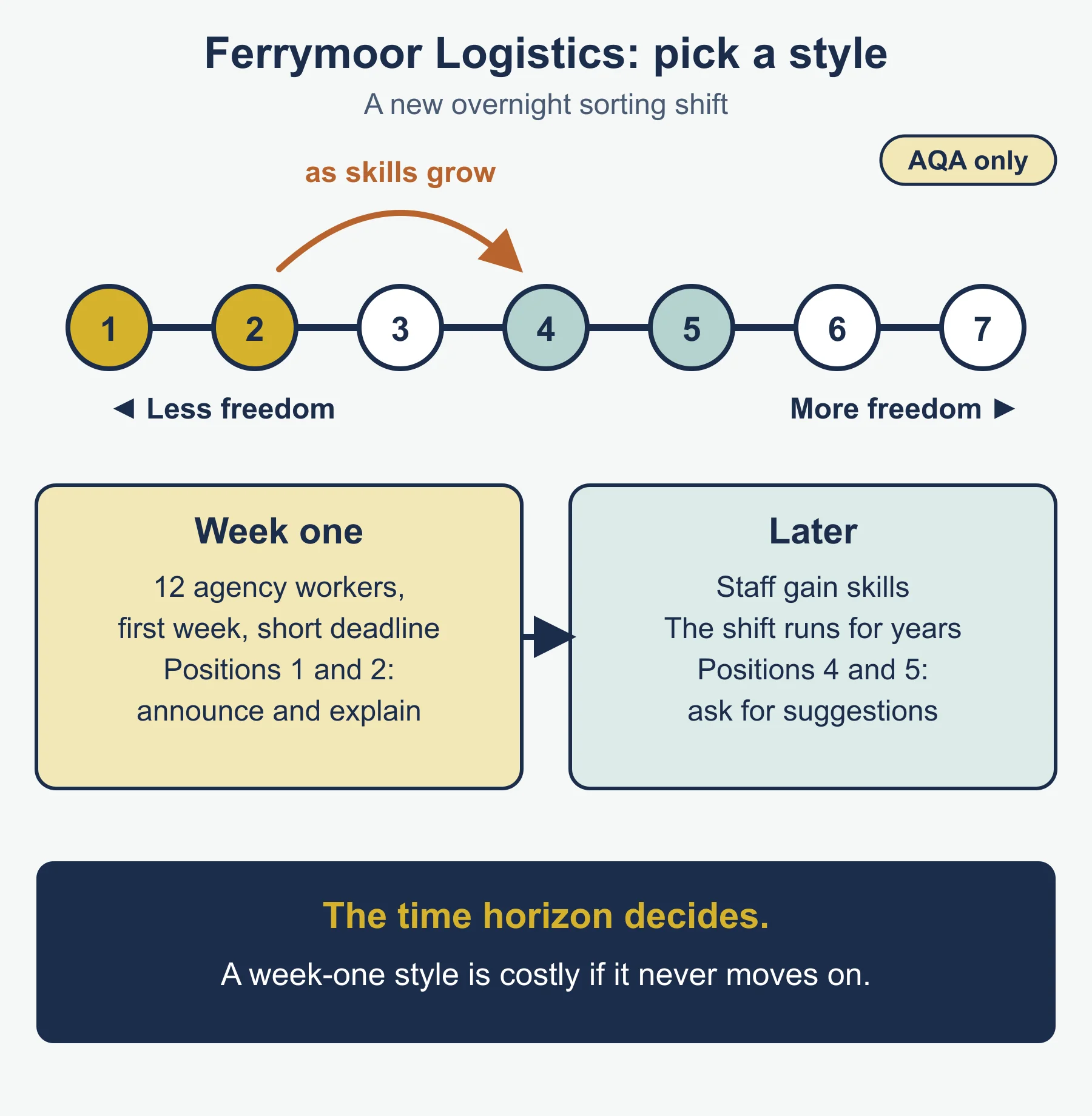
Ferrymoor Logistics is about to open an overnight sorting shift in a rush, staffed by 12 agency workers on their first week. Which style fits?
- The staff are new and untrained, so they need clear instructions (supports a directive style, continuum 1 or 2).
- The deadline is short, so there is no time for lengthy consultation.
- But the shift will run for years, and the depot will want staff to stay and suggest improvements.
- Judgement: begin with positions 1 and 2 on the continuum, with clear explanations of why, then move towards 4 and 5 as skills grow. The decisive factor is the time horizon: a style right for week one will be costly if it continues.
Common errors
- Writing “democratic is best” without tying it to the case.
- Treating the continuum as four boxes. It is a line of seven positions.
- Reading the grid as one score. You need both numbers, written in the order (production, people).
- Assuming (9,9) always works, or that a (9,1) manager must fail.
- Not separating management (planning, organising, controlling) from leadership (setting direction and inspiring people) when a question asks for the distinction.
- Saying a style “motivates” staff with no evidence such as turnover or output.
- Confusing management and leadership styles with decision making methods, which belong to 3.2.2.
Frequently asked questions
What is the difference between autocratic, paternalistic, democratic and laissez-faire styles? An autocratic manager decides and expects instructions to be followed. A paternalistic manager decides but explains and acts in what they believe is employees’ interest. A democratic manager involves staff and may go with the group view, and a laissez-faire manager sets limits and leaves staff to decide how to work.
Is (9,9) always the best Blake Mouton position? The theory suggests (9,9) as the style to aim for, but a good answer treats this as a claim to test rather than a fact, because reaching high scores on both scales takes time, skills and cost.
How many positions does the Tannenbaum Schmidt continuum have? The standard form has seven positions. Positions 1 and 2 sit close to autocratic and paternalistic behaviour, and positions 3 to 5 are consultative and shade into democratic.
How do you place a manager on the Tannenbaum Schmidt continuum? Ask who makes the final decision, whether staff views were sought before or after it, and how much freedom is left to the team, then name the position and quote the evidence.
Official syllabus
AQA AS and A-level Business specification (7131/7132), section 3.2.1 Understanding management, leadership and decision making. For first teaching from September 2023 (A-level 7132).
Get free revision emails (optional)
Occasional emails with practice questions, worked explanations and links to free resources for the qualification and subjects you choose. No spam, and you can unsubscribe from any email. The free tools on this site never need an email.
Related resources
-
Practice questions
AQA A-Level Business: Understanding management, leadership and decision making (7132) – Practice Questions
Original practice questions with worked answers on AQA A-Level Business (7132) 3.2.1: Tannenbaum Schmidt, leadership styles and their effectiveness.
Business · AQA · A Level
Try questions -
Revision notes
AQA A-Level Business: Understanding management, leadership and decision making (7132) – Revision Notes
Condensed revision notes for AQA A-Level Business (7132) 3.2.1: management and leadership, styles, Tannenbaum Schmidt, style influences and a self-test.
Business · AQA · A Level
Revise topic -
Study guides
AQA A-Level Business: Understanding the role and importance of stakeholders (7132)
Study guide to AQA A-level Business section 3.2.3: stakeholder needs, power and interest mapping, conflict, influences and managing relationships.
Business · AQA · A Level
Read guide
Related articles
-
teaching
A Level tuition in Dubai: Cambridge or Pearson Edexcel International A Level?
Schools in Dubai and Abu Dhabi teach either Cambridge International AS & A Level or Pearson Edexcel International A Level. How the two are structured, why it matters for tuition, and how online classes from Lahore work.
9 October 2026
-
curriculum guides
Choosing subjects at IGCSE and A Level
How subject choices at 14 and 16 affect university options later, and how to keep pathways open without overloading a timetable.
28 July 2026
Studying this with a teacher
Working through Business A LEVELS?
This page is free and stays free. If you would rather be taught it, Marlbridge runs Business classes one-to-one and in small groups of up to 15, online in your own time zone. The first trial class is free. WhatsApp replies within an hour (8am–11pm Pakistan time, every day); email the same day.
AQA Business teachers at Marlbridge
