
Study Guides
AQA A-Level Business: Understanding management decision making (7132)
Study guide to AQA A-Level Business 3.2.2: data versus intuition, decision trees, expected value, net gain, risk, opportunity cost and influences.
- Subject
- Business
- Level
- A LEVELS
- Topic
- Managers, leadership and decision making
- Author
- Marlbridge Academic Team
- Updated
- Reviewed by
- Salman Ahmad (what this means)
Aligned to AQA A Level Business (7132), For first teaching from September 2023. Official specification .
Syllabus page (what it covers and how it is assessed): AQA A Level Business.
Syllabus points this page covers
7132
- 3.2.2 Understanding management decision making
Found an error? Report a correction.
Need help with this topic? Request a free trial class for A Level Business (7132).
This guide teaches section 3.2.2, Understanding management decision making, from the AQA AS and A-level Business specification (7132, A-level). It follows the wording of the specification’s subject content. It is part of the topic Managers, leadership and decision making, which also covers leadership styles and stakeholders. All businesses and figures below are invented.
For condensed recall use the revision notes, then test yourself with the practice questions. The topic-level pages are the topic study guide, topic revision notes and topic practice paper. Course links: Business hub, checklist and the free diagnostics.
What the specification asks for
| Content point | What you must be able to do |
|---|---|
| Value of decision making based on data (scientific) and on intuition | Explain what each is worth, and when each suits a business |
| Scientific decision making | Understand and interpret decision trees; calculate expected value and net gains |
| Decision making and risks, rewards, uncertainty, opportunity cost | Use each idea correctly in a decision |
| Use and value of decision trees | Explain what trees offer and where they fall short |
| Influences on decision making | Mission, objectives, ethics, the external environment including competition, resource constraints |
Scientific decision making and intuition
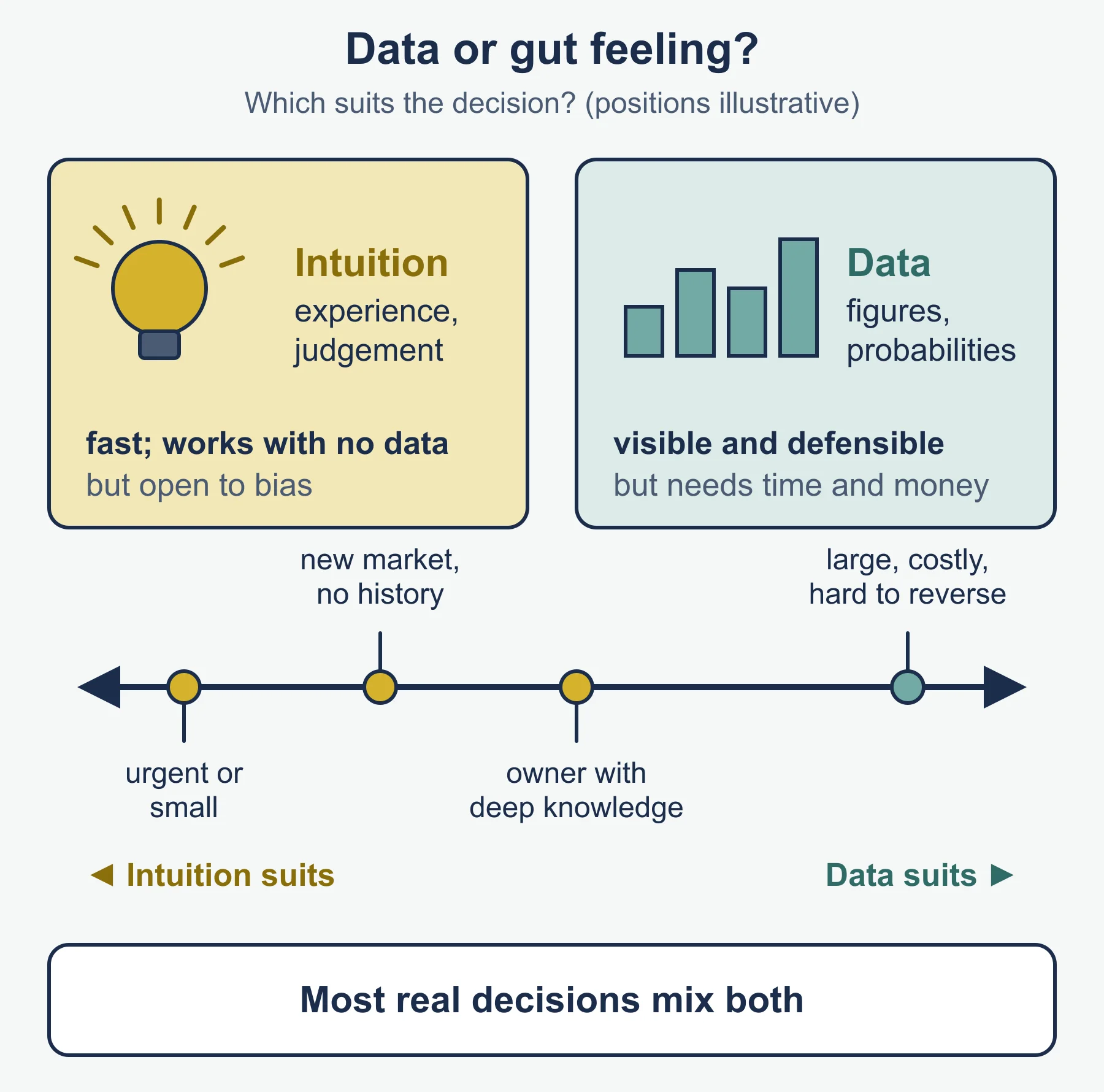
Scientific decision making bases a choice on data: sales figures, market research, costs, estimated probabilities. The method is to set out the options, put numbers on the possible outcomes, and compare. Decision trees are the specification’s named tool.
Intuition means deciding on judgement, gut feeling and experience, without a formal analysis.
| Data-based (scientific) | Intuition | |
|---|---|---|
| Value | Makes assumptions visible; options can be compared and defended to lenders or owners; less dependent on one person’s mood | Fast; works where no reliable data exist; draws on experience that is hard to put into numbers |
| Weakness | Needs data, time and money; only as good as the figures fed in; can ignore what cannot be measured | Hard to justify to others; open to bias and overconfidence; experience may not fit a new situation |
| Suits | Large, costly, hard-to-reverse choices where data can be gathered | Urgent or small decisions, new markets with no history, owner-managers with deep knowledge |
Most real decisions mix the two. A manager may calculate, then override the result because the numbers miss something. An exam answer gains by saying which suits this business and why, not by declaring one approach always better.
Risk, reward, uncertainty and opportunity cost
Keep these four ideas separate. The specification names them without defining them, so the meanings below are the standard ones.
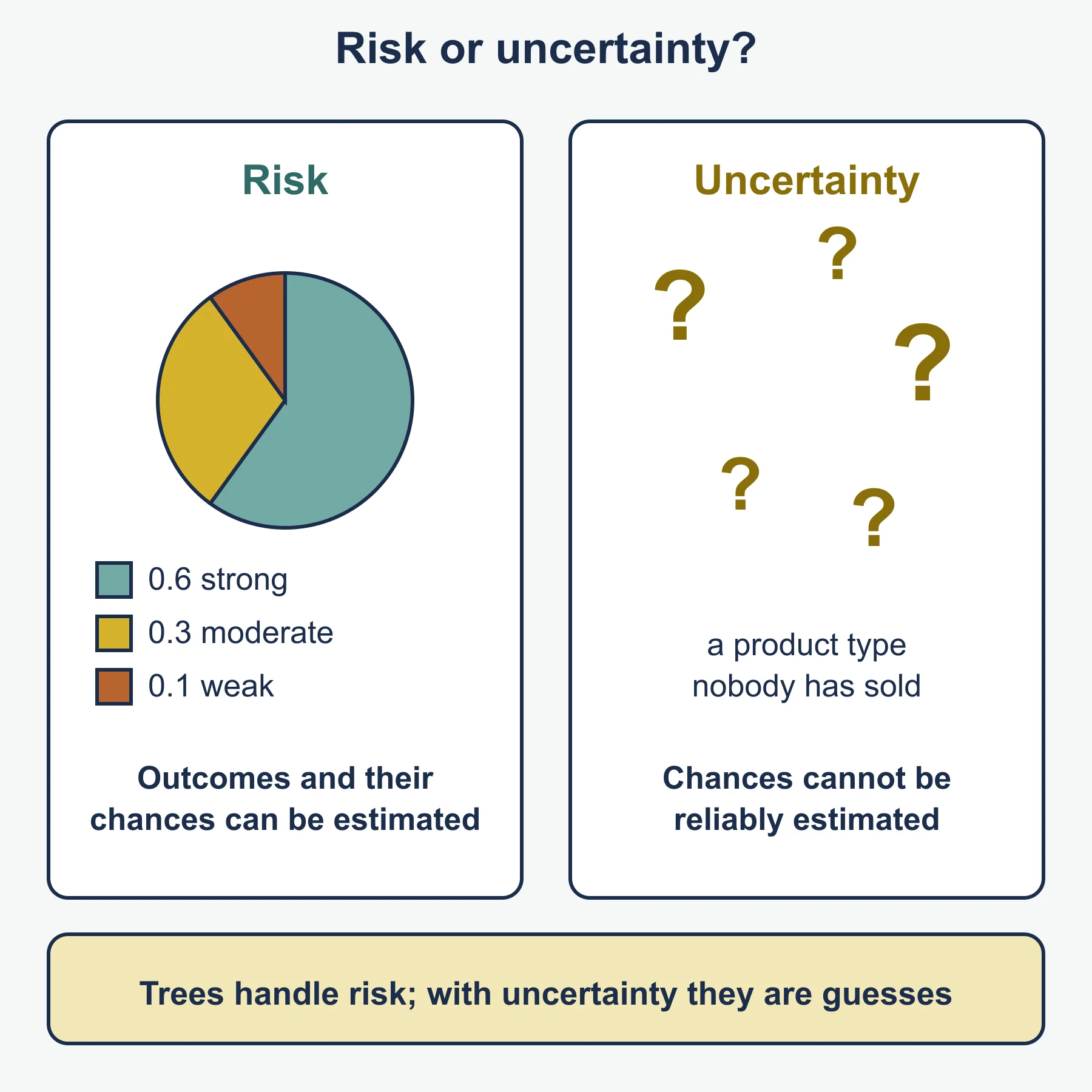
- Risk: the chance that a decision turns out badly, where the possible outcomes and their likelihood can be estimated. A decision tree handles risk.
- Reward: the benefit if it goes well, such as extra profit, sales or market share. Higher potential reward often comes with higher risk.
- Uncertainty: a situation where outcomes or their likelihood cannot be reliably estimated, for example launching a product type nobody has sold before. Probabilities on a tree become guesses.
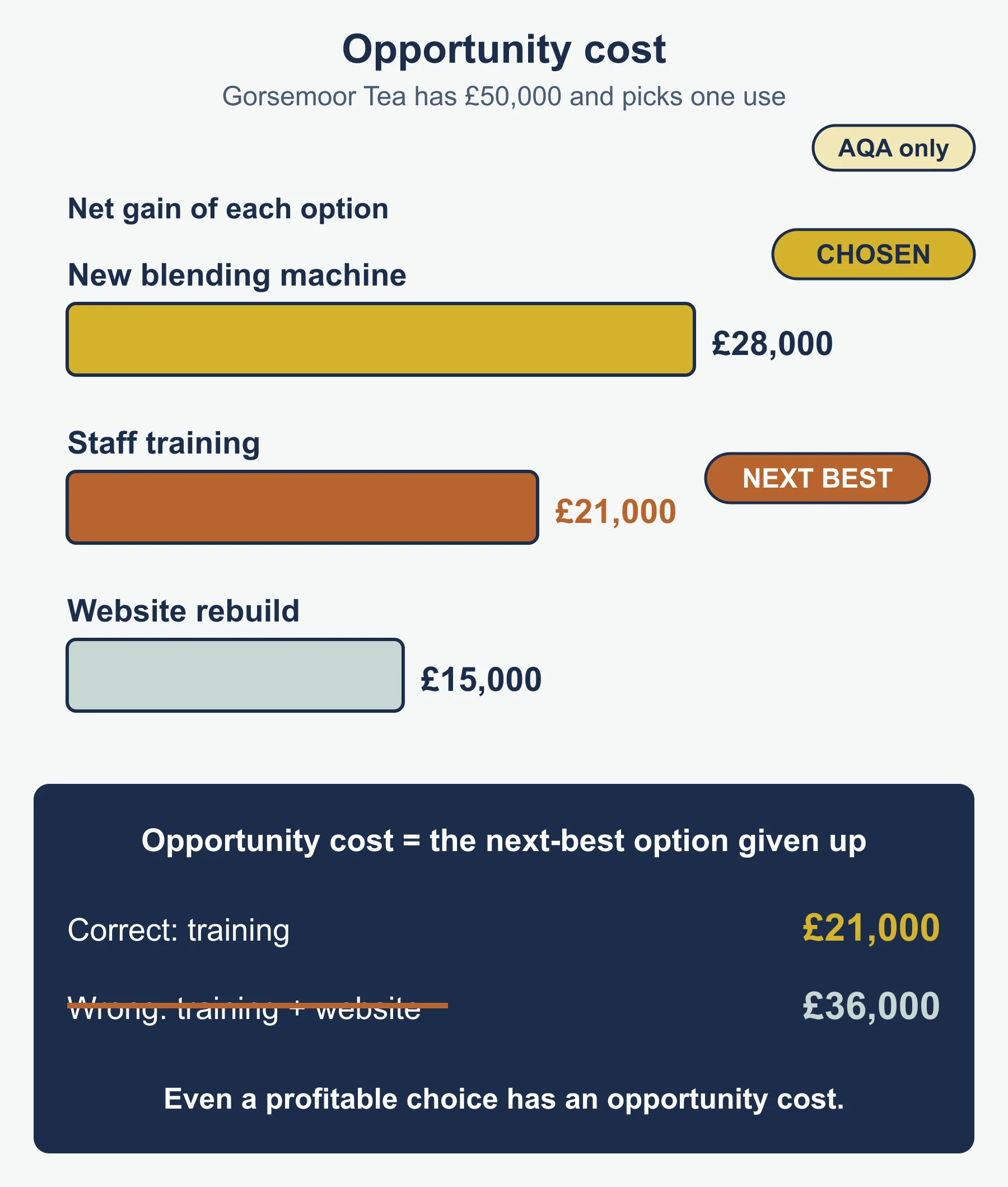
- Opportunity cost: the value of the next-best alternative given up. It is that one alternative, not the sum of all the options rejected.
Worked example: opportunity cost. The owner of Gorsemoor Tea has £50,000 and compares three uses, each with its calculated net gain: a new blending machine £28,000, staff training £21,000, a website rebuild £15,000. She picks the machine. The opportunity cost is the next-best option, £21,000 from training, not £36,000 (training plus website). Even a profitable choice has an opportunity cost, and it can be large.
Decision trees
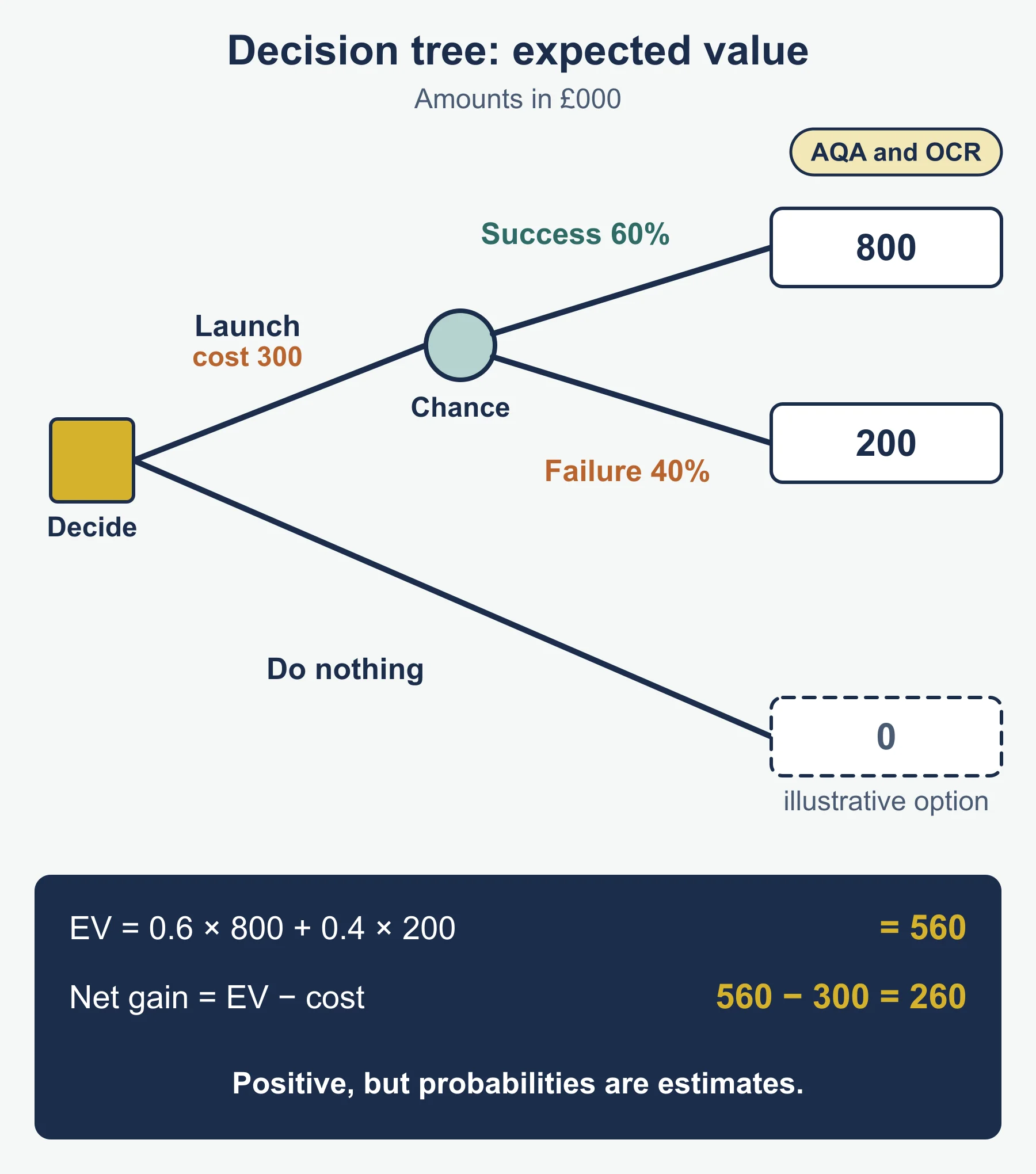
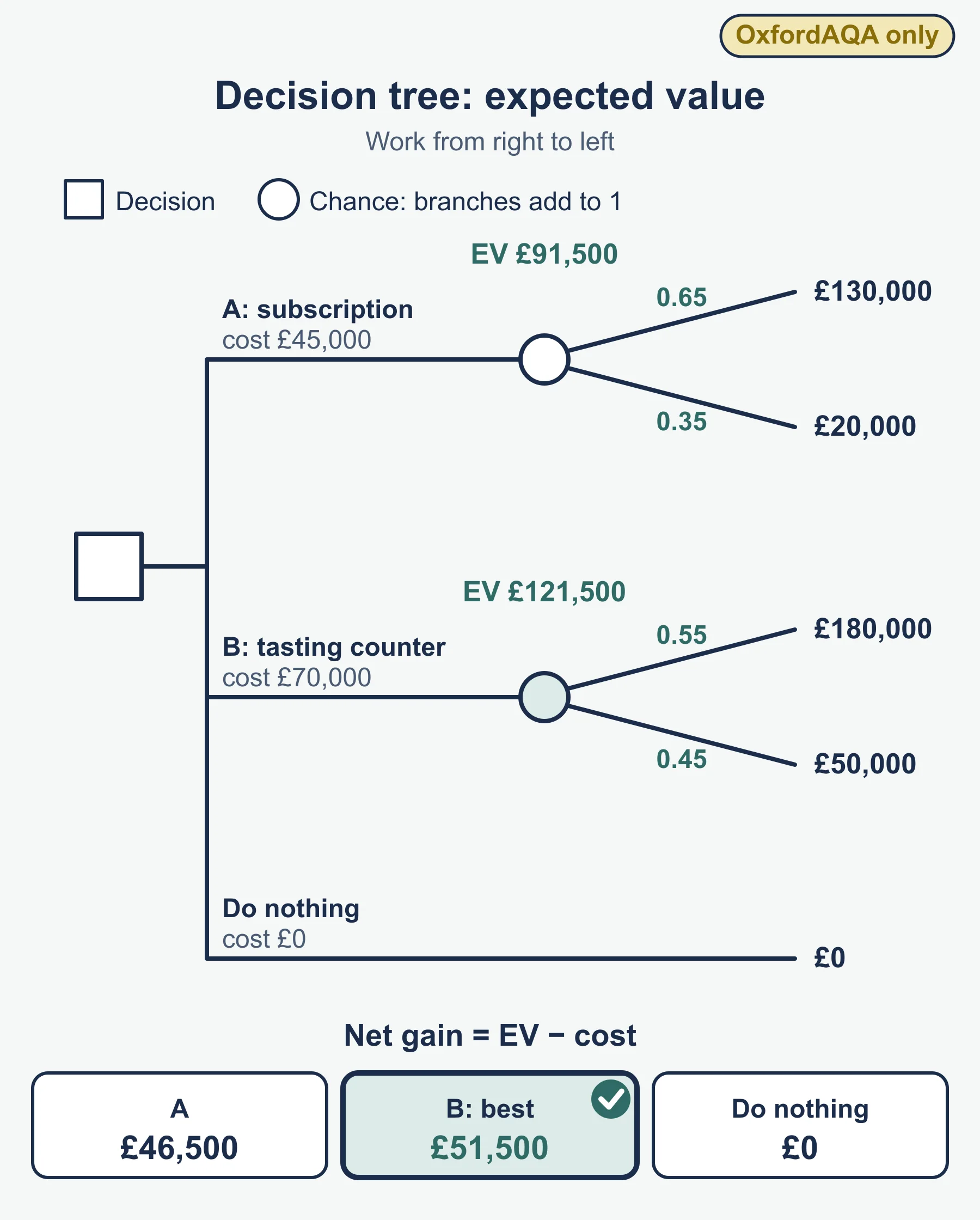
A decision tree maps a decision from left to right. By the usual convention a square is a decision node, where the business chooses, and a circle is a chance node, where events outside its control decide the branch. Each branch from a chance node carries a probability (the probabilities from one node add to 1) and a payoff, the return if that branch happens. The cost of an option sits on its decision branch.
Two calculations (the specification names both; the formulas below are the standard form):
- Expected value (EV) = the sum of (probability × payoff) for each outcome of an option. It is a weighted average.
- Net gain = expected value − cost of the option.
Method: calculate each option’s EV, subtract its cost, compare net gains, and choose the highest, unless risk, constraints or other influences say otherwise.
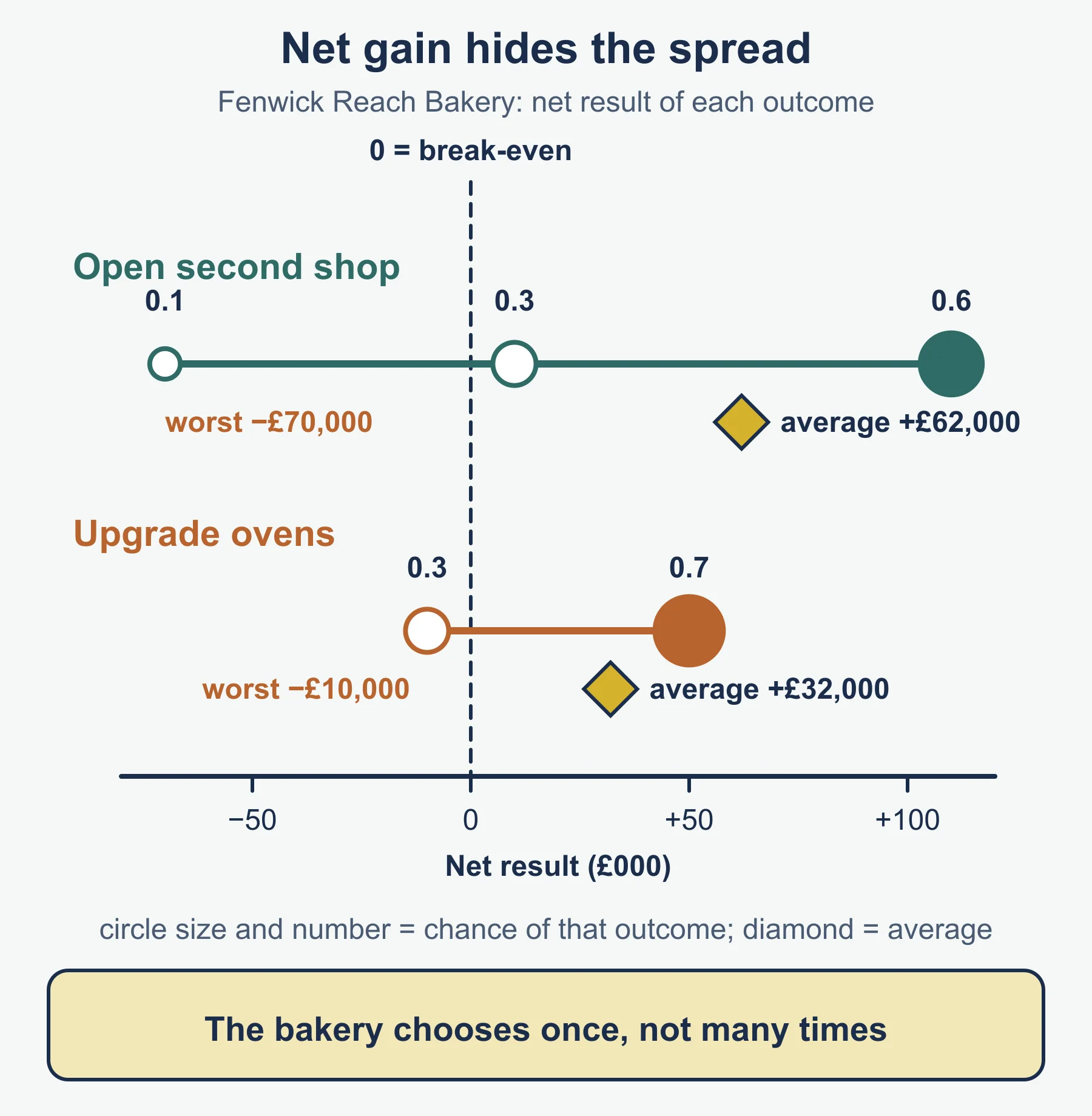
Worked example 1. Fenwick Reach Bakery can open a second shop (cost £90,000) or upgrade its ovens (cost £40,000).
Decision --- Open shop (cost £90,000) --- Chance --- 0.6 strong   £200,000
                                                  --- 0.3 moderate £100,000
                                                  --- 0.1 weak      £20,000
         --- Upgrade ovens (cost £40,000) - Chance - 0.7 good      £90,000
--- 0.3 poor £30,000- Shop: EV = (0.6 × 200,000) + (0.3 × 100,000) + (0.1 × 20,000) = 120,000 + 30,000 + 2,000 = £152,000. Net gain = 152,000 − 90,000 = £62,000.
- Ovens: EV = (0.7 × 90,000) + (0.3 × 30,000) = 63,000 + 9,000 = £72,000. Net gain = 72,000 − 40,000 = £32,000.
On net gain the shop is better by £30,000. Now interpret. The shop’s worst outcome returns £20,000 on a £90,000 outlay, a loss of £70,000; the ovens’ worst case returns £30,000 on £40,000, a loss of £10,000. If the bakery cannot absorb a £70,000 loss, the lower-net-gain option may be wiser. The net gain is an average over many repeats, and the bakery makes this choice once.
A two-stage tree
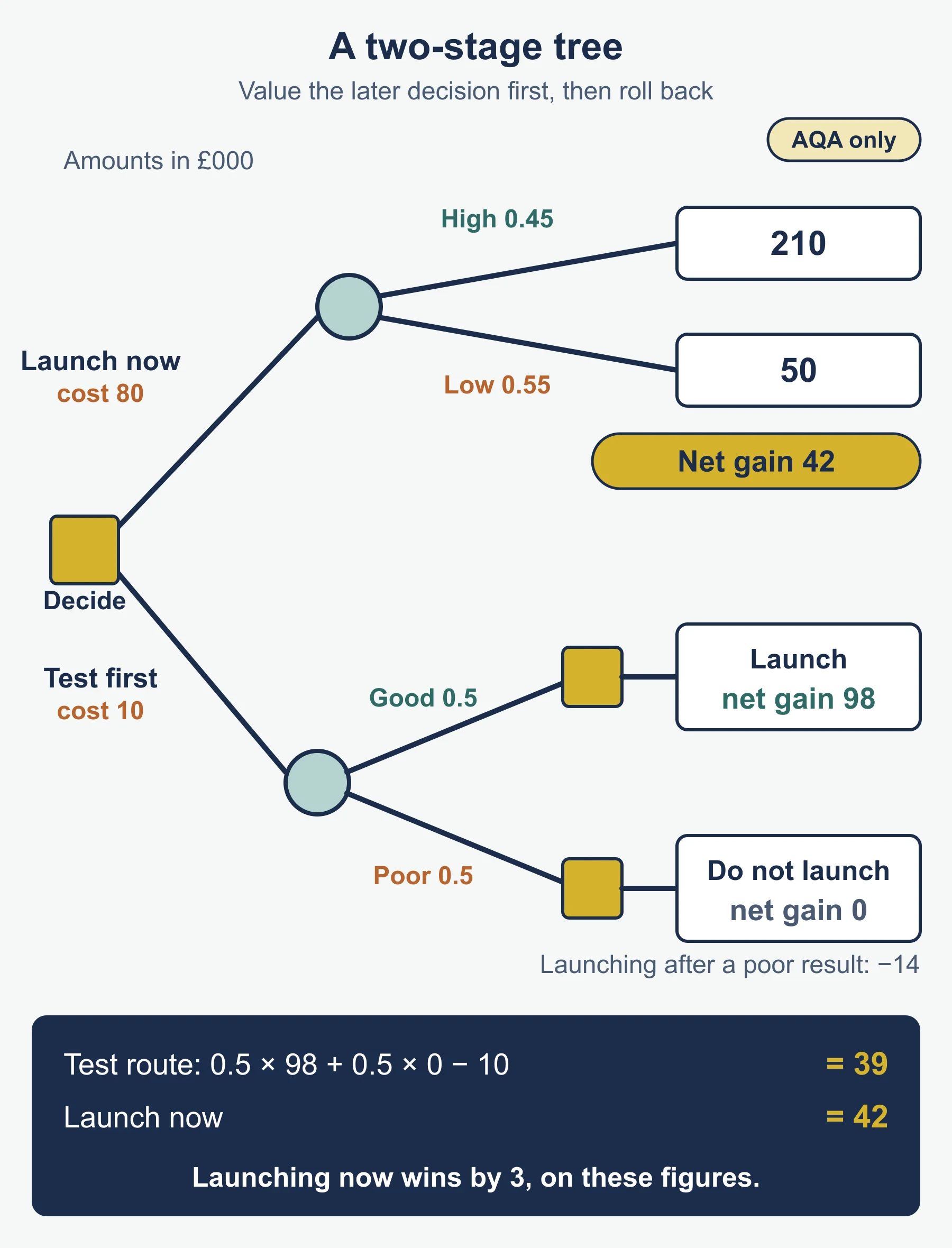
When a first decision leads to later decisions, work right to left: value the later decisions first, then roll the result back.
Worked example 2. Calder Moss Cycles can launch a new e-bike straight away (cost £80,000) or pay £10,000 for a test market first. Demand is high or low; a high-demand launch returns £210,000, a low-demand launch £50,000.
- A good test result has probability 0.5; then high demand has probability 0.8. A poor result has probability 0.5; then high demand has probability 0.1.
- After a good result, launching: EV = (0.8 × 210,000) + (0.2 × 50,000) = £178,000; net gain £98,000.
- After a poor result, launching: EV = (0.1 × 210,000) + (0.9 × 50,000) = £66,000; net gain −£14,000. Do not launch: value 0.
- Test route: (0.5 × 98,000) + (0.5 × 0) = £49,000, less the £10,000 test = £39,000.
- Direct launch: the overall chance of high demand is (0.5 × 0.8) + (0.5 × 0.1) = 0.45. EV = (0.45 × 210,000) + (0.55 × 50,000) = £122,000; net gain £42,000.
Launching directly scores £3,000 more on these figures. The test is worth having only if the value of the information exceeds its cost. Here it does not, but it also removes the chance of a £30,000 loss (80,000 − 50,000) after a launch into low demand, which a risk-averse owner might value.
Value and limits of decision trees
Value: they force managers to list options, probabilities and costs; they compare options on one measure; they show the downside as well as the average; they give a record of reasoning to defend.
Limits: probabilities and payoffs are estimates, often opinions in numerical form, and a small change can reverse the ranking; they ignore the timing of returns and non-financial factors such as brand, morale or ethics; net gain hides the spread of outcomes; gathering data costs time and money; and they suit risk, not true uncertainty.
Influences on decision making
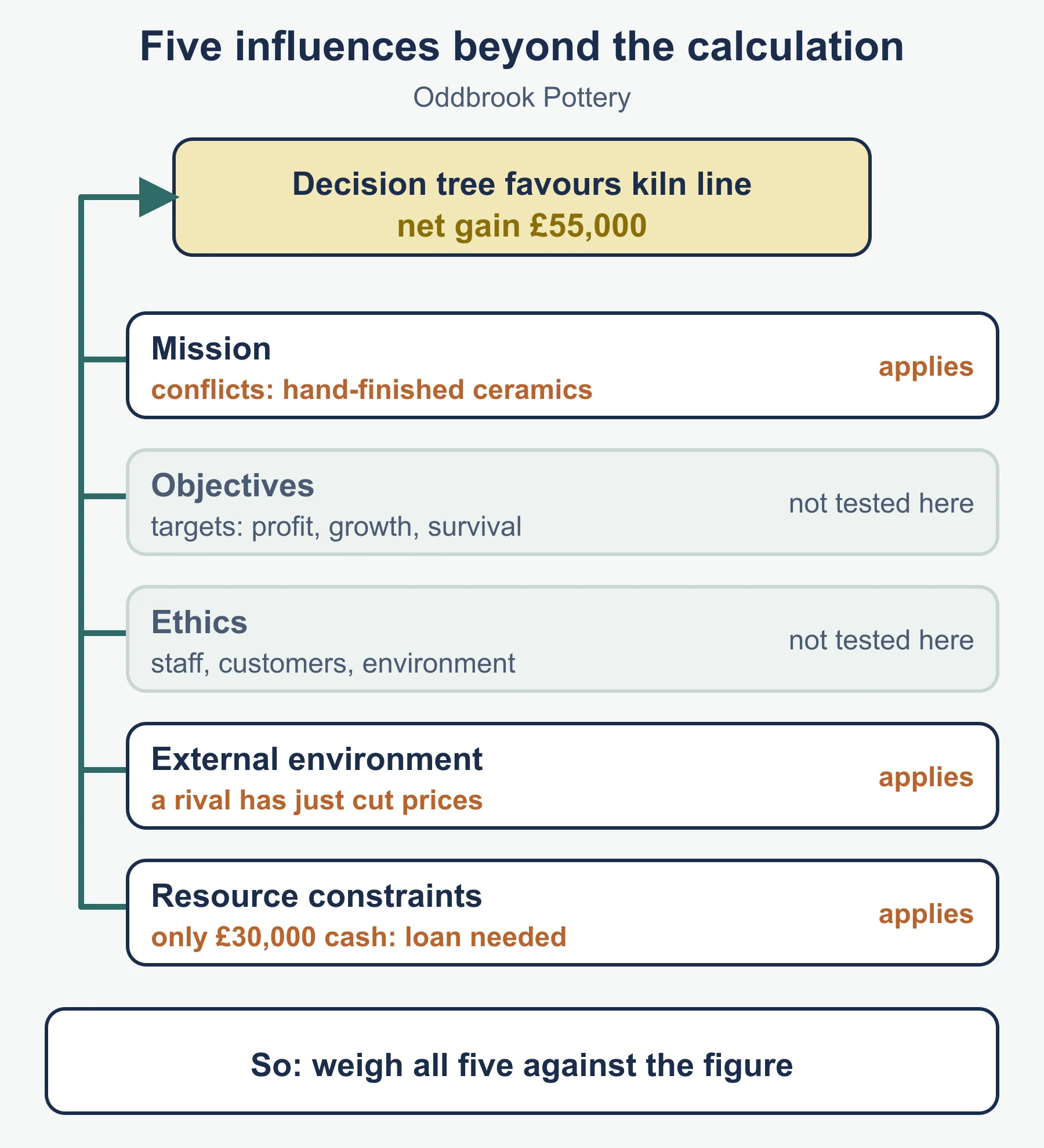
Even a correct calculation does not settle a decision. The specification lists five influences.
| Influence | How it shapes the decision |
|---|---|
| Mission | Its purpose and values rule options in or out. A business whose mission is hand-made quality will not mass-produce, whatever the net gain |
| Objectives | The decision is judged against targets such as profit, growth or survival. A growth objective may accept lower net gain for market share |
| Ethics | Moral principles on treatment of staff, suppliers, customers, communities and the environment. An option with a high net gain may be rejected if it harms people or damages reputation |
| External environment, including competition | Rival prices, new entrants, economic conditions, technology and regulation change both the options and the probabilities |
| Resource constraints | Money, skilled staff, time, space and equipment limit what can be done. An option the business cannot fund is not really an option |
Worked example 3. Oddbrook Pottery’s decision tree favours buying a kiln line that triples output (net gain £55,000). Mission (hand-finished ceramics) conflicts with it. The business has £30,000 in cash, so a loan is needed (resource constraint). A rival has just cut prices (competition). A good recommendation weighs these against the figure, perhaps favouring a smaller purchase that fits the mission and the budget.
Reaching a judgement
For evaluation, ask: how reliable are the data? How large and reversible is the decision? How much time is there? Can the business survive the worst case? Which influence matters most here? Then state a conclusion and what it depends on.
Common errors
- Stopping at expected value: net gain needs the cost subtracted.
- Adding probabilities that do not sum to 1, or applying them to costs.
- Calling opportunity cost the total of rejected options.
- Treating risk and uncertainty as the same.
- Saying data are always better than intuition, or the reverse.
- Listing influences without linking them to the business in the question.
Frequently asked questions
What is the difference between risk and uncertainty? Risk is where the possible outcomes and their likelihood can be estimated, so a decision tree can handle it. Uncertainty is where outcomes or their likelihood cannot be reliably estimated.
How do you work out a two-stage decision tree? Work right to left: value the later decisions first, taking the best branch at each decision node and the probability-weighted average at each chance node, then roll the result back and subtract costs.
What are the limitations of decision trees? The probabilities and payoffs are estimates, often opinions in numerical form, and a small change can reverse the ranking. A one-off decision also gets one actual outcome, never the average.
When is a test market worth paying for? A test market is worth having only if the value of the information it gives exceeds its cost. Otherwise it can improve the decision but still be poor value.
Which section of the AQA Business specification covers management decision making? Section 3.2.2, Understanding management decision making, in AQA AS and A-level Business (7131 and 7132).
Official syllabus
AQA AS and A-level Business specification (7131 and 7132), subject content section 3.2.2 Understanding management decision making, published by AQA.
Get free revision emails (optional)
Occasional emails with practice questions, worked explanations and links to free resources for the qualification and subjects you choose. No spam, and you can unsubscribe from any email. The free tools on this site never need an email.
Related resources
-
Practice questions
AQA A-Level Business: Understanding management decision making (7132) – Practice Questions
Original AQA A-Level Business practice questions with worked answers on decision trees, net gain, opportunity cost, risk and influences on decisions.
Business · AQA · A Level
Try questions -
Revision notes
AQA A-Level Business: Understanding management decision making (7132) – Revision Notes
Condensed AQA A-Level Business revision notes for 3.2.2: data versus intuition, decision trees, net gain, risk, opportunity cost and influences.
Business · AQA · A Level
Revise topic -
Study guides
AQA A-Level Business: Understanding management, leadership and decision making (7132)
A full study guide to AQA A-Level Business (7132) section 3.2.1: management and leadership, styles, Tannenbaum Schmidt and judging style effectiveness.
Business · AQA · A Level
Read guide
Related articles
-
teaching
A Level tuition in Dubai: Cambridge or Pearson Edexcel International A Level?
Schools in Dubai and Abu Dhabi teach either Cambridge International AS & A Level or Pearson Edexcel International A Level. How the two are structured, why it matters for tuition, and how online classes from Lahore work.
9 October 2026
-
curriculum guides
Choosing subjects at IGCSE and A Level
How subject choices at 14 and 16 affect university options later, and how to keep pathways open without overloading a timetable.
28 July 2026
Studying this with a teacher
Working through Business A LEVELS?
This page is free and stays free. If you would rather be taught it, Marlbridge runs Business classes one-to-one and in small groups of up to 15, online in your own time zone. The first trial class is free. WhatsApp replies within an hour (8am–11pm Pakistan time, every day); email the same day.
AQA Business teachers at Marlbridge
