
Revision Notes
AQA A-Level Chemistry: Bonding (7405) – Revision Notes
Recall notes on ionic, covalent, dative and metallic bonding, structures, shapes, polarity and intermolecular forces for AQA A-Level Chemistry.
- Subject
- Chemistry
- Level
- AS LEVEL
- Topic
- Bonding
- Author
- Marlbridge Academic Team
- Updated
- Reviewed by
- Nouman Ahmed (what this means)
Aligned to AQA A Level Chemistry (7405), For teaching from September 2015. Official specification .
Syllabus page (what it covers and how it is assessed): AQA A Level Chemistry.
Syllabus points this page covers
7405 (AS Level)
- 3 Bonding (whole topic)
Found an error? Report a correction.
Need help with this topic? Request a free trial class for A Level Chemistry (7405).
These notes condense section 3.1.3 (Bonding) of the AQA AS and A-level Chemistry specification (7404/7405), covering 3.1.3.1 to 3.1.3.7. The specification lists this content under Paper 1 and Paper 2 at both AS and A-level. For full explanations read the Bonding study guide, then test yourself with the practice questions. Related notes: Atomic Structure and Periodicity. Course hub: AQA A-level Chemistry. Track progress on the printable checklist, and use the free 10-minute diagnostics to find weak spots.
Key definitions
| Term | Learn it as |
|---|---|
| Ionic bonding | Electrostatic attraction between oppositely charged ions in a lattice |
| Single covalent bond | A shared pair of electrons |
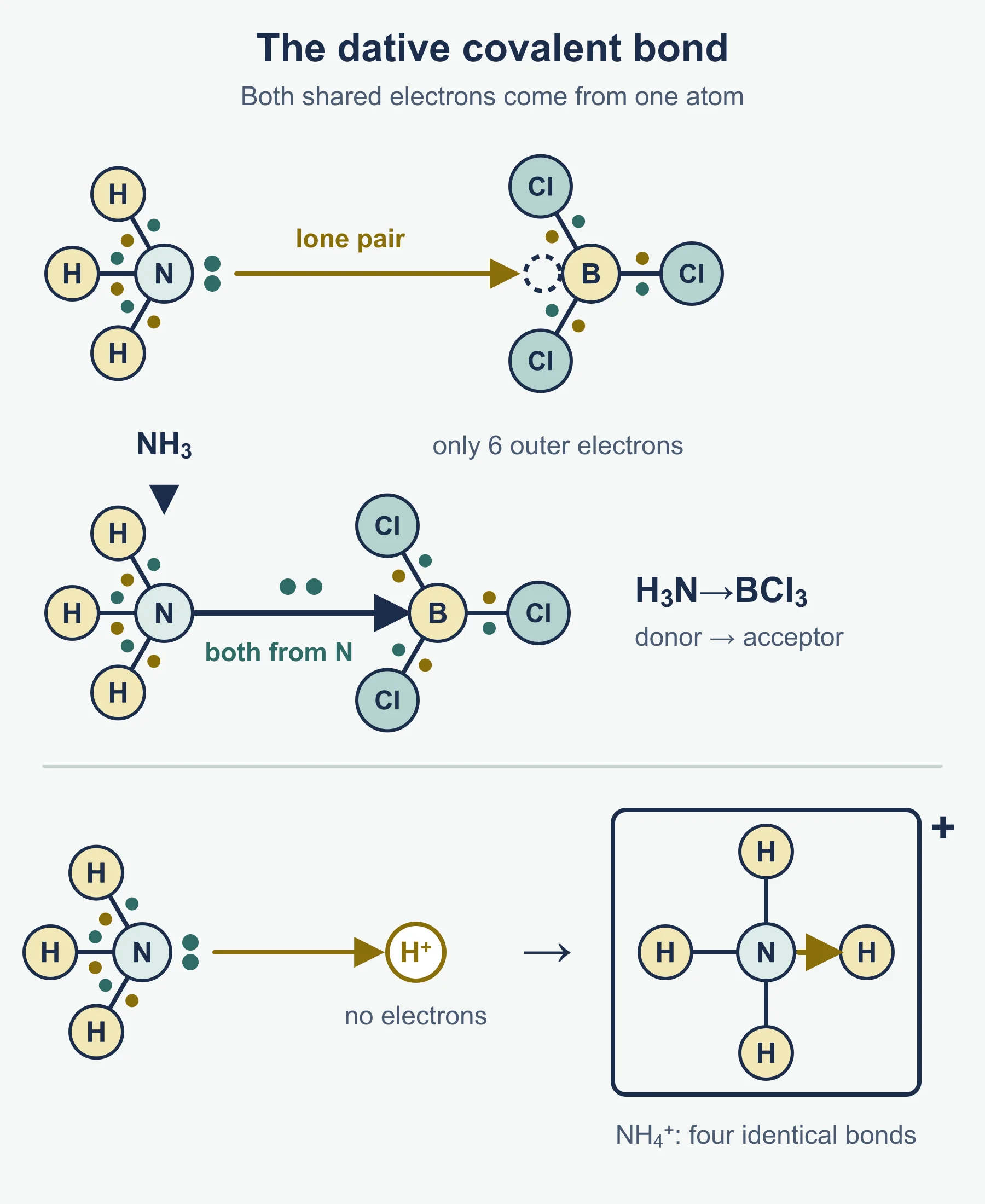
| Co-ordinate (dative covalent) bond | A shared pair of electrons with both electrons supplied by one atom |
| Metallic bonding | Attraction between positive metal ions in a lattice and the delocalised electrons around them |
| Electronegativity | The ability of an atom to draw the bonding pair of electrons towards itself in a covalent bond |
| Permanent dipole | Unsymmetrical electron distribution across a whole molecule, caused by polar bonds that do not cancel |
| Induced dipole-dipole forces | Also known as London (dispersion) or van der Waals forces |
3.1.3.1 Ionic bonding
Charges from the Periodic Table. Metals lose electrons and non-metals gain them, to reach a noble-gas arrangement.
| Group number | 1 | 2 | 13 | 15 | 16 | 17 |
|---|---|---|---|---|---|---|
| Charge on simple ion | 1+ | 2+ | 3+ | 3- | 2- | 1- |
Compound ions to know. Hydroxide OH⁻, nitrate NO₃⁻, carbonate CO₃²⁻, sulfate SO₄²⁻, ammonium NH₄⁺.
Method for a formula.
- Write each ion with its charge.
- Find the smallest numbers of each ion that make the total charge zero.
- Put brackets round a compound ion if you need more than one of it.
Worked reminder: magnesium nitride. Mg²⁺ and N³⁻. Three Mg²⁺ (+6) balance two N³⁻ (-6), so Mg₃N₂. With a compound ion: ammonium carbonate needs two NH₄⁺ for one CO₃²⁻, so (NH₄)₂CO₃.
3.1.3.2 Covalent and dative covalent bonds
- A single bond is one shared pair. A double bond is two shared pairs and a triple bond is three.
- Draw a covalent bond as a line. Draw a co-ordinate bond as an arrow pointing from the atom that supplies both electrons to the atom that accepts them.
- A co-ordinate bond forms when one atom has a lone pair and the other has a vacant space for a pair. Typical examples are the ammonium ion, the oxonium ion H₃O⁺, and the compound formed when ammonia donates to boron trifluoride.
- Once formed, a co-ordinate bond is identical in length and strength to the other bonds of that type in the species.
3.1.3.3 Metallic bonding
Positive metal ions sit in a lattice, surrounded by delocalised electrons that came from the outer shells of the atoms.
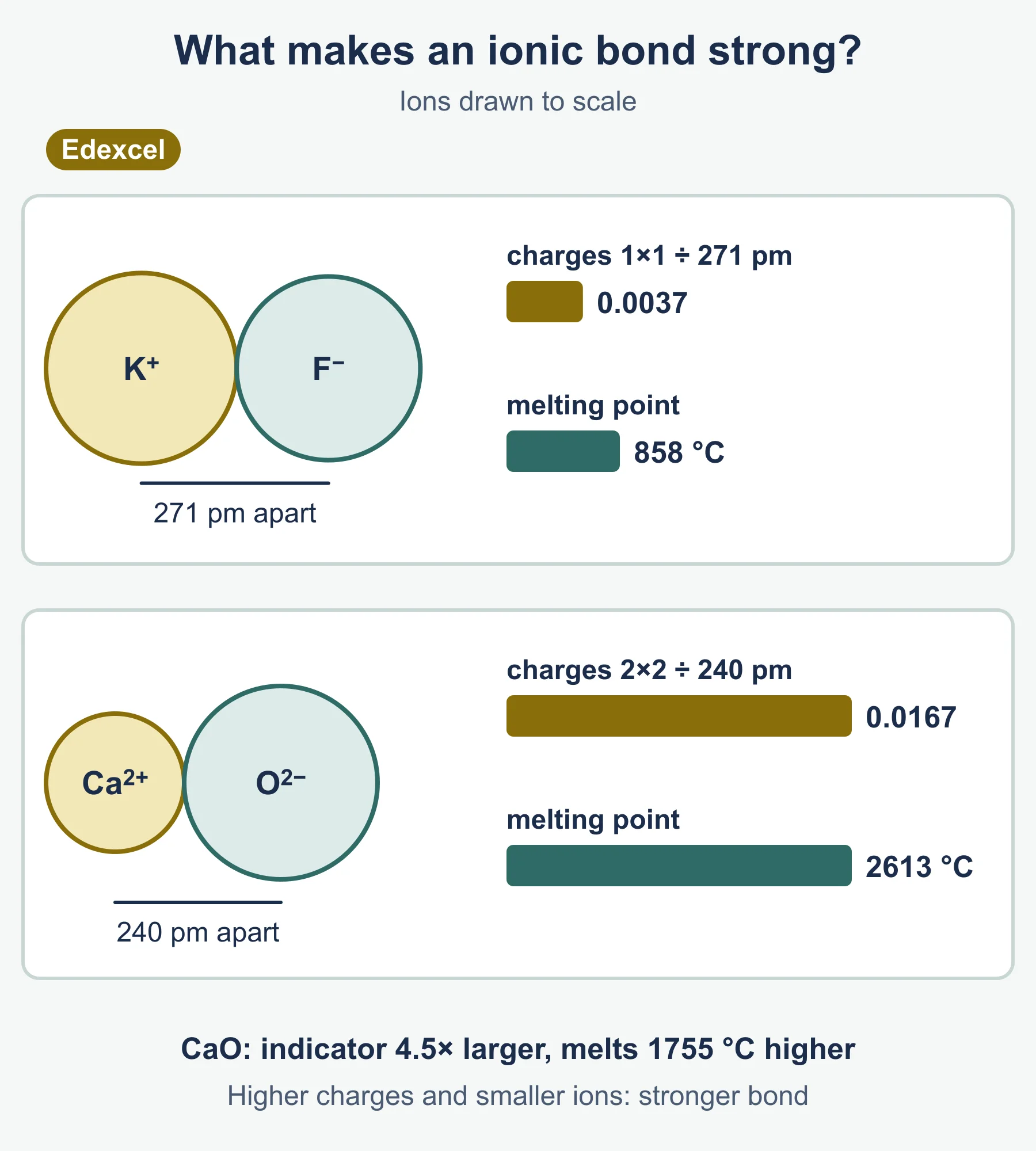
- Stronger when the ions carry a bigger charge, the ions are smaller, or each atom adds more electrons to the delocalised pool.
- Conducts: the delocalised electrons move through the lattice.
- Malleable: layers of ions slide, and the electrons keep the lattice bonded.
- Do not call the electrons “shared between two atoms”. That is covalent language.
3.1.3.4 Bonding and physical properties
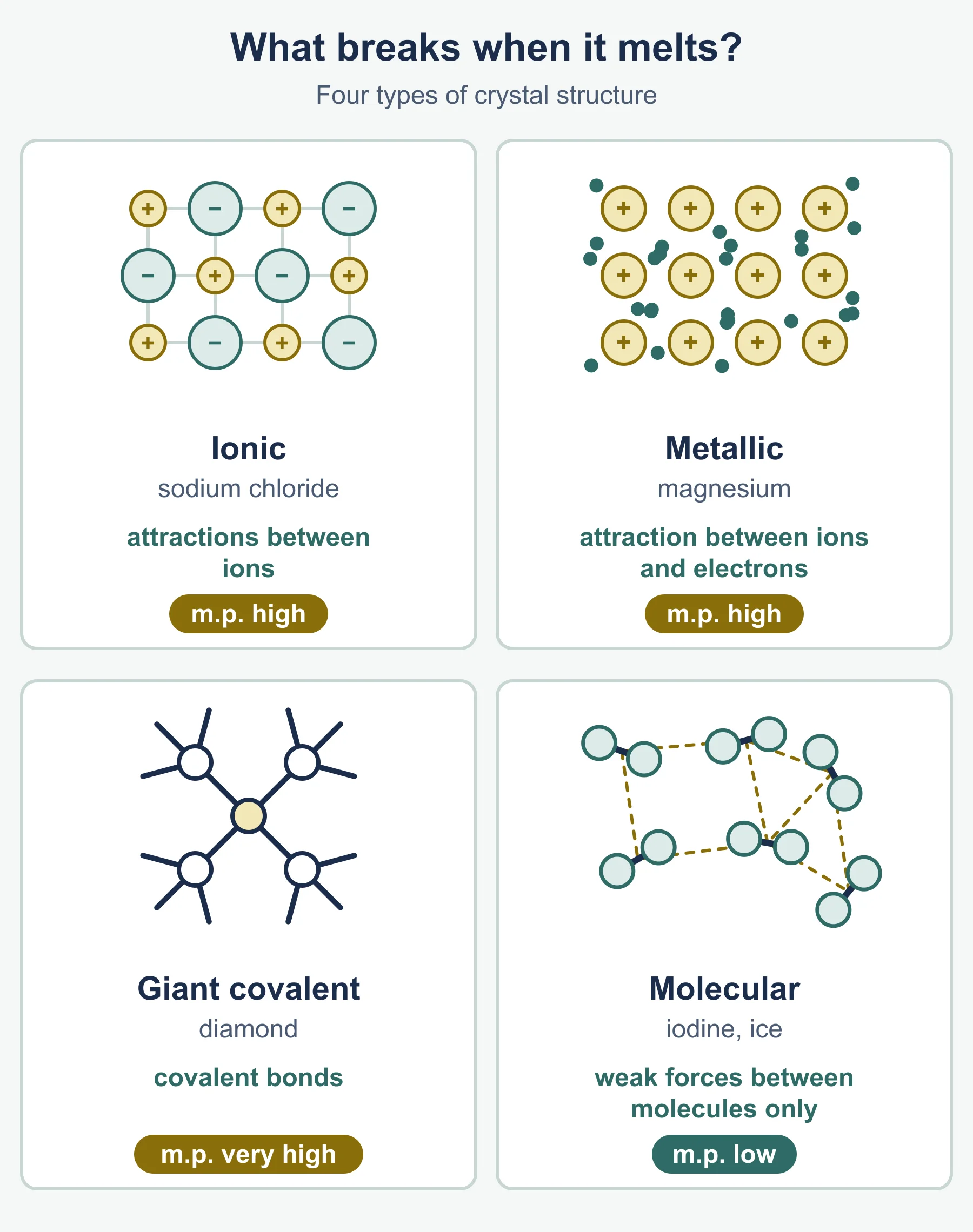
The four crystal types
| Type | Example | Particles held by | Melting point | Conducts? | Dissolves in water? |
|---|---|---|---|---|---|
| Ionic | sodium chloride | Strong electrostatic attraction between ions | High | Only molten or dissolved | Often yes |
| Metallic | magnesium | Ions and delocalised electrons | Generally high | Solid and liquid | No (they may react) |
| Macromolecular | diamond, graphite | Covalent bonds throughout | Very high | Graphite only | No |
| Molecular | iodine, ice | Weak forces between molecules | Low | No | Varies |
Structures to draw
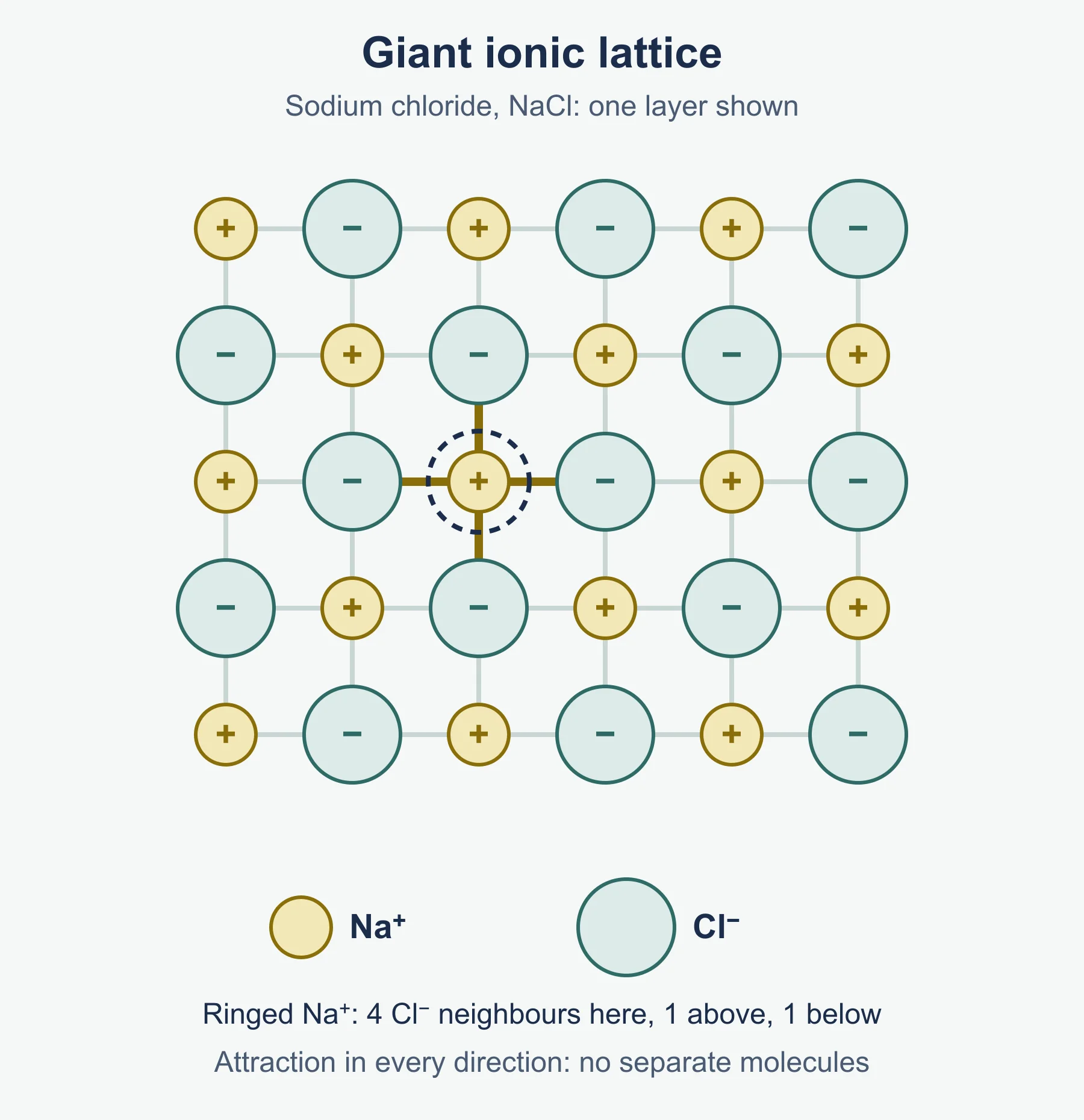
Sodium chloride (a layer of 16 ions, 8 of each):
  Na+ Cl- Na+ Cl-
  Cl- Na+ Cl- Na+
  Na+ Cl- Na+ Cl-
  Cl- Na+ Cl- Na+
Each ion in the 3-D crystal has 6 oppositely charged neighbours.- Diamond: each carbon forms 4 covalent bonds to four others, in a tetrahedral arrangement. All outer electrons are held in bonds, so it does not conduct.
- Graphite: each carbon forms 3 covalent bonds, giving flat layers of hexagons. The fourth outer electron per carbon is delocalised between layers, so graphite conducts. Weak induced dipole-dipole forces hold the layers together, so they slide.
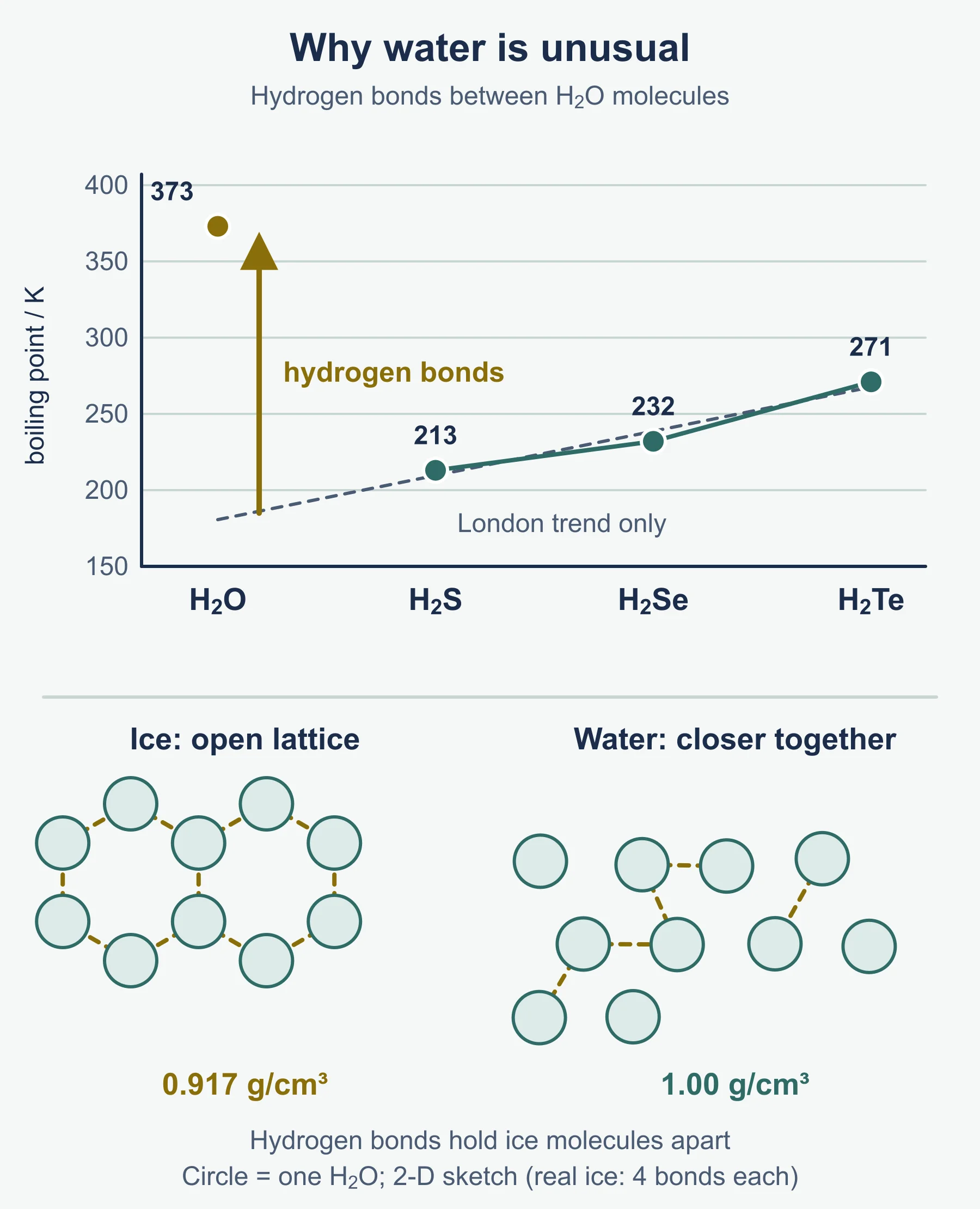
- Ice: every H₂O molecule forms hydrogen bonds with four neighbours, giving an open lattice.
- Iodine: I₂ molecules in a regular arrangement, with weak induced dipole-dipole forces between them.
- Magnesium: a regular array of Mg²⁺ ions in a sea of delocalised electrons.
Changes of state
- Heating a solid at its melting point supplies energy that overcomes the forces holding particles in position. The temperature stays constant during the change because the energy increases the potential energy of the particles.
- Name what is overcome. Ionic: electrostatic attraction between ions. Macromolecular: covalent bonds. Molecular: intermolecular forces, not the covalent bonds inside molecules.
- Boiling needs more energy than melting because the particles must be separated completely.
- Condensing and freezing release the same energy as the reverse changes absorb.
Identifying an unknown by experiment
| Observation | Likely structure |
|---|---|
| Hard to melt, conducts only when molten or in solution | Ionic |
| Conducts as a solid, insoluble | Metallic |
| Very hard to melt, insoluble, no conduction | Macromolecular |
| Melts easily, no conduction | Molecular |
3.1.3.5 Shapes of molecules and ions
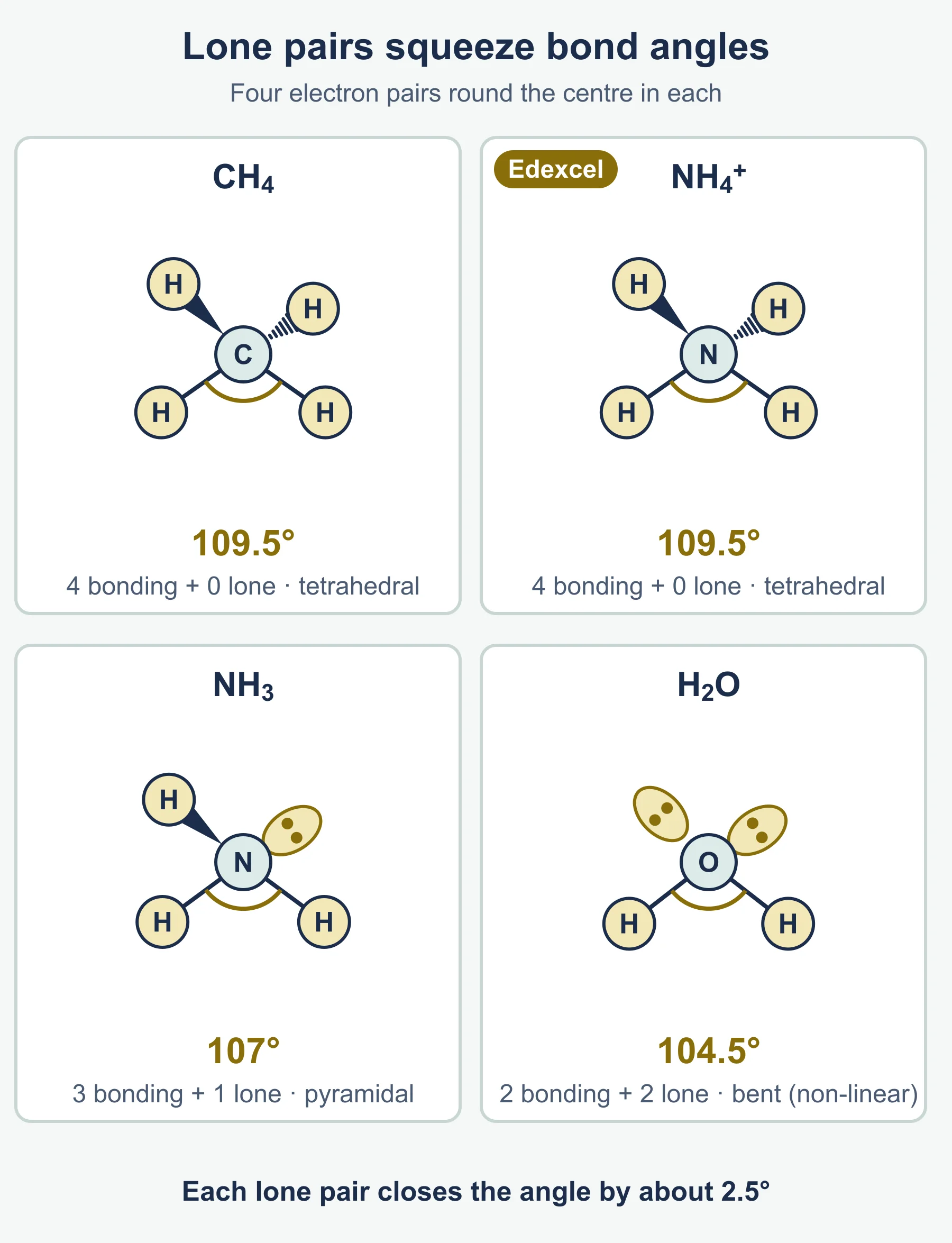
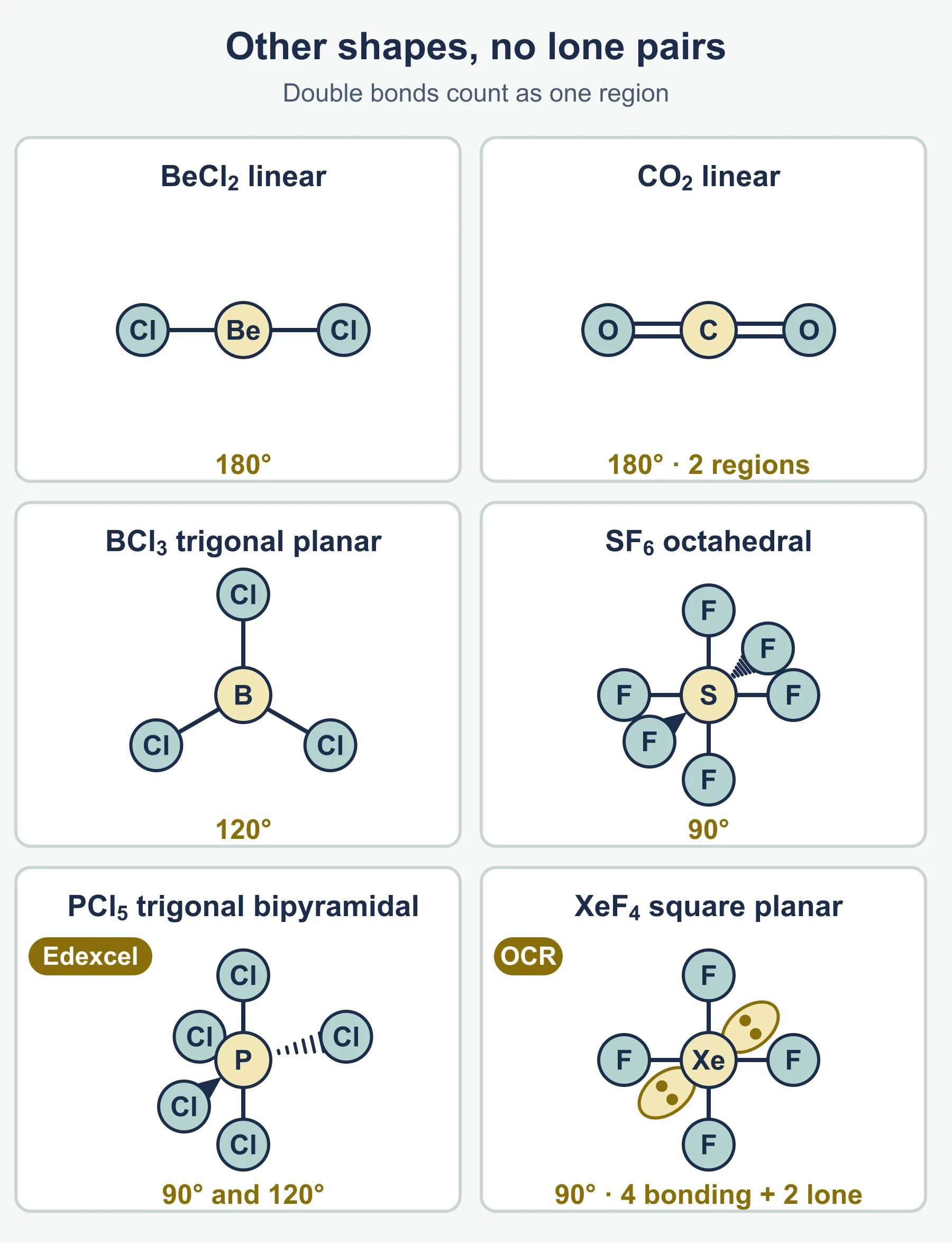
Principle. Bonding pairs and lone pairs are charge clouds. They repel and arrange themselves as far apart as possible. A double bond counts as one charge cloud.
Repulsion order. Lone pair-lone pair is greater than lone pair-bond pair, which is greater than bond pair-bond pair. Each lone pair therefore squeezes the bond angles.
Method in steps.
- Count outer electrons on the central atom, add one per bonded monovalent atom, adjust for charge.
- Halve to get the electron pairs.
- Subtract bonding pairs to get lone pairs.
- Pick the shape from the table.
| Example | Electron pairs | Bonding pairs | Lone pairs | Shape | Angle |
|---|---|---|---|---|---|
| BeCl₂ | 2 | 2 | 0 | Linear | 180° |
| BF₃ | 3 | 3 | 0 | Trigonal planar | 120° |
| SO₂ | 3 | 2 | 1 | Bent | Under 120° |
| NH₄⁺ | 4 | 4 | 0 | Tetrahedral | 109.5° |
| H₃O⁺ | 4 | 3 | 1 | Trigonal pyramidal | Under 109.5° |
| NH₂⁻ | 4 | 2 | 2 | Bent | Under 109.5° |
| PCl₅ | 5 | 5 | 0 | Trigonal bipyramidal | 120° and 90° |
| SF₄ | 5 | 4 | 1 | See-saw | Angles reduced by the lone pair |
| ClF₃ | 5 | 3 | 2 | T-shaped | Angles reduced by the lone pairs |
| ICl₂⁻ | 5 | 2 | 3 | Linear | 180° |
| SF₆ | 6 | 6 | 0 | Octahedral | 90° |
| XeF₄ | 6 | 4 | 2 | Square planar | 90° |
In the six-pair case the two lone pairs sit opposite each other, which keeps lone pair-lone pair repulsion as low as possible. In the five-pair cases the lone pairs sit in the trigonal plane.
3.1.3.6 Bond polarity
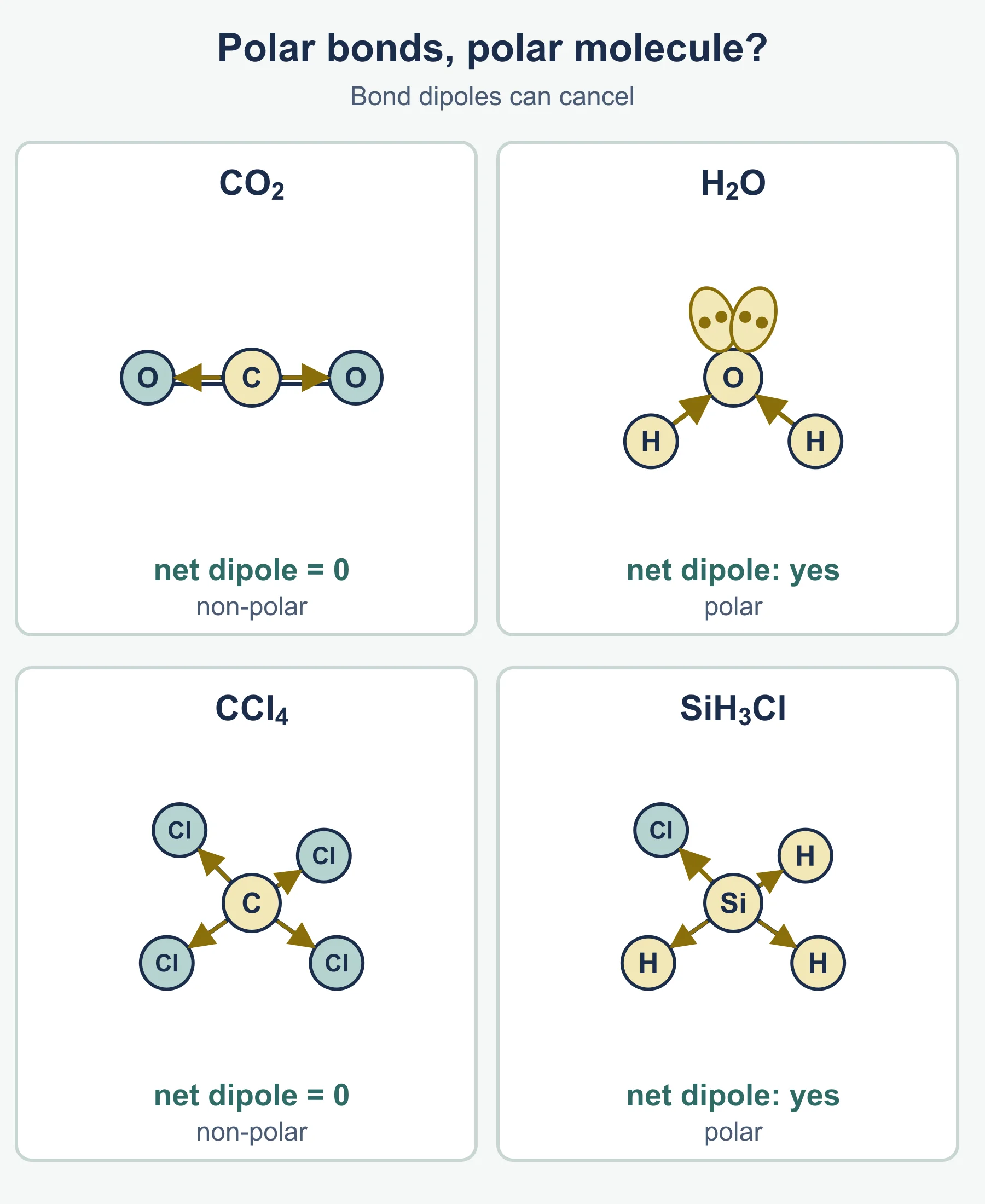
- A bond is polar when its two atoms have different electronegativities. The more electronegative atom takes the larger share of the pair and gains a partial negative charge, δ-. The other atom gets δ+.
- Moving across a period electronegativity increases, and moving down a group it decreases, so fluorine is the most electronegative element.
- Show polarity like this: C(δ+)-Cl(δ-).
- Overall a molecule is polar only when its bond dipoles fail to cancel out. Symmetrical molecules such as BF₃, SF₆ and XeF₄ have polar bonds but no overall dipole. CH₂Cl₂ is tetrahedral but has two different outer atoms, so its dipoles do not cancel.
- Do not confuse the two ideas: electronegativity belongs to an atom, polarity belongs to a bond or molecule.
3.1.3.7 Forces between molecules
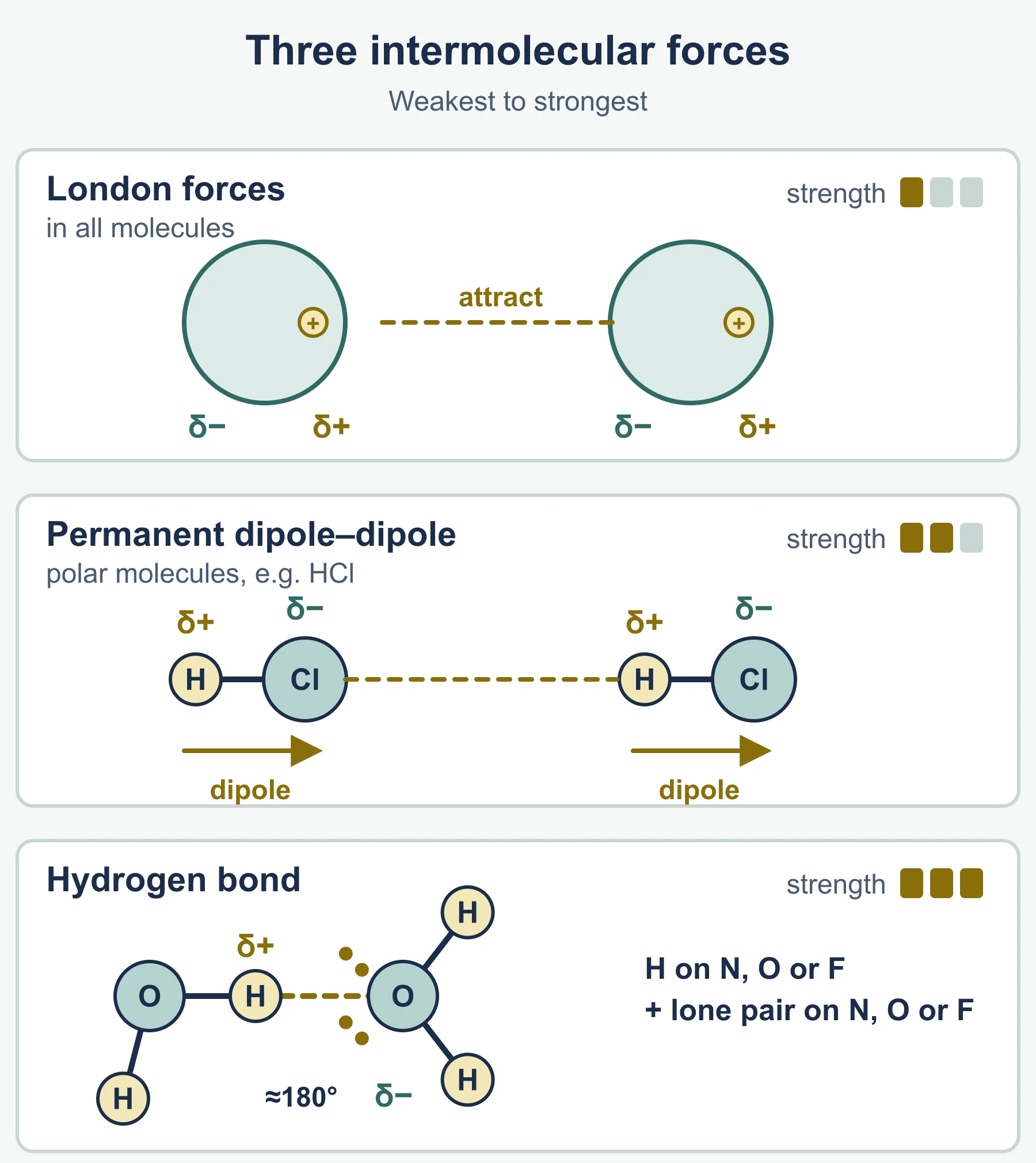
| Force | Where | Relative strength |
|---|---|---|
| Induced dipole-dipole (van der Waals) | Between all molecules | Weakest, but grows with electrons |
| Permanent dipole-dipole | Between polar molecules | Stronger |
| Hydrogen bonding | H on N, O or F, to a lone pair on N, O or F in another molecule | Strongest of the three |
- Chain length. More electrons in a molecule give larger induced dipoles, so a longer chain has a higher boiling point.
- Branching. A branched isomer has less surface contact, so a lower boiling point than its straight-chain isomer.
- Hydrogen bonding in hydrides. The hydrides of the first member of Groups 15, 16 and 17 (NH₃, H₂O, HF) have boiling points far above the trend set by the heavier hydrides in their groups.
- Ice. Hydrogen bonds hold each molecule in an open lattice, further apart than in water. Ice is less dense than liquid water.
- Always write both the force and the molecules it acts between. Covalent bonds inside molecules are not broken when a molecular substance boils.
Must-know distinctions
| Pair | Difference |
|---|---|
| Polar bond vs polar molecule | A molecule can contain polar bonds and still be non-polar overall |
| Giant ionic vs molecular | Melting an ionic solid overcomes ionic bonds. Melting a molecular solid overcomes only intermolecular forces |
| Diamond vs graphite | 4 bonds per carbon and no mobile electrons vs 3 bonds per carbon and delocalised electrons |
| Lone pair vs bonding pair | A lone pair repels more strongly and reduces bond angles |
Check yourself
- Write the formula of calcium nitrate.
- State the charge on the ion formed by an atom of a Group 15 element.
- How many co-ordinate bonds are in NH₄⁺, and which atom is the donor?
- Why can aluminium conduct electricity as a solid?
- State the shape and bond angle of BeCl₂.
- State the shape of H₃O⁺ and the number of lone pairs on oxygen.
- Which has a permanent dipole, BF₃ or BrCl?
- Name the strongest intermolecular force between methylamine, CH₃NH₂, molecules.
- Why does a longer straight-chain alkane have a higher boiling point?
- A solid does not conduct, but conducts when molten and dissolves in water. Name its structure type.
- How many carbon neighbours does each carbon have in diamond and in graphite?
Answers
- Ca(NO₃)₂.
- 3-.
- One. Nitrogen donates its lone pair to a hydrogen ion.
- It has delocalised electrons that are free to move.
- Linear, 180°.
- Trigonal pyramidal, one lone pair.
- BrCl. BF₃ is symmetrical so its bond dipoles cancel.
- Hydrogen bonding, through the N-H bond and the lone pair on nitrogen.
- More electrons, larger induced dipoles, stronger induced dipole-dipole forces, more energy to separate molecules.
- Ionic (giant ionic lattice).
- Four in diamond, three in graphite.
Where marks are usually lost
- Writing “shared electrons” for metallic bonding.
- Saying covalent bonds break when a molecular solid melts or boils.
- Forgetting the lone pair when counting electron pairs, then stating the wrong shape.
- Quoting a bond angle without saying that a lone pair repels more than a bonding pair.
- Writing “polar bonds so polar molecule” without checking symmetry.
- Writing “hydrogen bonds” for any molecule that merely contains hydrogen. The hydrogen must be on N, O or F.
- Leaving out a bracket in formulas such as Al₂(SO₄)₃.
- Failing to say why graphite conducts: it needs the delocalised electrons and their ability to move.
- Describing intermolecular forces in general terms, without naming the type or comparing strengths.
Frequently asked questions
What is a co-ordinate (dative covalent) bond? A co-ordinate bond is a shared pair of electrons in which both electrons are supplied by one atom. It is drawn as an arrow from the donor atom to the acceptor atom, and once formed it is identical to the other bonds of that type in the species.
What makes metallic bonding stronger? Metallic bonding is stronger when the metal ions carry a bigger charge, the ions are smaller, or each atom adds more electrons to the delocalised pool. Do not describe the electrons as shared between two atoms, which is covalent language.
Why do lone pairs reduce bond angles? Lone pair–lone pair repulsion is greater than lone pair–bond pair repulsion, which is greater than bond pair–bond pair repulsion. Each lone pair therefore squeezes the bond angles between the bonding pairs.
When does hydrogen bonding occur? Hydrogen bonding occurs when hydrogen is bonded to N, O or F and is attracted to a lone pair on N, O or F in another molecule. A molecule that merely contains hydrogen bonded to carbon does not form hydrogen bonds.
Is bonding examined at AS level in AQA Chemistry? Yes. The AQA 7404/7405 specification lists section 3.1.3 Bonding under Paper 1 and Paper 2 at both AS and A-level.
Official syllabus
Source: AQA AS and A-level Chemistry (7404/7405) specification, version 1.1, December 2015, published by AQA, section 3.1.3 Bonding.
Get free revision emails (optional)
Occasional emails with practice questions, worked explanations and links to free resources for the qualification and subjects you choose. No spam, and you can unsubscribe from any email. The free tools on this site never need an email.
Related resources
-
Study guides
AQA A-Level Chemistry: Bonding (7405)
Ionic, covalent, dative and metallic bonding, crystal structures, molecular shapes, bond polarity and intermolecular forces for AQA A-Level Chemistry 7405.
Chemistry · AQA · AS Level
Read guide -
Practice questions
AQA A-Level Chemistry: Bonding (7405) – Practice Questions
Original practice questions with worked answers on bonding, structures, molecular shapes, polarity and intermolecular forces for AQA A-Level Chemistry.
Chemistry · AQA · AS Level
Try questions -
Study guides
AQA A-Level Chemistry: Carboxylic acids and derivatives (7405)
AQA A-Level Chemistry carboxylic acids taught from scratch: esters, hydrolysis, soap, biodiesel, acyl chlorides, anhydrides, aspirin and practical 10.
Chemistry · AQA · A Level
Read guide
Related articles
-
study skills
How to revise for a science examination
Most science revision fails because it rereads notes instead of retrieving them. A practical method for revising physics, chemistry and biology in the weeks before a paper.
14 July 2026
-
teaching
A Level tuition in Dubai: Cambridge or Pearson Edexcel International A Level?
Schools in Dubai and Abu Dhabi teach either Cambridge International AS & A Level or Pearson Edexcel International A Level. How the two are structured, why it matters for tuition, and how online classes from Lahore work.
9 October 2026
Studying this with a teacher
Working through Chemistry AS LEVEL?
This page is free and stays free. If you would rather be taught it, Marlbridge runs Chemistry classes one-to-one and in small groups of up to 15, online in your own time zone. The first trial class is free. WhatsApp replies within an hour (8am–11pm Pakistan time, every day); email the same day.
AQA Chemistry teachers at Marlbridge

