
Study Guides
AQA A-Level Chemistry: Fundamental particles (7405)
AQA A-Level Chemistry fundamental particles from scratch: how atomic models changed, relative charge and mass, and the nuclear atom.
- Subject
- Chemistry
- Level
- AS LEVEL
- Topic
- Atomic structure
- Author
- Marlbridge Academic Team
- Updated
- Reviewed by
- Nouman Ahmed (what this means)
Aligned to AQA A Level Chemistry (7405), For teaching from September 2015. Official specification .
Syllabus page (what it covers and how it is assessed): AQA A Level Chemistry.
Syllabus points this page covers
7405 (AS Level)
- 3.1.1.1 Fundamental particles
Found an error? Report a correction.
Need help with this topic? Request a free trial class for A Level Chemistry (7405).
This guide teaches section 3.1.1.1 Fundamental particles of the AQA AS and A-level Chemistry specification (7404/7405), for AS and A-level exams from June 2016 onwards. This is the first sub-section of 3.1.1 Atomic structure and it is AS content and is not marked A-level only. The specification places section 3.1.1 on Paper 1 for both the AS and the A-level, and it is the base for every later idea about electrons, isotopes and bonding.
The sub-section is short, so this guide is slow and careful rather than wide. For mass number, isotopes and mass spectrometry, use the Atomic Structure study guide. For quick recall use the Atomic Structure revision notes, and for questions on the neighbouring sub-sections use the Atomic Structure practice set. Questions written for this sub-section are in the Fundamental particles practice questions. The course hub is AQA A-Level Chemistry, the printable list is the AQA A-Level Chemistry checklist, and to check where you stand before you start, take the free 10-minute diagnostics.
What the specification asks for
| Specification wording | What you should be able to do |
|---|---|
| Appreciate that knowledge and understanding of atomic structure has evolved over time | Describe how new evidence led to changes in the model of the atom, and explain why a model is replaced when evidence does not fit it |
| Protons, neutrons and electrons: relative charge and relative mass | State the relative charge and relative mass of each particle, and use them in simple calculations |
| An atom consists of a nucleus containing protons and neutrons surrounded by electrons | Describe where each particle is found, and explain what that means for the charge and mass of an atom |
How ideas about the atom changed
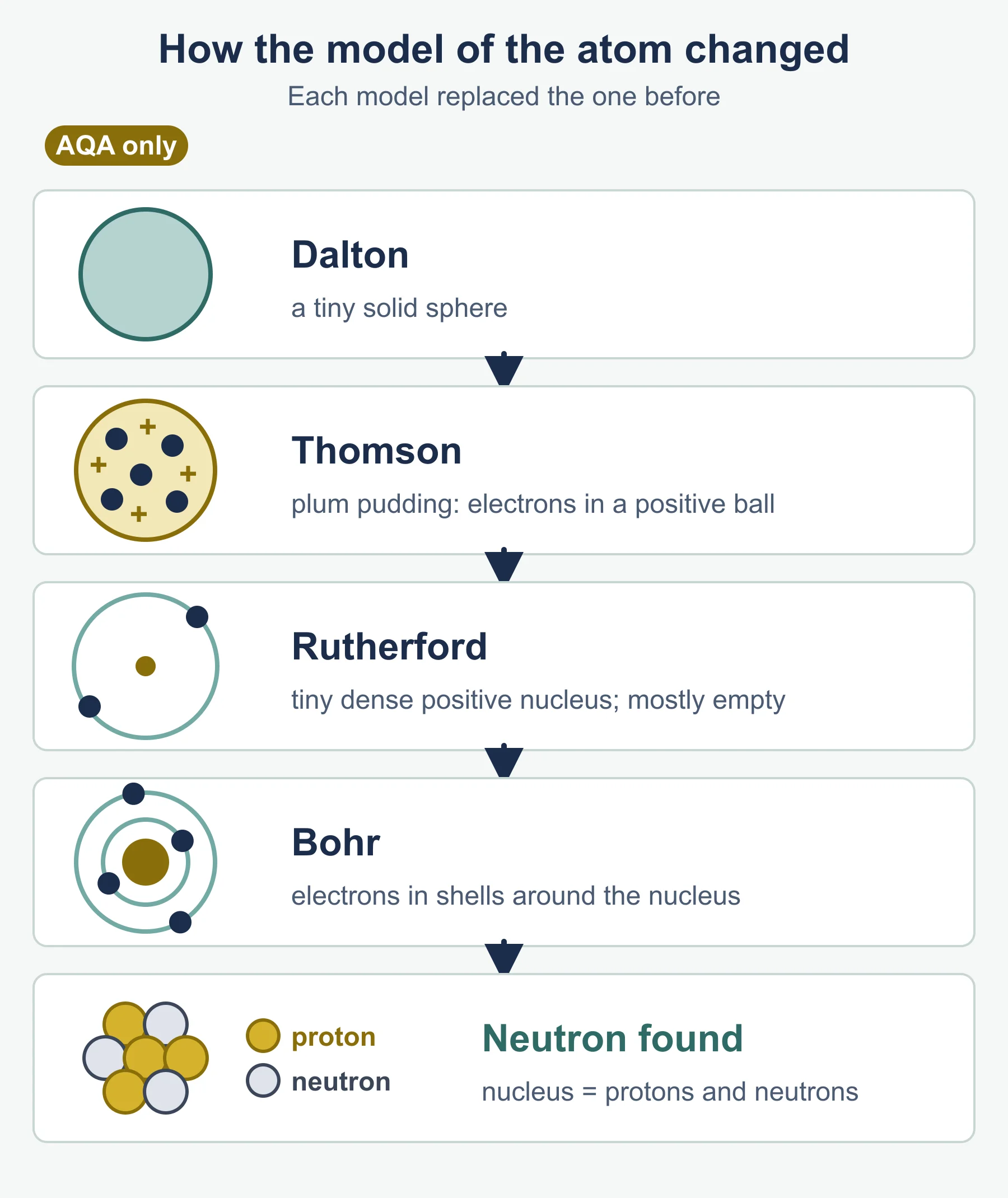
The specification does not name particular scientists or models. It asks you to appreciate that understanding has evolved. The sequence below is a useful example, and you can use it, or others, to support an answer.
- Early idea. Atoms were thought of as tiny, solid spheres that could not be divided. This fits the fact that elements combine in fixed proportions.
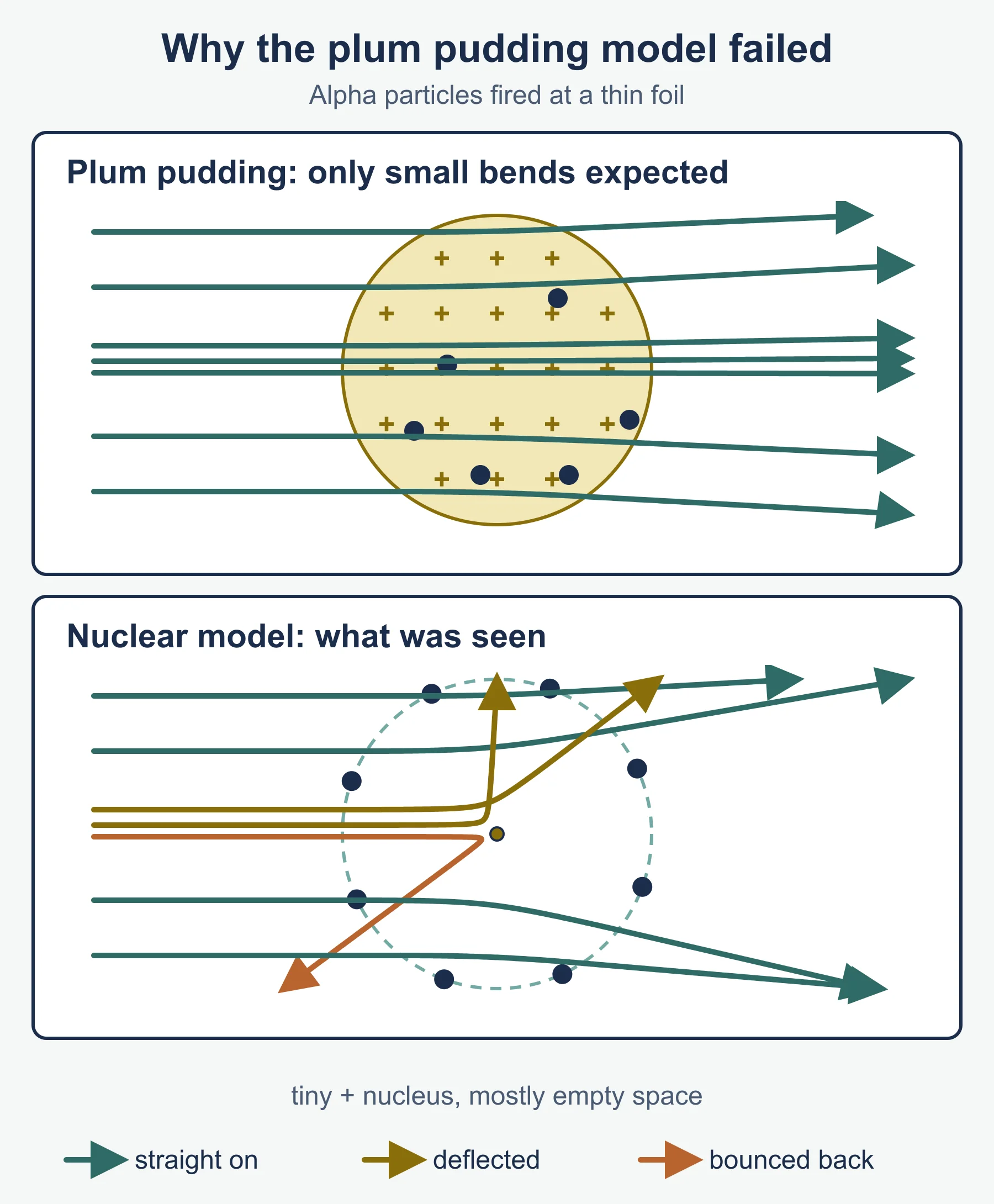
- Electrons found. Experiments on electricity passing through gases at low pressure showed that atoms contain smaller, negatively charged particles. Atoms are neutral overall, so a “plum pudding” model followed: a sphere of positive charge with electrons embedded in it.
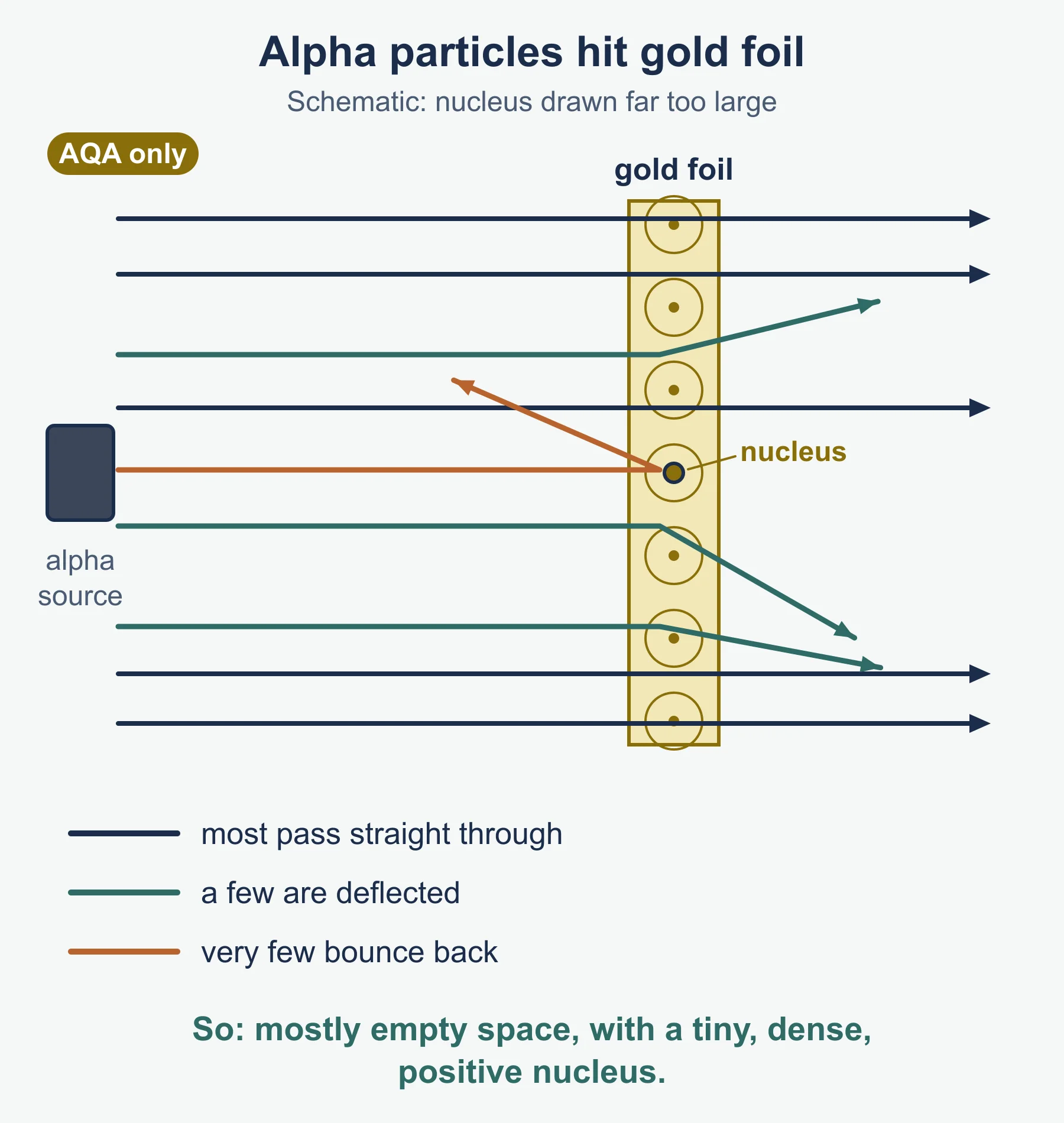
- The nuclear atom. In experiments directed by Rutherford, thin gold foil was bombarded with alpha particles (positively charged). Nearly all passed straight through, some were deflected, and a tiny fraction rebounded. The plum pudding model could not explain the large deflections, so it was replaced by a model with a tiny, dense, positively charged nucleus and mostly empty space around it.
- Shells. Bohr proposed that electrons occupy fixed energy levels around the nucleus. This model was later refined, and you meet the refined version under electron configuration.
- The neutron. Chadwick showed in 1932 that the nucleus also contains a neutral particle of similar mass to the proton. This answered a puzzle: nuclei were heavier than the total mass of their protons.
The pattern matters more than the dates. A model is useful while it explains the evidence. When a reliable experiment gives a result the model cannot explain, the model is changed. Other scientists repeat and test the new evidence before the change is accepted.
Worked example: reading scattering results
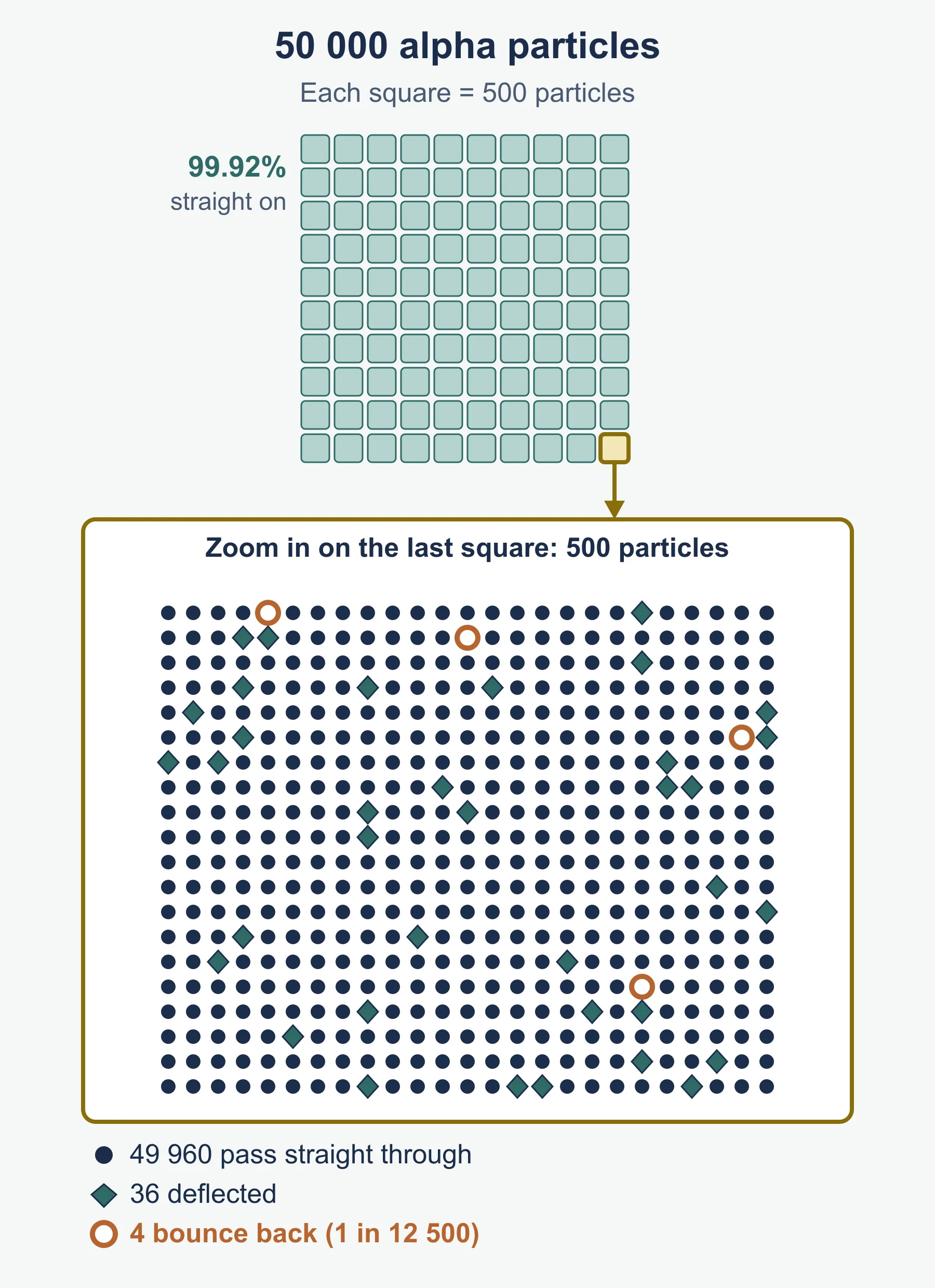
In an invented experiment, 50 000 alpha particles are fired at a thin metal foil and their paths are recorded.
| Observation | Count | Percentage of total |
|---|---|---|
| Passed through with no noticeable change in direction | 49 960 | 99.92% |
| Deflected by a small or moderate angle | 36 | 0.072% |
| Deflected back through more than 90 degrees | 4 | 0.008% (1 in 12 500) |
Check: 49 960 + 36 + 4 = 50 000.
Interpretation.
- Almost all particles pass through, so the atom is largely empty space.
- A few are deflected, and alpha particles are positive, so something positive and concentrated repels them.
- Four in 50 000 are turned back, so the positive charge must be packed into a very small volume. A particle only reverses if it meets a heavy, strongly charged region head-on.
- This evidence supports a small nucleus and cannot be explained by positive charge spread evenly through the atom.
Relative charge and relative mass
Particles in atoms are so small that chemists compare them with each other instead of using kilograms and coulombs. A relative value has no units.
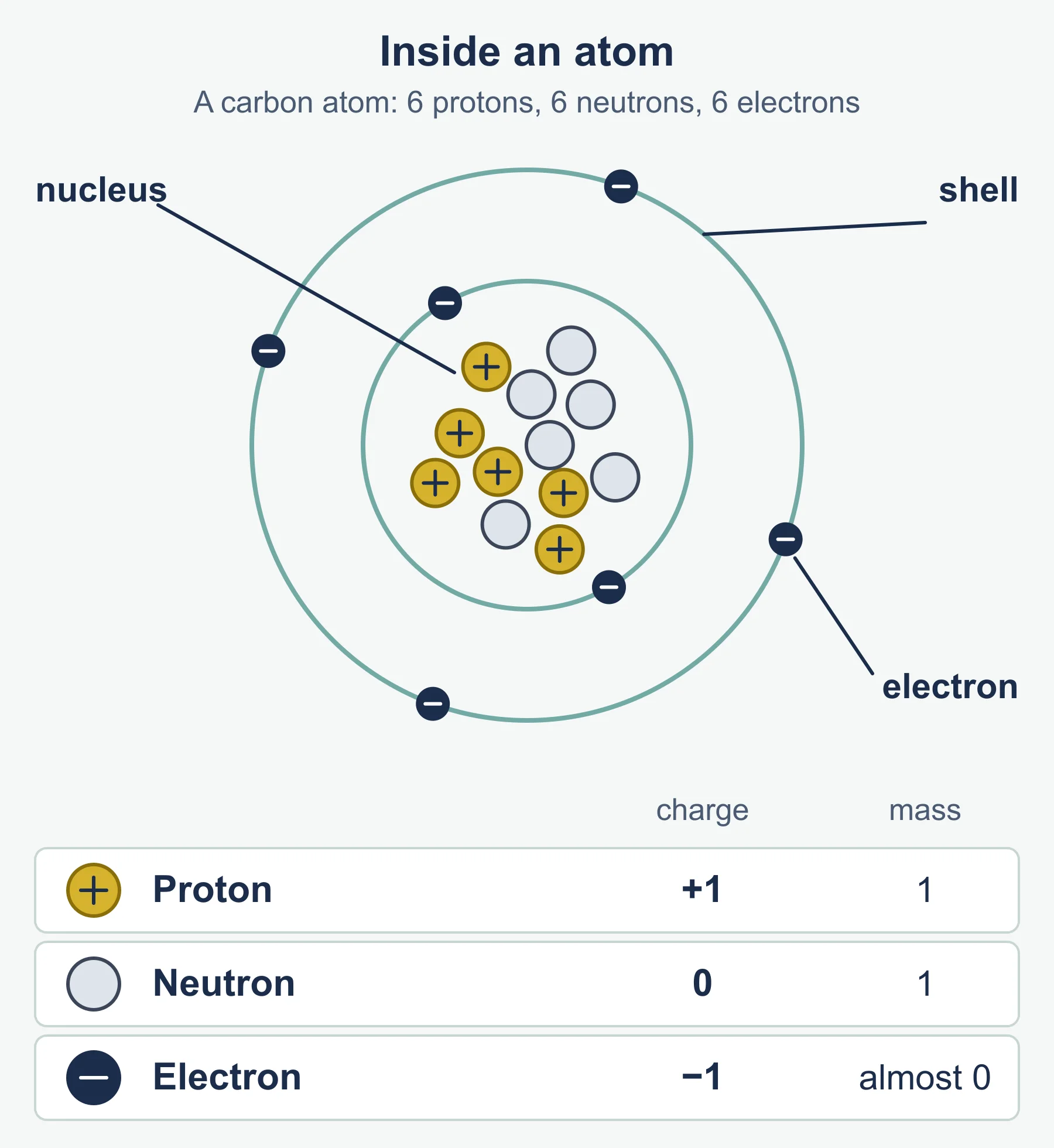
| Particle | Relative charge | Relative mass |
|---|---|---|
| Proton | +1 | 1 |
| Neutron | 0 | 1 |
| Electron | −1 | 1/1840 (about 0.00054) |
Points to hold on to:
- The proton and the electron have equal and opposite charges. That is why an atom with equal numbers of each is neutral.
- The neutron has no charge.
- The proton and neutron have almost the same mass, so each is given a relative mass of 1. The neutron is very slightly heavier.
- The electron has a tiny mass. Its relative mass is written as 1/1840, and you may also see 1/1836. Both describe the same fact: it takes nearly two thousand electrons to equal the mass of one proton. Use the value your teacher or the question gives you.
Where the 1/1840 comes from
Compare the actual masses: proton 1.6726 × 10⁻²⁷ kg and electron 9.1094 × 10⁻³¹ kg. Dividing gives 1.6726 × 10⁻²⁷ ÷ 9.1094 × 10⁻³¹ ≈ 1836. So the electron has about 1/1836 of the proton’s mass. You are not asked to remember the actual masses, but seeing the division helps you trust the relative figure.
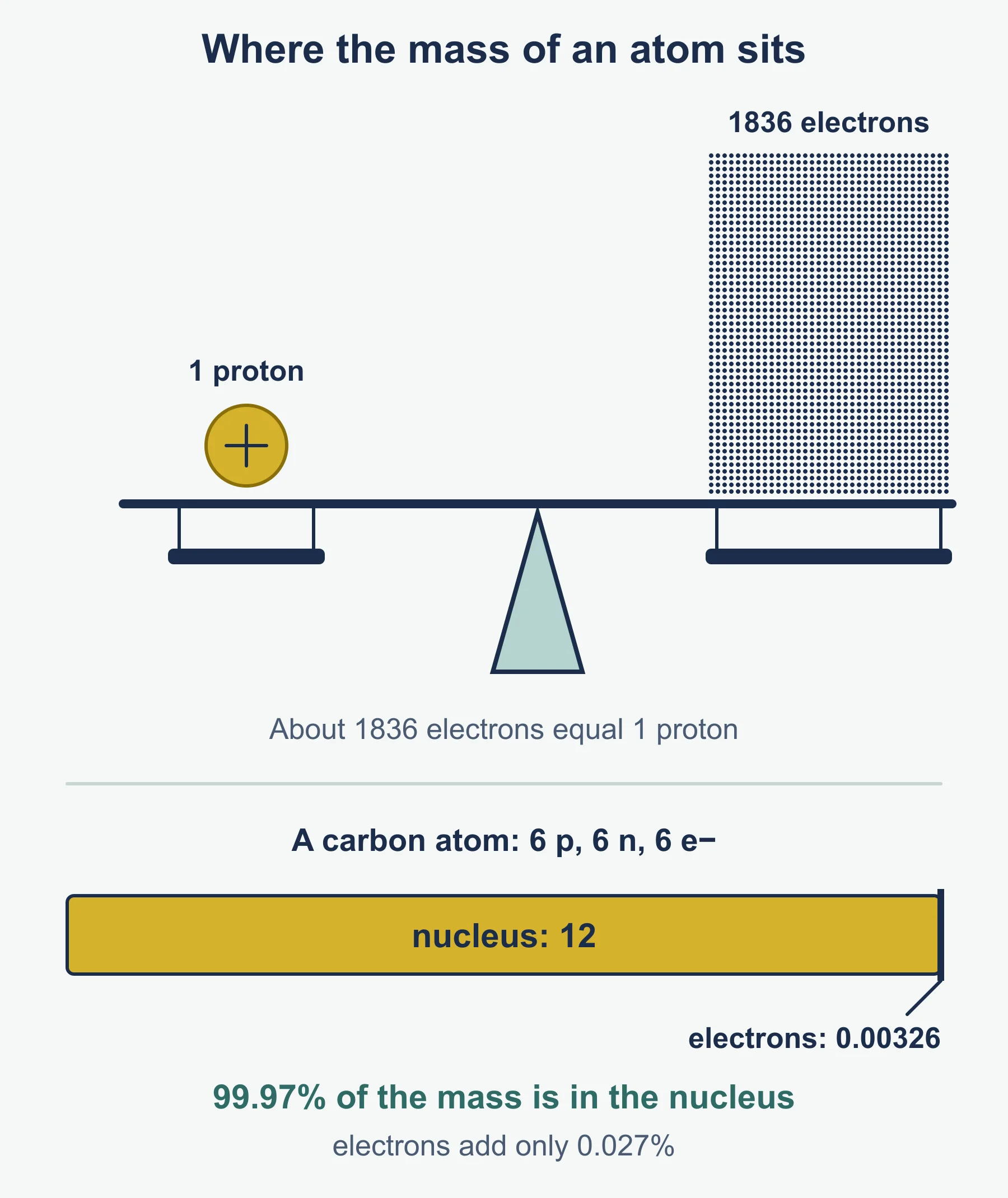
Worked example: where the mass of an atom sits
A carbon atom with six protons, six neutrons and six electrons. Use relative masses.
protons + neutrons:  6 x 1 + 6 x 1 = 12
electrons:           6 x (1/1840)  = 0.00326
whole atom:                          12.00326
share in electrons:  0.00326 / 12.00326 = 0.0272 %
share in nucleus:                          99.97 %
Over 99.9% of an atom’s mass sits in its nucleus. The electrons add so little that, in most calculations, the mass of an atom or ion is taken from its protons and neutrons alone.
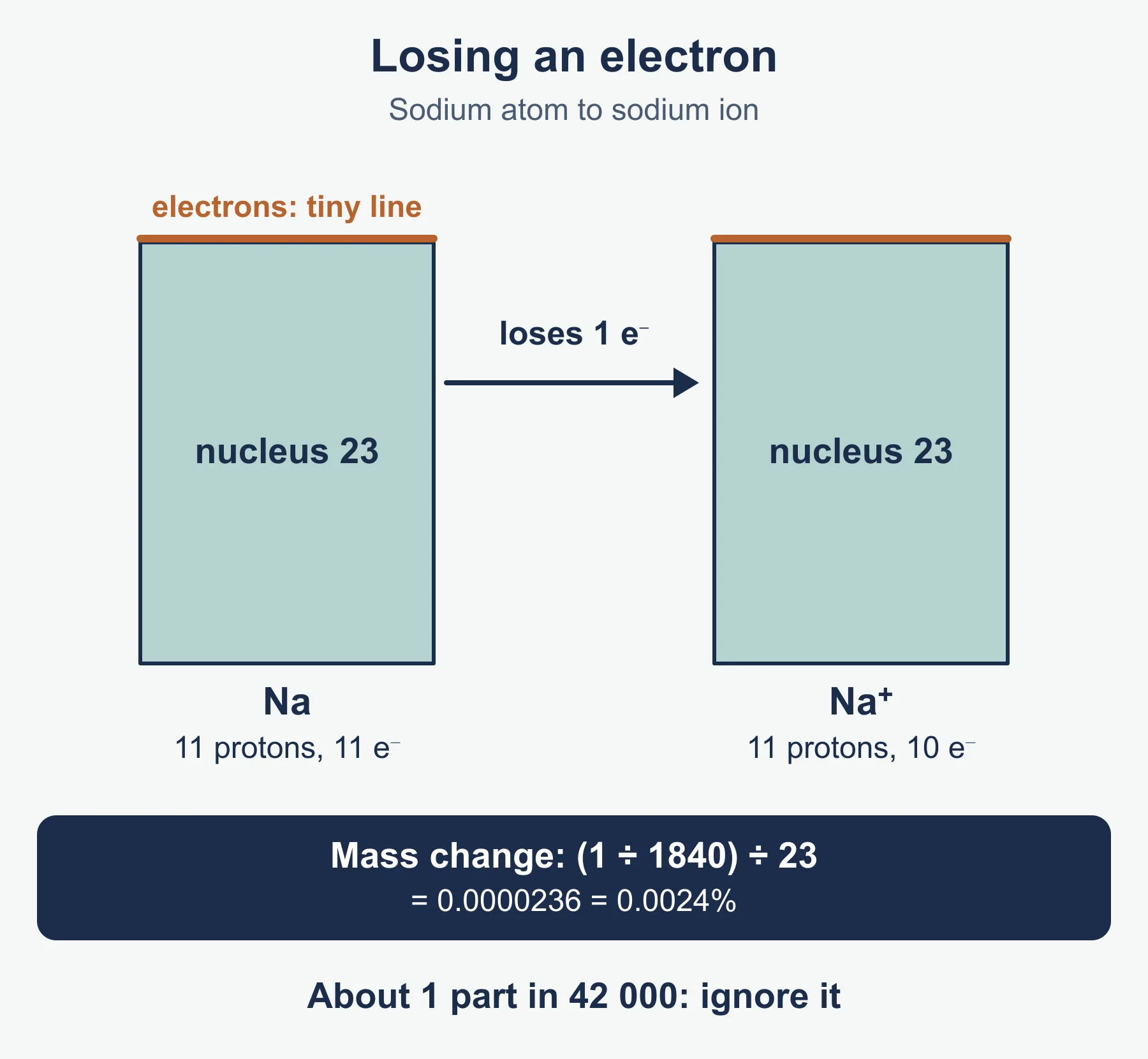
Worked example: why losing an electron hardly changes the mass
A sodium atom has 11 protons and 12 neutrons, so a relative mass of 23 from its nucleus. When it forms Na⁺ it loses one electron, and the mass falls by 1/1840 of a unit. As a fraction of the total: (1/1840) ÷ 23 = 0.0000236, or 0.0024%. The ion and the atom have effectively the same mass, so you can ignore the change when comparing masses.
The structure of the atom
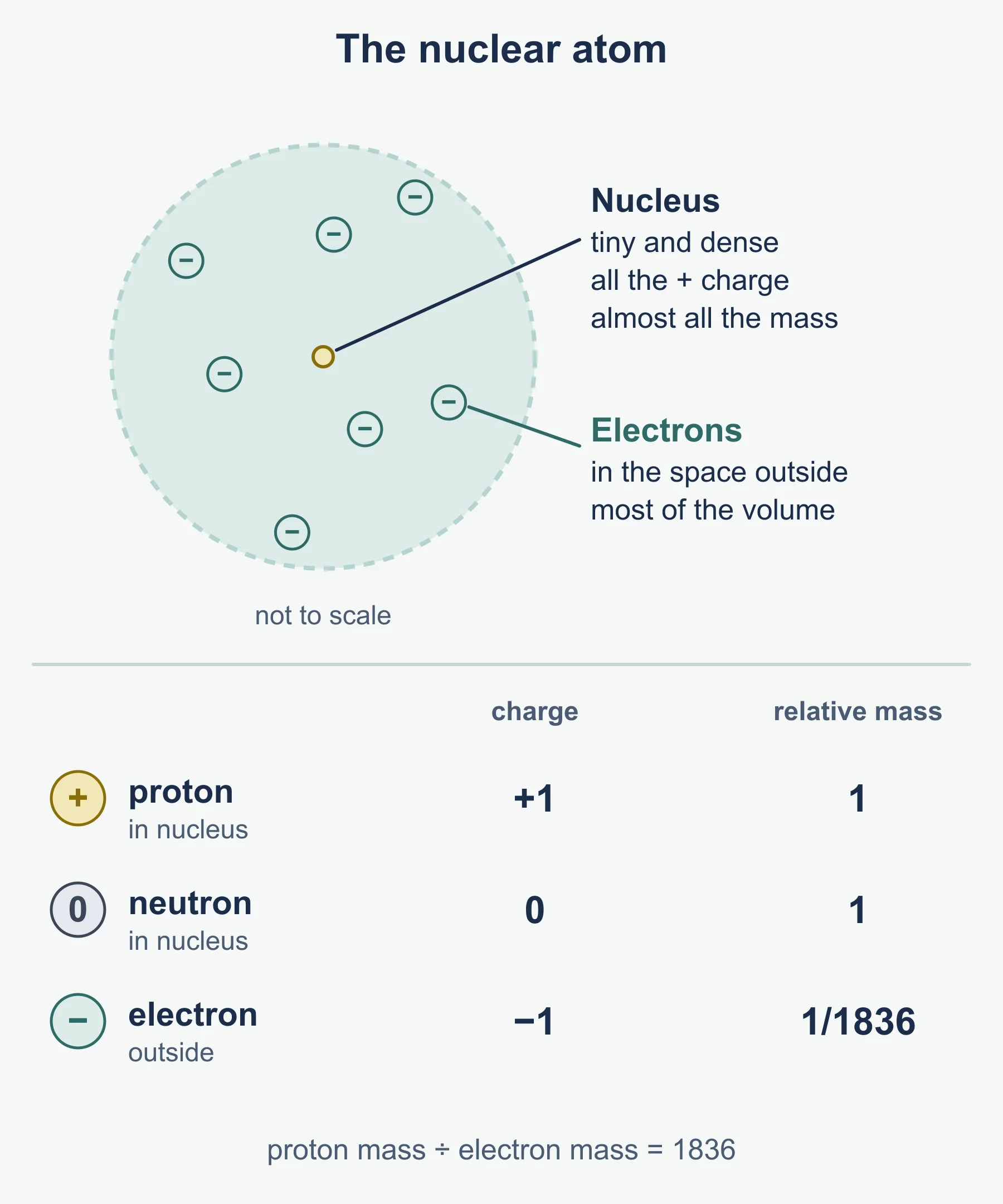
An atom has two regions:
- The nucleus at the centre contains the protons and neutrons. It is positively charged because only the protons carry charge.
- The electrons are outside the nucleus. Electrons are held by the attraction between their negative charge and the positive nucleus.
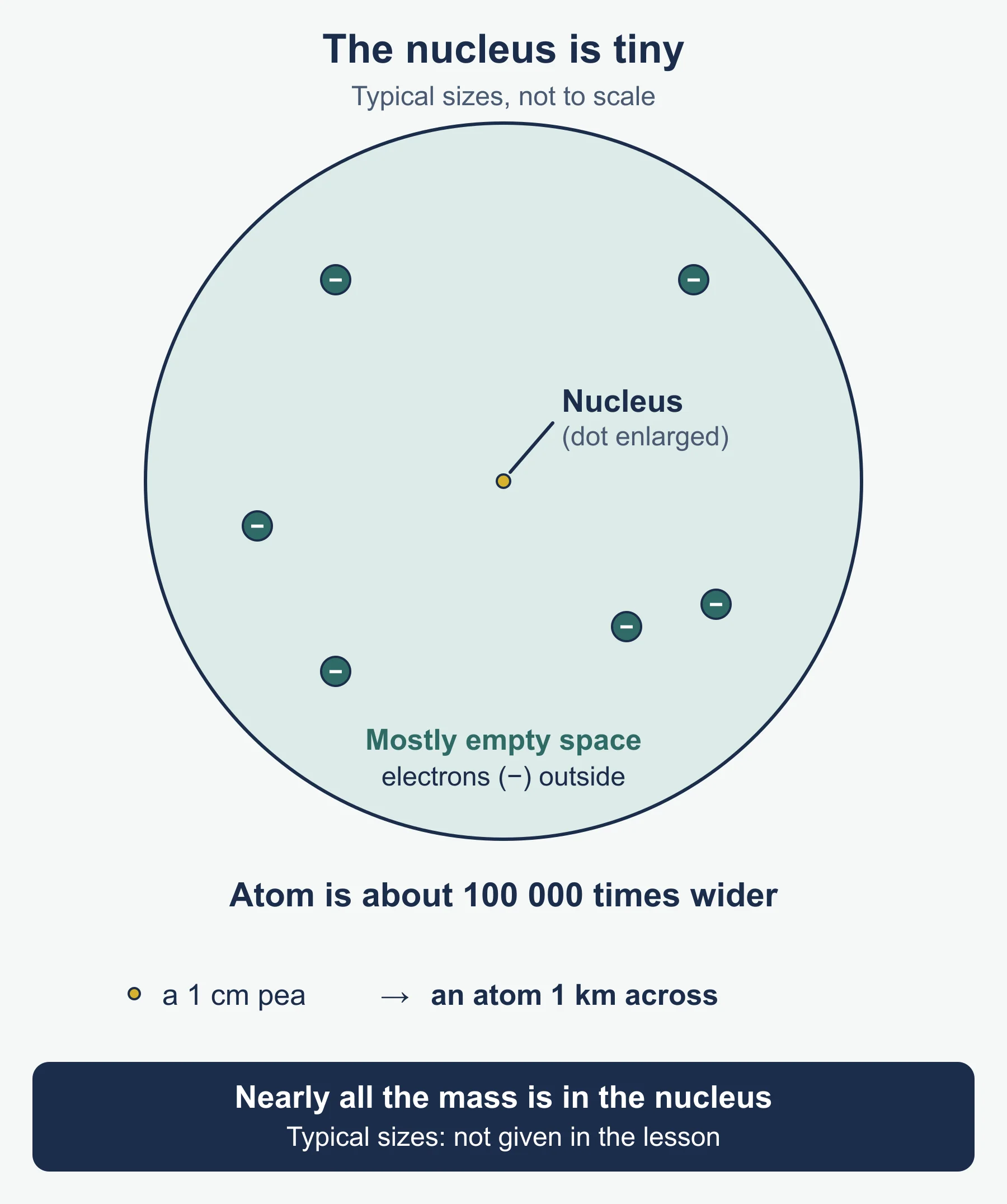
The nucleus is very small compared with the atom as a whole. The atom is mostly empty space with electrons moving through it. Nearly all the mass is in the nucleus and the size of the atom is set by where its electrons are.
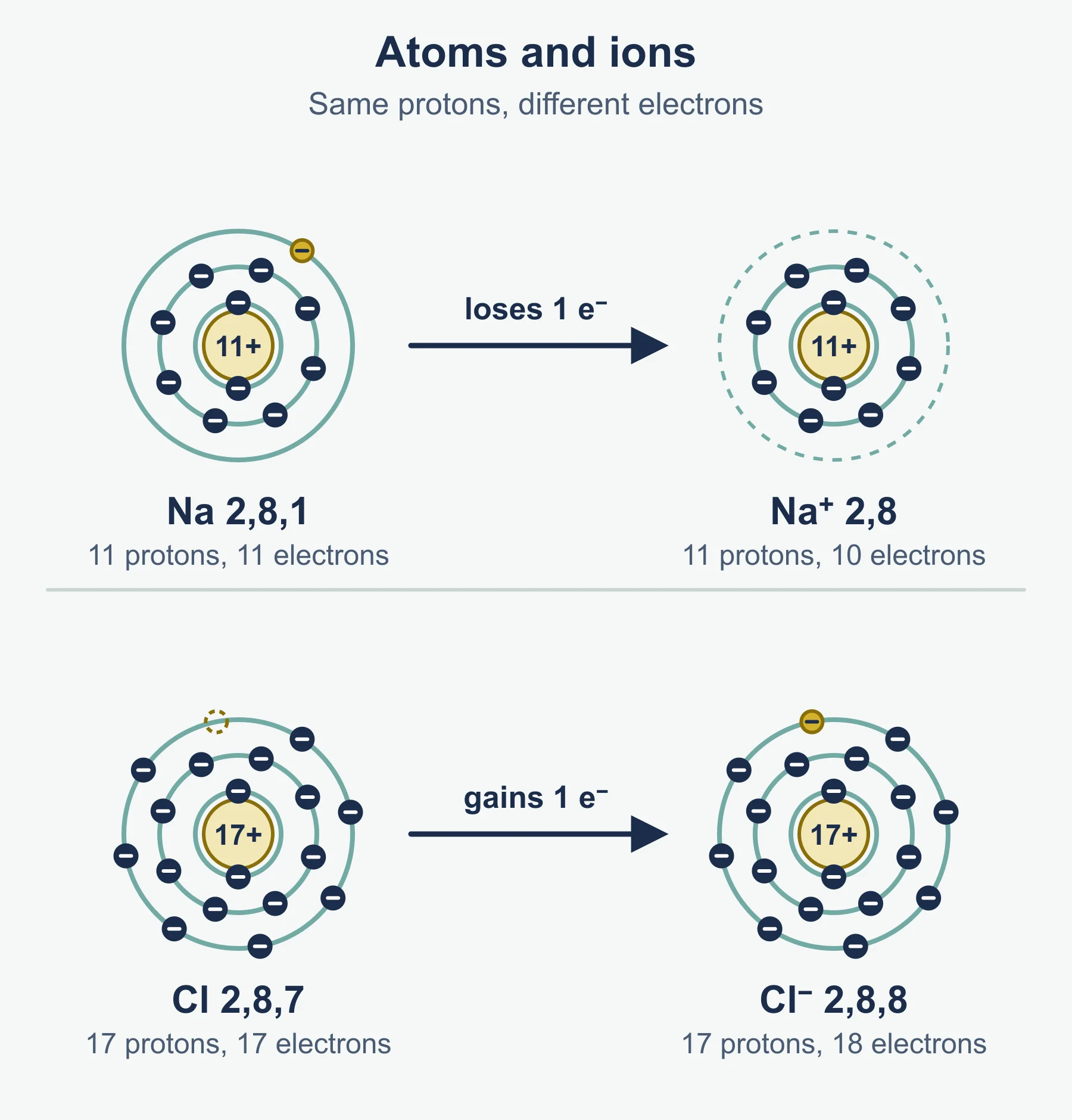
Charge in atoms and ions
The overall charge is found from the relative charges:
overall charge = number of protons - number of electrons- In an atom the two numbers are equal, so the overall charge is zero.
- In a positive ion there are fewer electrons than protons.
- In a negative ion there are more electrons than protons.
- Neutrons do not change the charge. They only change the mass.
Changing the number of electrons makes an ion. Changing the number of protons would make a different element, and changing the number of neutrons gives a different isotope (covered in 3.1.1.2).
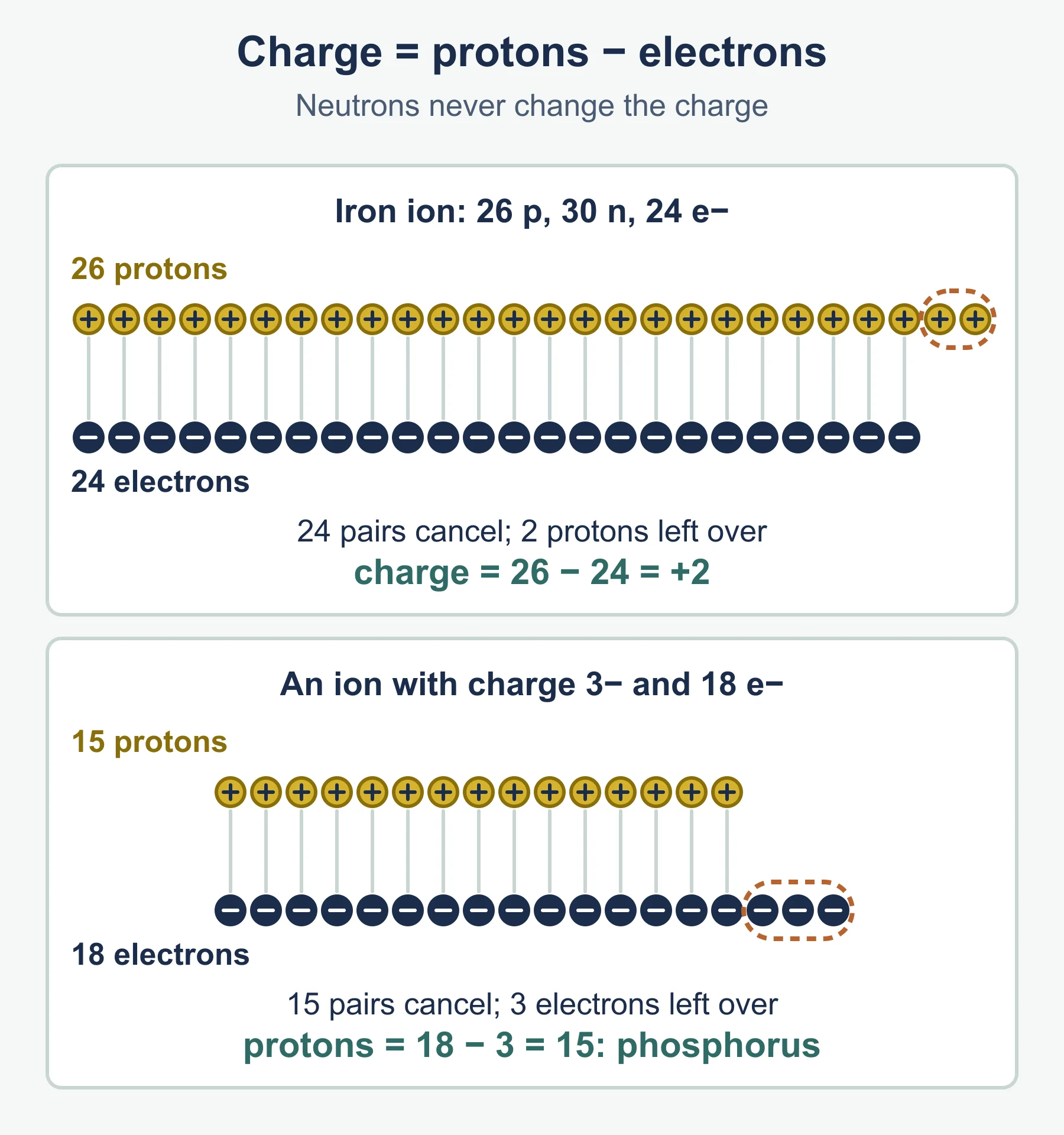
Worked example: finding the charge on an ion
A particle has 26 protons, 30 neutrons and 24 electrons.
charge = 26 - 24 = +2
nuclear mass = 26 + 30 = 56
electron mass = 24 / 1840 = 0.0130
total relative mass = 56.013
The particle has a relative charge of +2 and a relative mass of about 56. Read the other way, an ion of charge +2 with 26 protons must have 24 electrons.
Worked example: working backwards
An ion has a charge of 3− and contains 18 electrons.
charge = protons - electrons
-3     = protons - 18
protons = 15
It has 15 protons, so the atomic number is 15 and the element is phosphorus.
Writing good answers
Describe the structure of an atom. Give three points: a nucleus at the centre containing protons and neutrons; electrons outside the nucleus; the atom is neutral because the number of protons equals the number of electrons.
Explain why a model was changed. Name the new evidence, say what the old model predicted, and say how the evidence contradicts it. For example, “most alpha particles passed through foil but a few reflected, which a uniform positive sphere could not explain, so a small dense nucleus was proposed”.
Compare particles. Use both properties. “The neutron has the same mass as the proton but no charge” is a full comparison. “They are similar” is not.
Common errors
- Giving the electron a relative mass of zero. Its mass is very small, but it is not zero.
- Writing the relative charge of the electron as 1 without the minus sign.
- Saying that the nucleus contains electrons. The nucleus holds protons and neutrons only.
- Saying that neutrons are negative or have “neutral mass”. The neutron is neutral in charge, not mass.
- Describing the nuclear model as “solid”. Most of the atom is empty space.
- Explaining the change of model by saying scientists “got it wrong”. The better answer is that new evidence did not fit the old model.
- Using the number of neutrons to find charge.
Frequently asked questions
What are the relative charge and mass of a proton, neutron and electron? A proton has relative charge +1 and relative mass 1, a neutron has charge 0 and mass 1, and an electron has charge −1 and mass 1/1840. Relative values have no units.
Where are protons, neutrons and electrons found in an atom? The protons and neutrons are in the nucleus at the centre, and the electrons are outside the nucleus. The nucleus is very small compared with the atom, which is mostly empty space, but it holds nearly all the mass.
Why was the plum pudding model replaced? When alpha particles were fired at thin gold foil, nearly all passed straight through but some were deflected and a tiny fraction rebounded. The plum pudding model could not explain the large deflections, so it was replaced by a model with a tiny, dense, positively charged nucleus.
Do you need to learn the names of scientists for AQA A-level Chemistry 3.1.1.1? The specification does not name particular scientists or models. It asks you to appreciate that understanding of atomic structure has evolved, and to explain why a model is changed when new evidence does not fit it.
Does the electron have zero mass? No. The electron’s relative mass is very small, about 1/1840, but it is not zero. Giving the electron a mass of zero is a common error.
Next steps
Try the Fundamental particles practice questions, then move on to isotopes and mass spectrometry in the Atomic Structure study guide.
Official syllabus
AQA, AS and A-level Chemistry specification (7404/7405), for AS and A-level exams June 2016 onwards: section 3.1.1.1 Fundamental particles.
Get free revision emails (optional)
Occasional emails with practice questions, worked explanations and links to free resources for the qualification and subjects you choose. No spam, and you can unsubscribe from any email. The free tools on this site never need an email.
Related resources
-
Practice questions
AQA A-Level Chemistry: Fundamental particles (7405) – Practice Questions
Original practice questions with worked answers on protons, neutrons, electrons and how atomic models changed, for AQA A-Level Chemistry.
Chemistry · AQA · AS Level
Try questions -
Study guides
AQA A-Level Chemistry: Group 2, the alkaline earth metals (7405)
AQA A-Level Chemistry Group 2 taught from scratch: trends from Mg to Ba, reactions with water, hydroxide and sulfate solubility, uses and the sulfate test.
Chemistry · AQA · AS Level
Read guide -
Practice questions
AQA A-Level Chemistry: Group 2, the alkaline earth metals (7405) – Practice Questions
Original AQA A-Level Chemistry Group 2 questions with marked answers: trends, water reactions, titanium, solubility, flue gases and the sulfate test.
Chemistry · AQA · AS Level
Try questions
Related articles
-
study skills
How to revise for a science examination
Most science revision fails because it rereads notes instead of retrieving them. A practical method for revising physics, chemistry and biology in the weeks before a paper.
14 July 2026
-
teaching
A Level tuition in Dubai: Cambridge or Pearson Edexcel International A Level?
Schools in Dubai and Abu Dhabi teach either Cambridge International AS & A Level or Pearson Edexcel International A Level. How the two are structured, why it matters for tuition, and how online classes from Lahore work.
9 October 2026
Studying this with a teacher
Working through Chemistry AS LEVEL?
This page is free and stays free. If you would rather be taught it, Marlbridge runs Chemistry classes one-to-one and in small groups of up to 15, online in your own time zone. The first trial class is free. WhatsApp replies within an hour (8am–11pm Pakistan time, every day); email the same day.
AQA Chemistry teachers at Marlbridge

