
Study Guides
AQA A-Level English Language (7702): Language Investigation
Designing, collecting data for and writing up the 2,000-word NEA language investigation, with evaluative methodology examples: AQA A-level English 7702 3.3.1.
- Subject
- English
- Level
- A LEVELS
- Topic
- Non-exam Assessment – Language in Action
- Author
- Marlbridge Academic Team
- Updated
- Reviewed by
- Ammar Bilal (what this means)
Aligned to AQA A Level English (7702), For first teaching 2015. Official specification .
Syllabus page (what it covers and how it is assessed): AQA A Level English Language.
Found an error? Report a correction.
Need help with this topic? Request a free trial class for A Level English Language (7702).
This guide covers 3.3.1 Language Investigation, the larger part of the non-exam assessment in AQA A-level English Language (7702): a 2,000-word investigation, excluding data, worth 50 of the NEA’s 100 marks. The Language in Action NEA guide explains the required sections and how to narrow a topic. This page goes into what happens after that: research design, data collection, ethics, and writing each section so that it earns credit.
What the specification requires
You choose an area of individual interest, in consultation with your supervising teacher, collect your own data and select your own approach to analysis. The specification’s example areas include representations of individuals or groups, regional dialect, gendered talk, the language of new communication technologies, children’s language, the language of the media, code-switching, occupational language and historical change. Data may be spoken, written or multimodal, word lists, or material on attitudes, uses or views of language.
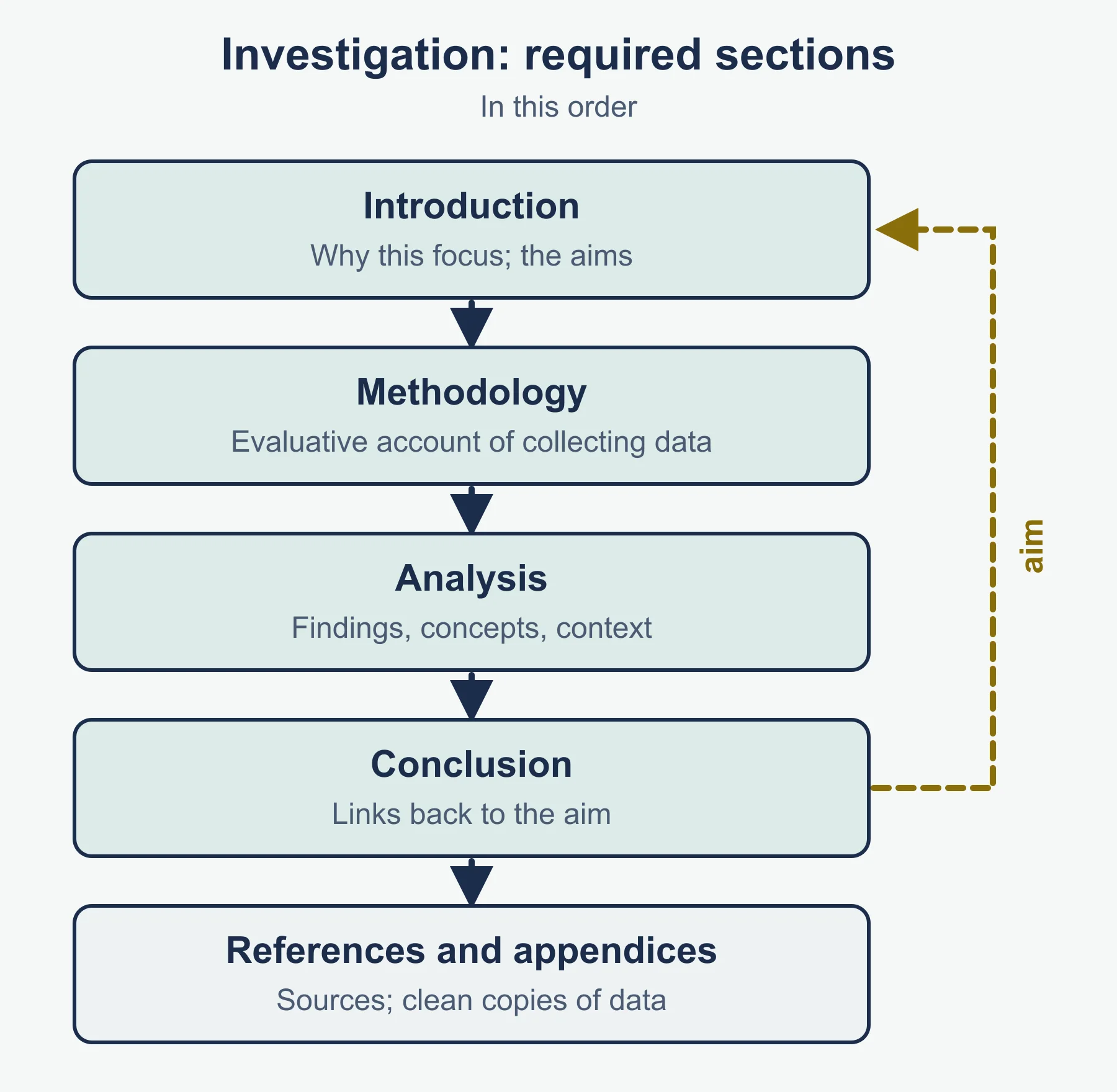
The finished investigation contains an introduction (reasons and aims), a methodology (an evaluative account of how data was collected and organised, and approaches to analysis), an analysis (interpretation of findings, critical consideration of relevant concepts and issues, and contextual influences on the data), a conclusion linked to the aim, references and appendices (clean copies of data and evidence for quantitative approaches).
Step 1: from aim to research questions
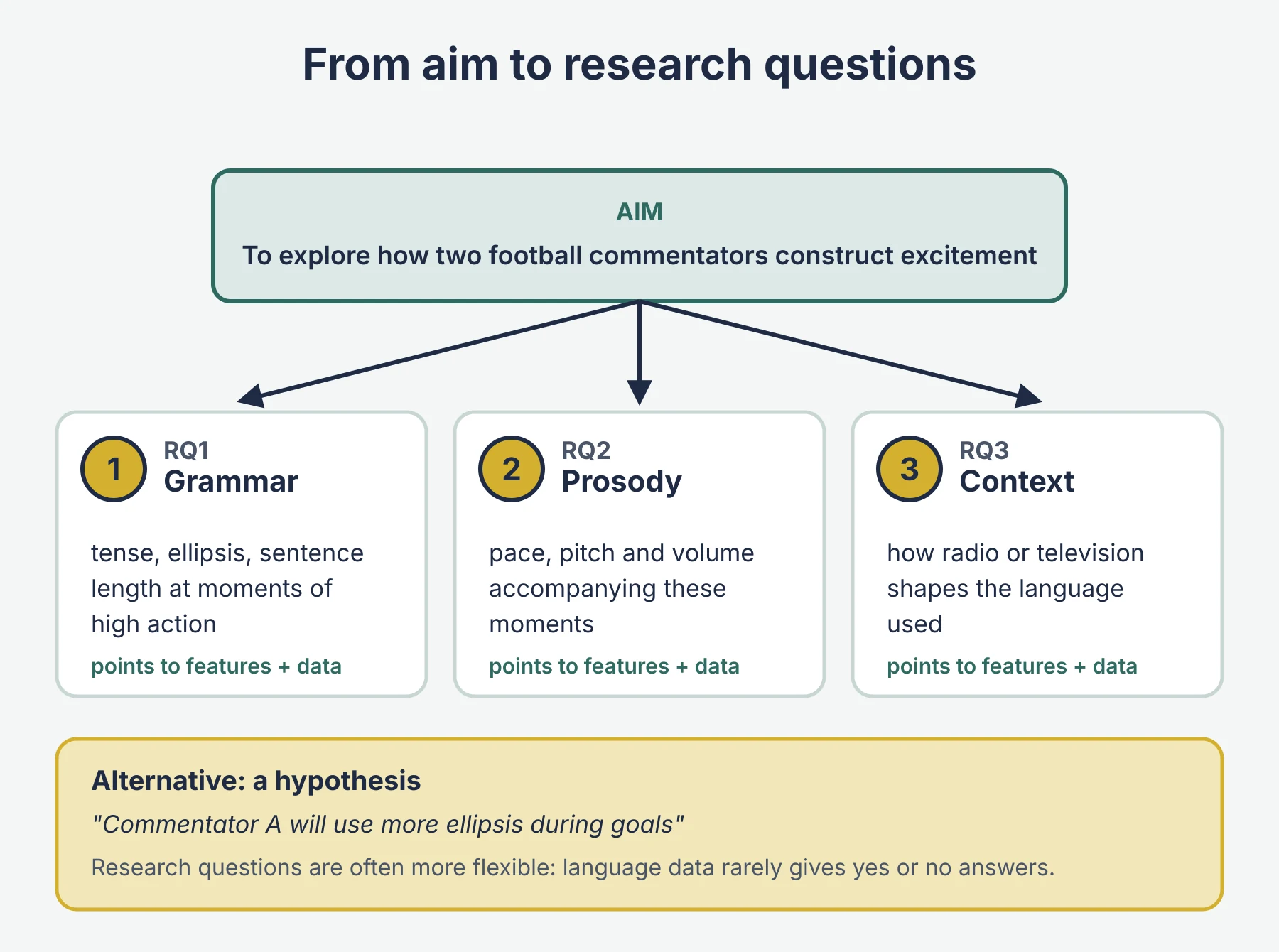
An aim states what you want to find out. Research questions break it into answerable parts, each pointing to specific features and data.
Aim:     To explore how two football commentators construct excitement.
RQ1      How do the commentators' grammatical choices (tense, ellipsis,
         sentence length) change at moments of high action?
RQ2      What prosodic features (pace, pitch, volume) accompany these moments?
RQ3      How does the radio or television context shape the language used?
Some students frame a hypothesis (“Commentator A will use more ellipsis during goals”). That can work, but research questions are often more flexible, because language data rarely gives simple yes or no answers.
Step 2: designing data collection
| Data type | Collection method | Design decisions to justify |
|---|---|---|
| Spontaneous speech | Audio or video recording, then transcription | Length of sample, number of speakers, setting, transcription conventions |
| Broadcast or published speech | Recording from a public source | Selection of extracts, comparability (same sport, same length) |
| Written texts | Collected set (adverts, reports, articles, posts) | Size of set, date range, source, matching texts for comparison |
| Children’s language | Recordings or writing samples, with consent from parents and school | Age, task given, setting |
| Attitudes | Questionnaires or interviews | Question wording, sample size and spread, leading questions avoided |
| Word lists | Collected lexis (new words, shop names) | Source, period, criteria for inclusion |
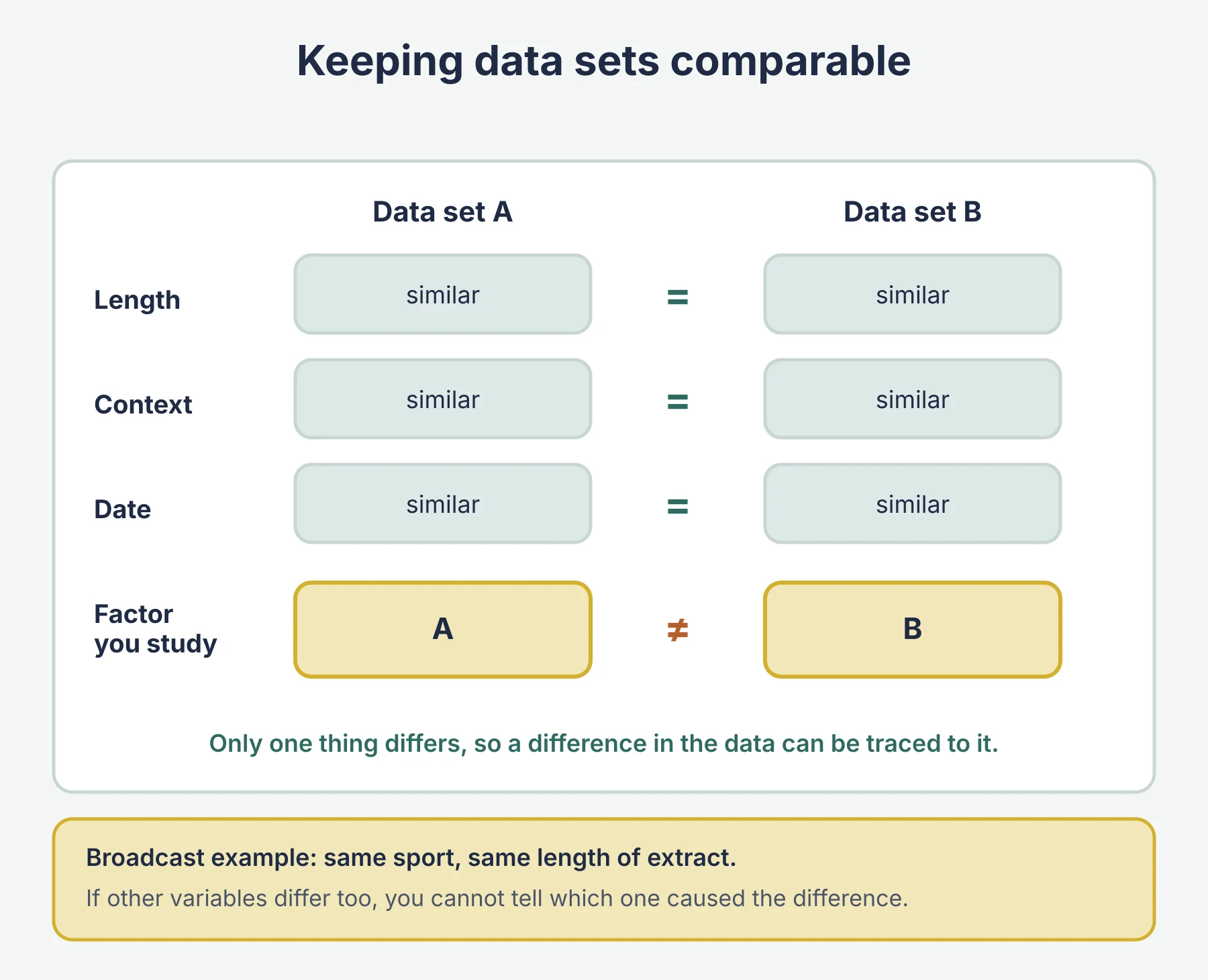
Comparability matters. If you compare two groups or two sets of texts, keep other variables as similar as possible: similar length, similar context, similar date. Otherwise you cannot tell whether a difference comes from the factor you are studying.
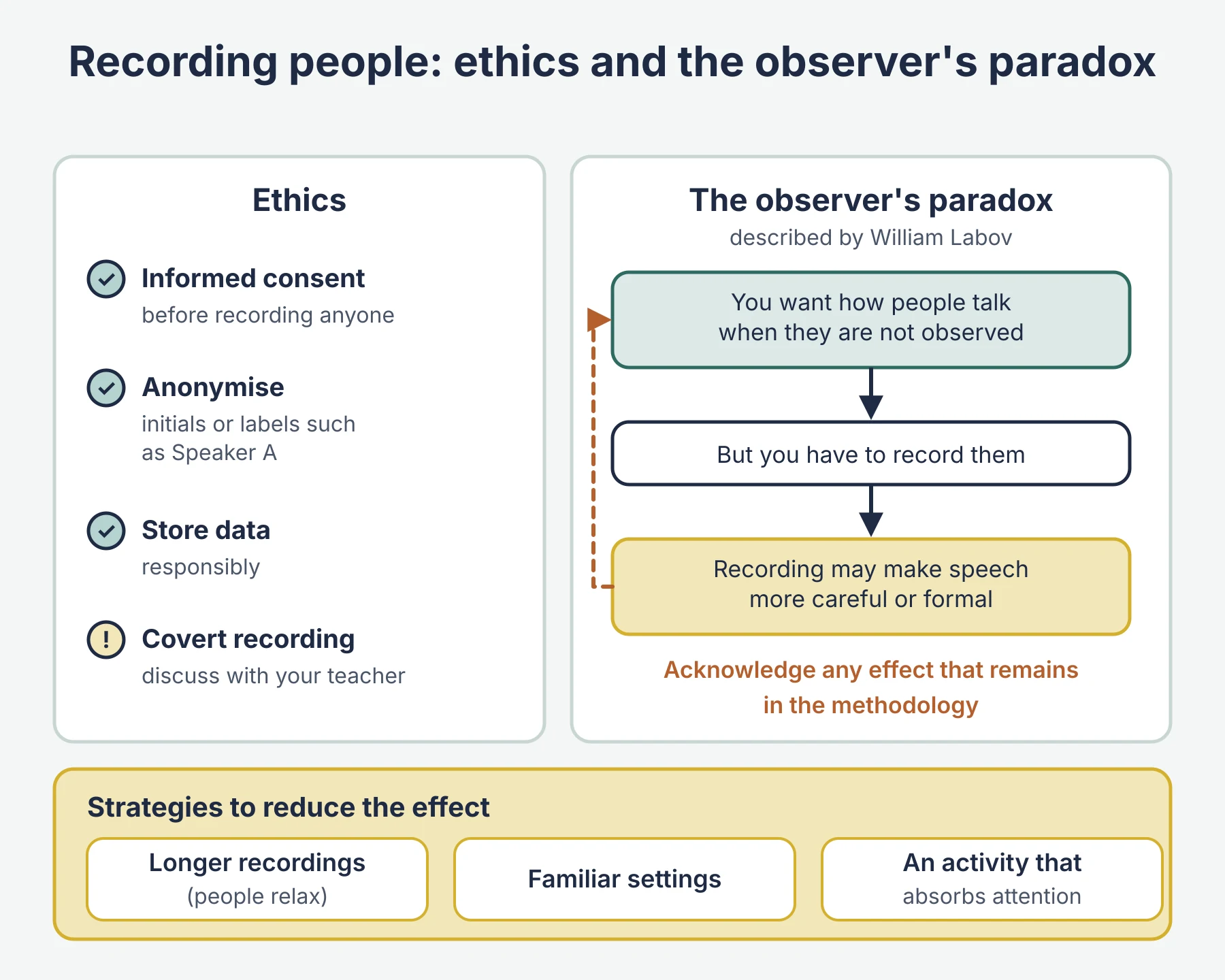
Ethics. Obtain informed consent before recording people, anonymise participants (use initials or labels such as Speaker A), and store data responsibly. Covert recording raises ethical problems and should be discussed with your teacher.
The observer’s paradox. William Labov described the problem that researchers want to observe how people talk when not observed. Recording may make speech more careful or formal. Strategies include longer recordings (people relax), familiar settings, or recording an activity that absorbs attention. Acknowledge any remaining effect.
Writing the introduction
Keep it brief: why this focus interests you and why it matters linguistically (for example, a gap between popular claims and real usage), the aim, and the research questions. A sentence or two placing the topic in relevant research shows the reader which concepts the analysis will test. Avoid long personal narratives: the introduction earns its words by setting up the analysis.
Step 3: writing an evaluative methodology
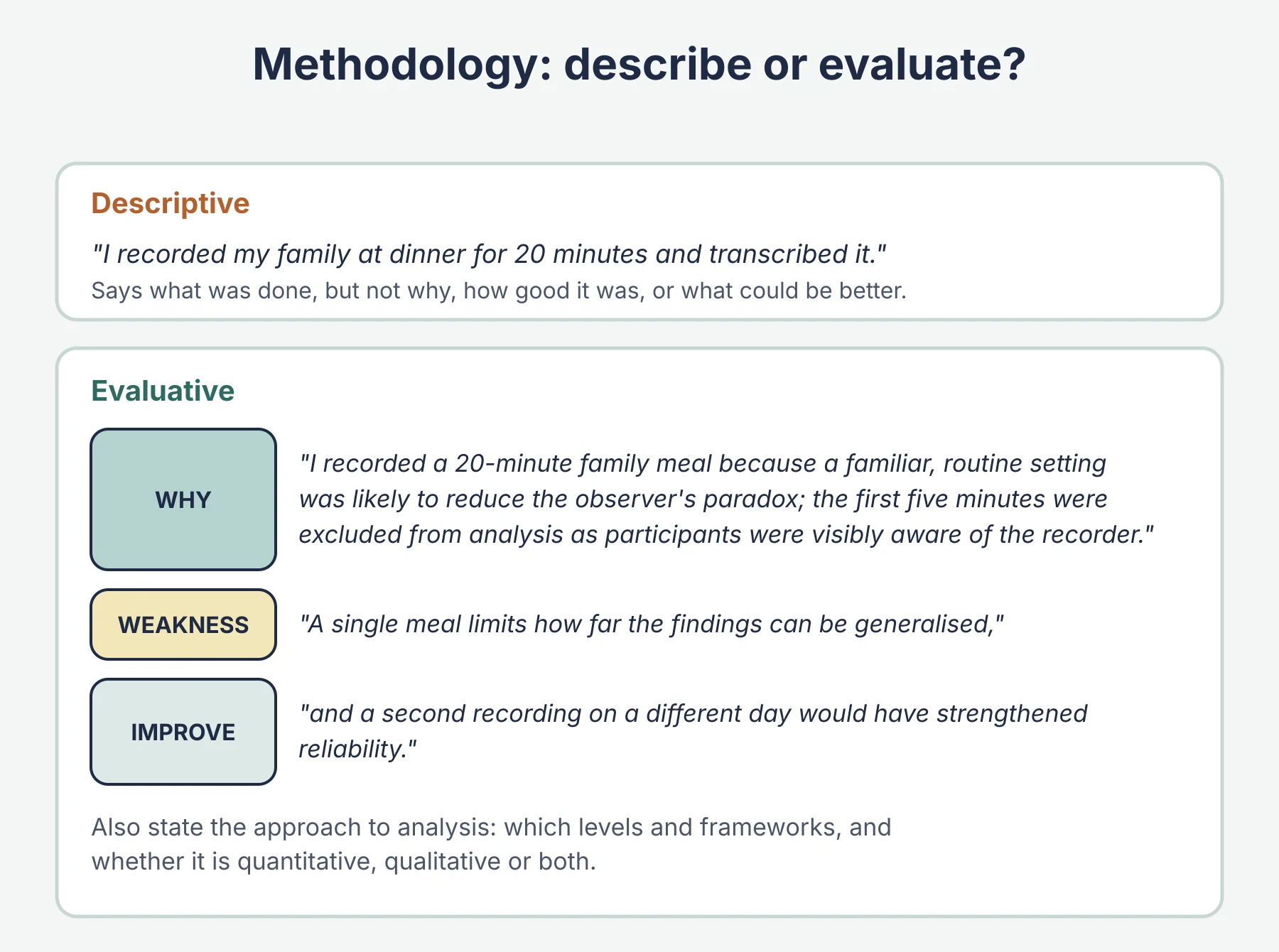
The specification asks for an evaluative account, not a description. Compare:
Descriptive: “I recorded my family at dinner for 20 minutes and transcribed it.”
Evaluative: “I recorded a 20-minute family meal because a familiar, routine setting was likely to reduce the observer’s paradox; the first five minutes were excluded from analysis as participants were visibly aware of the recorder. A single meal limits how far the findings can be generalised, and a second recording on a different day would have strengthened reliability.”
The evaluative version explains why each choice was made, identifies its weaknesses and suggests improvements. It also states the approach to analysis: which levels and frameworks, and whether analysis is quantitative, qualitative or both.
Step 4: organising the analysis
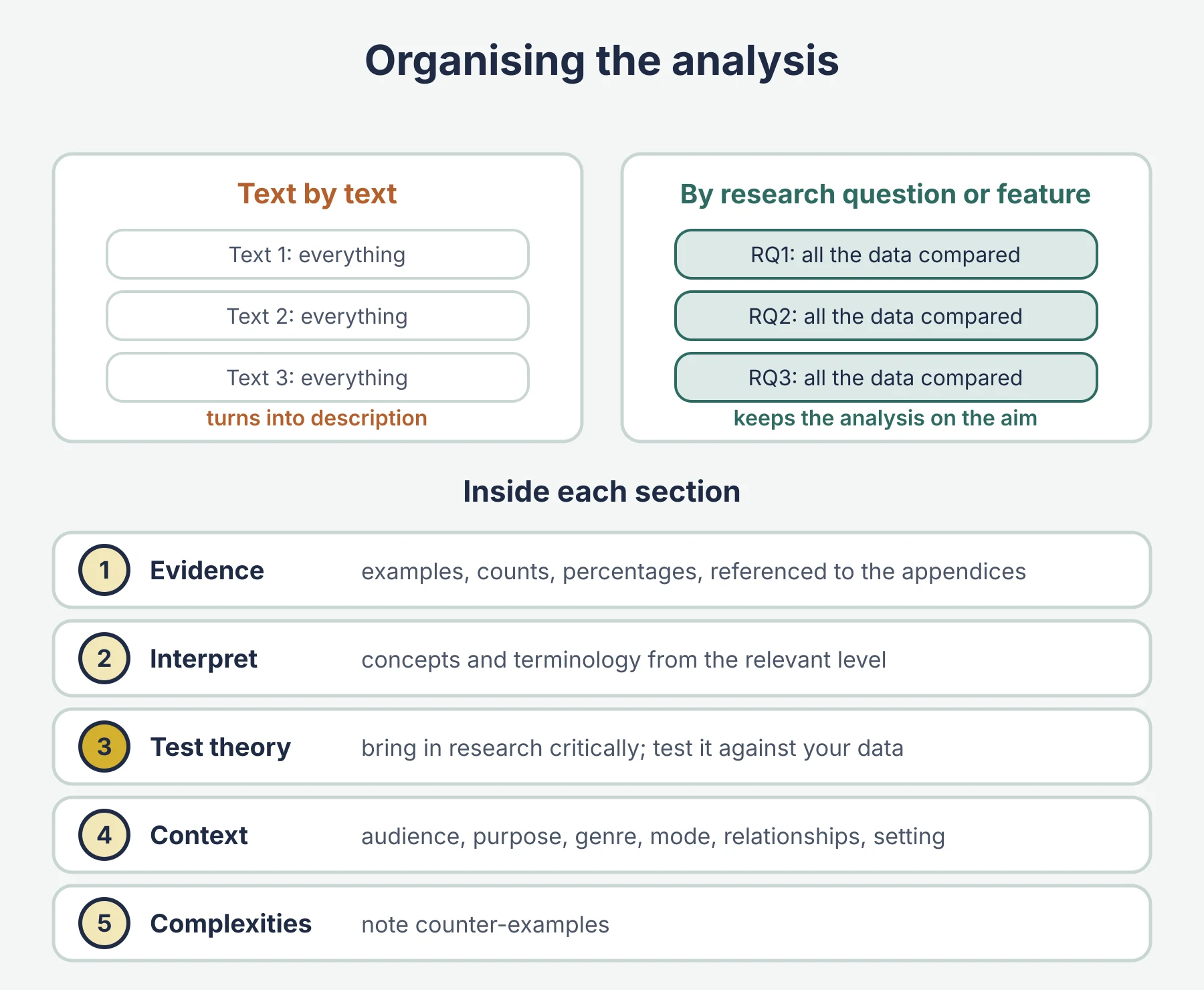
Organise by research question or feature, not by text or speaker one after another. Each section should:
- present the evidence (examples, counts, percentages, referenced to the appendices);
- interpret it using concepts and terminology from the relevant level;
- bring in relevant research or theory critically, testing it against your data rather than simply confirming it;
- explain contextual influences (audience, purpose, genre, mode, relationships, setting);
- note complexities and counter-examples.
Example analysis paragraph: “Commentator A’s turns during the goal sequence are dominated by verbless clauses (‘Smith… wide… crosses… header!’), whereas his build-up turns use complete clauses with present progressive verbs (‘Smith is moving down the left’). The ellipsis compresses information to match the speed of action, which radio requires because listeners cannot see the pitch. Commentator B, on television, uses fewer verbless clauses at the same moment, suggesting that the visual channel reduces the need for continuous description.”
Step 5: a cautious conclusion
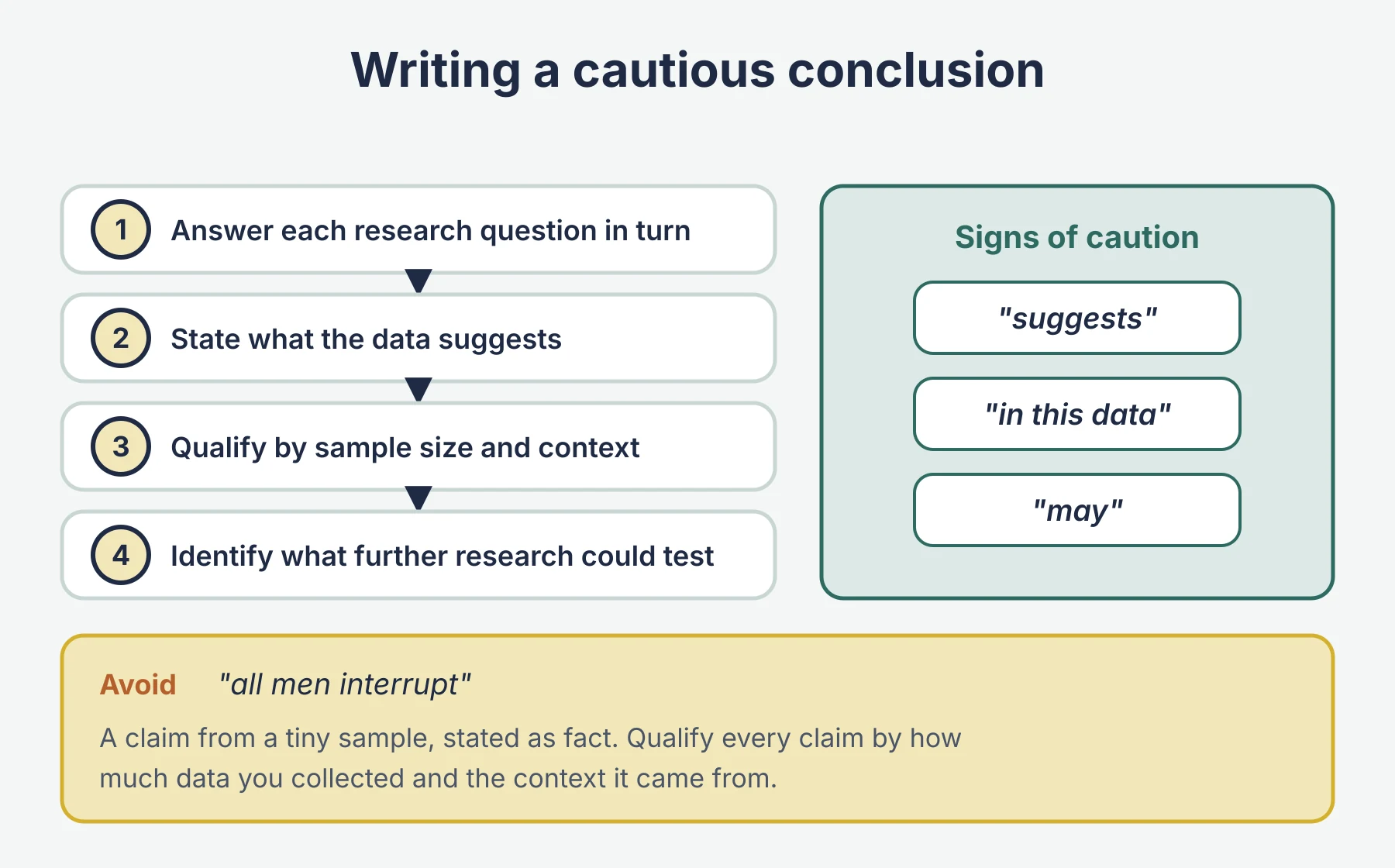
Answer each research question in turn, state what the data suggests, and qualify claims by sample size and context. Words such as “suggests”, “in this data” and “may” are signs of appropriate caution. Identify what further research could test.
References and appendices
List every source used, paper and web-based, in a consistent format. Appendices hold clean copies of all data (with a transcription key where relevant) and the evidence behind any counts or percentages, such as coding tables. The 2,000 words exclude the data, but analysis quotations should be brief and purposeful.
Common mistakes
- An aim with no research questions, so the analysis wanders.
- Data sets that cannot be compared fairly.
- A methodology that narrates steps without evaluating them.
- Analysis organised text by text, which turns into description.
- Theory applied as fact, or quoted without testing it against the data.
- Conclusions that generalise from tiny samples (“all men interrupt”).
- Missing consent, anonymisation or a transcription key.
How it is assessed
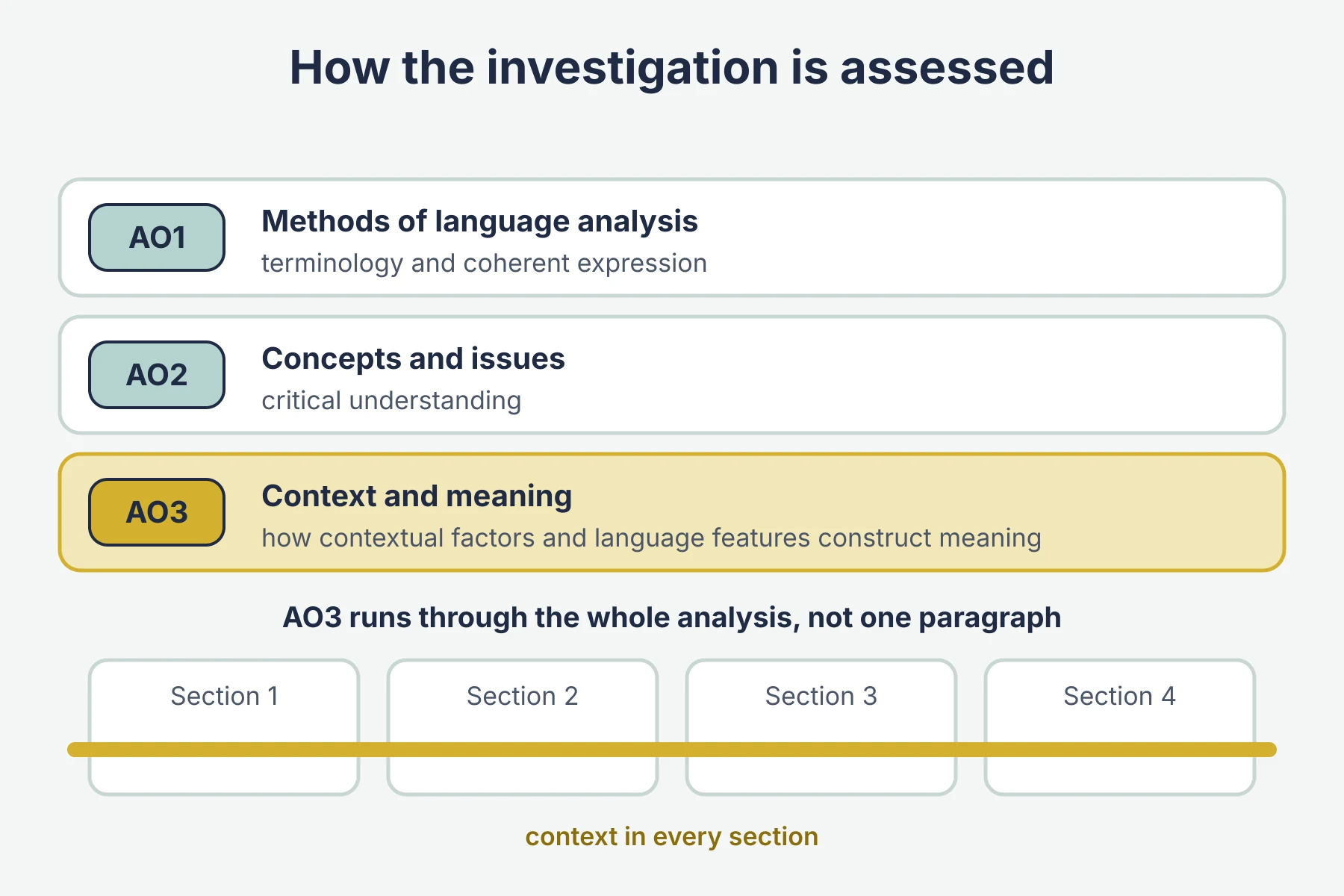
From the NEA assessment criteria, the investigation is marked on applying methods of language analysis with terminology and coherent expression (AO1), critical understanding of concepts and issues (AO2), and analysing and evaluating how contextual factors and language features construct meaning (AO3). Contextual analysis therefore needs to run through the whole analysis, not sit in a single paragraph.
Where to go next
- Language investigation revision notes
- Language investigation practice questions
- Methods of language analysis in the NEA
Official syllabus
AQA AS and A-level English Language (7701/7702) specification, A-level subject content 3.3.1 Language Investigation, part of the non-exam assessment Language in Action.
Section numbers. This site follows the A-level (7702) subject content on aqa.org.uk, where the NEA is 3.3. The combined AS and A-level specification PDF numbers the same A-level sections 4.1, 4.2 and 4.3.
Related resources
-
Practice questions
AQA A-Level English Language (7702): Language Investigation – Practice Questions
Original practice on research questions, data design, ethics, evaluative methodology and cautious conclusions for the AQA A-level English Language 7702 NEA.
English · AQA · A Level
Try questions -
Revision notes
AQA A-Level English Language (7702): Language Investigation – Revision Notes
Condensed notes on research questions, data collection, ethics, evaluative methodology and cautious conclusions for the AQA A-level English Language 7702 NEA.
English · AQA · A Level
Revise topic -
Practice questions
AQA A-Level English Language (7702): Methods of Language Analysis (NEA) – Practice Questions
Original practice applying language levels to NEA data: transcription, coding, pragmatic and discourse frameworks and commentary, for AQA A-level English 7702.
English · AQA · A Level
Try questions
Get free revision emails (optional)
Occasional emails with practice questions, worked explanations and links to free resources for the qualification and subjects you choose. No spam, and you can unsubscribe from any email. The free tools on this site never need an email.