
Revision Notes
AQA A-Level English Language (7702): Language Investigation – Revision Notes
Condensed notes on research questions, data collection, ethics, evaluative methodology and cautious conclusions for the AQA A-level English Language 7702 NEA.
- Subject
- English
- Level
- A LEVELS
- Topic
- Non-exam Assessment – Language in Action
- Author
- Marlbridge Academic Team
- Updated
- Reviewed by
- Ammar Bilal (what this means)
Aligned to AQA A Level English (7702), For first teaching 2015. Official specification .
Syllabus page (what it covers and how it is assessed): AQA A Level English Language.
Found an error? Report a correction.
Need help with this topic? Request a free trial class for A Level English Language (7702).
Condensed recall for 3.3.1 Language Investigation in the AQA A-level English Language (7702) non-exam assessment: 2,000 words excluding data, 50 of the NEA’s 100 marks. The full guide is the language investigation study guide.
The investigation in one paragraph
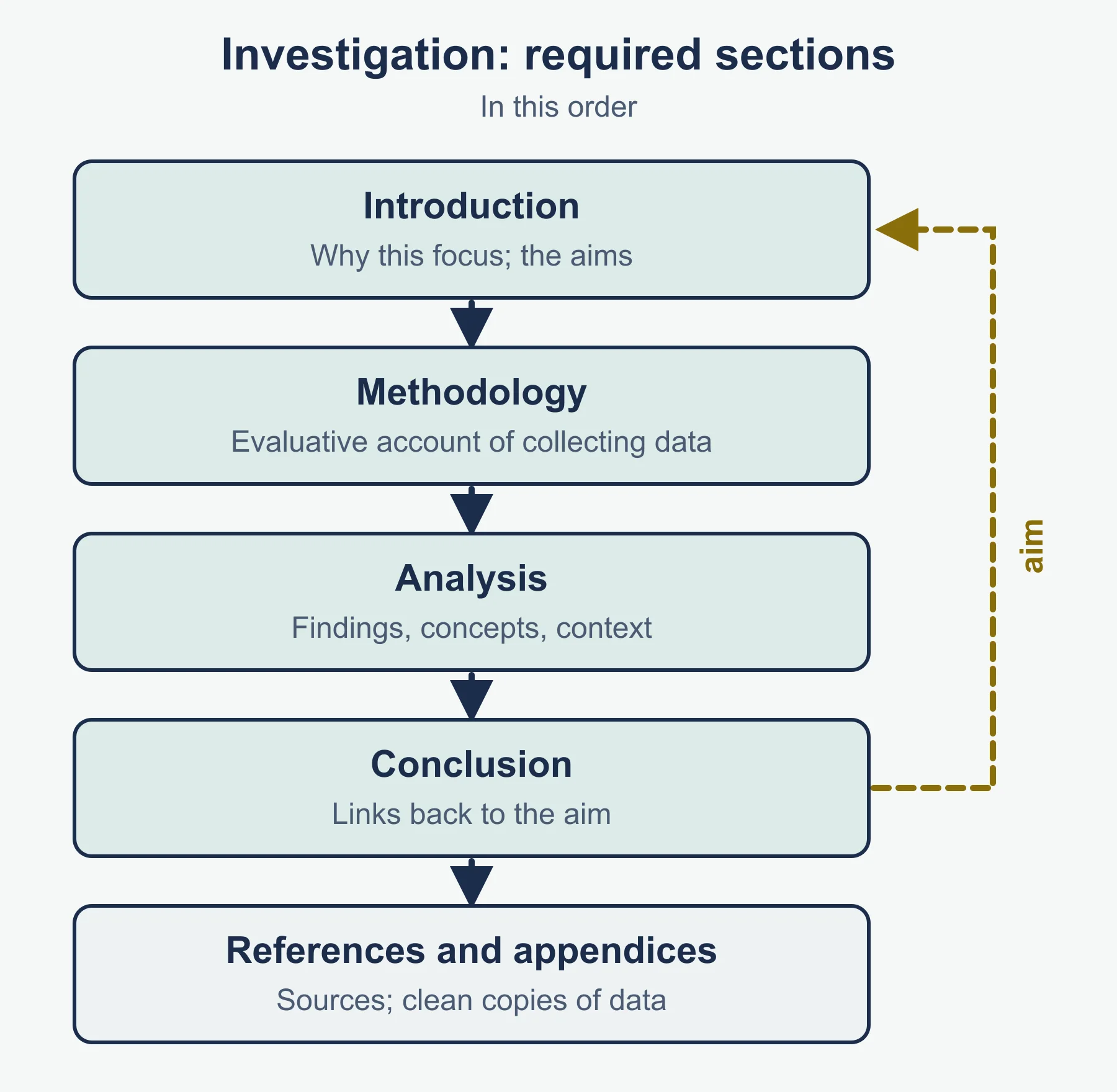
Choose a specific focus with your supervising teacher, collect your own data, choose your own approach to analysis, and write up an introduction, an evaluative methodology, an analysis that interprets findings with concepts and context, a conclusion linked to the aim, references and appendices.
Required sections (specification)
| Section | Must contain |
|---|---|
| Introduction | Reasons for the focus; aims |
| Methodology | Evaluative account of data collection and organisation; approaches to analysis |
| Analysis | Interpretation of findings against the aim; critical consideration of concepts and issues; contextual influences on the data |
| Conclusion | Interpretation of findings linked to the aim or focus |
| References | All paper and web-based sources |
| Appendices | Clean copies of data; evidence supporting quantitative approaches |
Key terms
| Term | Meaning |
|---|---|
| Aim | The overall purpose of the investigation |
| Research question | A specific, answerable question within the aim |
| Hypothesis | A testable prediction about the data |
| Variable | A factor that could affect the language (age, setting, mode, topic) |
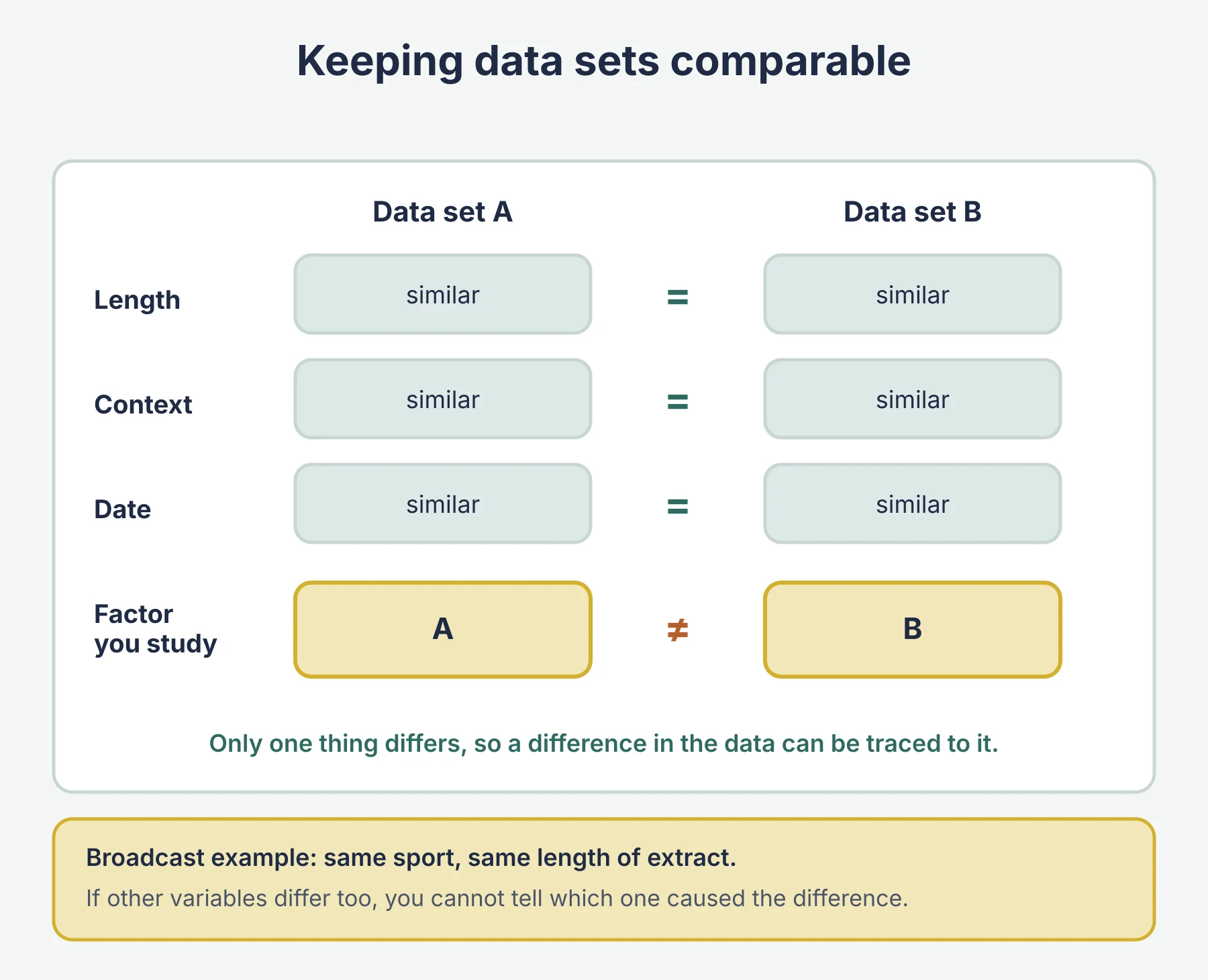
| Comparability | Data sets matched so that differences can be attributed to the factor studied |
| Sample | The data or participants chosen |
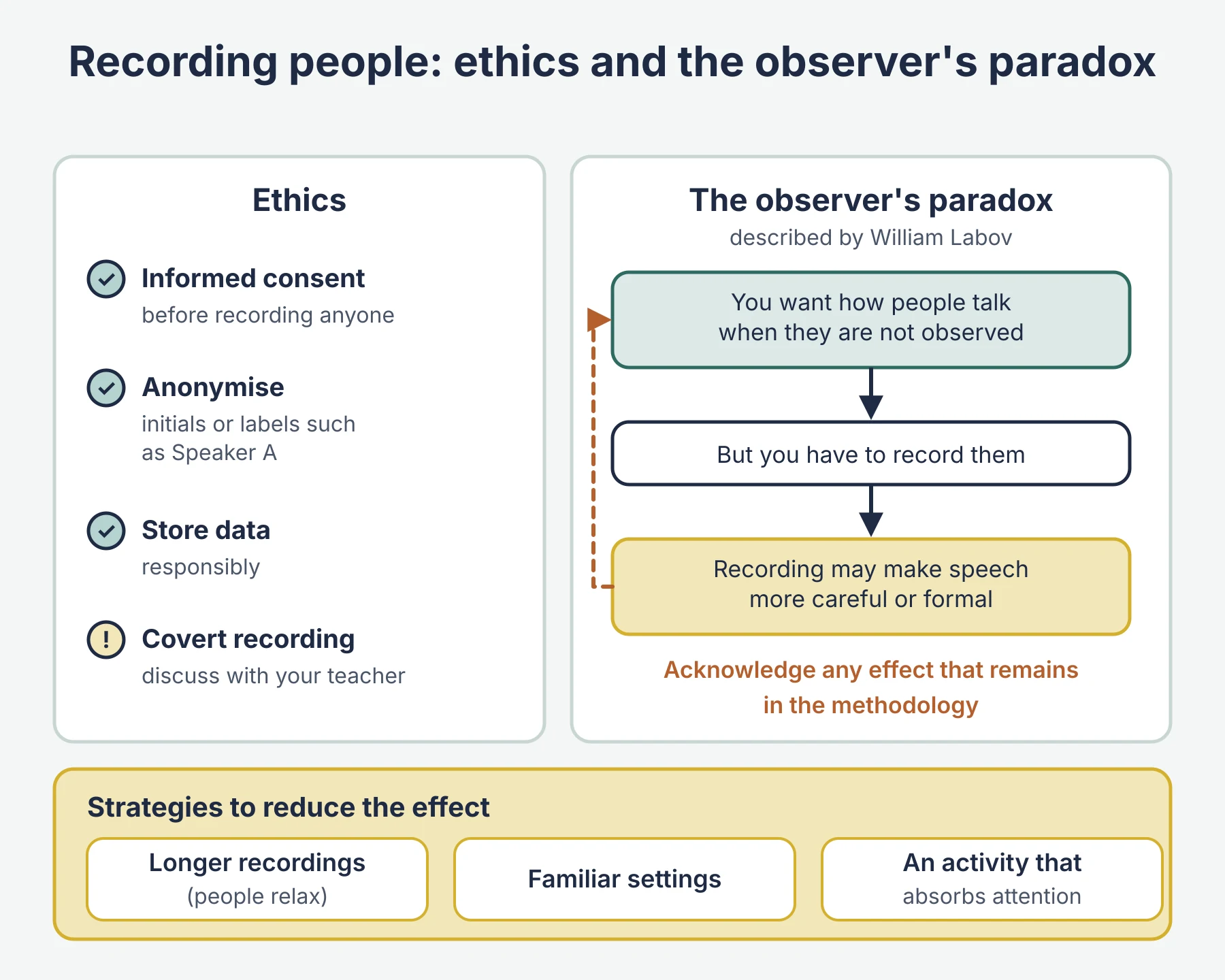
| Informed consent | Participants agree to take part, knowing what the research involves |
| Anonymisation | Removing identifying details from data |
| Observer’s paradox | Labov: observing speech changes how people speak |
| Quantitative / qualitative | Counting features / interpreting examples in depth |
| Coding | Categorising every instance of chosen features in the data |
| Reliability | How consistently the method would produce similar results |
| Validity | Whether the method actually measures what the question asks |
Choosing data and methods
- Speech: record, transcribe with a key, anonymise.
- Broadcast or published texts: match extracts for length, genre and date.
- Written texts: collect a defined set with clear criteria.
- Children: consent from parents and setting; record age and task.
- Attitudes: questionnaires or interviews; neutral wording; varied sample.
- Word lists: state source, period and inclusion criteria.
From aim to research questions (pattern)
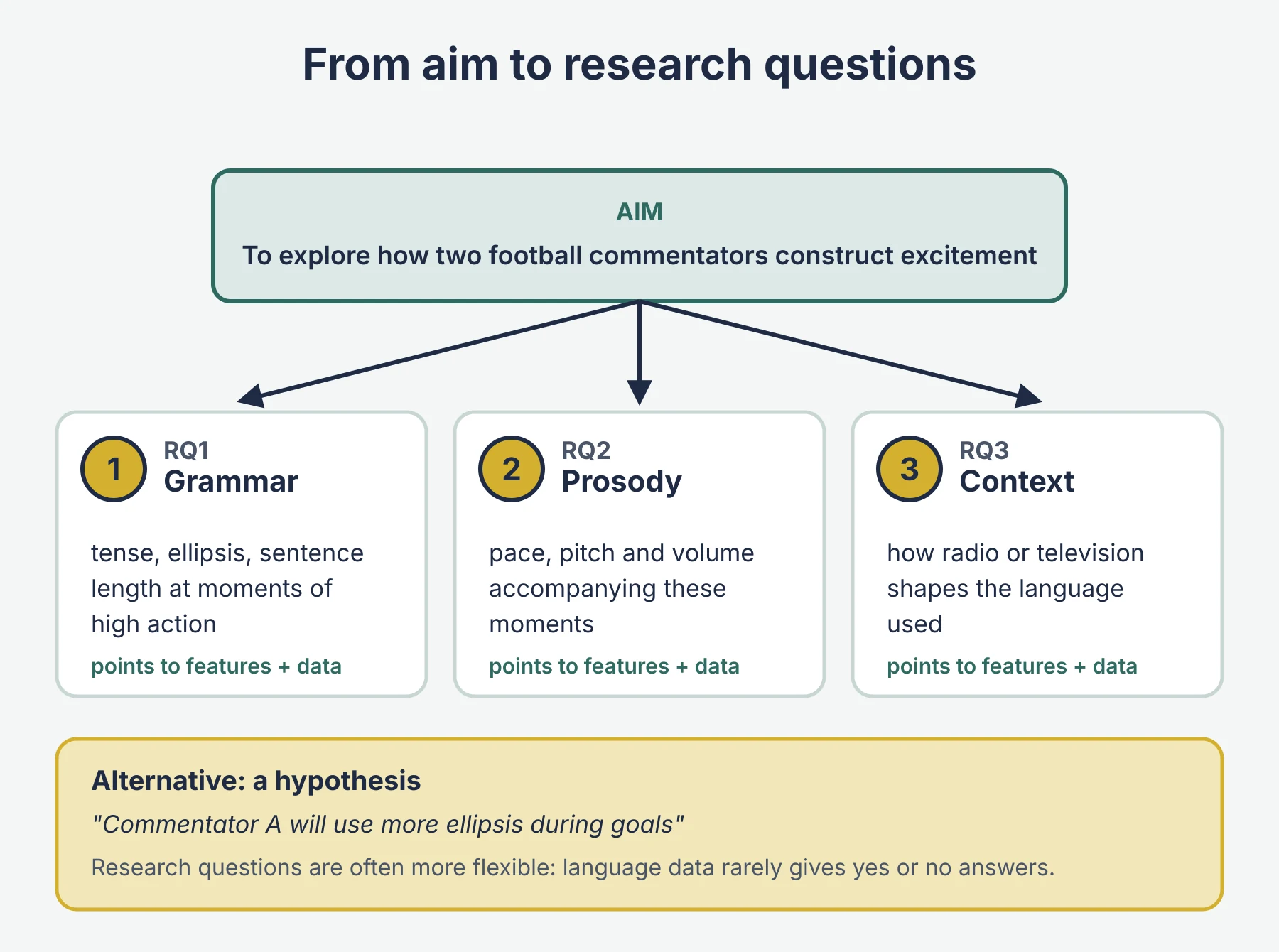
Aim:  To explore how [group/text type] uses language to [function] in [context].
RQ1   Which [level] features are used, and how often?
RQ2   How do these features differ between [data set A] and [data set B]?
RQ3   How do [audience / purpose / mode] explain the differences?
Each research question should point to a level of analysis, a data set and a comparison or function, so the analysis can be organised around it.
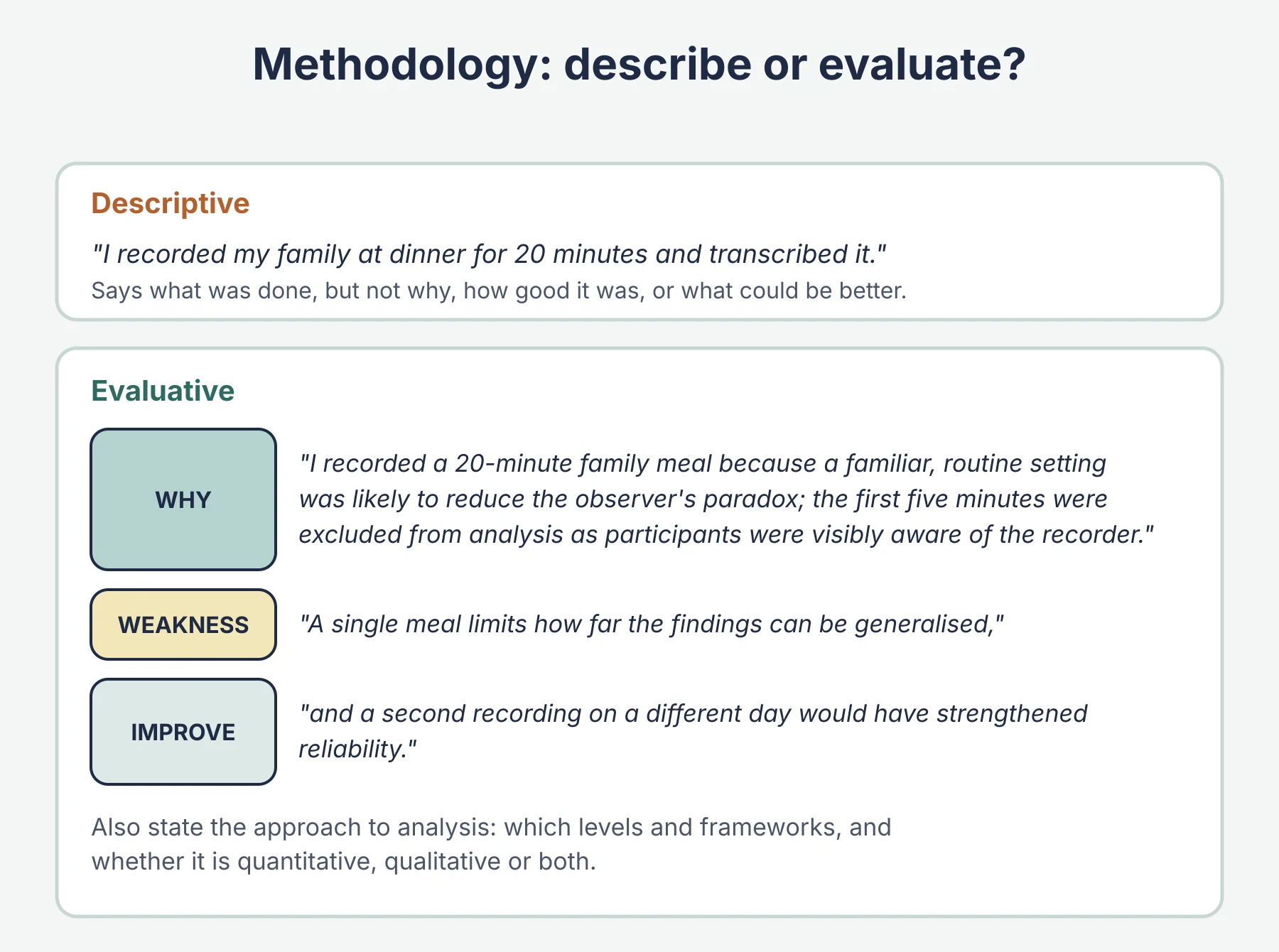
Evaluative methodology: the three moves
- What you did (briefly).
- Why you did it (justify each choice).
- Limitations and improvements (what weakens the findings, and what would strengthen them).
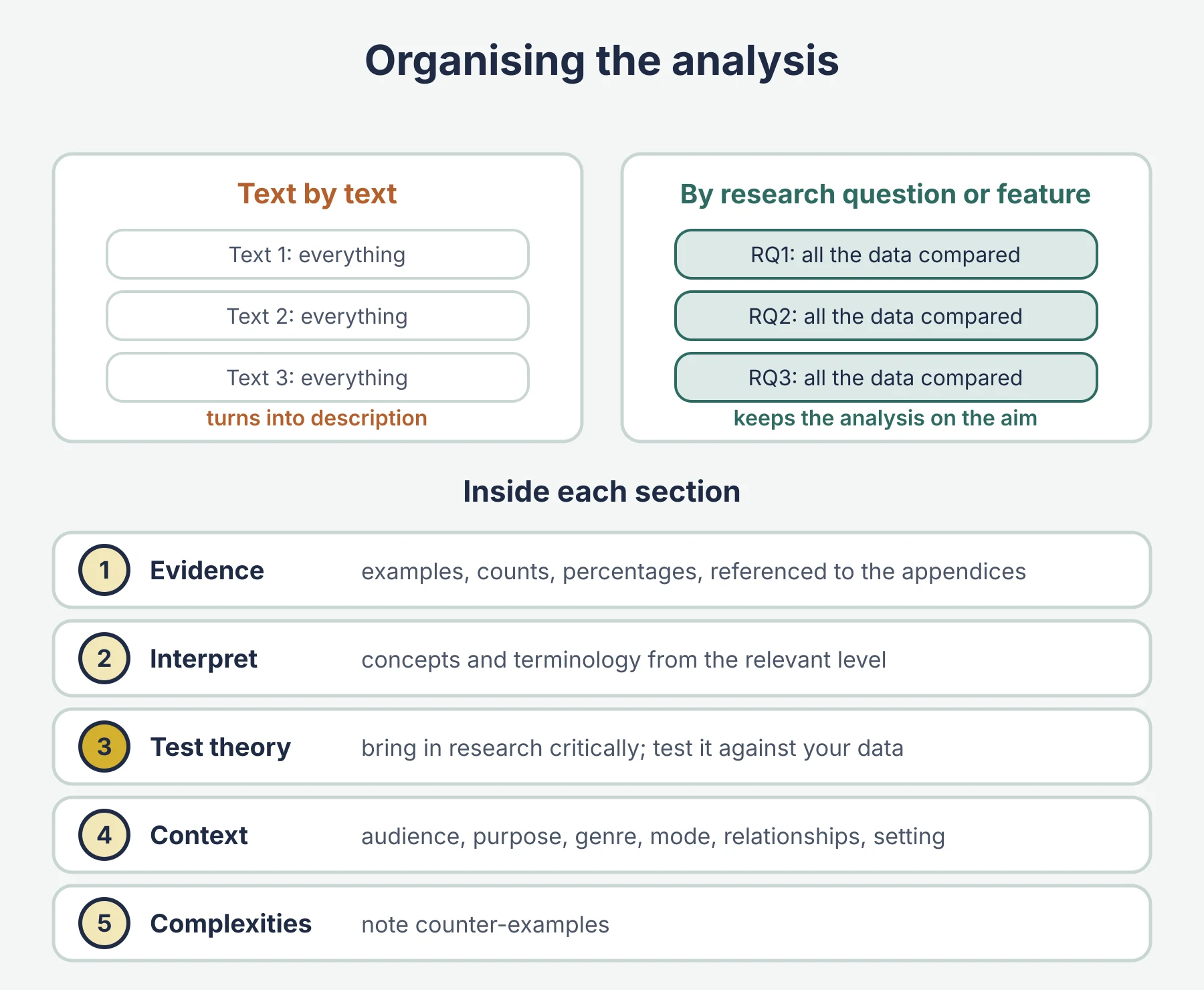
Analysis checklist
- Organise by research question or feature, not text by text.
- Evidence: examples plus counts or percentages, cross-referenced to appendices.
- Interpretation with precise terminology.
- Theory and research tested against the data, not just confirmed.
- Context explained throughout: audience, purpose, genre, mode, relationships, setting.
- Counter-examples and complexities acknowledged.
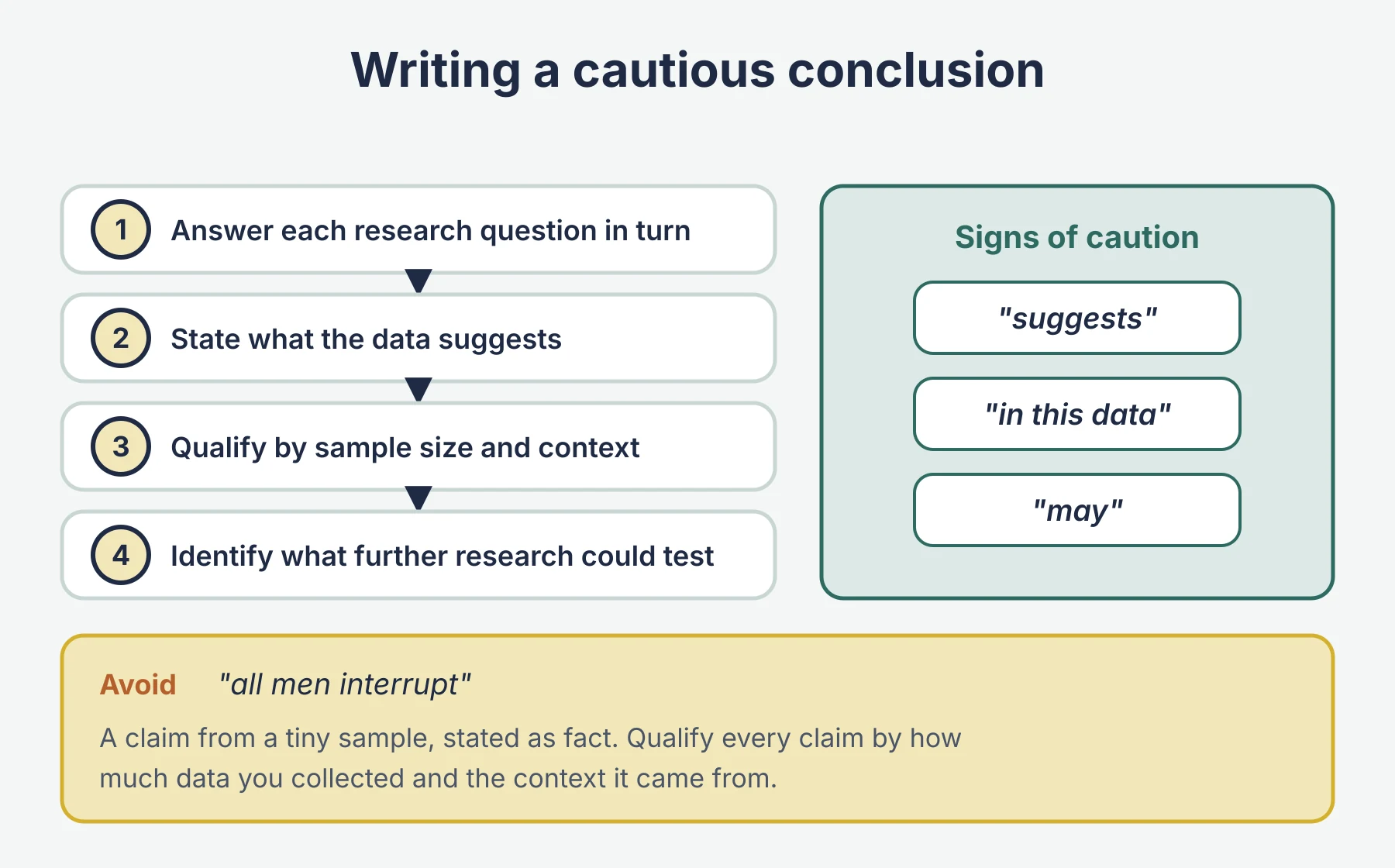
Conclusion checklist
- Answer each research question.
- Use cautious language: “suggests”, “in this data”, “may”.
- Note the effect of sample size and context.
- Suggest further research.
- Return to the aim in the final sentence, so the investigation reads as one argument rather than a set of findings.
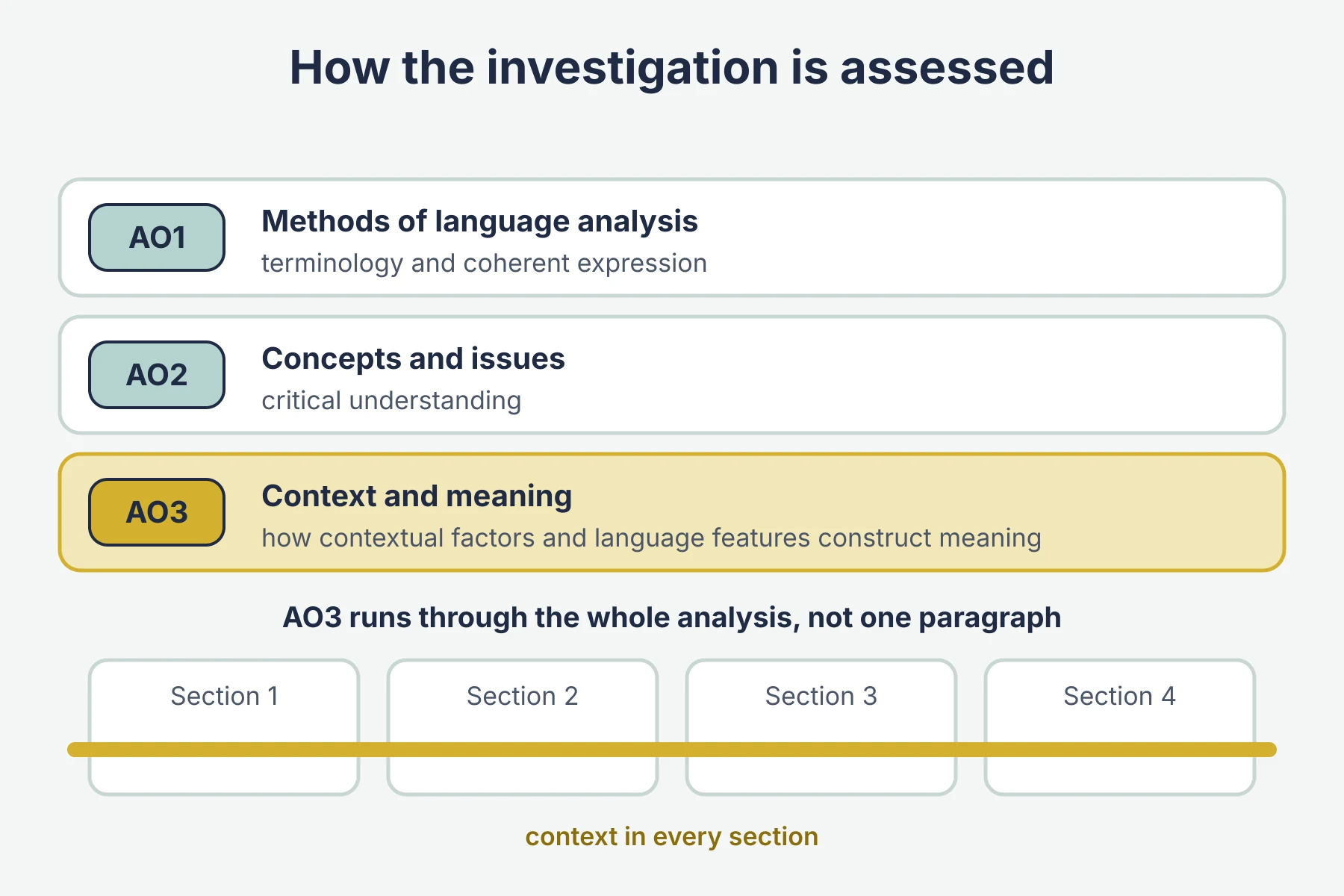
Assessment focus
The investigation is assessed on methods and terminology with coherent expression (AO1), critical understanding of concepts and issues (AO2), and how contextual factors and language features construct meaning (AO3), with AO3 carrying the largest share of the investigation’s marks.
Exam-style traps (NEA version)
- Broad focus (“social media language”) with no boundary.
- Unmatched data sets.
- Methodology as narrative (“First I… then I…”).
- Theory treated as proven fact.
- Overgeneralised conclusions from small samples.
- No transcription key, consent or anonymisation.
- Counts in the analysis with no supporting evidence in the appendices.
Self-test
- How many words is the investigation, and what is excluded?
- What must the methodology contain, according to the specification?
- What are the three moves of an evaluative methodology?
- What is the observer’s paradox, and whose term is it?
- Give two strategies to reduce it.
- Why must data sets be comparable?
- What is the difference between reliability and validity?
- How should the analysis be organised?
- What must the appendices contain?
- Give two ethical steps when recording speech.
- Which assessment objective carries the largest share of the investigation’s marks?
- Rewrite “Men interrupt more than women” as a cautious conclusion.
Answers
- 2,000 words, excluding data (and quotations from data).
- An evaluative account of how data was collected and organised for analysis, and approaches to analysis.
- What you did; why you did it; its limitations and possible improvements.
- The problem that observing or recording people changes how they speak; William Labov.
- Any two: longer recordings; familiar settings; absorbing activities; excluding the first minutes.
- So that differences can be attributed to the factor being studied rather than to other variables.
- Reliability is consistency of results; validity is whether the method measures what the question asks.
- By research question or feature, with both data sets discussed together.
- Clean copies of the collected data and evidence supporting any quantitative approach.
- Informed consent; anonymising participants (also secure storage, avoiding covert recording).
- AO3.
- “In this data, the two male speakers interrupted more often than the two female speakers, though roles in the conversation may explain the pattern as much as gender.”
More resources on this topic
Related resources
-
Practice questions
AQA A-Level English Language (7702): Methods of Language Analysis (NEA) – Practice Questions
Original practice applying language levels to NEA data: transcription, coding, pragmatic and discourse frameworks and commentary, for AQA A-level English 7702.
English · AQA · A Level
Try questions -
Revision notes
AQA A-Level English Language (7702): Methods of Language Analysis (NEA) – Revision Notes
Recall notes on applying the six language levels in the AQA A-level English Language 7702 NEA: transcription, coding, frameworks and analysing your own writing.
English · AQA · A Level
Revise topic -
Study guides
AQA A-Level English Language (7702): Original Writing
Choosing and analysing a style model, crafting a 750-word original piece and writing the reflective commentary for the AQA A-level English Language 7702 NEA.
English · AQA · A Level
Read guide
Get free revision emails (optional)
Occasional emails with practice questions, worked explanations and links to free resources for the qualification and subjects you choose. No spam, and you can unsubscribe from any email. The free tools on this site never need an email.