
Study Guides
AQA A-Level English Language (7702): Original Writing
Choosing and analysing a style model, crafting a 750-word original piece and writing the reflective commentary for the AQA A-level English Language 7702 NEA.
- Subject
- English
- Level
- A LEVELS
- Topic
- Non-exam Assessment – Language in Action
- Author
- Marlbridge Academic Team
- Updated
- Reviewed by
- Ammar Bilal (what this means)
Aligned to AQA A Level English (7702), For first teaching 2015. Official specification .
Syllabus page (what it covers and how it is assessed): AQA A Level English Language.
Found an error? Report a correction.
Need help with this topic? Request a free trial class for A Level English Language (7702).
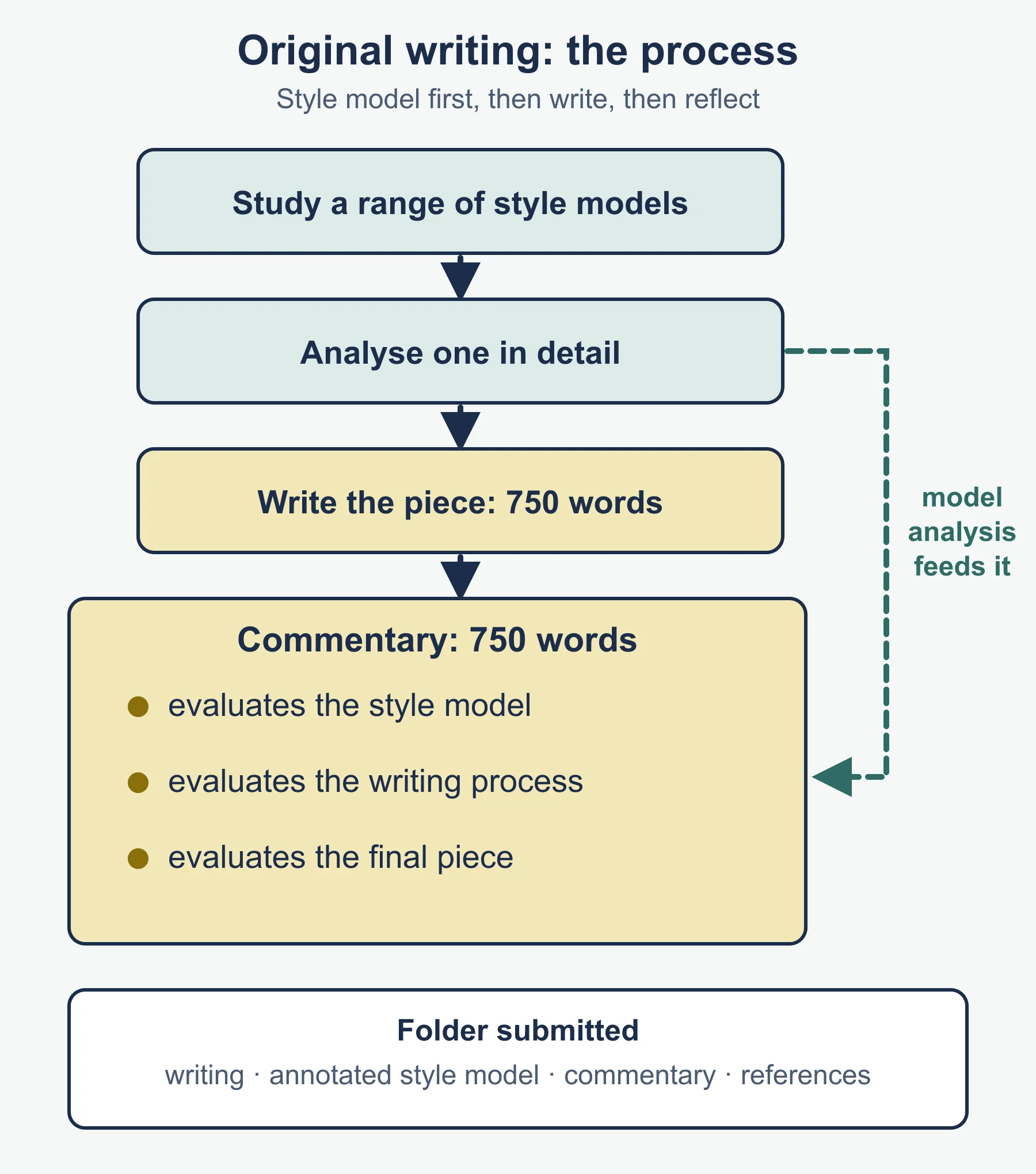
This guide covers 3.3.2 Original writing in the AQA A-level English Language (7702) non-exam assessment: a 750-word piece of original writing (25 marks) and a 750-word commentary (25 marks). The Language in Action NEA guide lists the areas and example forms. This page concentrates on the process: reading a style model as a writer, turning that analysis into craft choices, and writing a commentary that evaluates rather than narrates.
What the specification requires
You produce one piece of original writing in one of three areas, The Power of Persuasion, The Power of Storytelling or The Power of Information, with one accompanying commentary. In preparation, you study a range of style models, then select and analyse one style model in detail, chosen in consultation with your supervising teacher. The commentary lets you “consider and evaluate the style model, the writing process and the effectiveness of the final piece of writing”. The folder contains the original writing, an annotated style model, the reflective commentary and references.
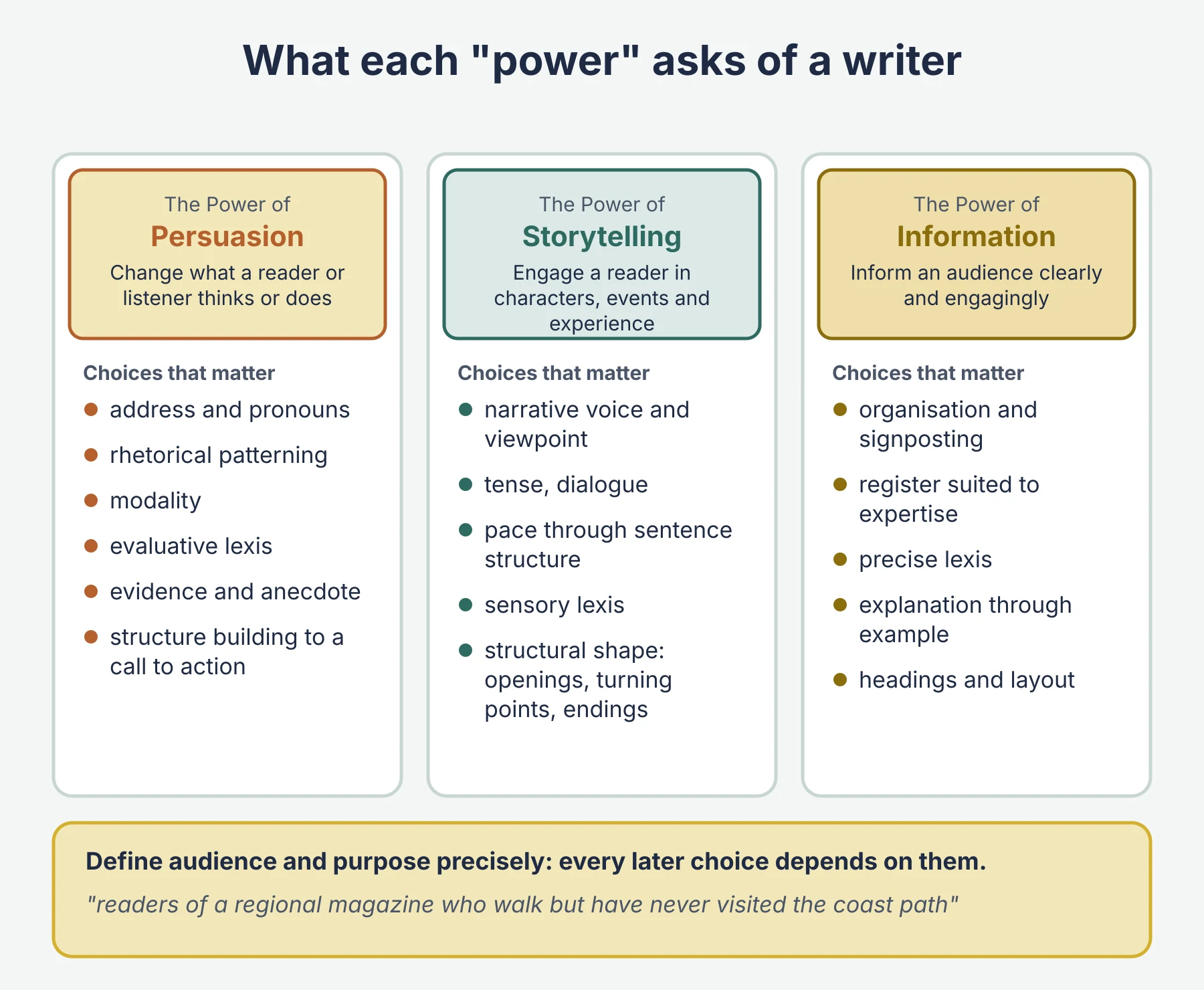
What each “power” asks of a writer
| Area | What the writing must do | Language choices that typically matter |
|---|---|---|
| Persuasion | Change what a reader or listener thinks or does | Address and pronouns, rhetorical patterning, modality, evaluative lexis, evidence and anecdote, structure building to a call to action |
| Storytelling | Engage a reader in characters, events and experience | Narrative voice and viewpoint, tense, dialogue, pace through sentence structure, sensory lexis, structural shape (openings, turning points, endings) |
| Information | Inform an audience clearly and engagingly | Organisation and signposting, register suited to expertise, precise lexis, explanation through example, headings and layout |
Choose a form you can realise in 750 words: a speech, a short story, a feature article, a blog, a local history piece, a dramatic monologue. Define the audience and purpose precisely (“readers of a regional magazine who walk but have never visited the coast path”), because every later choice depends on them.
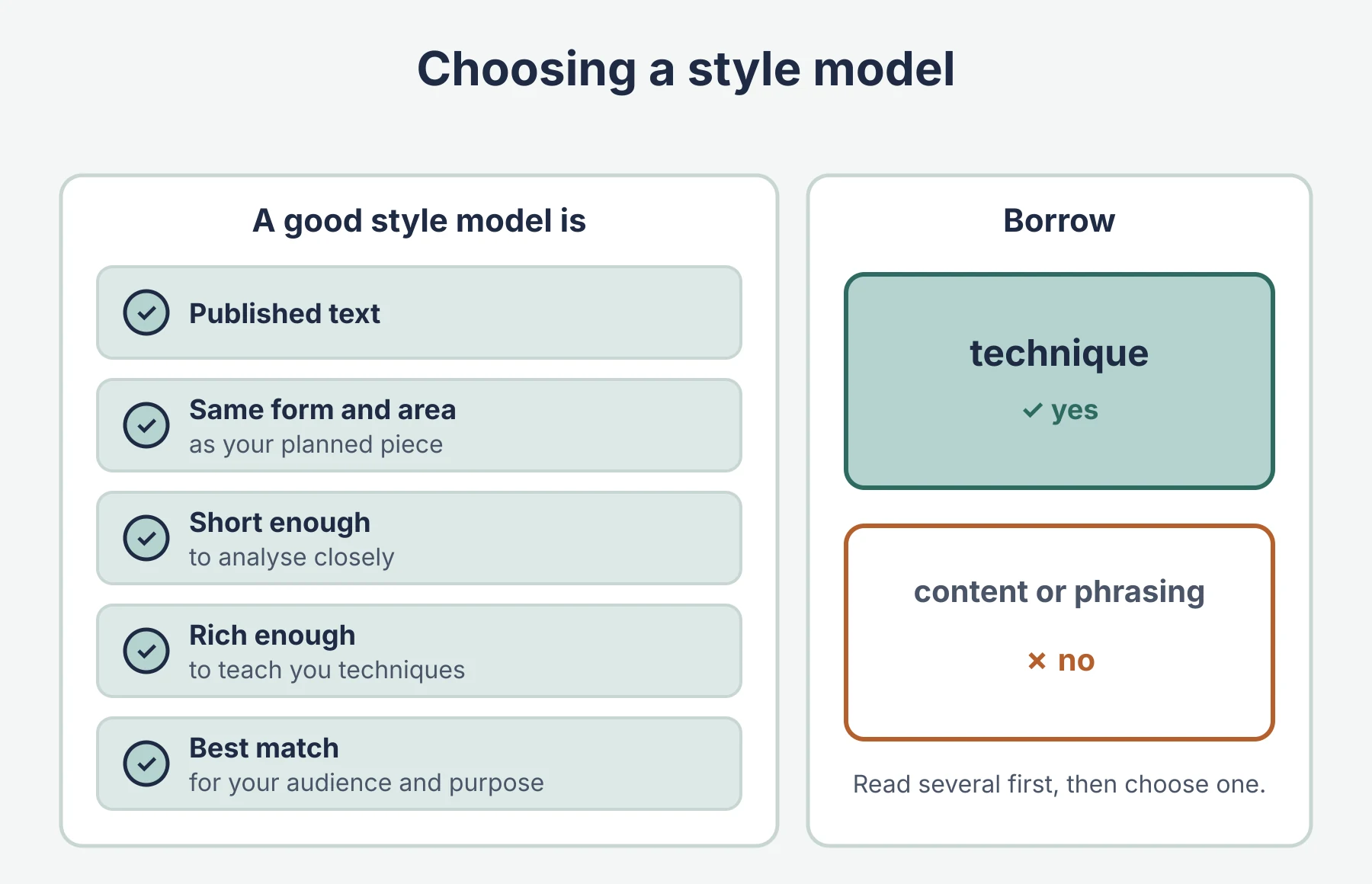
Choosing a style model
A good style model is a published text in the same form and area as your planned piece, short enough to analyse closely, and rich enough to teach you techniques. Read several first, then select the one that best matches your audience and purpose. Your style model should not be one whose content you plan to borrow: you borrow technique, not material.
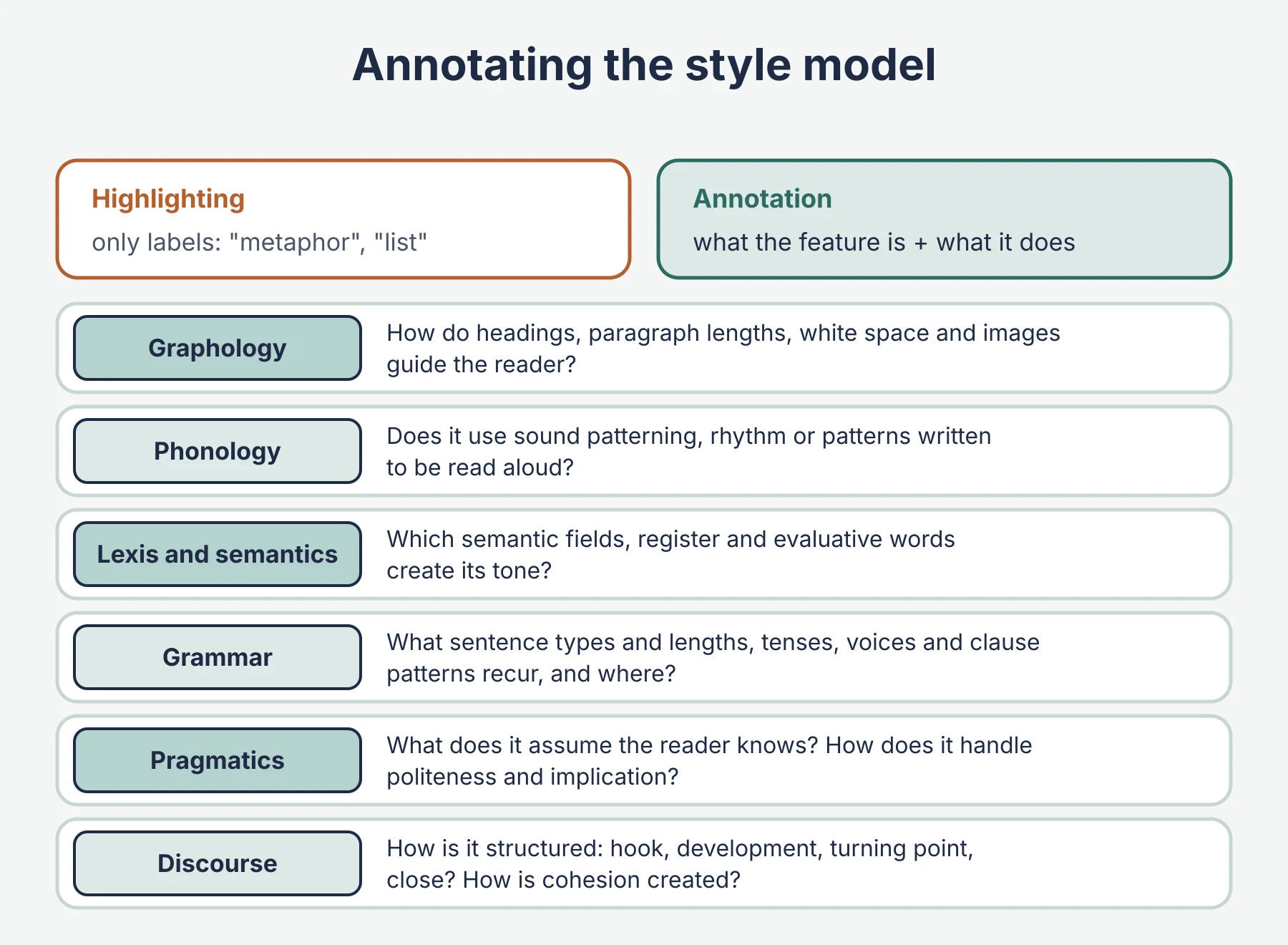
Annotating the style model at the language levels
Annotation is analysis, not highlighting. For each feature, note what it is and what it does.
| Level | Questions to ask of the style model |
|---|---|
| Graphology | How do headings, paragraph lengths, white space and images guide the reader? |
| Phonology | Does the text use sound patterning, rhythm or patterns written to be read aloud? |
| Lexis and semantics | Which semantic fields, register and evaluative words create its tone? |
| Grammar | What sentence types and lengths, tenses, voices and clause patterns recur, and where? |
| Pragmatics | What does it assume the reader knows? How does it handle politeness and implication? |
| Discourse | How is it structured: opening hook, development, turning point, close? How is cohesion created? |
From analysis to writing
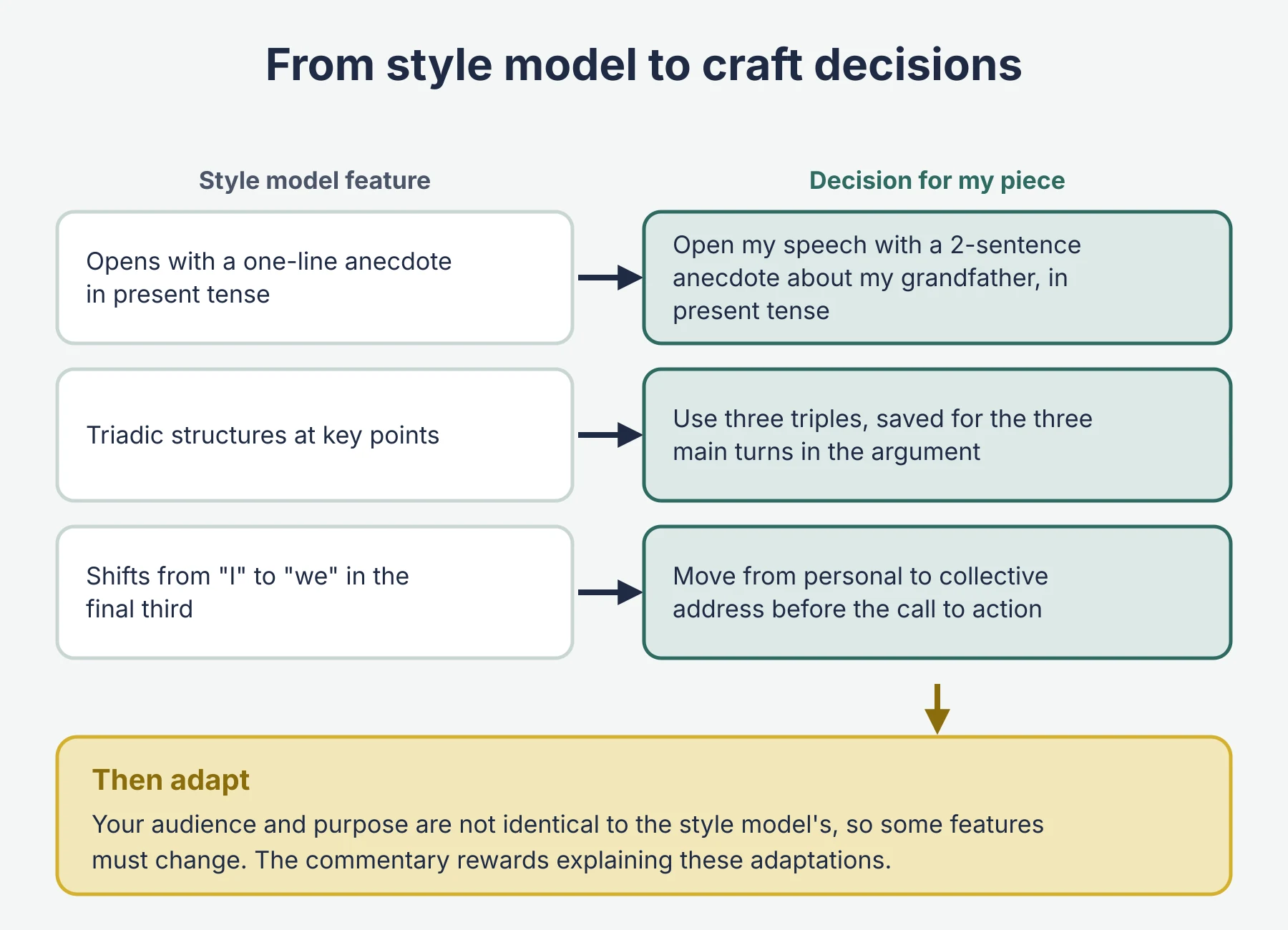
Turn each annotation into a craft decision for your piece:
Style model feature                     Decision for my piece
Opens with a one-line anecdote          Open my speech with a 2-sentence anecdote
in present tense                        about my grandfather, in present tense
Triadic structures at key points        Use three triples, saved for the three
                                        main turns in the argument
Shifts from "I" to "we" in the          Move from personal to collective address
final third                             before the call to action
Then adapt: your audience and purpose are not identical to the style model’s, so some features must change. The commentary rewards explaining these adaptations.
Drafting and redrafting
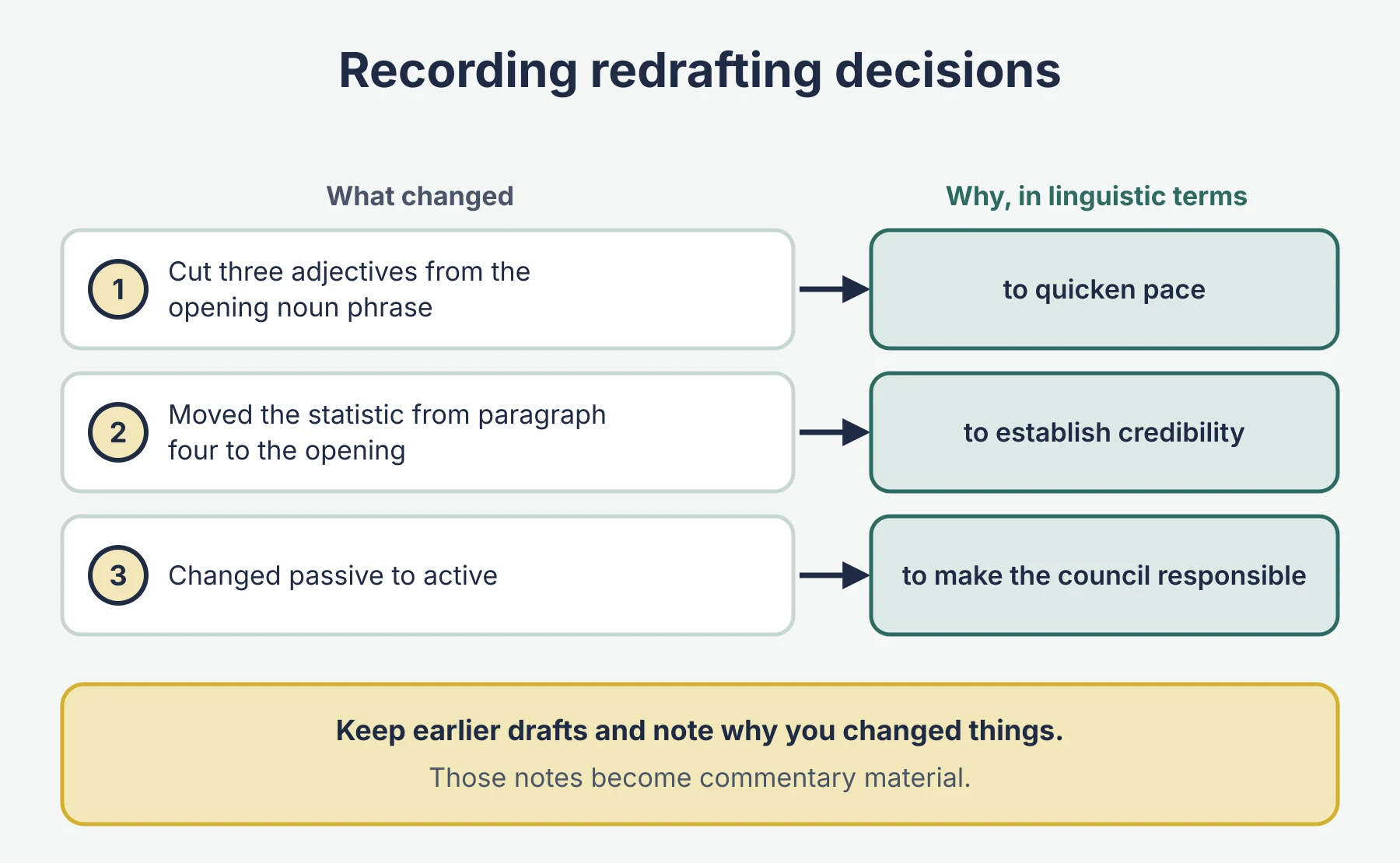
The specification’s preparation list includes planning, drafting and redrafting. Keep earlier drafts and note why you changed things, in linguistic terms: “cut three adjectives from the opening noun phrase to quicken pace”, “moved the statistic from paragraph four to the opening to establish credibility”, “changed passive to active to make the council responsible”. Those notes become commentary material.
Writing the commentary
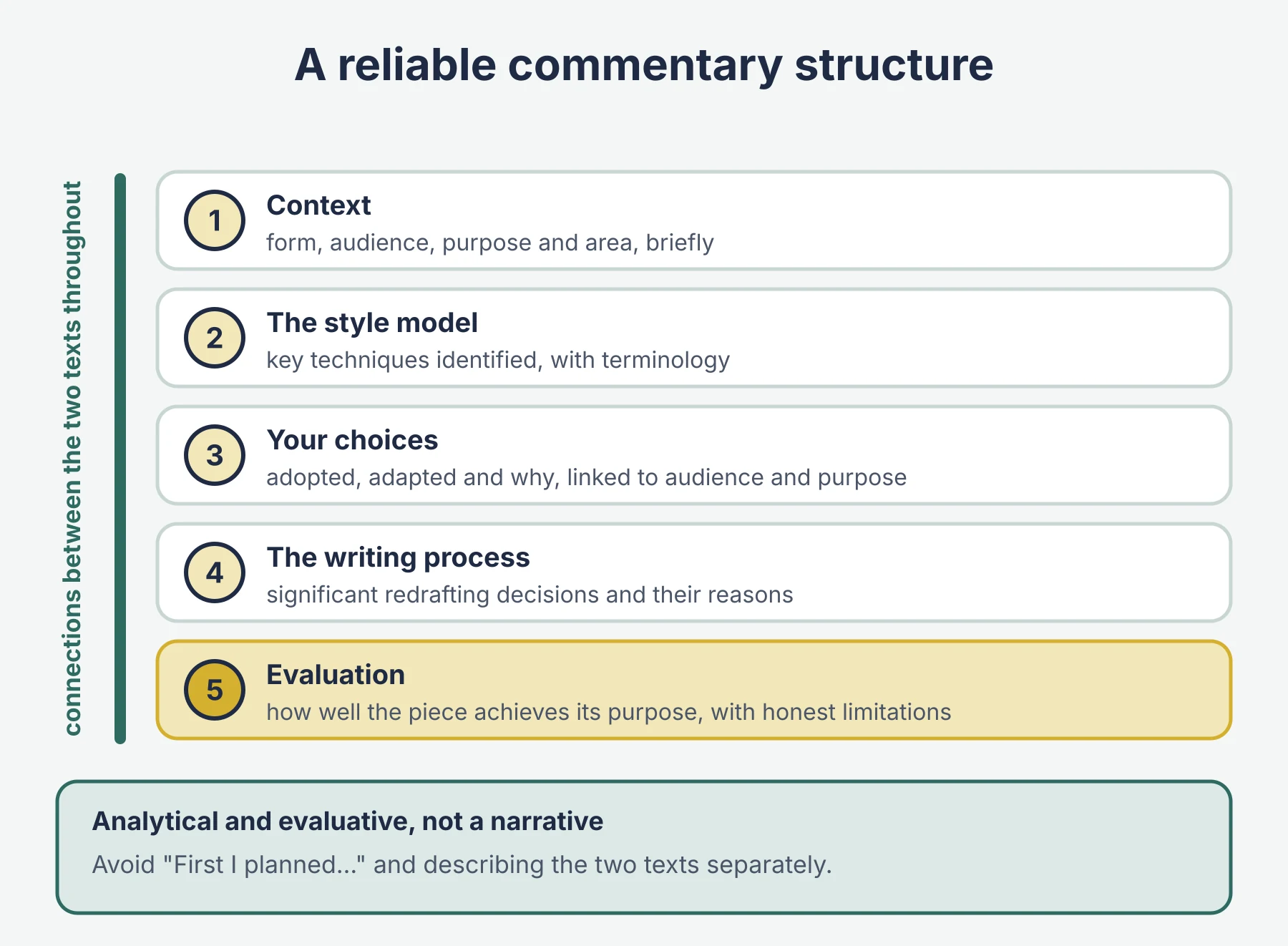
The commentary is analytical and evaluative. A reliable structure:
- Context: form, audience, purpose and area, briefly.
- The style model: the key techniques you identified, with terminology.
- Your choices: what you adopted, what you adapted and why, linked to audience and purpose.
- The writing process: significant redrafting decisions and their reasons.
- Evaluation: how effectively the piece achieves its purpose, including honest limitations.
Keep connections between the two texts running throughout, rather than describing the style model and then your own piece separately.
Model commentary paragraph (for a persuasive speech to a town council on keeping a library open): “My style model, a campaign speech, delayed its main claim until after a personal anecdote, positioning listeners as witnesses before asking them to judge. I adopted this structure, opening with a present-tense account of a child choosing her first library book, so that councillors would picture the service before hearing the argument. However, the style model addressed a sympathetic rally; my audience was a council weighing costs, so I replaced its emotive hyperbole with hedged, evidence-led declaratives (‘Our figures suggest…’), and kept second-person address for the closing appeal only. On redrafting, I changed ‘the library will be closed’ to ‘you will close the library’, replacing an agentless passive with an active clause to make responsibility explicit. This was the most effective choice in the piece, although the change of tone in the final paragraph may feel abrupt.”
The paragraph connects style model and piece, uses terminology, explains choices through audience, records a redrafting decision and evaluates effectiveness.
How the two parts are assessed
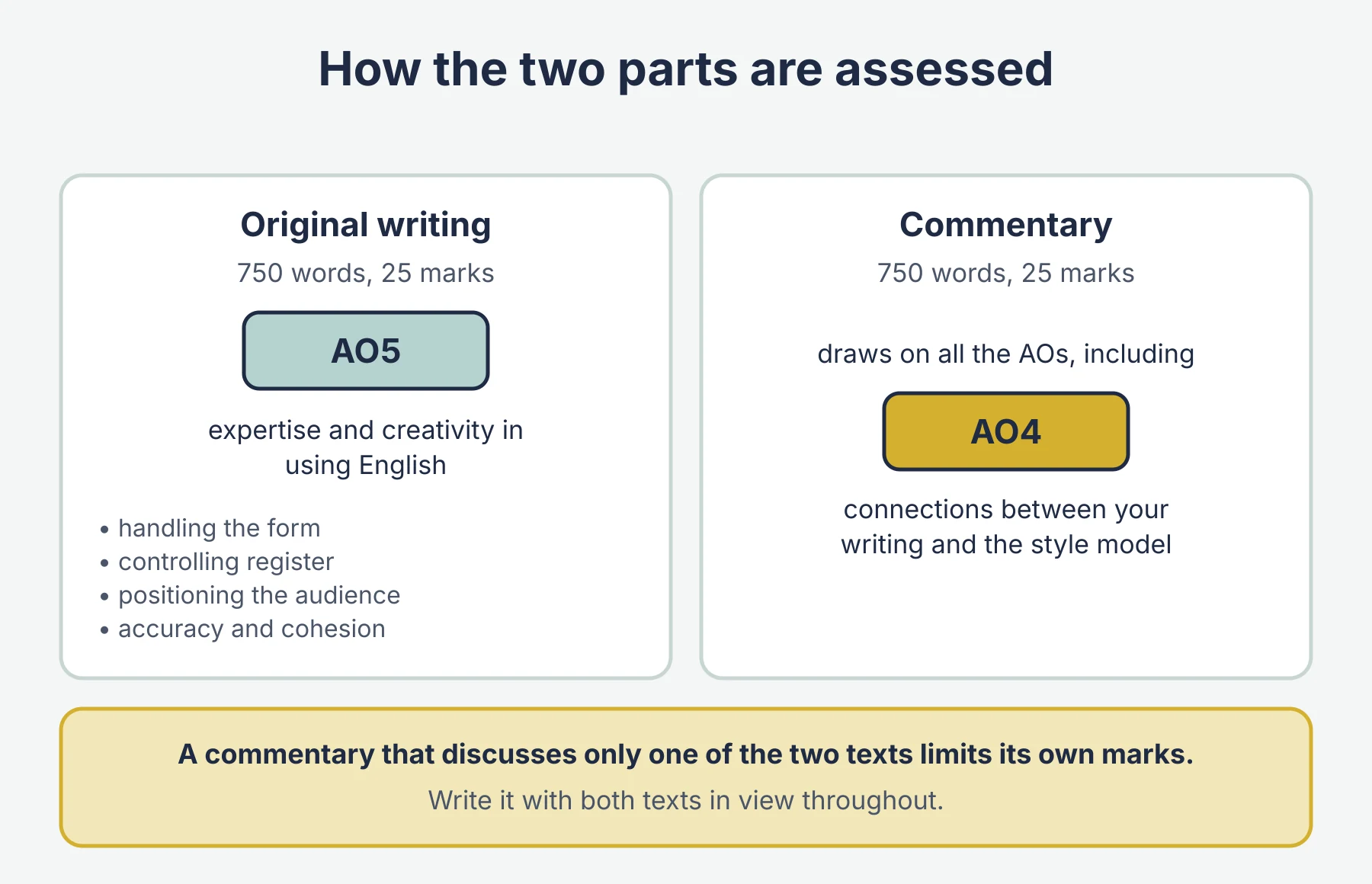
The original writing is assessed on expertise and creativity in using English (AO5): handling the form, controlling register, positioning the audience, and writing accurately and cohesively. The commentary draws on all the assessment objectives, including connections between your writing and the style model (AO4), which is why a commentary that discusses only one of the two texts limits its own marks. Write the commentary with both texts in view throughout.
Common mistakes
- A style model in a different form from the piece, so few techniques transfer.
- Annotations that only label features (“metaphor”, “list”).
- A piece with no clear audience, or a form that cannot work in 750 words.
- Borrowing the style model’s content or phrasing too closely.
- A commentary that narrates the process (“First I planned…”) with little analysis.
- Discussing only your own piece and not the style model.
- Claiming every choice worked, with no honest evaluation.
Where to go next
- Original writing revision notes
- Original writing practice questions
- Methods of language analysis in the NEA
Official syllabus
AQA AS and A-level English Language (7701/7702) specification, A-level subject content 3.3.2 Original writing, part of the non-exam assessment Language in Action.
Section numbers. This site follows the A-level (7702) subject content on aqa.org.uk, where the NEA is 3.3. The combined AS and A-level specification PDF numbers the same A-level sections 4.1, 4.2 and 4.3.
Related resources
-
Practice questions
AQA A-Level English Language (7702): Original Writing – Practice Questions
Original practice on analysing style models, crafting writing, redrafting and commentary for AQA A-level English Language 7702 NEA original writing.
English · AQA · A Level
Try questions -
Revision notes
AQA A-Level English Language (7702): Original Writing – Revision Notes
Condensed notes on the three powers, style-model annotation, redrafting and the reflective commentary for AQA A-level English Language 7702 original writing.
English · AQA · A Level
Revise topic -
Study guides
AQA A-Level English Language: The Language in Action NEA (7702)
AQA A-Level English Language 7702 NEA Language in Action: the language investigation, original writing and commentary, and the methods of analysis they use.
English · AQA · A Level
Read guide
Get free revision emails (optional)
Occasional emails with practice questions, worked explanations and links to free resources for the qualification and subjects you choose. No spam, and you can unsubscribe from any email. The free tools on this site never need an email.