
Revision Notes
AQA A-Level English Language (7702): Original Writing – Revision Notes
Condensed notes on the three powers, style-model annotation, redrafting and the reflective commentary for AQA A-level English Language 7702 original writing.
- Subject
- English
- Level
- A LEVELS
- Topic
- Non-exam Assessment – Language in Action
- Author
- Marlbridge Academic Team
- Updated
- Reviewed by
- Ammar Bilal (what this means)
Aligned to AQA A Level English (7702), For first teaching 2015. Official specification .
Syllabus page (what it covers and how it is assessed): AQA A Level English Language.
Found an error? Report a correction.
Need help with this topic? Request a free trial class for A Level English Language (7702).
Condensed recall for 3.3.2 Original writing in the AQA A-level English Language (7702) non-exam assessment: a 750-word piece and a 750-word commentary, 25 marks each. The full guide is the original writing study guide.
The task in one paragraph
Study a range of style models in one area (Persuasion, Storytelling or Information), select and analyse one in detail, write your own piece for a defined audience and purpose, then write a commentary evaluating the style model, the writing process and the effectiveness of your piece.
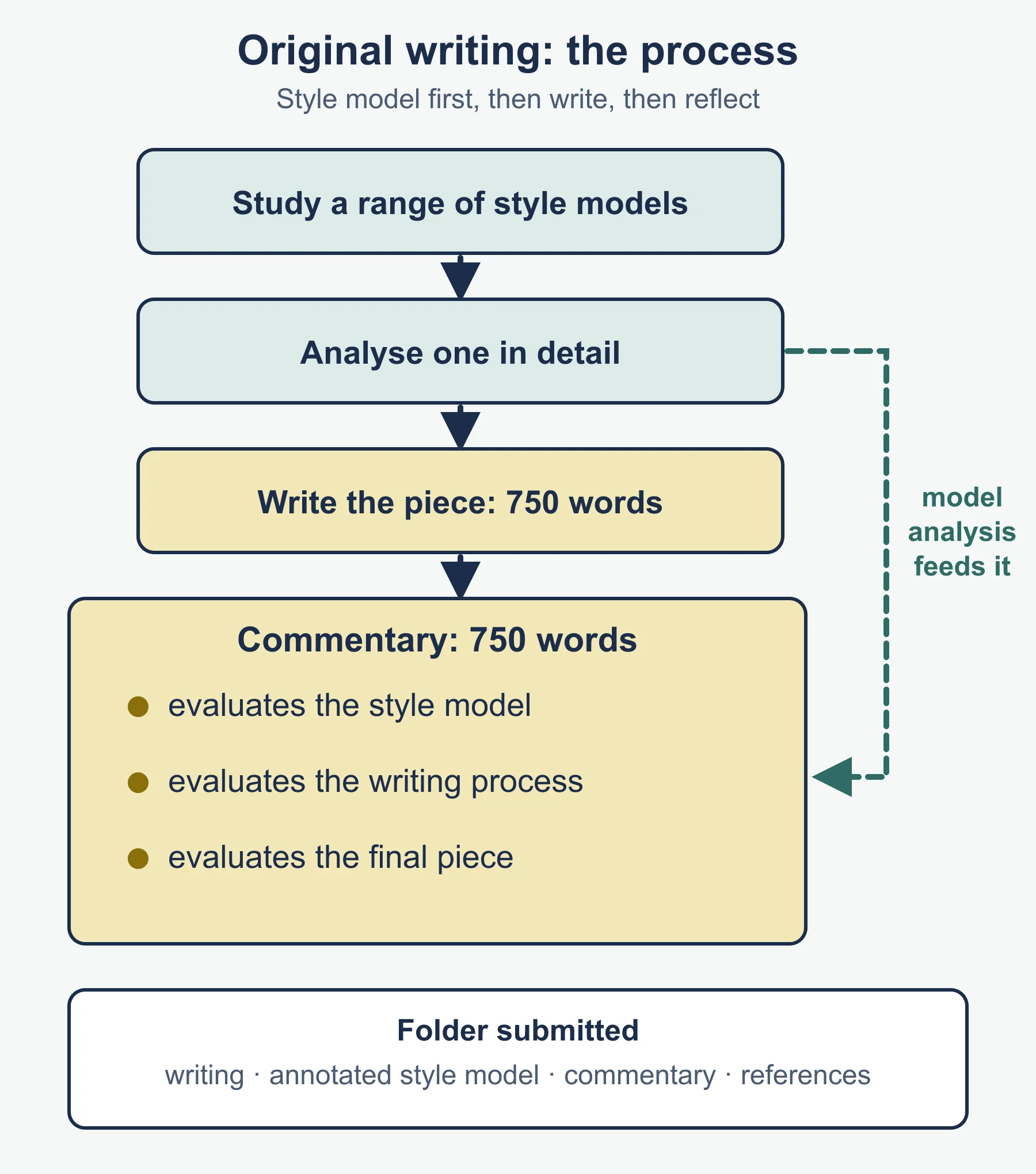
Folder contents (specification)
- A piece of original writing.
- An annotated style model.
- A reflective commentary.
- References (paper and web-based).
Key terms
| Term | Meaning |
|---|---|
| Style model | A published text in your chosen form, analysed to inform your writing |
| Annotation | Notes identifying features and explaining their effects |
| Form | The type of text (speech, short story, feature article, blog) |
| Audience and purpose | Who the piece is for and what it aims to do |
| Register | Language variety suited to context: formality, field, relationship |
| Narrative viewpoint | The perspective a story is told from (first person, third person limited, omniscient) |
| Rhetorical patterning | Repetition, triples, parallelism, contrast used to persuade |
| Signposting | Phrases and headings guiding a reader through information |
| Adaptation | Changing a borrowed technique to suit your own audience |
| Redrafting | Revising a draft for specific, explainable reasons |
| Evaluation | Judging how well choices achieved the purpose |
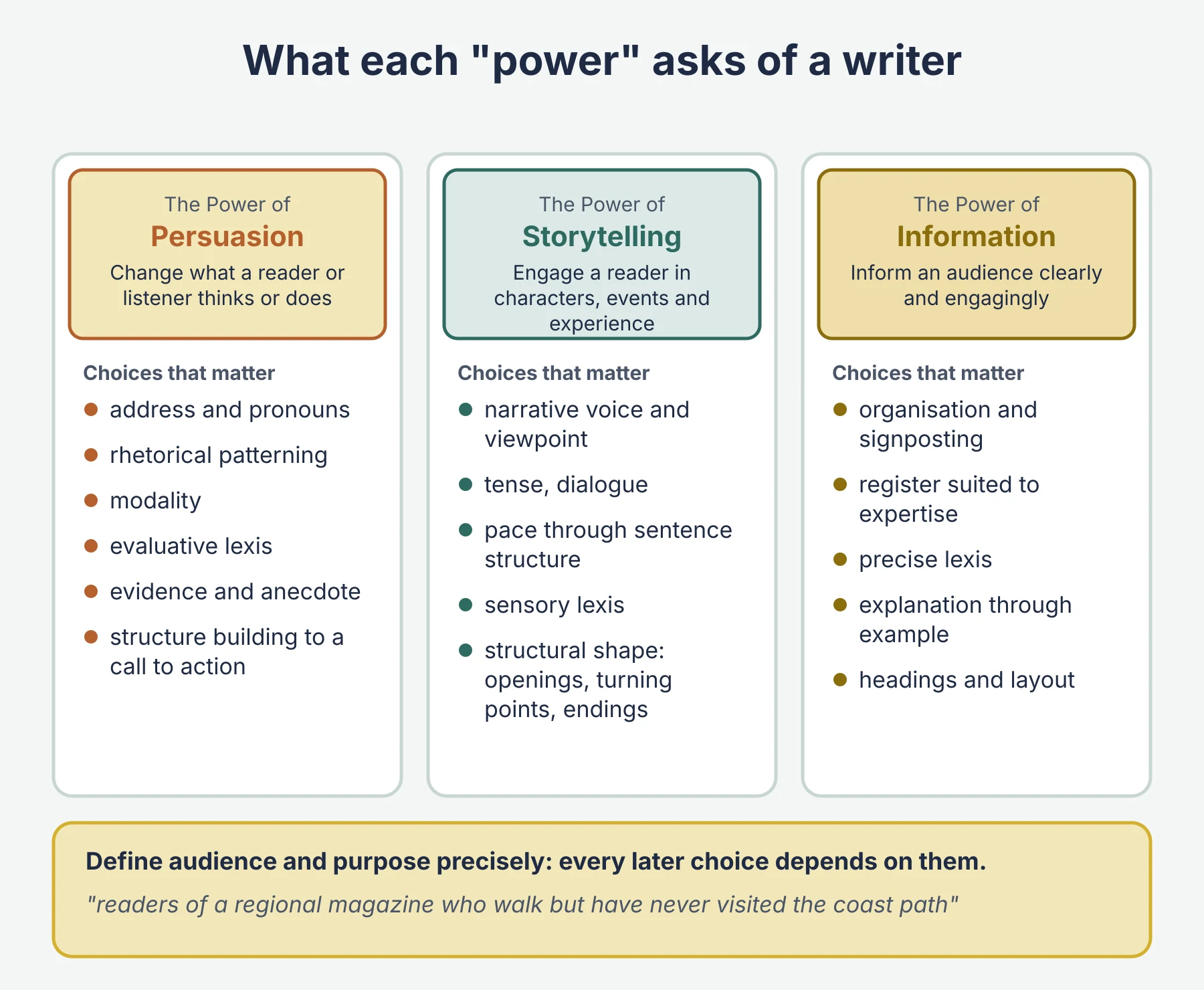
The three powers: what to control
| Power | Key choices |
|---|---|
| Persuasion | Address, pronoun shifts, modality, evaluative lexis, evidence and anecdote, building to a call to action |
| Storytelling | Viewpoint, tense, dialogue, pace through sentence length and structure, sensory lexis, structural shape |
| Information | Organisation, headings, register for the reader’s expertise, precise lexis, examples, layout |
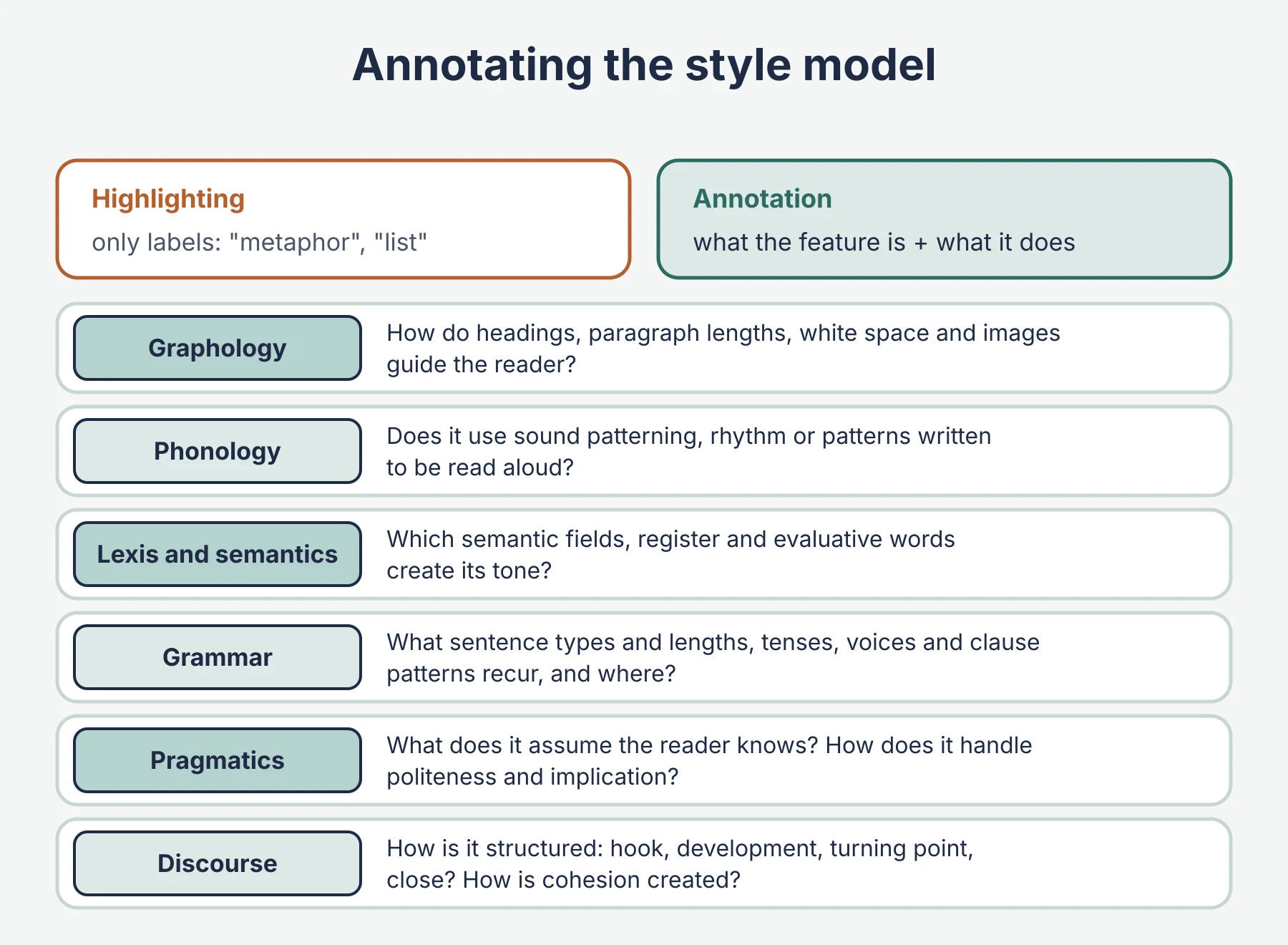
Style model annotation checklist
- Graphology: headings, paragraphing, white space, images.
- Phonology: rhythm and sound patterning, especially in texts for speaking.
- Lexis: semantic fields, register, evaluative words.
- Grammar: recurring sentence types, tense, voice, clause patterns.
- Pragmatics: assumed knowledge, implication, politeness.
- Discourse: opening, development, turning point, close; cohesion.
For every feature: what it is + what it does + what I will do with it.
Commentary structure
1. Context: form, audience, purpose, area.
2. Style model: key techniques, with terminology.
3. My choices: adopted, adapted, and why (audience and purpose).
4. Process: important redrafting decisions and reasons.
5. Evaluation: what worked, what did not, and why.
Keep both texts in view throughout.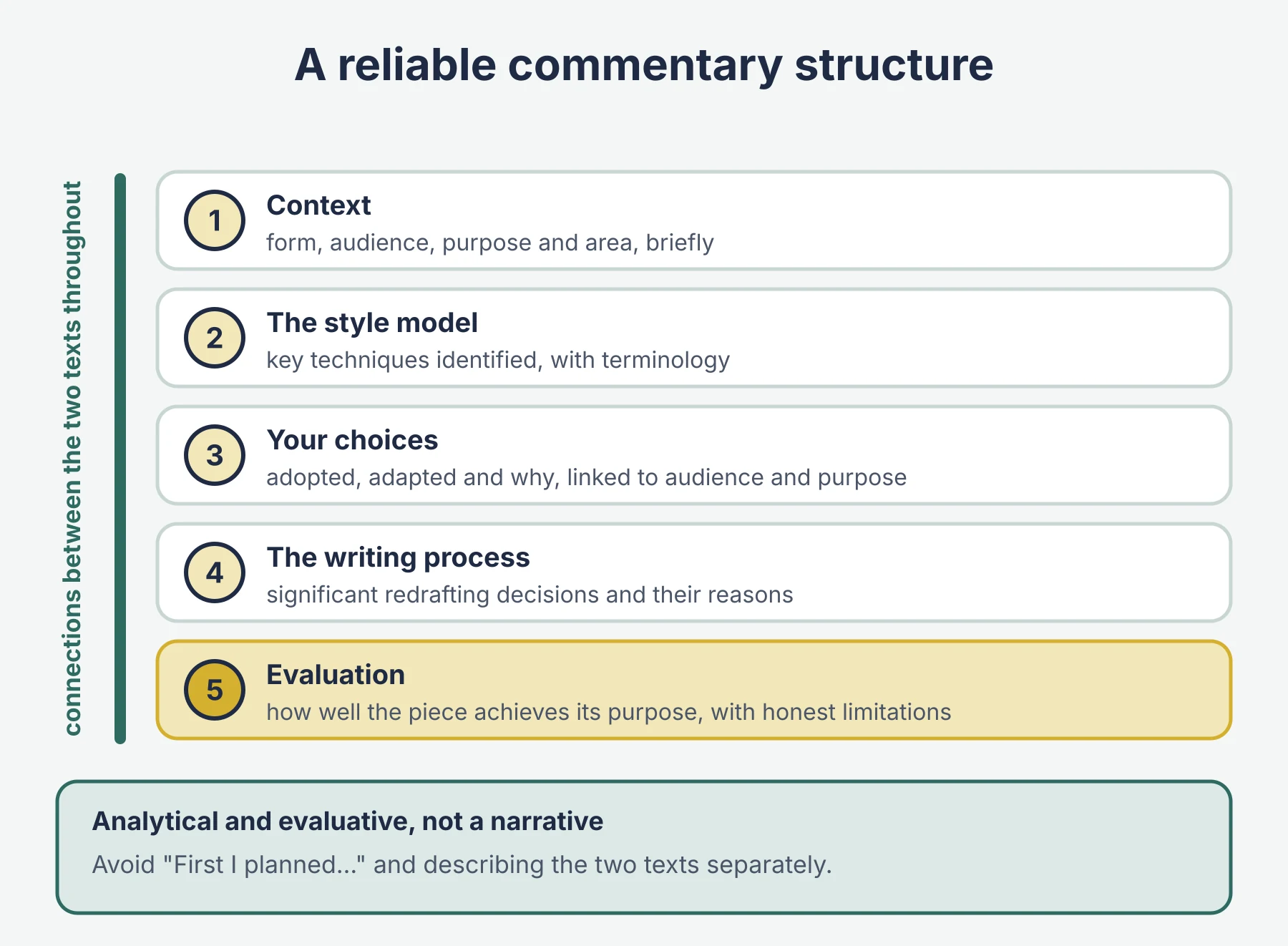
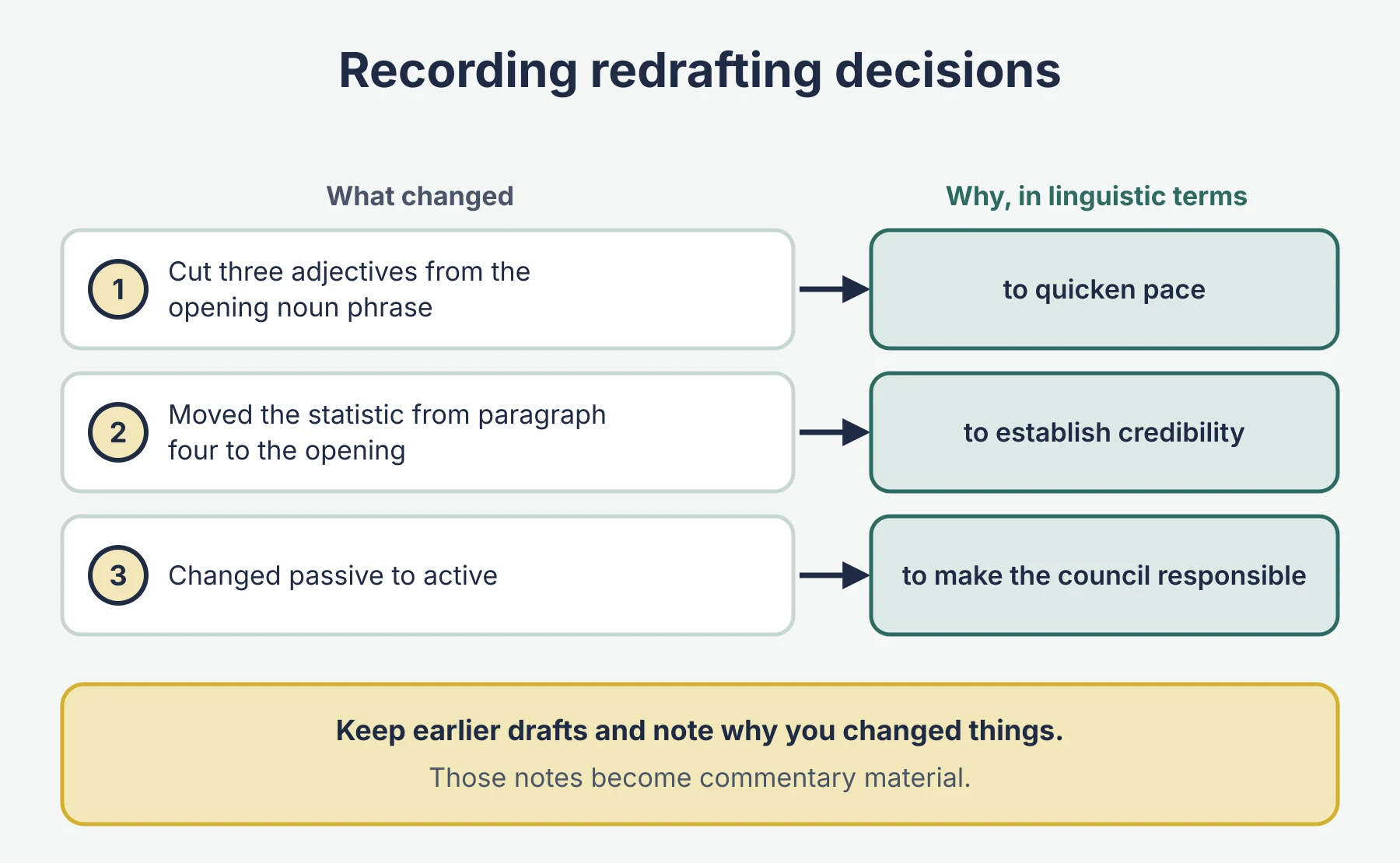
Redrafting reasons worth recording
| Change | Linguistic reason to give |
|---|---|
| Cut modifiers in an opening | Faster pace; reader reaches the main verb sooner |
| Passive to active | Makes an agent responsible, sharpening persuasion |
| Moved evidence earlier | Establishes credibility before the main claim |
| Added a minor sentence | Creates emphasis or a pause at a turning point |
| Removed jargon | Matches the audience’s knowledge |
| Changed viewpoint or tense | Alters intimacy or immediacy in storytelling |
Keep dated drafts so the commentary can point to real decisions rather than reconstructed ones.
Useful commentary frames
- “The style model’s use of … positions the reader as …; I adopted this because …”
- “Unlike the style model, which addressed …, my audience …, so I …”
- “In my second draft I replaced … with …, because …”
- “This was effective in …, although …”
Traps
- Style model in a different form from your piece.
- Labels without effects in the annotation.
- Vague audience (“everyone”, “adults”).
- Borrowing the style model’s content or phrases.
- Narrating the process instead of analysing it.
- Ignoring the style model in the commentary.
- No honest evaluation of limitations.
- Exceeding the 750-word limits instead of cutting with purpose.
Self-test
- Name the three areas for original writing.
- What four items go into the folder?
- How long are the piece and the commentary?
- What does the commentary allow you to consider and evaluate, according to the specification?
- What makes a good style model?
- What three things should every annotation note?
- Give two language choices central to Storytelling.
- Give two language choices central to Persuasion.
- Why should audience be defined precisely?
- What is adaptation, and why does the commentary reward it?
- Rewrite as commentary analysis: “I made the start better in my second draft.”
- Why must the commentary keep both texts in view?
Answers
- The Power of Persuasion, The Power of Storytelling, The Power of Information.
- The original writing, an annotated style model, a reflective commentary and references.
- 750 words each.
- The style model, the writing process and the effectiveness of the final piece.
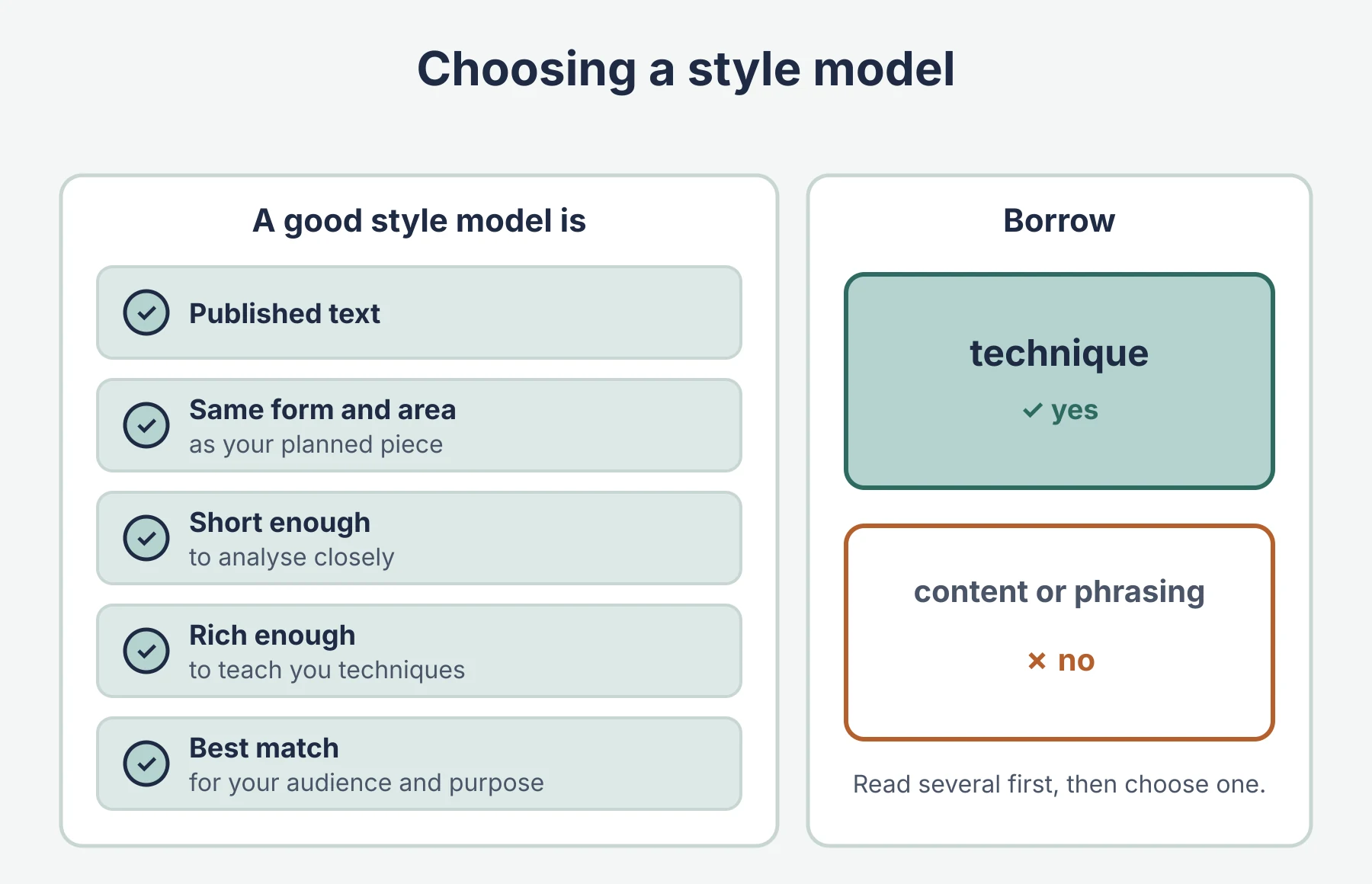
- A published text in the same form and area as your piece, short enough to analyse closely and rich in techniques.
- What the feature is, what it does, and what you will do with it.
- Any two: viewpoint, tense, dialogue, pace through sentence structure, sensory lexis, structural shape.
- Any two: pronoun address, modality, rhetorical patterning, evaluative lexis, evidence and anecdote, call to action.
- Every choice of register, lexis, structure and content depends on what that audience knows and needs.
- Changing a borrowed technique to suit your own audience and purpose; it shows understanding of how context shapes language.
- For example: “In my second draft I cut the opening noun phrase from four modifiers to one, so the first sentence reached its verb sooner and created pace.”
- Connections between your writing and the style model are assessed, so discussing only one limits the commentary.
More resources on this topic
Related resources
-
Study guides
AQA A-Level English Language: The Language in Action NEA (7702)
AQA A-Level English Language 7702 NEA Language in Action: the language investigation, original writing and commentary, and the methods of analysis they use.
English · AQA · A Level
Read guide -
Study guides
AQA A-Level English Language: Methods of Language Analysis in the NEA (7702)
How to apply the six language levels in the AQA A-level English Language 7702 NEA: choosing methods, coding data and analysing your own writing.
English · AQA · A Level
Read guide -
Practice questions
AQA A-Level English Language 7702: Language in Action (NEA) — Practice Questions
Original NEA practice for AQA A-level English Language (7702): investigation design, data analysis, style-model work and commentary writing, with model answers.
English · AQA · A Level
Try questions
Get free revision emails (optional)
Occasional emails with practice questions, worked explanations and links to free resources for the qualification and subjects you choose. No spam, and you can unsubscribe from any email. The free tools on this site never need an email.