
Revision Notes
AQA A-Level English Language (7702): Methods of Language Analysis (NEA) – Revision Notes
Recall notes on applying the six language levels in the AQA A-level English Language 7702 NEA: transcription, coding, frameworks and analysing your own writing.
- Subject
- English
- Level
- A LEVELS
- Topic
- Non-exam Assessment – Language in Action
- Author
- Marlbridge Academic Team
- Updated
- Reviewed by
- Ammar Bilal (what this means)
Aligned to AQA A Level English (7702), For first teaching 2015. Official specification .
Syllabus page (what it covers and how it is assessed): AQA A Level English Language.
Found an error? Report a correction.
Need help with this topic? Request a free trial class for A Level English Language (7702).
Condensed recall for 3.3.3 Methods of language analysis in the AQA A-level English Language (7702) non-exam assessment, Language in Action. The full explanation, with worked examples on choosing methods and analysing your commentary, is in the methods of language analysis in the NEA study guide.
The specification point
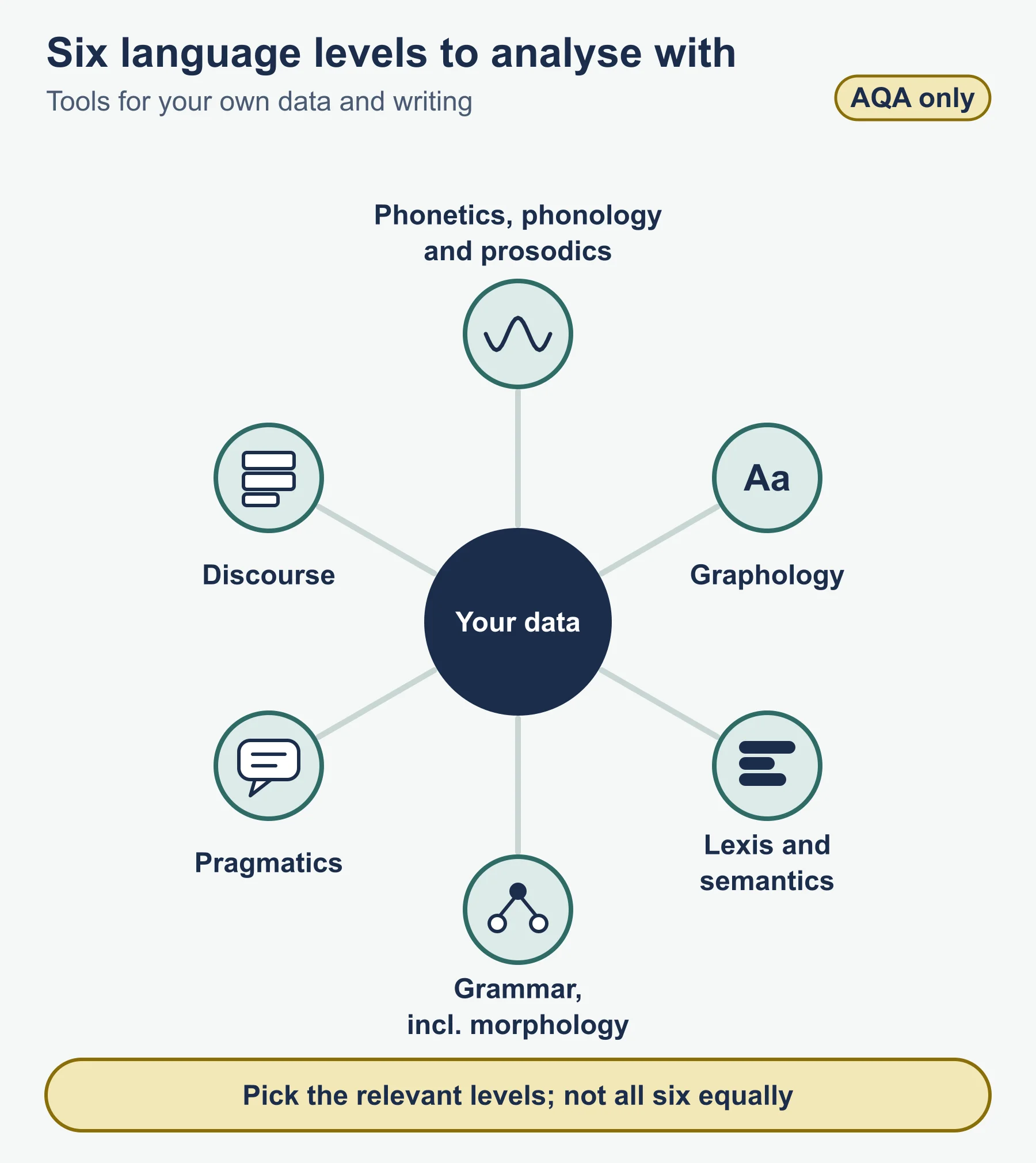
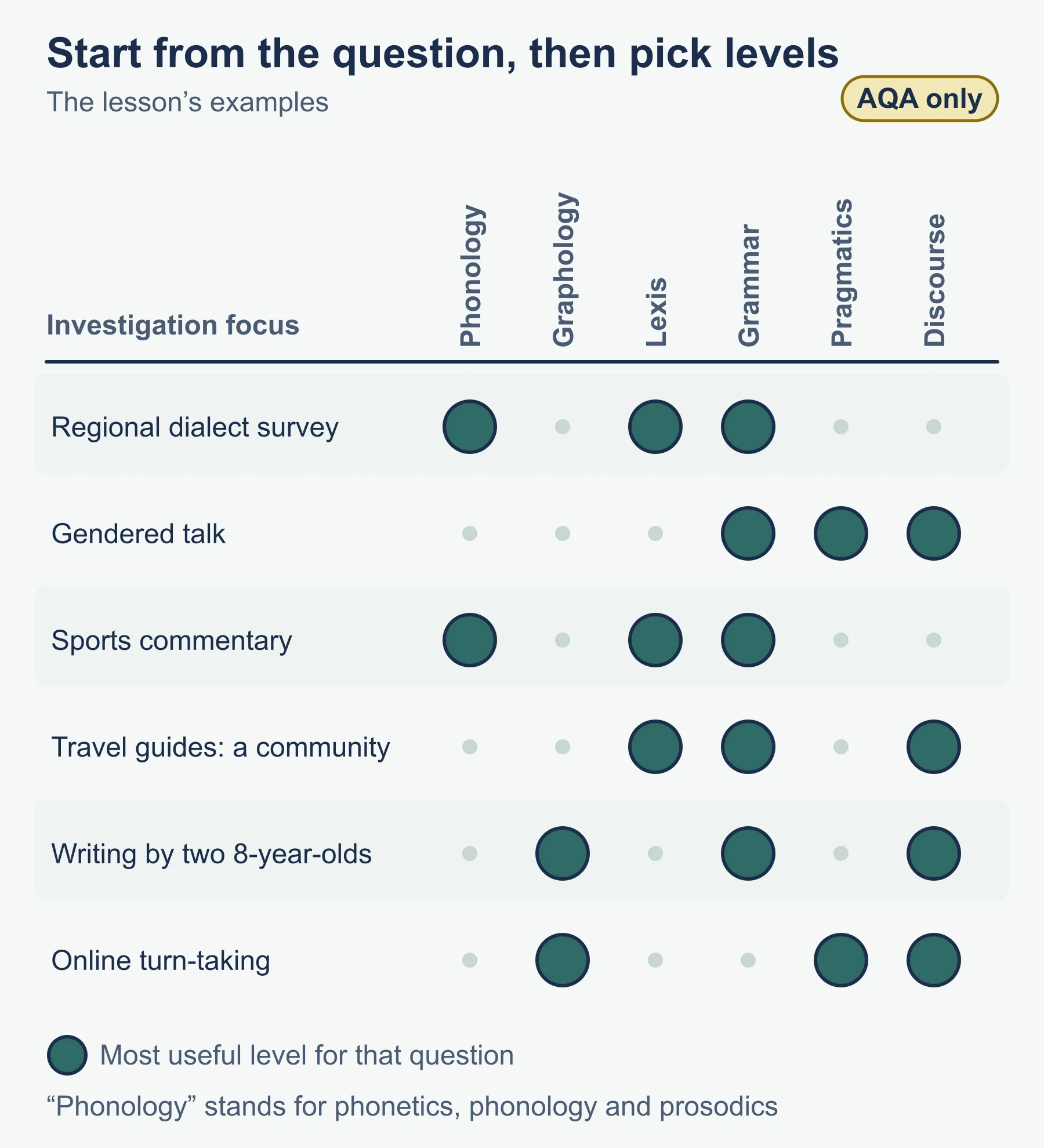
Both the investigation and the original writing have a distinctive approach to analysis shaped by the research pathway or theme chosen, but underlying any analysis is coverage of relevant aspects of the six language levels: phonetics, phonology and prosodics; graphology; lexis and semantics; grammar, including morphology; pragmatics; discourse. Relevant, not all: depth on the levels your question needs.
Level by level: NEA uses and frameworks
| Level | Typical NEA use | Frameworks and concepts to apply |
|---|---|---|
| Phonetics, phonology and prosodics | Accent surveys; commentary; speech data | Phonemic symbols for variants; stress, intonation, pace, pauses |
| Graphology | Advertisements, websites, comics, children’s writing | Layout, typography, image and text relations, anchorage |
| Lexis and semantics | Representation studies; occupational language; word lists | Semantic fields, connotation, collocation, word formation, semantic change |
| Grammar, including morphology | Most investigations; children’s writing | Clause types, modality, voice, tense and aspect, noun phrase structure, inflections |
| Pragmatics | Talk data; persuasion; politeness | Grice’s maxims and implicature, speech acts, face and politeness strategies |
| Discourse | Conversation; genre studies; narrative | Adjacency pairs, turn-taking, topic management, cohesion, genre structure |
Transcription essentials
- Use a consistent set of conventions and include a key with the data.
- Common symbols: (.) micropause; (2) timed pause in seconds; a bracket or // for overlap; capitals or underlining for stress; arrows for rising or falling intonation; = for latching (no gap between turns).
- Number lines so analysis can cite them precisely.
- Anonymise speakers (Speaker A, or initials).
- Transcribe only what you analyse closely, but keep the full recording’s details in your methodology.
From data to findings: the coding cycle
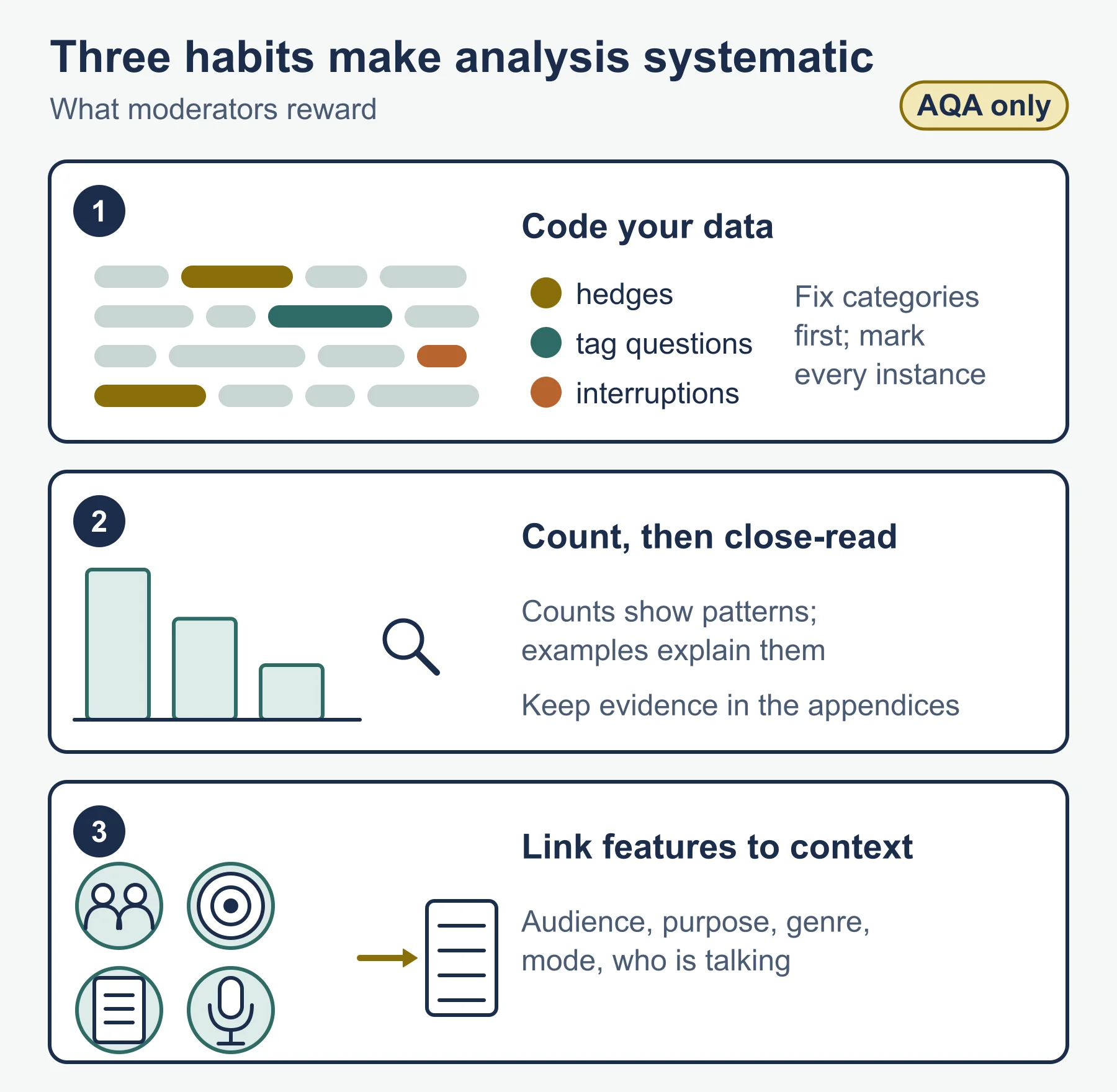
1. Define each category precisely (what counts as a "hedge"?).
2. Code every instance in the data, consistently.
3. Count and, where sets differ in size, normalise (per 100 turns, per 1,000 words).
4. Read the examples closely: what does each instance do in context?
5. Explain patterns through context: audience, purpose, roles, mode.
6. Note exceptions and limits.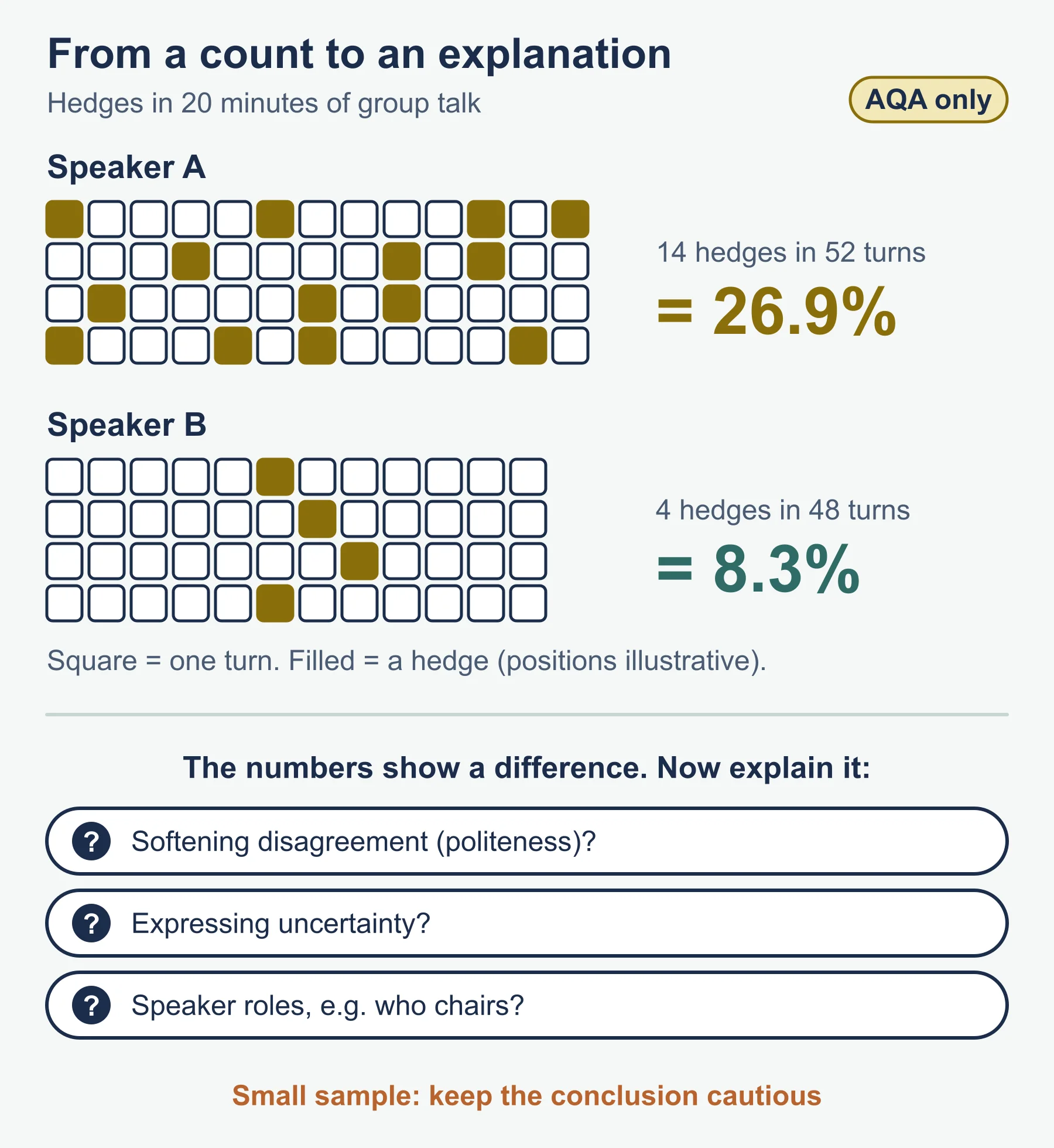
Quantitative and qualitative
| Quantitative | Qualitative |
|---|---|
| Counts, percentages, normalised frequencies | Close analysis of selected examples |
| Shows patterns and differences | Explains meaning and function |
| Needs evidence in the appendices | Needs precise terminology and context |
| Risk: numbers without interpretation | Risk: cherry-picked examples |
The strongest analyses combine both: numbers locate the pattern, close reading explains it.
Matching levels to data type
- Spoken data: prosodics, pragmatics and discourse are usually central; grammar of spontaneous speech (ellipsis, fillers, repair) needs describing on its own terms, not as “errors”.
- Written data: grammar, lexis and discourse structure; graphology where layout carries meaning.
- Multimodal data: graphology and the relation between image and text, alongside lexis and grammar.
- Attitudes data: lexis and semantics of respondents’ answers; analysis of question wording itself.
Methods in the commentary
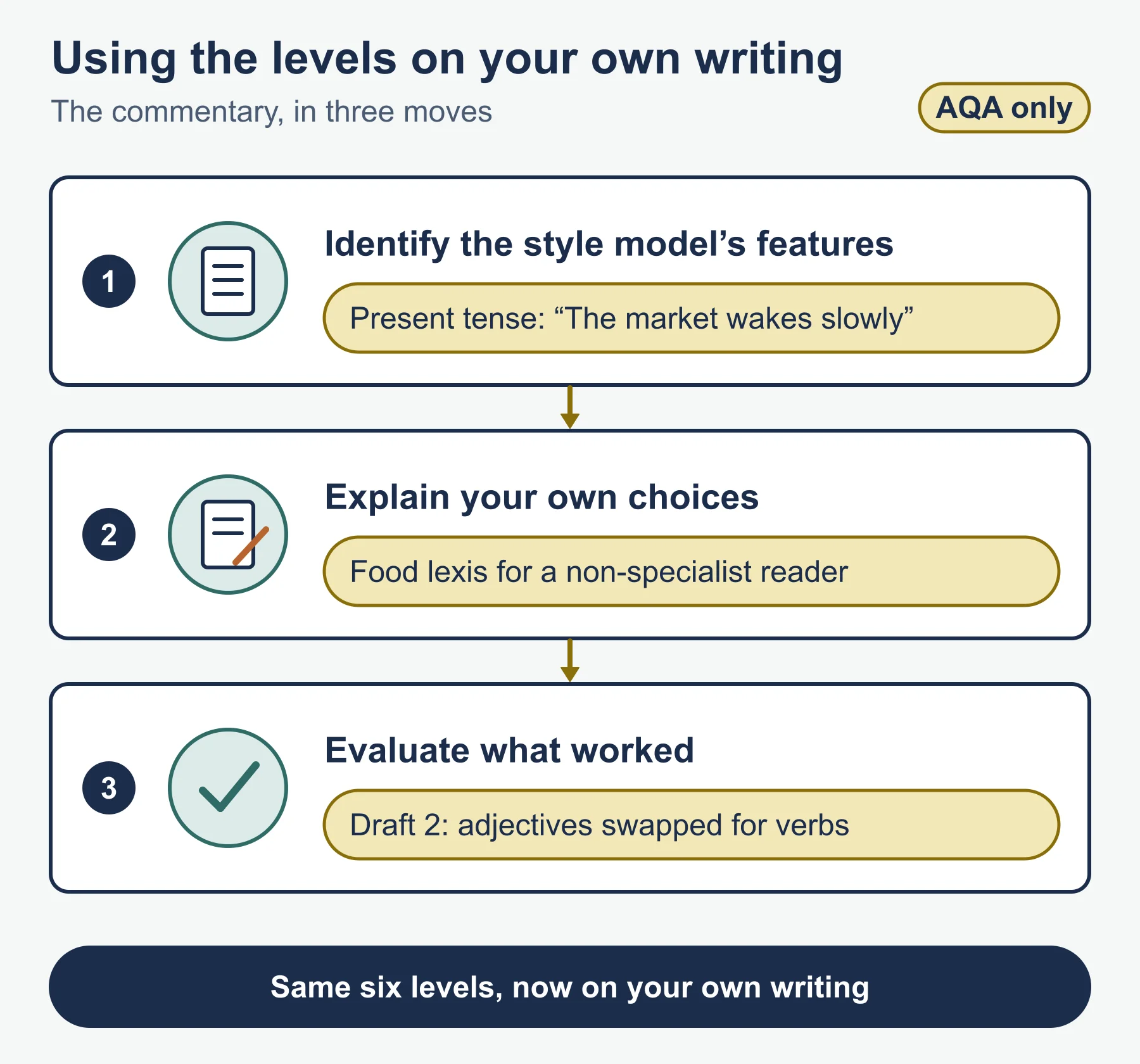
Use the levels to analyse your style model and your own choices: name the feature, explain its effect for the audience and purpose, compare the two texts, and evaluate. A commentary describing the writing process without linguistic analysis misses the point of 3.3.3.
Key terms
| Term | Meaning |
|---|---|
| Latching | One turn following another with no gap |
| Adjacency pair | Two linked turns (question and answer, offer and acceptance) |
| Speech act | What an utterance does (request, apology, promise) |
| Face-threatening act | An act that threatens another’s positive or negative face |
| Normalised frequency | A count adjusted to a common base for comparison |
| Operational definition | A precise statement of what counts as an instance of a category |
| Cherry-picking | Choosing only examples that support a claim |
Traps
- Applying all six levels thinly instead of the relevant levels in depth.
- No transcription key, or inconsistent symbols.
- Categories never defined, so counts are unreliable.
- Raw counts compared across data sets of different sizes.
- Frameworks named but not tested against the data.
- Commentary as narrative rather than analysis.
Self-test
- What does the specification say about which levels an NEA analysis must cover?
- What must accompany a transcript?
- What does “=” usually show in a transcript?
- Why define coding categories before counting?
- When should counts be normalised?
- Give one strength and one risk of quantitative analysis.
- Name one pragmatic framework and what it explains.
- What is an adjacency pair? Give an example.
- Which levels would suit an investigation into how a comic tells stories?
- How should methods of analysis appear in the commentary?
- What is cherry-picking, and how do you avoid it?
- Why number transcript lines?
Answers
- Relevant aspects of the six levels, shaped by the research pathway or theme; not every level equally.
- A key explaining the conventions used.
- Latching: the next turn follows with no gap.
- So that every instance is coded consistently and counts are reliable.
- When the data sets being compared differ in size or length.
- Strength: shows patterns and differences; risk: numbers without interpretation of function or context.
- Grice’s maxims, which explain implicature; or Brown and Levinson’s politeness theory, which explains strategies that protect face.
- Two linked turns by different speakers, such as a question followed by an answer.
- Graphology (panels, layout, lettering), discourse (narrative structure) and lexis or grammar (dialogue, captions).
- Applied to the style model and your own choices, with terminology, comparison and evaluation.
- Selecting only supporting examples; avoid it by coding all the data and reporting counter-examples.
- So analysis can cite evidence precisely and the moderator can find it.
More resources on this topic
Related resources
-
Study guides
AQA A-Level English Language (7702): Original Writing
Choosing and analysing a style model, crafting a 750-word original piece and writing the reflective commentary for the AQA A-level English Language 7702 NEA.
English · AQA · A Level
Read guide -
Practice questions
AQA A-Level English Language (7702): Original Writing – Practice Questions
Original practice on analysing style models, crafting writing, redrafting and commentary for AQA A-level English Language 7702 NEA original writing.
English · AQA · A Level
Try questions -
Revision notes
AQA A-Level English Language (7702): Original Writing – Revision Notes
Condensed notes on the three powers, style-model annotation, redrafting and the reflective commentary for AQA A-level English Language 7702 original writing.
English · AQA · A Level
Revise topic
Get free revision emails (optional)
Occasional emails with practice questions, worked explanations and links to free resources for the qualification and subjects you choose. No spam, and you can unsubscribe from any email. The free tools on this site never need an email.