
Revision Notes
AQA A-Level English Language (7702): Children's Language Development – Revision Notes
Condensed recall on children's spoken and written development, theories and data analysis for AQA A-level English Language 7702 Paper 1 Section B.
- Subject
- English
- Level
- A LEVELS
- Topic
- Paper 1 – Language, the Individual and Society
- Author
- Marlbridge Academic Team
- Updated
- Reviewed by
- Ammar Bilal (what this means)
Aligned to AQA A Level English (7702), For first teaching 2015. Official specification .
Syllabus page (what it covers and how it is assessed): AQA A Level English Language.
Found an error? Report a correction.
Need help with this topic? Request a free trial class for A Level English Language (7702).
Condensed recall for 3.1.3 Children’s language development (ages 0 to 11), assessed by one discursive essay from a choice of two in Paper 1 Section B (30 marks) of AQA A-level English Language (7702). Full explanations and a worked transcript are in the children’s language development study guide.
What you must cover
Functions of children’s language; phonological, pragmatic, lexical, semantic and grammatical development; genres of speech and writing; spoken, written and multimodal modes; theories and research.
Key terms
| Term | Meaning |
|---|---|
| Holophrase | A single word carrying the meaning of a whole utterance |
| Telegraphic speech | Content words with function words and inflections omitted |
| Virtuous error | A logical mistake from over-applying a rule (“runned”, “sheeps”) |
| Overextension / underextension | Word used too widely / too narrowly |
| Child-directed speech | Adapted adult speech: higher pitch, repetition, simple syntax, questions |
| Recast / expansion | Adult repeats the child’s utterance in correct form / with added detail |
| Scaffolding | Support from a more knowledgeable person, withdrawn as the child gains skill |
| Zone of proximal development | Vygotsky: what a child can do with help but not yet alone |
| LAD | Chomsky’s proposed innate Language Acquisition Device |
| LASS | Bruner’s Language Acquisition Support System: the caregiver’s supportive interaction |
| Phonological process | Regular simplification of adult sounds (deletion, substitution, assimilation) |
| Orthography | The spelling system of a language |
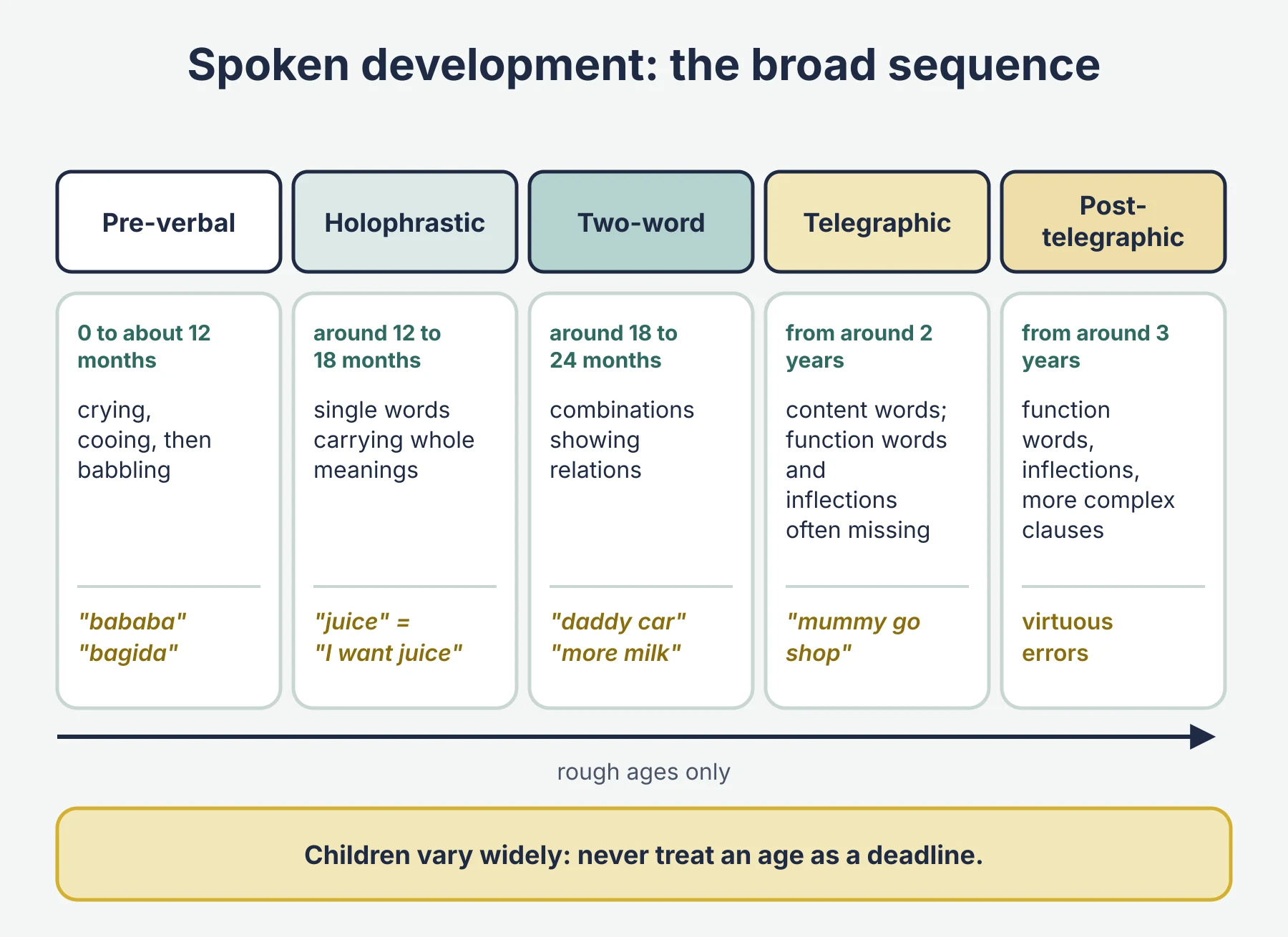
Development checklist by level
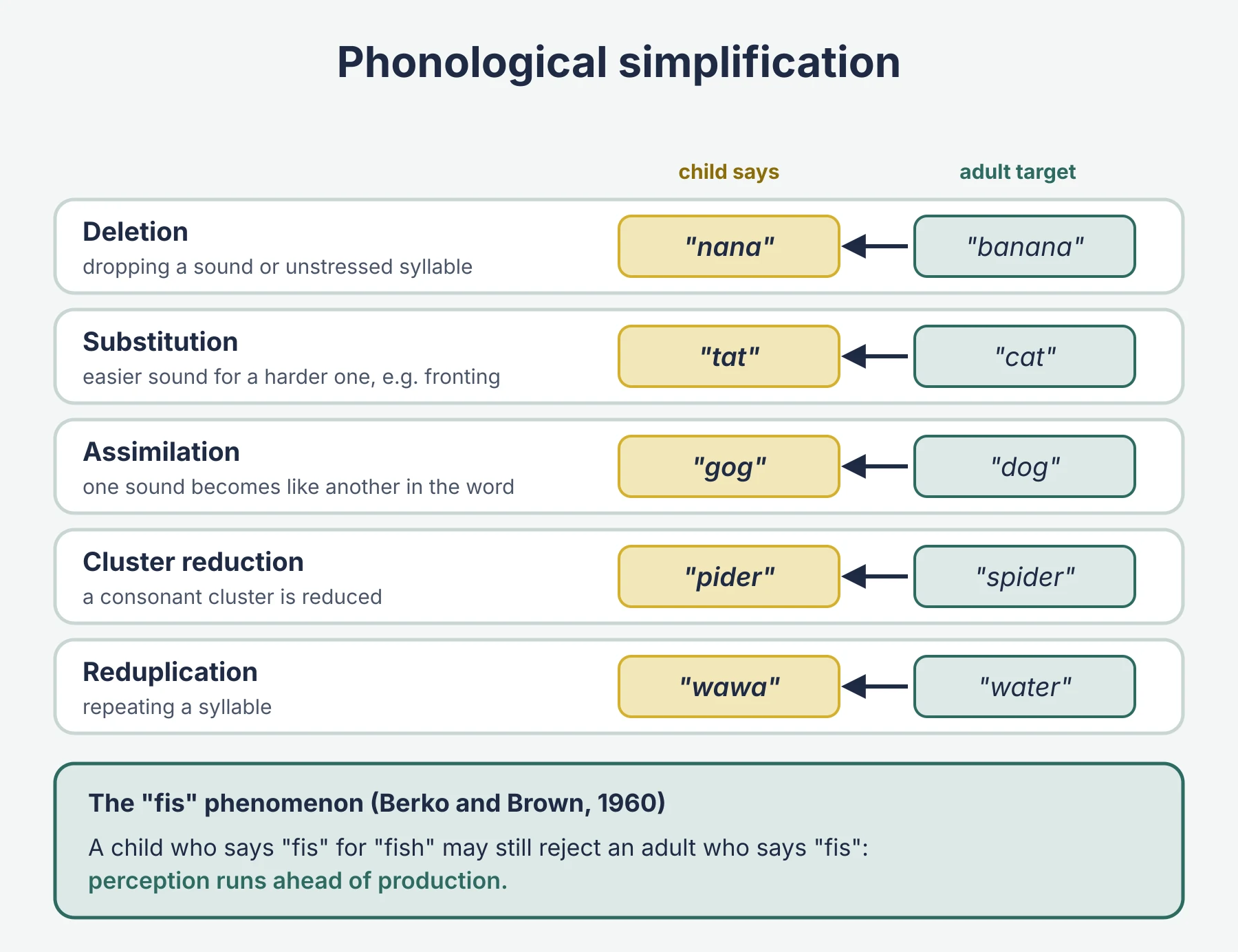
Phonological: babbling (reduplicated, variegated); deletion (“ca” for “cat”); substitution such as fronting (“tat” for “cat”); assimilation (“gog” for “dog”); cluster reduction (“pider”); reduplication (“wawa”). Perception ahead of production: Berko and Brown’s “fis” phenomenon.
Lexical and semantic: early words mostly naming, then action, social and modifying words; vocabulary spurt; over- and underextension (Rescorla: categorical, analogical, mismatch); Aitchison’s labelling, packaging and network building.
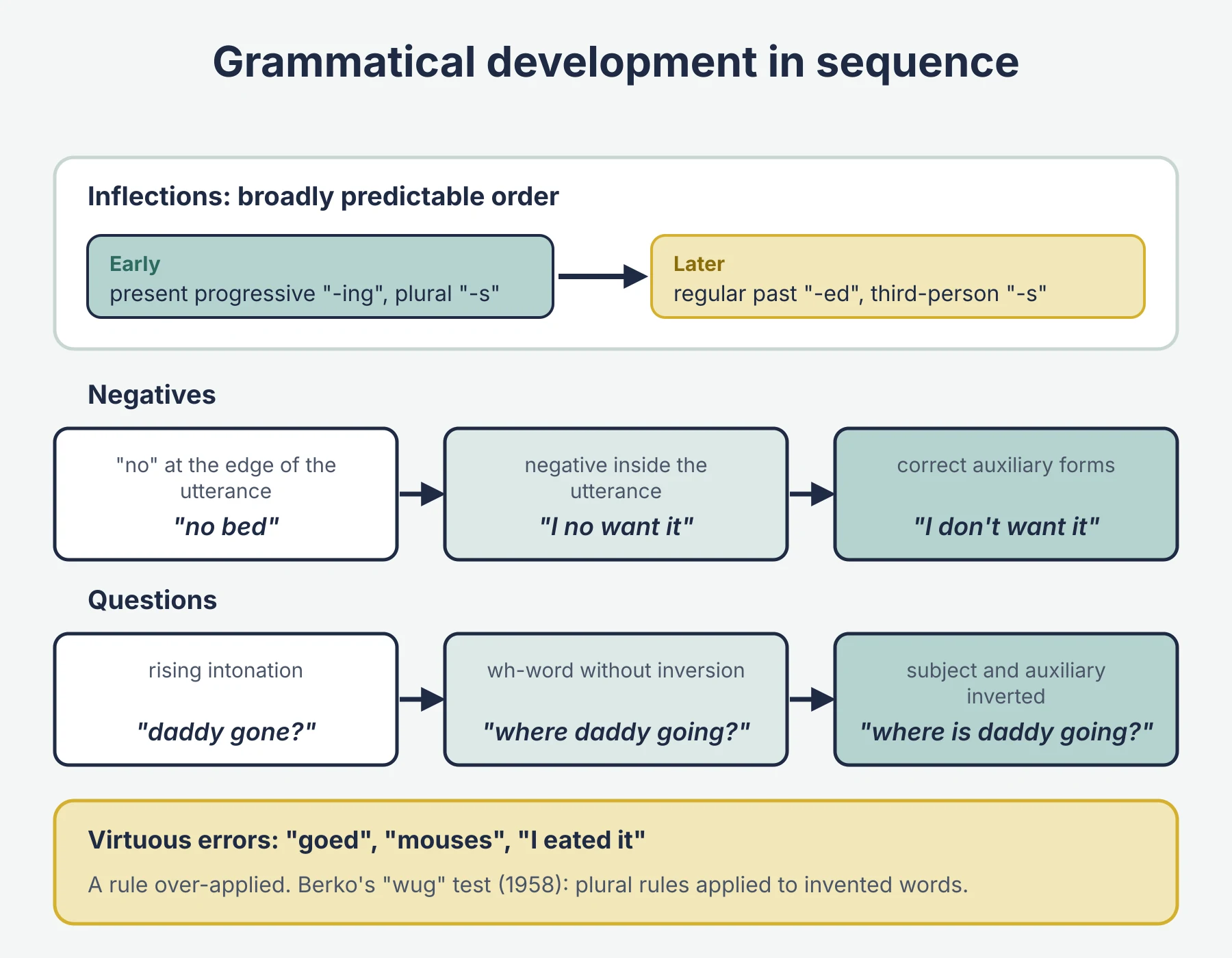
Grammatical: holophrastic, two-word, telegraphic, post-telegraphic; inflections “-ing” and plural “-s” early, “-ed” and third-person “-s” later; Berko’s “wug” test (1958); negatives from “no bed” to “I no want” to “I don’t want”; questions from intonation, to wh-word without inversion, to inversion.
Pragmatic: turn-taking; politeness routines; repair; awareness of the listener; Halliday’s functions widening from instrumental and regulatory towards representational and heuristic uses.
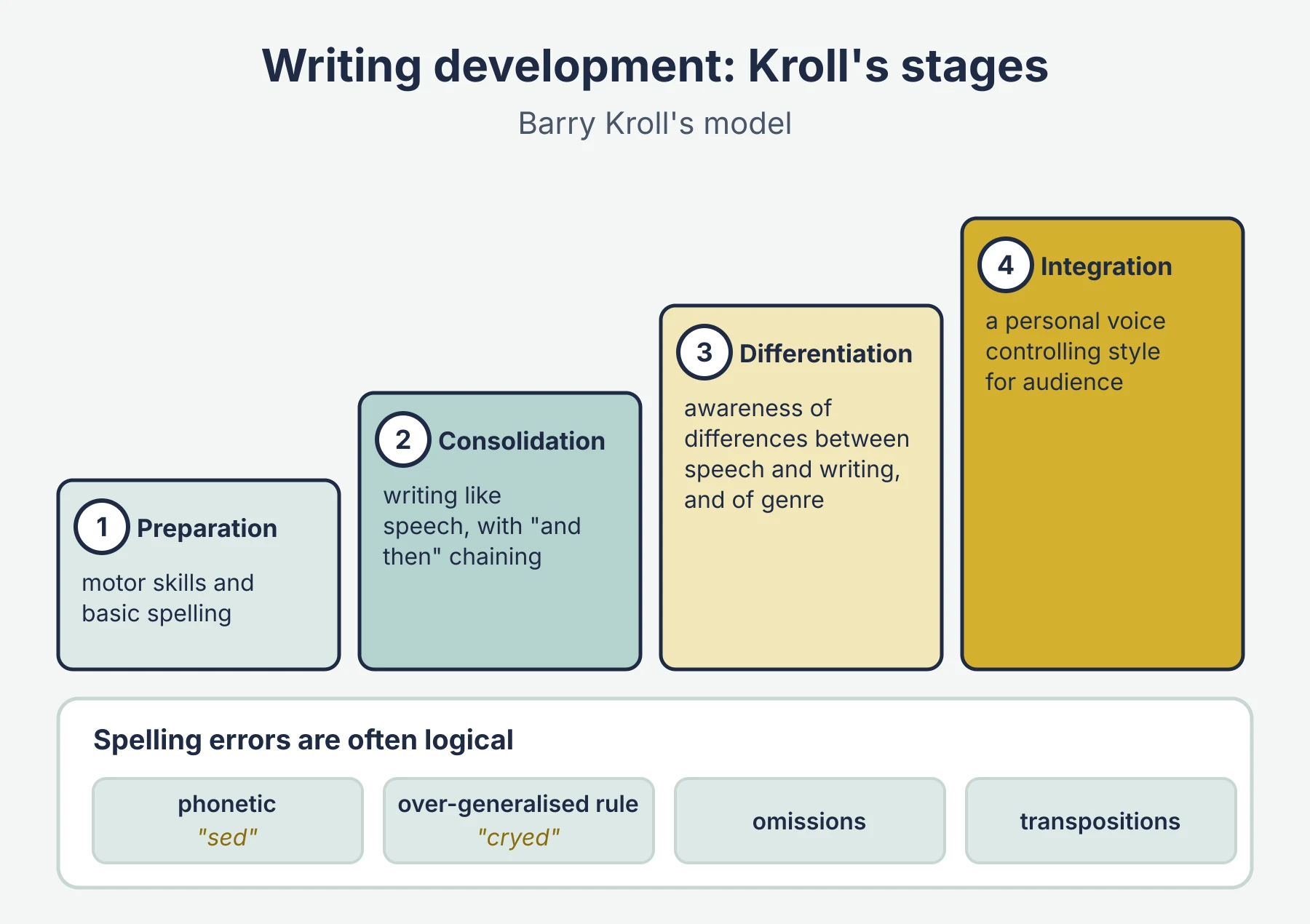
Writing: letter formation and orientation; phonetic and over-generalised spellings; punctuation acquired gradually; Kroll’s preparation, consolidation, differentiation, integration; genre awareness (story, recount, instructions, letter); influence of teaching on structure and connectives.
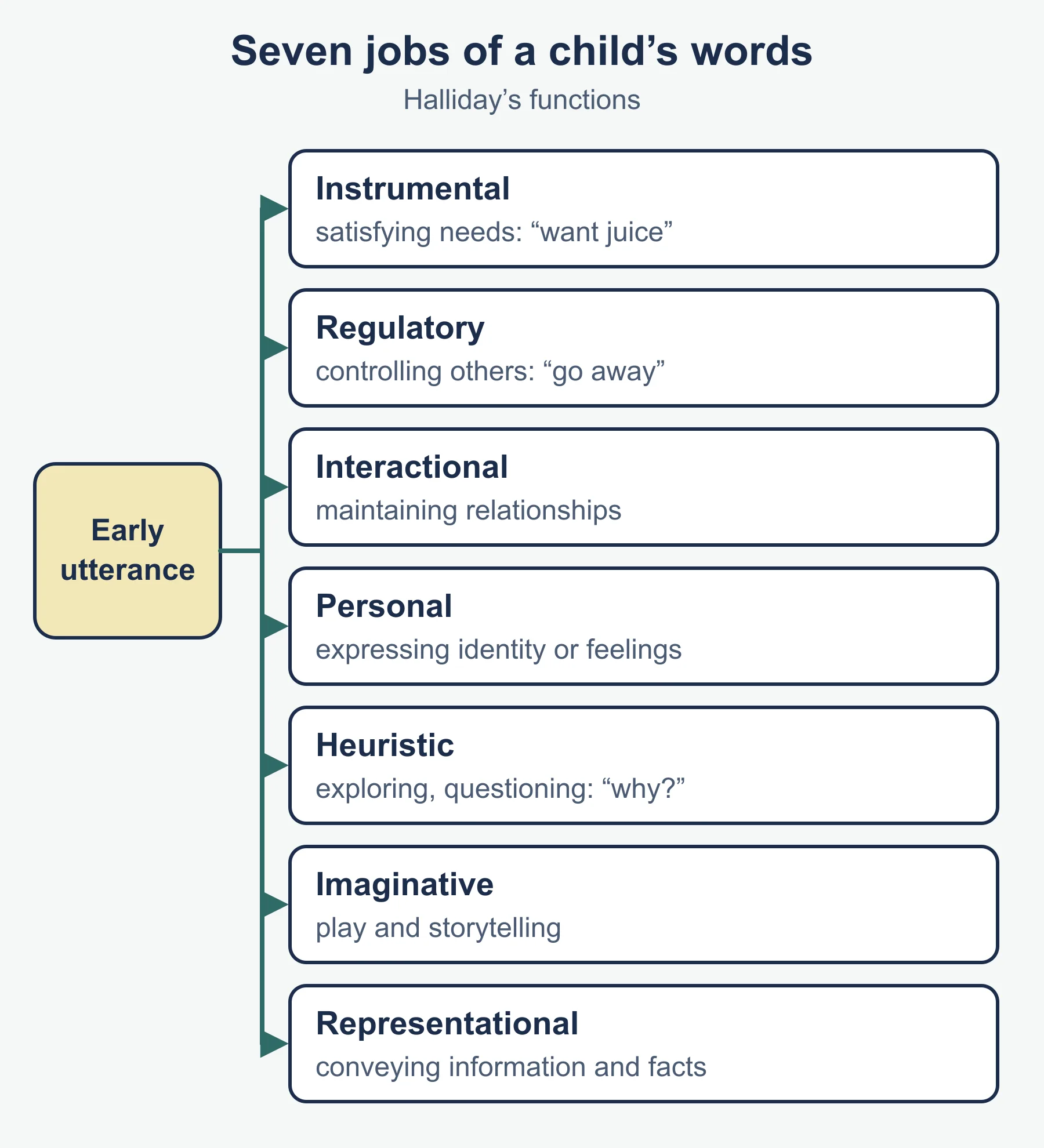
Halliday’s functions (quick recall)
| Function | Child’s purpose | Example |
|---|---|---|
| Instrumental | Getting needs met | “want biscuit” |
| Regulatory | Controlling others | “stop it” |
| Interactional | Relating to others | “love you mummy” |
| Personal | Expressing self | “me sad” |
| Heuristic | Finding out | “what that?” |
| Imaginative | Pretending | “I’m a dragon” |
| Representational | Giving information | “doggy in garden” |
Theories in one line each
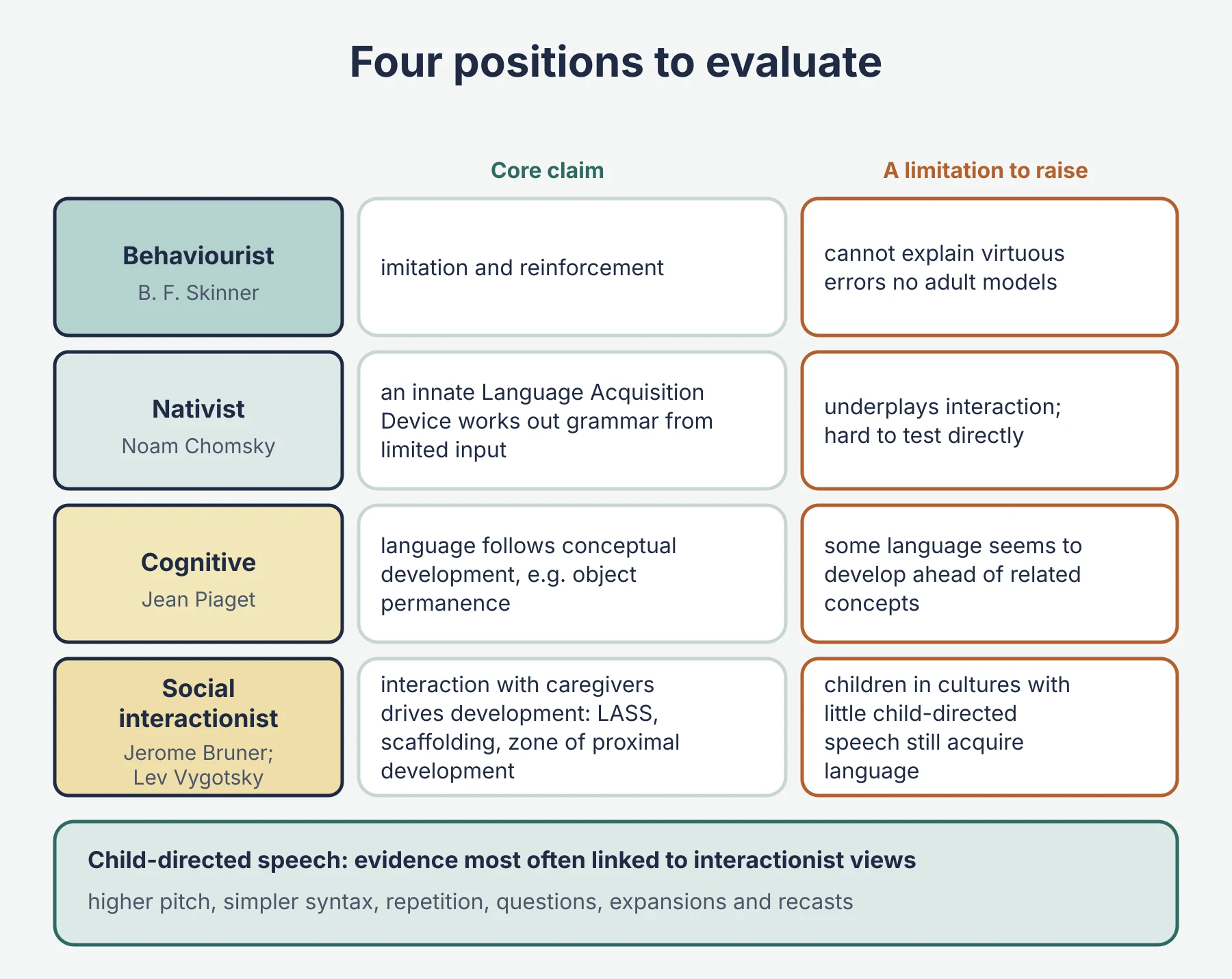
- Skinner (behaviourist): imitation and reinforcement. Weakness: virtuous errors are not imitated.
- Chomsky (nativist): innate LAD; poverty of the stimulus. Weakness: underplays input and interaction.
- Piaget (cognitive): language follows concepts such as object permanence. Weakness: some language appears to outpace concepts.
- Bruner and Vygotsky (interactionist): scaffolding, LASS, zone of proximal development. Weakness: children acquire language even where child-directed speech is less common.
Child-directed speech: what to look for in the adult’s turns
| Feature | Example | Why it matters |
|---|---|---|
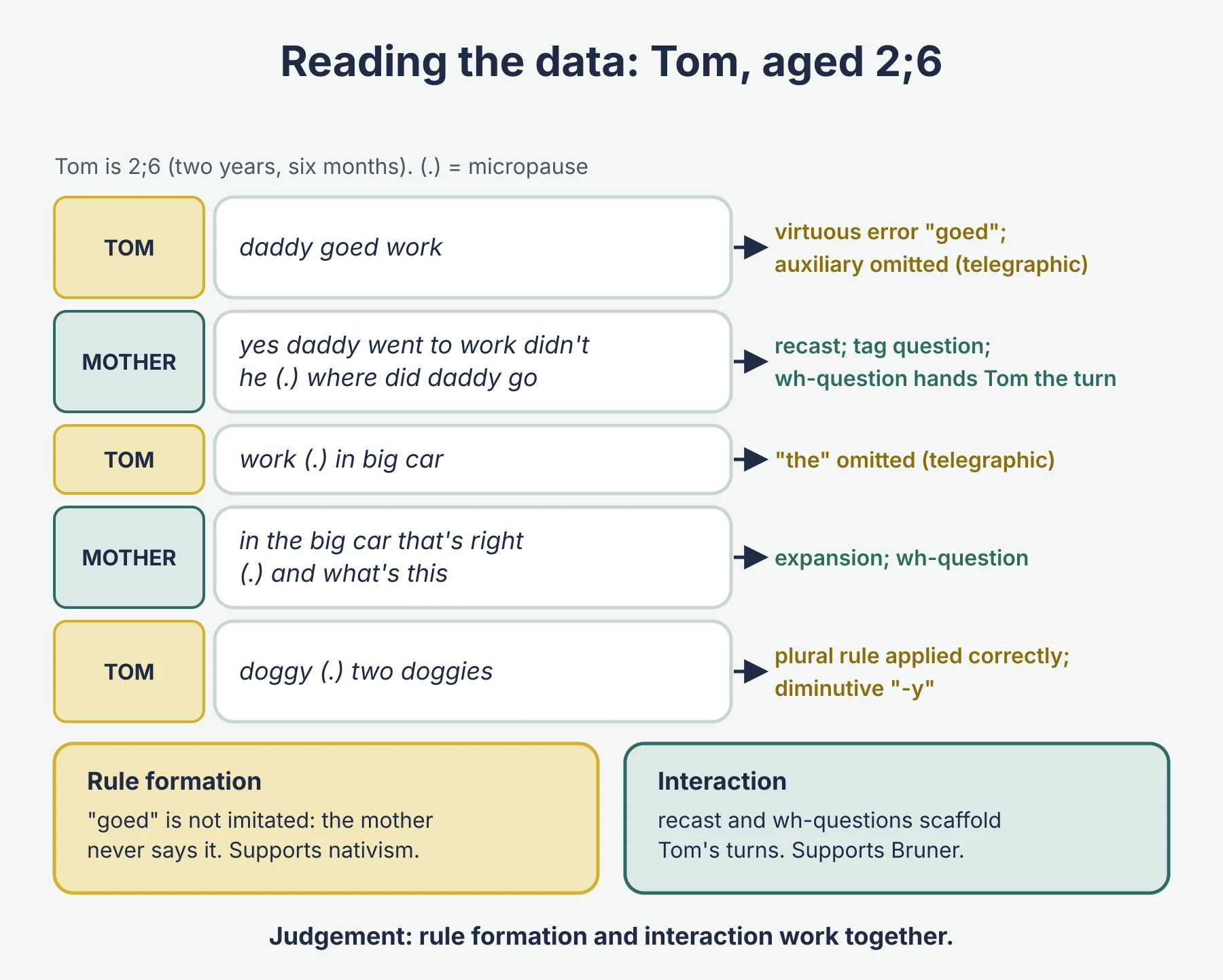
| Questions handing over the turn | “And what’s this?” | Invites the child to practise; scaffolding |
| Recasts | Child: “me goed”; adult: “you went, didn’t you” | Models correct forms without correction |
| Expansions | Child: “big car”; adult: “yes, a big red car” | Extends grammar and vocabulary |
| Repetition and simple syntax | “Look, a ball. A big ball.” | Makes structure easy to pick out |
| Exaggerated intonation | Rising pitch on key words | Holds attention and marks important words |
Method for the essay
1. Read the question: what view must you evaluate?
2. Note the data's mode, genre and the child's age.
3. Annotate features by level, including the adult's language.
4. Match features to the view: which support it, which challenge it?
5. Bring in theory and research beyond the data.
6. Conclude with a qualified judgement.
Exam traps
- Treating ages as fixed milestones.
- Listing theories without using the data.
- Mixing levels: calling “pider” a virtuous error (it is phonological) or “goed” a phonological process (it is grammatical).
- Ignoring the adult’s turns, which often provide the best evidence for interactionist arguments.
- Writing about a child’s written text only in terms of spelling.
- Forgetting to reach a judgement on the essay question.
Self-test
- List the five areas of study the specification names for 3.1.3, besides genres and modes.
- What is a holophrase?
- Which phonological process is “gog” for “dog”?
- What did Berko’s “wug” test show?
- Give the typical three-step sequence for negatives.
- What is the difference between a recast and an expansion?
- Which theory does a virtuous error most directly challenge, and why?
- What does LASS stand for, and whose term is it?
- What is the zone of proximal development?
- Name Kroll’s four stages of writing development.
- Classify “what that?” using Halliday’s functions.
- What is the “fis” phenomenon evidence of?
Answers
- Functions of children’s language; phonological development; pragmatic development; lexical and semantic development; grammatical development; plus theories and research.
- A single word used to express a whole utterance’s meaning, such as “up” for “pick me up”.
- Assimilation.
- That children apply grammatical rules, such as plural “-s”, to invented words they have never heard.
- “No” at the edge (“no bed”), negative inside the utterance (“I no want”), correct auxiliary (“I don’t want”).
- A recast repeats the child’s meaning in correct form; an expansion adds detail or grammar to extend it.
- Behaviourism, because the child produces a form (“goed”) that no adult models, so it cannot be pure imitation.
- Language Acquisition Support System; Jerome Bruner.
- Vygotsky’s term for the gap between what a child can do alone and what they can do with help.
- Preparation, consolidation, differentiation, integration.
- Heuristic.
- That children perceive adult sound distinctions before they can produce them.
More resources on this topic
Related resources
-
Study guides
AQA A-Level English Language: Language, the Individual and Society (7702)
Textual variations and representations, and children's language development – the full content of Paper 1 for AQA A-Level English Language (7702).
English · AQA · A Level
Read guide -
Practice questions
AQA A-Level English Language 7702: Paper 1 — Practice Questions
Original practice with worked answers on textual variations, representation, discourse and analysis methods for AQA A-Level English Language 7702 Paper 1.
English · AQA · A Level
Try questions -
Revision notes
AQA A-Level English Language 7702: Paper 1 — Revision Notes
Condensed notes on AQA A-Level English Language 7702 Paper 1: exam structure, analysis methods, representation and children's language development.
English · AQA · A Level
Revise topic
Get free revision emails (optional)
Occasional emails with practice questions, worked explanations and links to free resources for the qualification and subjects you choose. No spam, and you can unsubscribe from any email. The free tools on this site never need an email.