
Study Guides
AQA A-Level English Language (7702): Children's Language Development
How children develop spoken and written language from 0 to 11, with theories and an annotated transcript: 3.1.3 for AQA A-level English Language 7702 Paper 1.
- Subject
- English
- Level
- A LEVELS
- Topic
- Paper 1 – Language, the Individual and Society
- Author
- Marlbridge Academic Team
- Updated
- Reviewed by
- Ammar Bilal (what this means)
Aligned to AQA A Level English (7702), For first teaching 2015. Official specification .
Syllabus page (what it covers and how it is assessed): AQA A Level English Language.
Found an error? Report a correction.
Need help with this topic? Request a free trial class for A Level English Language (7702).
This guide covers 3.1.3 Children’s language development in AQA A-level English Language (7702), assessed in Paper 1 Section B: one discursive essay from a choice of two, worth 30 marks, with data focusing on spoken, written or multimodal language from children aged 0 to 11. The Paper 1 study guide gives the overview; this page goes into the detail you need to discuss data and theory together.
What the specification asks you to study
Students explore how children develop their spoken and written skills, studying:
- the functions of children’s language;
- phonological, pragmatic, lexical, semantic and grammatical development;
- different genres of speech and writing;
- different modes of communication (spoken, written, multimodal);
- theories and research about language development.
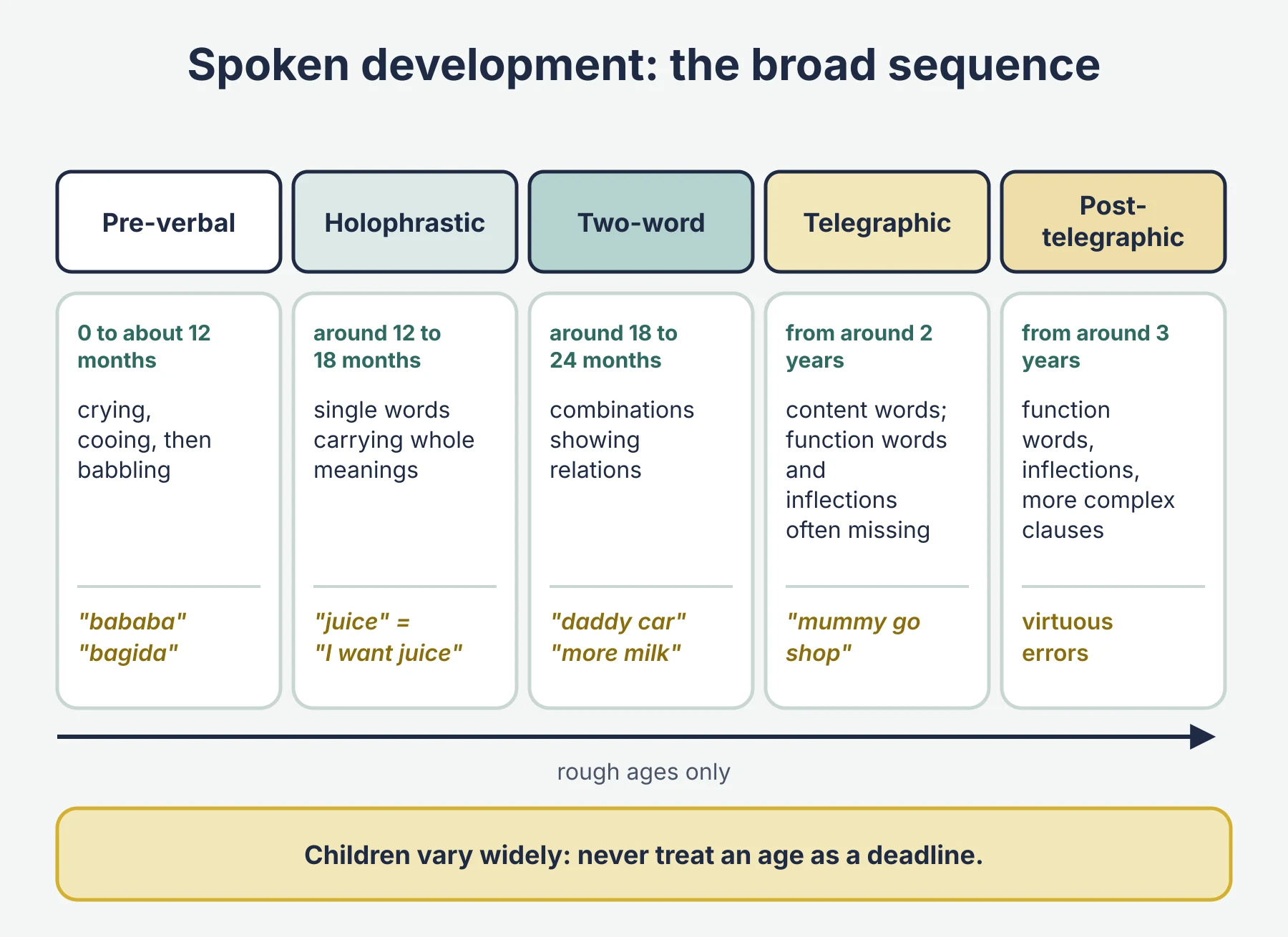
Spoken development: the broad sequence
Ages are approximate; children vary widely, and the essay should never treat an age as a deadline.
| Stage | Rough age | Typical features |
|---|---|---|
| Pre-verbal | 0 to about 12 months | Crying, cooing, then babbling: reduplicated (“bababa”) and variegated (“bagida”) |
| Holophrastic | Around 12 to 18 months | Single words carrying whole meanings (“juice” = “I want juice”) |
| Two-word | Around 18 to 24 months | Combinations showing relations (“daddy car”, “more milk”) |
| Telegraphic | From around 2 years | Content words with function words and inflections often missing (“mummy go shop”) |
| Post-telegraphic | From around 3 years | Function words, inflections and more complex clauses; virtuous errors |
Phonological development
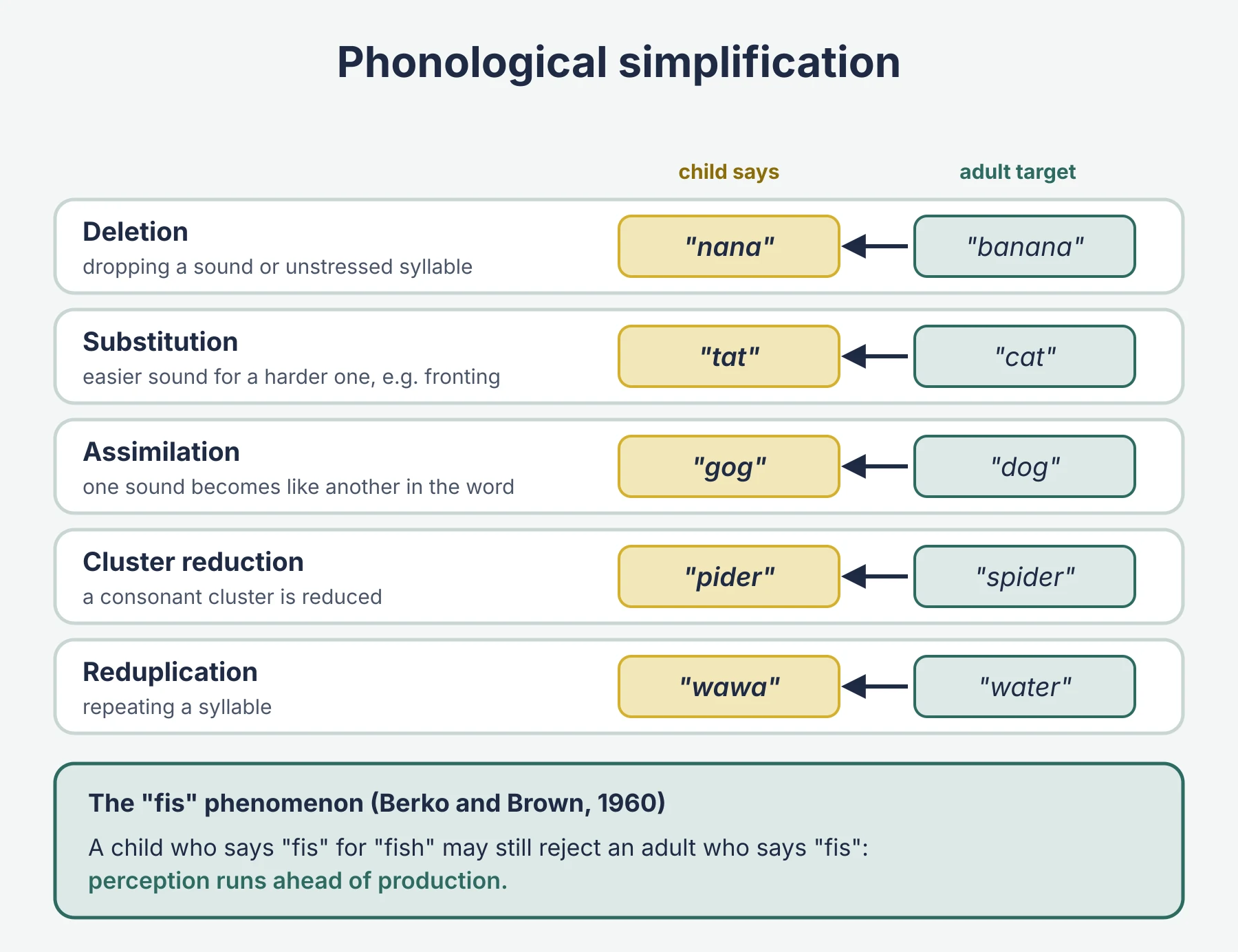
Children simplify adult targets in regular, patterned ways. Name the process precisely:
- Deletion: dropping a sound or unstressed syllable (“nana” for “banana”, “ca” for “cat”).
- Substitution: replacing a harder sound with an easier one, such as fronting (“tat” for “cat”).
- Assimilation: one sound becomes like another in the word (“gog” for “dog”).
- Consonant cluster reduction: “pider” for “spider”.
- Reduplication: repeating a syllable (“wawa” for “water”).
Berko and Brown’s “fis” phenomenon (1960) shows that perception runs ahead of production: a child who says “fis” for “fish” may still reject an adult who says “fis”.
Lexical and semantic development
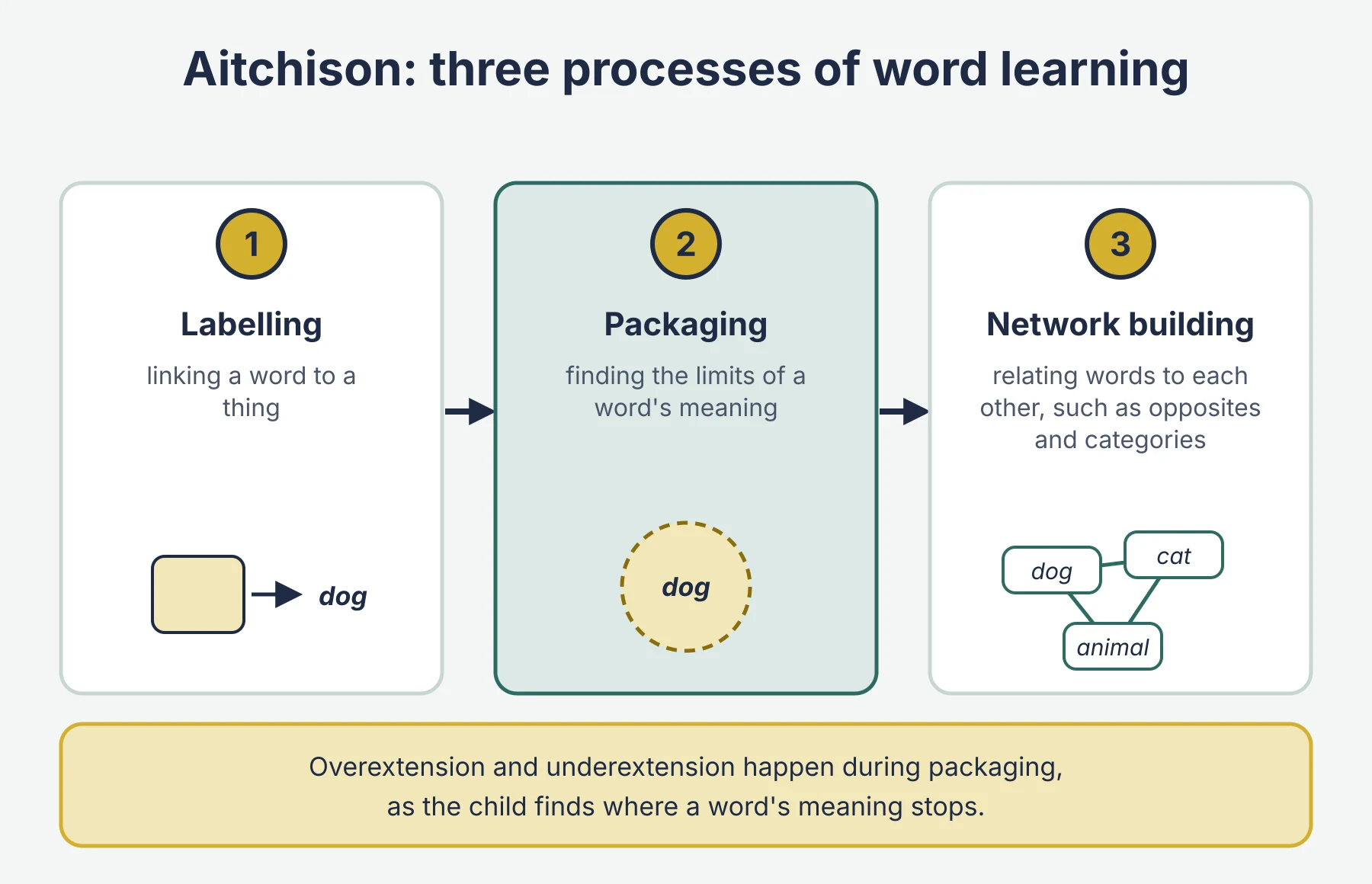
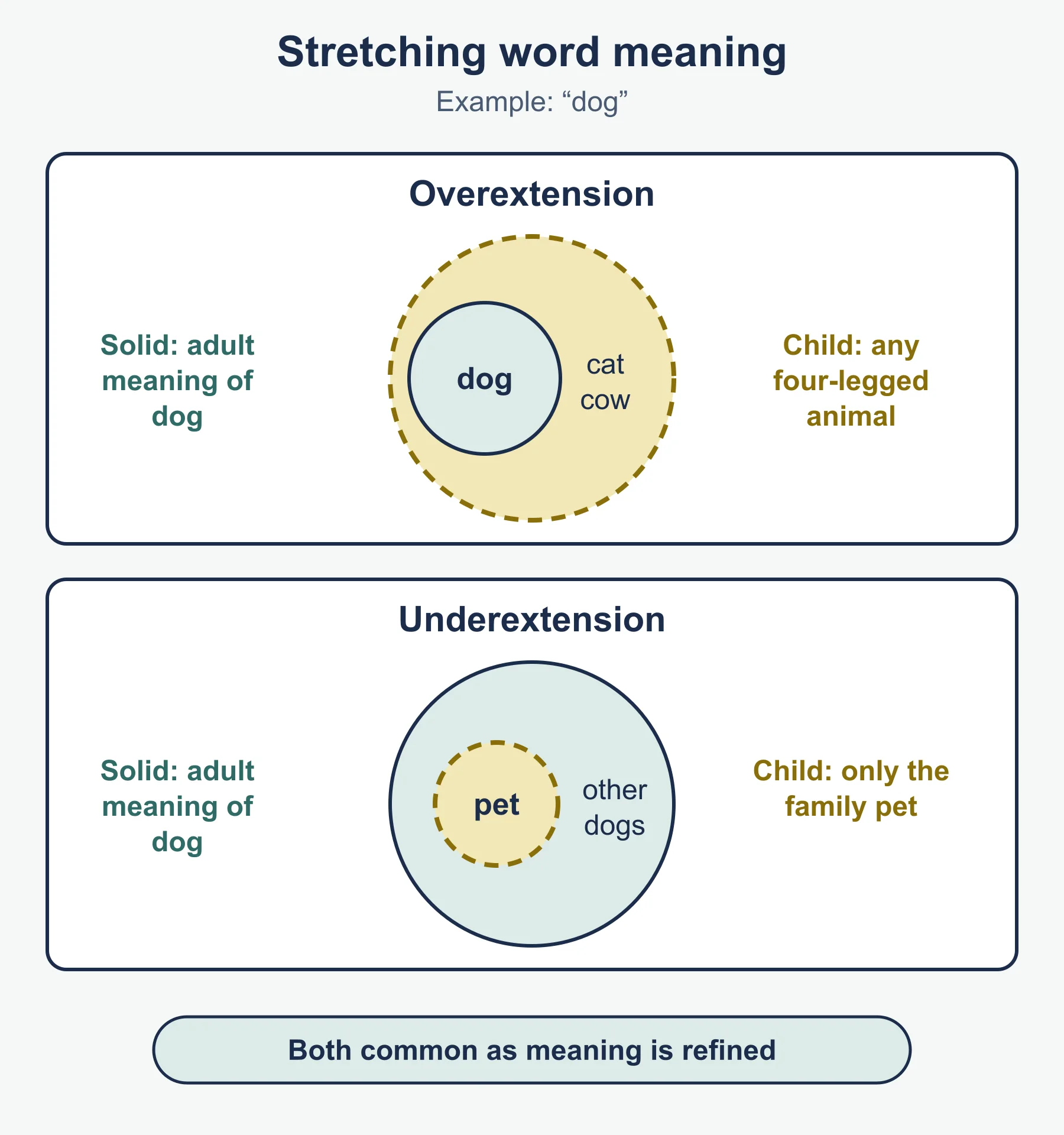
Early vocabulary is dominated by naming words, with action words, social words (“bye-bye”) and some modifiers. Vocabulary grows slowly at first and then rapidly (the vocabulary spurt, often around 18 months). Children refine meanings through overextension (“dog” for all four-legged animals) and underextension (“dog” only for the family pet). Leslie Rescorla’s research distinguished categorical, analogical and mismatch overextensions. Jean Aitchison describes three processes: labelling (linking a word to a thing), packaging (finding the limits of a word’s meaning) and network building (relating words to each other, such as opposites and categories).
Grammatical development
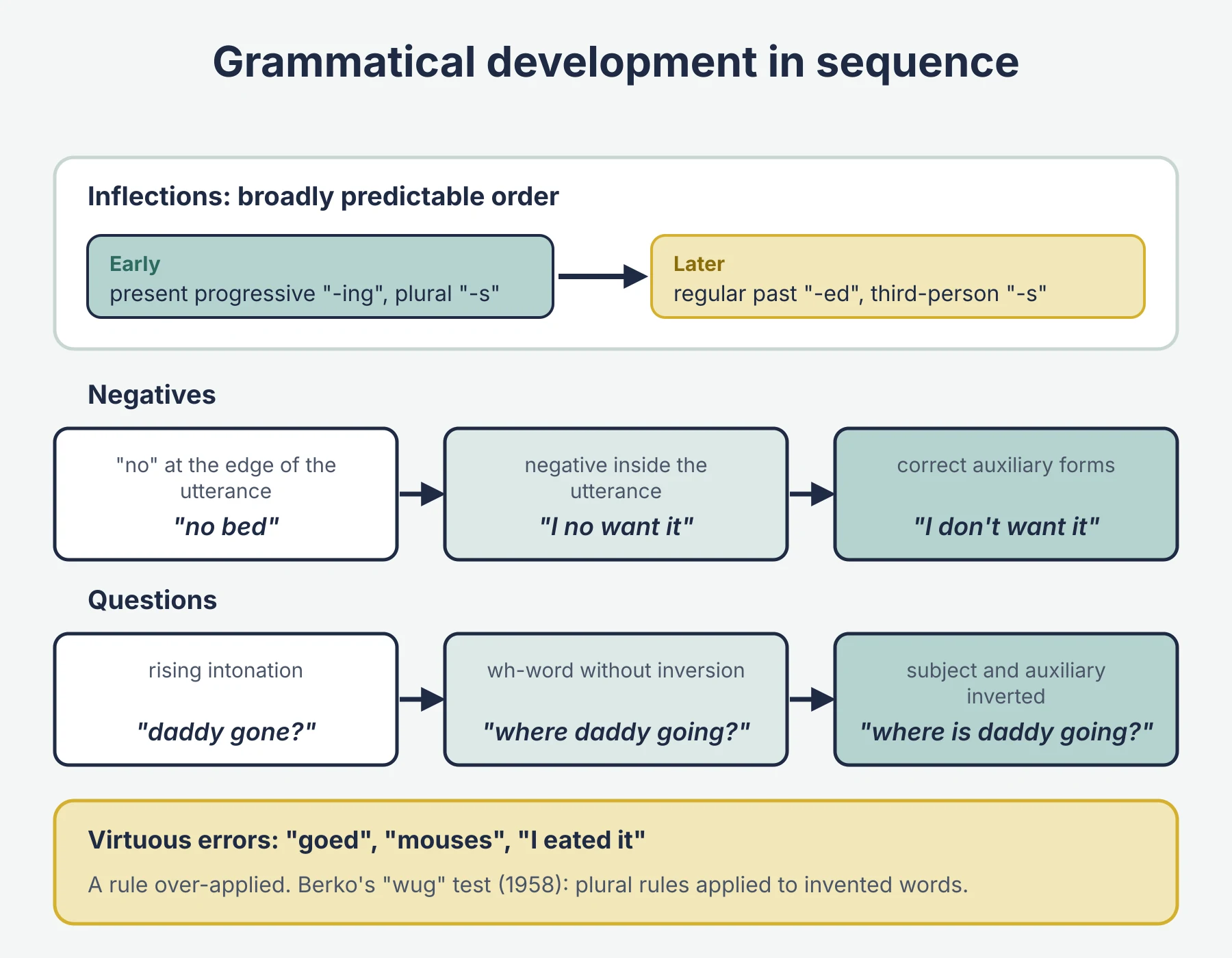
- Inflections appear in a broadly predictable order: present progressive “-ing” and plural “-s” early, regular past “-ed” and third-person “-s” later.
- Virtuous errors (“goed”, “mouses”, “I eated it”) show a rule being over-applied. Jean Berko’s “wug” test (1958) showed that children apply plural rules to invented words they have never heard.
- Negatives typically move from “no” placed at the edge of an utterance (“no bed”), to negatives inside it (“I no want it”), to correct auxiliary forms (“I don’t want it”).
- Questions typically move from rising intonation (“daddy gone?”), to wh-words without inversion (“where daddy going?”), to inversion of subject and auxiliary (“where is daddy going?”).
Pragmatic development and functions
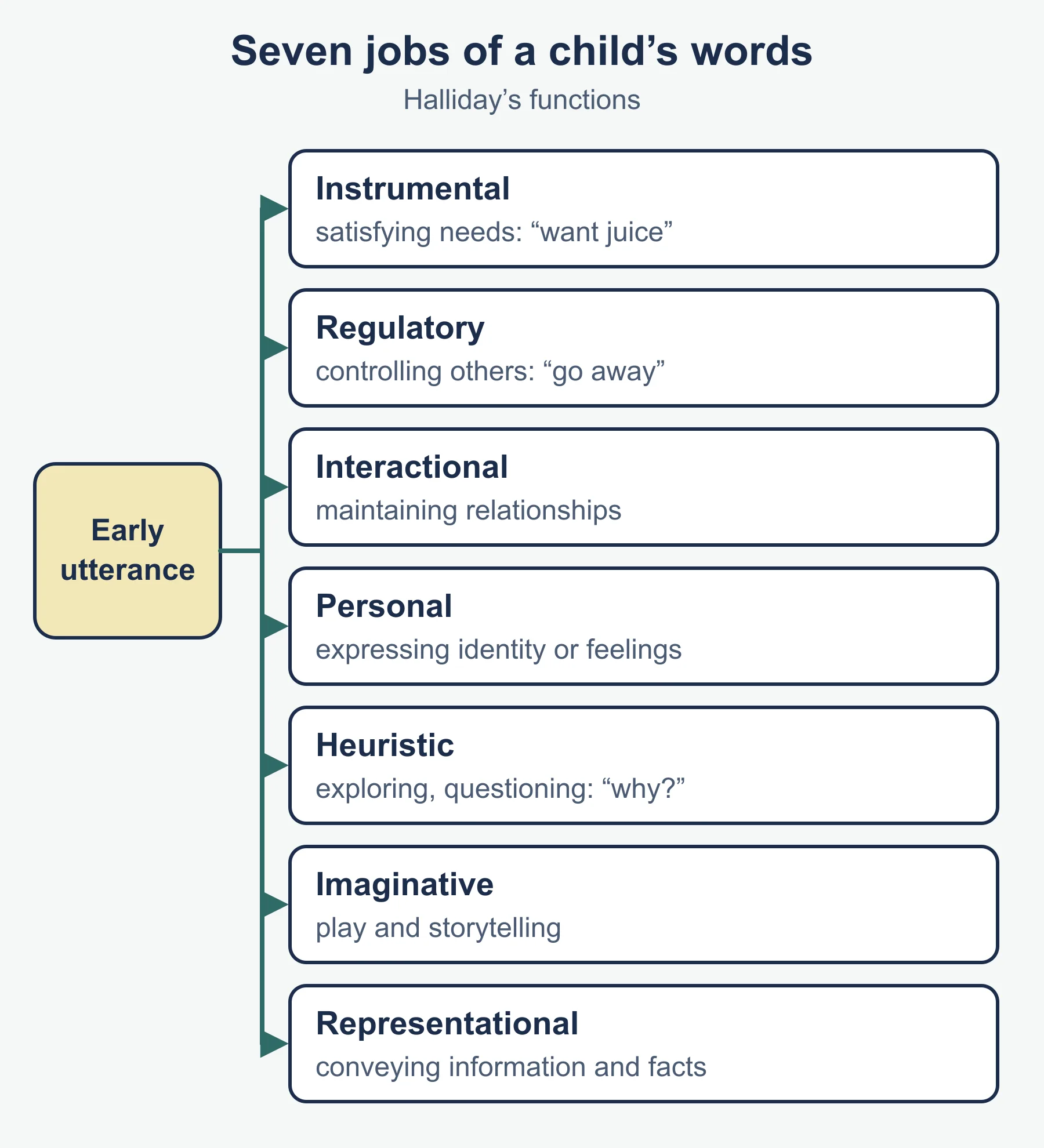
Pragmatic development is learning to use language appropriately in context: turn-taking, politeness routines (“say please”), repair when misunderstood, and awareness of what a listener knows. Michael Halliday’s functions (instrumental, regulatory, interactional, personal, heuristic, imaginative, representational) let you classify what an utterance does, and show functions widening as the child grows.
Writing development
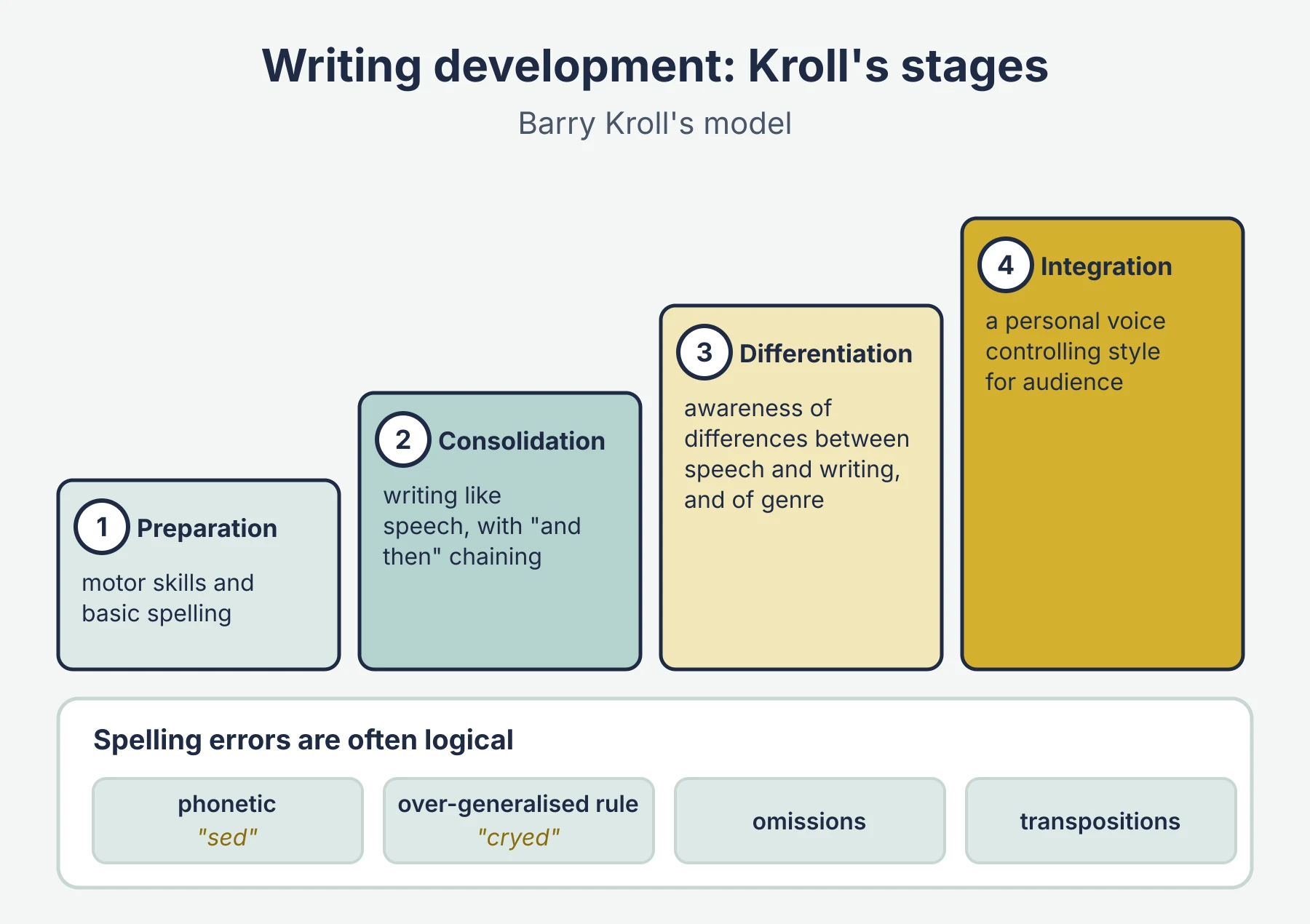
Children’s writing draws on speech but must master new systems: letter formation, spelling, punctuation and the conventions of written genres. Barry Kroll’s model describes stages of preparation (motor skills and basic spelling), consolidation (writing like speech, with “and then” chaining), differentiation (awareness of differences between speech and writing, and of genre) and integration (a personal voice controlling style for audience). Spelling errors are often logical: phonetic spellings (“sed”), over-generalised rules (“cryed”), omissions and transpositions. Genres matter: a story, a recount, a letter and a set of instructions each bring different structures, and school writing often shows taught features such as time connectives.
Theories and research: positions to evaluate
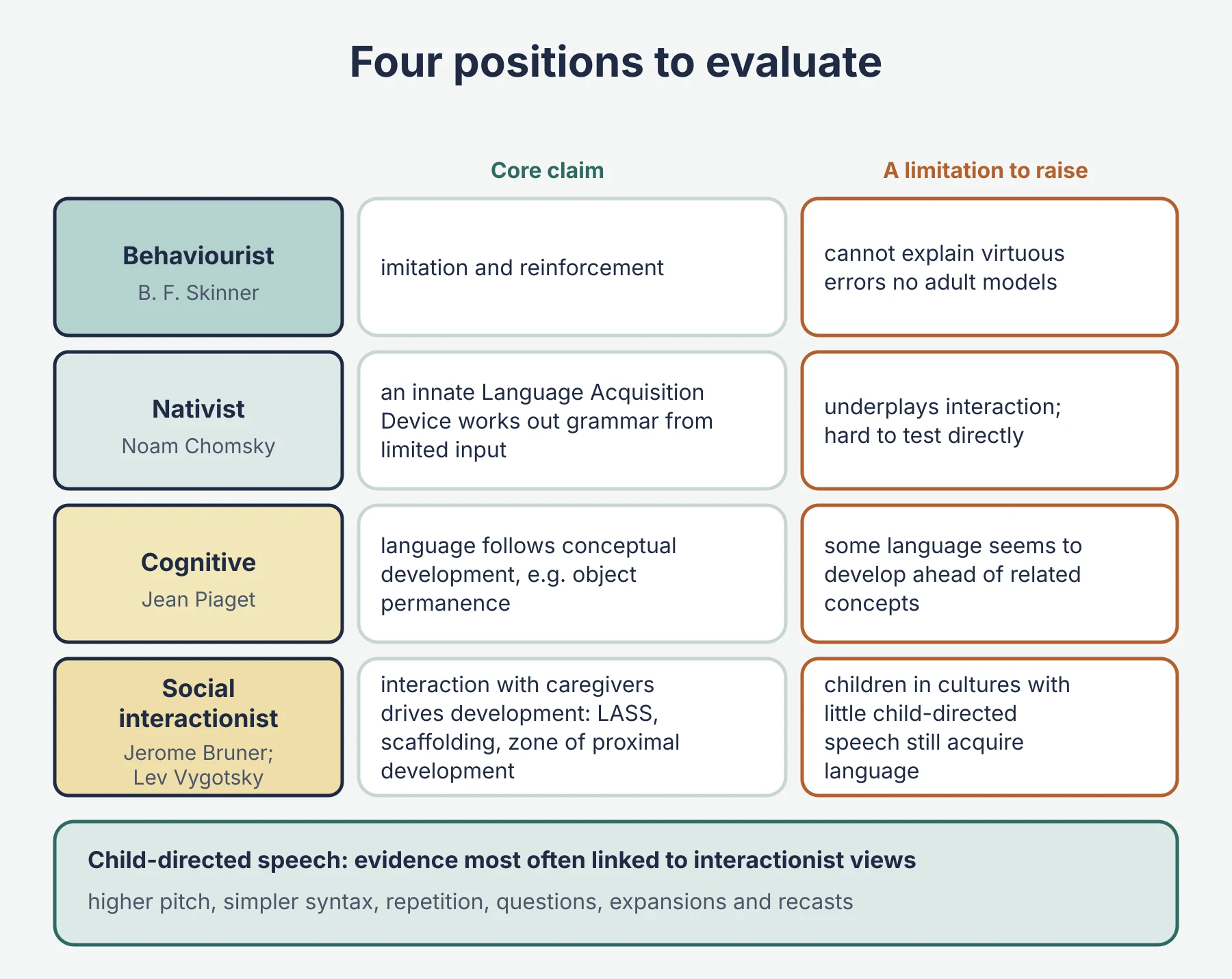
| Position | Key figure(s) | Core claim | A limitation to raise |
|---|---|---|---|
| Behaviourist | B. F. Skinner | Language is learned through imitation and reinforcement | Cannot explain virtuous errors no adult models |
| Nativist | Noam Chomsky | An innate Language Acquisition Device lets children work out grammar from limited input | Underplays the role of interaction; hard to test directly |
| Cognitive | Jean Piaget | Language follows conceptual development (for example object permanence) | Some language seems to develop ahead of related concepts |
| Social interactionist | Jerome Bruner; Lev Vygotsky | Interaction with caregivers drives development: Bruner’s Language Acquisition Support System and scaffolding; Vygotsky’s zone of proximal development | Children in cultures with little child-directed speech still acquire language |
Child-directed speech (higher pitch, simpler syntax, repetition, questions, expansions and recasts) is the evidence most often linked to interactionist views.
Worked example: data and an essay paragraph
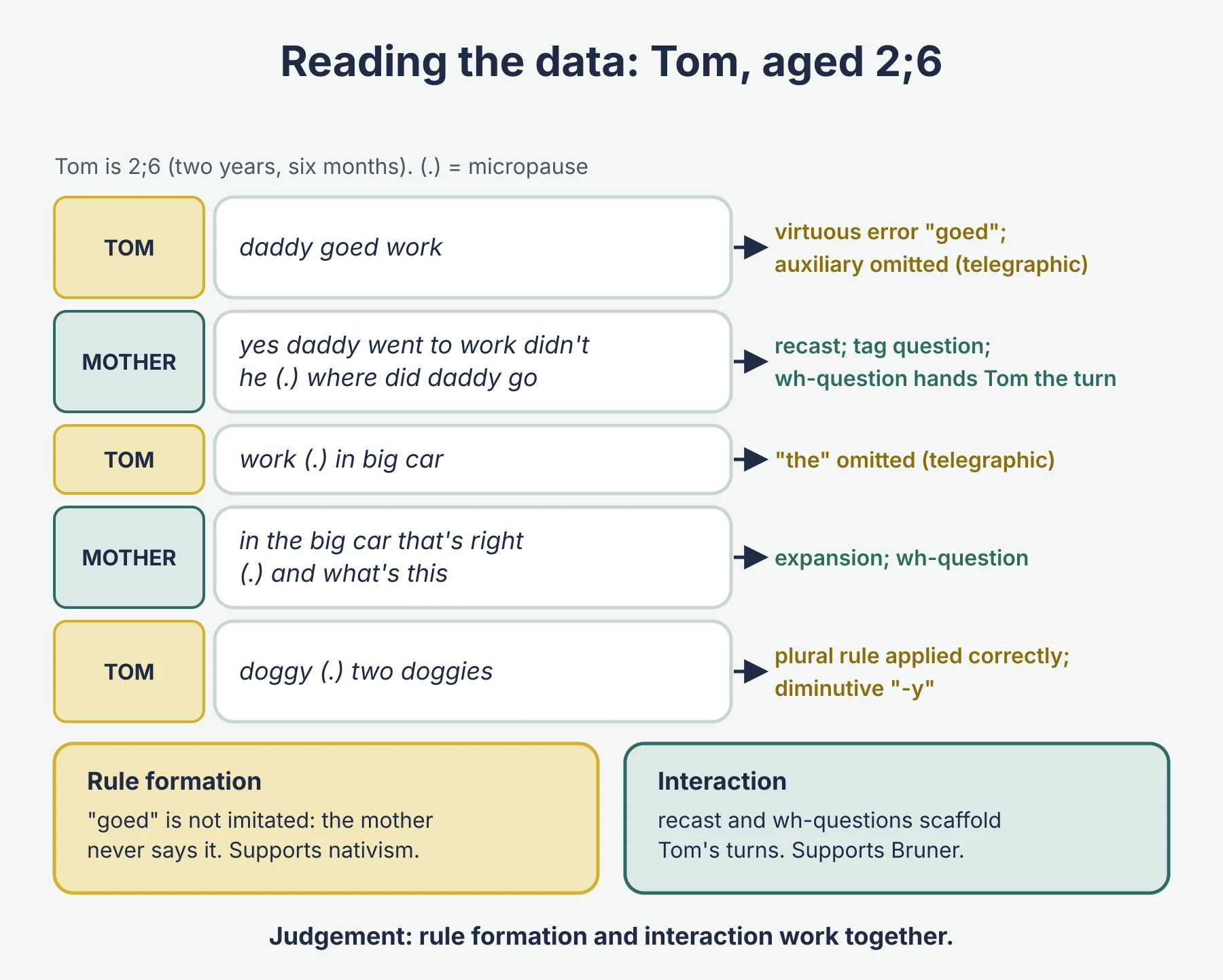
The transcript below is original, written for this page. Tom is 2;6 (two years, six months). Key: (.) micropause.
TOM: daddy goed work
MOTHER: yes daddy went to work didn’t he (.) where did daddy go
TOM: work (.) in big car
MOTHER: in the big car that’s right (.) and what’s this
TOM: doggy (.) two doggies
Annotations. “goed” is a virtuous error, over-applying the regular “-ed” rule; omission of the auxiliary in “daddy goed work” and of “the” in “in big car” are telegraphic features; “doggies” shows the plural rule correctly applied, alongside a diminutive “-y” suffix typical of child-directed speech. The mother uses a recast (“daddy went to work”) without explicit correction, a tag question and wh-questions that hand Tom the next turn, and an expansion (“in the big car”).
Model paragraph. Tom’s “daddy goed work” suggests that he has abstracted the regular past-tense rule rather than imitating his mother, who never says “goed”; this supports a nativist account better than a behaviourist one. Yet the mother’s recast “daddy went to work” models the irregular form without correction, and her wh-questions scaffold Tom into extending his turn (“in big car”), which supports Bruner’s view that interaction provides the support for development. The data therefore suggests that rule formation and interaction work together, rather than either explaining development alone.
The paragraph quotes data, names features precisely, links to two theories and reaches a qualified judgement.
Exam technique for the discursive essay
- Evaluate a view means weigh evidence for and against it and reach a reasoned conclusion.
- Use the data throughout, not only in an opening section; then go beyond it with your own knowledge.
- Treat theories as competing explanations, each with strengths and limits.
- Use precise terminology for features (AO1) and show critical understanding of concepts and issues (AO2).
- Check the mode of the data: spoken, written and multimodal data need different features.
Common mistakes
- Describing stages as fixed ages (“at 18 months children say two words”).
- Reciting theories without linking them to the data.
- Calling every error a virtuous error: “pider” is a phonological simplification, not a grammatical rule.
- Ignoring the adult’s language in the transcript.
- Analysing a child’s writing only for spelling and missing genre, structure and audience.
Where to go next
- Children’s language development revision notes
- Children’s language development practice questions
- Paper 1 methods of language analysis guide
Official syllabus
AQA AS and A-level English Language (7701/7702) specification, A-level subject content 3.1.3 Children’s language development, assessed in Paper 1 Section B.
Section numbers. This site follows the A-level (7702) subject content on aqa.org.uk, where Paper 1 content is 3.1. The combined AS and A-level specification PDF numbers the same A-level sections 4.1, 4.2 and 4.3.
Related resources
-
Practice questions
AQA A-Level English Language (7702): Children's Language Development – Practice Questions
Original data-based practice on children's speech and writing, theories and evaluation, with full answers, for AQA A-level English Language 7702 Paper 1.
English · AQA · A Level
Try questions -
Revision notes
AQA A-Level English Language (7702): Children's Language Development – Revision Notes
Condensed recall on children's spoken and written development, theories and data analysis for AQA A-level English Language 7702 Paper 1 Section B.
English · AQA · A Level
Revise topic -
Study guides
AQA A-Level English Language: Language, the Individual and Society (7702)
Textual variations and representations, and children's language development – the full content of Paper 1 for AQA A-Level English Language (7702).
English · AQA · A Level
Read guide
Get free revision emails (optional)
Occasional emails with practice questions, worked explanations and links to free resources for the qualification and subjects you choose. No spam, and you can unsubscribe from any email. The free tools on this site never need an email.