
Revision Notes
AQA A-Level English Language (7702): Methods of Language Analysis (Paper 1) – Revision Notes
Condensed terminology for the six language levels in AQA A-level English Language 7702 Paper 1, with exam traps and a self-test on precise feature description.
- Subject
- English
- Level
- A LEVELS
- Topic
- Paper 1 – Language, the Individual and Society
- Author
- Marlbridge Academic Team
- Updated
- Reviewed by
- Ammar Bilal (what this means)
Aligned to AQA A Level English (7702), For first teaching 2015. Official specification .
Syllabus page (what it covers and how it is assessed): AQA A Level English Language.
Found an error? Report a correction.
Need help with this topic? Request a free trial class for A Level English Language (7702).
Condensed recall for 3.1.2 Methods of language analysis, the toolkit integrated into Paper 1 of AQA A-level English Language (7702). The full explanation and worked examples are in the Paper 1 methods of language analysis study guide.
The core demand
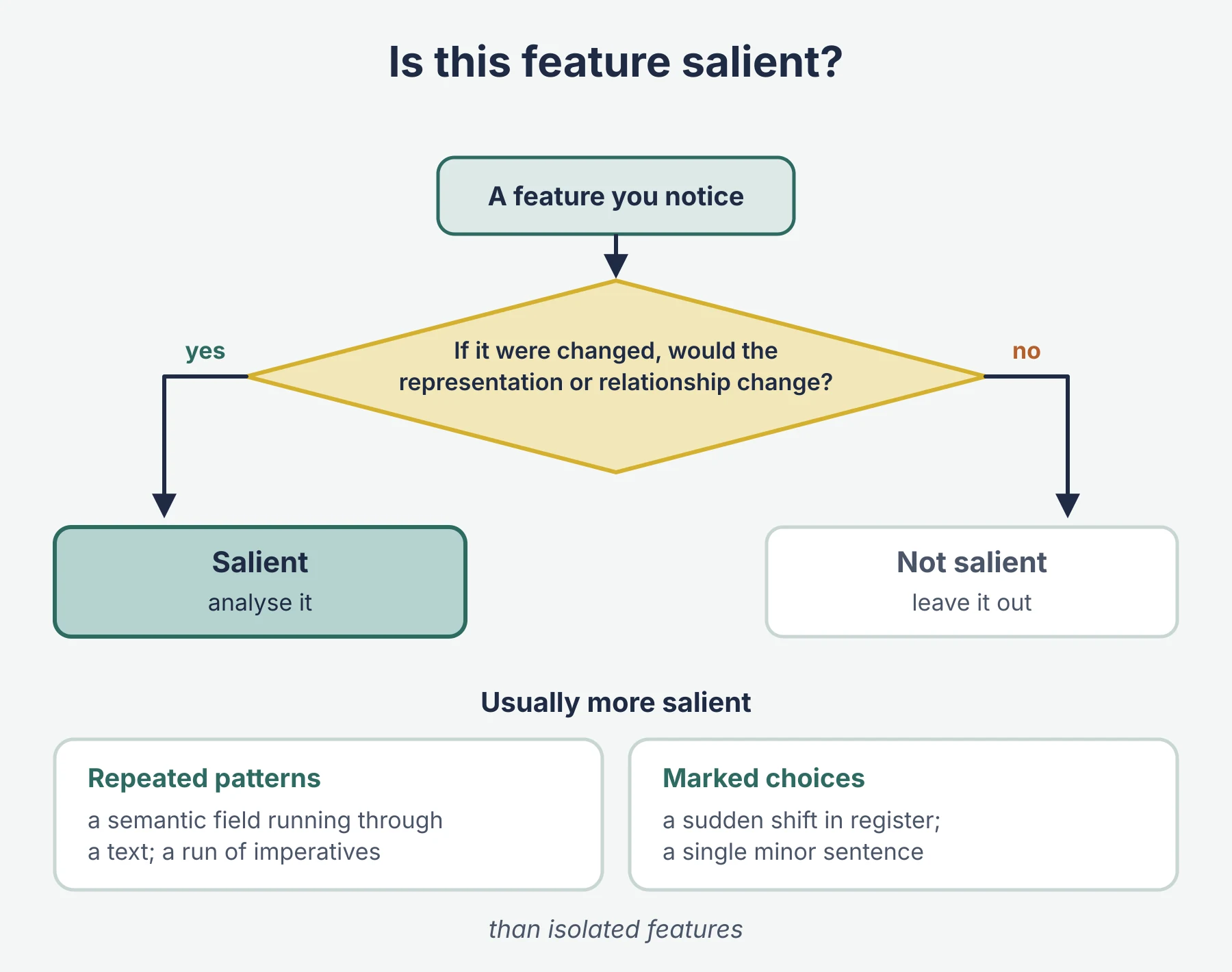
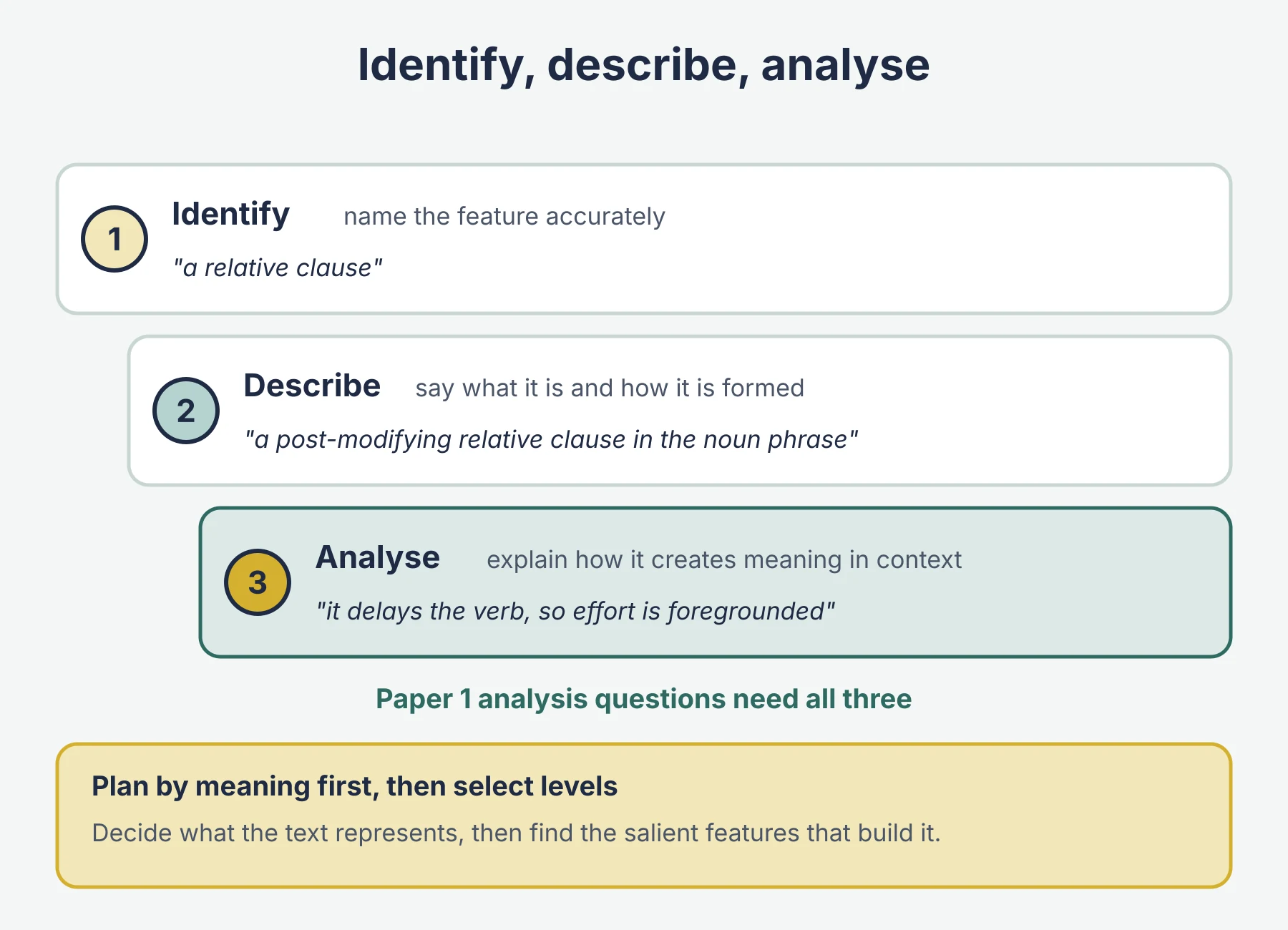
Identify and describe the salient features of language in the texts, so that you can explain how they create meanings and representations. Salient means prominent and significant: patterns and marked choices, not every feature you can find.
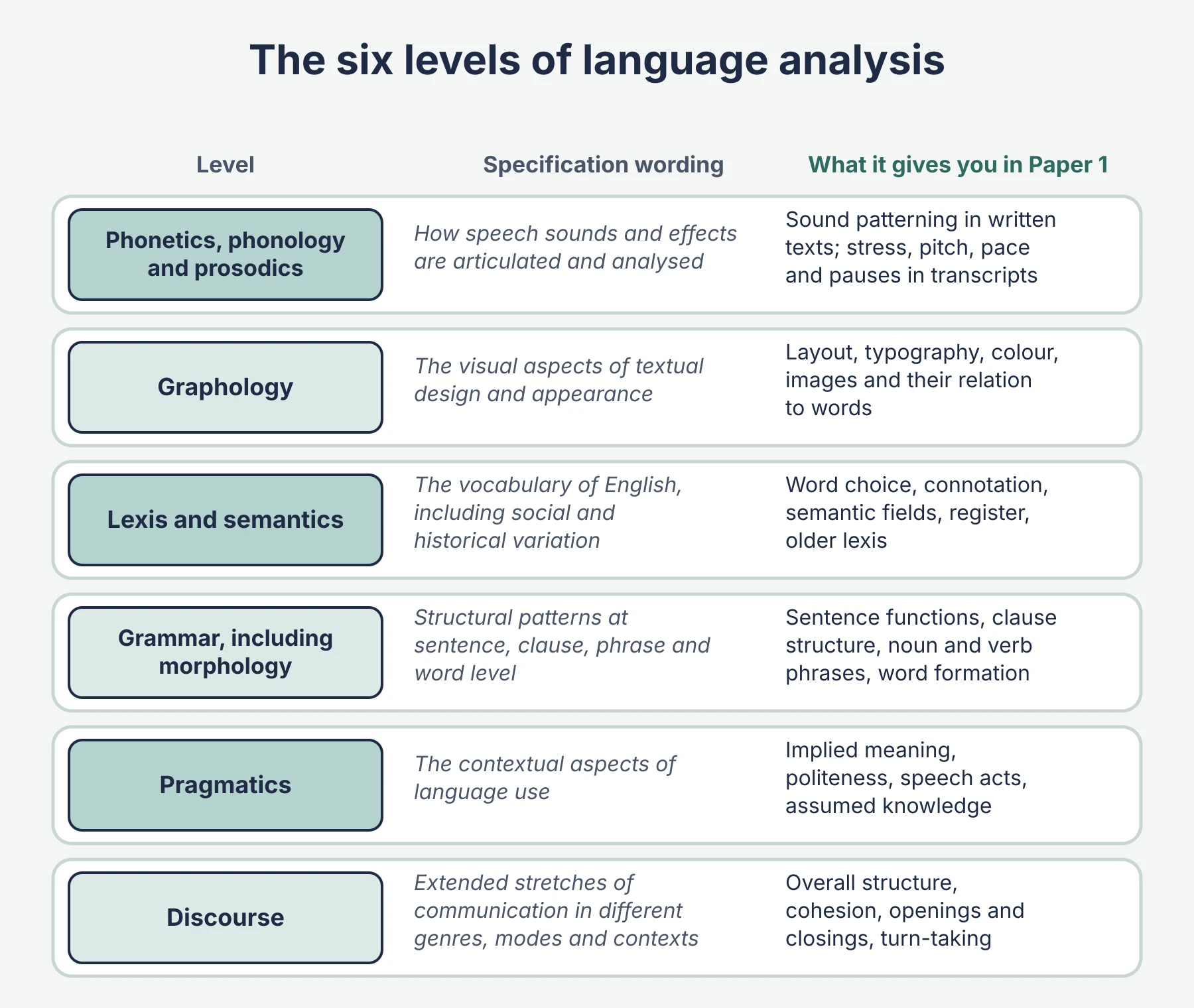
Phonetics, phonology and prosodics
| Term | Meaning |
|---|---|
| Alliteration / sibilance | Repeated initial consonant sounds / repeated “s” and “sh” sounds |
| Assonance | Repeated vowel sounds |
| Stress | Emphasis on a syllable or word, often marked in a transcript |
| Intonation | Rise and fall of pitch, signalling questions, certainty or attitude |
| Elision | Omission of a sound in connected speech (“gonna”, “fish ‘n’ chips”) |
| Micropause / pause | A very brief pause / a timed pause, shown in the transcript key |
Graphology
| Term | Meaning |
|---|---|
| Typography | Choice of typeface, size, weight and style |
| Layout | Arrangement of text blocks, headings, columns and white space |
| Anchorage | Words fixing the meaning of an image (for example a caption) |
| Salience (visual) | The element that draws the eye first through size, colour or position |
Lexis and semantics
| Term | Meaning |
|---|---|
| Semantic field | A group of words from the same area of meaning |
| Connotation | Associations a word carries beyond its literal meaning |
| Collocation | Words that habitually occur together |
| Euphemism / dysphemism | Softened expression / deliberately harsh expression |
| Register | Variety of language suited to a situation (field, tenor, mode) |
| Jargon | Specialist lexis of an occupation or interest group |
Grammar, including morphology
| Term | Meaning |
|---|---|
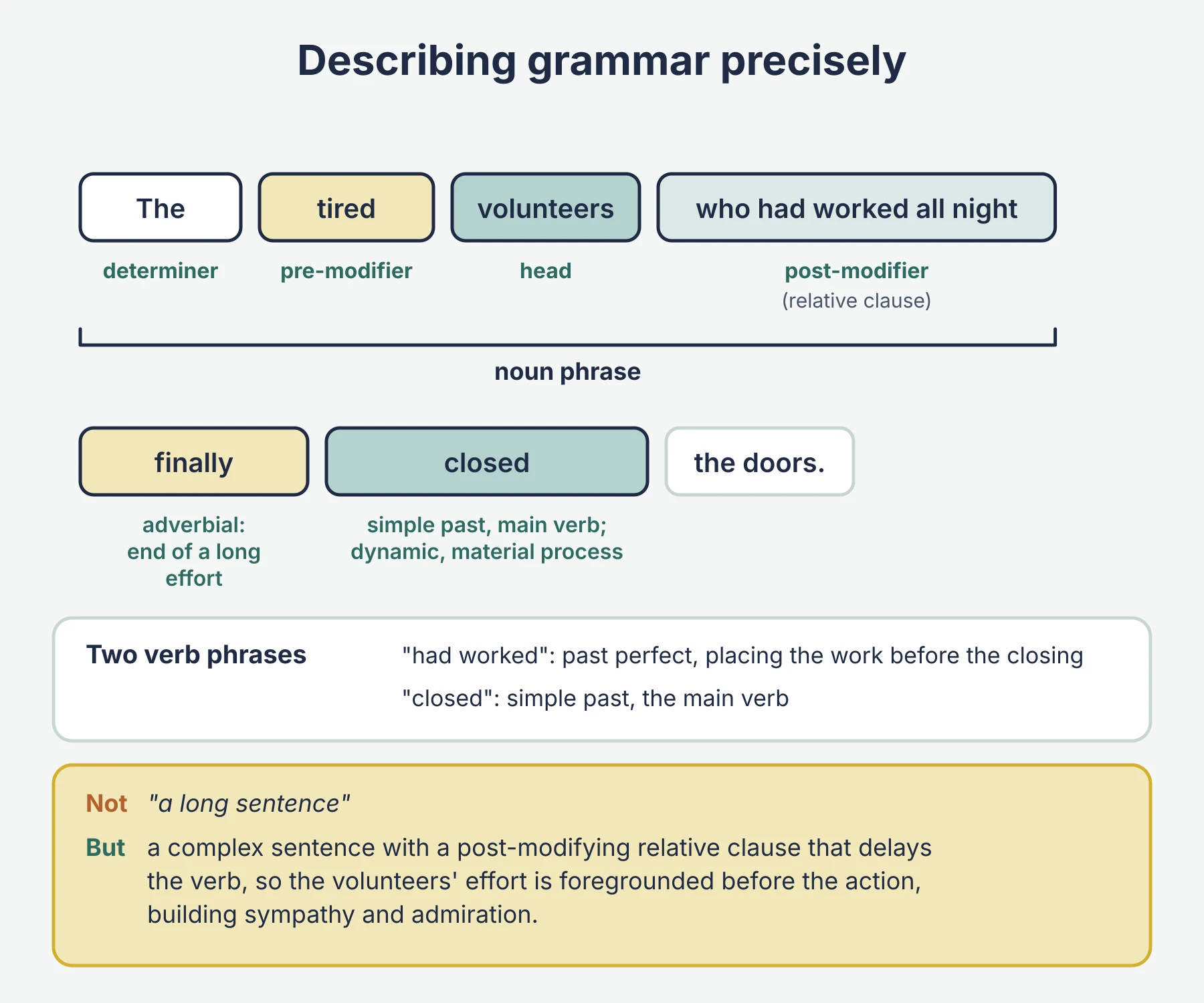
| Noun phrase | Head noun with determiners and modifiers (“the old red bus”) |
| Pre- / post-modification | Words before the head / phrases or clauses after it (“bus with no driver”) |
| Modal verb | Auxiliary expressing possibility, obligation or ability (may, must, could) |
| Aspect | Progressive (“is running”) or perfect (“has run”) forms of the verb |
| Active / passive voice | Subject performs the action / subject is affected by it |
| Main / subordinate clause | Clause that can stand alone / clause dependent on another |
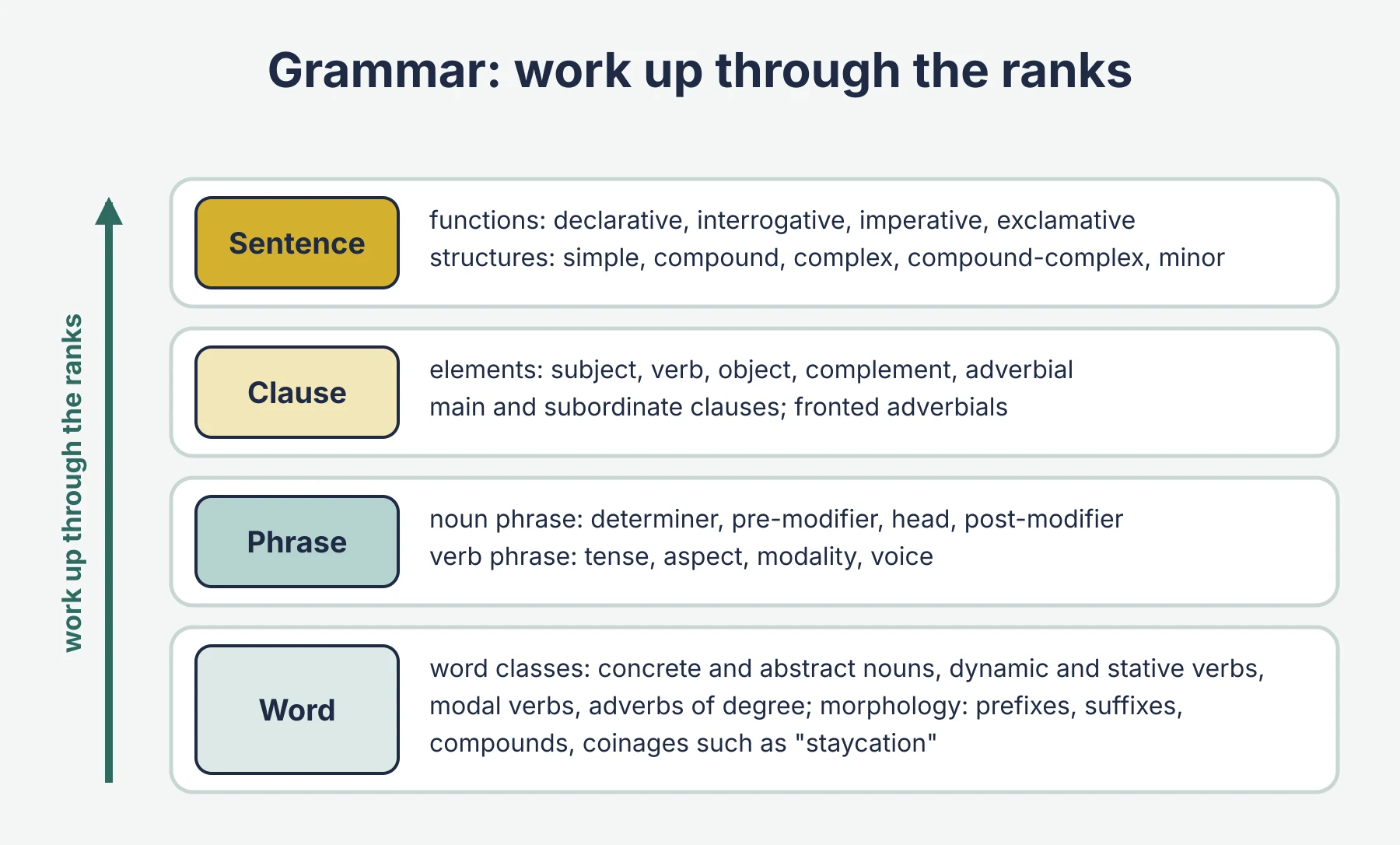
| Sentence functions | Declarative, interrogative, imperative, exclamative |
| Sentence structures | Simple, compound, complex, compound-complex, minor |
| Morpheme | Smallest unit of meaning; free (book) or bound (-s, un-) |
Pragmatics
| Term | Meaning |
|---|---|
| Implicature | Meaning implied rather than stated |
| Grice’s maxims | Quantity, quality, relation, manner: flouting one creates implicature |
| Speech act | The action an utterance performs (request, promise, warning) |
| Face | Public self-image; positive face (approval) and negative face (freedom) |
| Deixis | Words whose reference depends on context (here, then, you, this) |
| Presupposition | An assumption taken for granted by an utterance |
Discourse
| Term | Meaning |
|---|---|
| Cohesion | How a text holds together through reference, repetition, ellipsis and conjunctions |
| Anaphoric / cataphoric reference | Pointing back / pointing forward |
| Adjacency pair | Two linked turns, such as question and answer or greeting and greeting |
| Discourse marker | Words organising talk or text (so, anyway, right, firstly) |
| Repair | Correcting a problem in talk, by oneself or another speaker |
Precise descriptions to memorise
- Not “short sentence” but “minor sentence”, “simple declarative” or “imperative”.
- Not “describing words” but “pre-modifying adjectives in the noun phrase”.
- Not “the word ‘we’” but “first-person plural pronoun, used inclusively / exclusively”.
- Not “a question” but “interrogative” (and only “rhetorical” if no answer is expected).
- Not “makes it sound informal” but “colloquial lexis and contractions create an informal tenor”.
Exam traps
- Treating length as structure: a long sentence can be simple; a short one can be complex.
- Assuming every “we” is inclusive: in “We at Brightway Bank” it excludes the reader.
- Naming a level with no evidence, such as “the phonology is interesting”.
- Ignoring prosody in transcripts, where stress and intonation carry attitude.
- Ignoring how an older text’s grammar or lexis reflects its period.
- Spending the answer on one level; aim for range with depth.
Self-test
- What does “salient” mean in the specification’s wording?
- Name the six language levels.
- Identify the head and the post-modifier in “a house with green shutters”.
- What is the difference between tense and aspect?
- Give the sentence function of “Mind the gap”.
- Is “When the bell rang, everyone left.” simple, compound or complex? Why?
- What is a free morpheme? Give an example.
- Name Grice’s four maxims.
- What is deixis? Give two examples.
- What is anaphoric reference?
- What is anchorage in graphology?
- “Could you possibly close the window?” Which aspect of face does the speaker protect, and how?
Answers
- Prominent and significant: the features that do most to create the text’s meanings.
- Phonetics, phonology and prosodics; graphology; lexis and semantics; grammar, including morphology; pragmatics; discourse.
- Head: “house”; post-modifier: the prepositional phrase “with green shutters”.
- Tense locates time (present or past); aspect shows whether an action is ongoing (progressive) or completed relative to a point (perfect).
- Imperative.
- Complex: it has a subordinate clause (“When the bell rang”) and a main clause (“everyone left”).
- A morpheme that can stand alone as a word, for example “chair”.
- Quantity, quality, relation, manner.
- Words whose meaning depends on the context of utterance, for example “here”, “tomorrow”, “you”.
- A word, usually a pronoun, referring back to something already mentioned.
- The use of words, such as a caption, to fix the intended meaning of an image.
- The hearer’s negative face (freedom from imposition), by using an interrogative, the modal “could” and the hedge “possibly” to make the request indirect.
More resources on this topic
Related resources
-
Study guides
AQA A-Level English Language (7702): Textual Variations and Representations
How texts vary with audience, purpose, genre, mode and context, and how language builds representations: 3.1.1 for AQA A-level English Language Paper 1.
English · AQA · A Level
Read guide -
Practice questions
AQA A-Level English Language (7702): Textual Variations and Representations – Practice Questions
Original practice on representation, positioning, relationships and comparing a contemporary and an older text, for AQA A-level English Language 7702 Paper 1.
English · AQA · A Level
Try questions -
Revision notes
AQA A-Level English Language (7702): Textual Variations and Representations – Revision Notes
Condensed notes on 3.1.1 Textual variations and representations for AQA A-level English Language 7702: context, representation, positioning, comparison.
English · AQA · A Level
Revise topic
Get free revision emails (optional)
Occasional emails with practice questions, worked explanations and links to free resources for the qualification and subjects you choose. No spam, and you can unsubscribe from any email. The free tools on this site never need an email.