
Revision Notes
AQA A-Level English Language (7702): Textual Variations and Representations – Revision Notes
Condensed notes on 3.1.1 Textual variations and representations for AQA A-level English Language 7702: context, representation, positioning, comparison.
- Subject
- English
- Level
- A LEVELS
- Topic
- Paper 1 – Language, the Individual and Society
- Author
- Marlbridge Academic Team
- Updated
- Reviewed by
- Ammar Bilal (what this means)
Aligned to AQA A Level English (7702), For first teaching 2015. Official specification .
Syllabus page (what it covers and how it is assessed): AQA A Level English Language.
Found an error? Report a correction.
Need help with this topic? Request a free trial class for A Level English Language (7702).
Condensed recall for 3.1.1 Textual variations and representations, assessed in Paper 1 Section A of AQA A-level English Language (7702). For full explanation and annotated examples, use the textual variations and representations study guide.
The section in one paragraph
You get two unseen texts linked by topic or theme, one contemporary and one older. You analyse how each uses language to create meanings and representations (25 marks each), then compare them (20 marks). Every point should connect a precise language feature to what it represents and to the context that explains it.
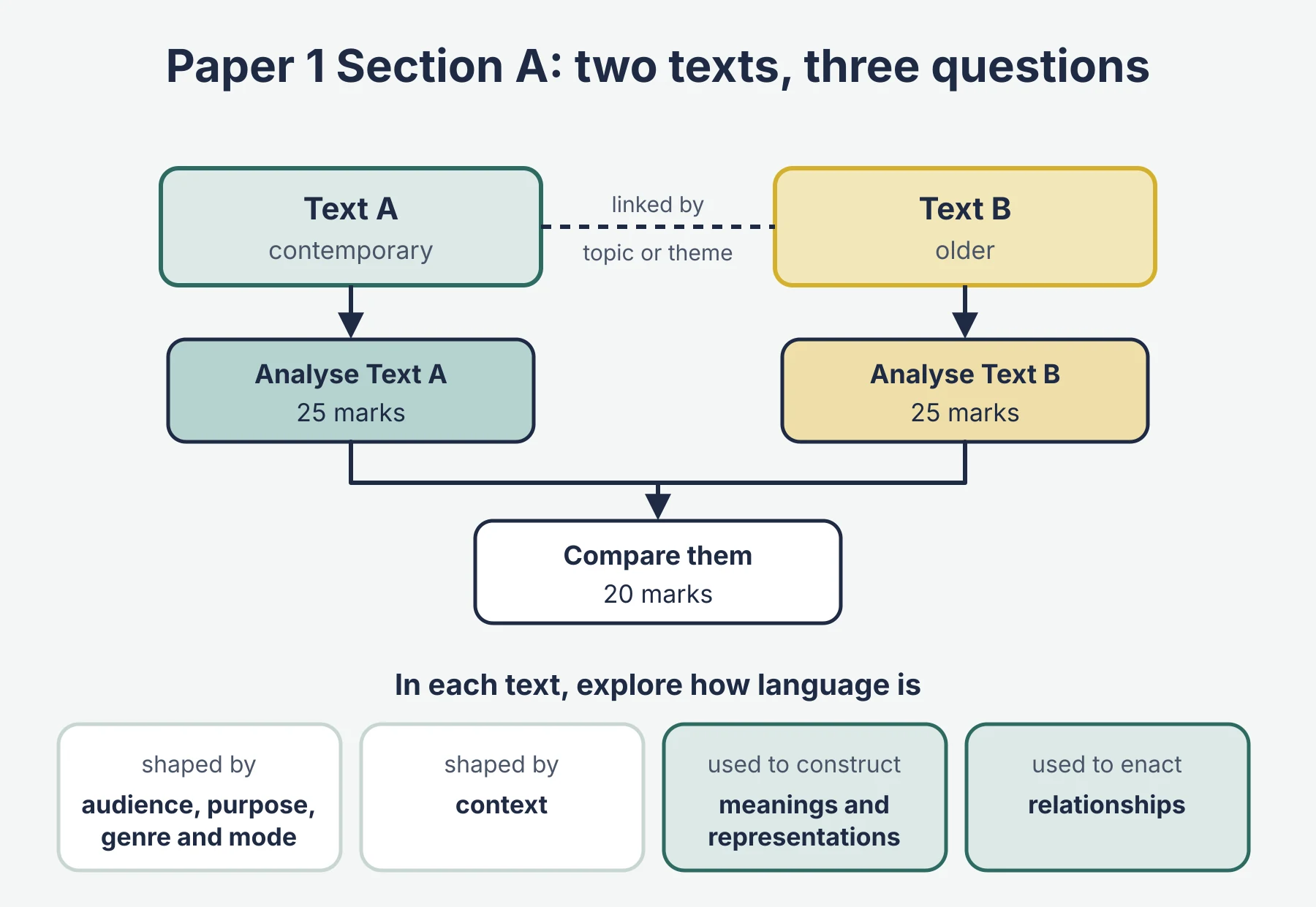
What the specification says you explore
| You explore how language is… | In practice, ask… |
|---|---|
| Shaped by audience, purpose, genre and mode | Who is it for, what is it for, what form is it, how planned or spontaneous? |
| Shaped by context | When and where was it produced, and what was expected then? |
| Used to construct meanings and representations | What picture of people, places or ideas is built? |
| Used to enact relationships | How does the producer relate to the audience, or participants to each other? |
The exploration also covers identity construction, addressing and positioning audiences, text functions, structure and organisation and how representations are produced.
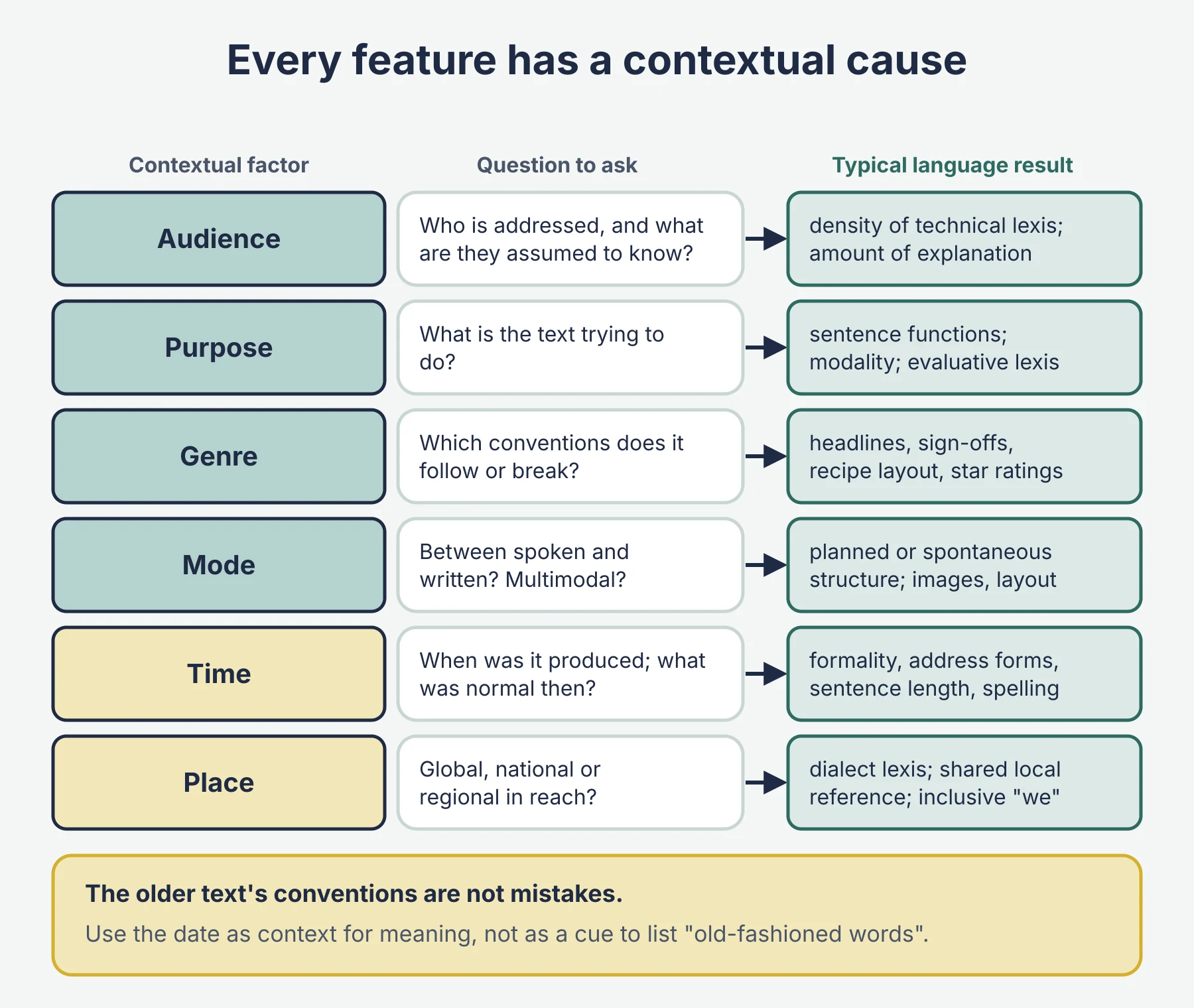
Key terms
| Term | Meaning |
|---|---|
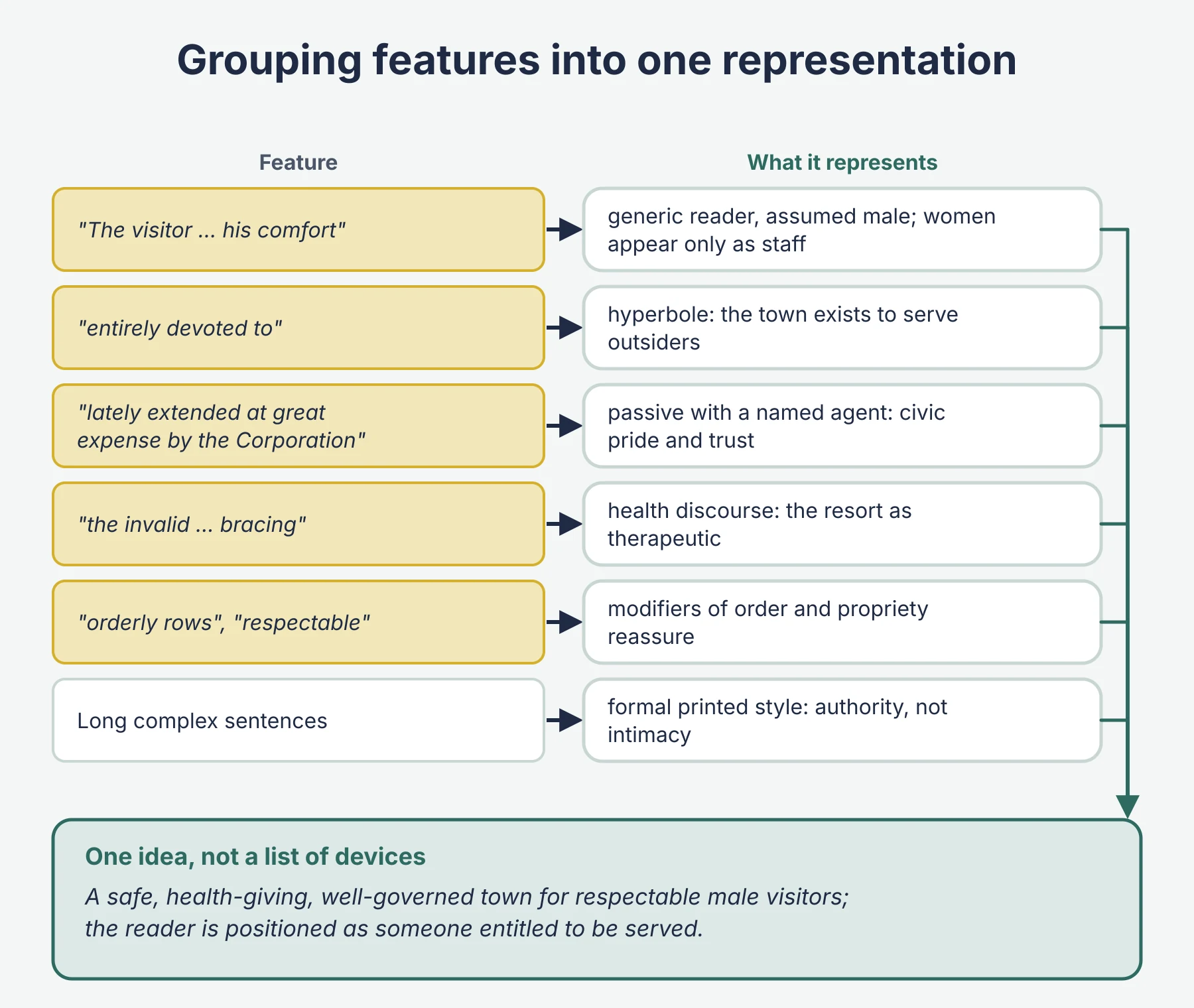
| Representation | The constructed version of a person, group, place, event or idea in a text |
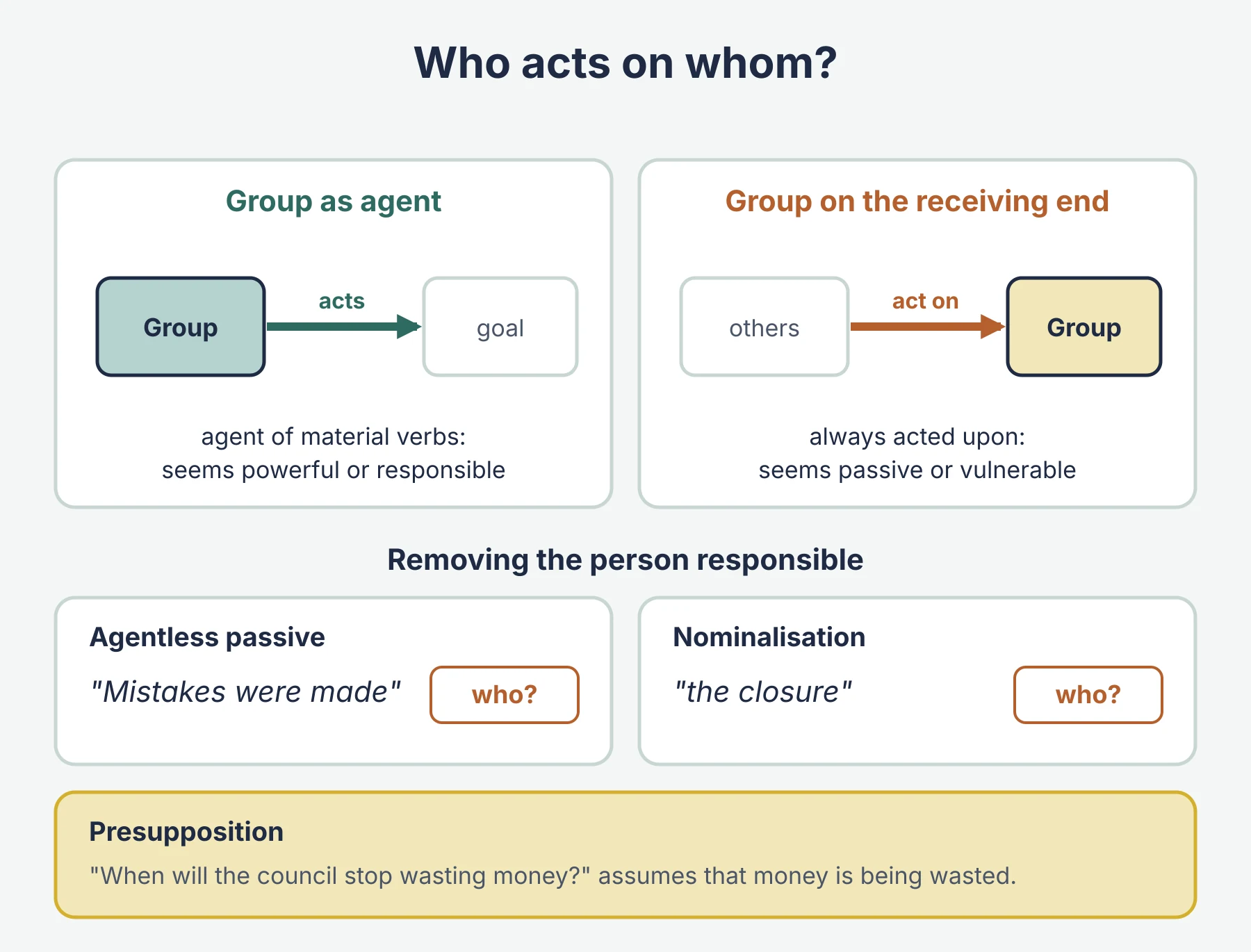
| Transitivity | Who does what to whom: agents, processes and affected participants in a clause |
| Agentless passive | A passive clause with no “by” phrase, hiding who acted (“The library was closed”) |
| Nominalisation | Turning a process into a noun (“the closure”), often removing the actor |
| Modification | Words attached to a head noun that describe or evaluate it |
| Presupposition | An assumption built into a sentence that the reader must accept to process it |
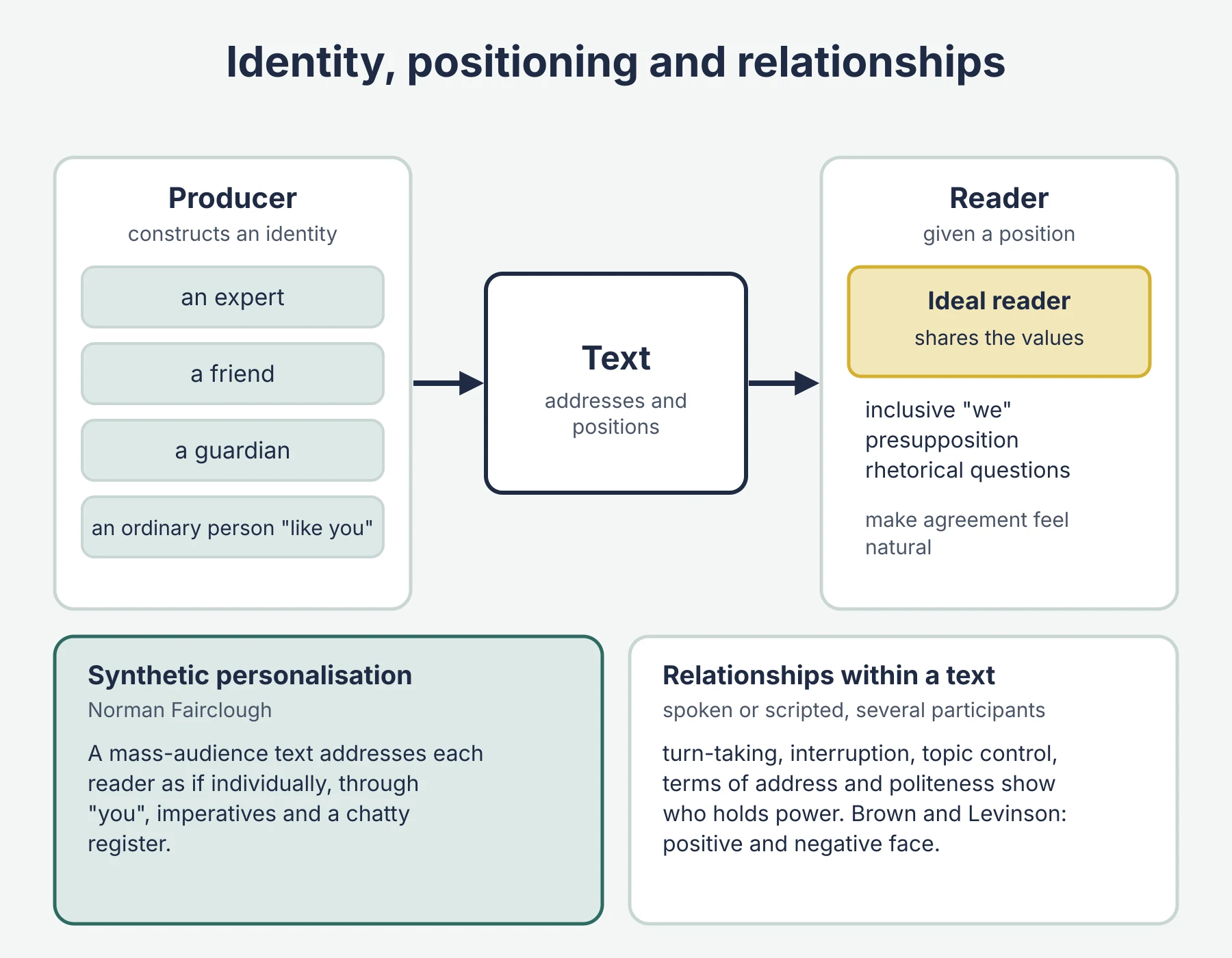
| Synthetic personalisation | Fairclough’s term for addressing a mass audience as if individually |
| Ideal reader | The reader a text assumes, sharing its values and knowledge |
| Positioning | The role and viewpoint a text creates for its reader |
| Face | In Brown and Levinson’s theory, a person’s public self-image (positive: to be liked; negative: to be free from imposition) |
| Multimodal | Combining language with images, layout, sound or other modes |
| Register | Language variety suited to a situation, varying in formality and field |
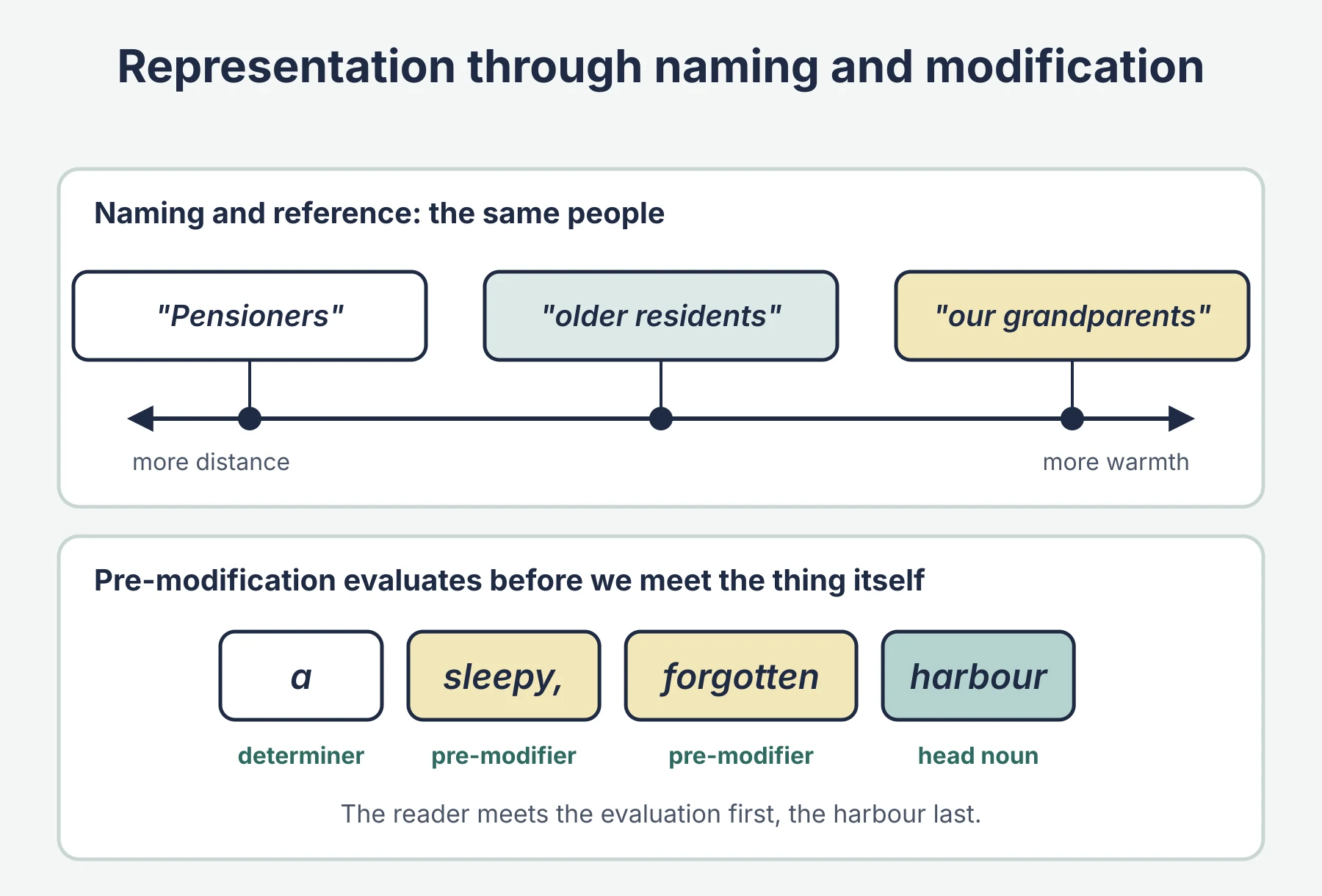
Representation toolkit (quick recall)
- Naming: which label is chosen, and how distant or warm is it?
- Modification: which evaluations are attached before and after the noun?
- Transitivity: is the group an agent or always acted upon?
- Hiding agency: agentless passives, nominalisation.
- Presupposition: what is taken for granted?
- Semantic field and metaphor: what frame does the lexis set up?
- Selection and voice: who is quoted, and who is missing?
- Graphology: which images, fonts and positions reinforce the picture?
Relationships checklist
- Producer to audience: pronouns (I, we, you), imperatives, questions, register, humour, deference.
- Between participants (transcripts, scripts, interviews): turn length, interruptions, topic control, address terms, hedges and politeness strategies.
- Power: who sets the agenda, who is allowed to evaluate, who must justify themselves?
The older text
- Use its date to explain conventions: formality, address forms, sentence length, spelling or capitalisation.
- Do not call its features “wrong” or “quaint”; link them to the readers and expectations of the time.
- Ask how social attitudes of its period shape what it represents (roles of men and women, class, health, empire, childhood).
- Change itself as a topic is Paper 2; here the date is context for meaning.
Comparison method (the 20-mark question)
1. Find 3-4 shared points: representation of the topic, producer identity,
   reader positioning, genre and mode, structure.
2. For each point: Text A evidence + feature, Text B evidence + feature.
3. Explain the difference or similarity through context (time, audience,
   purpose, technology, attitudes).
4. Keep the texts together in every paragraph.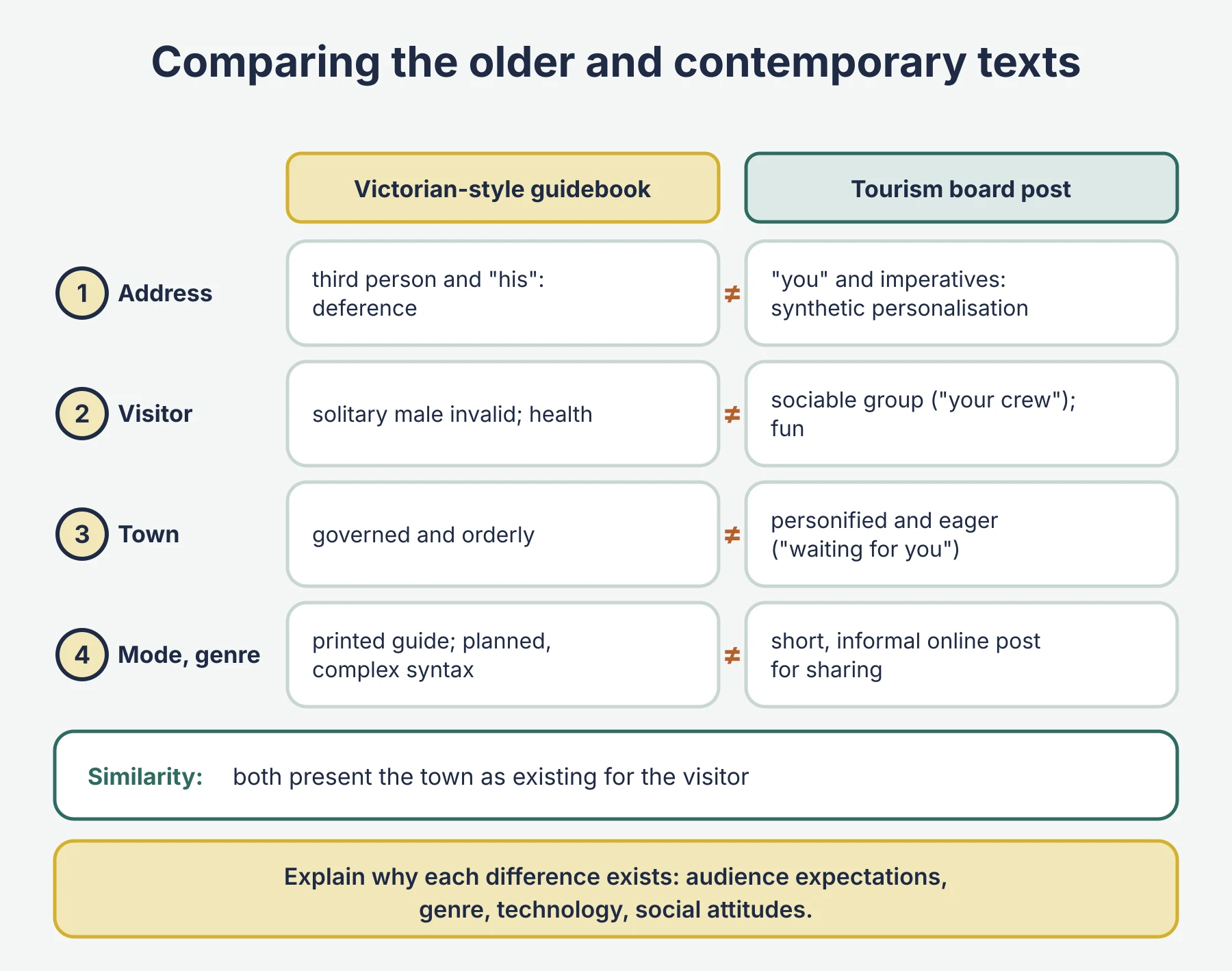
Exam traps
- Labelling features without saying what they represent.
- Writing about the topic rather than the language.
- Ignoring images, layout or typography in multimodal texts.
- Missing the relationship between participants in a spoken text.
- Comparing only at the end, in one sentence.
- Vague effects: “makes the reader want to read on”, “engages the audience”.
- Treating every feature as deliberate in spontaneous speech; some features, such as fillers, reflect real-time production.
Self-test
- What are the four things the specification says language is shaped by or used for in 3.1.1?
- How are the two Section A texts chosen?
- What does transitivity reveal about representation?
- Give an example of an agentless passive and explain its effect.
- What is presupposition? Give an example.
- Define synthetic personalisation and name the linguist associated with it.
- What is an ideal reader?
- What is negative face?
- Why should the older text’s conventions not be treated as errors?
- How should a comparison answer be organised?
- Name two ways a multimodal text can represent a place through graphology.
- Name three things the specification’s “exploration” includes besides methods of language analysis.
Answers
- Shaped according to audience, purpose, genre and mode; shaped according to context; used to construct meanings and representations; used to enact relationships.
- Two texts linked by topic or theme, one contemporary and one older.
- Whether a person or group is presented as an agent (active, responsible, powerful) or as affected (passive, vulnerable, blamed or pitied), and so how responsibility is assigned.
- “Jobs were lost”: the agent is hidden, so no one is blamed and the loss seems to have no cause.
- An assumption that must be accepted to make sense of a sentence, for example “Why are our streets still dirty?” assumes they are dirty and should have been cleaned.
- Addressing a mass audience as if each reader were an individual, through “you”, imperatives and a friendly register; Norman Fairclough.
- The reader a text assumes, who shares its values and background knowledge.
- The wish to be free from imposition, which requests and orders threaten.
- They reflect the audience, technology and expectations of their time, so they are evidence of context and meaning.
- By shared points of comparison, with evidence from both texts in each paragraph and context explaining differences.
- For example: photographs chosen to show an empty beach or a crowded one; colour schemes and fonts suggesting luxury or fun; placement of the town’s name or logo.
- Any three: how identity is constructed; how audiences are addressed and positioned; the functions of the texts; their structure and organisation; how representations are produced.
More resources on this topic
Related resources
-
Study guides
AQA A-Level English Language (7702): Children's Language Development
How children develop spoken and written language from 0 to 11, with theories and an annotated transcript: 3.1.3 for AQA A-level English Language 7702 Paper 1.
English · AQA · A Level
Read guide -
Practice questions
AQA A-Level English Language (7702): Children's Language Development – Practice Questions
Original data-based practice on children's speech and writing, theories and evaluation, with full answers, for AQA A-level English Language 7702 Paper 1.
English · AQA · A Level
Try questions -
Revision notes
AQA A-Level English Language (7702): Children's Language Development – Revision Notes
Condensed recall on children's spoken and written development, theories and data analysis for AQA A-level English Language 7702 Paper 1 Section B.
English · AQA · A Level
Revise topic
Get free revision emails (optional)
Occasional emails with practice questions, worked explanations and links to free resources for the qualification and subjects you choose. No spam, and you can unsubscribe from any email. The free tools on this site never need an email.