
Study Guides
AQA A-Level English Language (7702): Methods of Language Analysis (Paper 1)
How to identify and describe salient features at all six language levels in unseen Paper 1 texts: 3.1.2 Methods of language analysis for AQA A-level 7702.
- Subject
- English
- Level
- A LEVELS
- Topic
- Paper 1 – Language, the Individual and Society
- Author
- Marlbridge Academic Team
- Updated
- Reviewed by
- Ammar Bilal (what this means)
Aligned to AQA A Level English (7702), For first teaching 2015. Official specification .
Syllabus page (what it covers and how it is assessed): AQA A Level English Language.
Found an error? Report a correction.
Need help with this topic? Request a free trial class for A Level English Language (7702).
This guide covers 3.1.2 Methods of language analysis in AQA A-level English Language (7702): the analytical toolkit for Paper 1. The specification says you must “identify and describe salient features of language in the texts” using methods of language analysis, in order to study textual variations and representations. The same toolkit describes children’s language data in Section B. For what you do with the features (representation, positioning, comparison), see the textual variations and representations study guide.
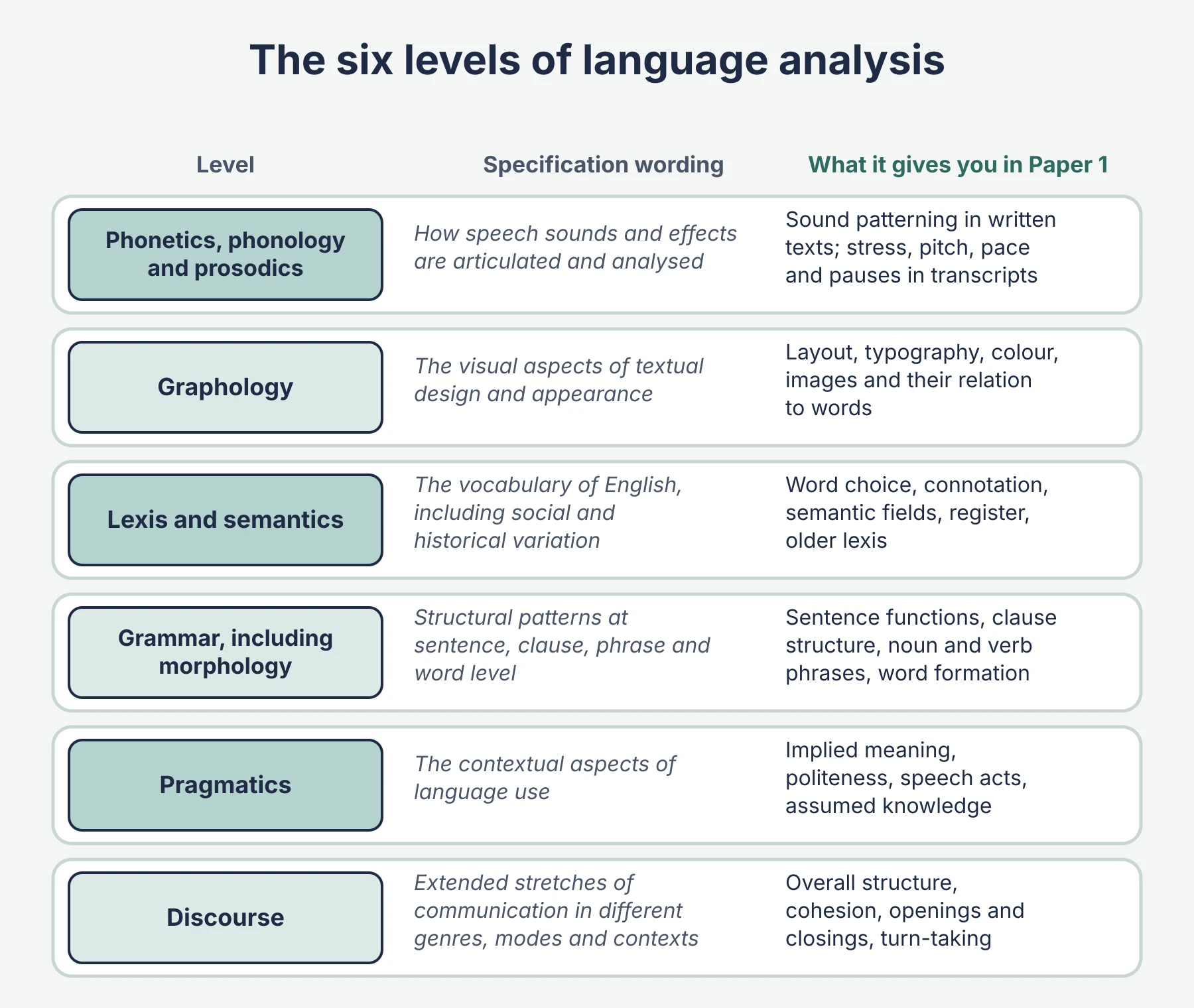
The six levels in the specification
| Level | Specification wording | What it gives you in Paper 1 |
|---|---|---|
| Phonetics, phonology and prosodics | How speech sounds and effects are articulated and analysed | Sound patterning in written texts; stress, pitch, pace and pauses in transcripts |
| Graphology | The visual aspects of textual design and appearance | Layout, typography, colour, images and their relation to words |
| Lexis and semantics | The vocabulary of English, including social and historical variation | Word choice, connotation, semantic fields, register, older lexis |
| Grammar, including morphology | Structural patterns at sentence, clause, phrase and word level | Sentence functions, clause structure, noun and verb phrases, word formation |
| Pragmatics | The contextual aspects of language use | Implied meaning, politeness, speech acts, assumed knowledge |
| Discourse | Extended stretches of communication in different genres, modes and contexts | Overall structure, cohesion, openings and closings, turn-taking |
“Salient” is the key word
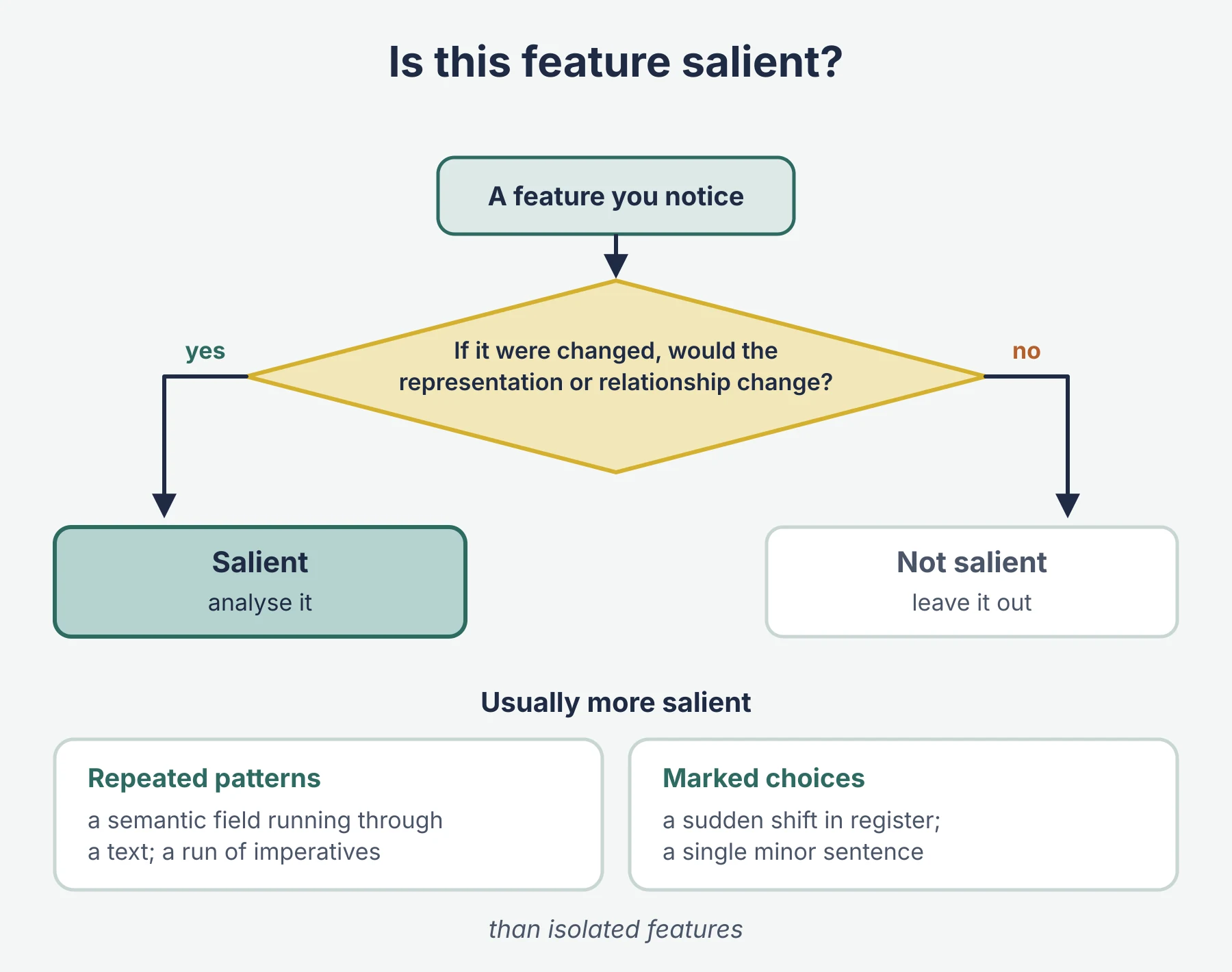
Salient means prominent and significant. You are not asked to find every feature at every level; you are asked to find the features that do most to create the text’s meanings. A practical test: if this feature were changed, would the representation or relationship change? If yes, it is salient. Repeated patterns (a semantic field running through a text, a run of imperatives) and marked choices (a sudden shift in register, a single minor sentence) are usually more salient than isolated features.
Level by level: the terminology that earns credit
Phonology and prosodics. In written texts: alliteration, sibilance, assonance, rhyme, rhythm and onomatopoeia, which matter most in slogans, headlines and speeches written to be heard. In transcripts: stress (often shown in capitals or underlining), rising and falling intonation, pauses and micropauses, changes of pace and volume, and features such as elision (“gonna”). Always use the transcript’s own key.
Graphology. Typeface (serif, sans serif, handwritten-style), size and weight, colour, layout and white space, the positioning of headings and images, logos, and the relationship between image and text: does the image anchor the meaning of the words, or do the words direct how we read the image? In an older printed text, dense columns and few images are themselves evidence of context.
Lexis and semantics. Semantic fields; connotation; formal versus informal register; jargon and specialist lexis; colloquialisms; euphemism and dysphemism; collocation (words that habitually go together, and deliberate breaks in collocation); figurative language; lexis that has changed meaning or fallen out of use in an older text.
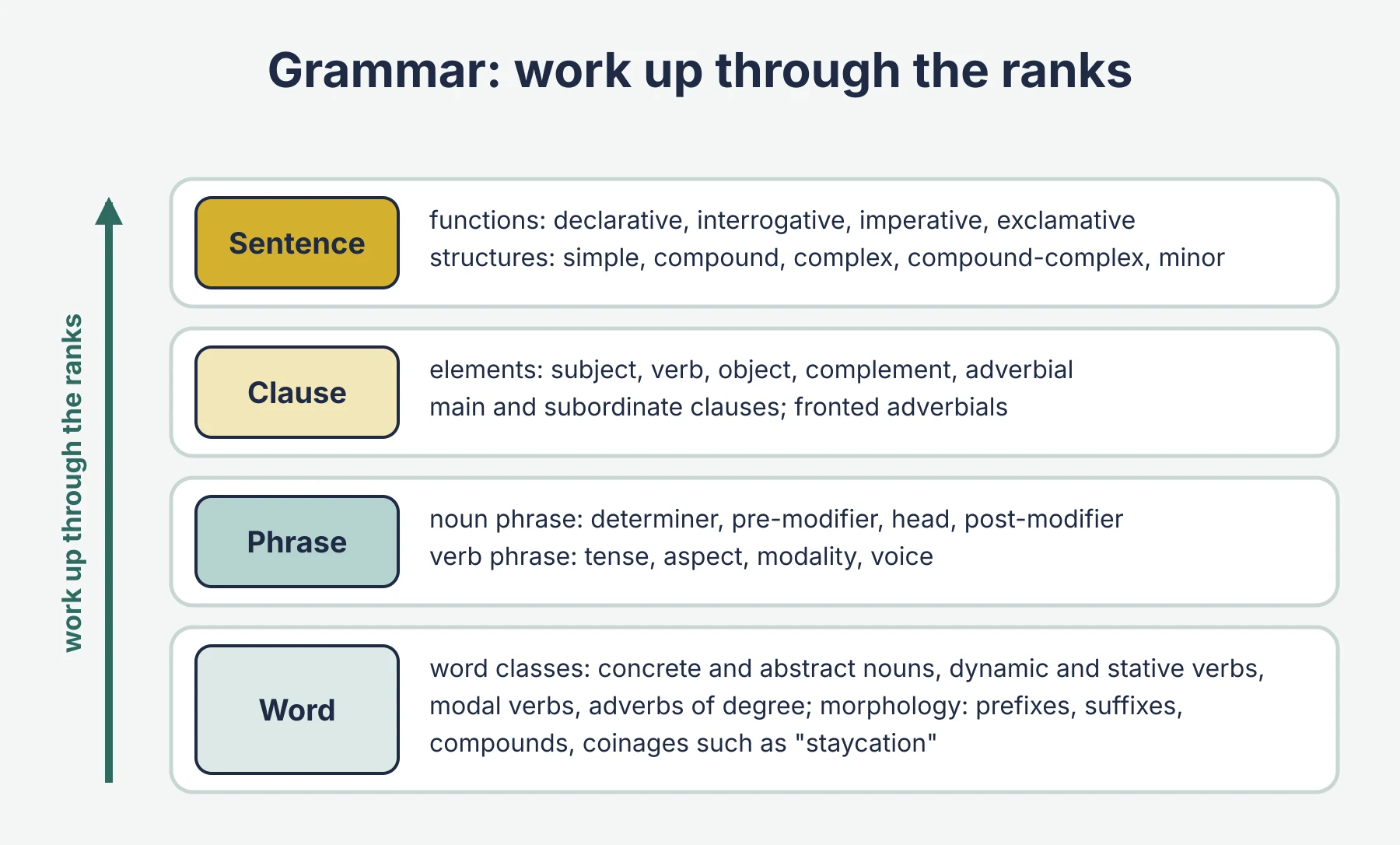
Grammar, including morphology. Work up through the ranks:
- Word: word classes (concrete and abstract nouns, dynamic and stative verbs, modal verbs, adverbs of degree); morphology (prefixes, suffixes, compounds, coinages such as “staycation”).
- Phrase: noun phrase structure (determiner, pre-modifier, head, post-modifier); verb phrase (tense, aspect, modality, voice).
- Clause: clause elements (subject, verb, object, complement, adverbial); main and subordinate clauses; fronted adverbials.
- Sentence: functions (declarative, interrogative, imperative, exclamative) and structures (simple, compound, complex, compound-complex, minor).
Pragmatics. Implicature (meaning implied beyond what is said, often explained through Grice’s maxims of quantity, quality, relation and manner); presupposition; speech acts (the action an utterance performs: apologising, warning, promising); politeness and face; deixis (words such as “here”, “now”, “we” whose meaning depends on context); assumed shared knowledge.
Discourse. Overall structure (narrative, problem and solution, question and answer, chronological); cohesion through reference (pronouns pointing back or forward), lexical repetition, synonyms, ellipsis and conjunctions; openings and closings; in speech, adjacency pairs, turn-taking, topic shifts and repair.
Worked example: describing salient features precisely
The text below is original, written for this page: a leaflet for a community café.
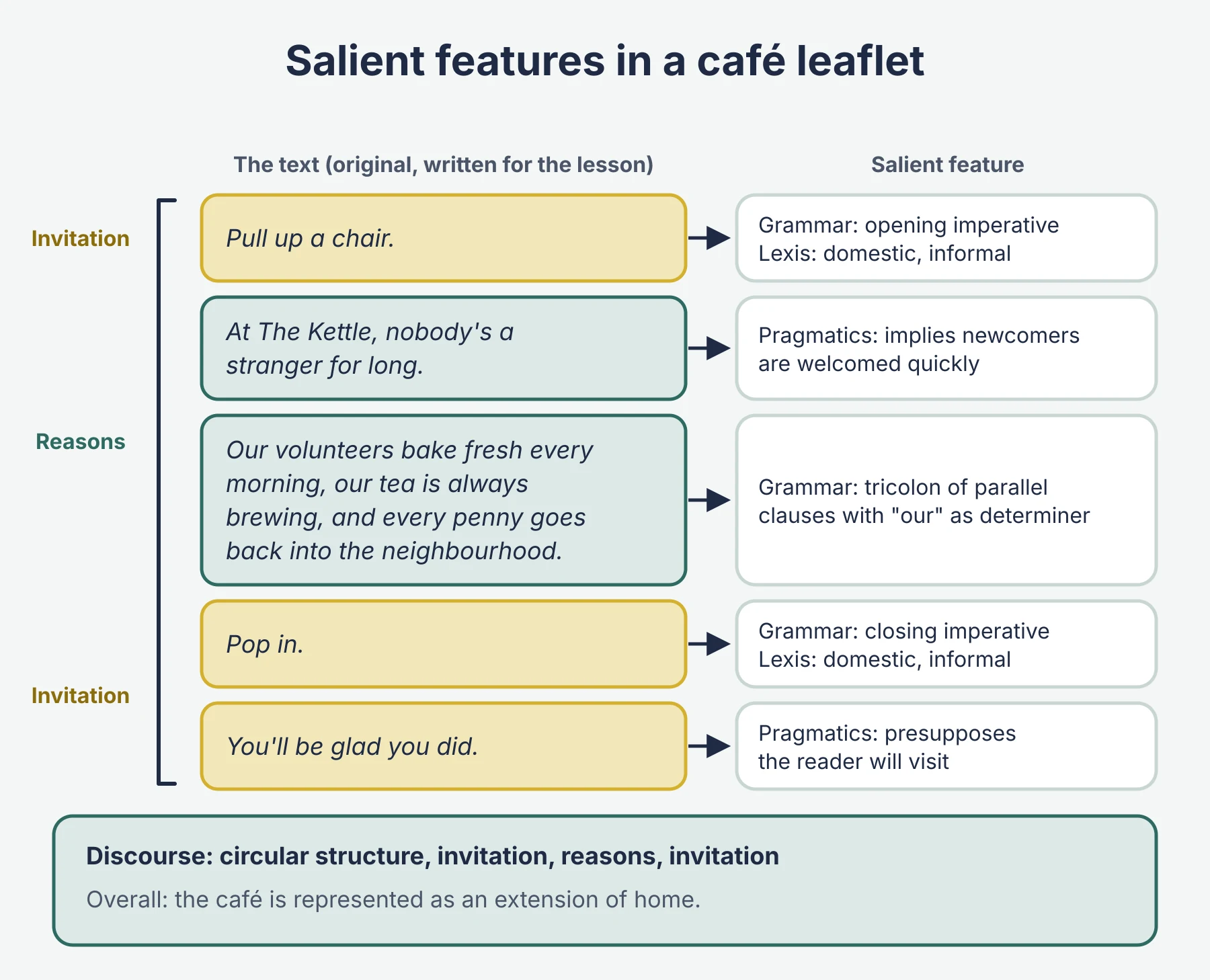
“Pull up a chair. At The Kettle, nobody’s a stranger for long. Our volunteers bake fresh every morning, our tea is always brewing, and every penny goes back into the neighbourhood. Pop in. You’ll be glad you did.”
| Level | Salient feature, precisely described | Contribution to meaning |
|---|---|---|
| Grammar | Opening and closing imperatives (“Pull up a chair”, “Pop in”), short simple sentences | Direct, friendly invitation framing the text |
| Grammar | Tricolon of parallel clauses with “our” as determiner | Builds a rhythm of collective pride and generosity |
| Lexis | Domestic, informal lexis (“Pull up a chair”, “Pop in”, “brewing”) | Represents the café as an extension of home |
| Pragmatics | “nobody’s a stranger for long” implies that newcomers are welcomed quickly | Reassures a lonely or new reader without naming loneliness |
| Pragmatics | Future “You’ll be glad you did” presupposes the reader will visit | Positions the reader as already persuaded |
| Discourse | Circular structure: invitation, reasons, invitation | Cohesion through repeated directive address |
| Graphology | (In the real leaflet you would analyse font, colour and images) | Whether design reinforces warmth and informality |
Notice that the table never says “short sentence for effect”. It names the structure, quotes it and states the meaning it helps create.
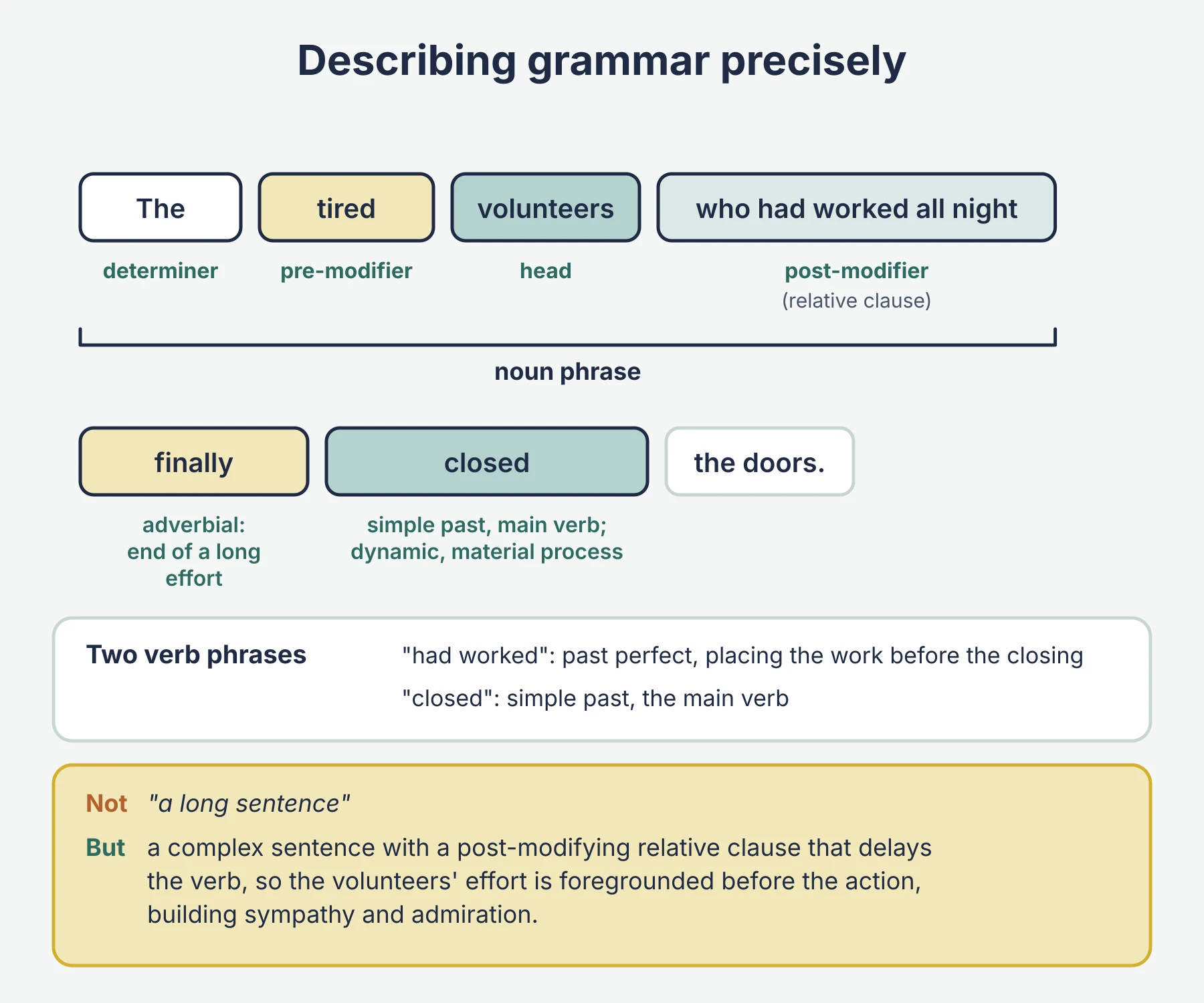
Worked example: getting grammar right
“The tired volunteers who had worked all night finally closed the doors.”
Noun phrase   the (determiner) + tired (pre-modifier) + volunteers (head)
              + who had worked all night (post-modifying relative clause)
Verb phrase   had worked: past perfect, placing the work before the closing
              closed: simple past, main verb; dynamic, material process
Adverbial     finally: adverb signalling the end of a long effort
Clause        main clause "The tired volunteers ... closed the doors" with an
              embedded relative clause; sentence structure is complex
Effect        the modifiers and the past perfect foreground the volunteers'
              effort before the action, building sympathy and admiration
Accurate description like this lets you make confident claims. Calling this a “long sentence” earns nothing; calling it a complex sentence with a post-modifying relative clause that delays the verb, so that effort is foregrounded, earns credit for method and for meaning.
Applying methods to children’s data (Section B)
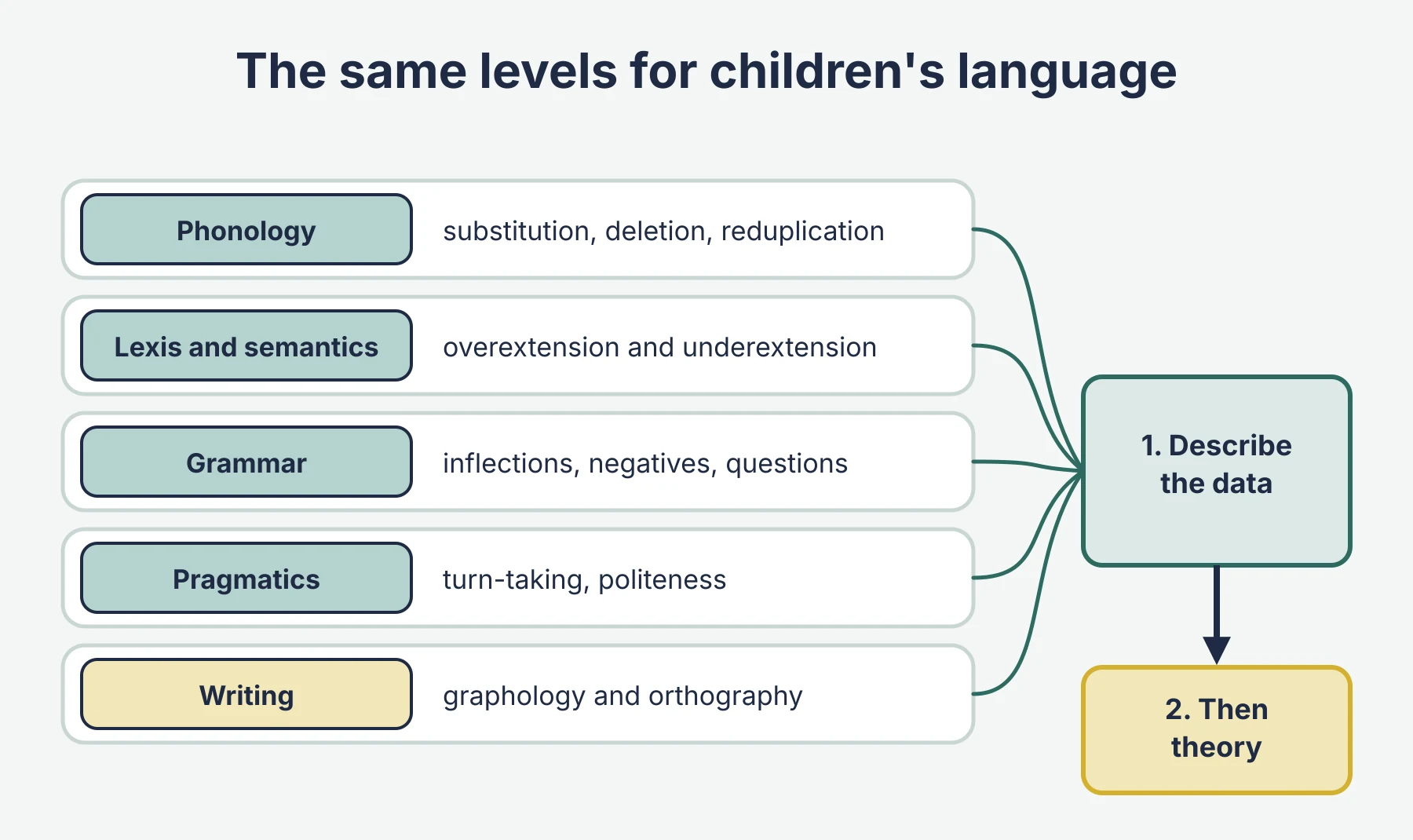
The same levels describe children’s speech and writing: phonological processes (substitution, deletion, reduplication), lexical and semantic development (over- and underextension), grammatical development (inflections, negatives, questions), pragmatic development (turn-taking, politeness) and, for writing, graphology and orthography. Description comes first; theory follows. See the children’s language development study guide.
Common mistakes
- Using “short sentence” or “long sentence” instead of naming structure or function.
- Calling every question “rhetorical”, or every “we” “inclusive” without checking who it includes.
- Confusing simple sentences (one main clause) with short ones.
- Listing word classes (“there are adjectives and verbs”) with no pattern or purpose.
- Ignoring graphology in a multimodal text, or prosody in a transcript.
- Applying a level mechanically when it adds nothing to the text’s meaning.
- Mislabelling: calling a noun phrase a clause, or a modal verb an adverb.
Exam technique
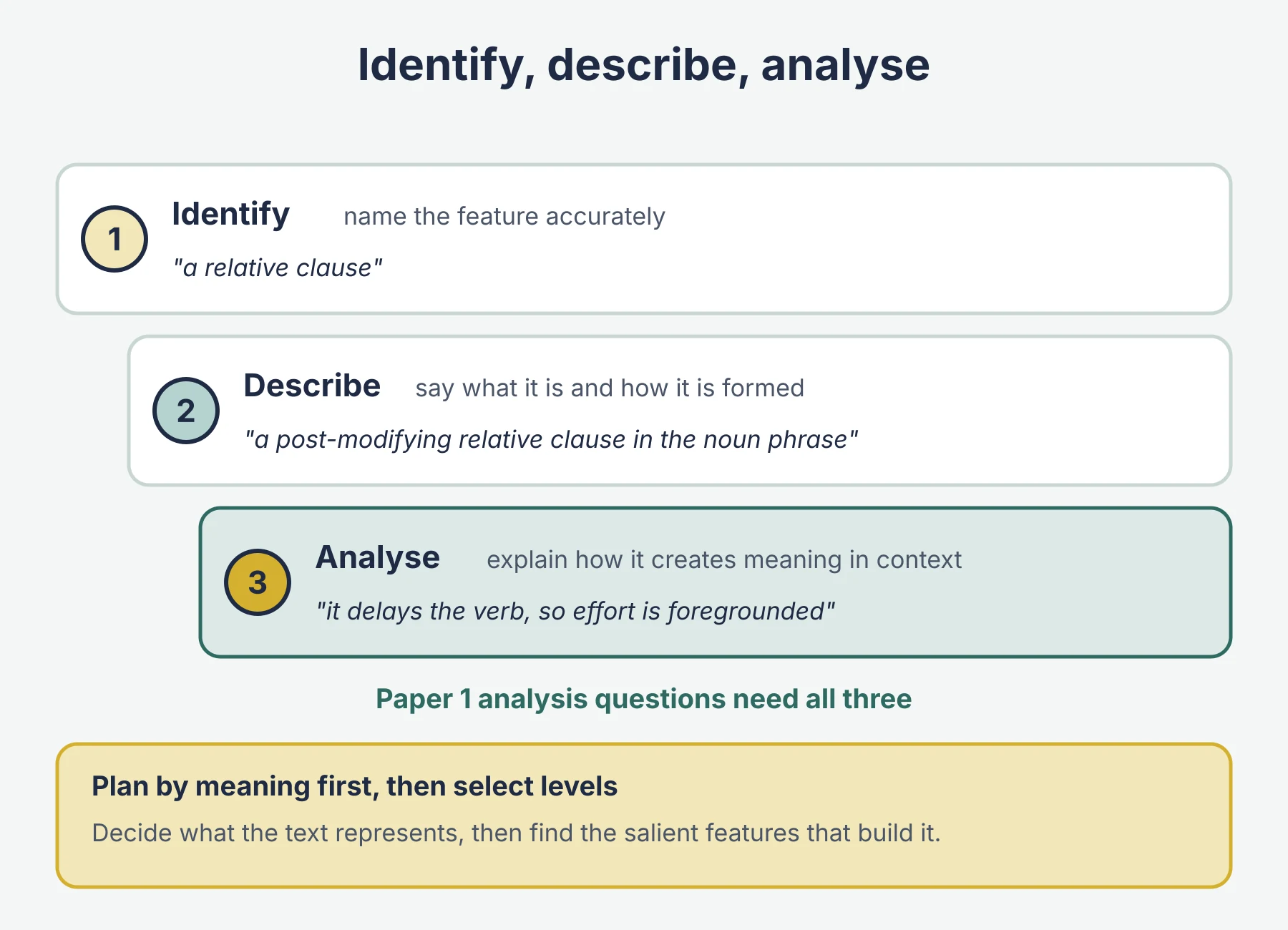
- Identify means name the feature accurately; describe means say what it is and how it is formed; analyse means explain how it creates meaning in context. Paper 1 analysis questions need all three.
- Plan by meaning first, then select levels: decide what the text represents, then find the salient features that build it.
- Range matters, but depth matters more. Aim to use several levels across an answer, and develop each point.
- Quote briefly and precisely, embedding quotations in your sentences.
Where to go next
- Paper 1 methods of language analysis revision notes
- Paper 1 methods of language analysis practice questions
- Paper 1 study guide
Official syllabus
AQA AS and A-level English Language (7701/7702) specification, A-level subject content 3.1.2 Methods of language analysis, integrated into Paper 1.
Section numbers. This site follows the A-level (7702) subject content on aqa.org.uk, where Paper 1 content is 3.1. The combined AS and A-level specification PDF numbers the same A-level sections 4.1, 4.2 and 4.3.
Related resources
-
Practice questions
AQA A-Level English Language (7702): Methods of Language Analysis (Paper 1) – Practice Questions
Original practice identifying and describing salient features at each language level, with mark-scheme answers, for AQA A-level English Language 7702 Paper 1.
English · AQA · A Level
Try questions -
Revision notes
AQA A-Level English Language (7702): Methods of Language Analysis (Paper 1) – Revision Notes
Condensed terminology for the six language levels in AQA A-level English Language 7702 Paper 1, with exam traps and a self-test on precise feature description.
English · AQA · A Level
Revise topic -
Study guides
AQA A-Level English Language (7702): Textual Variations and Representations
How texts vary with audience, purpose, genre, mode and context, and how language builds representations: 3.1.1 for AQA A-level English Language Paper 1.
English · AQA · A Level
Read guide
Get free revision emails (optional)
Occasional emails with practice questions, worked explanations and links to free resources for the qualification and subjects you choose. No spam, and you can unsubscribe from any email. The free tools on this site never need an email.