
Study Guides
AQA A-Level English Language (7702): Textual Variations and Representations
How texts vary with audience, purpose, genre, mode and context, and how language builds representations: 3.1.1 for AQA A-level English Language Paper 1.
- Subject
- English
- Level
- A LEVELS
- Topic
- Paper 1 – Language, the Individual and Society
- Author
- Marlbridge Academic Team
- Updated
- Reviewed by
- Ammar Bilal (what this means)
Aligned to AQA A Level English (7702), For first teaching 2015. Official specification .
Syllabus page (what it covers and how it is assessed): AQA A Level English Language.
Found an error? Report a correction.
Need help with this topic? Request a free trial class for A Level English Language (7702).
This guide goes deep on one part of the AQA A-level English Language (7702) subject content: 3.1.1 Textual variations and representations, the content behind Paper 1 Section A. The broader Paper 1 study guide maps the whole paper; this page concentrates on how you actually analyse a pair of unseen texts for meaning, representation and relationships.
What the specification asks you to study
The specification lists the range of texts you should meet: texts about various subjects, from various writers and speakers, for various audiences and purposes, in a variety of genres, in written, spoken and electronic modes, from different times and from different places (global, national and regional). When you analyse them you explore how language is:
- shaped according to audience, purpose, genre and mode;
- shaped according to context;
- used to construct meanings and representations;
- used to enact relationships between writers, speakers and audiences, or between participants within a text.
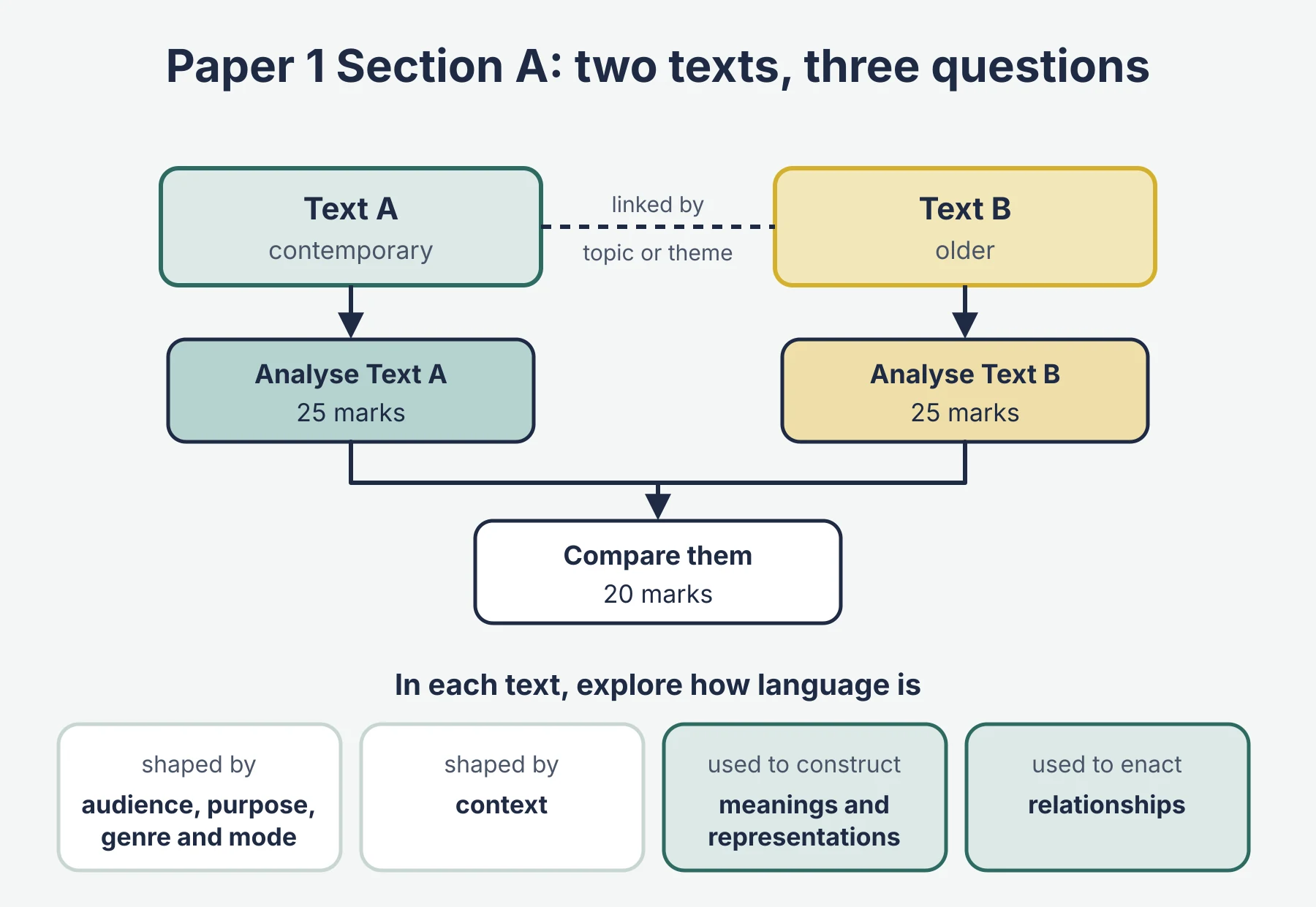
That exploration includes how identity is constructed, how audiences are addressed and positioned, the functions of texts, their structure and organisation, and how representations are produced. In the exam this becomes Section A: two texts, one contemporary and one older, linked by topic or theme, with a question analysing each text (25 marks each) and a question comparing them (20 marks).
Key idea 1: variation is always explained, never just noticed
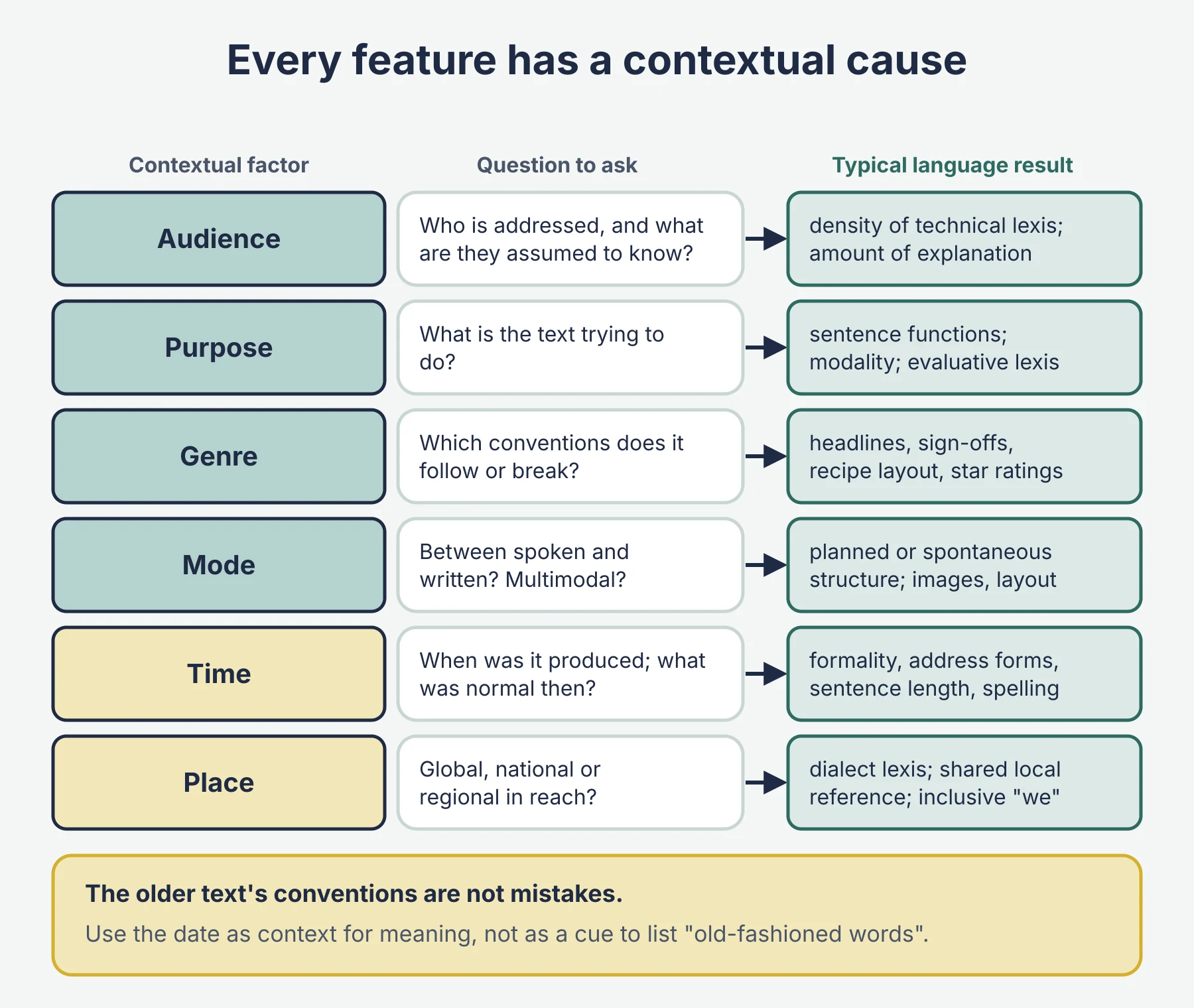
“Textual variation” means that two texts on the same topic look and sound different because their contexts differ. A strong answer treats every feature as the visible result of a contextual pressure.
| Contextual factor | Question to ask | Typical language consequence |
|---|---|---|
| Audience | Who is addressed, and what are they assumed to know? | Density of technical lexis; amount of explanation |
| Purpose | What is the text trying to do: inform, persuade, entertain, instruct, commemorate? | Sentence functions; modality; evaluative lexis |
| Genre | Which conventions does the text follow or break? | Headlines, sign-offs, recipe layout, review star ratings |
| Mode | Where does it sit between spoken and written, and is it multimodal? | Planned or spontaneous structure; images and layout |
| Time | When was it produced, and what was normal then? | Formality, address forms, sentence length, spelling |
| Place | Is it global, national or regional in reach? | Dialect lexis; shared local reference; inclusive “we” |
The older text matters here. Its conventions are not mistakes: a long, carefully balanced sentence in a nineteenth- century guidebook reflects the expectations of its readers and the prestige of formal written style at the time. Use the date as context for meaning, not as a cue to list “old-fashioned words”. Detailed study of change over time belongs to Paper 2.
Key idea 2: representation is built from choices
A representation is the version of a person, group, place, event or idea that a text constructs. It is never a neutral copy of reality, because every text selects some details and leaves others out. The most productive tools:
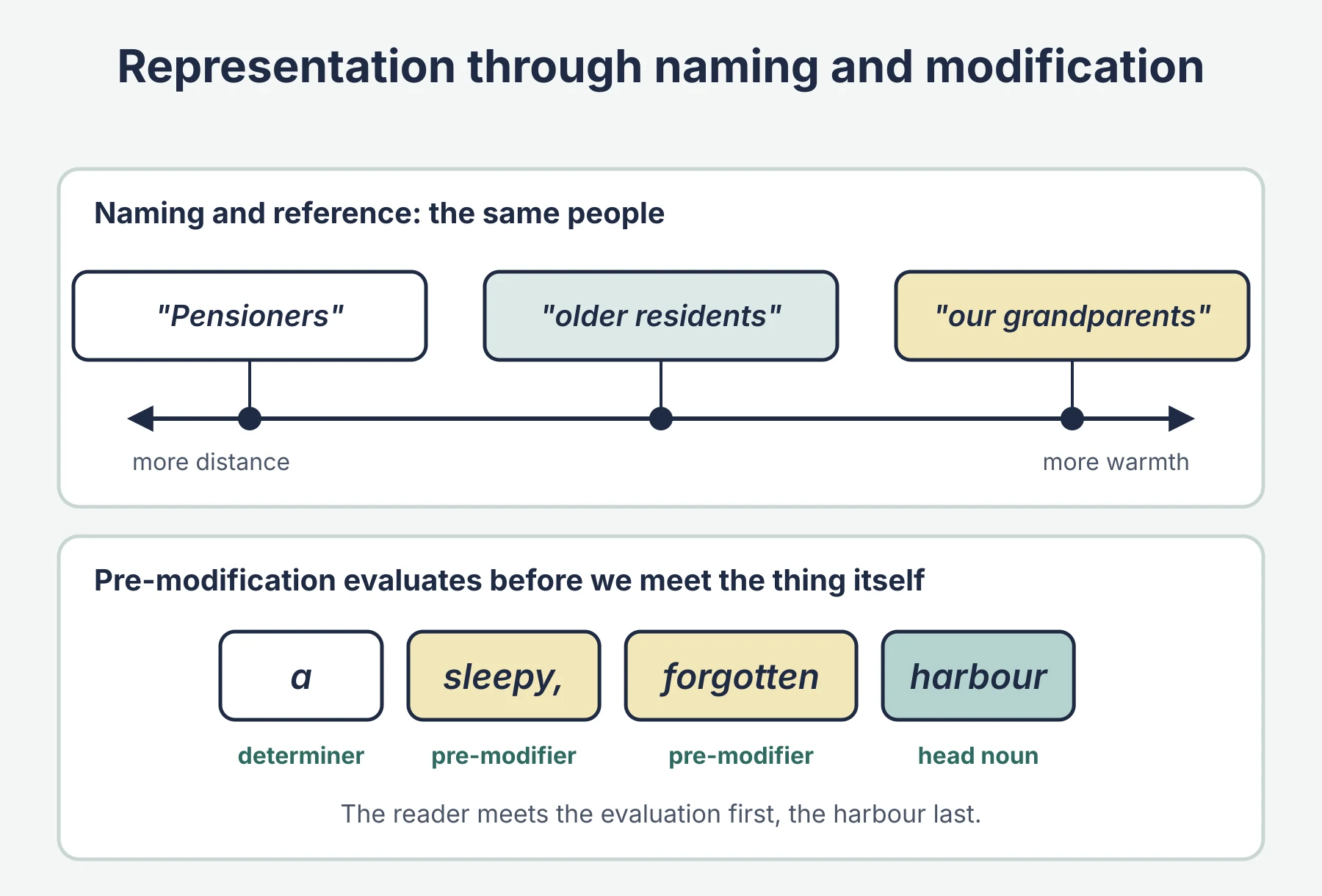
- Naming and reference. “Pensioners”, “older residents” and “our grandparents” refer to the same people with different degrees of distance and warmth.
- Pre- and post-modification. Adjectives, nouns and clauses attached to a head noun evaluate before the reader has met the thing itself (“a sleepy, forgotten harbour”).
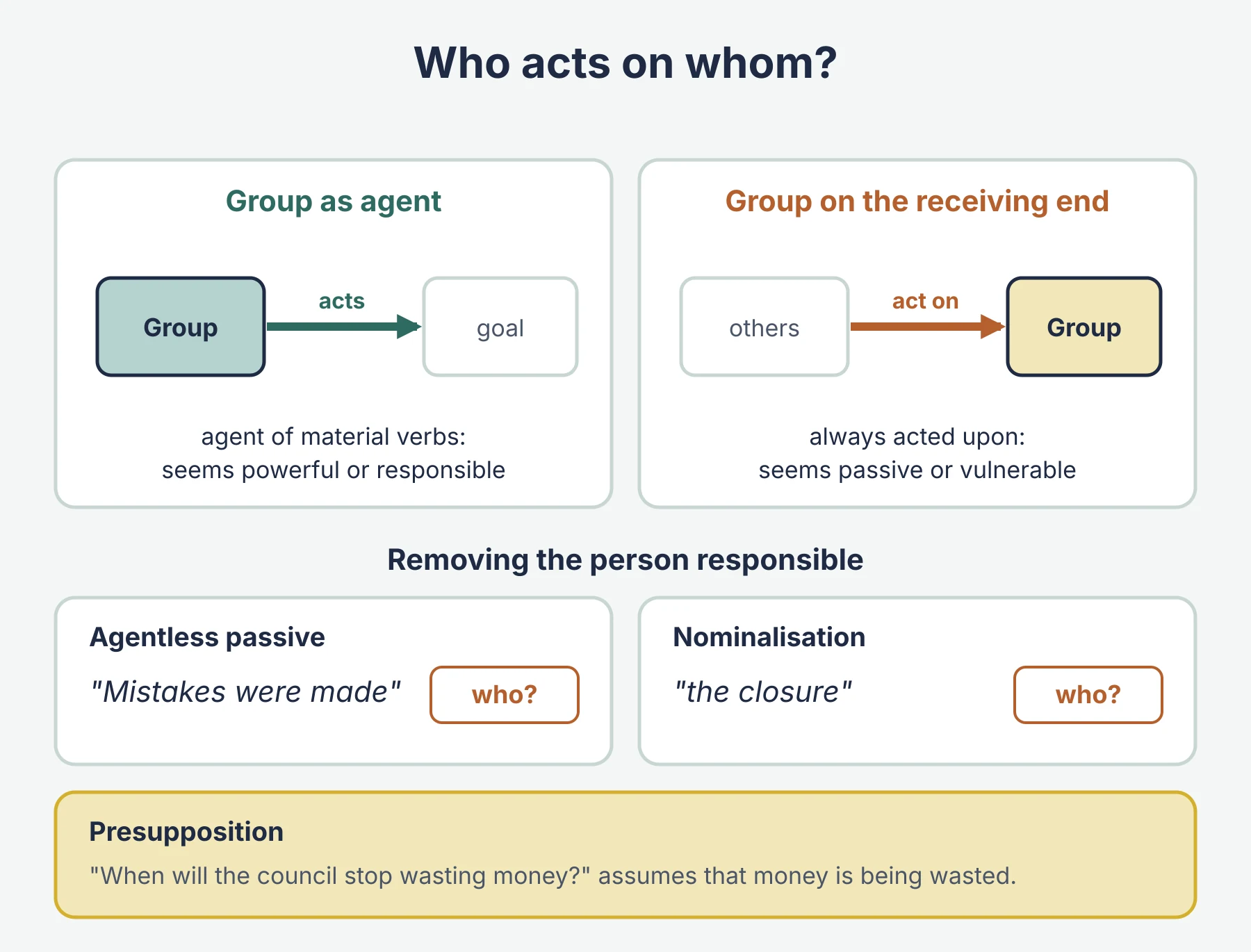
- Transitivity. Who acts on whom? A group placed as the agent of material verbs seems powerful or responsible; a group always on the receiving end seems passive or vulnerable.
- Agentless passives and nominalisation. “Mistakes were made” and “the closure” remove the person responsible.
- Presupposition. “When will the council stop wasting money?” assumes that money is being wasted.
- Metaphor and semantic field. A field of battle, illness or water frames an issue before any argument is made.
- Selection and ordering. What comes first, what is quoted, and whose voice is absent all shape the picture.
Key idea 3: identity, positioning and relationships
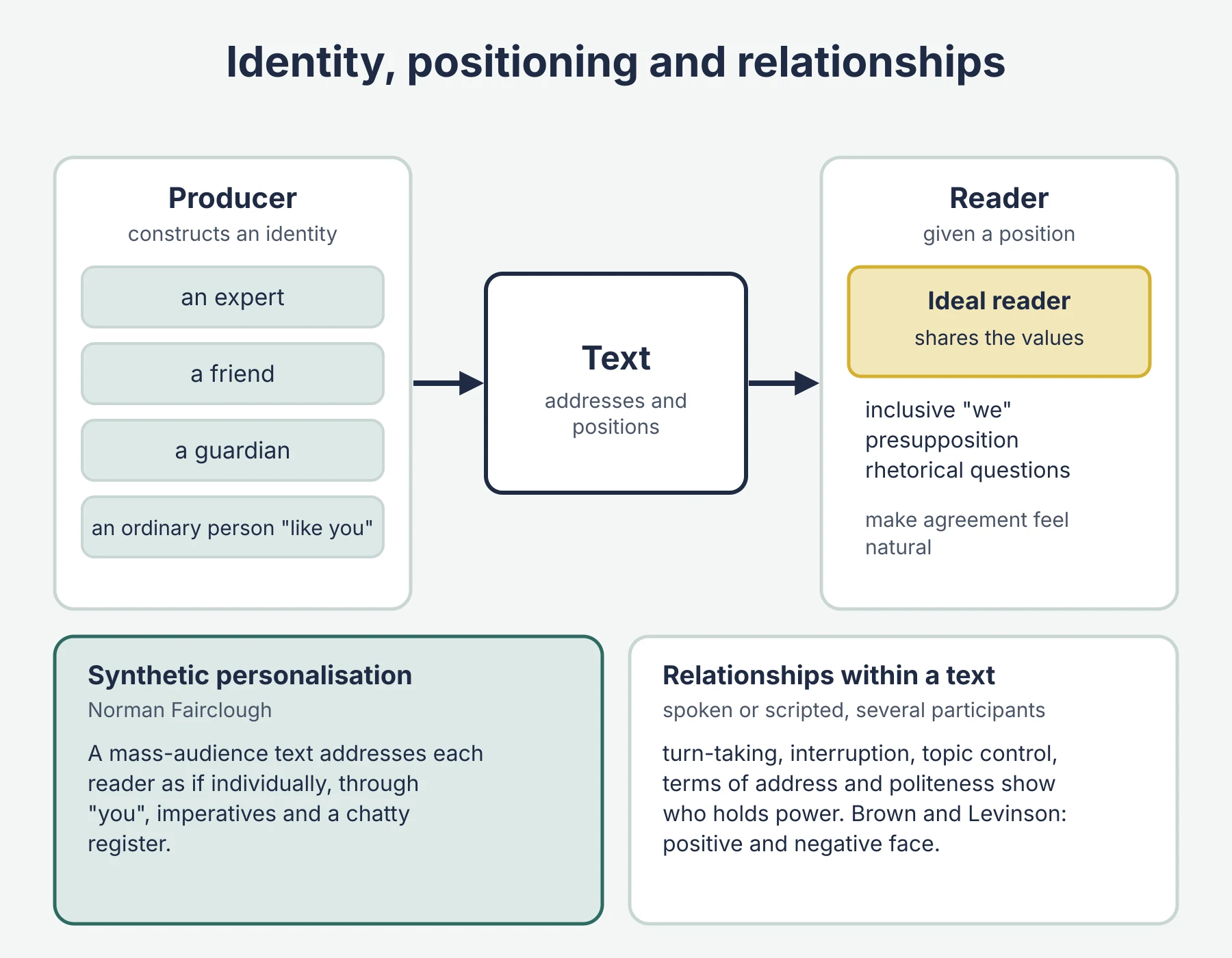
Texts also construct an identity for their producer: an expert, a friend, a guardian, an ordinary person “like you”. Look for first-person pronouns, register, references to experience or credentials, humour and self- deprecation. Norman Fairclough’s term synthetic personalisation describes how mass-audience texts address each reader as if individually, through “you”, imperatives and a chatty register.
Positioning is the role a text creates for its reader. An “ideal reader” shares the text’s values; inclusive “we”, presupposition and rhetorical questions make agreement feel natural.
In spoken or scripted texts with several participants, relationships are enacted within the text. Turn-taking, interruption, topic control, terms of address and politeness strategies show who holds power. Brown and Levinson’s politeness theory (positive and negative face) is useful when one speaker softens a request or a criticism.
Worked example: an annotated older text
The extract below is original, written for this page in the style of a late-Victorian seaside guidebook.
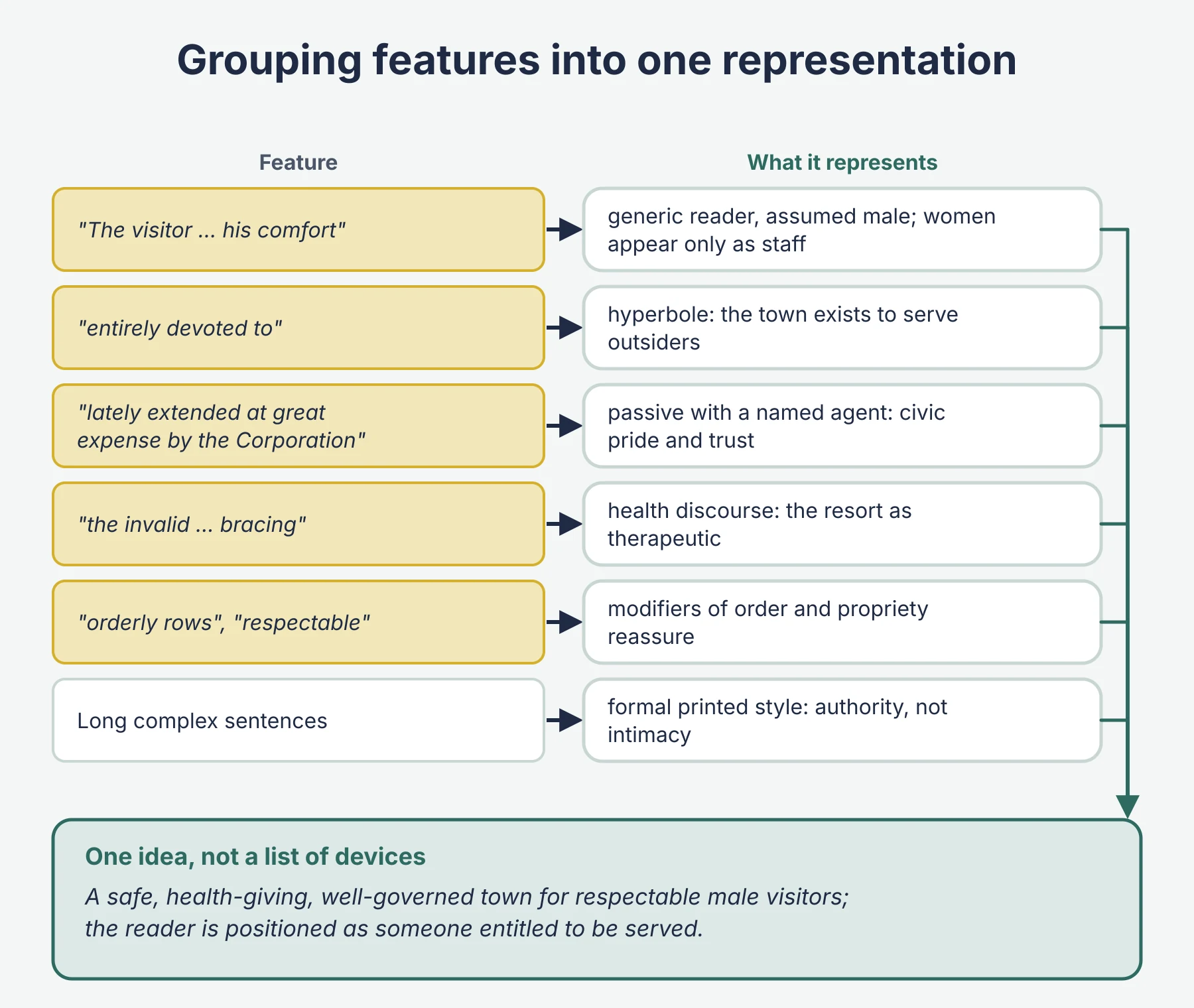
“The visitor who alights at Saltmere will find a town entirely devoted to his comfort. The promenade, lately extended at great expense by the Corporation, affords the invalid a gentle and bracing walk, while the bathing machines, ranged in orderly rows, are attended by respectable women of the district.”
"The visitor ... his comfort"   Generic third-person reader, assumed male: the
                                ideal visitor is a gentleman of means; women
                                appear only as staff.
"entirely devoted to"           Hyperbolic evaluation: the town is represented
                                as existing to serve outsiders.
"lately extended at great       Passive with a named agent: the Corporation
expense by the Corporation"     is credited, building civic pride and trust.
"the invalid ... bracing"       Health discourse of the period: the resort is
                                represented as therapeutic.
"orderly rows", "respectable"   Modifiers of order and propriety reassure a
                                middle-class audience about moral standards.
Long complex sentences          Formal written style expected of a printed
                                guide; authority rather than intimacy.
A paragraph built from this would group the features under one idea: the guide represents Saltmere as a safe, health-giving, well-governed town for respectable male visitors, and positions its reader as someone entitled to be served. That is analysis of representation, not a list of devices.
Worked example: comparing with a contemporary text
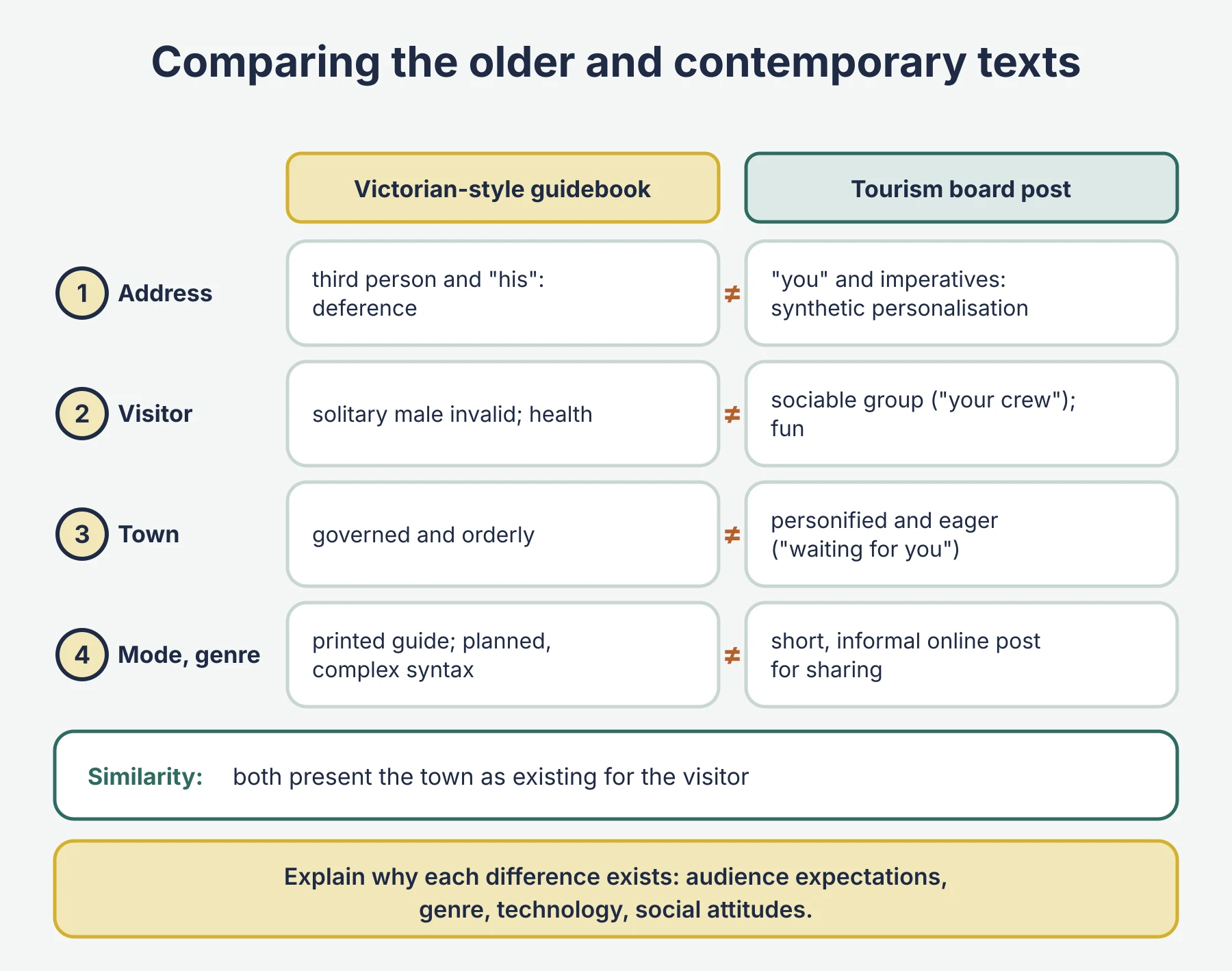
Imagine the paired contemporary text is a tourism board’s social media post: “Saltmere’s waiting for you! Grab your crew, hit the beach and make memories this summer.” Useful points of comparison:
- Address: generic third person and “his” versus second-person “you” and imperatives, a shift from deference to synthetic personalisation.
- Represented visitor: solitary male invalid versus a sociable group (“your crew”); health versus fun.
- Represented town: governed and orderly versus personified and eager (“waiting for you”).
- Mode and genre: printed guide with planned, complex syntax versus short, informal online post designed for sharing.
Each point should explain why the texts differ (audience expectations, genre, technology, social attitudes), and note any similarity, such as both texts presenting the town as existing for the visitor.
Exam technique for analysis and comparison
- Analyse how a text uses language means feature, quotation, effect and context together. Name the feature precisely (“agentless passive”, not “a sentence”).
- Create meanings and representations directs you to what the text is saying about its subject. Open each paragraph with a claim about representation or relationship.
- Compare or explore similarities and differences rewards connections. Organise by shared points, not text by text, and always explain the cause of a difference.
- Spend a few minutes establishing audience, purpose, genre, mode, time and place before annotating features.
- Choose the most significant features. Three well-developed ideas beat ten labels.
Common mistakes
- Feature-spotting: “there are lots of adjectives” with no link to meaning.
- Treating the older text’s conventions as errors or as quaint, rather than as evidence of its context.
- Ignoring multimodal elements such as images, layout and typography when they carry meaning.
- Writing about the topic (seaside holidays) rather than the language.
- In comparison, analysing one text and then the other with a single “both” sentence at the end.
- Using vague effects such as “draws the reader in” without saying how or why.
Where to go next
Condensed recall and a self-test are in the textual variations and representations revision notes. Practise on original texts with the textual variations and representations practice questions, and see how the language levels are applied in the Paper 1 methods of language analysis guide.
Official syllabus
AQA AS and A-level English Language (7701/7702) specification, A-level subject content 3.1.1 Textual variations and representations, assessed in Paper 1 Section A.
Section numbers. This site follows the A-level (7702) subject content on aqa.org.uk, where Paper 1 content is 3.1. The combined AS and A-level specification PDF numbers the same A-level sections 4.1, 4.2 and 4.3.
Related resources
-
Practice questions
AQA A-Level English Language (7702): Textual Variations and Representations – Practice Questions
Original practice on representation, positioning, relationships and comparing a contemporary and an older text, for AQA A-level English Language 7702 Paper 1.
English · AQA · A Level
Try questions -
Revision notes
AQA A-Level English Language (7702): Textual Variations and Representations – Revision Notes
Condensed notes on 3.1.1 Textual variations and representations for AQA A-level English Language 7702: context, representation, positioning, comparison.
English · AQA · A Level
Revise topic -
Study guides
AQA A-Level English Language (7702): Children's Language Development
How children develop spoken and written language from 0 to 11, with theories and an annotated transcript: 3.1.3 for AQA A-level English Language 7702 Paper 1.
English · AQA · A Level
Read guide
Get free revision emails (optional)
Occasional emails with practice questions, worked explanations and links to free resources for the qualification and subjects you choose. No spam, and you can unsubscribe from any email. The free tools on this site never need an email.