
Study Guides
AQA A Level Law (7162): The Rules of Contract Law
Where contract rules come from, the objective approach, consumer and business contracts, void and voidable contracts and a problem method, AQA Law 7162.
- Subject
- Law
- Level
- A LEVELS
- Topic
- Topic 4: Law of contract
- Author
- Marlbridge Academic Team
- Updated
- Reviewed by
- Aizaz Raoof Ali (what this means)
Aligned to AQA A Level Law (7162), For teaching from September 2017 onwards, A-level exams 2019 onwards. Official specification .
Syllabus page (what it covers and how it is assessed): AQA A Level Law.
Syllabus points this page covers
7162
- The rules of contract law
Found an error? Report a correction.
Need help with this topic? Request a free trial class for A Level Law (7162).
This guide covers the opening row of AQA A-level Law (7162) section 3.4, The rules of contract law. The specification describes it as “rules and principles of contract law concerning formation, terms, vitiating factors, discharge of a contract and associated remedies”. This row is the framework for the whole option: where the rules come from, how courts read agreements, which statute applies to which kind of contract, and how to work through a problem in a logical order. Each area has its own row and page; the Law of contract study guide covers the topic as a whole.
The life of a contract
The specification’s five areas follow a contract from beginning to end. Most problem questions sit at one or two points on this line.
FORMATION  ->  TERMS  ->  VITIATING FACTORS  ->  DISCHARGE  ->  REMEDIES
Is there a     What was    Is the agreement     How did the    What can the
contract?      promised?   flawed?              contract end?  innocent party get?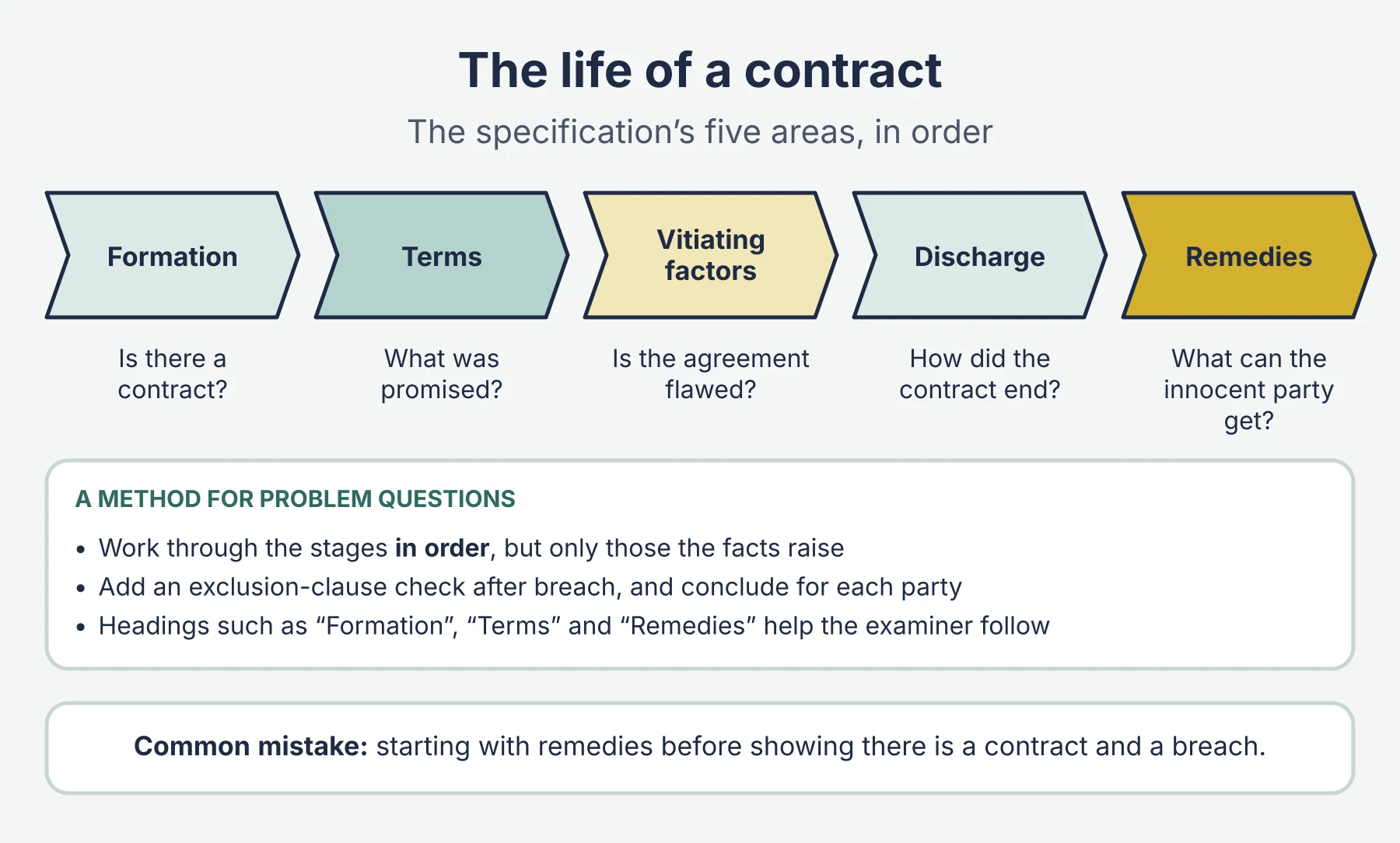
Where the rules come from
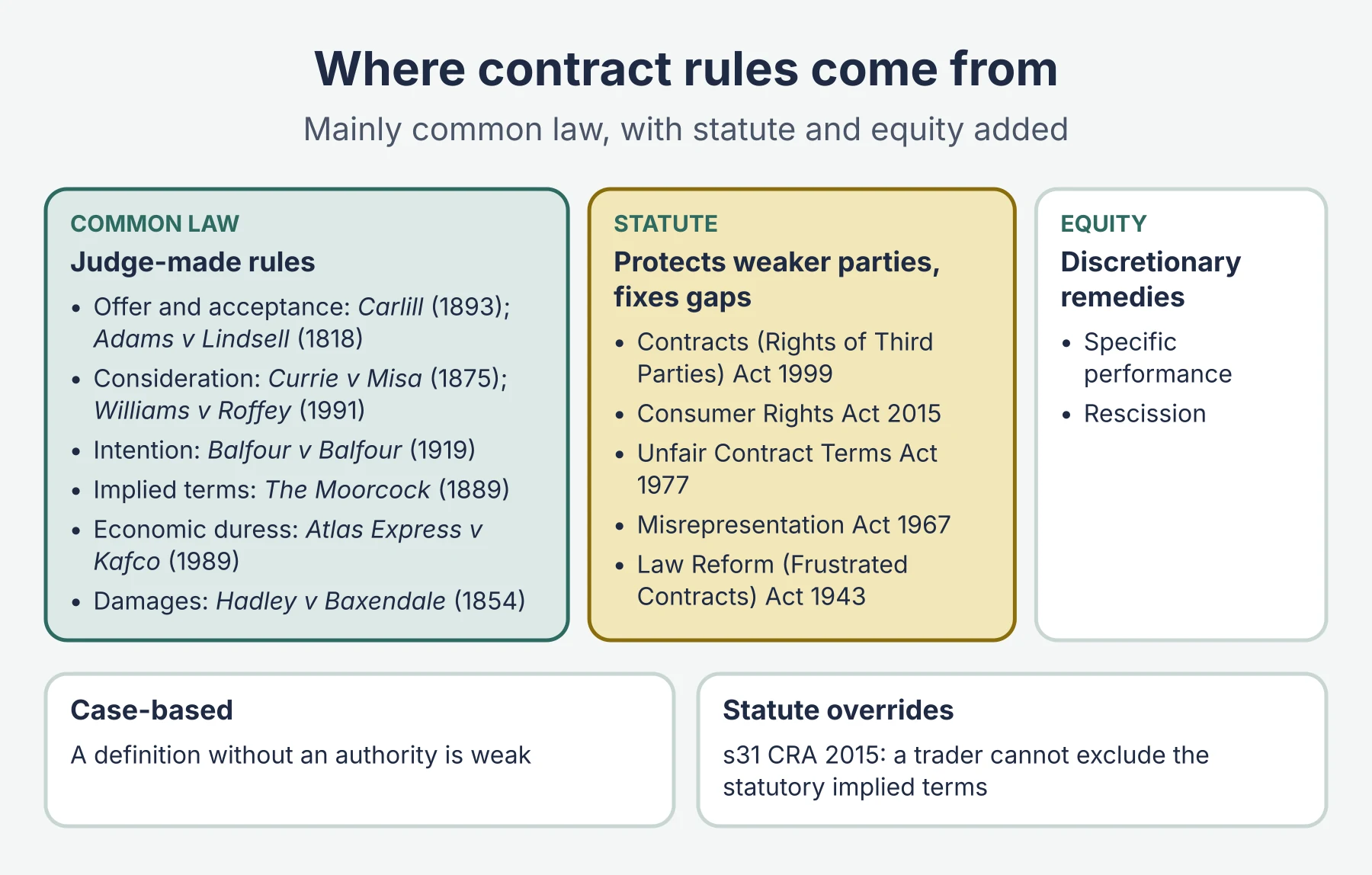
Contract is mainly common law, built up by judges from the nineteenth century onwards, with statute added where Parliament wanted to protect weaker parties or fix problems the courts could not.
| Area | Main source | Key statute or leading case |
|---|---|---|
| Offer and acceptance | Common law | Carlill v Carbolic Smoke Ball Co (1893); Adams v Lindsell (1818) |
| Consideration | Common law | Currie v Misa (1875); Williams v Roffey Bros (1991) |
| Privity | Common law, reformed by statute | Contracts (Rights of Third Parties) Act 1999 |
| Intention to create legal relations | Common law presumptions | Balfour v Balfour (1919) |
| Express and implied terms | Common law | The Moorcock (1889) |
| Consumer implied terms | Statute | Consumer Rights Act 2015, ss9–11, 49, 52 |
| Exclusion clauses | Common law and statute | Unfair Contract Terms Act 1977; Consumer Rights Act 2015 |
| Misrepresentation | Common law and statute | Misrepresentation Act 1967 |
| Economic duress | Common law | Atlas Express v Kafco (1989) |
| Frustration | Common law and statute | Taylor v Caldwell (1863); Law Reform (Frustrated Contracts) Act 1943 |
| Damages | Common law | Hadley v Baxendale (1854) |
| Specific performance and rescission | Equity | Discretionary remedies |
Two consequences follow. First, many rules are case-based, so a definition without an authority is weak. Second, where a statute applies it overrides the common law: for example, s31 Consumer Rights Act 2015 prevents a trader excluding the statutory implied terms, whatever the contract says.
Proving a contract claim
Contract claims are civil. The claimant must prove the contract, its terms and the breach on the balance of probabilities. A defendant who relies on a vitiating factor or a discharge, such as frustration, must prove it to the same standard.
The objective approach
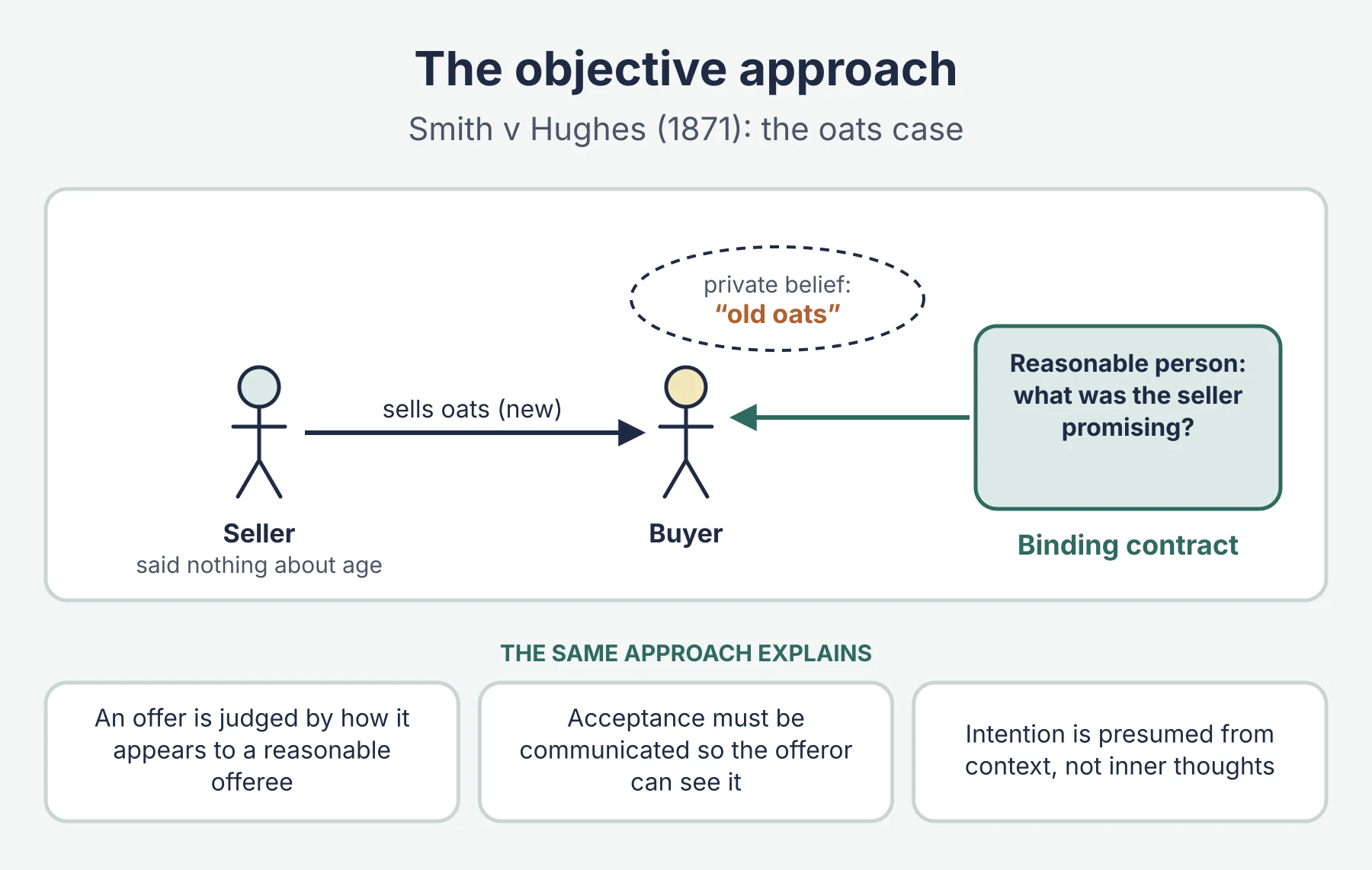
Courts judge agreement objectively: what would a reasonable person in the position of the other party understand from the words and conduct, not what one party privately meant. In Smith v Hughes (1871) a buyer bought oats thinking they were old oats, when they were new; the seller had said nothing about age. The court held that the buyer’s private mistake about the quality of the oats, which the seller had not caused, did not prevent a binding contract: the question was what a reasonable person would have understood the seller to be promising.
The objective approach explains several rules: an offer is judged by how it appears to a reasonable offeree; acceptance must be communicated in a way the offeror can see; and intention to create legal relations is presumed from the context rather than proved from inner thoughts.
Consumer or business?
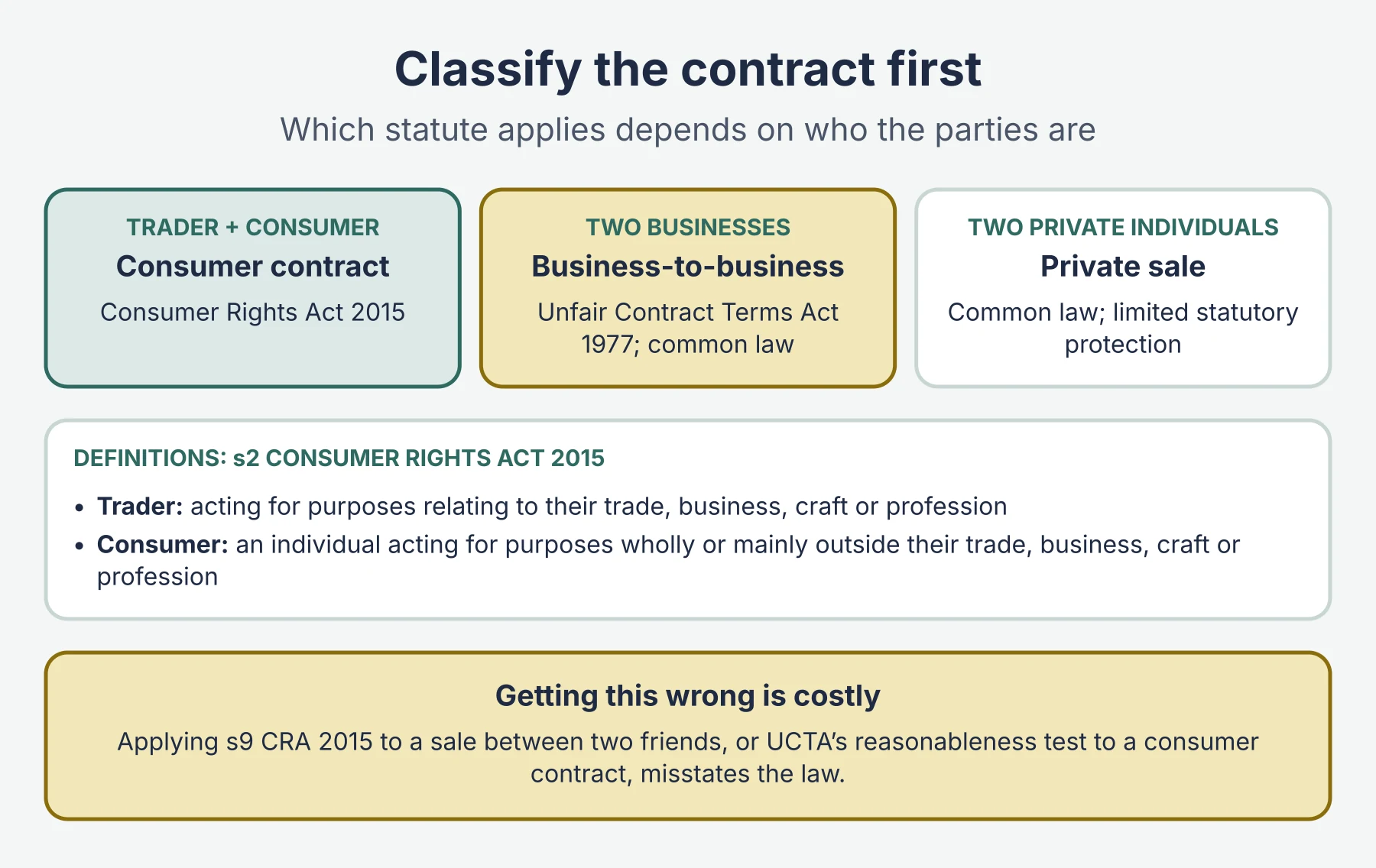
Many rules depend on the type of contract, so classify it early.
| Contract | Parties | Main statute |
|---|---|---|
| Consumer contract | A trader (acting for purposes relating to their trade, business, craft or profession) and a consumer (an individual acting for purposes wholly or mainly outside their trade, business, craft or profession): s2 Consumer Rights Act 2015 | Consumer Rights Act 2015 |
| Business-to-business | Two businesses | Unfair Contract Terms Act 1977; common law |
| Private sale | Two private individuals | Common law; limited statutory protection |
Getting this wrong is costly: applying s9 Consumer Rights Act 2015 to a sale between two friends, or UCTA’s reasonableness test to a consumer contract, misstates the law.
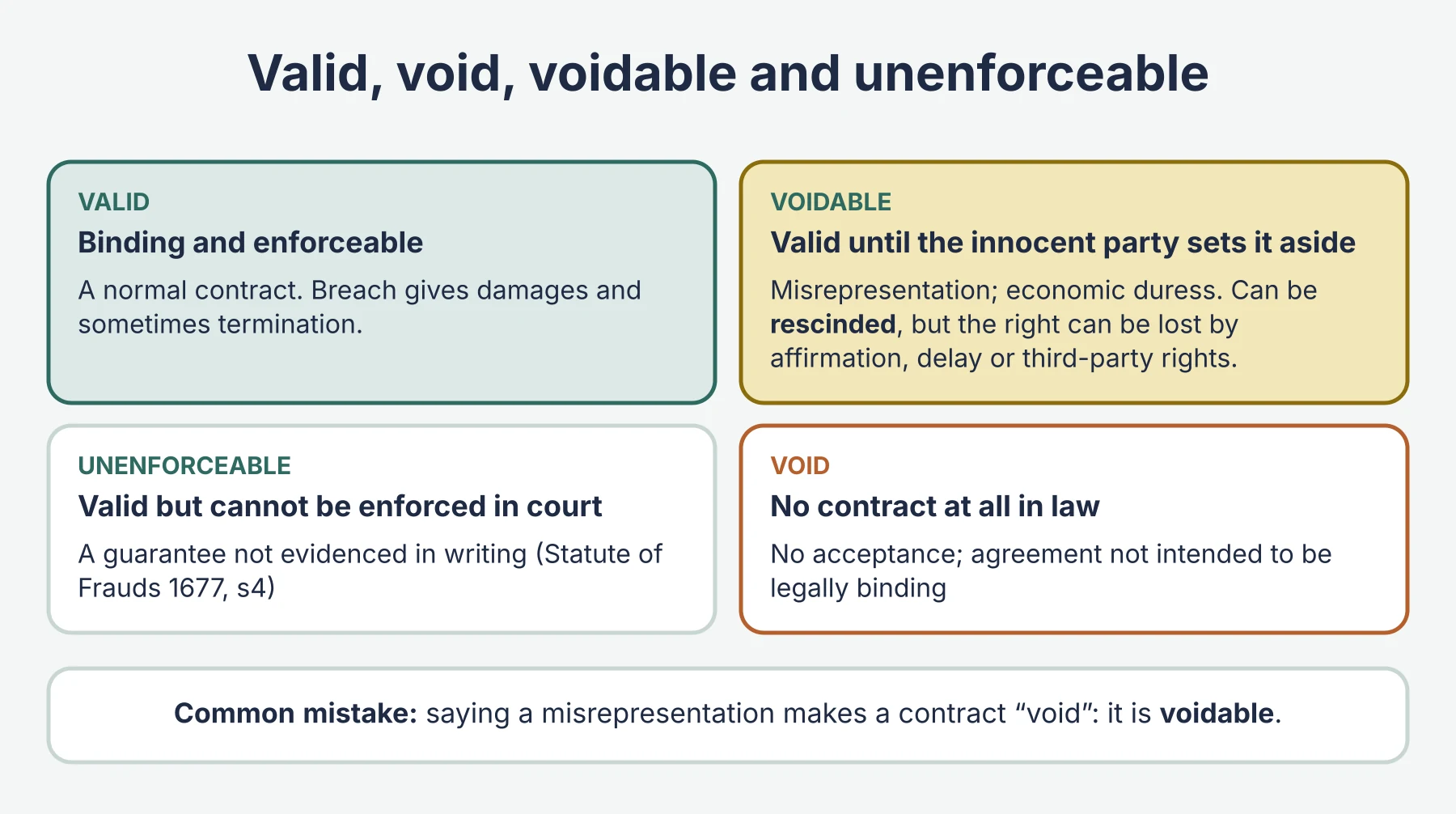
Valid, void, voidable and unenforceable
| Status | Meaning | Example |
|---|---|---|
| Valid | Binding and enforceable | Normal contract |
| Void | No contract at all in law | No acceptance; agreement not intended to be legally binding |
| Voidable | Valid until the innocent party chooses to set it aside | Misrepresentation; economic duress |
| Unenforceable | Valid but cannot be enforced in court | A guarantee not evidenced in writing (Statute of Frauds 1677, s4) |
The distinction controls remedies. A voidable contract can be rescinded, unwinding it, but the right can be lost through affirmation, delay or third-party rights. A breach of a valid contract gives damages and sometimes termination.
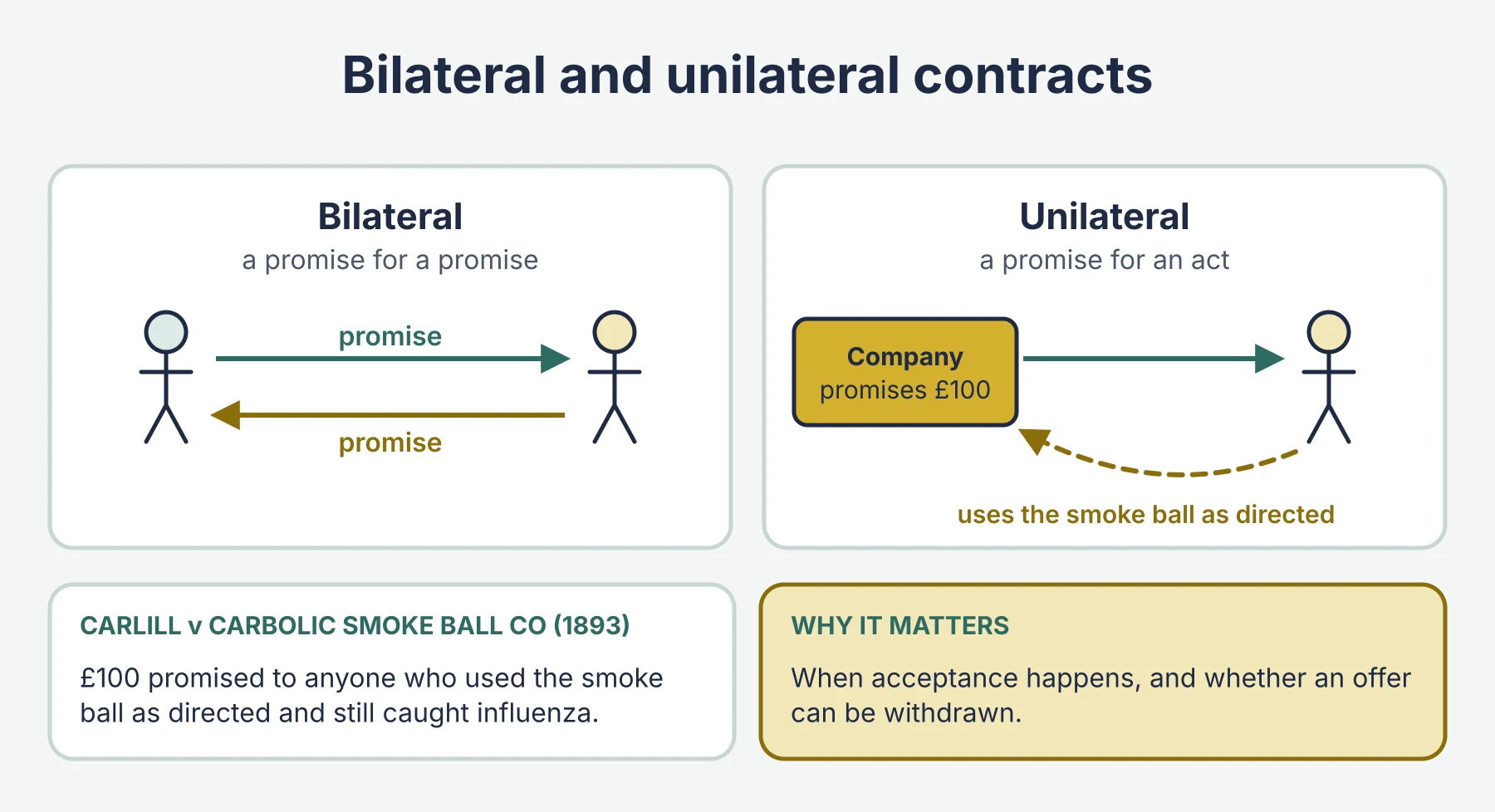
Bilateral and unilateral contracts
In a bilateral contract each side promises something: a promise is exchanged for a promise. In a unilateral contract one party promises in return for an act, as in Carlill, where the company promised £100 to anyone who used the smoke ball as directed and still caught influenza. The distinction matters for when acceptance happens and whether an offer can be withdrawn.
A method for problem questions
AQA contract problems reward working through the life of the contract in order, but only the stages the facts raise:
- Formation: offer, acceptance, consideration, intention. Skip if formation is not in doubt.
- Terms: what was agreed (express), what is added (implied, including by statute), and how important each term is.
- Breach or vitiating factor: did a party break a term, or was the contract flawed from the start?
- Exclusion clause: does any clause protect the party in breach?
- Discharge: has the contract ended by performance, breach or frustration?
- Remedies: what can the innocent party obtain?
- Conclude for each party.
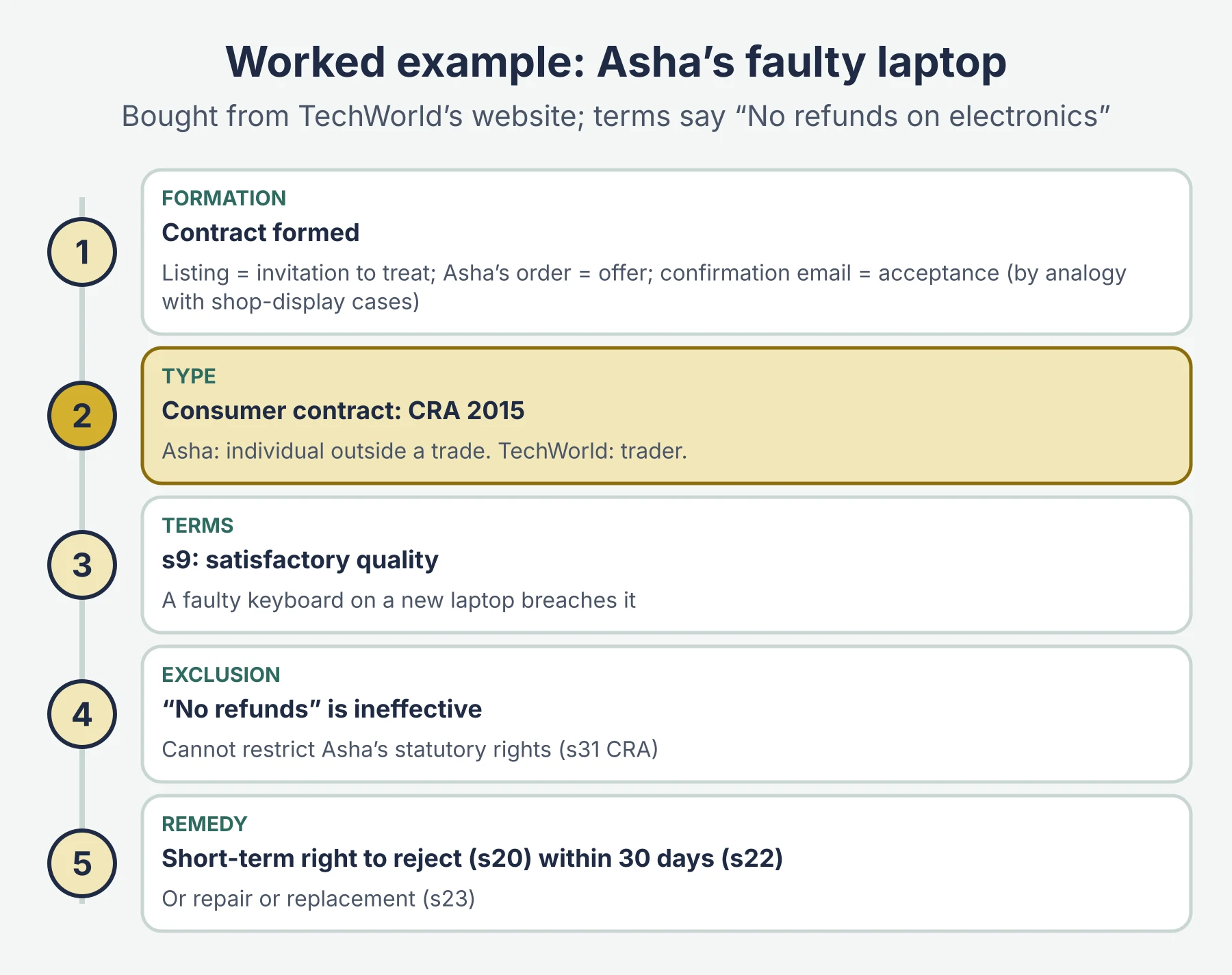
Worked example
Asha, a student, buys a laptop from TechWorld’s website for her studies. She clicks “Buy” and receives an email: “Your order is confirmed.” The laptop arrives with a faulty keyboard. TechWorld’s terms say “No refunds on electronics.”
Formation:   Website listing is an invitation to treat; Asha's order is the
             offer; confirmation email is acceptance (by analogy with the
             shop-display cases). Contract formed.
Type:        Asha - individual acting outside a trade; TechWorld - trader.
             Consumer contract: Consumer Rights Act 2015.
Terms:       s9 - goods must be of satisfactory quality; a faulty keyboard
             on a new laptop breaches it.
Exclusion:   "No refunds" cannot restrict Asha's statutory rights (s31 CRA).
Remedy:      Short-term right to reject (s20) within 30 days (s22); or
             repair or replacement (s23).
Conclusion:  Asha can reject the laptop for a full refund if she acts in time.
The answer works because it classifies the contract before choosing the statute, and moves through the stages in order.
Common mistakes
- Starting with remedies before showing there is a contract and a breach.
- Applying consumer statutes to private sales or business contracts.
- Saying a misrepresentation makes a contract “void”: it is voidable.
- Giving rules without authorities in a case-based subject.
- Discussing every stage at equal length instead of focusing on the issues in dispute.
Exam technique
Short “explain” questions on this row may ask about the sources of contract rules, the objective approach or the consumer/business distinction: give a definition, an authority and an example. In problem questions, the rules here are the skeleton of your answer. Headings such as “Formation”, “Terms” and “Remedies” make it easy for the examiner to follow your reasoning.
More resources on this topic
Rules of contract law revision notes | Rules of contract law practice questions | Theory of contract law study guide
Related resources
-
Practice questions
AQA A Level Law (7162): The Rules of Contract Law – Practice Questions
Original practice questions with mark-scheme answers on contract rule sources, the objective approach, consumer contracts and voidable status, AQA 7162.
Law · AQA · A Level
Try questions -
Revision notes
AQA A Level Law (7162): The Rules of Contract Law – Revision Notes
Recall notes on the sources of contract rules, the objective approach, consumer and business contracts, contract status and a problem method, AQA Law 7162.
Law · AQA · A Level
Revise topic -
Study guides
AQA A Level Law (7162): Theory of Contract Law
Freedom of contract and consumer protection, the postal rule, consideration, privity and duress, exemption clauses and remedies evaluated, AQA Law 7162.
Law · AQA · A Level
Read guide
Get free revision emails (optional)
Occasional emails with practice questions, worked explanations and links to free resources for the qualification and subjects you choose. No spam, and you can unsubscribe from any email. The free tools on this site never need an email.