
Revision Notes
AQA A Level Law (7162): The Rules of Contract Law – Revision Notes
Recall notes on the sources of contract rules, the objective approach, consumer and business contracts, contract status and a problem method, AQA Law 7162.
- Subject
- Law
- Level
- A LEVELS
- Topic
- Topic 4: Law of contract
- Author
- Marlbridge Academic Team
- Updated
- Reviewed by
- Aizaz Raoof Ali (what this means)
Aligned to AQA A Level Law (7162), For teaching from September 2017 onwards, A-level exams 2019 onwards. Official specification .
Syllabus page (what it covers and how it is assessed): AQA A Level Law.
Syllabus points this page covers
7162
- The rules of contract law
Found an error? Report a correction.
Need help with this topic? Request a free trial class for A Level Law (7162).
Condensed notes for the section 3.4 row The rules of contract law: “rules and principles of contract law concerning formation, terms, vitiating factors, discharge of a contract and associated remedies”. These notes cover the framework; the detailed rules are in each area’s own notes. For explanation and a worked example, use the rules of contract law study guide.
The five areas in order
FORMATION -> TERMS -> VITIATING FACTORS -> DISCHARGE -> REMEDIES
offer        express     misrepresentation   performance   damages
acceptance   implied     economic duress     breach        specific performance
consideration conditions                     frustration   rescission
intention    exclusion                                      termination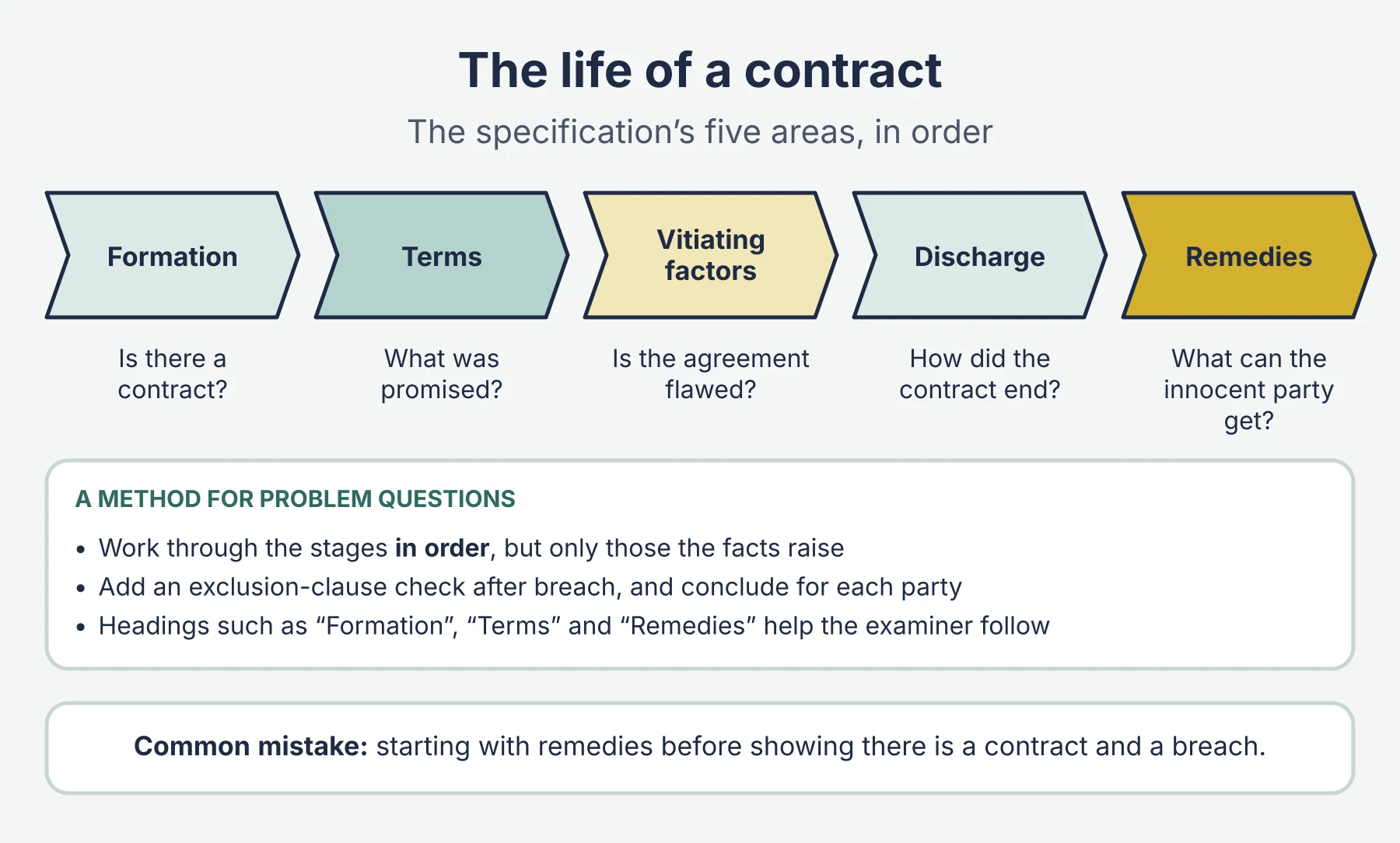
Sources at a glance
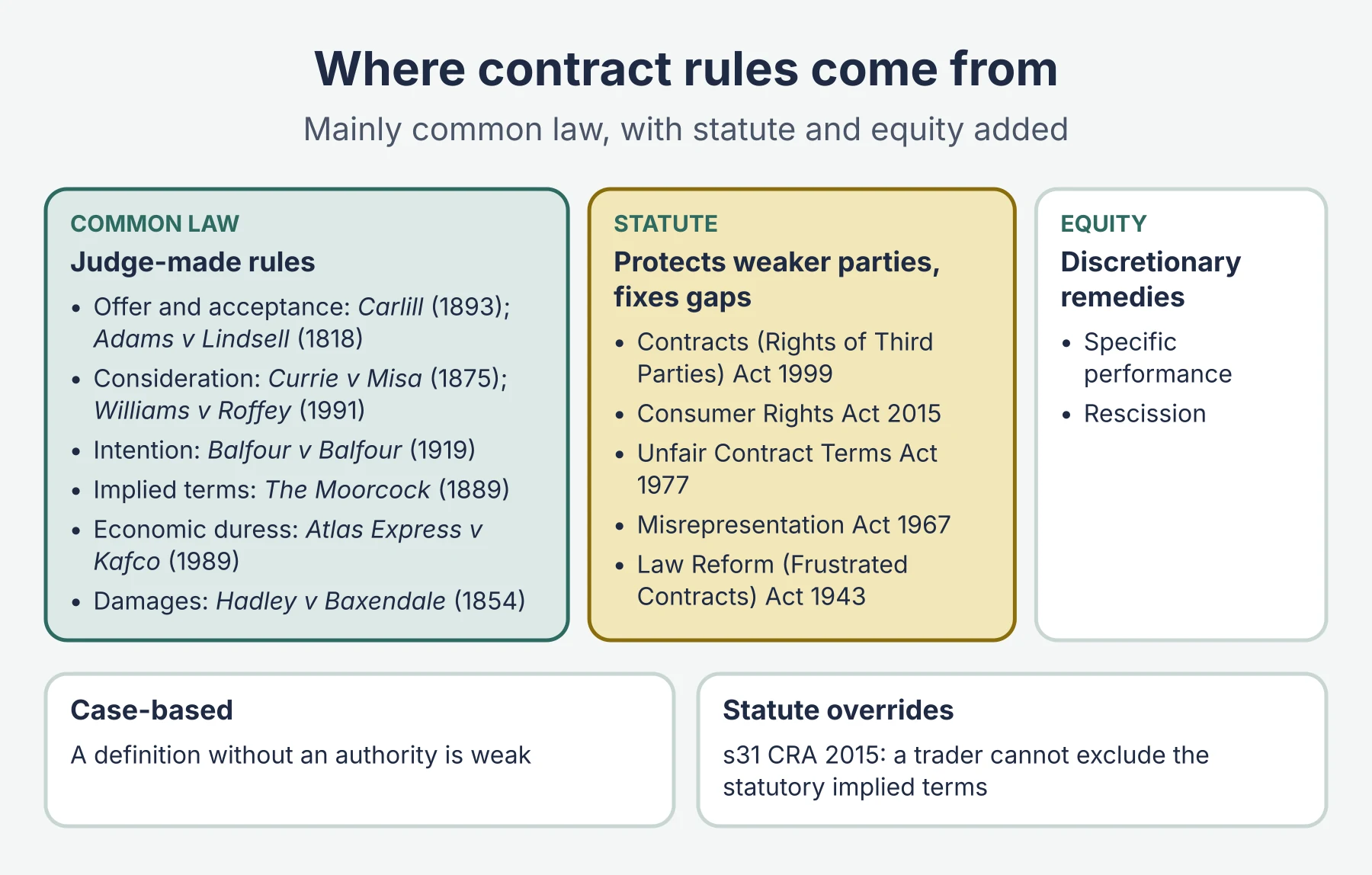
Mainly common law: offer and acceptance; consideration; intention to create legal relations; express and implied-in-fact terms; classification of terms; incorporation and construction of exclusion clauses; economic duress; frustration; damages.
Equity: specific performance; rescission; promissory estoppel.
Statute:
- Consumer Rights Act 2015: implied terms (ss9–11, 49, 52), remedies (ss20, 23, 24, 55, 56), exclusion controls (ss31, 57, 65).
- Unfair Contract Terms Act 1977: exclusion clauses in business contracts (ss2, 3).
- Misrepresentation Act 1967: s2(1) damages for negligent misrepresentation; s2(2) damages in lieu of rescission.
- Contracts (Rights of Third Parties) Act 1999: third-party enforcement.
- Law Reform (Frustrated Contracts) Act 1943: money after frustration.
Statute overrides common law: for example s31 CRA 2015 prevents exclusion of the consumer implied terms.
Burden and standard
Claimant  ---- contract, terms, breach ---- balance of probabilities
Defendant ---- vitiating factor / frustration / exclusion ---- balance of probabilities
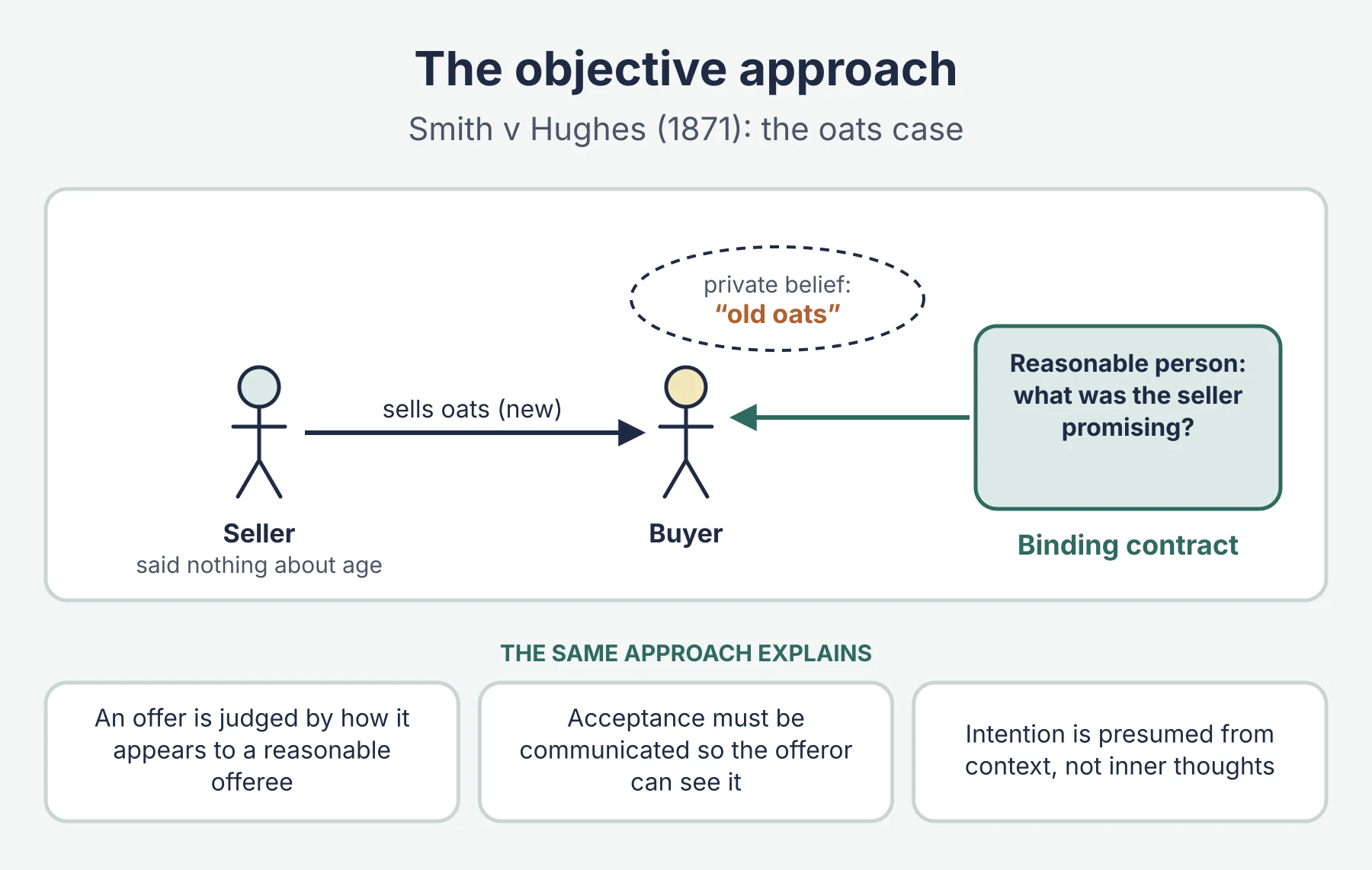
The objective approach
- Agreement judged by what a reasonable person would understand from words and conduct.
- Smith v Hughes (1871): buyer’s private mistake about old and new oats did not prevent a contract.
- Explains rules on offers, communication of acceptance and presumptions about intention.
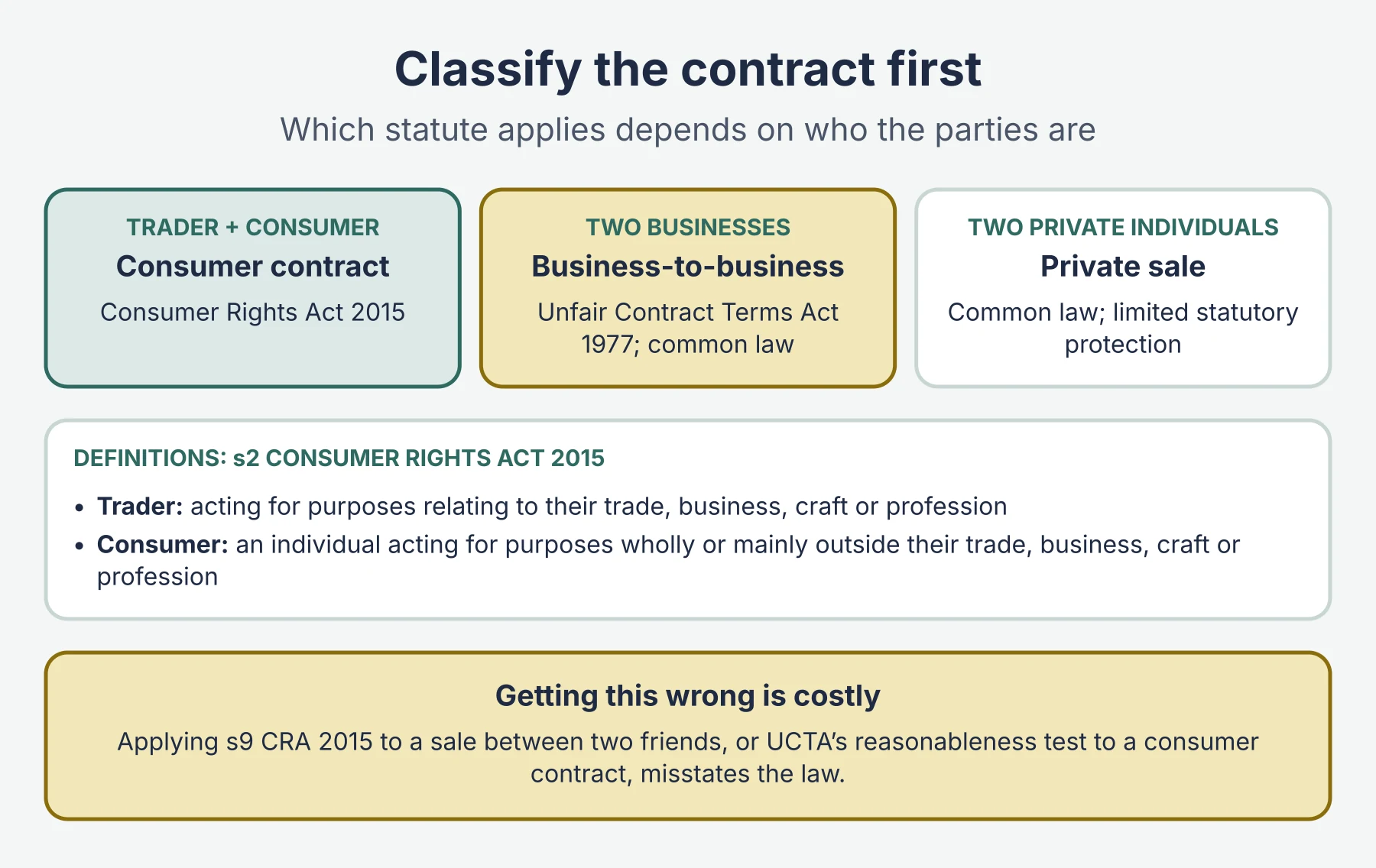
Consumer or business?
| Term | Definition (s2 CRA 2015) |
|---|---|
| Trader | Person acting for purposes relating to their trade, business, craft or profession |
| Consumer | Individual acting for purposes wholly or mainly outside their trade, business, craft or profession |
| Contract type | Governing rules |
|---|---|
| Trader to consumer | Consumer Rights Act 2015 |
| Business to business | UCTA 1977 and common law |
| Private individuals | Common law |
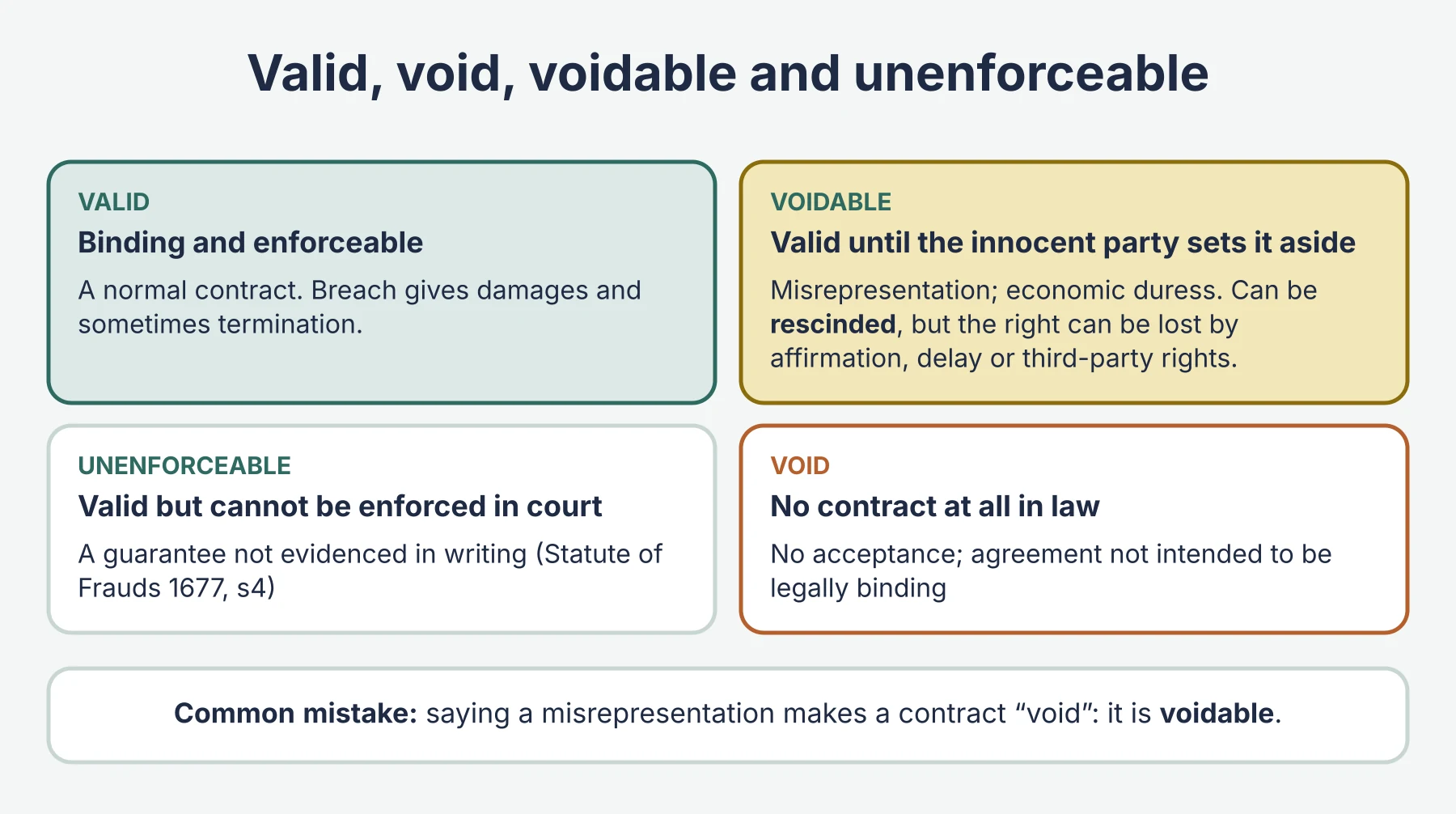
Status of contracts
| Status | Meaning | Example |
|---|---|---|
| Valid | Binding and enforceable | Ordinary contract |
| Void | No contract in law | No intention to create legal relations |
| Voidable | Valid until set aside by innocent party | Misrepresentation; economic duress |
| Unenforceable | Valid but not enforceable in court | Guarantee not evidenced in writing (Statute of Frauds 1677, s4) |
Rescission (for voidable contracts) can be lost through affirmation, delay or third-party rights.
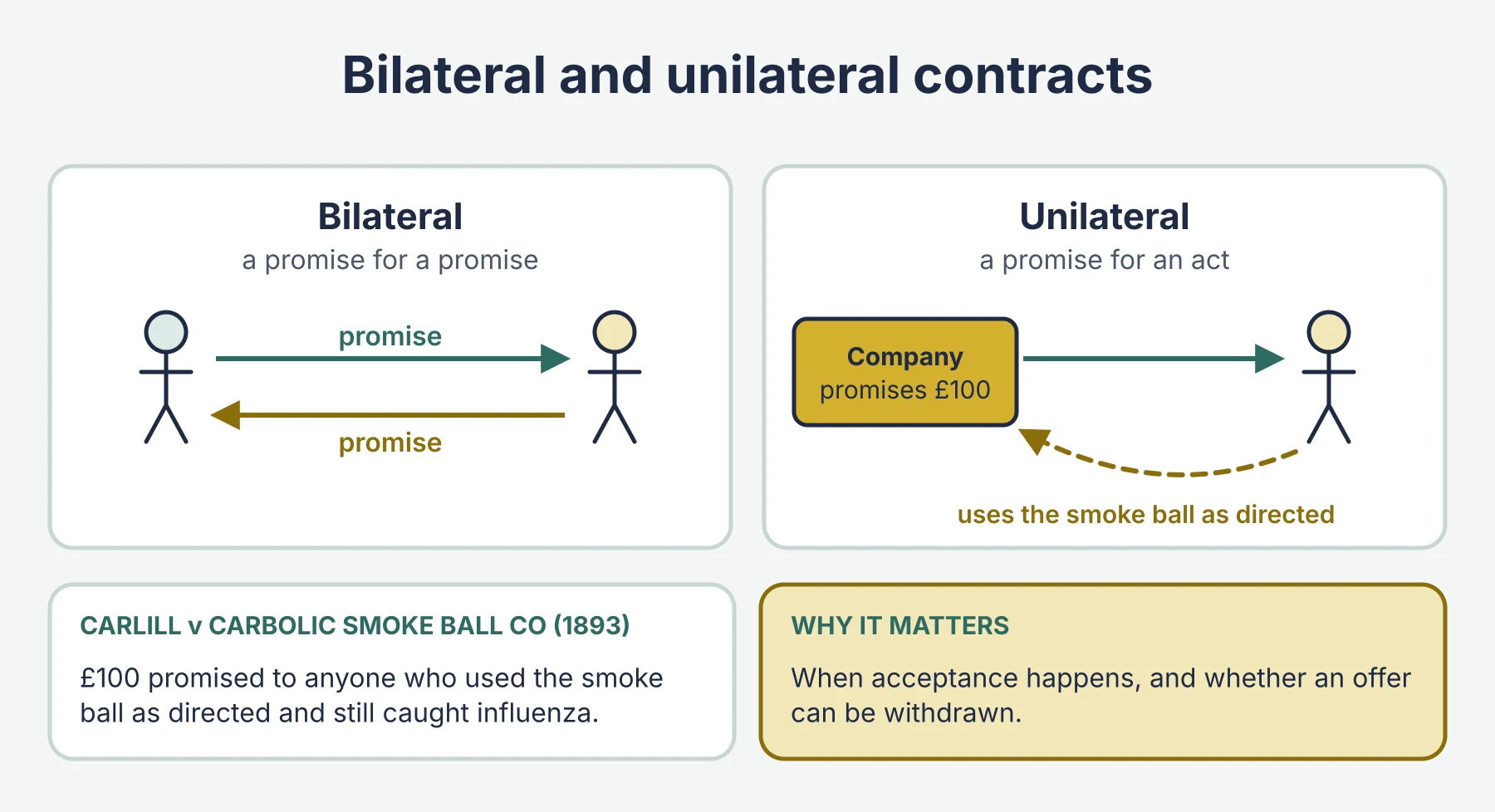
Bilateral and unilateral
| Bilateral | Unilateral |
|---|---|
| Promise for a promise | Promise for an act |
| Most commercial and consumer sales | Rewards; Carlill v Carbolic Smoke Ball Co (1893) |
| Accepted by communicating agreement | Accepted by performing the act |
Problem method
- Formation (only if in doubt).
- Terms: express, implied, statutory; classify.
- Breach or vitiating factor.
- Exclusion clause.
- Discharge.
- Remedies.
- Conclude for each party.
Choosing the right authority
| Issue in the facts | Go to | Typical authority |
|---|---|---|
| Was there an offer or only an invitation? | Formation | Pharmaceutical Society v Boots (1953) |
| Was a statement a term or a representation? | Terms | Bannerman v White (1861) |
| Faulty goods bought from a trader | Consumer statutory terms | s9 CRA 2015 |
| A clause limiting liability | Exclusion clauses | Olley v Marlborough Court (1949); UCTA 1977 |
| A false statement before the contract | Misrepresentation | Misrepresentation Act 1967 |
| An event making performance impossible | Frustration | Taylor v Caldwell (1863) |
Key terms
| Term | Meaning |
|---|---|
| Common law | Law made by judges through precedent |
| Equity | Body of discretionary rules and remedies developed to supplement the common law |
| Objective approach | Judging agreement by the view of a reasonable person |
| Consumer | Individual acting wholly or mainly outside their trade |
| Trader | Person acting for business purposes |
| Void | Of no legal effect |
| Voidable | Valid until rescinded by the innocent party |
| Rescission | Setting a contract aside and restoring the parties to their original positions |
| Unilateral contract | A promise in return for an act |
Exam traps
- Classify the contract (consumer or business) before choosing a statute.
- Misrepresentation and duress make a contract voidable, not void.
- Do not start with remedies: show the contract and the breach first.
- Use authorities: contract is case-based.
- Spend time on the stage the facts actually dispute.
Self-test
- List the five areas named in the specification row. Formation, terms, vitiating factors, discharge and remedies.
- Name two areas of contract that are mainly common law. Any two: offer and acceptance, consideration, intention, frustration, damages, economic duress.
- Which Act governs exclusion clauses in business-to-business contracts? The Unfair Contract Terms Act 1977.
- What does the 1999 Act allow? A third party to enforce a term in certain circumstances.
- What standard of proof applies in contract claims? Balance of probabilities.
- What is the objective approach? Agreement is judged by what a reasonable person would understand.
- What did Smith v Hughes decide? A party’s private mistake, not caused by the other, does not prevent a binding contract.
- Define “consumer” under s2 CRA 2015. An individual acting for purposes wholly or mainly outside their trade, business, craft or profession.
- What is the difference between void and voidable? Void: no contract; voidable: valid until set aside.
- Give an example of a voidable contract. One induced by misrepresentation or economic duress.
- How is a unilateral contract accepted? By performing the requested act.
- Which section prevents exclusion of the CRA implied terms? s31 Consumer Rights Act 2015.
More resources on this topic
Rules of contract law practice questions | Law of contract revision notes
Related resources
-
Study guides
AQA A Level Law (7162): Theory of Contract Law
Freedom of contract and consumer protection, the postal rule, consideration, privity and duress, exemption clauses and remedies evaluated, AQA Law 7162.
Law · AQA · A Level
Read guide -
Practice questions
AQA A Level Law (7162): Theory of Contract Law – Practice Questions
Original practice questions with mark-scheme answers on freedom of contract, the postal rule, consideration, privity, duress and remedies, AQA Law 7162.
Law · AQA · A Level
Try questions -
Revision notes
AQA A Level Law (7162): Theory of Contract Law – Revision Notes
Recall notes on freedom of contract, consumer protection, the postal rule, consideration, privity, duress, exemption clauses and remedies for AQA Law 7162.
Law · AQA · A Level
Revise topic
Get free revision emails (optional)
Occasional emails with practice questions, worked explanations and links to free resources for the qualification and subjects you choose. No spam, and you can unsubscribe from any email. The free tools on this site never need an email.