
Study Guides
AQA A Level Law (7162): Theory of Contract Law
Freedom of contract and consumer protection, the postal rule, consideration, privity and duress, exemption clauses and remedies evaluated, AQA Law 7162.
- Subject
- Law
- Level
- A LEVELS
- Topic
- Topic 4: Law of contract
- Author
- Marlbridge Academic Team
- Updated
- Reviewed by
- Aizaz Raoof Ali (what this means)
Aligned to AQA A Level Law (7162), For teaching from September 2017 onwards, A-level exams 2019 onwards. Official specification .
Syllabus page (what it covers and how it is assessed): AQA A Level Law.
Syllabus points this page covers
7162
- Theory of contract law
Found an error? Report a correction.
Need help with this topic? Request a free trial class for A Level Law (7162).
This guide covers the section 3.4 row Theory of contract law in AQA A-level Law (7162). The specification asks for “analysis and evaluation of the voluntary nature of a contract and of principles governing contract law”, with an outline of five issues: freedom of contract against the need to protect consumers; offers, unilateral offers and invitations to treat, and the rationale for the postal rule and its relationship to electronic communications; the rationale for consideration and its relationships with privity and economic duress; the nature and effectiveness of exemption clauses; and the nature and effectiveness of remedies, especially consumer remedies. The rules are in the Law of contract study guide; this page explains why they exist and how to evaluate them.
The voluntary nature of contract
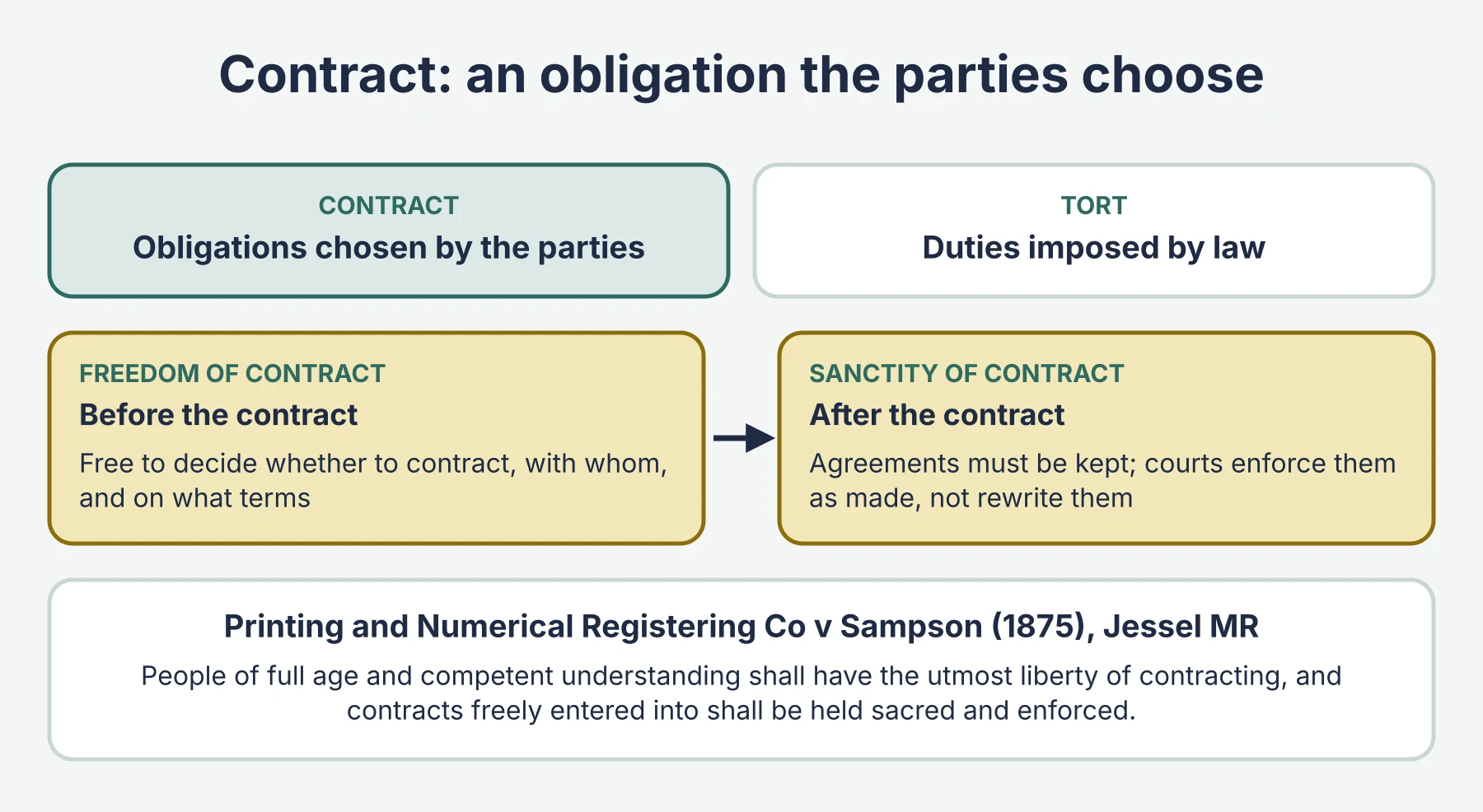
A contract is an obligation the parties choose to take on. This is what separates it from tort, where duties are imposed by law. Two ideas follow:
- Freedom of contract: people are free to decide whether to contract, with whom, and on what terms.
- Sanctity of contract: once made, agreements must be kept, and courts enforce them as made rather than rewriting them.
The classic statement is Sir George Jessel MR in Printing and Numerical Registering Co v Sampson (1875): if there is one thing more than another public policy requires, it is that people of full age and competent understanding shall have the utmost liberty of contracting, and that their contracts freely entered into shall be held sacred and enforced by the courts.
Issue 1: freedom of contract and consumer protection
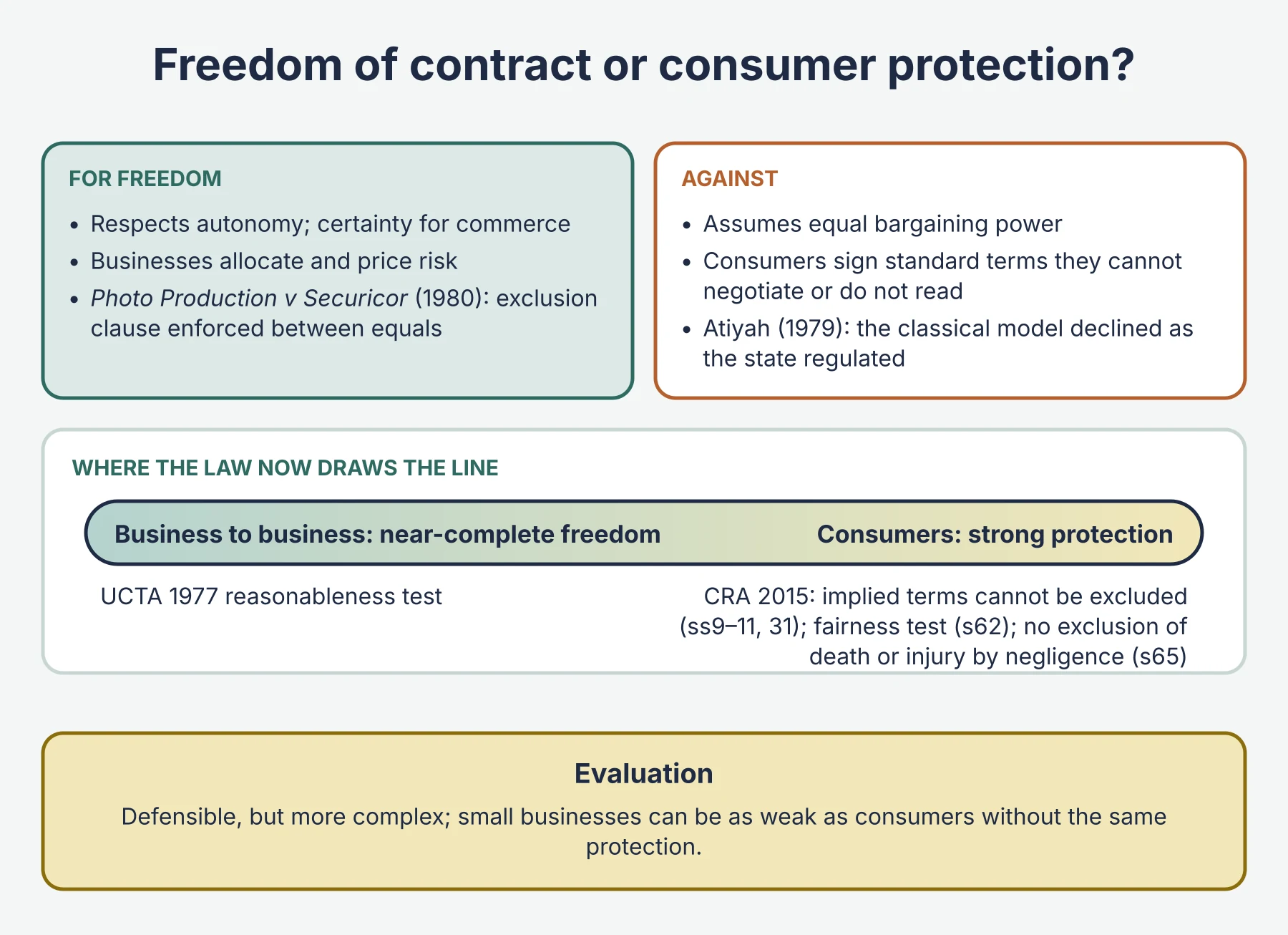
For freedom of contract. It respects individual autonomy, gives certainty to commercial dealing, and lets businesses allocate risk and price it. In Photo Production v Securicor (1980) the House of Lords enforced an exclusion clause between businesses of equal bargaining power, stressing that commercial parties should be free to allocate risk as they choose.
Against it. Freedom assumes equal bargaining power. Consumers usually contract on standard terms they cannot negotiate and often do not read. P.S. Atiyah’s The Rise and Fall of Freedom of Contract (1979) argued that the classical model had declined as the state increasingly regulated contracts to protect weaker parties.
The law’s response. Parliament now protects consumers through:
- implied terms that cannot be excluded (Consumer Rights Act 2015, ss9–11, 31);
- a fairness test for consumer terms (s62) and a ban on excluding liability for death or personal injury caused by negligence (s65);
- controls on exclusion clauses in business contracts through the reasonableness test (Unfair Contract Terms Act 1977).
Evaluation. The law now draws a line: near-complete freedom between businesses, strong protection for consumers. This is defensible, but it makes the law more complex, and small businesses can be in as weak a position as consumers without the same protection.
Issue 2: offers, invitations to treat and the postal rule
Offers and invitations to treat
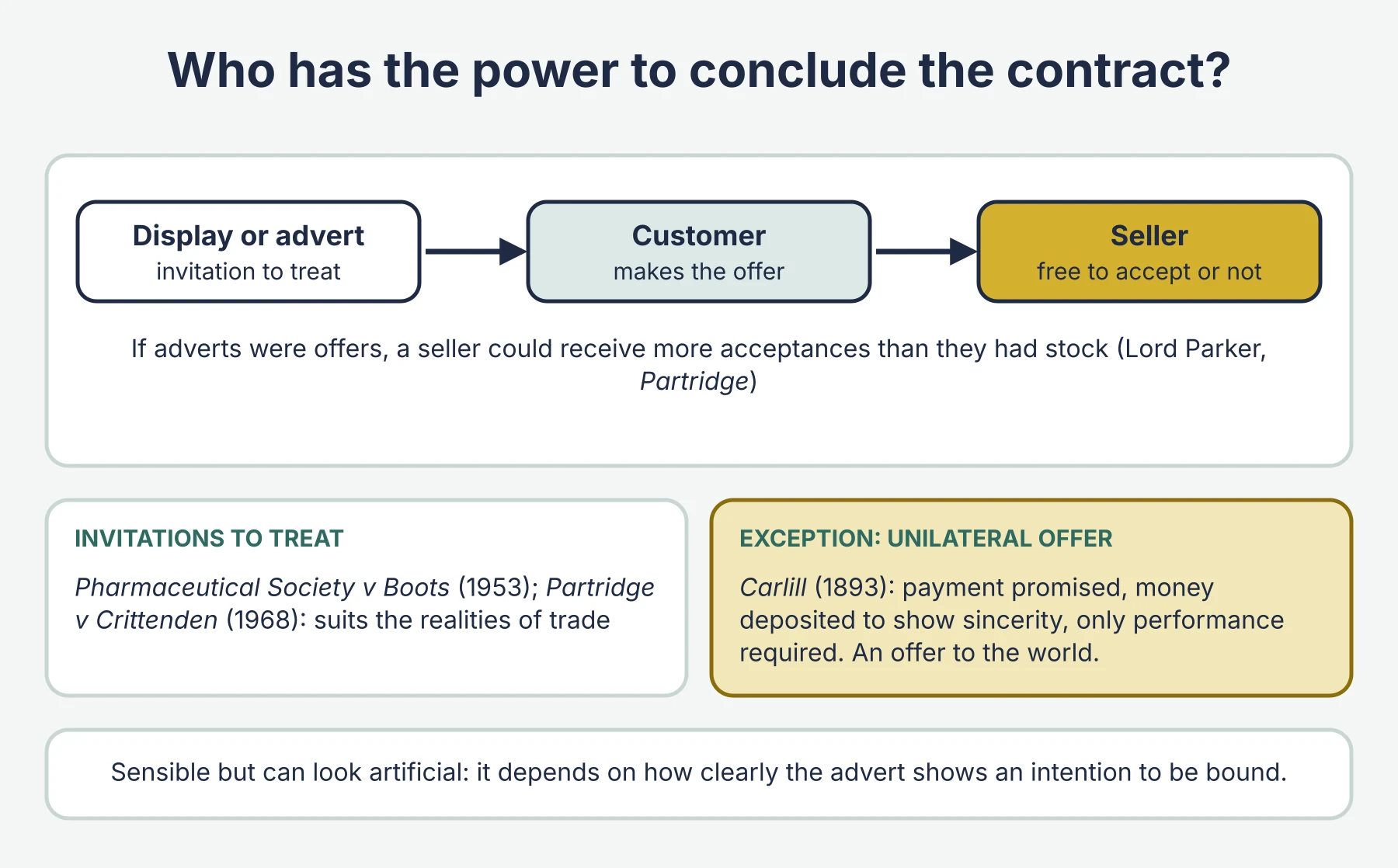
The distinction decides who has the power to conclude the contract. If displays and adverts were offers, a shop could be bound to sell more than it had, or to sell to anyone. Treating them as invitations to treat (Pharmaceutical Society v Boots, 1953; Partridge v Crittenden, 1968) leaves the seller free to decide, which suits the realities of trade. Lord Parker in Partridge reasoned that an advertisement could not be an offer because the seller might receive more acceptances than they had stock.
Unilateral offers are the exception. In Carlill v Carbolic Smoke Ball Co (1893) the advertisement promised payment, stated that money had been deposited with a bank to show sincerity, and required only performance. The court treated it as an offer to the world, protecting people who relied on such promises. The distinction is sensible but can look artificial: whether an advert is an offer depends on how clearly it shows an intention to be bound.
The postal rule
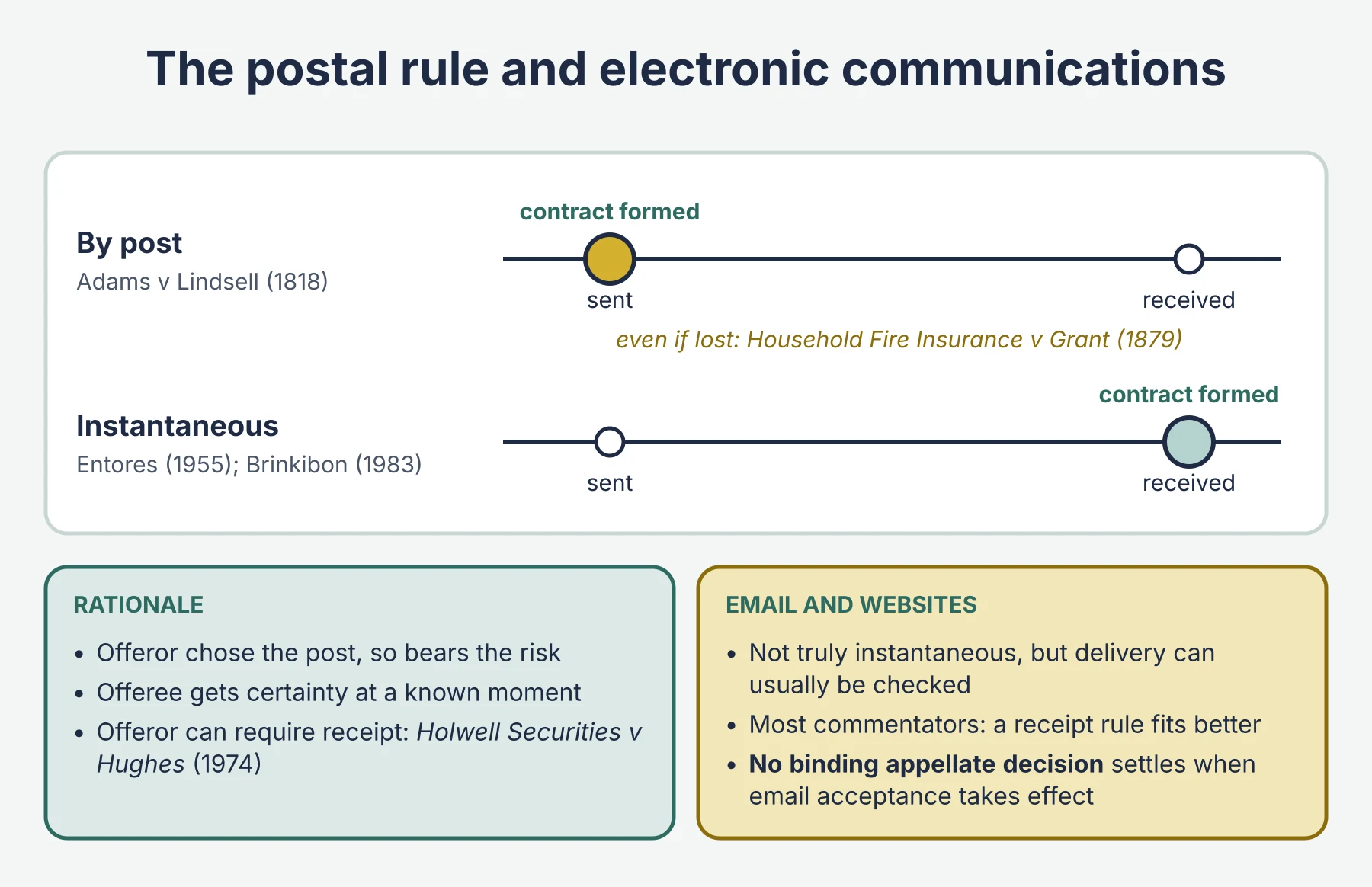
Under the postal rule, acceptance by post takes effect when the letter is posted (Adams v Lindsell, 1818), even if it never arrives (Household Fire Insurance v Grant, 1879).
Rationale.
- The offeror chose, or impliedly accepted, the post as a method, so should bear the risk of delay or loss.
- It gives the offeree certainty at a known moment and allows them to act on the contract straight away.
- The offeror can protect themselves by stating that acceptance must be received: in Holwell Securities v Hughes (1974) an option to be exercised “by notice in writing” required actual receipt.
Relationship with electronic communications. For instantaneous methods, acceptance takes effect when it is received (Entores v Miles Far East, 1955), and in Brinkibon v Stahag Stahl (1983) the House of Lords applied this to telex, noting that no universal rule could cover every case, which depends on the parties’ intentions and where the risk should lie. Email and website orders raise the question again. They are not truly instantaneous, but the sender can usually check delivery, so most commentators argue that the reasons for the postal rule do not apply and that a receipt rule fits better. There is no binding appellate decision settling exactly when an email acceptance takes effect.
Evaluation. The postal rule was a practical solution for nineteenth-century communications. It is now rarely relevant, and its survival shows the courts’ preference for certainty, though applying it to email would place the risk on the wrong party.
Issue 3: consideration, privity and economic duress
Why consideration?
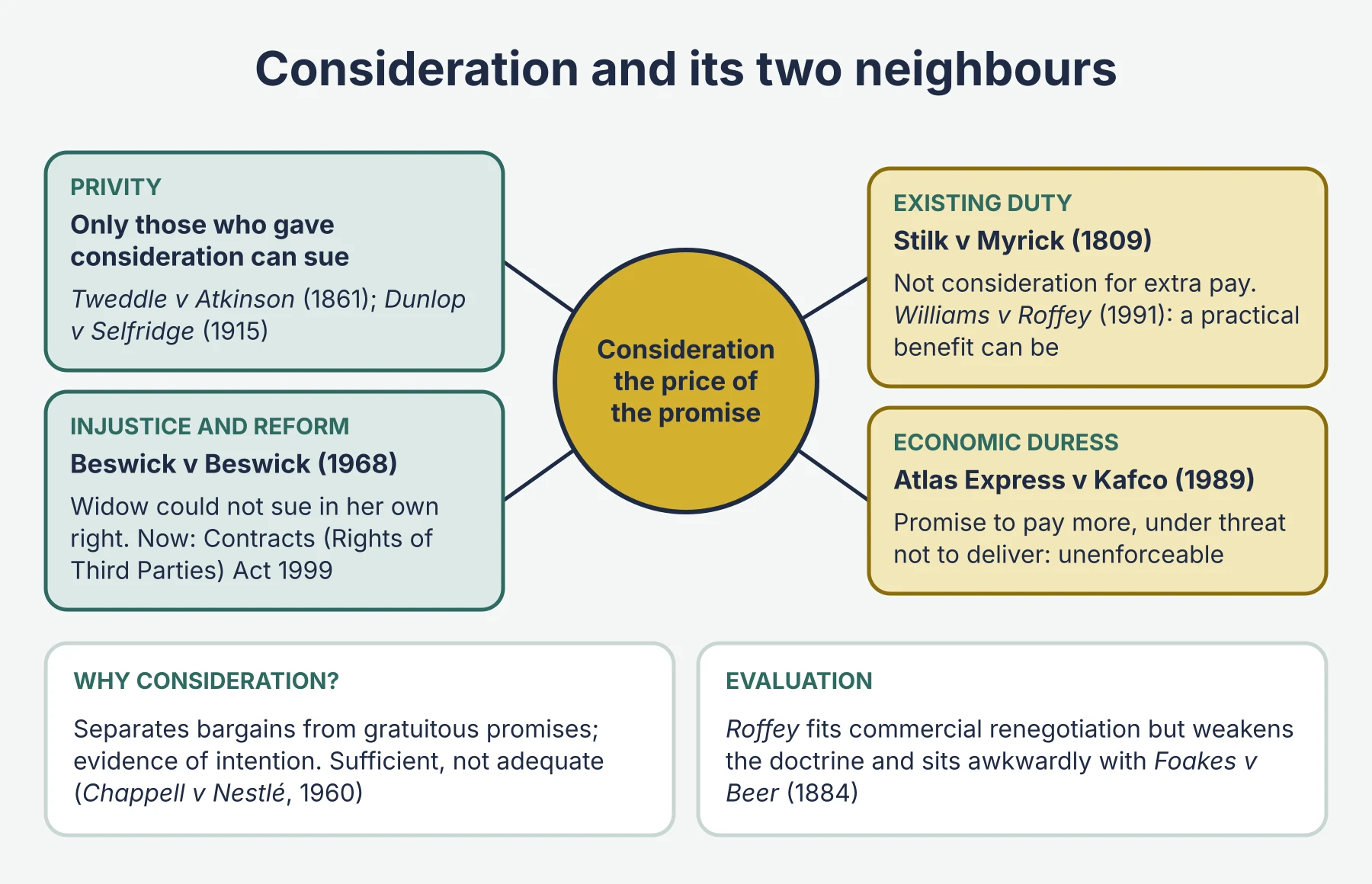
Consideration distinguishes bargains, which the law enforces, from gratuitous promises, which it does not. It has been described as the price for which the promise of the other is bought (Dunlop v Selfridge, 1915). It also acts as evidence that the parties meant to be bound. The rule that consideration must be sufficient but need not be adequate (Chappell v Nestlé, 1960) respects freedom of contract: courts do not judge whether a bargain was a good one.
Consideration and privity
Privity means only parties to a contract can sue on it. It is linked to consideration because only someone who has given consideration has “bought” the promise (Tweddle v Atkinson, 1861; Dunlop v Selfridge, 1915). The result could be unjust: in Beswick v Beswick (1968) a widow could not sue in her own right on her husband’s contract that promised her an annuity, although she succeeded as administratrix of his estate. The Contracts (Rights of Third Parties) Act 1999 now lets a third party enforce a term if the contract expressly allows it or the term purports to confer a benefit on them, unless the parties did not intend it to be enforceable by them.
Consideration and economic duress
Performing an existing contractual duty traditionally is not consideration for a promise of extra payment (Stilk v Myrick, 1809). In Williams v Roffey Bros (1991) the Court of Appeal held that a practical benefit can be consideration, provided the promise was not obtained by fraud or economic duress. Duress now carries much of the protective work consideration once did: in Atlas Express v Kafco (1989) a promise to pay more, extracted by a carrier threatening not to deliver, was unenforceable both for lack of consideration and because of economic duress.
Evaluation. Williams v Roffey fits commercial reality, where renegotiation is common. But it weakens the doctrine of consideration, and it sits awkwardly with Foakes v Beer (1884), under which part payment of a debt is still not consideration for forgiving the rest.
Issue 4: the nature and effectiveness of exemption clauses
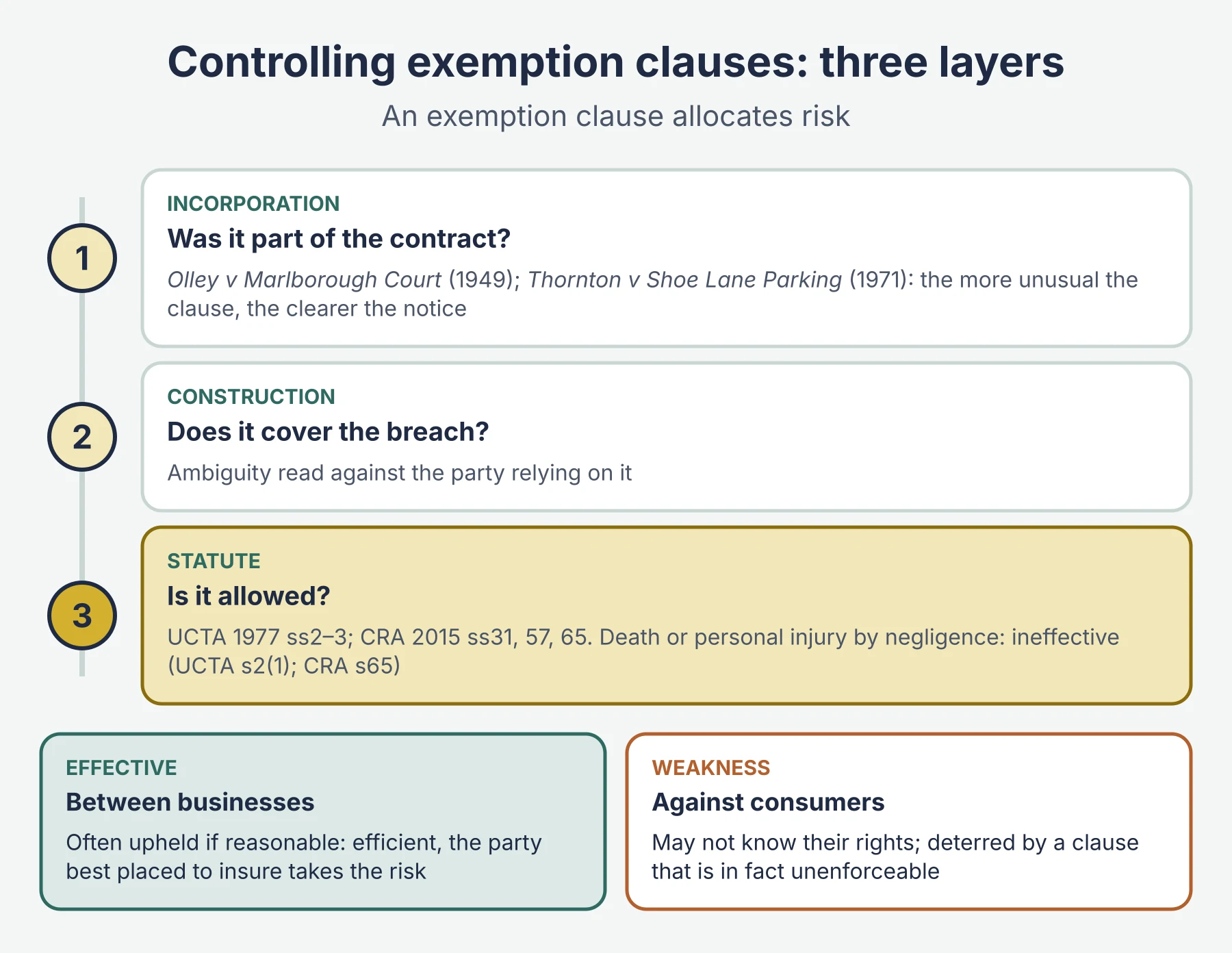
An exemption (exclusion or limitation) clause allocates risk. Between businesses it can be efficient: the party best placed to insure takes the risk, and the price reflects it. Against consumers it can remove the rights the contract appears to give.
The law controls them in three layers: incorporation (Olley v Marlborough Court, 1949; Thornton v Shoe Lane Parking, 1971, where Lord Denning said the more unusual the clause, the clearer the notice must be), construction (ambiguity read against the party relying on it), and statute (UCTA 1977 ss2–3; CRA 2015 ss31, 57, 65).
Effectiveness. Clauses excluding liability for death or personal injury caused by negligence are ineffective in business contexts (UCTA s2(1)) and against consumers (CRA s65). Clauses in business contracts are often upheld if reasonable, which supports freedom of contract. The weakness is that consumers may not know their rights and may be deterred by a clause that is in fact unenforceable.
Issue 5: the nature and effectiveness of remedies
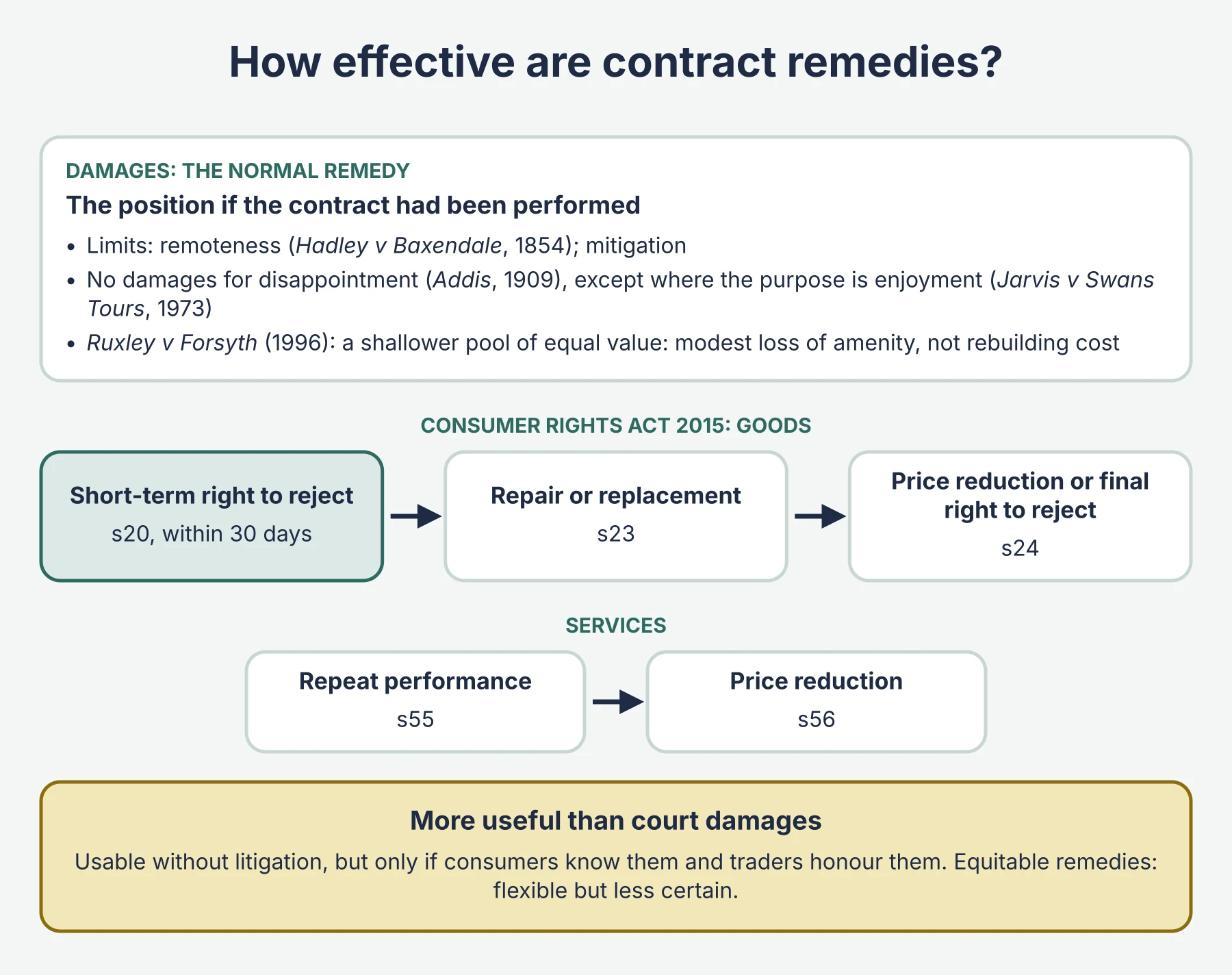
Damages are the normal remedy and aim to put the claimant in the position they would have been in had the contract been performed. Limits include remoteness (Hadley v Baxendale, 1854) and mitigation. Damages for disappointment are generally not available (Addis v Gramophone, 1909), although they are for contracts whose purpose is enjoyment (Jarvis v Swans Tours, 1973). In Ruxley Electronics v Forsyth (1996) a swimming pool built shallower than agreed but no less valuable led to a modest award for loss of amenity rather than the full cost of rebuilding.
Equitable remedies (specific performance, rescission) are discretionary, which gives flexibility but less certainty.
Consumer remedies under the Consumer Rights Act 2015 are designed to be simple and practical: a short-term right to reject (s20) within 30 days, repair or replacement (s23), then a price reduction or final right to reject (s24); for services, repeat performance (s55) or a price reduction (s56). These are more useful to most consumers than court damages, because they can be used without litigation. Their effectiveness depends on consumers knowing them and traders honouring them.
Common mistakes
- Describing rules without the reason for them.
- Treating freedom of contract as either wholly good or wholly outdated.
- Saying the postal rule applies to emails as settled law.
- Forgetting that economic duress links to consideration through Williams v Roffey.
Exam technique
The command words for this row are usually “explain”, “discuss” or “evaluate”. Structure each point as: the rule, the reason for it, a case, a criticism, and a short judgement. Paper 3 essays reward a clear line of argument across the answer, not a list of isolated points.
More resources on this topic
Theory of contract law revision notes | Theory of contract law practice questions | Rules of contract law study guide
Related resources
-
Practice questions
AQA A Level Law (7162): Theory of Contract Law – Practice Questions
Original practice questions with mark-scheme answers on freedom of contract, the postal rule, consideration, privity, duress and remedies, AQA Law 7162.
Law · AQA · A Level
Try questions -
Revision notes
AQA A Level Law (7162): Theory of Contract Law – Revision Notes
Recall notes on freedom of contract, consumer protection, the postal rule, consideration, privity, duress, exemption clauses and remedies for AQA Law 7162.
Law · AQA · A Level
Revise topic -
Study guides
AQA A Level Law (7162): Vitiating factors
Misrepresentation and economic duress for AQA A Level Law 7162: what counts as a misrepresentation, the three types, rescission, damages and the duress tests.
Law · AQA · A Level
Read guide
Get free revision emails (optional)
Occasional emails with practice questions, worked explanations and links to free resources for the qualification and subjects you choose. No spam, and you can unsubscribe from any email. The free tools on this site never need an email.