
Revision Notes
AQA A Level Law (7162): Theory of Contract Law – Revision Notes
Recall notes on freedom of contract, consumer protection, the postal rule, consideration, privity, duress, exemption clauses and remedies for AQA Law 7162.
- Subject
- Law
- Level
- A LEVELS
- Topic
- Topic 4: Law of contract
- Author
- Marlbridge Academic Team
- Updated
- Reviewed by
- Aizaz Raoof Ali (what this means)
Aligned to AQA A Level Law (7162), For teaching from September 2017 onwards, A-level exams 2019 onwards. Official specification .
Syllabus page (what it covers and how it is assessed): AQA A Level Law.
Syllabus points this page covers
7162
- Theory of contract law
Found an error? Report a correction.
Need help with this topic? Request a free trial class for A Level Law (7162).
Condensed notes for the section 3.4 row Theory of contract law: “analysis and evaluation of the voluntary nature of a contract and of principles governing contract law”, with an outline of five issues. For explanation and evaluation, use the theory of contract law study guide.
The five issues in one line each
- Freedom of contract v consumer protection: autonomy and certainty against inequality of bargaining power.
- Offers, invitations to treat and the postal rule: who controls conclusion of the contract; who bears the risk of communication failure.
- Consideration, privity and duress: consideration marks a bargain; privity follows from it; duress now polices renegotiation.
- Exemption clauses: risk allocation, controlled by incorporation, construction and statute.
- Remedies: damages, equitable remedies and simple statutory consumer remedies.
Voluntary nature
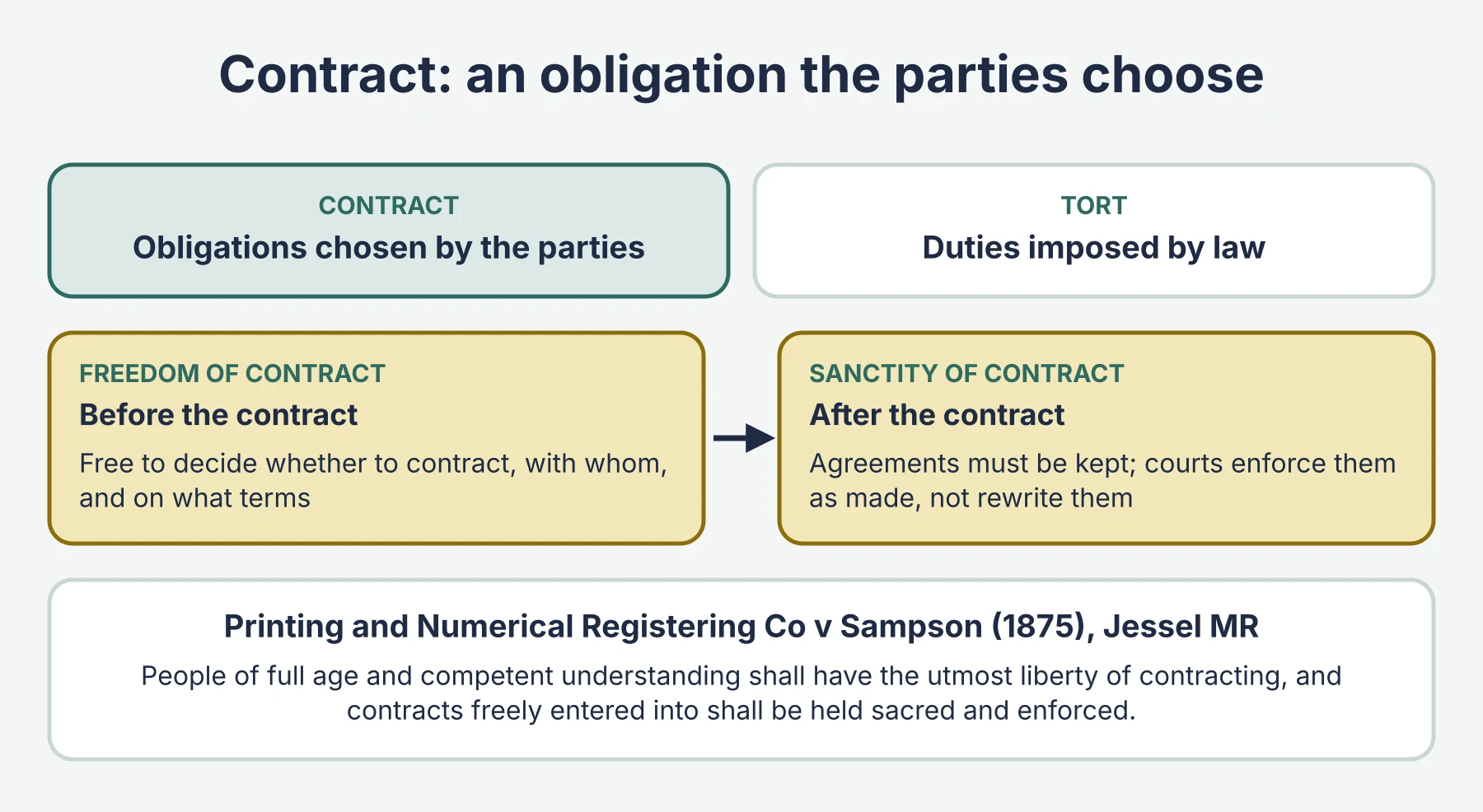
- Contract obligations are chosen; tort obligations are imposed.
- Freedom of contract and sanctity of contract: Jessel MR, Printing and Numerical Registering Co v Sampson (1875), “utmost liberty of contracting”.
Issue 1
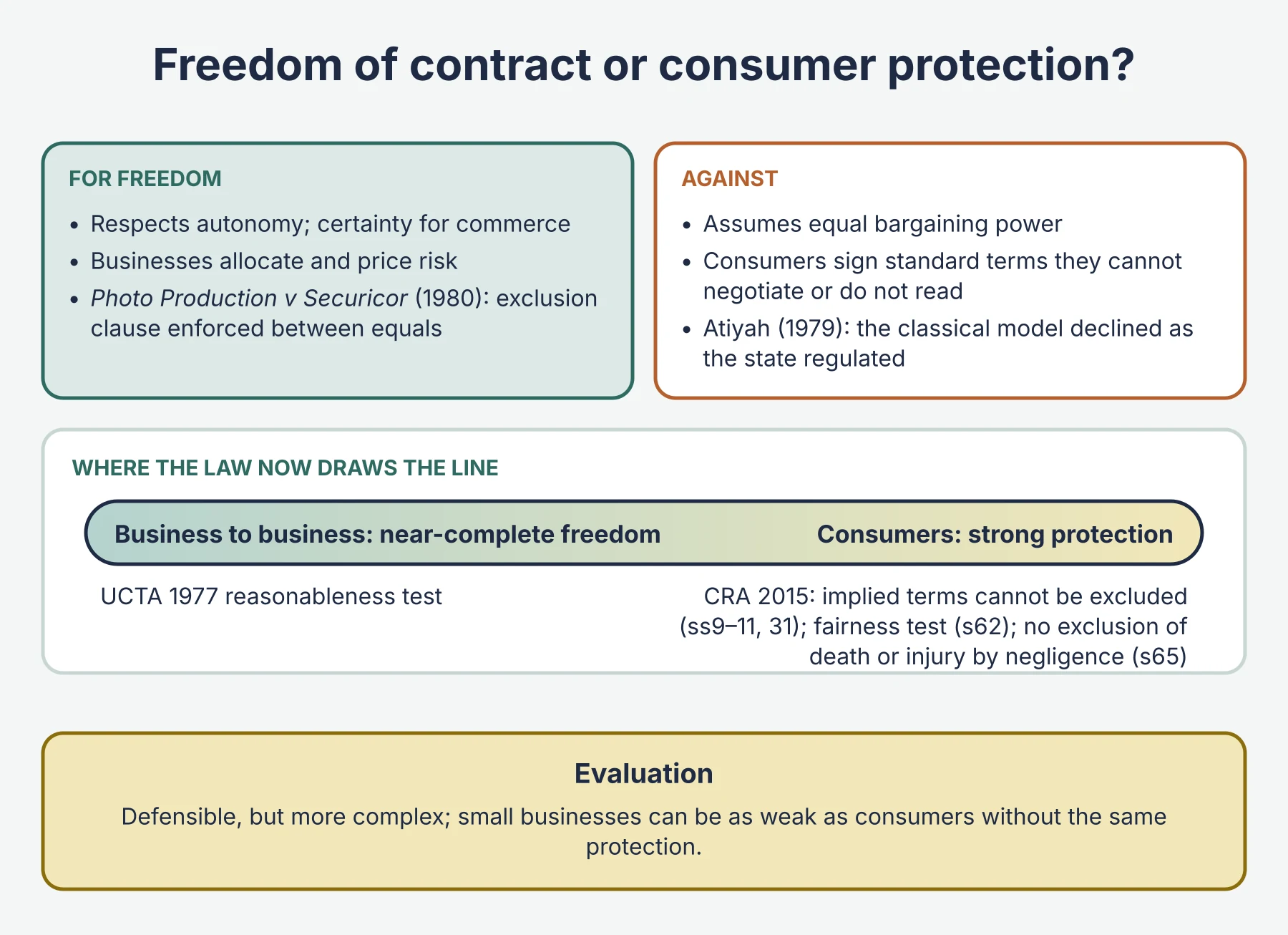
| For freedom | Against / protection |
|---|---|
| Autonomy | Unequal bargaining power |
| Certainty for business | Standard terms not negotiated or read |
| Parties allocate and price risk: Photo Production v Securicor (1980) | Atiyah, The Rise and Fall of Freedom of Contract (1979) |
Protection: CRA 2015 ss9–11, 31 (implied terms not excludable), s62 (fairness), s65 (death or personal injury); UCTA 1977 reasonableness for business contracts.
Issue 2
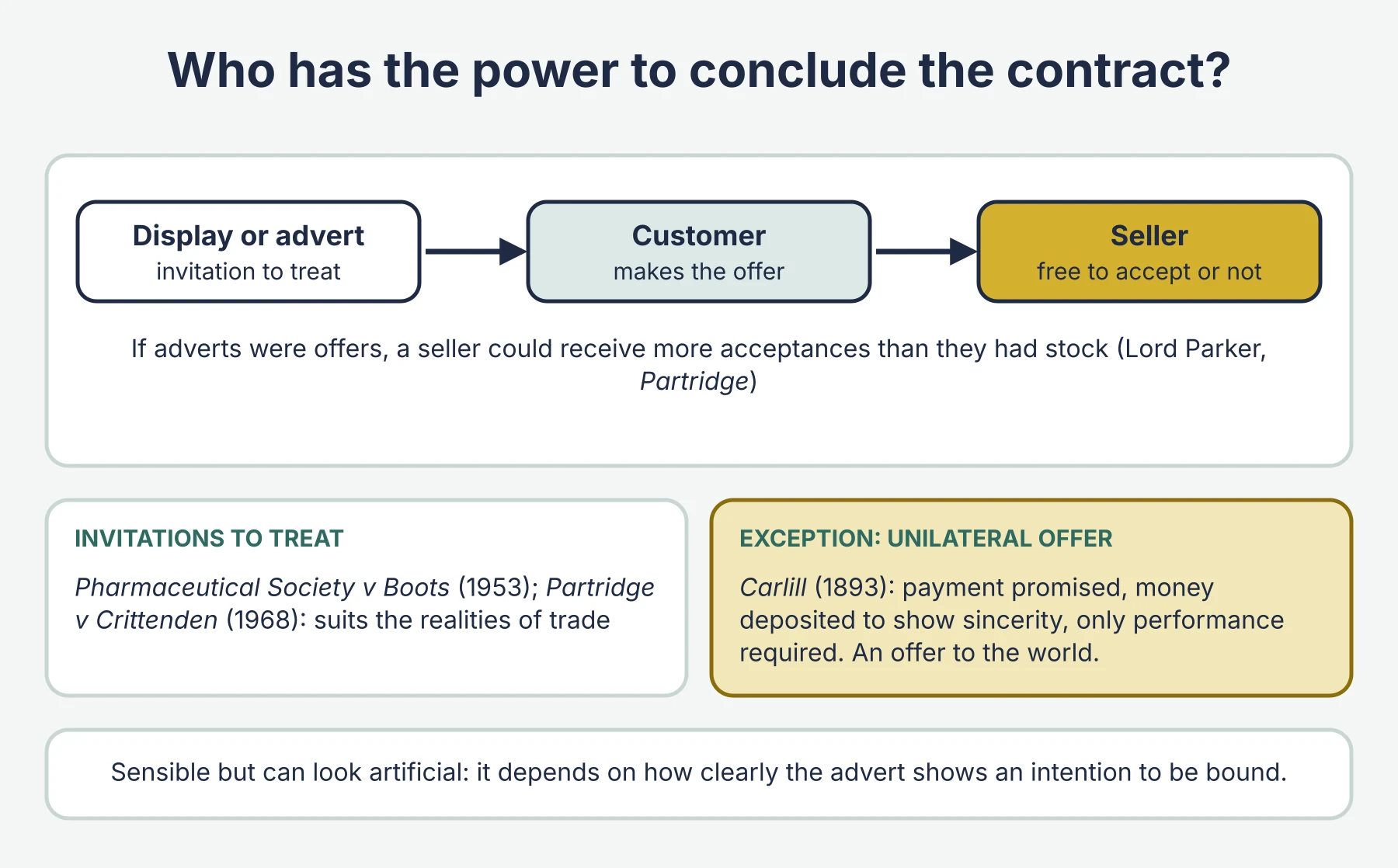
Invitation to treat: leaves seller free to decide; avoids over-commitment of stock (Boots, 1953; Partridge v Crittenden, 1968). Unilateral offer: Carlill (1893): bank deposit showed intention; accepted by performance.
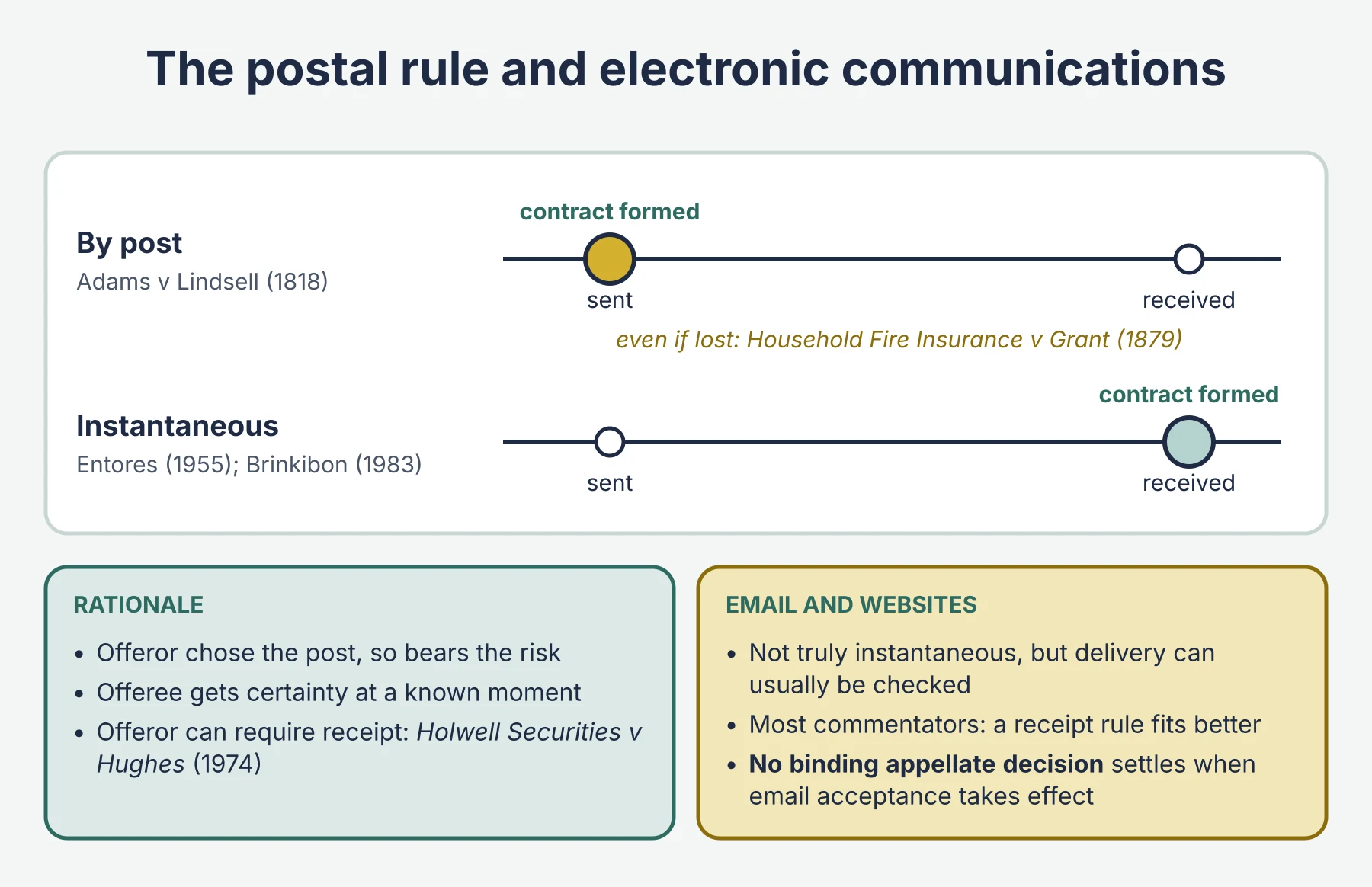
Postal rule: acceptance effective on posting (Adams v Lindsell, 1818), even if lost (Household Fire Insurance v Grant, 1879).
| Rationale | Limit |
|---|---|
| Offeror chose the post, so bears risk | Excluded by “notice in writing”: Holwell Securities v Hughes (1974) |
| Certainty for the offeree | Instant methods: receipt rule (Entores, 1955) |
| Offeree can act at once | Brinkibon (1983): no universal rule; intention and risk |
Electronic communications: sender can usually check delivery; most commentators favour a receipt rule; no binding appellate decision on email acceptance.
Issue 3
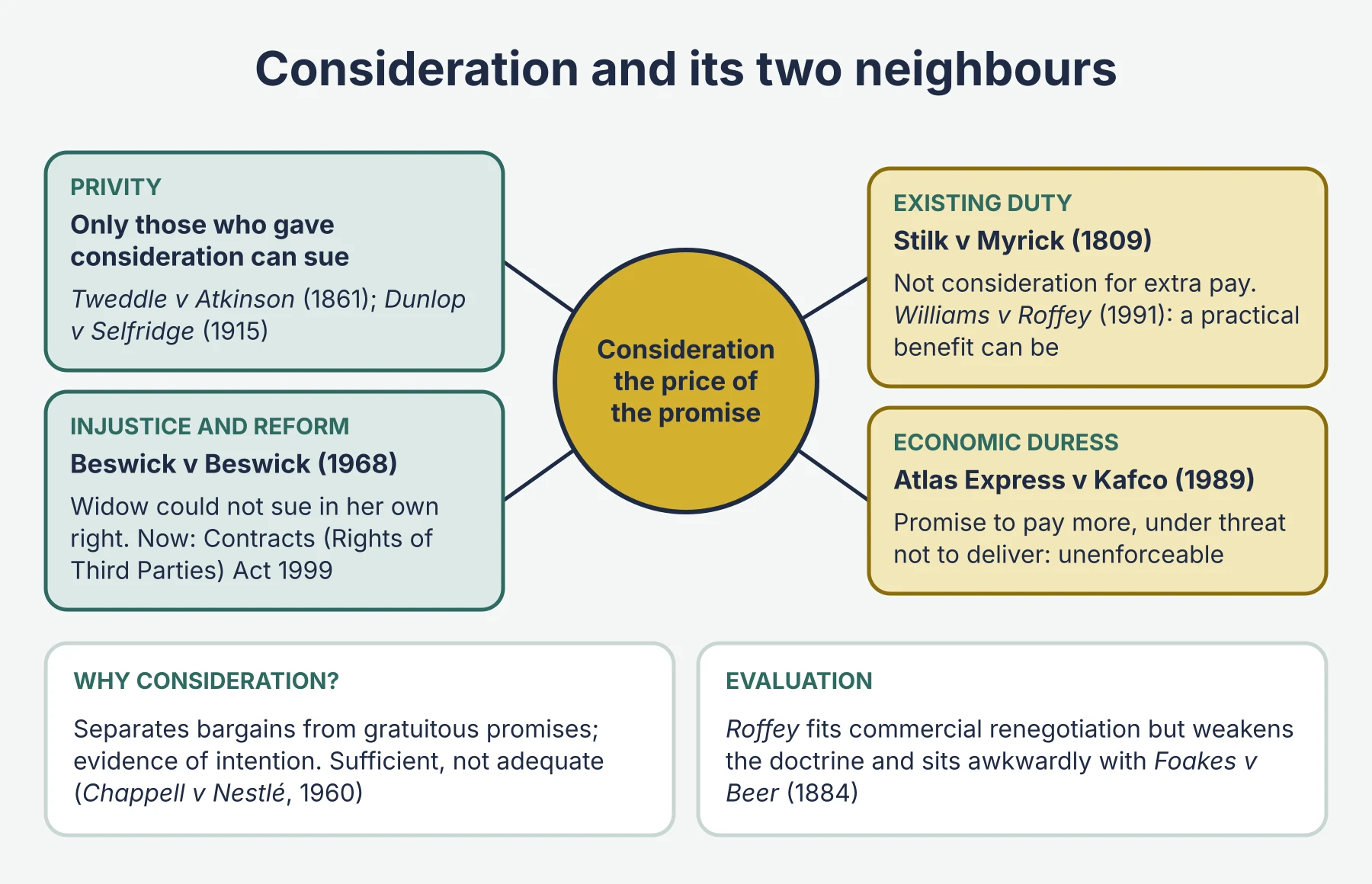
- Rationale: consideration distinguishes bargains from gifts; “the price for which the promise of the other is bought” (Dunlop v Selfridge, 1915); evidence of intention.
- Sufficient, not adequate: Chappell v Nestlé (1960): courts do not judge the bargain.
- Privity: Tweddle v Atkinson (1861); Dunlop v Selfridge (1915); injustice in Beswick v Beswick (1968); reform by Contracts (Rights of Third Parties) Act 1999.
- Duress: Stilk v Myrick (1809) v Williams v Roffey (1991): practical benefit is consideration if no duress or fraud; Atlas Express v Kafco (1989): duress and no consideration.
- Tension: Foakes v Beer (1884) still governs part payment of debts.
Issue 4
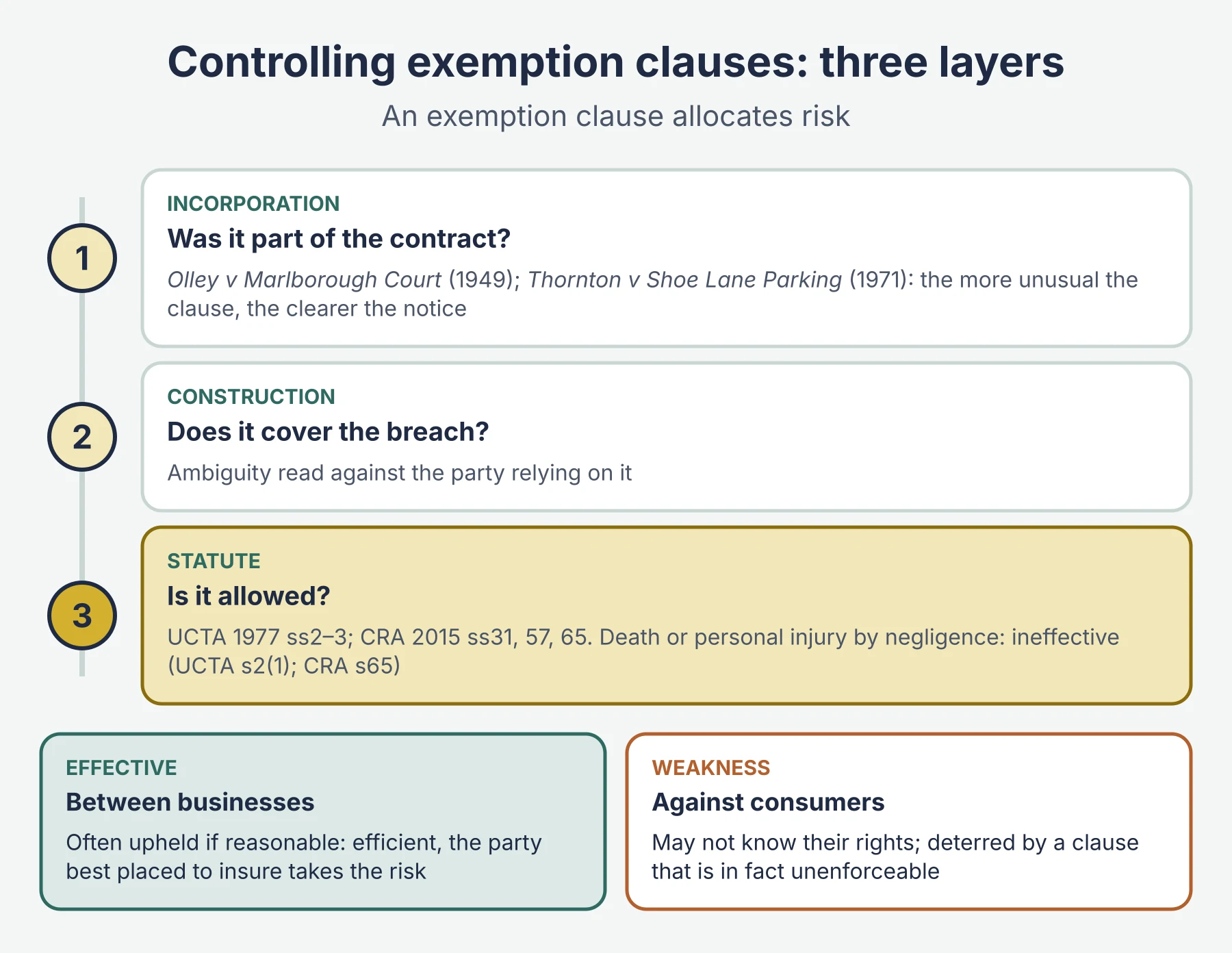
- Nature: clauses that exclude or limit liability; allocate risk.
- Controls: incorporation (Olley, 1949; Thornton, 1971: unusual clauses need clearer notice); construction (ambiguity against the party relying); statute (UCTA ss2–3; CRA ss31, 57, 65).
- Effectiveness: strong control of death or personal injury exclusions; business clauses often upheld if reasonable; consumers may not know their rights.
Issue 5
| Remedy | Strength | Weakness |
|---|---|---|
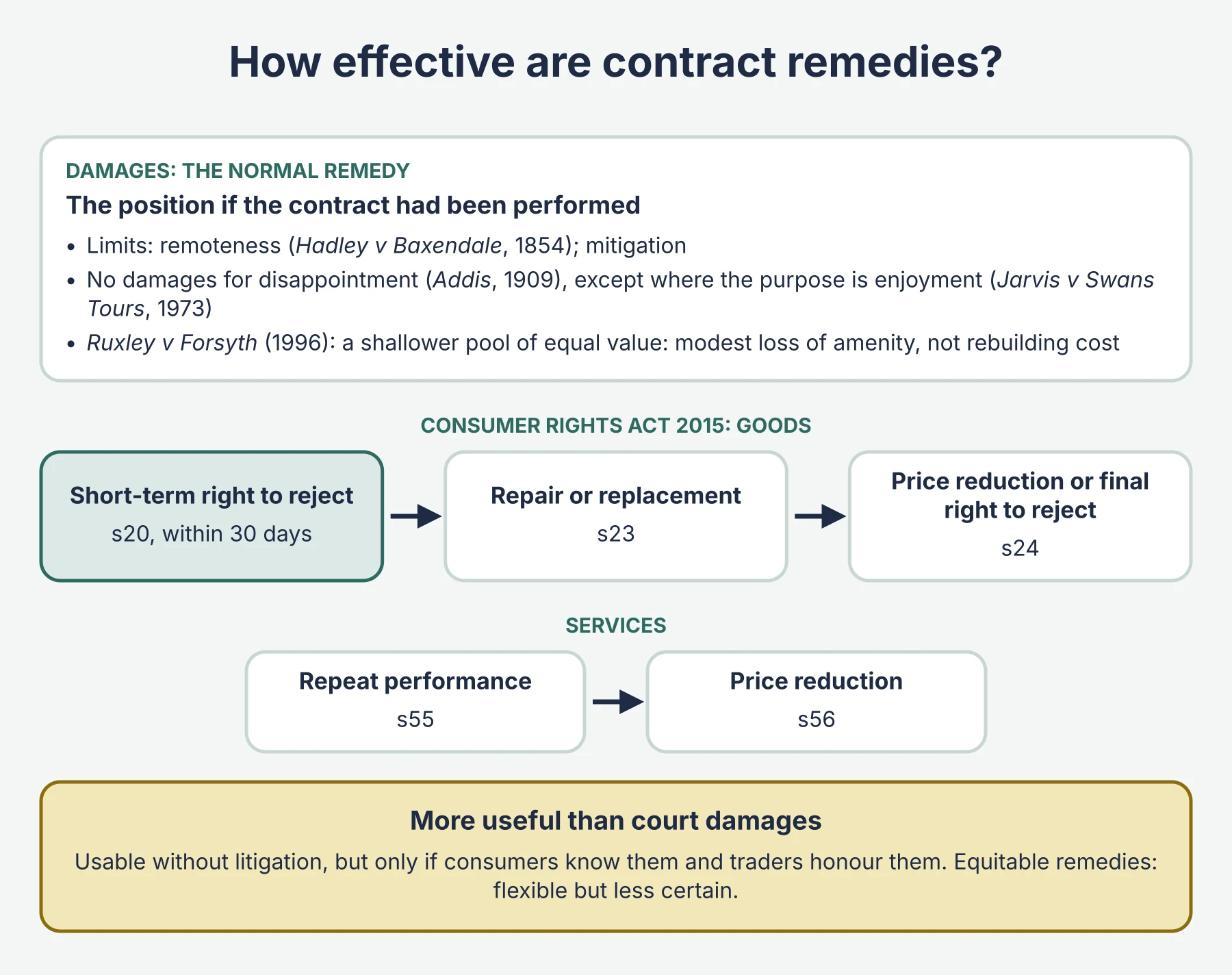
| Damages | Standard, predictable | Limits: remoteness (Hadley v Baxendale, 1854), mitigation, no general distress damages (Addis, 1909) |
| Enjoyment contracts | Jarvis v Swans Tours (1973) recognises disappointment | Limited category |
| Cost of cure v loss of amenity | Ruxley v Forsyth (1996) avoids waste | Claimant may not get what was promised |
| Equitable remedies | Flexible | Discretionary, less certain |
| CRA consumer remedies | Simple, usable without court: ss20, 23, 24, 55, 56 | Depend on awareness and trader compliance |
Key terms
| Term | Meaning |
|---|---|
| Freedom of contract | Liberty to choose whether, with whom and on what terms to contract |
| Sanctity of contract | Agreements freely made should be enforced |
| Inequality of bargaining power | One party can dictate terms to the other |
| Postal rule | Acceptance by post effective when posted |
| Privity | Only parties to a contract can enforce it |
| Practical benefit | A real advantage that can count as consideration (Williams v Roffey) |
| Economic duress | Illegitimate commercial pressure making a contract voidable |
| Exemption clause | A term excluding or limiting liability |
Exam traps
- Give the reason for a rule, not just the rule.
- Do not claim the postal rule definitely applies to email.
- Link Williams v Roffey to duress: the specification names this relationship.
- In evaluation, distinguish business contracts (freedom) from consumer contracts (protection).
- End with a judgement.
Self-test
- Who described the “utmost liberty of contracting”? Jessel MR in Printing and Numerical Registering Co v Sampson (1875).
- Give one argument against freedom of contract. Inequality of bargaining power, especially for consumers on standard terms.
- Why are shop displays invitations to treat? To leave the seller free to decide whether to sell, avoiding over-commitment.
- What showed intention to be bound in Carlill? The statement that money had been deposited with a bank.
- Give one rationale for the postal rule. The offeror chose the post, so should bear the risk; or certainty for the offeree.
- How can an offeror exclude the postal rule? By requiring actual receipt, e.g. “notice in writing” (Holwell v Hughes).
- What did Brinkibon say about instantaneous communications? No universal rule; depends on intention, business practice and where risk should lie.
- How is consideration linked to privity? Only someone who gave consideration can sue on the promise.
- What did the 1999 Act change? A third party can enforce a term that expressly allows it or purports to benefit them.
- How does Williams v Roffey link consideration and duress? Practical benefit is consideration only if the promise was not obtained by duress or fraud.
- Which provision prevents excluding liability for death or personal injury against a consumer? s65 Consumer Rights Act 2015.
- Why are CRA consumer remedies said to be effective? They are simple and can be used without going to court.
More resources on this topic
Theory of contract law practice questions | Law of contract revision notes
Related resources
-
Study guides
AQA A Level Law (7162): Vitiating factors
Misrepresentation and economic duress for AQA A Level Law 7162: what counts as a misrepresentation, the three types, rescission, damages and the duress tests.
Law · AQA · A Level
Read guide -
Practice questions
AQA A Level Law (7162): Vitiating factors – Practice Questions
Original practice on misrepresentation and economic duress for AQA A Level Law 7162, with mark-scheme answers on types, damages, rescission bars and duress.
Law · AQA · A Level
Try questions -
Revision notes
AQA A Level Law (7162): Vitiating factors – Revision Notes
Condensed recall on misrepresentation and economic duress for AQA A Level Law 7162: elements, types, damages measures, bars to rescission and the DSND test.
Law · AQA · A Level
Revise topic
Get free revision emails (optional)
Occasional emails with practice questions, worked explanations and links to free resources for the qualification and subjects you choose. No spam, and you can unsubscribe from any email. The free tools on this site never need an email.