
Revision Notes
AQA A Level Law (7162): Vitiating factors – Revision Notes
Condensed recall on misrepresentation and economic duress for AQA A Level Law 7162: elements, types, damages measures, bars to rescission and the DSND test.
- Subject
- Law
- Level
- A LEVELS
- Topic
- Topic 4: Law of contract
- Author
- Marlbridge Academic Team
- Updated
- Reviewed by
- Aizaz Raoof Ali (what this means)
Aligned to AQA A Level Law (7162), For teaching from September 2017 onwards, A-level exams 2019 onwards. Official specification .
Syllabus page (what it covers and how it is assessed): AQA A Level Law.
Syllabus points this page covers
7162
- Vitiating factors
Found an error? Report a correction.
Need help with this topic? Request a free trial class for A Level Law (7162).
Condensed notes on the two vitiating factors in the specification: misrepresentation and economic duress. For full explanation and a worked scenario, use the vitiating factors study guide.
The answer route in one line
Misrepresentation: statement → of fact → made before or at contracting → induced the contract → type → rescission (any bars?) and damages. Economic duress: pressure → illegitimate → no practical choice → significant cause → rescission (affirmed?).
Both make the contract voidable, not void: it stands until the innocent party sets it aside.
Misrepresentation: elements
| Element | Rule | Case |
|---|---|---|
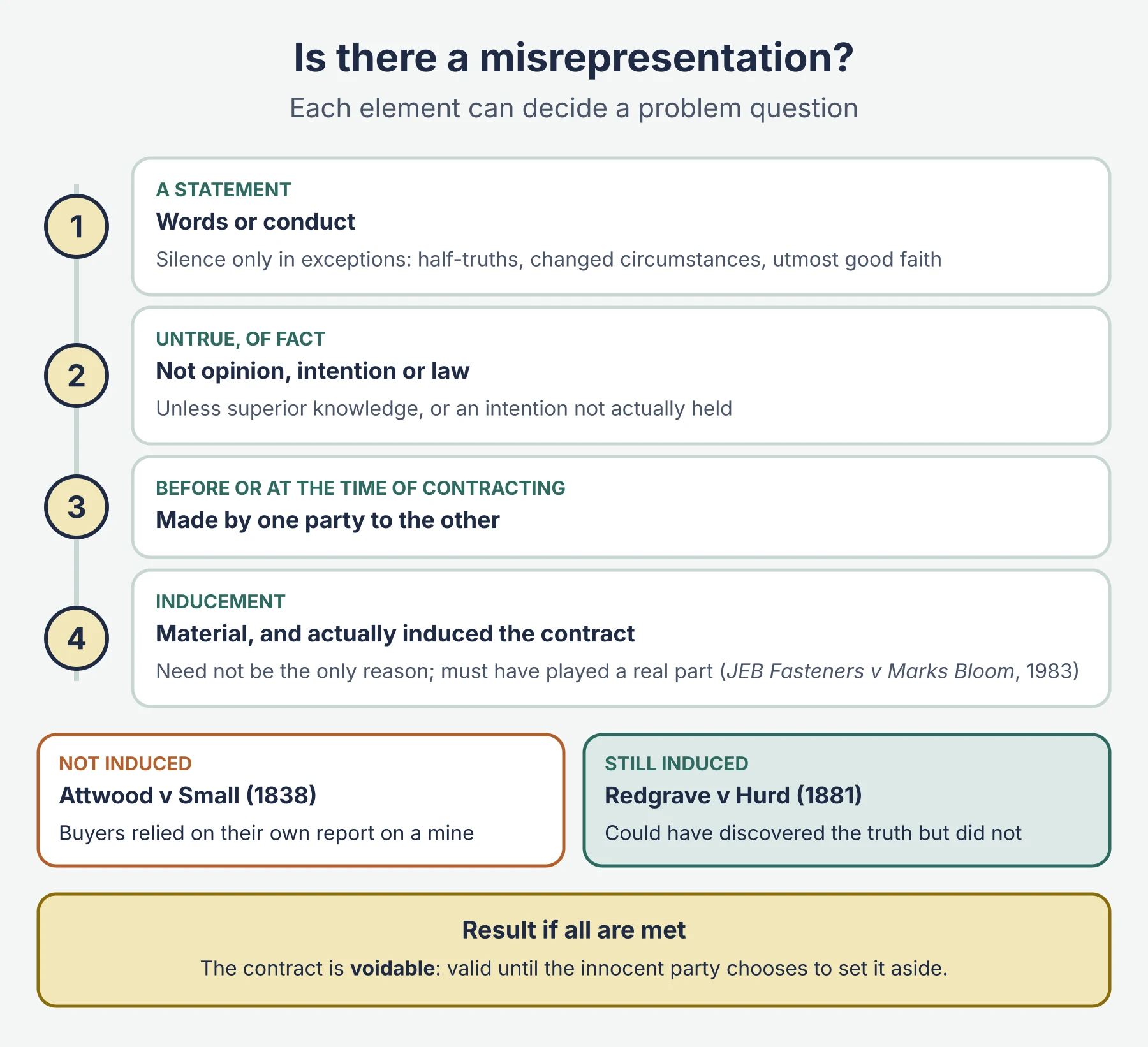
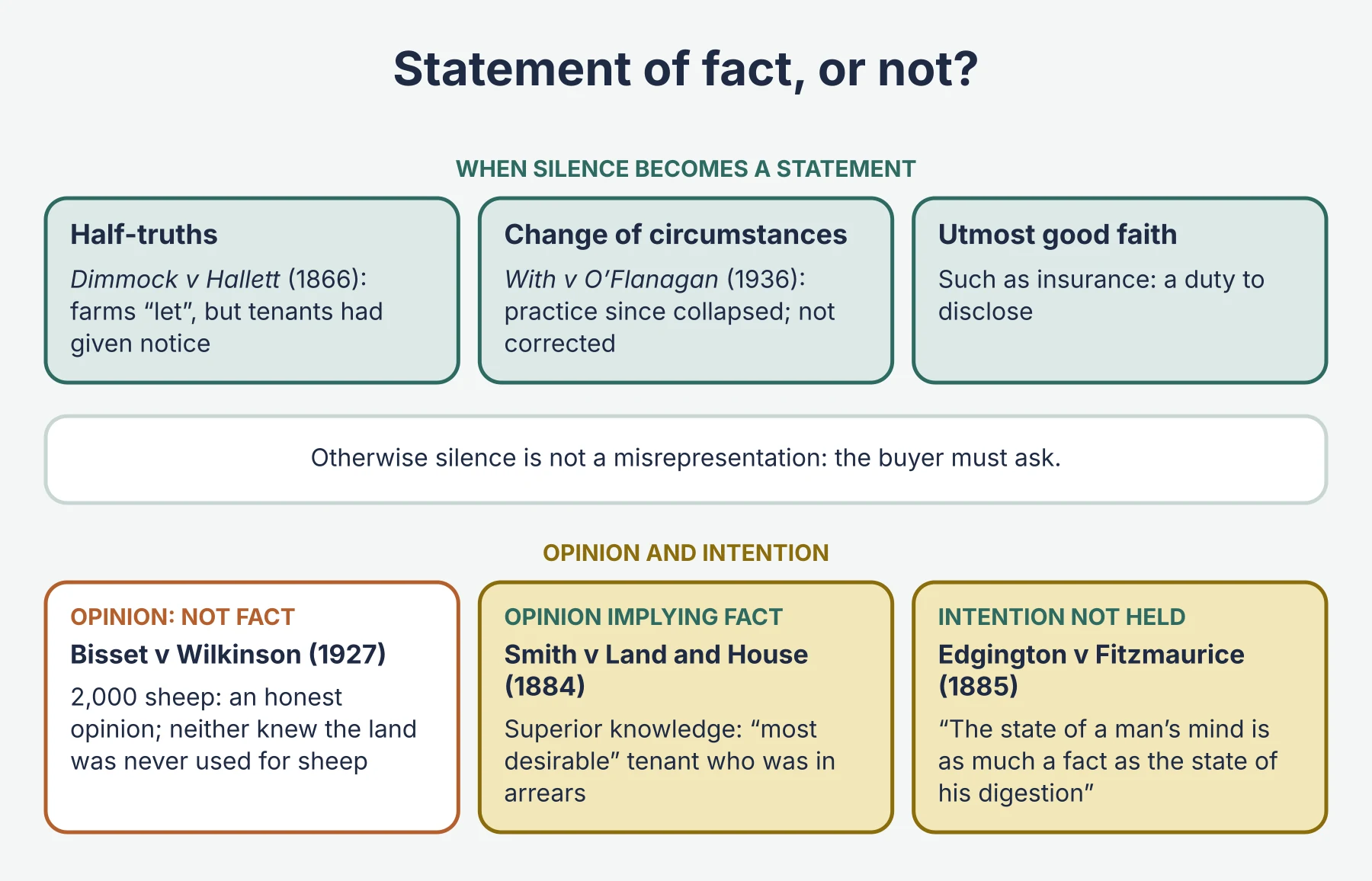
| Statement | Silence is not enough, except half-truths, changed circumstances and utmost good faith contracts | Dimmock v Hallett (1866); With v O’Flanagan (1936) |
| Fact, not opinion | Honest opinion where neither party has better knowledge is not fact | Bisset v Wilkinson (1927): 2,000 sheep |
| Opinion implying facts | Where the maker has superior knowledge | Smith v Land and House Property (1884): “most desirable” tenant in arrears |
| Fact, not intention | Unless the maker does not hold the stated intention | Edgington v Fitzmaurice (1885): “state of a man’s mind” |
| Inducement | Must play a real part, need not be the only cause | JEB Fasteners v Marks Bloom (1983) |
| No inducement | Claimant relied on own investigation | Attwood v Small (1838) |
| Still induced | Even if the claimant could have found out the truth | Redgrave v Hurd (1881) |
Types and damages
| Type | Test | Damages | Measure |
|---|---|---|---|
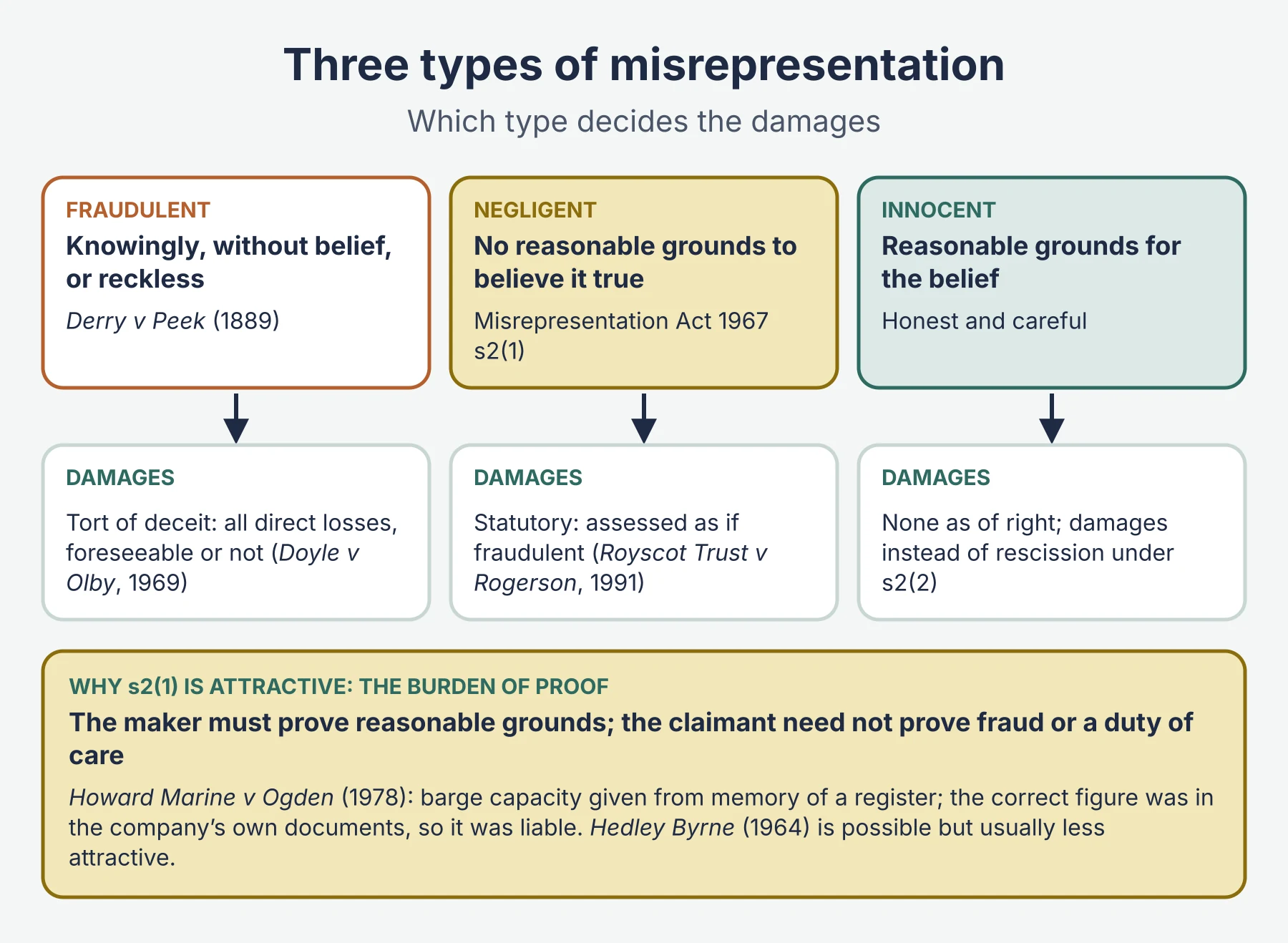
| Fraudulent | Knowingly, without belief, or reckless (Derry v Peek, 1889) | Deceit | All direct losses, foreseeable or not (Doyle v Olby, 1969) |
| Negligent | MA 1967 s2(1): defendant must prove reasonable grounds and actual belief | Statutory | As if fraudulent (Royscot Trust v Rogerson, 1991) |
| Innocent | Reasonable grounds for belief | Discretionary, s2(2) | Damages in place of rescission |
Howard Marine v Ogden (1978): capacity figure given from memory when correct figures were in the company’s own documents; no reasonable grounds, so liable under s2(1).
Rescission and its bars
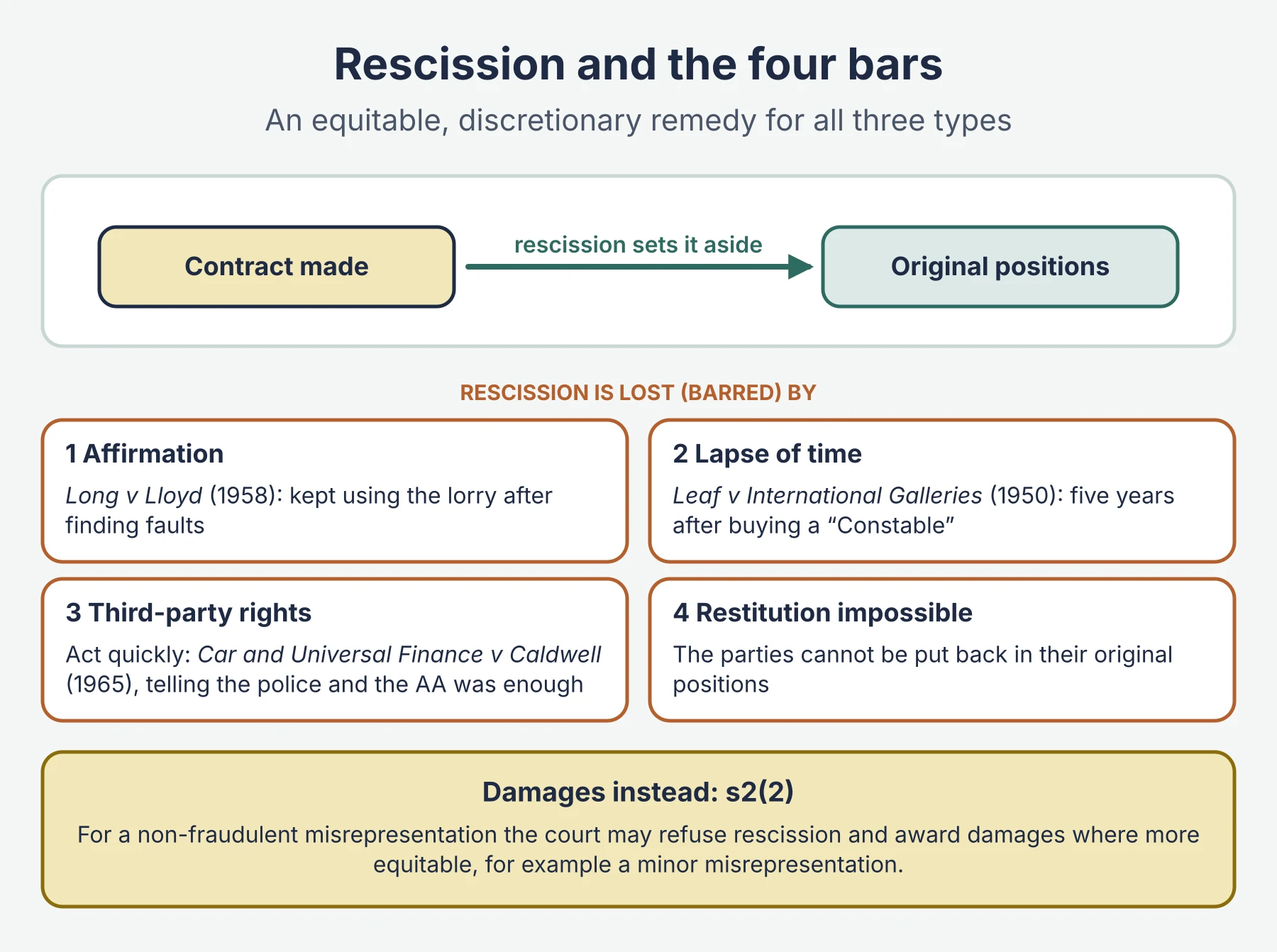
Rescission sets the contract aside and restores the parties. It is equitable and discretionary.
| Bar | Case |
|---|---|
| Affirmation | Long v Lloyd (1958): continued use of lorry after discovering faults |
| Lapse of time | Leaf v International Galleries (1950): five years after buying the “Constable” |
| Third-party rights | Car and Universal Finance v Caldwell (1965): rescission effective by telling police and AA before resale |
| Restitution impossible | Parties cannot be restored to their original positions |
Economic duress
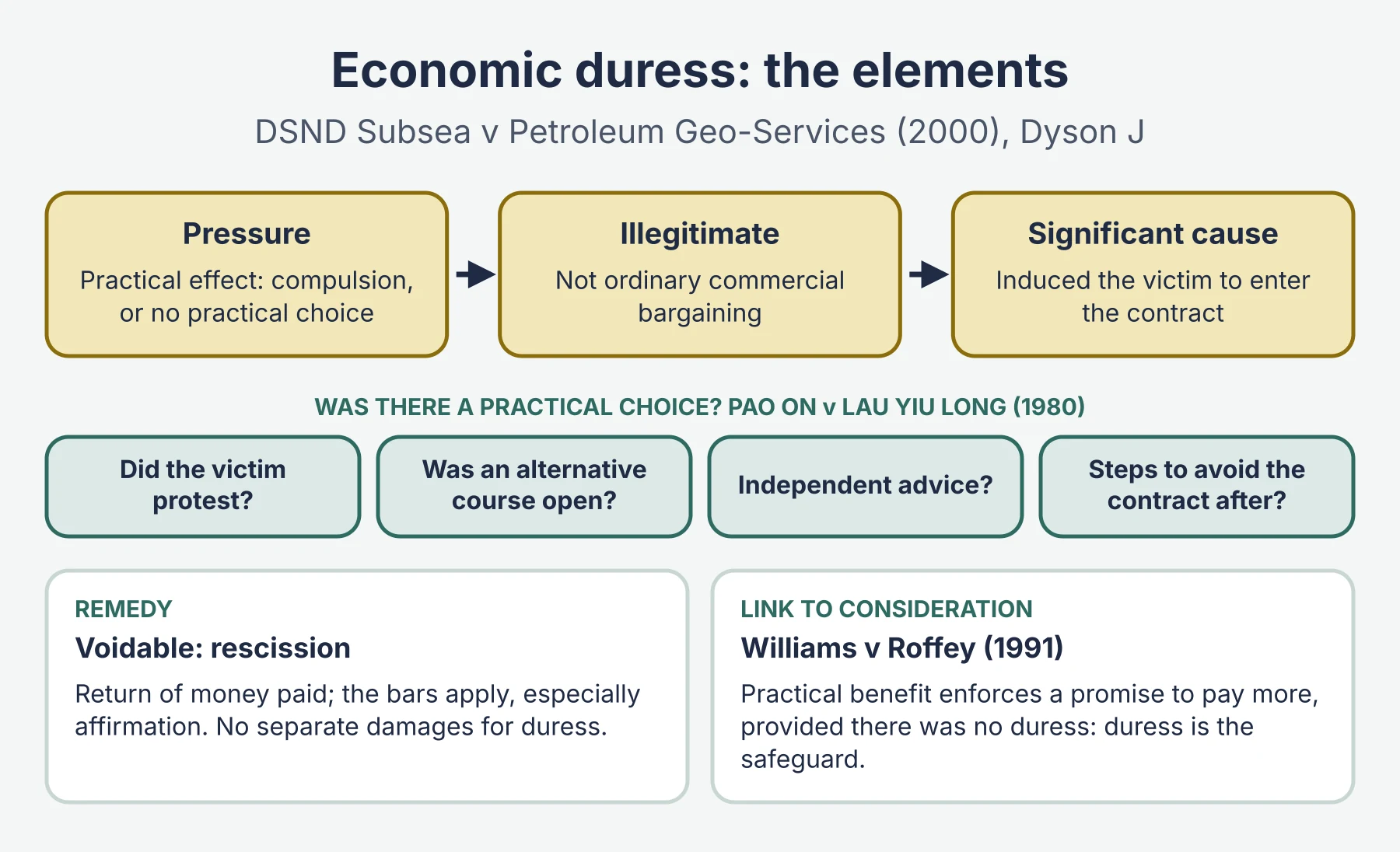
Definition (DSND Subsea v Petroleum Geo-Services, 2000):
- pressure with the practical effect of compulsion or no practical choice;
- the pressure is illegitimate;
- it is a significant cause of entering the contract.
Evidence of no choice (Pao On v Lau Yiu Long, 1980): protest; any alternative course; independent advice; steps taken to avoid the contract afterwards.
| Case | Point |
|---|---|
| Barton v Armstrong (1976) | Origin: duress to the person by threats to kill |
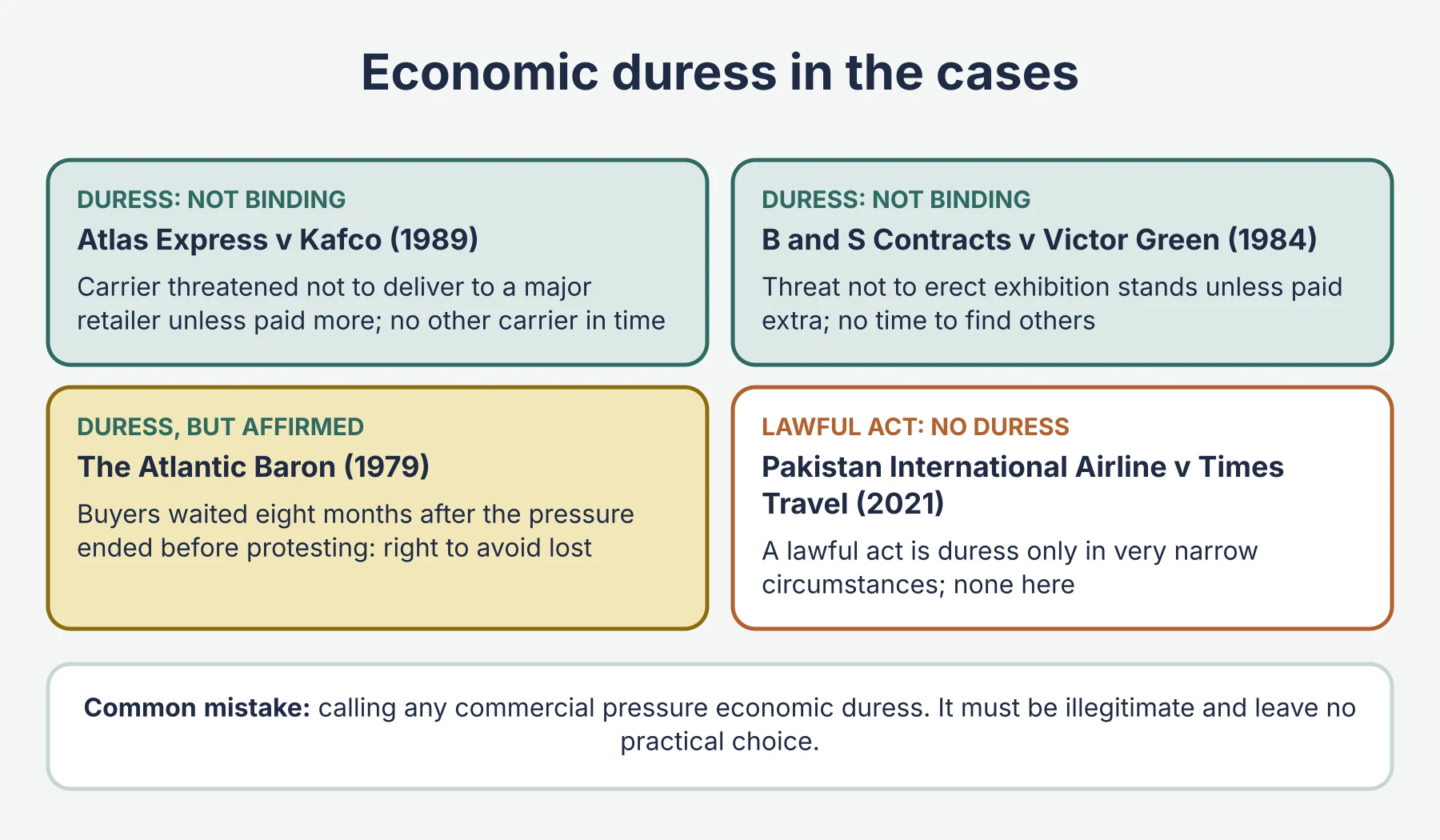
| Atlas Express v Kafco (1989) | Threat not to deliver unless paid more; no alternative carrier; duress |
| B and S Contracts v Victor Green (1984) | Threat not to build exhibition stands unless paid extra; duress |
| The Atlantic Baron (1979) | Duress existed, but eight months’ delay before protesting was affirmation |
| PIA v Times Travel (2021) | Lawful act duress only in very narrow circumstances; not made out |
| Williams v Roffey (1991) | Practical benefit can be consideration provided there is no duress |
Remedy: rescission and return of money paid; bars apply, especially affirmation. No damages for duress itself.
Key terms
| Term | Meaning |
|---|---|
| Vitiating factor | A flaw in the making of a contract that makes it voidable |
| Voidable | Valid until the innocent party chooses to set it aside |
| Representation | A statement of fact made before or at the time of contracting that induces it |
| Inducement | The statement played a real part in the decision to contract |
| Rescission | Setting the contract aside and restoring the parties to their original positions |
| Affirmation | Conduct showing the innocent party chooses to continue the contract |
| Illegitimate pressure | Pressure the law does not accept as normal commercial bargaining |
Exam traps
- Calling a puff or an honest opinion a misrepresentation without discussing Bisset v Wilkinson.
- Forgetting that a true statement can become a misrepresentation if circumstances change before the contract (With v O’Flanagan).
- Putting the burden of proof on the claimant under s2(1); it is on the defendant.
- Ignoring the bars: always apply affirmation, delay and third-party rights to the facts.
- Treating hard bargaining as duress; the question is whether the pressure was illegitimate and left no practical choice.
- Offering damages as the remedy for economic duress.
Self-test
- Is a contract affected by misrepresentation void or voidable?
- Give two situations in which silence can be a misrepresentation.
- Why was the statement in Bisset v Wilkinson not a misrepresentation?
- How did Smith v Land and House Property differ?
- What did Bowen LJ say in Edgington v Fitzmaurice?
- Why did the claim fail in Attwood v Small?
- What is the test for fraudulent misrepresentation?
- Who bears the burden of proof under s2(1) of the Misrepresentation Act 1967?
- What did Royscot Trust v Rogerson decide?
- Name the four bars to rescission.
- State the three elements of economic duress from DSND Subsea.
- Why did the claimants lose in The Atlantic Baron?
Answers: 1. Voidable. 2. Any two of: half-truths; a statement that becomes untrue before the contract; contracts of the utmost good faith. 3. It was an honest opinion; neither party knew whether the land could carry 2,000 sheep. 4. The seller had superior knowledge, so describing the tenant as “most desirable” implied facts that were untrue. 5. “The state of a man’s mind is as much a fact as the state of his digestion.” 6. The buyers relied on their own investigation, so they were not induced. 7. Made knowingly, without belief in its truth, or recklessly careless whether it was true or false (Derry v Peek). 8. The defendant, who must prove reasonable grounds for belief. 9. Damages under s2(1) are assessed as if the misrepresentation were fraudulent. 10. Affirmation, lapse of time, third-party rights and impossibility of restitution. 11. Pressure with the practical effect of compulsion or no practical choice, which is illegitimate, and which is a significant cause of entering the contract. 12. They affirmed the contract by waiting eight months after the pressure ended before protesting.
More resources on this topic
Vitiating factors study guide | Vitiating factors practice questions | Law of contract revision notes
Related resources
-
Practice questions
AQA A-Level Law: Law of Contract — Practice Questions
AQA A-level Law 7162 contract practice questions with worked answers on formation, CRA 2015 rights, exclusion clauses, misrepresentation, duress and remedies.
Law · AQA · A Level
Try questions -
Revision notes
AQA A-Level Law: Law of Contract — Revision Notes
AQA A-level Law 7162 contract notes: offer, consideration and privity, CRA 2015 terms, exclusion clauses, misrepresentation, duress, discharge, remedies.
Law · AQA · A Level
Revise topic -
Study guides
AQA A Level Law (7162): Law of contract – Study Guide
Formation, terms, consumer statutes, exclusion clauses, vitiating factors, discharge and remedies in contract law, with applied examples for AQA A Level Law.
Law · AQA · A Level
Read guide
Get free revision emails (optional)
Occasional emails with practice questions, worked explanations and links to free resources for the qualification and subjects you choose. No spam, and you can unsubscribe from any email. The free tools on this site never need an email.