
Study Guides
AQA A Level Law (7162): Vitiating factors
Misrepresentation and economic duress for AQA A Level Law 7162: what counts as a misrepresentation, the three types, rescission, damages and the duress tests.
- Subject
- Law
- Level
- A LEVELS
- Topic
- Topic 4: Law of contract
- Author
- Marlbridge Academic Team
- Updated
- Reviewed by
- Aizaz Raoof Ali (what this means)
Aligned to AQA A Level Law (7162), For teaching from September 2017 onwards, A-level exams 2019 onwards. Official specification .
Syllabus page (what it covers and how it is assessed): AQA A Level Law.
Syllabus points this page covers
7162
- Vitiating factors
Found an error? Report a correction.
Need help with this topic? Request a free trial class for A Level Law (7162).
This guide covers vitiating factors in section 3.4 Law of contract of AQA A-level Law (7162). The specification names two: “Misrepresentation (nature, types and remedies)” and “Economic duress (definition and remedies)”. A vitiating factor does not stop a contract coming into existence; it makes it voidable, so the innocent party may choose to set it aside. For the contract option in outline, start with the Law of contract study guide.
Misrepresentation: the nature of the wrong
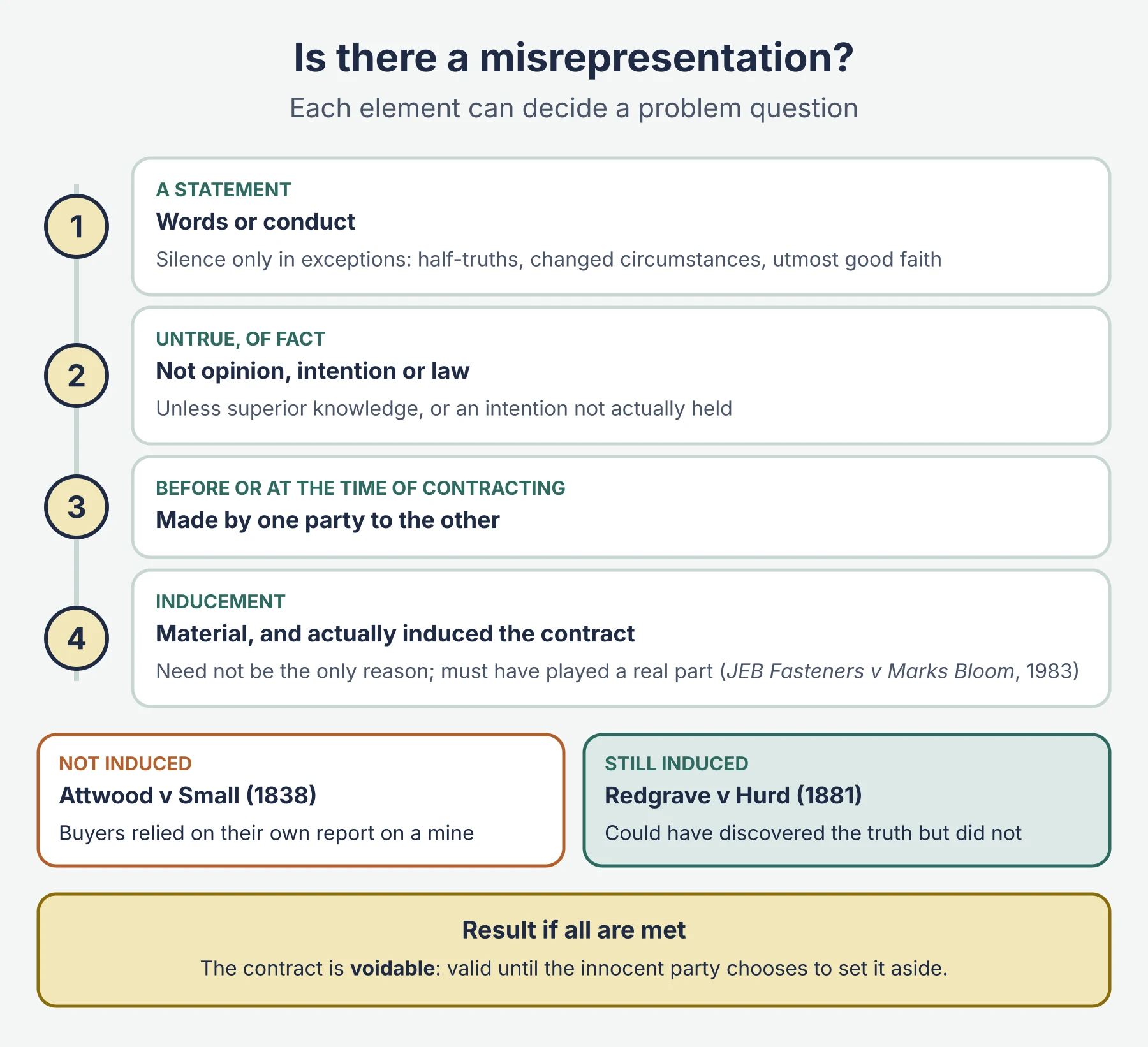
A misrepresentation is an untrue statement of fact made by one party to the other before or at the time of contracting which induces the other to enter the contract. Each element can decide a problem question.
A statement
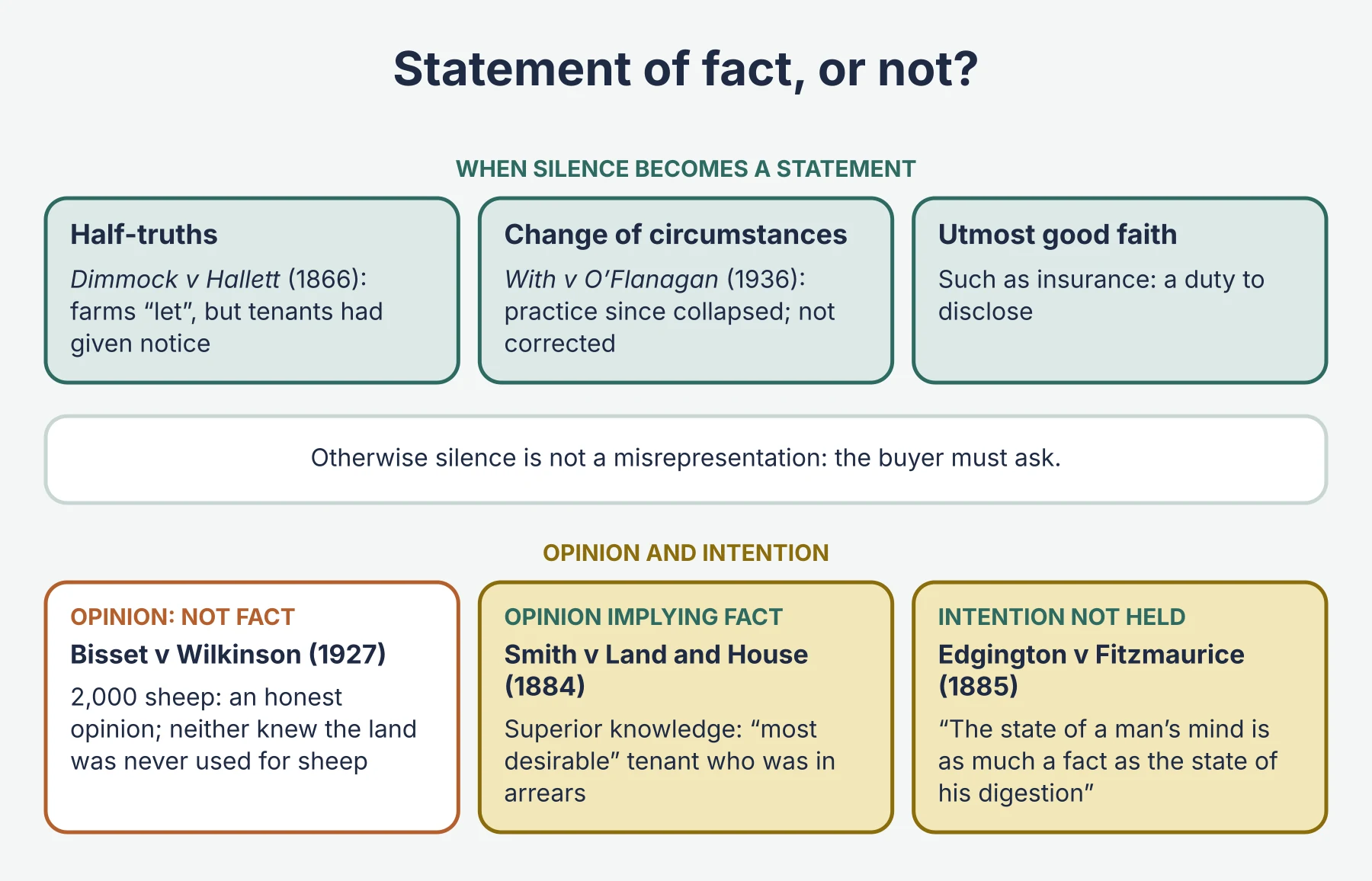
Usually words, but conduct can be enough, and three situations turn silence into a statement:
- Half-truths: in Dimmock v Hallett (1866) saying that farms were let, without saying the tenants had given notice to leave, was a misrepresentation.
- Change of circumstances: in With v O’Flanagan (1936) a doctor’s practice was accurately described months before the sale but had since collapsed; failure to correct the statement was a misrepresentation.
- Contracts of the utmost good faith, such as insurance, where there is a duty to disclose.
Otherwise silence is not a misrepresentation; the buyer must ask.
Of fact, not opinion, intention or law
- Opinion: in Bisset v Wilkinson (1927) a seller’s estimate that land could carry 2,000 sheep was an honest opinion, as neither party knew it had never been used for sheep. But where the maker has superior knowledge, an opinion may imply facts: in Smith v Land and House Property Corporation (1884) describing a tenant as “most desirable” when he was in arrears was a misrepresentation.
- Intention: a statement of future intention is not fact, unless the maker does not hold that intention at the time. In Edgington v Fitzmaurice (1885) company directors said a loan would be used to develop the business when they intended to pay off debts; “the state of a man’s mind is as much a fact as the state of his digestion” (Bowen LJ).
Inducement
The statement must be material and must actually induce the contract. It need not be the only reason (JEB Fasteners v Marks Bloom, 1983, where it must have played a real part).
- If the claimant did not know of the statement, or relied on their own checks, there is no inducement: in Attwood v Small (1838) buyers who commissioned their own report on a mine could not claim.
- But a claimant who could have discovered the truth and did not is still induced: Redgrave v Hurd (1881).
The three types and their damages
| Type | Test | Damages | Measure |
|---|---|---|---|
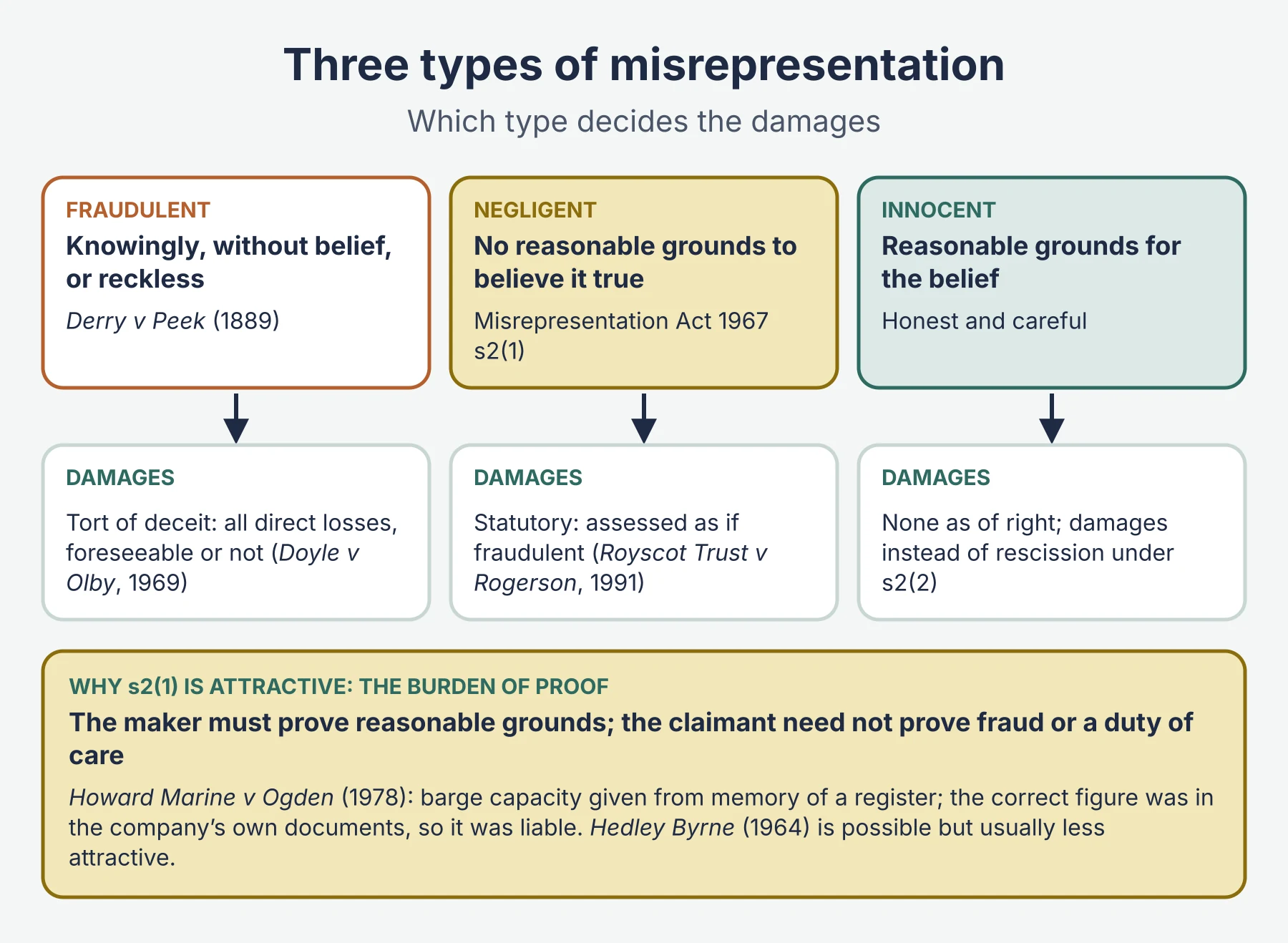
| Fraudulent | Made knowingly, without belief in its truth, or recklessly careless whether true or false (Derry v Peek, 1889) | Tort of deceit | All losses flowing directly from the fraud, foreseeable or not (Doyle v Olby, 1969) |
| Negligent | Under the Misrepresentation Act 1967 s2(1) the maker is liable unless they prove they had reasonable grounds to believe, and did believe, the statement was true | Statutory | Assessed as if fraudulent (Royscot Trust v Rogerson, 1991) |
| Innocent | The maker had reasonable grounds for their belief | None as of right | The court may award damages instead of rescission under s2(2) |
The burden of proof is what makes s2(1) attractive. In Howard Marine v Ogden (1978) a barge owner’s agent stated the barges’ capacity from memory of a shipping register, which was wrong; the correct figure was in documents the company held, so it could not prove reasonable grounds and was liable. The claimant does not have to prove fraud, which is hard (Derry v Peek), or a duty of care. A claim for negligent misstatement at common law under Hedley Byrne v Heller (1964) is possible but usually less attractive.
Remedies for misrepresentation
Rescission
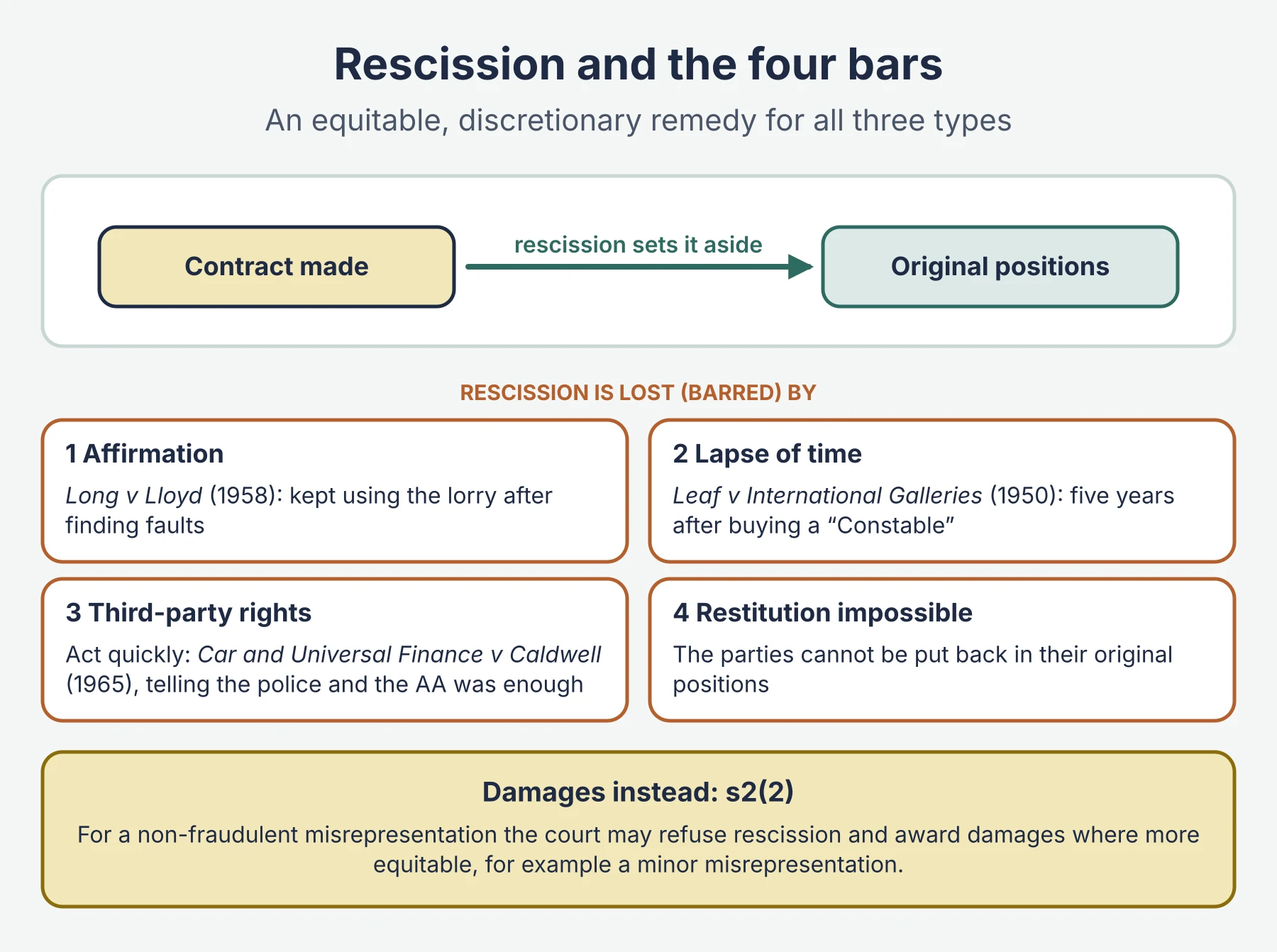
Rescission is an equitable remedy that sets the contract aside and restores both parties to their original positions. It is available for all three types, but it is discretionary and is lost (barred) in four situations:
- Affirmation: in Long v Lloyd (1958) a buyer of a lorry who continued to use it after discovering faults affirmed the contract.
- Lapse of time: in Leaf v International Galleries (1950) a claim brought five years after buying a painting wrongly said to be by Constable was too late.
- Third-party rights: rescission is barred once an innocent third party acquires rights in the goods. The innocent party can rescind quickly by doing everything reasonable to show their intention, as in Car and Universal Finance v Caldwell (1965), where telling the police and the AA was enough.
- Restitution impossible: where the parties cannot be put back in their original positions.
Damages
Damages follow the table above. Under s2(2) the court may refuse rescission and award damages instead for any non-fraudulent misrepresentation, where that is more equitable, for example where the misrepresentation was minor.
Economic duress
Definition
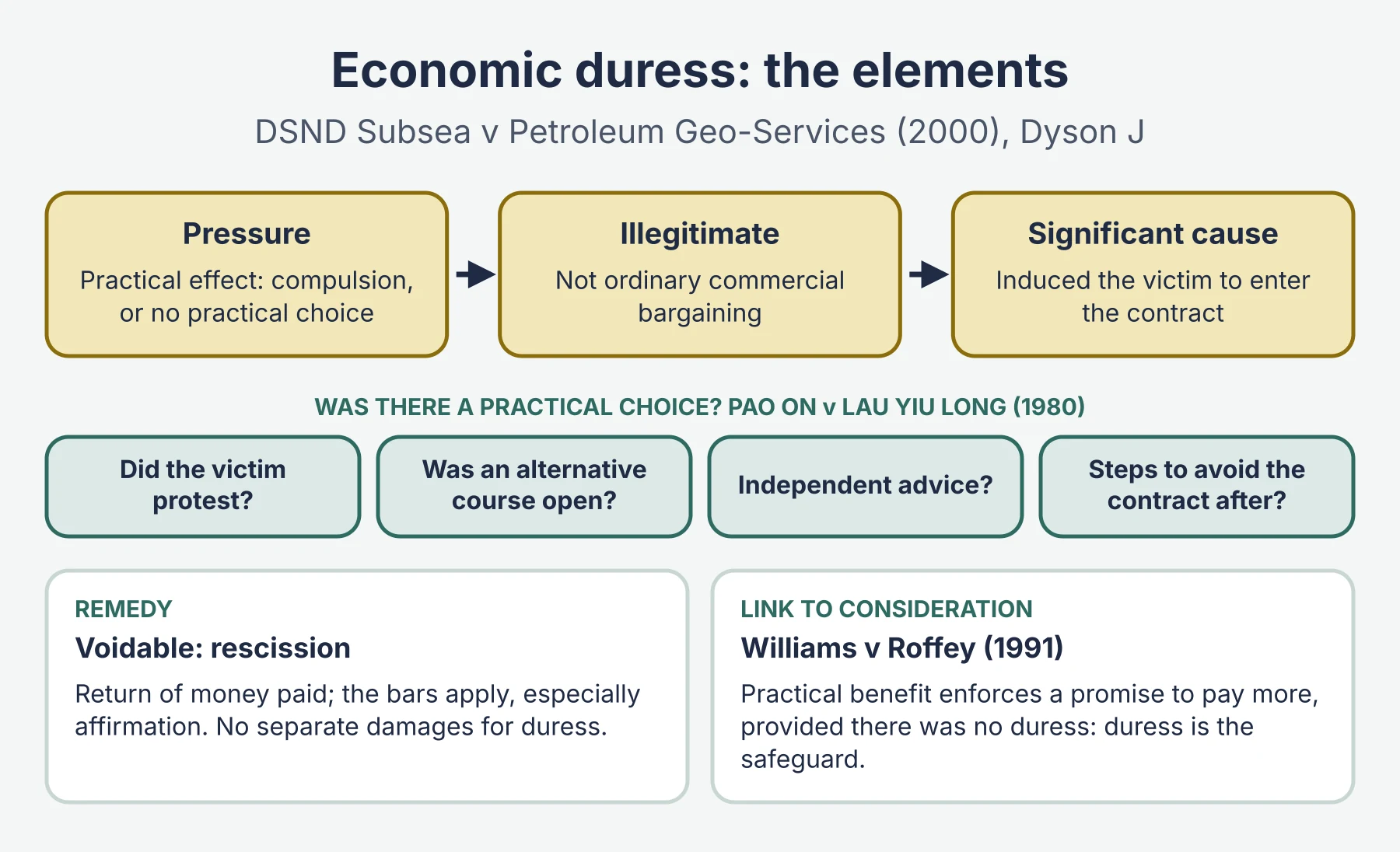
Duress at common law originally meant threats to the person (Barton v Armstrong, 1976). Economic duress extends it to illegitimate commercial pressure. In DSND Subsea v Petroleum Geo-Services (2000) Dyson J identified the elements:
- pressure, whose practical effect is compulsion or the lack of any practical choice for the victim;
- which is illegitimate;
- and which is a significant cause inducing the victim to enter the contract.
Factors that help show the absence of a practical choice come from Pao On v Lau Yiu Long (1980): whether the victim protested, whether they had an alternative course open to them, whether they had independent advice, and whether they took steps to avoid the contract after entering it.
Leading cases
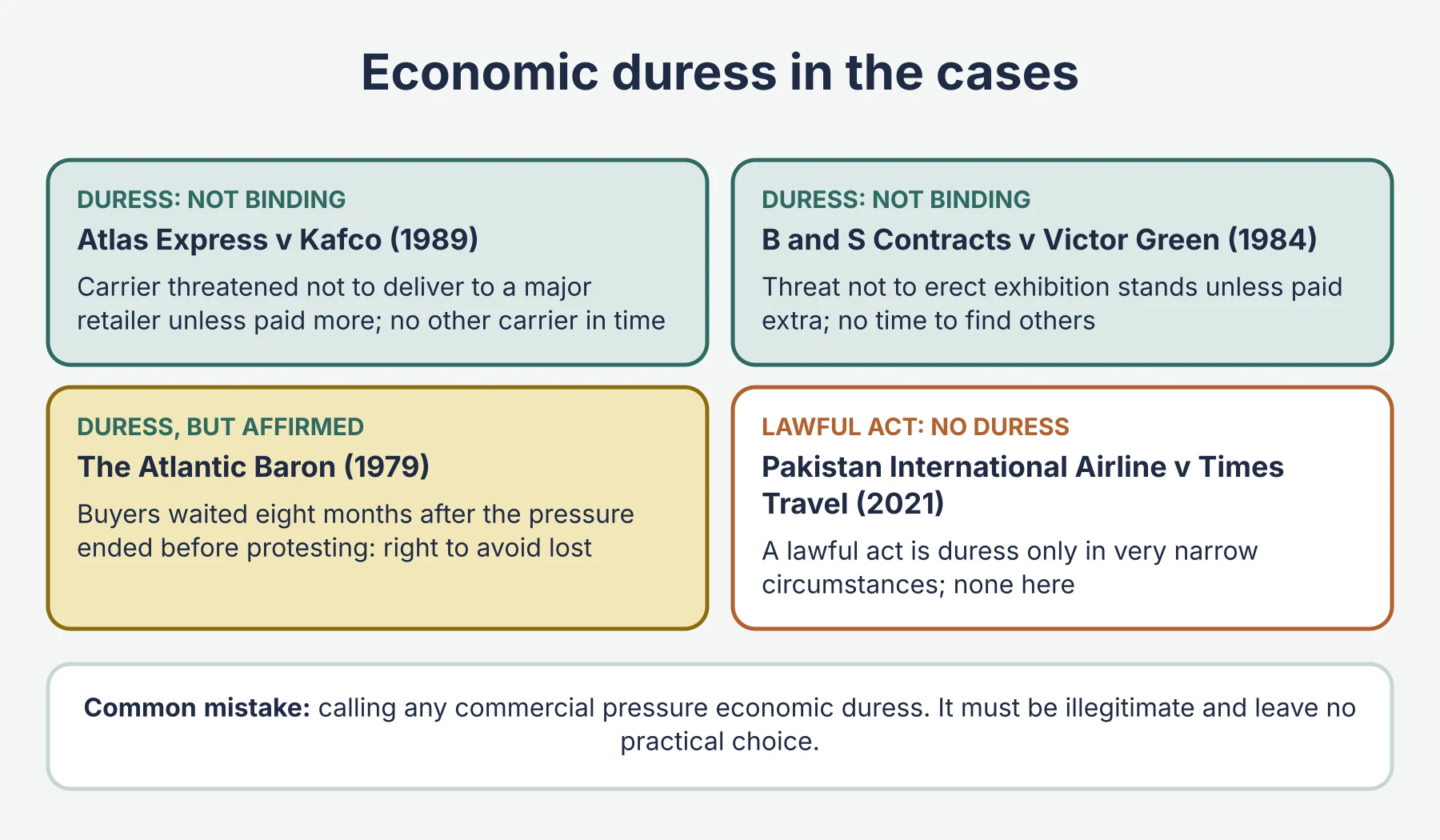
- Atlas Express v Kafco (1989): a carrier threatened not to deliver a small company’s goods to a major retailer unless it agreed to a higher price. Kafco could not find another carrier in time, so the agreement was made under economic duress and was not binding.
- B and S Contracts and Design v Victor Green Publications (1984): a threat not to erect exhibition stands unless extra money was paid, with no time to find others, was duress.
- The Atlantic Baron (North Ocean Shipping v Hyundai, 1979): there was economic duress, but the buyers lost the right to avoid the contract by waiting eight months after the pressure ended before protesting.
- Legitimate pressure: ordinary commercial bargaining is not duress. A threat to do something lawful is rarely illegitimate; in Pakistan International Airline v Times Travel (2021) the Supreme Court held that a lawful act is duress only in very narrow circumstances, and there was none.
Remedies
Economic duress makes the contract voidable. The remedy is rescission, with return of money paid under it; the bars to rescission apply, especially affirmation (The Atlantic Baron). There is no separate award of damages for duress as such.
The link to consideration
The specification’s theory section refers to the relationship between consideration and economic duress. In Williams v Roffey Bros (1991) a promise to pay more for existing work was enforceable because of a practical benefit, provided there was no duress. Duress is the safeguard that stops the practical benefit rule being used to enforce extorted promises.
Worked example
Facts: Theo buys a café from Mel. Mel says it “makes about £1,000 profit a week”, which was true a year ago; profit has since fallen to £300 and she says nothing. She also says the landlord “is planning to renew the lease”, which she knows is false. Theo discovers the truth three weeks after taking over.
Statements:     Profit figure – true when first given but no longer true;
                failure to correct is a misrepresentation (With v O'Flanagan).
                Lease – a statement of intention, but Mel knows it is false,
                so it misstates a present fact (Edgington v Fitzmaurice).
Inducement:     Both are material to buying a business; Theo relied on them.
Type:           Lease statement – fraudulent (Derry v Peek).
                Profit statement – at least negligent under s2(1); Mel cannot
                show reasonable grounds to believe it was still true.
Remedies:       Rescission – acted within three weeks, so no lapse of time;
                he should not affirm by continuing to trade. Damages in
                deceit or under s2(1) on the fraud measure (Royscot).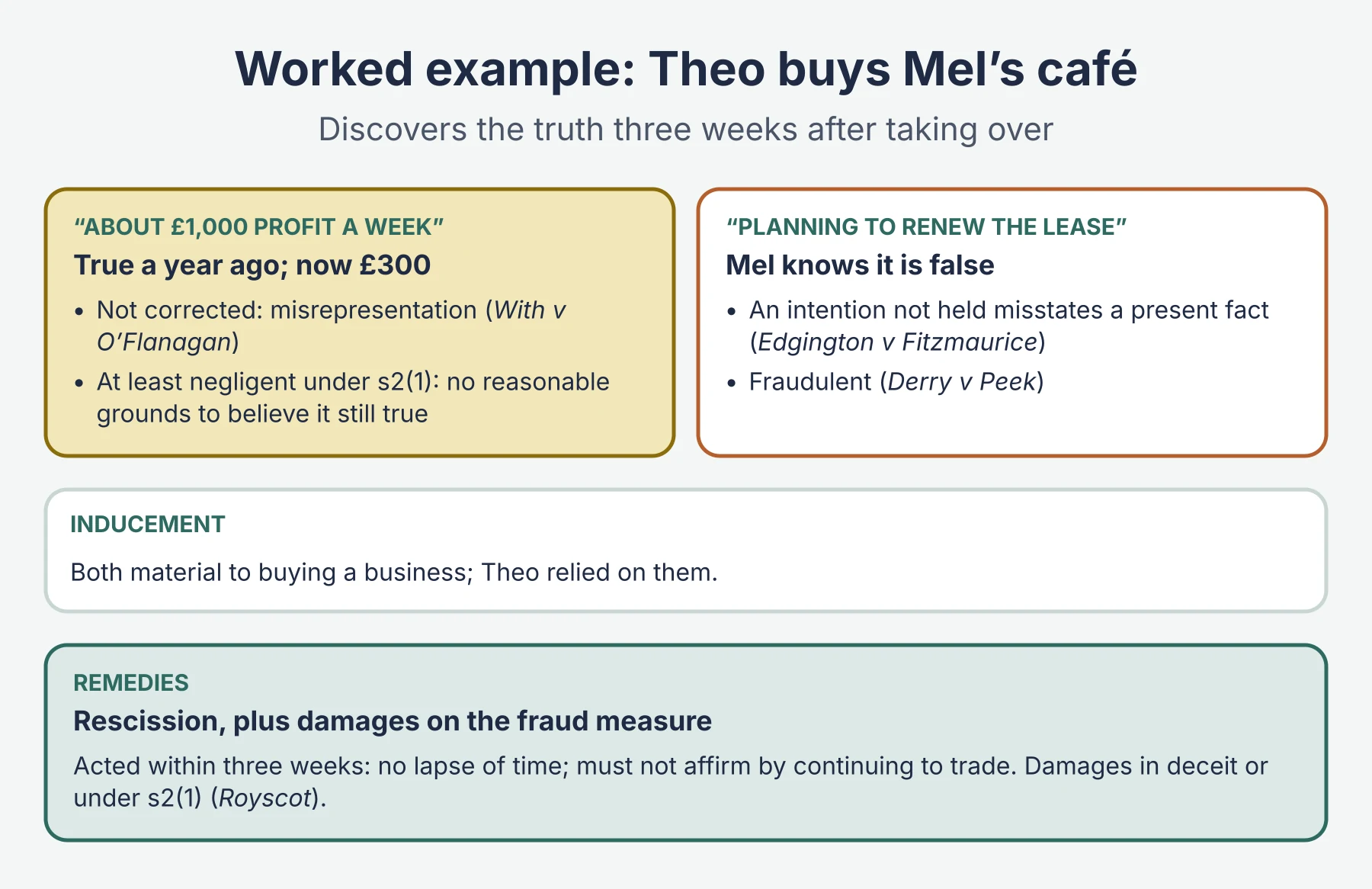
Common mistakes
- Treating every untrue statement as a misrepresentation without checking fact, inducement and timing.
- Saying silence is never a misrepresentation; half-truths and changed circumstances are exceptions.
- Claiming that a negligent misrepresentation claimant must prove negligence; under s2(1) the defendant must disprove it.
- Forgetting the bars to rescission.
- Calling any commercial pressure economic duress; the pressure must be illegitimate and leave no practical choice.
Exam technique
- Explain questions: give each element of misrepresentation, or each element of duress, with a case.
- Suggest and Advise questions: work through statement, fact, inducement, type, then remedies and bars, applying the dates in the facts.
- Consider questions: argue both ways on borderline points, such as opinion or fact, or whether pressure was legitimate.
- Discuss questions: evaluate whether the remedies are fair, for example whether Royscot’s fraud measure for negligence goes too far.
More resources on this topic
Vitiating factors revision notes | Vitiating factors practice questions | Remedies in contract study guide
Related resources
-
Practice questions
AQA A Level Law (7162): Vitiating factors – Practice Questions
Original practice on misrepresentation and economic duress for AQA A Level Law 7162, with mark-scheme answers on types, damages, rescission bars and duress.
Law · AQA · A Level
Try questions -
Revision notes
AQA A Level Law (7162): Vitiating factors – Revision Notes
Condensed recall on misrepresentation and economic duress for AQA A Level Law 7162: elements, types, damages measures, bars to rescission and the DSND test.
Law · AQA · A Level
Revise topic -
Practice questions
AQA A-Level Law: Law of Contract — Practice Questions
AQA A-level Law 7162 contract practice questions with worked answers on formation, CRA 2015 rights, exclusion clauses, misrepresentation, duress and remedies.
Law · AQA · A Level
Try questions
Get free revision emails (optional)
Occasional emails with practice questions, worked explanations and links to free resources for the qualification and subjects you choose. No spam, and you can unsubscribe from any email. The free tools on this site never need an email.