
Revision Notes
AQA A Level Law (7162): Contract terms: exclusion clauses – Revision Notes
Condensed recall on exclusion clauses for AQA A Level Law 7162: incorporation cases, construction, UCTA 1977 reasonableness and CRA 2015 ss31, 57 and 65.
- Subject
- Law
- Level
- A LEVELS
- Topic
- Topic 4: Law of contract
- Author
- Marlbridge Academic Team
- Updated
- Reviewed by
- Aizaz Raoof Ali (what this means)
Aligned to AQA A Level Law (7162), For teaching from September 2017 onwards, A-level exams 2019 onwards. Official specification .
Syllabus page (what it covers and how it is assessed): AQA A Level Law.
Syllabus points this page covers
7162
- Contract terms: exclusion clauses
Found an error? Report a correction.
Need help with this topic? Request a free trial class for A Level Law (7162).
Condensed notes on exclusion and limitation clauses. For full explanation and a worked scenario, use the exclusion clauses study guide.
The answer route in one line
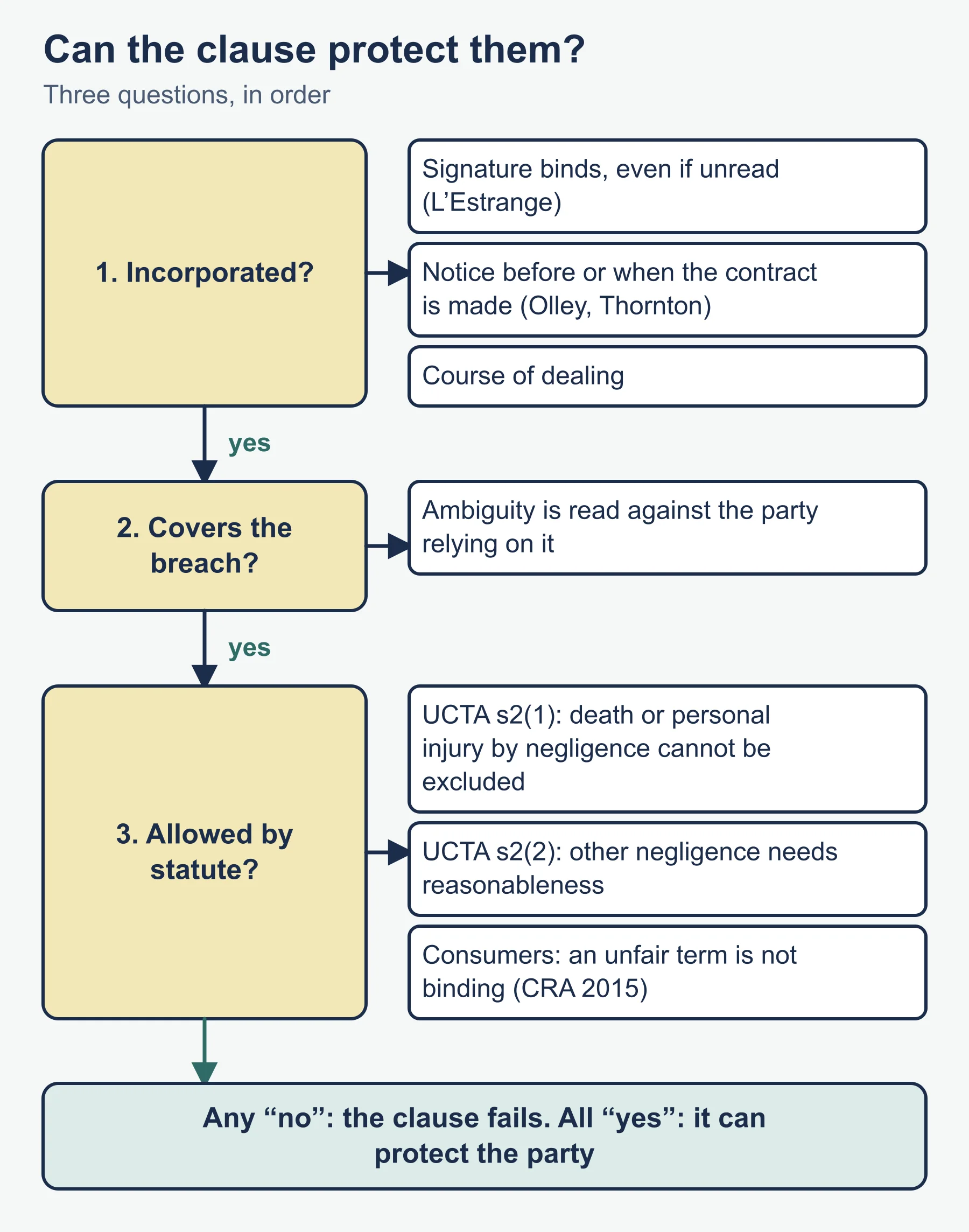
Exclusion or limitation? → incorporated? (signature, notice, course of dealing) → covers the loss on its true construction? → consumer or business contract? → CRA 2015 or UCTA 1977 → conclusion on liability.
Nature
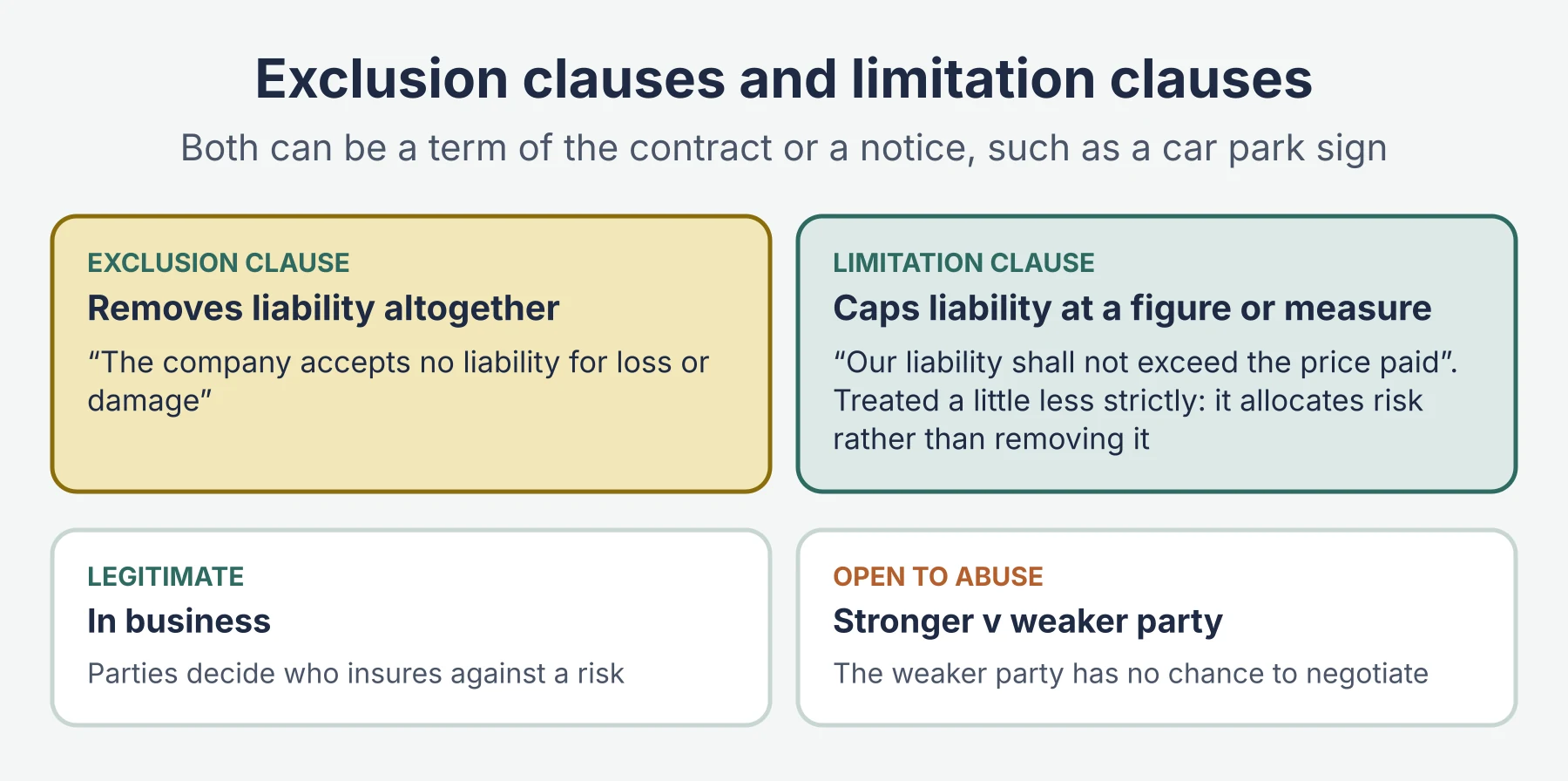
- Exclusion clause: removes liability completely.
- Limitation clause: caps liability at an amount or measure; treated slightly less strictly because it shares risk rather than removing it.
- Either can be a contract term or a notice.
- Purpose in business: allocates risk and insurance. Danger: imposed by a stronger party on a weaker one who cannot negotiate.
Incorporation
| Method | Rule | Case |
|---|---|---|
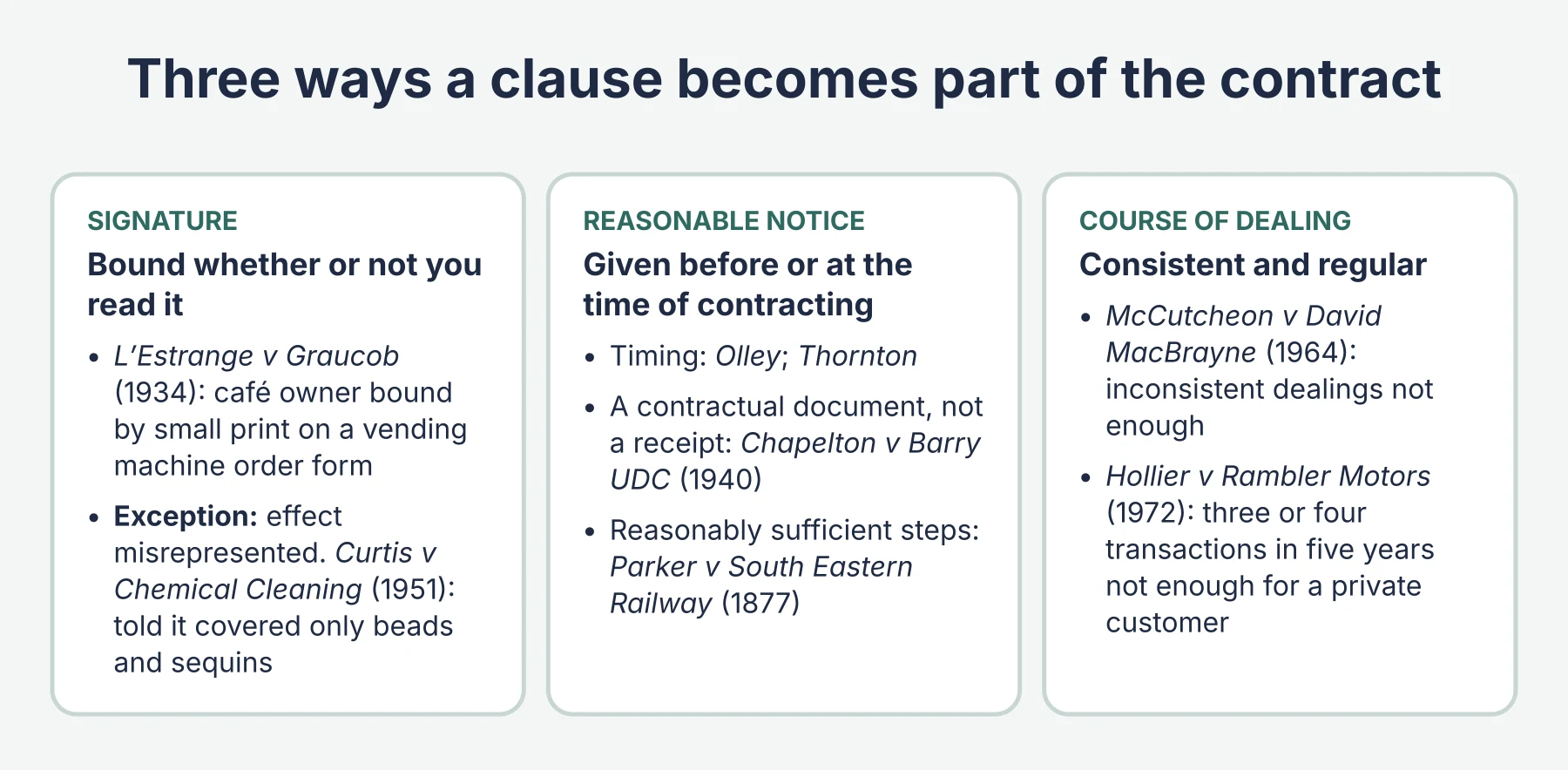
| Signature | Bound by a signed document even if unread | L’Estrange v Graucob (1934) |
| Signature exception | Not bound where the effect of the clause was misrepresented | Curtis v Chemical Cleaning (1951): “beads and sequins” |
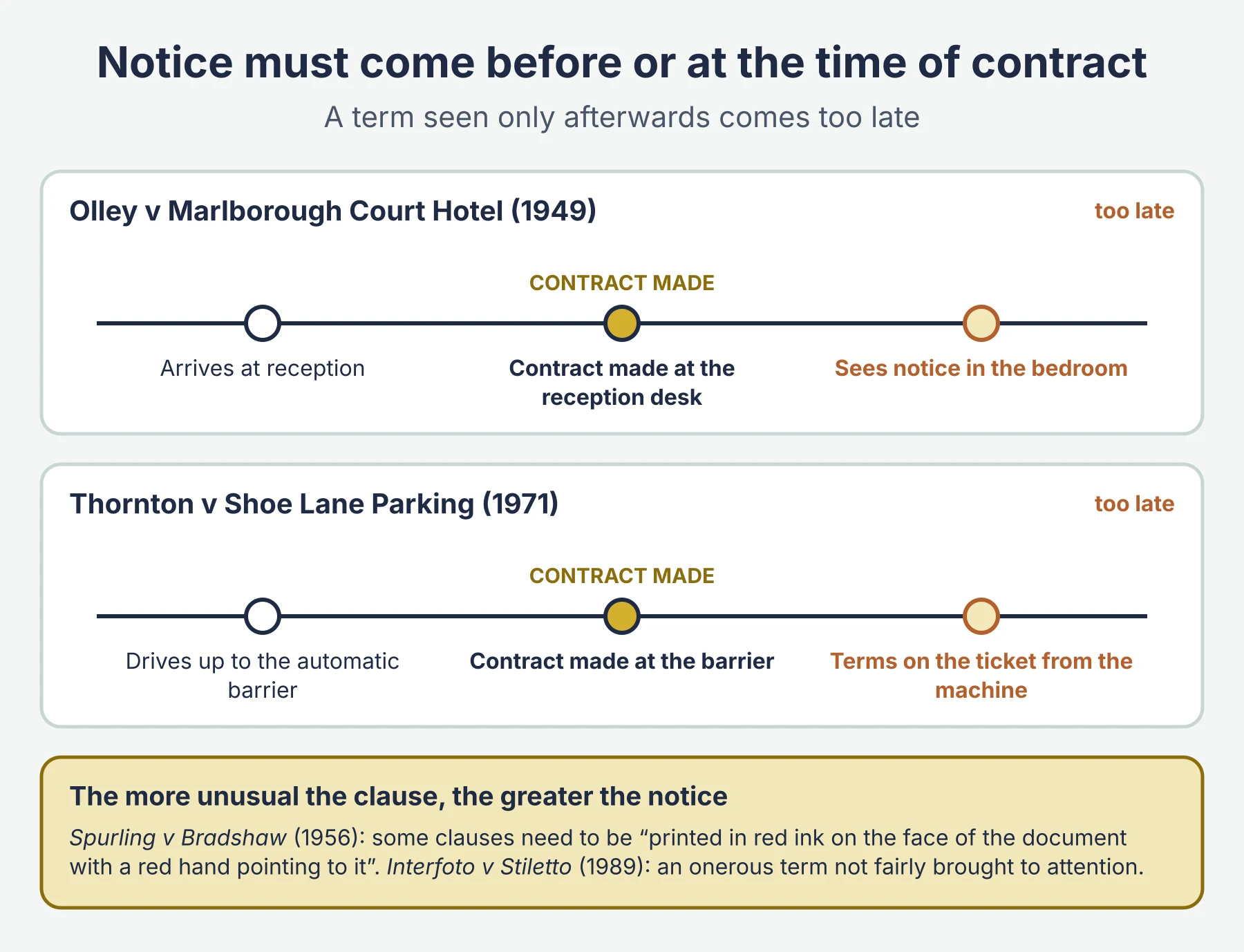
| Notice: timing | Must be given before or at the time of contracting | Olley v Marlborough Court (1949): bedroom notice too late |
| Notice: machines | Contract made at the machine; ticket terms come too late | Thornton v Shoe Lane Parking (1971) |
| Notice: document | Must be a document a reasonable person expects to contain terms | Chapelton v Barry UDC (1940): deckchair ticket a receipt |
| Notice: steps | Reasonably sufficient steps to give notice, not actual reading | Parker v South Eastern Railway (1877) |
| Notice: unusual terms | More onerous terms need more prominent notice | Spurling v Bradshaw (1956) “red hand”; Interfoto v Stiletto (1989) |
| Course of dealing | Must be regular and consistent | McCutcheon v MacBrayne (1964); Hollier v Rambler Motors (1972): three or four times in five years not enough |
Construction
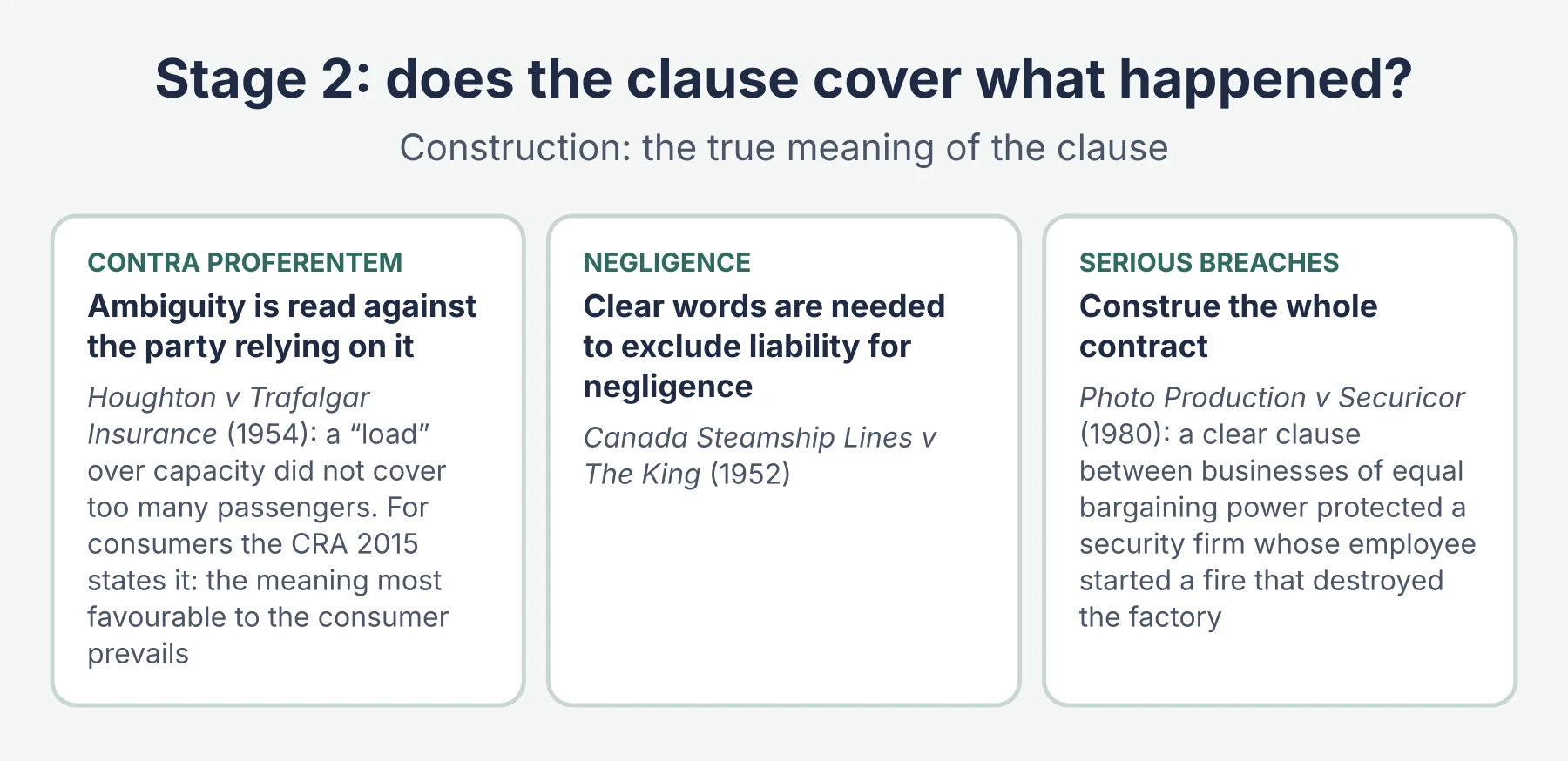
- Contra proferentem: ambiguity read against the party relying on the clause. Houghton v Trafalgar Insurance (1954): “load” did not include passengers.
- CRA 2015: where a term could have different meanings, the one most favourable to the consumer prevails.
- Negligence requires clear words: Canada Steamship Lines v The King (1952).
- Fundamental breach is a matter of construction, not a rule of law: Photo Production v Securicor (1980).
Statutory control
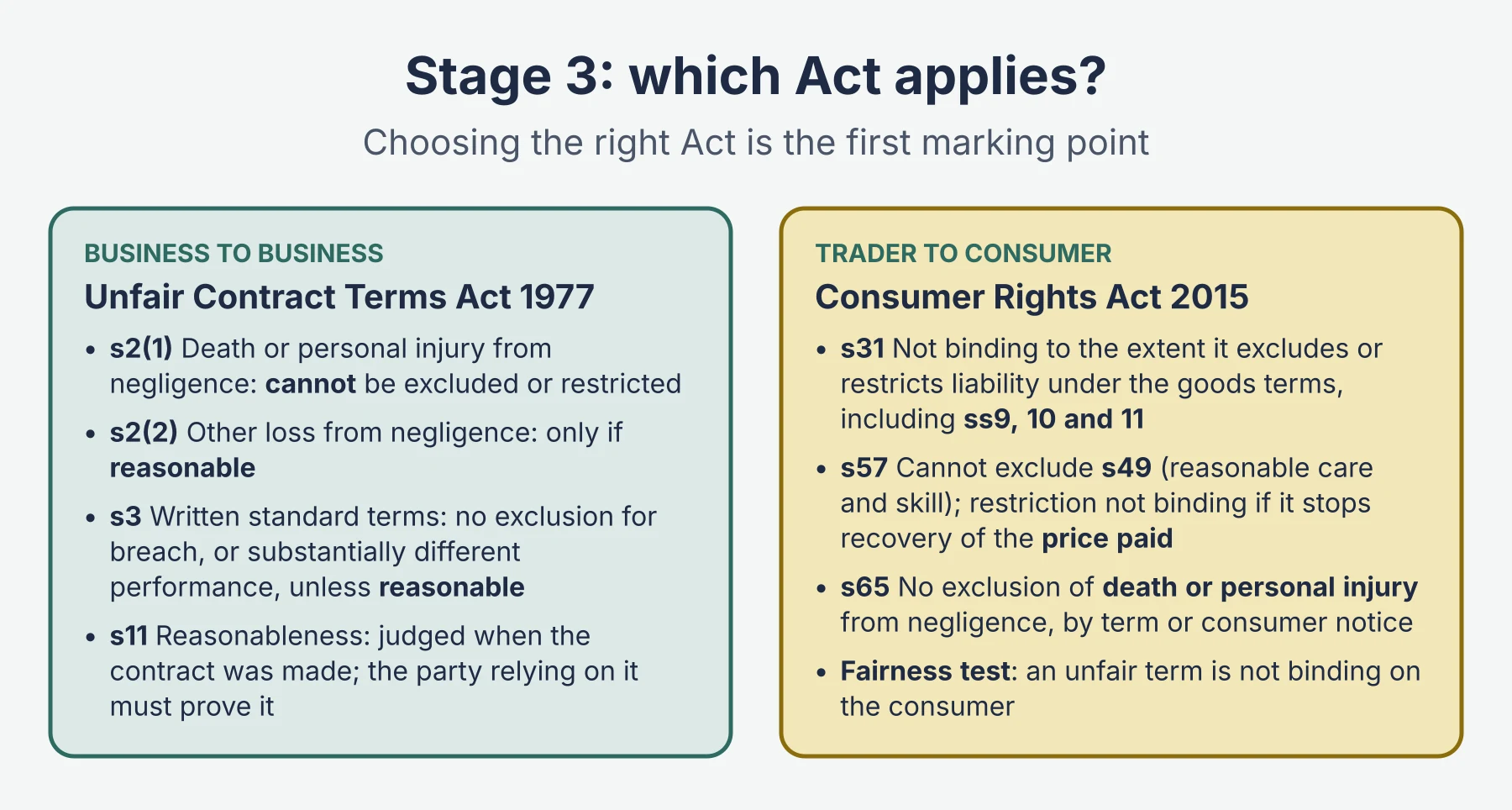
Which Act? Business to business → UCTA 1977. Trader to consumer → CRA 2015.
| Act and section | Effect |
|---|---|
| UCTA s2(1) | Cannot exclude or restrict liability for death or personal injury from negligence |
| UCTA s2(2) | Other negligence loss: only if reasonable |
| UCTA s3 | Written standard terms: exclusion of liability for breach, or a right to perform differently or not at all, only if reasonable |
| UCTA s11 | Reasonableness judged at the time of contracting; burden on the party relying on the clause |
| CRA s31 | Cannot exclude or restrict liability under the goods terms (ss9 to 11 and others) |
| CRA s57 | Cannot exclude s49 liability; cannot restrict s49 or s52 liability below the price paid |
| CRA s65 | Cannot exclude or restrict liability for death or personal injury from negligence by a term or consumer notice; knowing of it is not voluntary acceptance of risk |
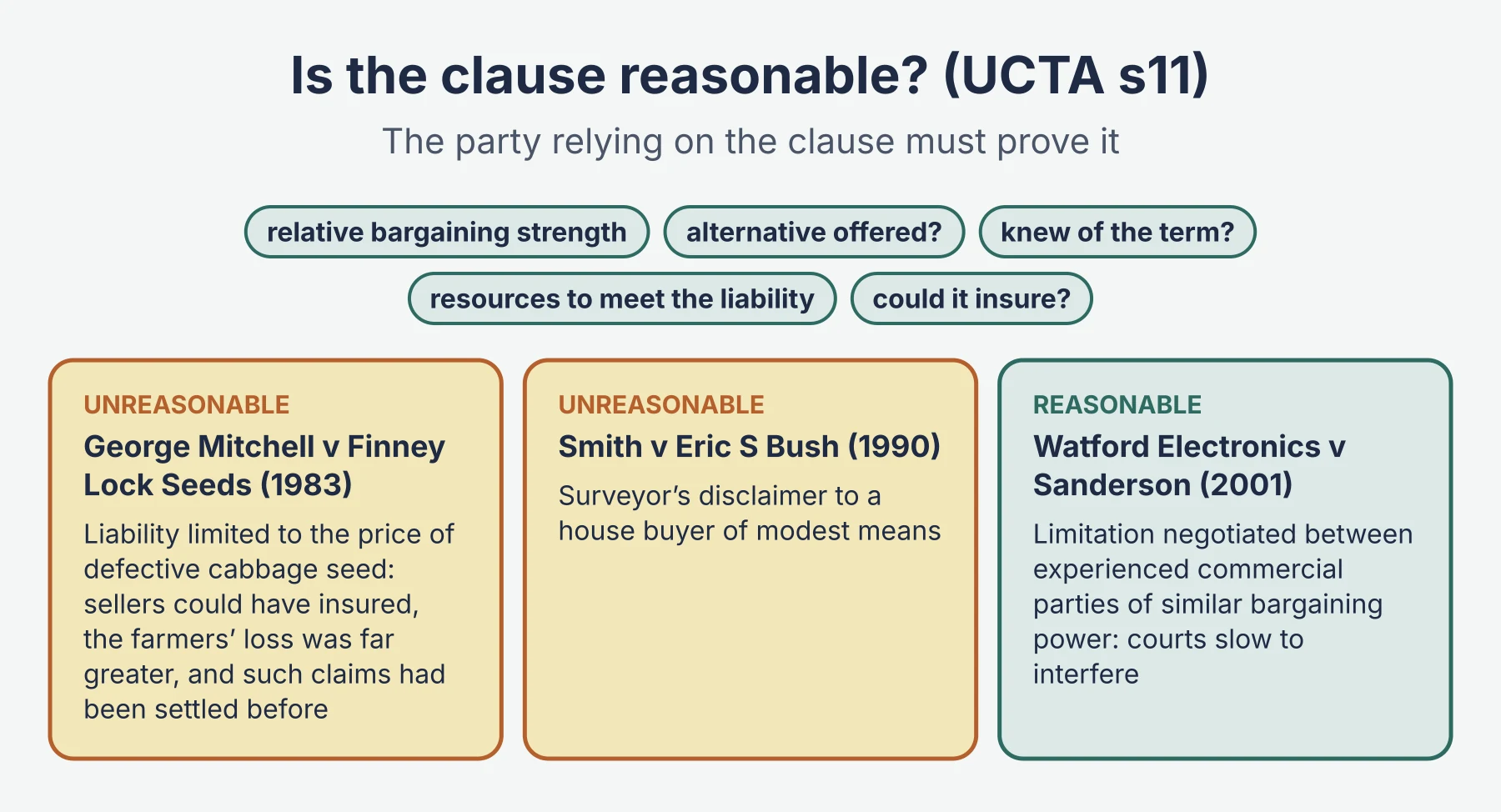
Reasonableness factors: relative bargaining strength; whether an alternative was offered; whether the customer knew or should have known of the term; for limitation clauses, the resources of the party and availability of insurance.
| Case | Outcome |
|---|---|
| George Mitchell v Finney Lock Seeds (1983) | Limitation to the price of seed unreasonable: sellers could insure, loss far greater, they had settled such claims before |
| Smith v Eric S Bush (1990) | Surveyor’s disclaimer to a house buyer of modest means unreasonable |
| Watford Electronics v Sanderson (2001) | Limitation between experienced commercial parties of similar strength reasonable |
Other exclusion terms in consumer contracts face the fairness test: contrary to good faith, causing a significant imbalance to the consumer’s detriment; an unfair term does not bind the consumer.
Key terms
| Term | Meaning |
|---|---|
| Exclusion clause | Term or notice removing liability |
| Limitation clause | Term or notice capping liability |
| Incorporation | Whether a clause became part of the contract |
| Contra proferentem | Ambiguity resolved against the party relying on the clause |
| Course of dealing | Regular, consistent previous contracts on the same terms |
| Written standard terms | A party’s usual printed terms, used without negotiation (UCTA s3) |
| Requirement of reasonableness | UCTA s11 test of whether the term was fair and reasonable when made |
| Consumer notice | A notice relating to rights or obligations between a trader and a consumer (CRA) |
Exam traps
- Discussing statute first: an unincorporated clause fails at stage 1, so stop there or say “even if incorporated”.
- Mixing up the Acts: UCTA for business contracts; CRA for consumer contracts.
- Judging reasonableness by hindsight. Section 11 looks at the time of contracting.
- Treating an unsigned ticket as automatically binding; ask whether it is a contractual document given in time.
- Forgetting that death or personal injury from negligence can never be excluded under either Act.
- Saying limitation clauses are always allowed. They are still tested for reasonableness or fairness.
Self-test
- What is the difference between an exclusion clause and a limitation clause?
- Which case decided that a signed document binds even if unread?
- Why could the cleaners not rely on their clause in Curtis?
- In Thornton v Shoe Lane Parking, when was the contract made?
- What did Chapelton v Barry UDC decide?
- What did Denning LJ say about unusual clauses in Spurling v Bradshaw?
- Why was there no course of dealing in Hollier v Rambler Motors?
- What does contra proferentem mean, and which case illustrates it?
- Which section of UCTA 1977 prevents exclusion of liability for death or personal injury caused by negligence?
- At what time is reasonableness judged under UCTA, and who must prove it?
- Why was the clause in George Mitchell v Finney Lock Seeds unreasonable?
- What does section 57 of the CRA 2015 provide?
Answers: 1. An exclusion clause removes liability; a limitation clause caps it. 2. L’Estrange v Graucob (1934). 3. The assistant misrepresented the clause as covering only beads and sequins. 4. When the customer drove up to the automatic barrier, so terms on the ticket came too late. 5. A deckchair ticket was a mere receipt, not a contractual document, so its terms were not incorporated. 6. Some would need to be printed in red ink with a red hand pointing to them before notice would be sufficient. 7. Three or four transactions over five years were not regular and consistent enough. 8. Ambiguous words are read against the party relying on them; Houghton v Trafalgar Insurance (1954). 9. Section 2(1). 10. At the time the contract was made; the party relying on the clause. 11. The sellers could have insured, the farmers’ loss far exceeded the price, and the sellers had settled such claims in the past. 12. A term cannot exclude liability under s49, and a term restricting liability under s49 or s52 does not bind the consumer if it would prevent recovery of the price paid.
More resources on this topic
Exclusion clauses study guide | Exclusion clauses practice questions | Law of contract revision notes
Related resources
-
Study guides
AQA A Level Law (7162): Contract Terms: General
Terms or representations, express and implied terms, and conditions, warranties and innominate terms with the effect of breach, for AQA A Level Law 7162.
Law · AQA · A Level
Read guide -
Practice questions
AQA A Level Law (7162): Contract Terms: General – Practice Questions
Original practice questions with mark-scheme answers on terms and representations, implied terms, and conditions, warranties and innominate terms, AQA Law 7162.
Law · AQA · A Level
Try questions -
Revision notes
AQA A Level Law (7162): Contract Terms: General – Revision Notes
Recall notes on terms and representations, express and implied terms, and conditions, warranties and innominate terms, for AQA A Level Law 7162 contract.
Law · AQA · A Level
Revise topic
Get free revision emails (optional)
Occasional emails with practice questions, worked explanations and links to free resources for the qualification and subjects you choose. No spam, and you can unsubscribe from any email. The free tools on this site never need an email.