
Revision Notes
AQA A Level Law (7162): Contract Terms: General – Revision Notes
Recall notes on terms and representations, express and implied terms, and conditions, warranties and innominate terms, for AQA A Level Law 7162 contract.
- Subject
- Law
- Level
- A LEVELS
- Topic
- Topic 4: Law of contract
- Author
- Marlbridge Academic Team
- Updated
- Reviewed by
- Aizaz Raoof Ali (what this means)
Aligned to AQA A Level Law (7162), For teaching from September 2017 onwards, A-level exams 2019 onwards. Official specification .
Syllabus page (what it covers and how it is assessed): AQA A Level Law.
Syllabus points this page covers
7162
- Contract terms: general
Found an error? Report a correction.
Need help with this topic? Request a free trial class for A Level Law (7162).
Condensed notes for the section 3.4 row Contract terms: general: “Express and implied terms” and “Conditions, warranties and innominate terms”. For explanation and a worked problem, use the contract terms: general study guide.
The sequence
1 Statement made  ->  TERM or REPRESENTATION?
2 If term         ->  EXPRESS or IMPLIED (fact, law, custom, statute)
3 Classify        ->  CONDITION / WARRANTY / INNOMINATE
4 Breach          ->  terminate and/or damages, or damages only
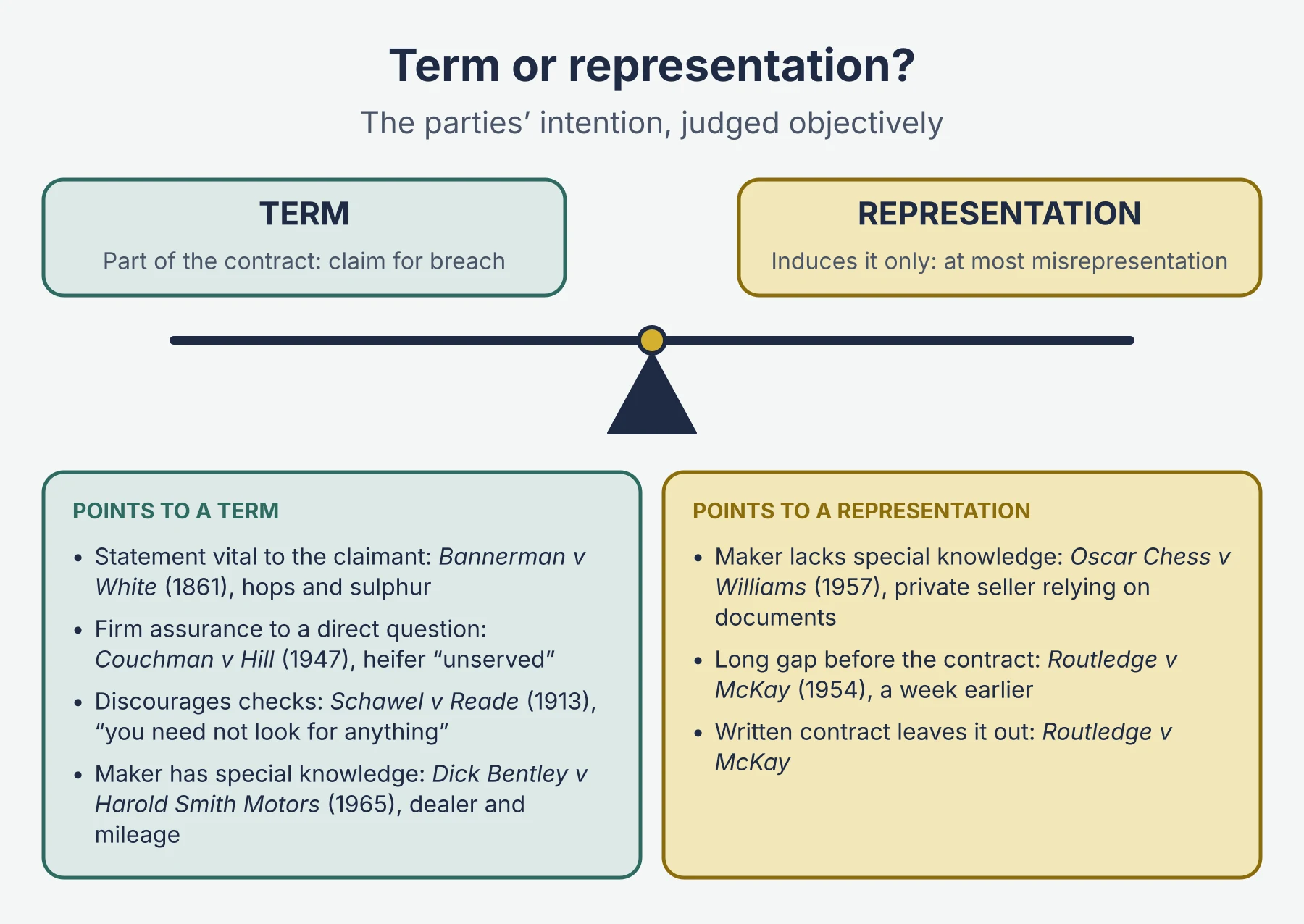
Term or representation?
| Factor | Case | Result |
|---|---|---|
| Importance stressed | Bannerman v White (1861) | Term (no sulphur) |
| Specific assurance on a direct question | Couchman v Hill (1947) | Term (heifer unserved) |
| Discouraging checks | Schawel v Reade (1913) | Term (horse sound) |
| Maker has special knowledge | Dick Bentley v Harold Smith (1965) | Term (dealer, mileage) |
| Maker lacks special knowledge | Oscar Chess v Williams (1957) | Representation (private seller, car age) |
| Time gap; omitted from writing | Routledge v McKay (1954) | Representation (motorcycle date) |
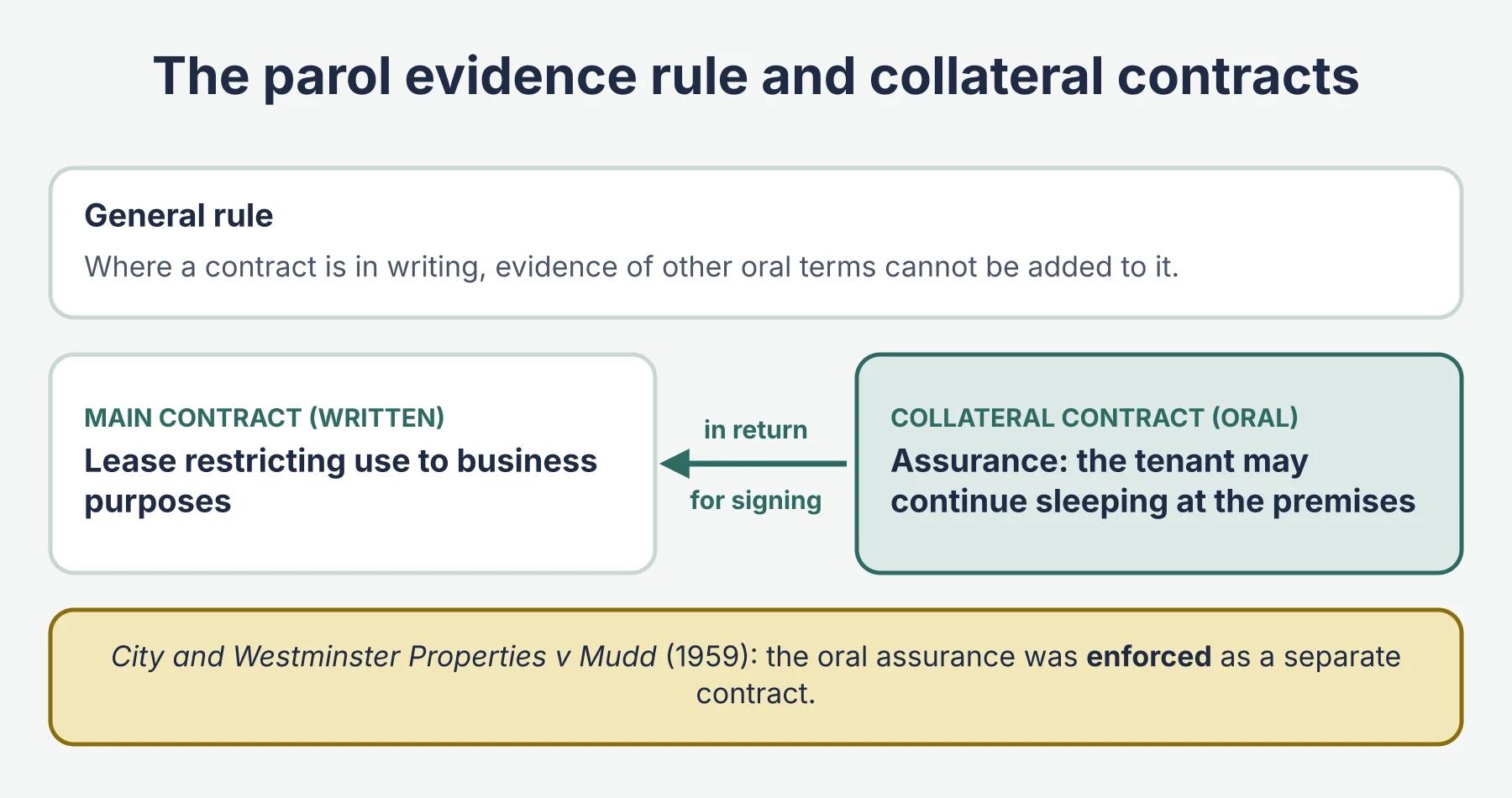
Parol evidence rule: oral terms not generally added to a written contract. Collateral contract: separate enforceable promise: City and Westminster Properties v Mudd (1959).
Implied terms
| Route | Test | Authority |
|---|---|---|
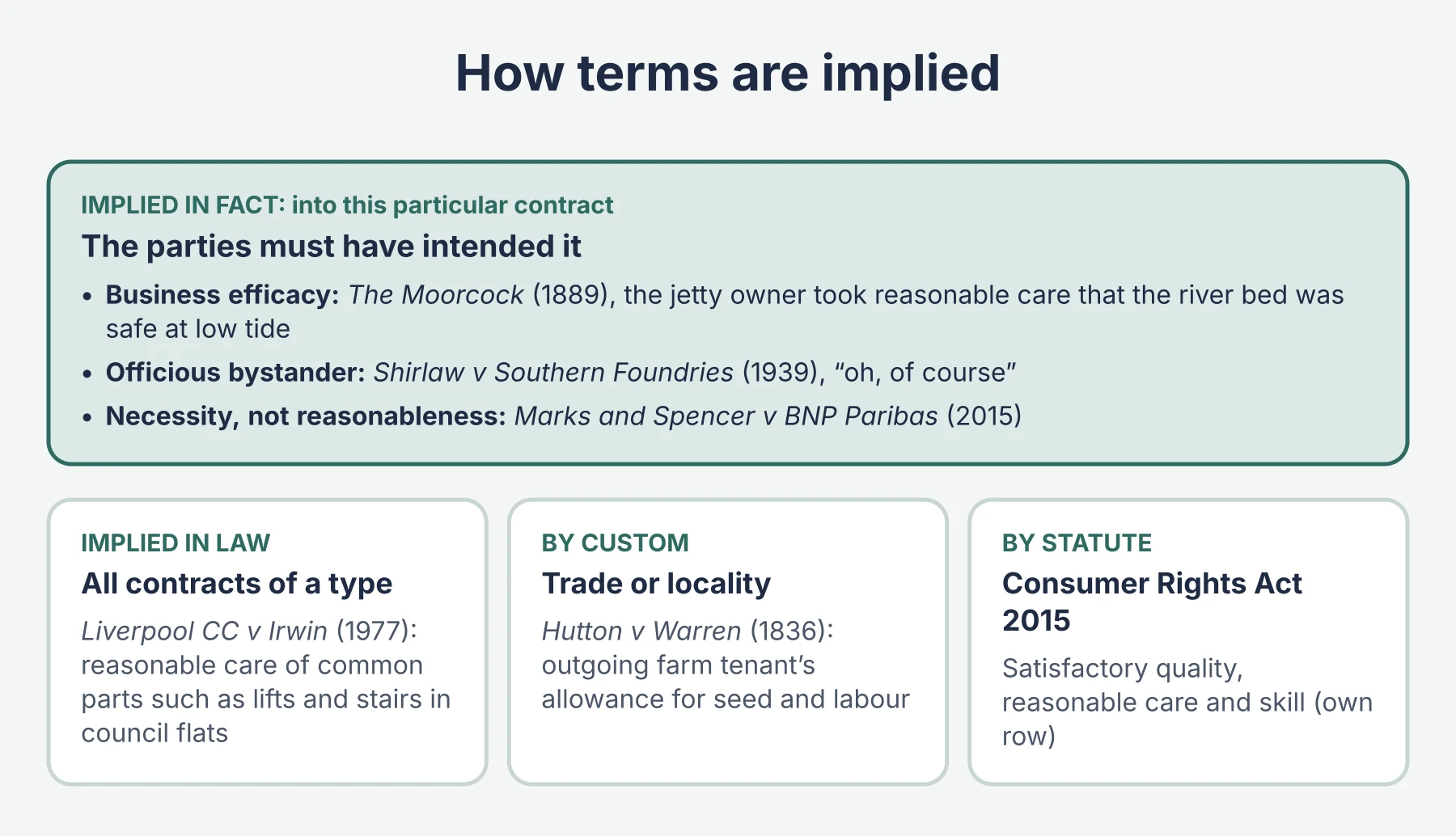
| In fact: business efficacy | Needed to make the contract work | The Moorcock (1889) |
| In fact: officious bystander | So obvious: “oh, of course” | Shirlaw v Southern Foundries (1939) |
| In fact: modern restatement | Necessity, not reasonableness | Marks and Spencer v BNP Paribas (2015) |
| In law | Implied into all contracts of that type | Liverpool CC v Irwin (1977) |
| Custom | Established trade or local custom | Hutton v Warren (1836) |
| Statute | Implied by Parliament | Consumer Rights Act 2015 (separate row) |
Classification of terms
| Type | Effect of breach | Authority |
|---|---|---|
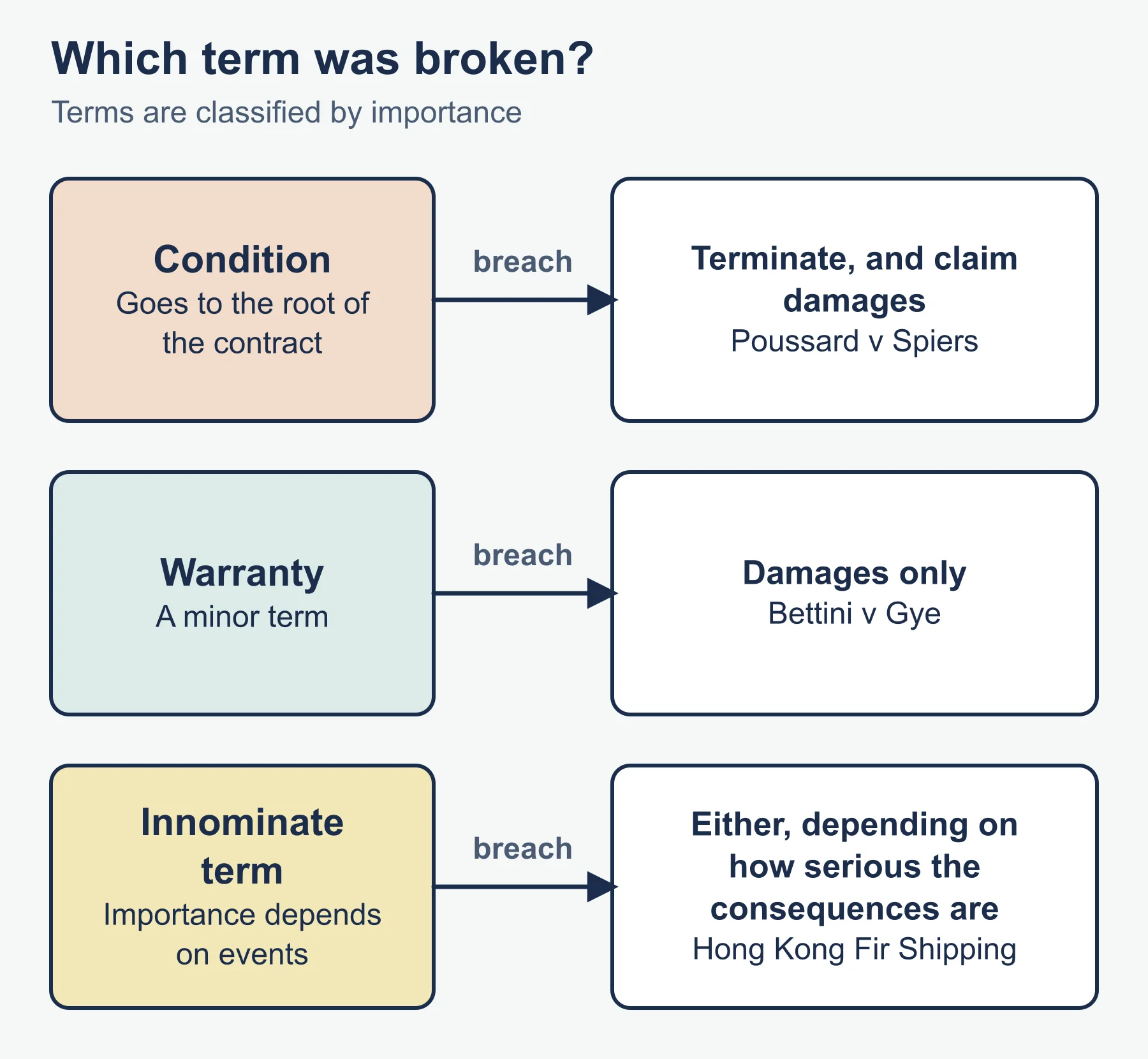
| Condition | Terminate or affirm; damages | Poussard v Spiers (1876) |
| Warranty | Damages only | Bettini v Gye (1876) |
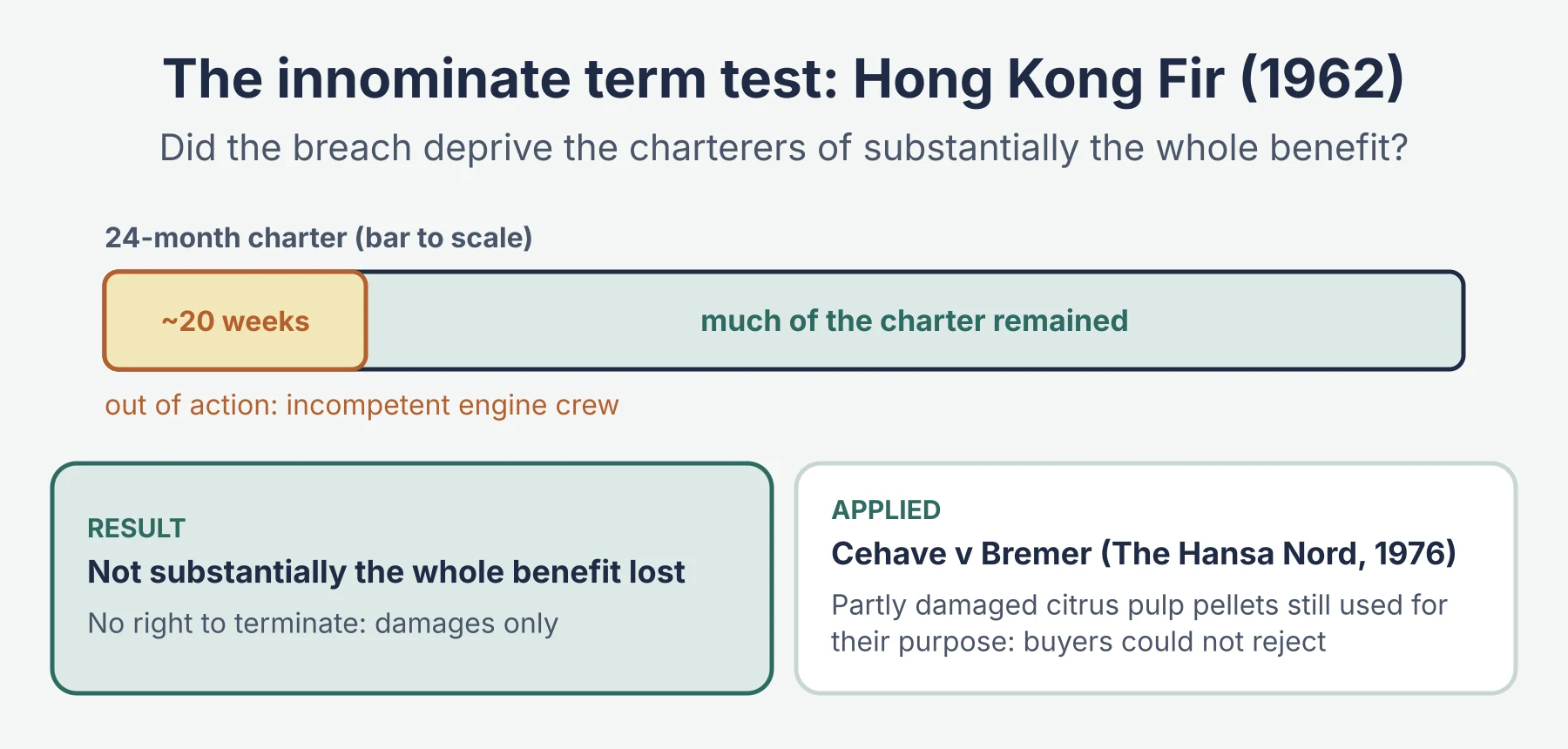
| Innominate | Terminate only if breach deprives of substantially the whole benefit | Hong Kong Fir (1962); The Hansa Nord (1976) |
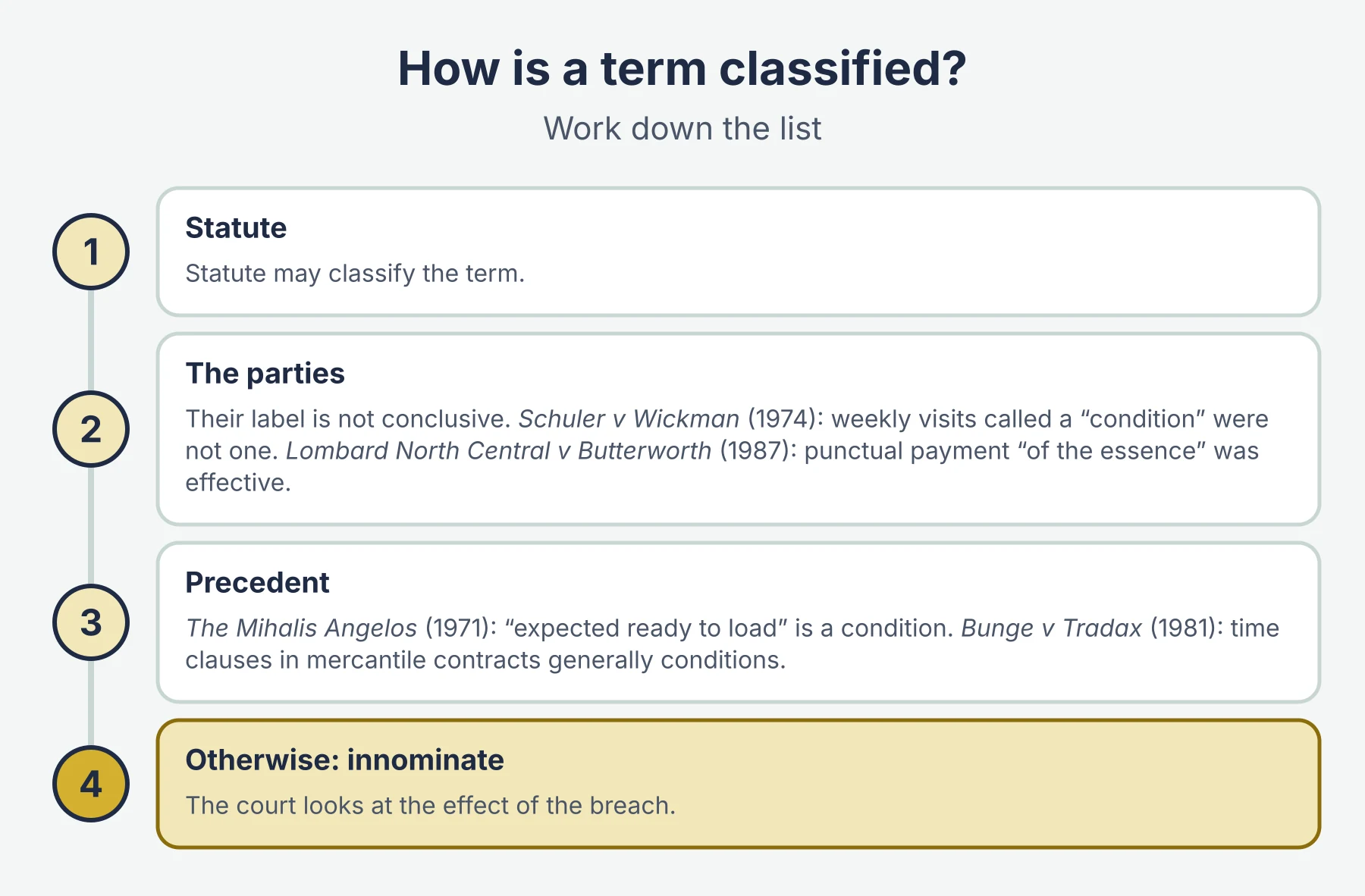
How classified:
- Statute.
- Parties: label not conclusive (Schuler v Wickman, 1974); “of the essence” effective (Lombard v Butterworth, 1987).
- Precedent: “expected ready to load” a condition (The Mihalis Angelos, 1971); time clauses in mercantile contracts usually conditions (Bunge v Tradax, 1981).
- Otherwise innominate.
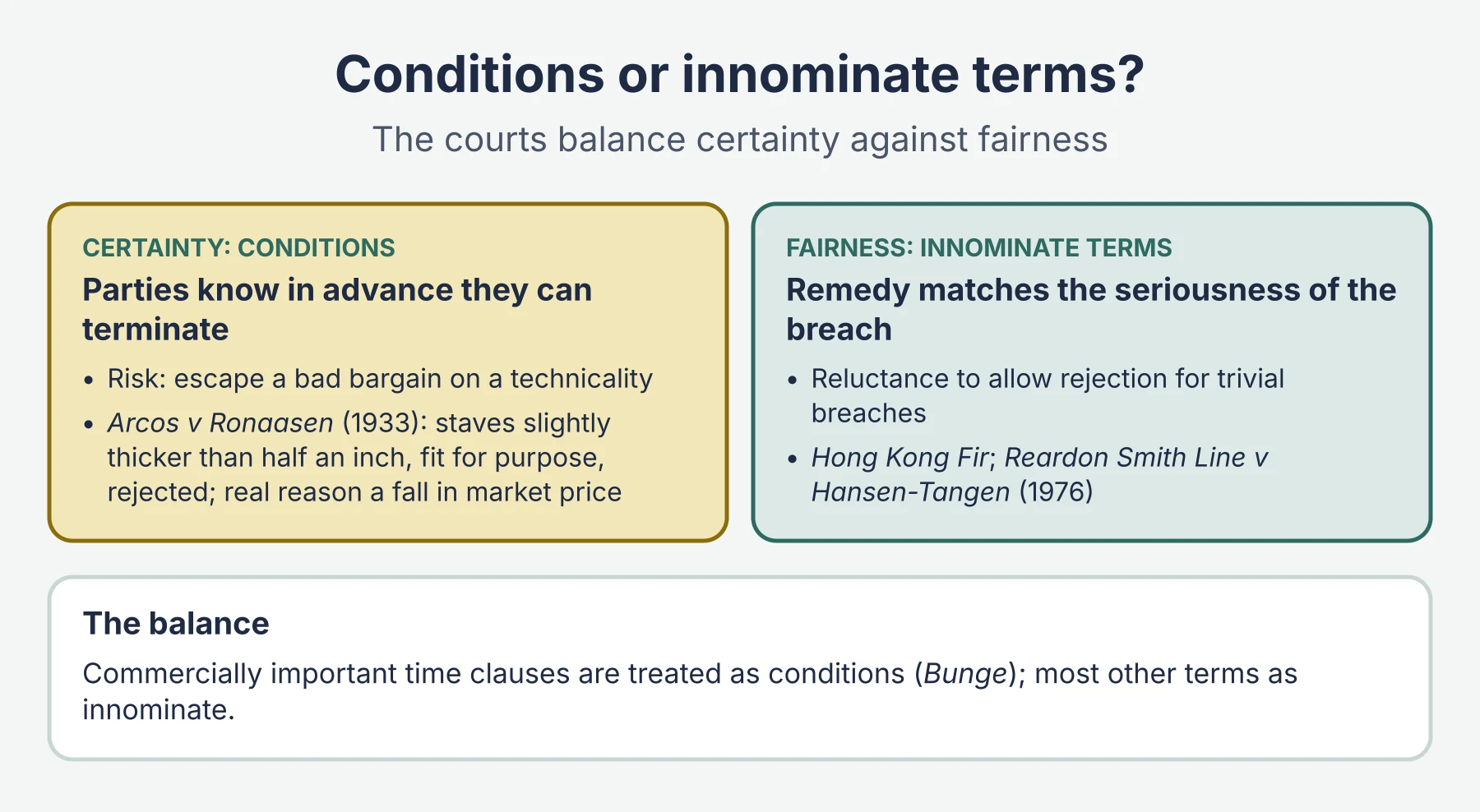
Strictness: Arcos v Ronaasen (1933): rejection for slightly thicker staves. Courts now reluctant to allow rejection for trivial breaches (Reardon Smith Line, 1976; Hansa Nord).
Applying it in a problem
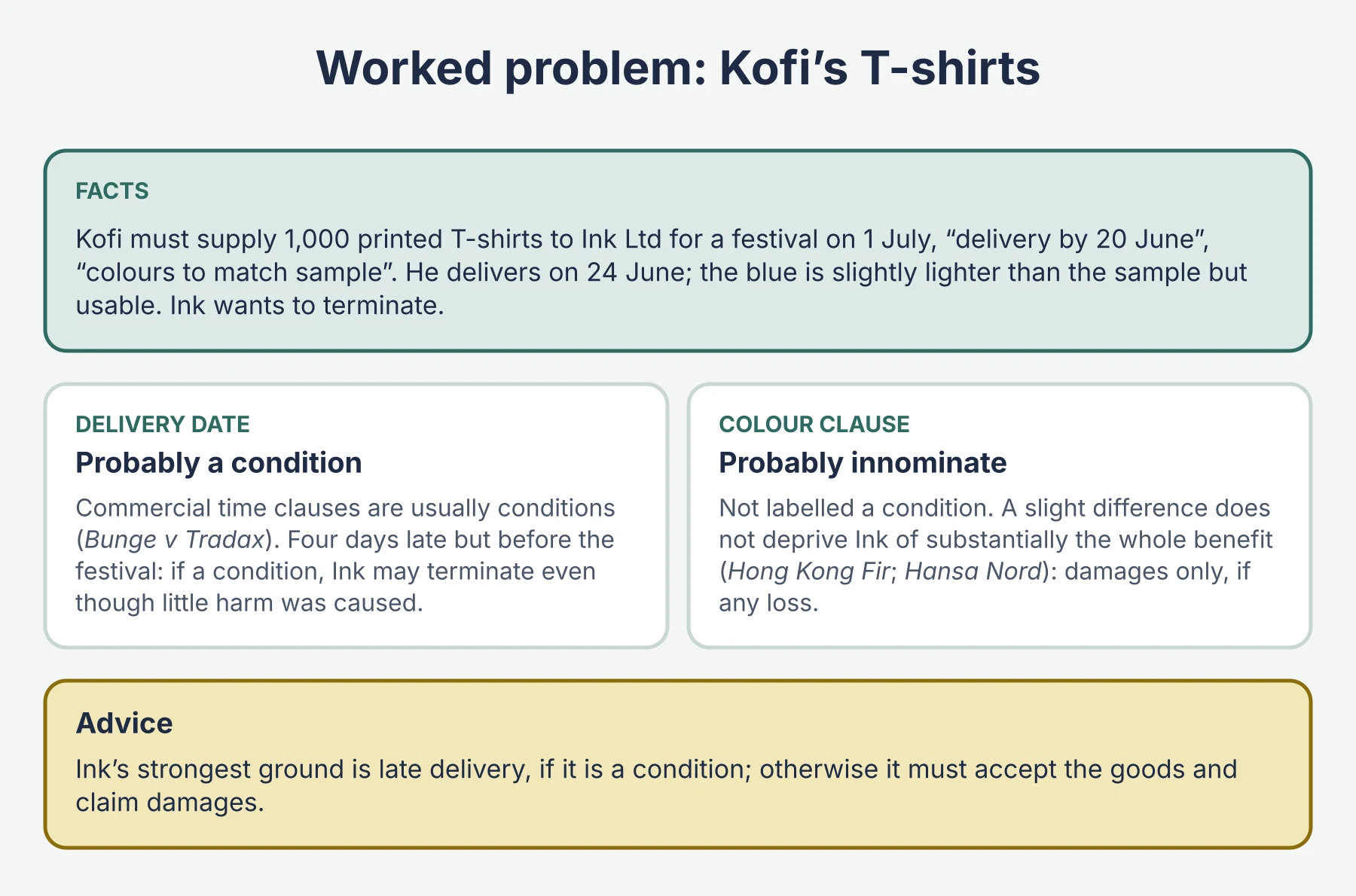
- Quote the statement from the facts and weigh at least two factors before deciding term or representation.
- If a term, say whether it is express or implied, and by which route.
- Classify using statute, the parties’ wording, then precedent; only then fall back on the innominate approach.
- State the remedy precisely: “may terminate and claim damages” or “damages only”.
Evaluation points
- Term or representation: factor tests are flexible but unpredictable; outcomes depend on how a court weighs expertise, timing and importance.
- Implied terms: Marks and Spencer restores the primacy of the written bargain, supporting certainty and freedom of contract.
- Conditions: give certainty and allow quick termination in commerce, but can be used to escape a bad bargain (Arcos).
- Innominate terms: match remedy to the seriousness of breach, but leave parties unsure whether they may terminate, risking wrongful termination themselves.
Key terms
| Term | Meaning |
|---|---|
| Term | A promise forming part of the contract |
| Representation | A pre-contract statement inducing the contract but not part of it |
| Express term | A term the parties stated |
| Implied term | A term added by fact, law, custom or statute |
| Parol evidence rule | Oral evidence cannot generally add to a written contract |
| Collateral contract | A separate contract containing an oral promise |
| Condition | An essential term; breach allows termination |
| Warranty | A minor term; breach gives damages only |
| Innominate term | A term whose breach is judged by its consequences |
| Affirm | Choose to continue the contract after breach |
Exam traps
- A false statement is not automatically a term.
- “Condition” in the contract does not decide classification (Schuler).
- Implied terms need necessity or obviousness, not fairness.
- Breach of a condition gives a choice: the innocent party may affirm.
- Do not use Hong Kong Fir where precedent has already classified the term as a condition.
Self-test
- Why was the statement in Bannerman v White a term? The buyer made clear its importance; he would not buy treated hops.
- Why was the statement in Oscar Chess v Williams a representation? The private seller had no special knowledge and relied on the logbook.
- What made the statement a representation in Routledge v McKay? The time gap and its omission from the written contract.
- What is a collateral contract? A separate contract containing an oral promise given in return for entering the main contract.
- What test did Marks and Spencer v BNP Paribas confirm for implied terms in fact? Necessity for business efficacy or obviousness, not reasonableness.
- What term was implied in Liverpool CC v Irwin? That the landlord would take reasonable care to maintain the common parts.
- What is the effect of breach of a condition? The innocent party may terminate or affirm, and claim damages.
- Distinguish Poussard and Bettini. Missing opening nights broke a condition; missing rehearsals broke a warranty.
- What question did Hong Kong Fir ask? Did the breach deprive the innocent party of substantially the whole benefit?
- Why was the “condition” in Schuler not treated as one? The parties could not have intended one missed visit to allow termination.
- What did Bunge v Tradax decide? Time clauses in mercantile contracts are generally conditions.
- Why is Arcos v Ronaasen criticised? It allowed rejection for a trivial breach to escape a falling market.
More resources on this topic
Contract terms: general practice questions | Law of contract revision notes
Related resources
-
Study guides
AQA A Level Law (7162): Contract terms: specific terms implied by statute law in relation to consumer contracts
Consumer Rights Act 2015 for AQA A Level Law 7162: terms implied by ss9, 10, 11, 49 and 52, and the remedies in ss20, 23, 24, 55 and 56, applied to scenarios.
Law · AQA · A Level
Read guide -
Practice questions
AQA A Level Law (7162): Contract terms: specific terms implied by statute law in relation to consumer contracts – Practice Questions
Original practice on Consumer Rights Act 2015 implied terms for AQA A Level Law 7162, with mark-scheme answers on ss9 to 11, 49, 52 and the remedy tiers.
Law · AQA · A Level
Try questions -
Revision notes
AQA A Level Law (7162): Contract terms: specific terms implied by statute law in relation to consumer contracts – Revision Notes
Condensed recall on Consumer Rights Act 2015 implied terms for AQA A Level Law 7162: ss9 to 11, 49 and 52, the tiered goods remedies and services remedies.
Law · AQA · A Level
Revise topic
Get free revision emails (optional)
Occasional emails with practice questions, worked explanations and links to free resources for the qualification and subjects you choose. No spam, and you can unsubscribe from any email. The free tools on this site never need an email.