
Study Guides
AQA A Level Law (7162): Contract terms: specific terms implied by statute law in relation to consumer contracts
Consumer Rights Act 2015 for AQA A Level Law 7162: terms implied by ss9, 10, 11, 49 and 52, and the remedies in ss20, 23, 24, 55 and 56, applied to scenarios.
- Subject
- Law
- Level
- A LEVELS
- Topic
- Topic 4: Law of contract
- Author
- Marlbridge Academic Team
- Updated
- Reviewed by
- Aizaz Raoof Ali (what this means)
Aligned to AQA A Level Law (7162), For teaching from September 2017 onwards, A-level exams 2019 onwards. Official specification .
Syllabus page (what it covers and how it is assessed): AQA A Level Law.
Syllabus points this page covers
7162
- Contract terms: specific terms implied by statute law in relation to consumer contracts
Found an error? Report a correction.
Need help with this topic? Request a free trial class for A Level Law (7162).
This guide covers the Consumer Rights Act 2015 content in section 3.4 Law of contract of AQA A-level Law (7162). The specification names exactly which sections you need: terms implied into a contract to supply goods (“s9 (satisfactory quality)”, “s10 (fitness for particular purpose)” and “s11 (description)”), the goods remedies in ss20, 23 and 24, the services terms in ss49 and 52, and the services remedies in ss55 and 56. For the whole contract option in outline, start with the Law of contract study guide.
Step 0: is this a consumer contract?
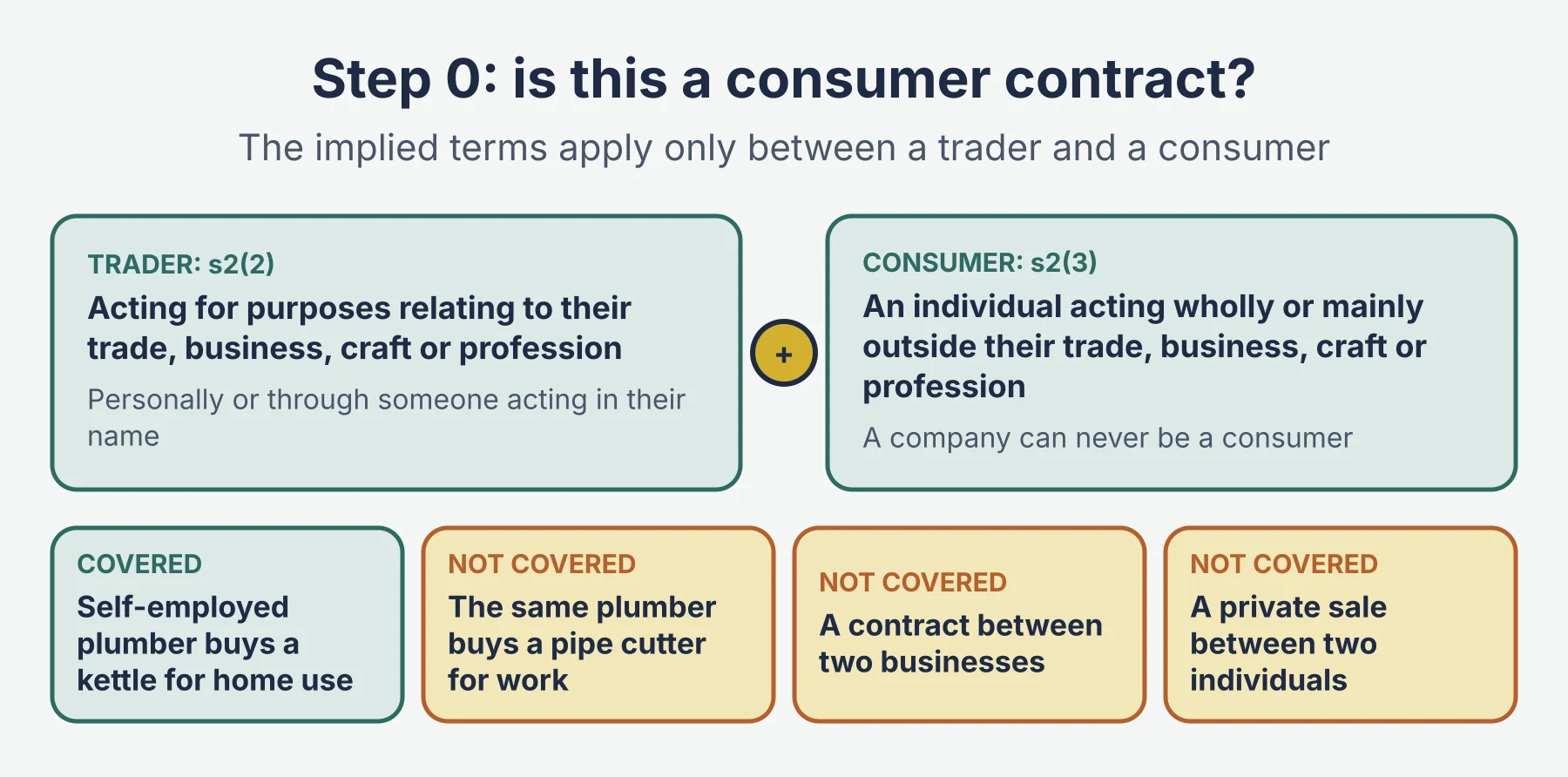
The implied terms in the Act apply only to a contract between a trader and a consumer. Check this before anything else, because a scenario between two businesses falls outside these sections.
- A consumer is “an individual acting for purposes that are wholly or mainly outside that individual’s trade, business, craft or profession” (section 2(3)). A company can never be a consumer. A self-employed plumber buying a kettle for home use is a consumer; the same plumber buying a pipe cutter for work is not.
- A trader is a person acting for purposes relating to their trade, business, craft or profession, whether personally or through someone acting in their name (section 2(2)).
- A private sale between two individuals is not covered.
Terms implied into contracts to supply goods
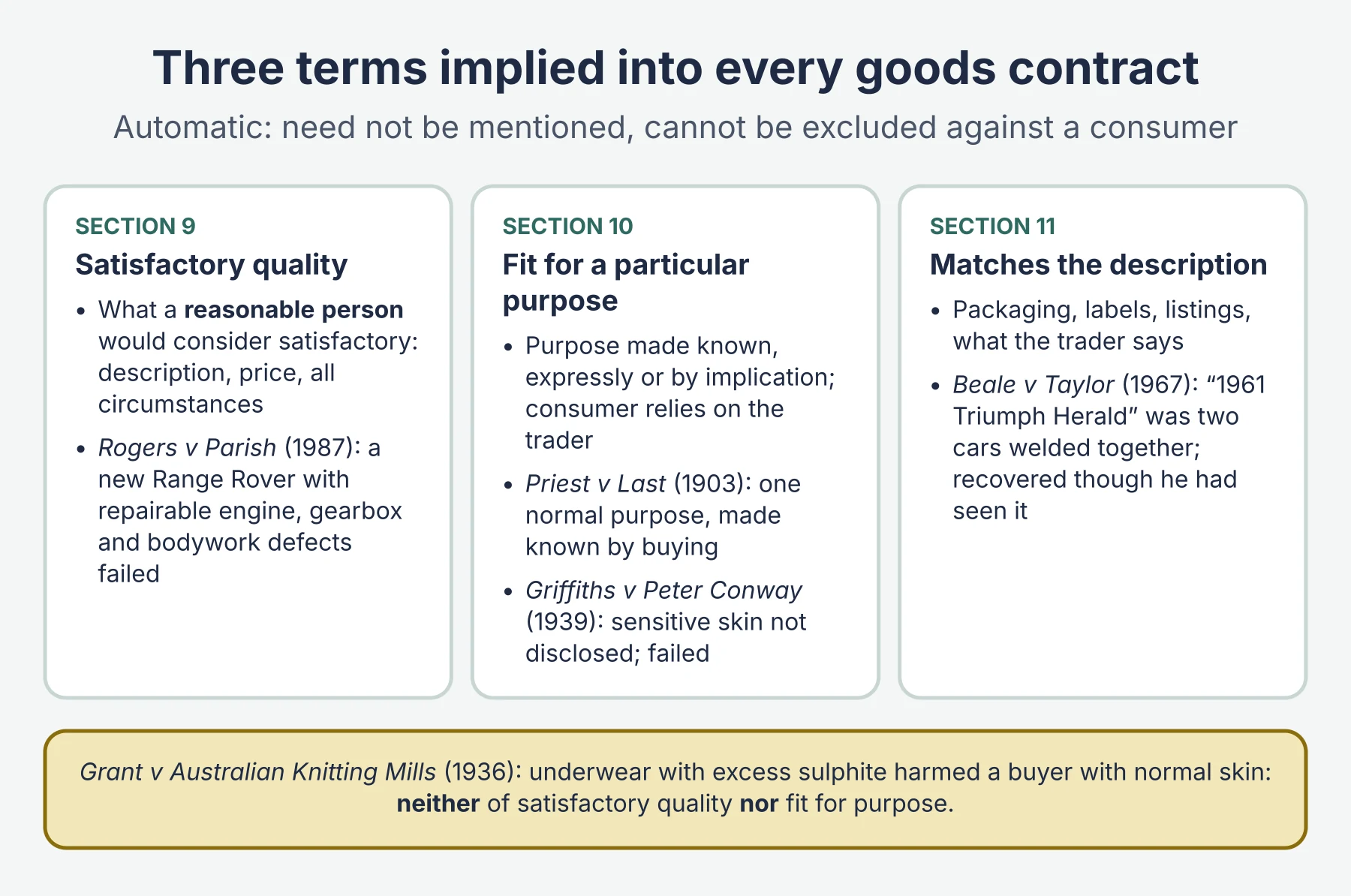
The Act says each contract to supply goods is “to be treated as including” these terms. They are automatic: the trader does not have to mention them and cannot exclude them against a consumer.
Section 9: satisfactory quality
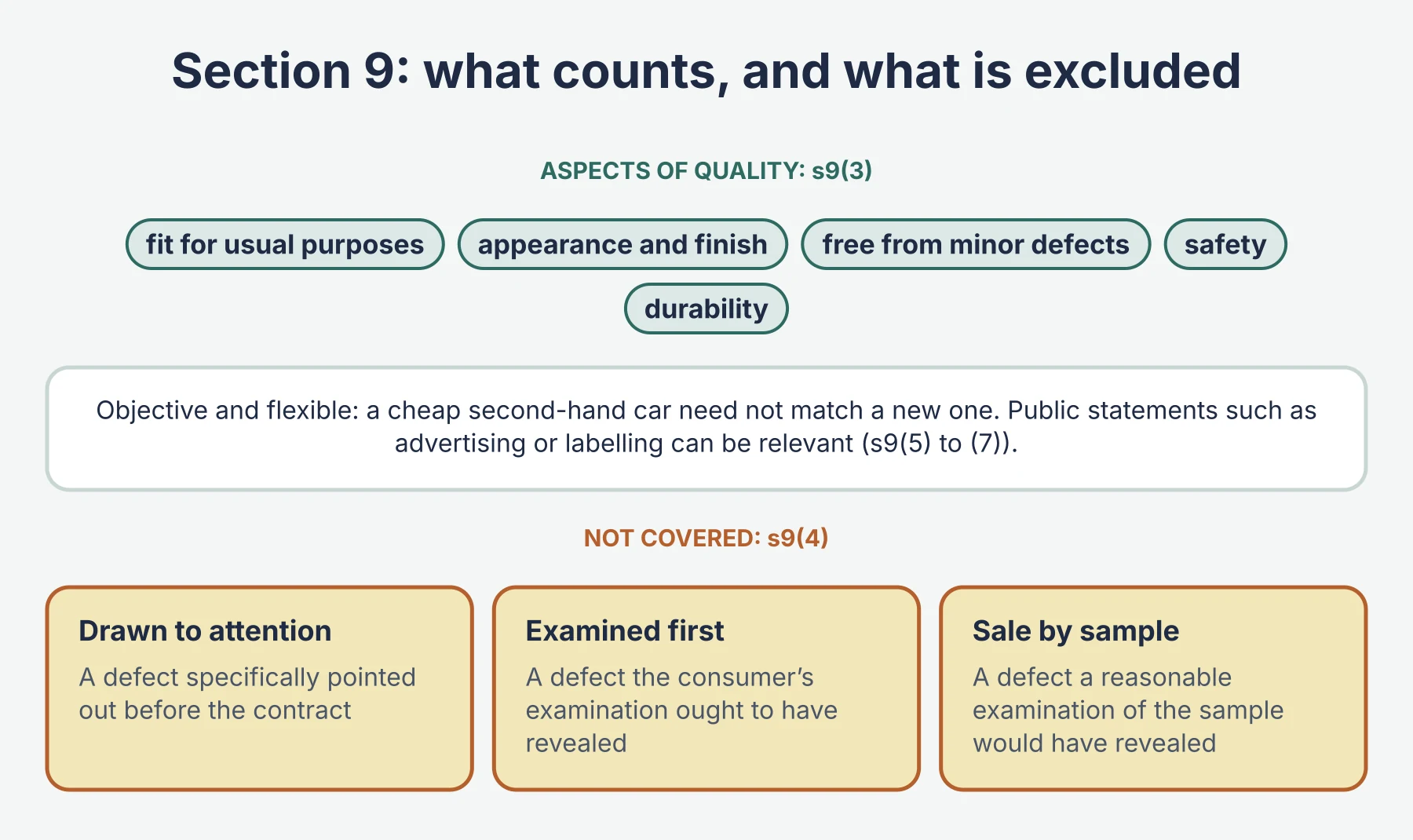
Goods must meet the standard that a reasonable person would consider satisfactory, taking account of any description, the price and all other relevant circumstances (section 9(2)). Section 9(3) lists aspects of quality that may be relevant:
- fitness for all the purposes for which goods of that kind are usually supplied;
- appearance and finish;
- freedom from minor defects;
- safety;
- durability.
The test is objective and flexible: a cheap second-hand car need not match a new one. Older case law still illustrates the idea: in Rogers v Parish (Scarborough) Ltd (1987) a new Range Rover with defects in the engine, gearbox and bodywork was not of the required quality, even though the defects could be repaired, because a buyer of a new vehicle at that price is entitled to expect more than a car that merely gets from A to B.
Section 9(4) sets out three situations in which the term does not cover a defect: a matter specifically drawn to the consumer’s attention before the contract was made; where the consumer examined the goods before the contract, a defect that the examination ought to have revealed; and, in a sale by sample, a defect that a reasonable examination of the sample would have revealed. Public statements about the goods, such as advertising or labelling, can also be relevant circumstances (section 9(5) to (7)).
Section 10: fitness for a particular purpose
If the consumer makes known to the trader, expressly or by implication, a particular purpose for which the goods are wanted, the goods must be reasonably fit for that purpose, whether or not it is a purpose for which such goods are usually supplied. The term does not apply where the consumer does not rely, or it is unreasonable for the consumer to rely, on the skill or judgment of the trader (section 10(4)).
- Priest v Last (1903): where goods have only one normal purpose, such as a hot-water bottle, the purpose is made known by implication simply by buying them. The bottle burst and the buyer recovered.
- Griffiths v Peter Conway Ltd (1939): a buyer with unusually sensitive skin who did not tell the seller about it could not claim that a coat was unfit when it caused dermatitis. The particular purpose had not been made known.
- Grant v Australian Knitting Mills (1936): woollen underwear containing excess sulphite caused dermatitis in a buyer with normal skin. It was neither of the required quality nor fit for purpose.
Section 11: goods to match a description
Where goods are supplied by description, they must match it. Description covers words on packaging, labels, online listings and things said by the trader. In Beale v Taylor (1967) a car advertised as a 1961 Triumph Herald was in fact two cars welded together, only one half of which was from 1961; the buyer recovered because the car did not match the description, even though he had seen it before buying. If goods are supplied by sample as well as description, they must match both.
Remedies for goods (sections 19 to 24)
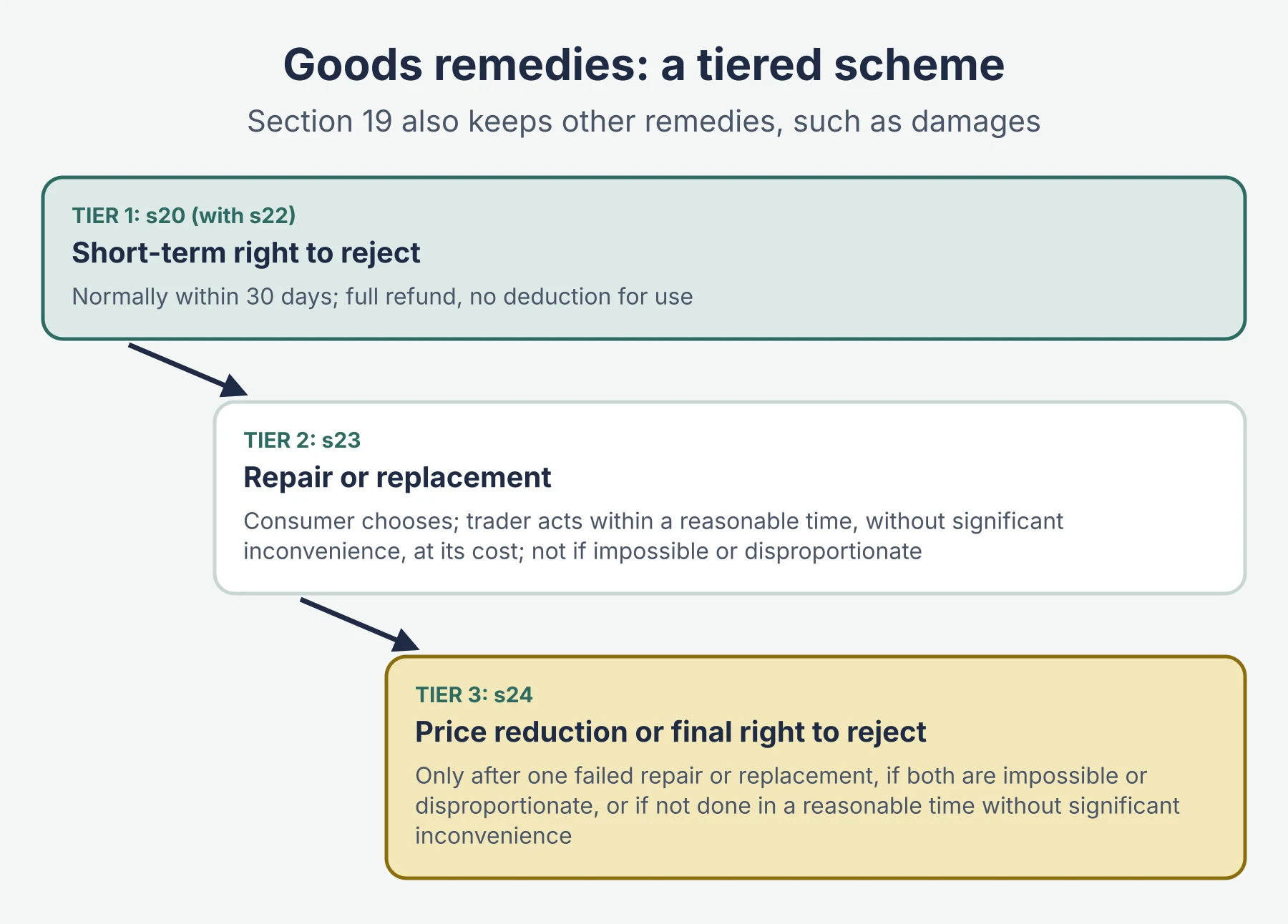
The specification names three remedies. They form a tiered scheme, which is the point most often tested.
| Tier | Section | Remedy | Key conditions |
|---|---|---|---|
| 1 | s20 (with s22) | Short-term right to reject | Normally within 30 days of the later of ownership or possession passing, delivery and any required installation; full refund with no deduction for use |
| 2 | s23 | Repair or replacement | Consumer chooses; trader must act within a reasonable time, without significant inconvenience, and bear the costs; not available if impossible or disproportionate compared with the other |
| 3 | s24 | Price reduction or final right to reject | Only after one repair or one replacement has failed, or if repair and replacement are impossible or disproportionate, or if the trader has not repaired or replaced within a reasonable time and without significant inconvenience |
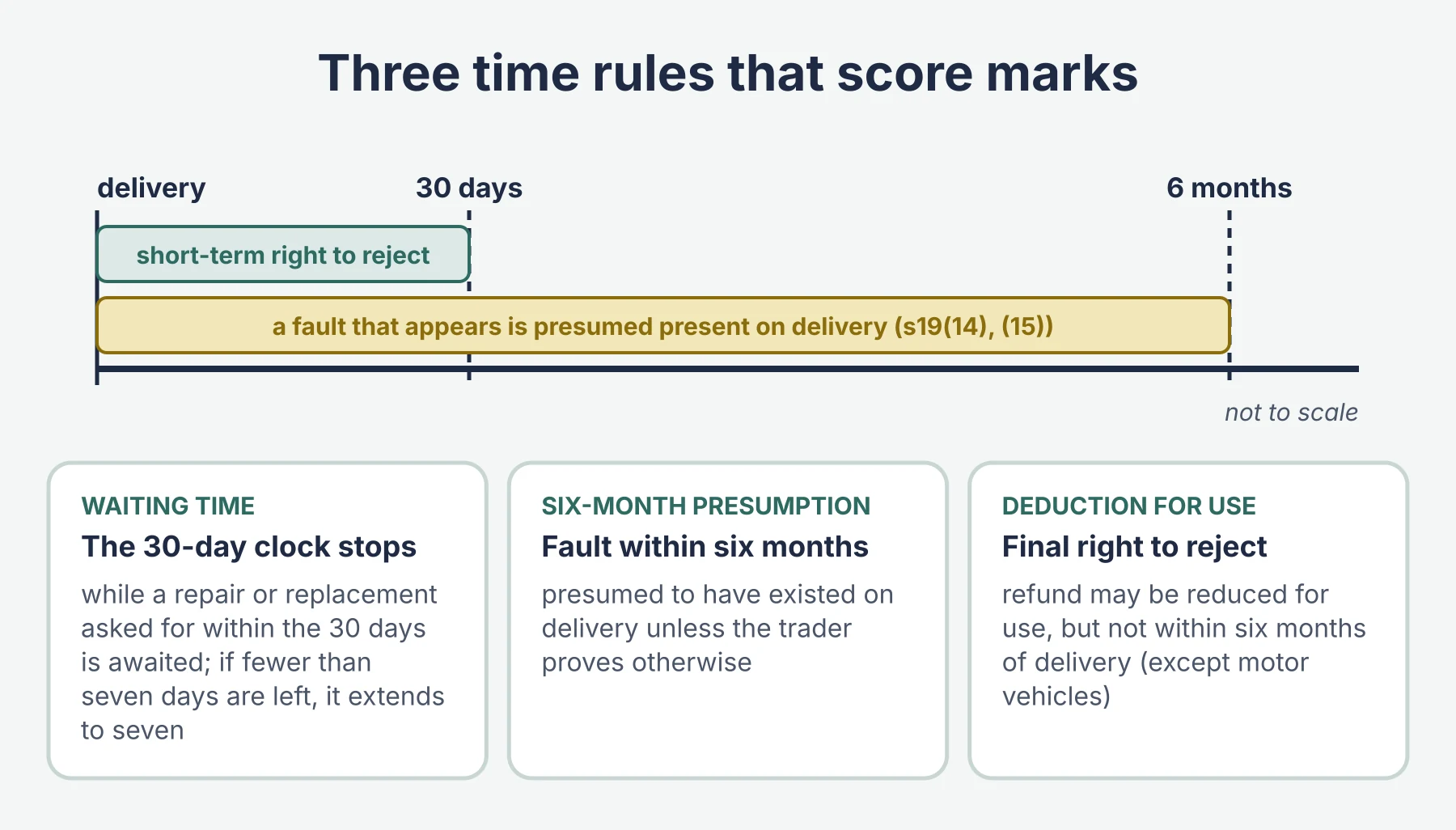
Three details score marks:
- Waiting time. If the consumer asks for a repair or replacement within the 30 days, the clock stops while waiting; if fewer than seven days are left when the goods come back, the period is extended to seven days.
- The six-month presumption. If a fault appears within six months of delivery, it is presumed to have existed on delivery unless the trader proves otherwise (section 19(14) and (15)). This matters because the terms are broken only if the goods did not conform when supplied.
- Deduction for use. Under the final right to reject, the refund may be reduced to reflect the use the consumer has had, but not if the right is exercised within six months of delivery (except for motor vehicles).
Section 19 also preserves other remedies, such as damages for damage the faulty goods caused.
Terms implied into contracts to supply services
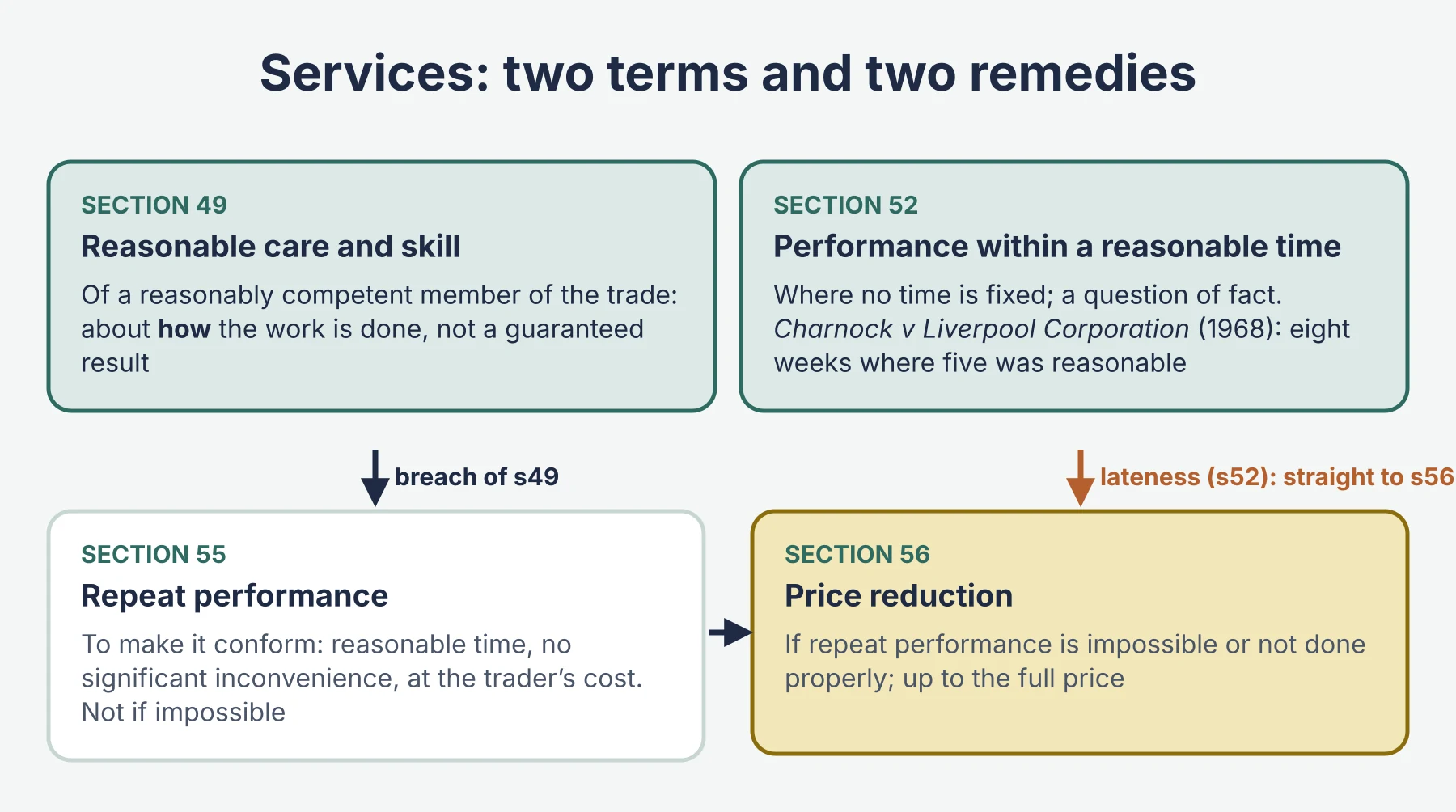
- Section 49: reasonable care and skill. The service must be performed with the care and skill of a reasonably competent member of that trade. This is a standard about how the work is done, not a guarantee of a result.
- Section 52: performance within a reasonable time. This applies where the contract does not fix the time for performance. What is reasonable is a question of fact. In Charnock v Liverpool Corporation (1968) a garage took eight weeks to repair a car when five weeks would have been reasonable, and was liable for the extra period.
Remedies for services
- Section 55: right to require repeat performance. The trader must perform the service again to the extent needed to make it conform, within a reasonable time, without significant inconvenience to the consumer and at the trader’s cost. It is not available if repeat performance is impossible.
- Section 56: right to a price reduction. Available where repeat performance is impossible or has not been carried out within a reasonable time and without significant inconvenience. The reduction can be up to the full price.
A breach of section 52 cannot sensibly be cured by repeating the service late, so the remedy for lateness is a price reduction under section 56 rather than repeat performance.
Worked example
Facts: Rhian buys a new laptop for £900 from an electronics retailer, telling the assistant she needs it for video editing. After 40 days it overheats and shuts down whenever she edits video. The retailer repairs it, but the fault returns a week later. Separately, she paid a builder £2,000 to tile her bathroom; the tiles were laid unevenly and the job took four months.
Consumer contract? Rhian is an individual buying for personal use; the retailer
                   and builder are traders (s2). The Act applies.
Goods terms:       s9 – an overheating new laptop is arguably not satisfactory
                   (durability, fitness for usual purposes).
                   s10 – she made known video editing and relied on the
                   assistant; the laptop is not fit for that purpose.
Timing:            40 days is outside the 30-day short-term right (s20/s22).
                   The fault appeared within six months, so it is presumed to
                   have been present at delivery (s19(14)).
Remedy:            One repair has failed, so she can move to s24: a price
                   reduction or the final right to reject. Within six months,
                   no deduction for use applies to a laptop.
Services terms:    Uneven tiling – breach of s49 (reasonable care and skill).
                   Four months may breach s52 if no time was fixed and the
                   job should reasonably have taken less.
Services remedy:   s55 – require the builder to re-lay the tiles at his cost;
                   if he fails or cannot, s56 price reduction. The delay is
                   remedied by price reduction under s56, not repeat work.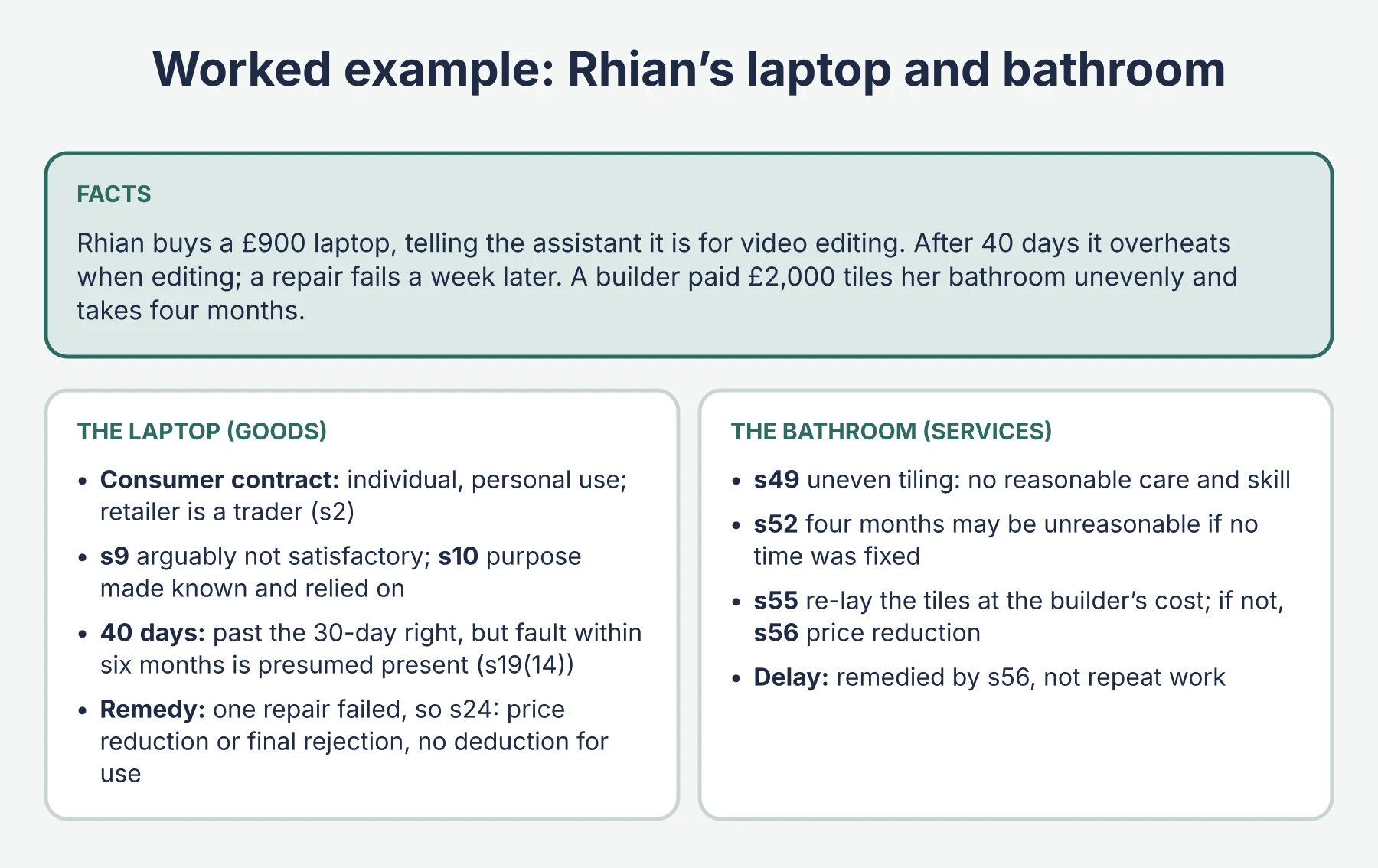
Common mistakes
- Applying the Act to a sale between two private individuals or between two businesses.
- Saying the consumer can always reject and get a refund. After 30 days the consumer normally goes to repair or replacement first.
- Treating section 49 as a promise that the service will achieve a particular outcome.
- Forgetting the six-month presumption, which often decides who has to prove the fault.
- Offering repeat performance as the remedy for late performance under section 52.
- Quoting the pre-2015 Sale of Goods Act wording (“merchantable quality”) as the current test.
Exam technique
- Explain questions: state the section number, the test in its own words and one illustration, as in the tables above.
- Suggest and Advise questions: establish a consumer contract, identify every implied term that might be broken, then walk through the remedy tiers in order, applying the time limits to the dates in the facts.
- Consider questions: weigh arguments on whether a defect is enough to make goods unsatisfactory, using price, description and the section 9(3) aspects.
- Discuss questions on theory: link the implied terms to the tension in the specification between freedom of contract and the need to protect the consumer, and ask whether the tiered remedies are clear and effective in practice.
More resources on this topic
Consumer contract implied terms revision notes | Consumer contract implied terms practice questions | Exclusion clauses study guide
Related resources
-
Practice questions
AQA A Level Law (7162): Contract terms: specific terms implied by statute law in relation to consumer contracts – Practice Questions
Original practice on Consumer Rights Act 2015 implied terms for AQA A Level Law 7162, with mark-scheme answers on ss9 to 11, 49, 52 and the remedy tiers.
Law · AQA · A Level
Try questions -
Revision notes
AQA A Level Law (7162): Contract terms: specific terms implied by statute law in relation to consumer contracts – Revision Notes
Condensed recall on Consumer Rights Act 2015 implied terms for AQA A Level Law 7162: ss9 to 11, 49 and 52, the tiered goods remedies and services remedies.
Law · AQA · A Level
Revise topic -
Study guides
AQA A Level Law (7162): Discharge of a contract
Discharge by performance, breach and frustration for AQA A Level Law 7162: entire obligations, anticipatory breach, limits on frustration and the 1943 Act.
Law · AQA · A Level
Read guide
Get free revision emails (optional)
Occasional emails with practice questions, worked explanations and links to free resources for the qualification and subjects you choose. No spam, and you can unsubscribe from any email. The free tools on this site never need an email.