
Study Guides
AQA A Level Law (7162): Discharge of a contract
Discharge by performance, breach and frustration for AQA A Level Law 7162: entire obligations, anticipatory breach, limits on frustration and the 1943 Act.
- Subject
- Law
- Level
- A LEVELS
- Topic
- Topic 4: Law of contract
- Author
- Marlbridge Academic Team
- Updated
- Reviewed by
- Aizaz Raoof Ali (what this means)
Aligned to AQA A Level Law (7162), For teaching from September 2017 onwards, A-level exams 2019 onwards. Official specification .
Syllabus page (what it covers and how it is assessed): AQA A Level Law.
Syllabus points this page covers
7162
- Discharge of a contract
Found an error? Report a correction.
Need help with this topic? Request a free trial class for A Level Law (7162).
This guide covers discharge of a contract in section 3.4 Law of contract of AQA A-level Law (7162). The specification lists three ways a contract ends: “Performance”, “Breach (actual and anticipatory breach)” and “Frustration”. Discharge means the parties are released from their obligations to perform in the future. For the contract option in outline, start with the Law of contract study guide.
Discharge by performance
The strict rule
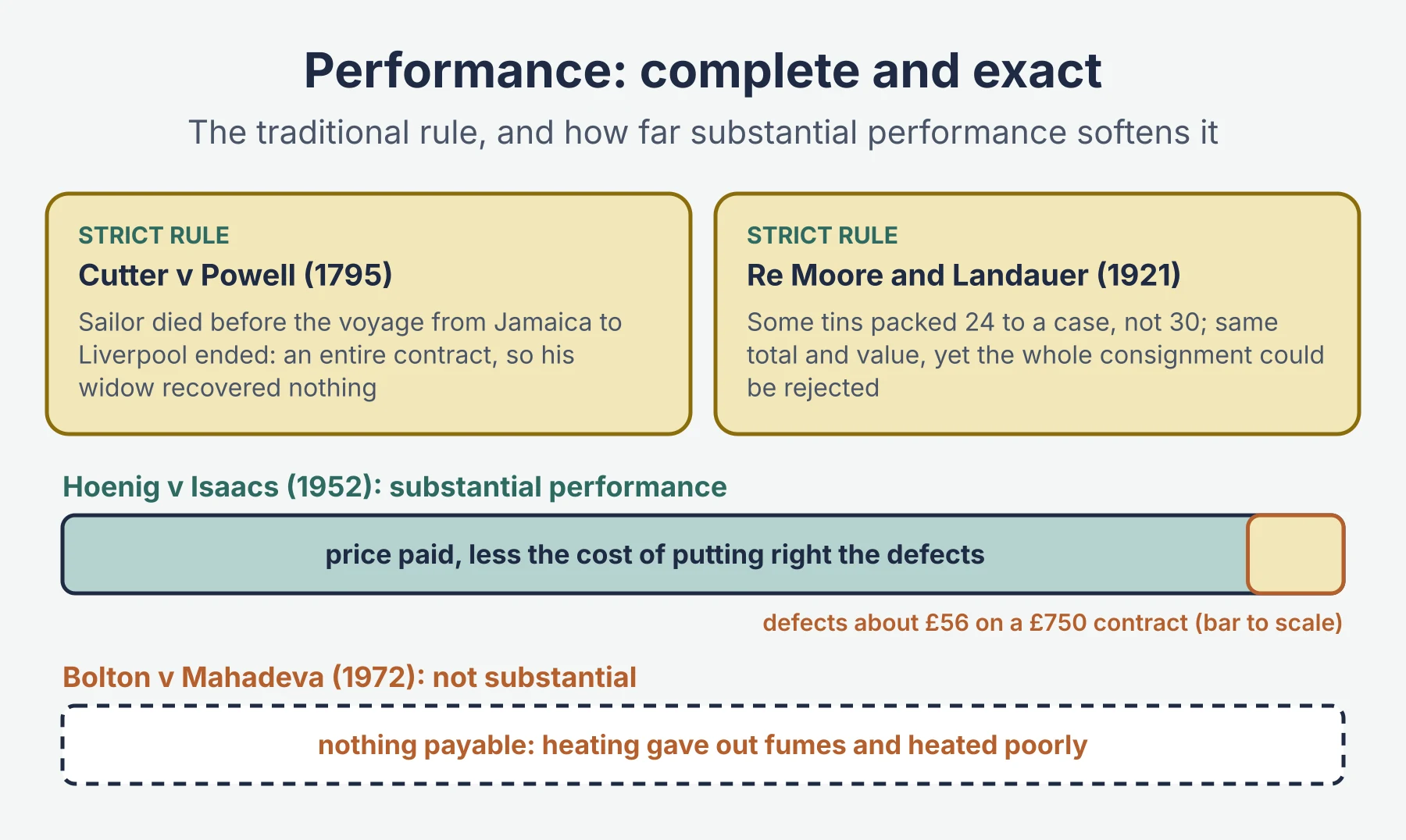
A contract is discharged by performance when both parties have done exactly what they promised. The traditional rule is that performance must be complete and exact.
- Cutter v Powell (1795): a sailor was to be paid on completing a voyage from Jamaica to Liverpool. He died before arrival, and his widow recovered nothing for the work he had done, because the contract was an entire one.
- Re Moore and Landauer (1921): tins of fruit were to be packed 30 to a case. Some came in cases of 24, even though the total number of tins was right and the market value was the same. The buyers could reject the whole consignment.
The strict rule protects the party who wanted the whole performance, but it can produce harsh results and allow a party to escape a bad bargain on a technicality.
Ways round the strict rule
| Exception | Rule | Case |
|---|---|---|
| Substantial performance | Where performance is substantially complete, the other party must pay the price less the cost of putting right the defects | Hoenig v Isaacs (1952): decorating and furnishing a flat, defects costing about £56 on a contract of £750; payment due less that sum |
| Not substantial | If the defects are serious, there is no substantial performance | Bolton v Mahadeva (1972): a central heating system that gave out fumes and heated poorly; nothing payable |
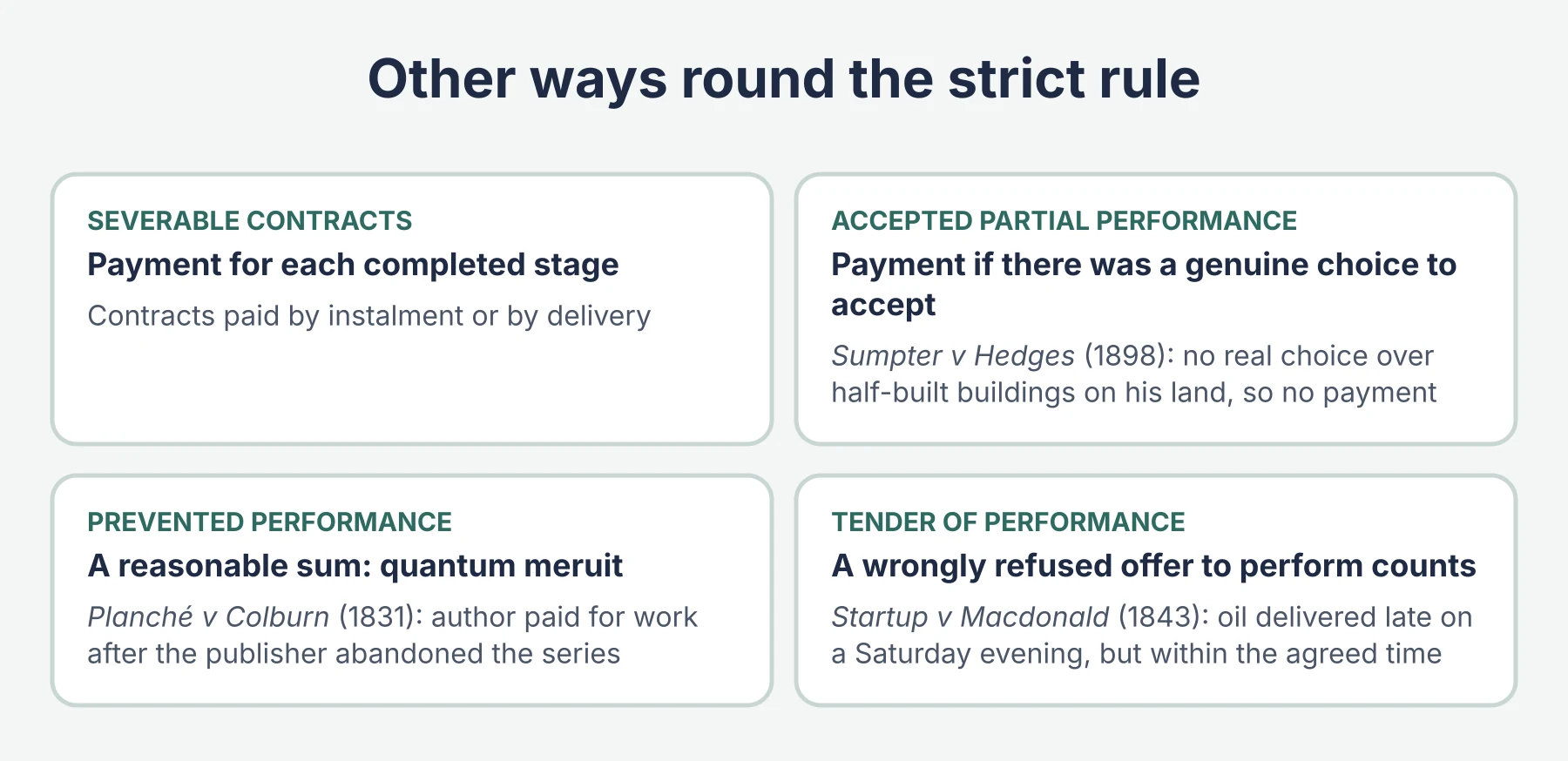
| Severable contracts | Payment due for each completed stage | Contracts paid by instalment or by delivery |
| Acceptance of partial performance | Payment for the part accepted, if the other party had a genuine choice to accept | Sumpter v Hedges (1898): the landowner had no real choice about half-built buildings on his land, so no payment for them |
| Prevented performance | A party prevented from completing by the other may claim a reasonable sum (quantum meruit) | Planché v Colburn (1831): author paid for work done on a book after the publisher abandoned the series |
| Tender of performance | Offering to perform in line with the contract, which is wrongly refused, counts as performance | Startup v Macdonald (1843): oil delivered late on a Saturday evening but within the agreed time |
Discharge by breach
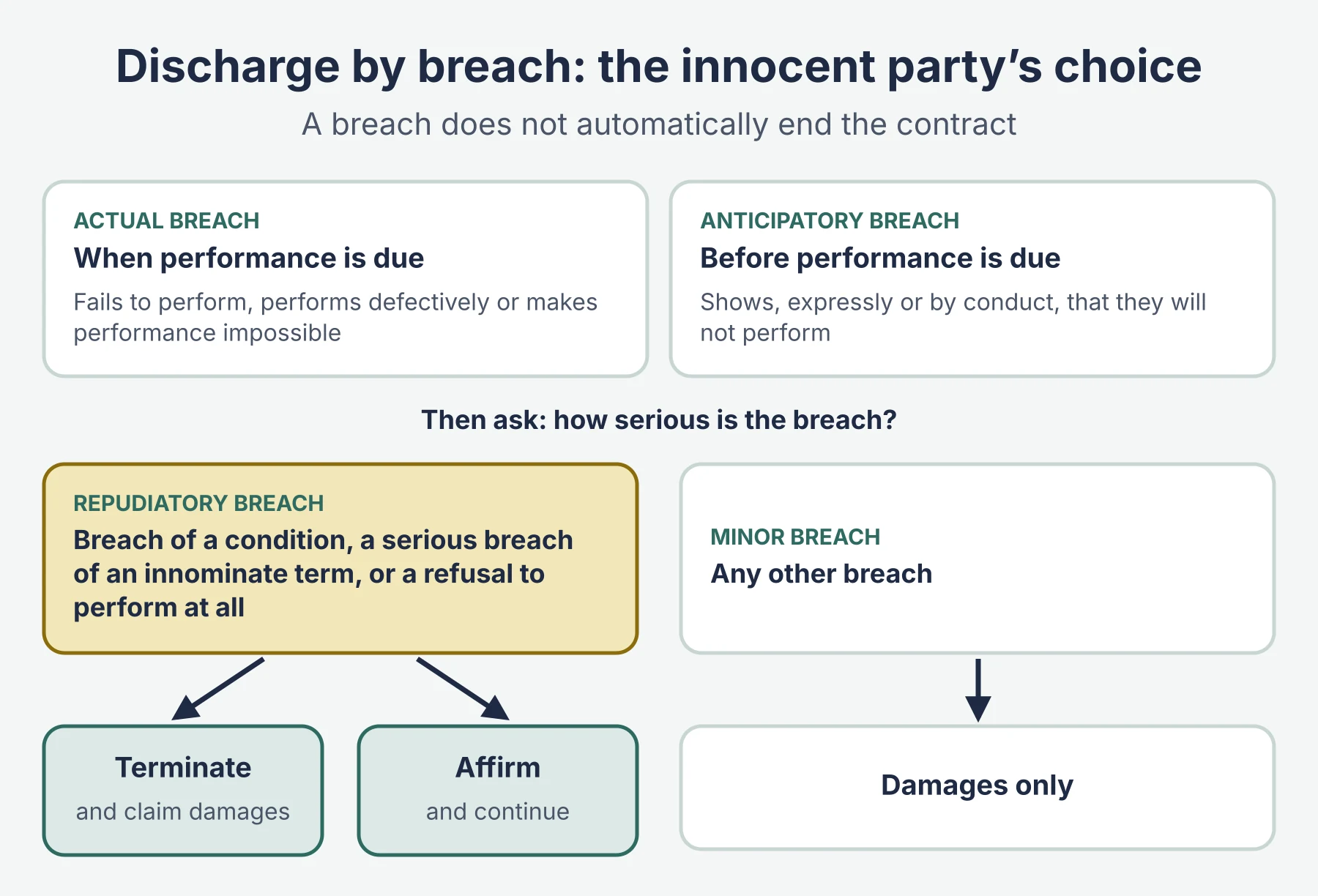
A breach does not automatically end the contract. A repudiatory breach gives the innocent party a choice: to terminate and claim damages, or to affirm and continue. A minor breach gives damages only. Breach of a condition, a serious breach of an innominate term or a refusal to perform at all is repudiatory.
Actual breach
Actual breach happens when the time for performance arrives and a party fails to perform, performs defectively, or makes performance impossible. Examples are failing to deliver on the agreed date or delivering goods that do not match the contract.
Anticipatory breach
Anticipatory breach happens when, before performance is due, a party shows that they will not perform, either expressly or by conduct that makes performance impossible.
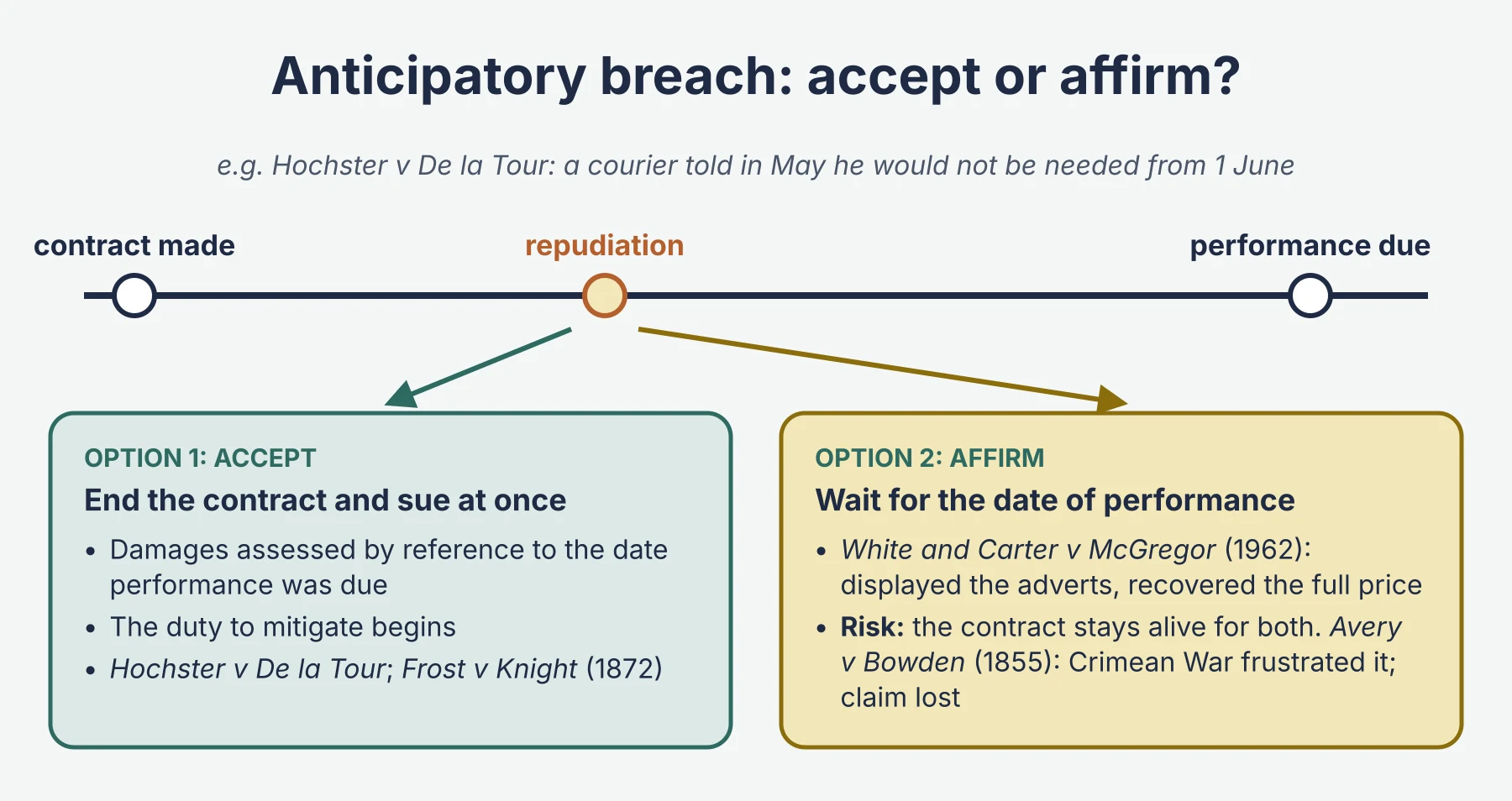
- Hochster v De la Tour (1853): a courier was engaged to start work on 1 June. In May the employer said his services would not be needed. The courier could sue straight away, without waiting until June.
- Frost v Knight (1872): a man promised to marry the claimant when his father died, then broke off the engagement while the father was alive. She could sue at once.
The innocent party has two options.
- Accept the repudiation, treat the contract as ended and sue at once. Damages are assessed by reference to the date when performance was due, and the duty to mitigate begins.
- Affirm the contract and wait for the date of performance. In White and Carter (Councils) v McGregor (1962) an advertising company affirmed, displayed the adverts for the full period and recovered the full price. But affirmation keeps the contract alive for both sides, which is risky: in Avery v Bowden (1855) a charterer refused to load, the shipowner waited, and the outbreak of the Crimean War then frustrated the contract, so the shipowner lost his claim.
Discharge by frustration
When frustration applies
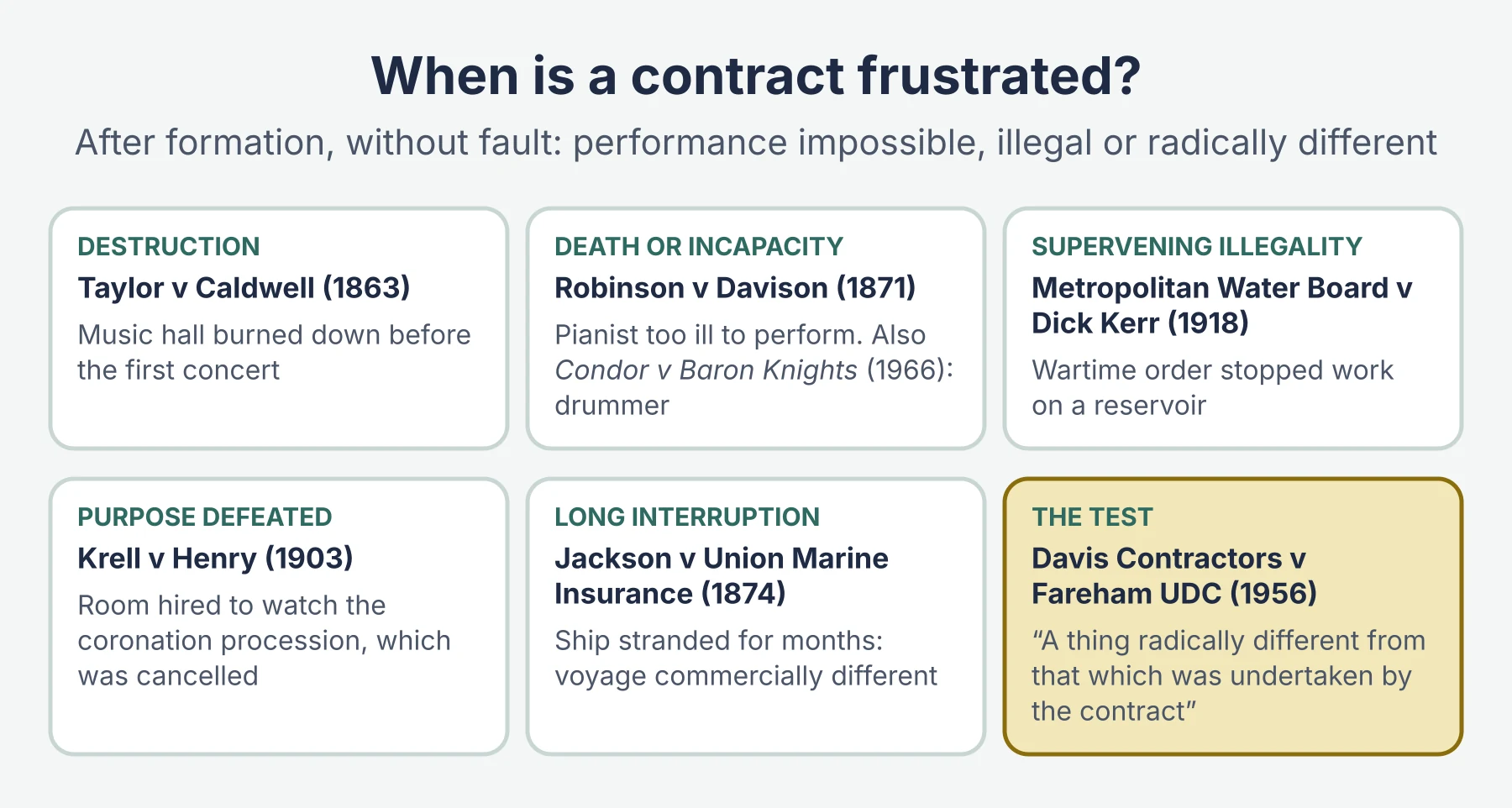
A contract is frustrated when, after it was made and without the fault of either party, an event makes performance impossible, illegal or radically different from what was agreed. In Davis Contractors v Fareham UDC (1956) Lord Radcliffe said frustration occurs when performance would be “a thing radically different from that which was undertaken by the contract”.
| Category | Case |
|---|---|
| Destruction of the subject matter | Taylor v Caldwell (1863): a music hall hired for concerts burned down before the first concert |
| Death or incapacity in a personal contract | Robinson v Davison (1871): a pianist was too ill to perform; Condor v Baron Knights (1966): a drummer could not play the full schedule because of illness |
| Supervening illegality | Metropolitan Water Board v Dick Kerr (1918): wartime government order stopped work on a reservoir |
| Purpose defeated | Krell v Henry (1903): a room hired to watch the coronation procession, which was cancelled |
| Long interruption | Jackson v Union Marine Insurance (1874): a ship stranded for months, so the voyage would be commercially different |
Limits on frustration
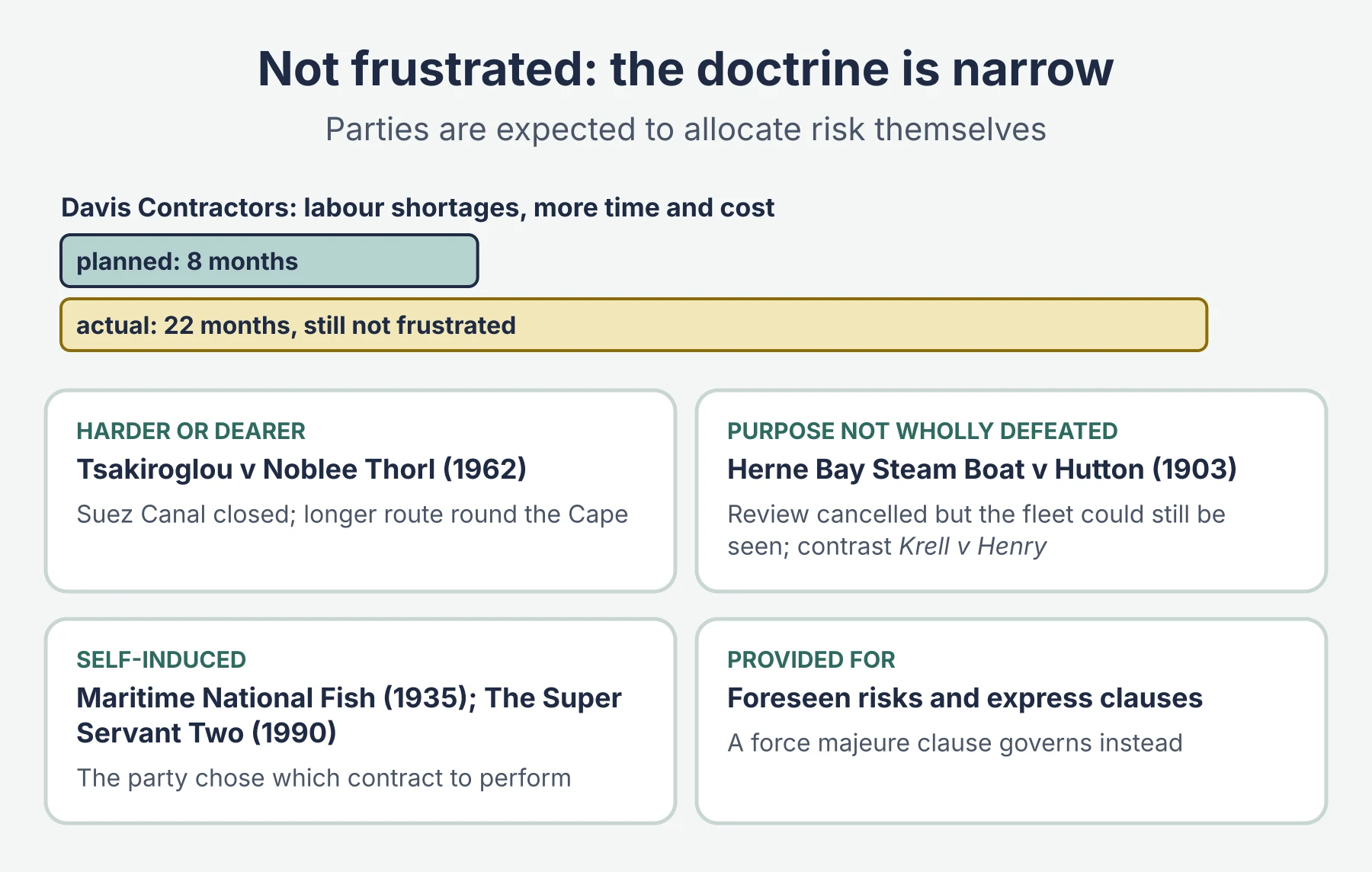
The doctrine is applied narrowly, because the parties are expected to allocate risk themselves.
- More expensive or difficult is not enough. In Davis Contractors labour shortages meant a building job took 22 months instead of 8 and cost more; the contract was not frustrated. In Tsakiroglou v Noblee Thorl (1962) the closure of the Suez Canal meant a longer route round the Cape; the contract was not frustrated.
- Purpose not wholly defeated. In Herne Bay Steam Boat v Hutton (1903) a boat hired to view the naval review and cruise round the fleet was not frustrated by cancellation of the review, because the fleet could still be seen.
- Self-induced frustration. In Maritime National Fish v Ocean Trawlers (1935) a company that chose to use its limited fishing licences for other ships could not claim frustration. In The Super Servant Two (1990) a carrier that chose which contract to perform after losing one of its two vessels could not claim frustration of the other.
- Foreseen risks and express clauses. Where the event was provided for by a term, such as a force majeure clause, the contract governs rather than frustration.
Effects: the Law Reform (Frustrated Contracts) Act 1943
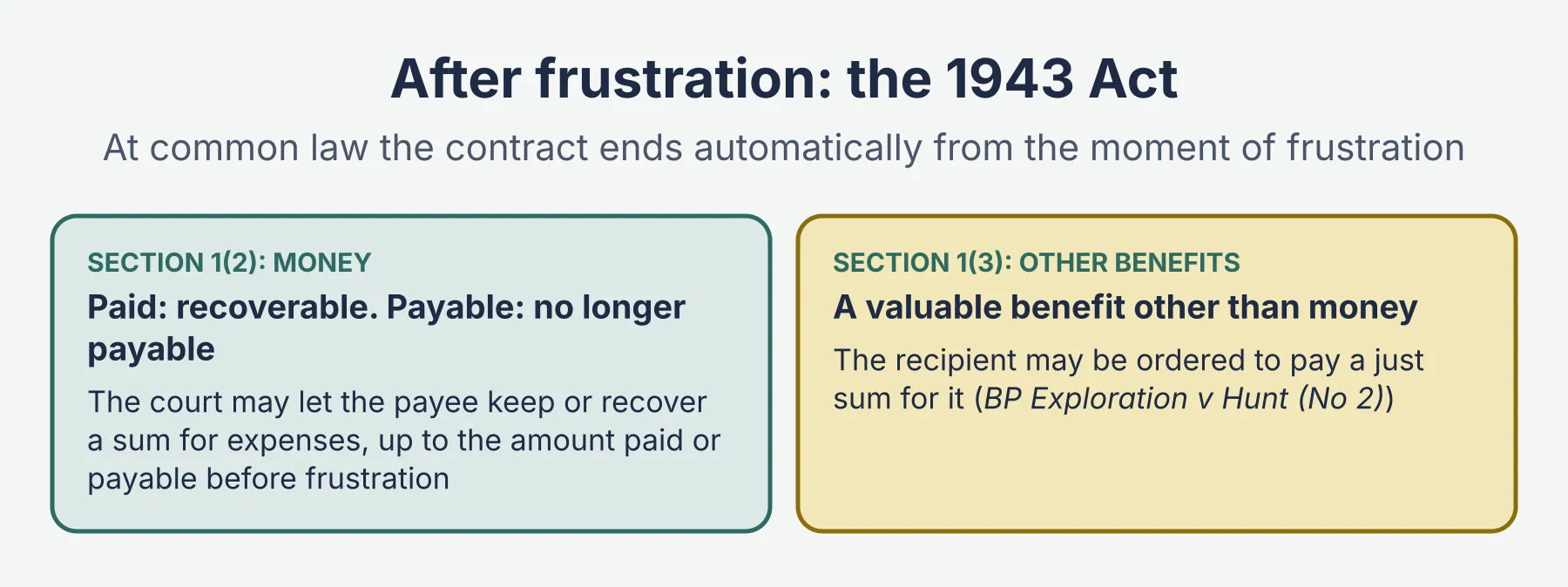
At common law a frustrated contract ends automatically from the moment of frustration. The 1943 Act adjusts the position between the parties.
- Section 1(2): money paid before frustration can be recovered, and money payable ceases to be payable. The court may allow the payee to keep or recover a sum to cover expenses incurred, up to the amount paid or payable before frustration.
- Section 1(3): a party who has received a valuable benefit, other than money, before frustration may be ordered to pay a just sum for it (BP Exploration v Hunt (No 2)).
Worked example
Facts: Dana hires a marquee company to provide a marquee for her open-air wedding on 20 June for £4,000, paying a £1,000 deposit. In April the company says it has double-booked and will not supply. Dana affirms and insists. On 18 June storms make the venue unsafe and the local authority bans all events there.
April statement:  Anticipatory breach (Hochster v De la Tour). Dana could have
                  accepted it, ended the contract and sued at once.
Her choice:       She affirmed, so the contract stayed alive for both sides
                  (White and Carter).
18 June:          A ban on events after formation, without fault, makes the
                  wedding there illegal or impossible: likely frustration
                  (Taylor v Caldwell; Dick Kerr).
Consequence:      As in Avery v Bowden, her claim for the earlier breach is
                  lost because she affirmed and the contract was then
                  frustrated.
1943 Act:         s1(2) – she can recover the £1,000 deposit, subject to the
                  court allowing the company its expenses up to that sum.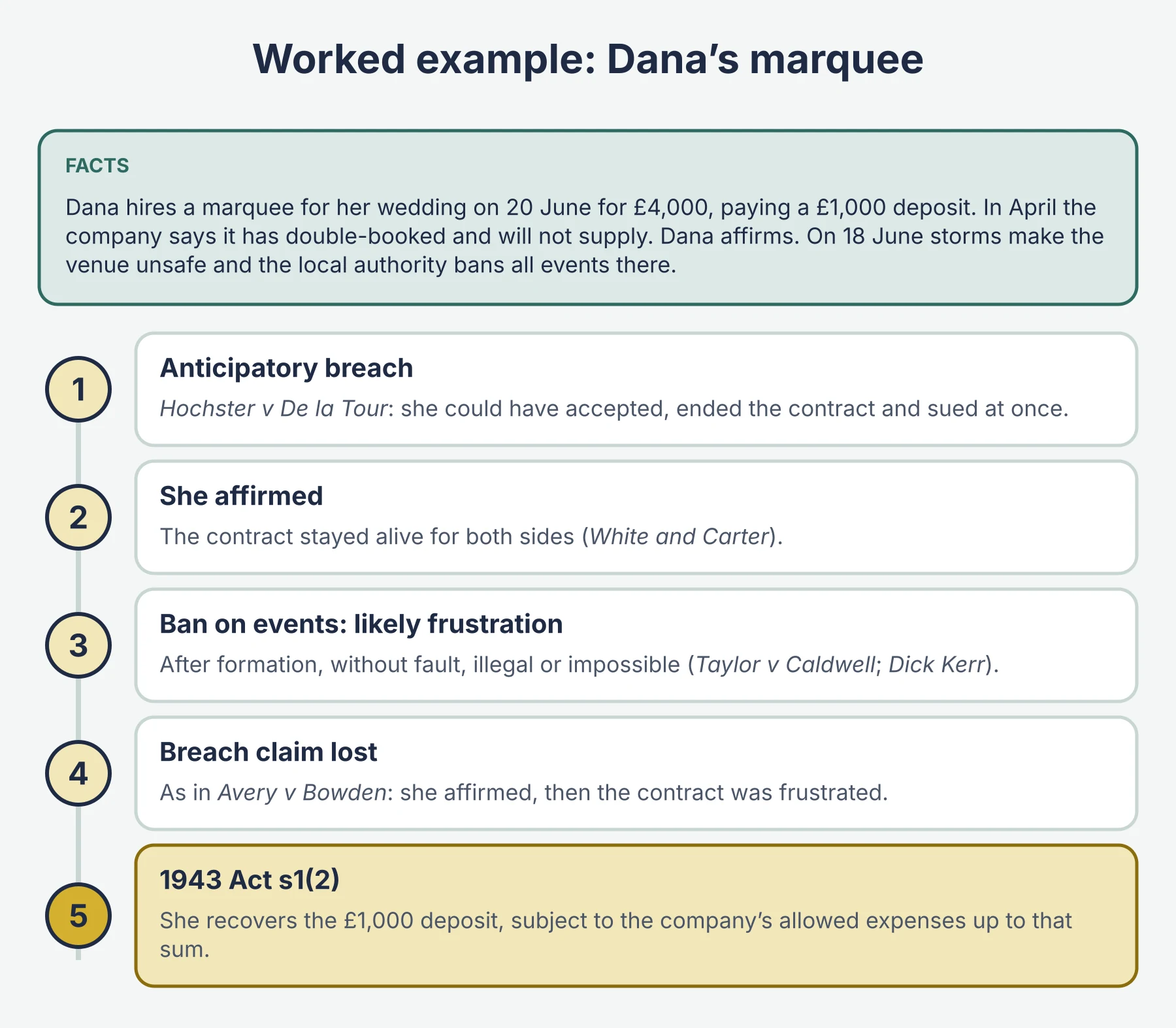
Common mistakes
- Saying any breach ends the contract; only a repudiatory breach gives a right to terminate.
- Forgetting that the innocent party can choose to affirm after an anticipatory breach.
- Treating an increase in cost or delay as frustration (Davis Contractors; Tsakiroglou).
- Missing self-induced frustration where a party made a choice.
- Leaving out the 1943 Act when the facts mention a deposit or work done.
Exam technique
- Explain questions: give the rule for each method of discharge with one case and one limit.
- Suggest and Advise questions: identify the event, decide which method applies, then state the consequence, including any money to be repaid under the 1943 Act.
- Consider questions: argue whether performance is substantial, or whether an event makes performance radically different, before concluding.
- Discuss questions: evaluate the strictness of the performance rule and the narrowness of frustration against certainty and freedom of contract.
More resources on this topic
Discharge of a contract revision notes | Discharge of a contract practice questions | Remedies in contract study guide
Related resources
-
Practice questions
AQA A Level Law (7162): Discharge of a contract – Practice Questions
Original practice on discharge for AQA A Level Law 7162 with mark-scheme answers on performance, actual and anticipatory breach, frustration and the 1943 Act.
Law · AQA · A Level
Try questions -
Revision notes
AQA A Level Law (7162): Discharge of a contract – Revision Notes
Condensed recall on discharge for AQA A Level Law 7162: exact and substantial performance, actual and anticipatory breach, frustration and the 1943 Act.
Law · AQA · A Level
Revise topic -
Study guides
AQA A Level Law (7162): Essential Requirements of Contract
Offer, acceptance, termination of offers, consideration, privity and intention to create legal relations, with a worked formation problem, for AQA Law 7162.
Law · AQA · A Level
Read guide
Get free revision emails (optional)
Occasional emails with practice questions, worked explanations and links to free resources for the qualification and subjects you choose. No spam, and you can unsubscribe from any email. The free tools on this site never need an email.