
Revision Notes
AQA A Level Law (7162): Discharge of a contract – Revision Notes
Condensed recall on discharge for AQA A Level Law 7162: exact and substantial performance, actual and anticipatory breach, frustration and the 1943 Act.
- Subject
- Law
- Level
- A LEVELS
- Topic
- Topic 4: Law of contract
- Author
- Marlbridge Academic Team
- Updated
- Reviewed by
- Aizaz Raoof Ali (what this means)
Aligned to AQA A Level Law (7162), For teaching from September 2017 onwards, A-level exams 2019 onwards. Official specification .
Syllabus page (what it covers and how it is assessed): AQA A Level Law.
Syllabus points this page covers
7162
- Discharge of a contract
Found an error? Report a correction.
Need help with this topic? Request a free trial class for A Level Law (7162).
Condensed notes on the three methods of discharge in the specification. For full explanation and a worked scenario, use the discharge of a contract study guide.
The answer route in one line
What happened? → performed exactly or substantially? → breach (actual or anticipatory; repudiatory?) → innocent party’s election → or frustration (event after formation, no fault, radically different, not excluded) → consequences (damages, or the 1943 Act).
Performance
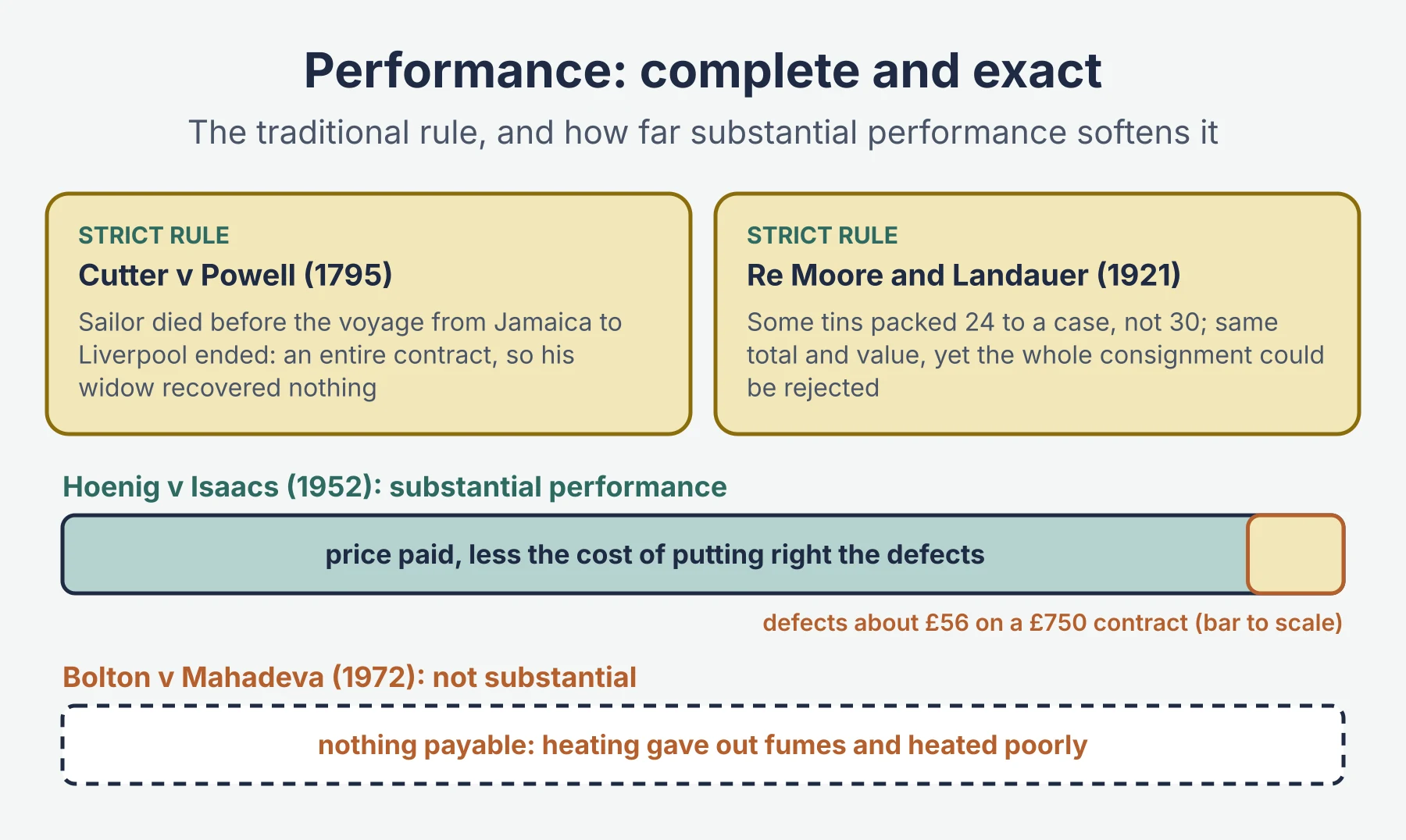
Rule: performance must be complete and exact.
| Case | Point |
|---|---|
| Cutter v Powell (1795) | Entire contract; sailor died before voyage ended; nothing recoverable |
| Re Moore and Landauer (1921) | Tins packed 24 instead of 30 to a case; whole consignment rejected |
Exceptions
| Exception | Case | Point |
|---|---|---|
| Substantial performance | Hoenig v Isaacs (1952) | Price less cost of fixing minor defects |
| Not substantial | Bolton v Mahadeva (1972) | Fume-producing heating system; nothing payable |
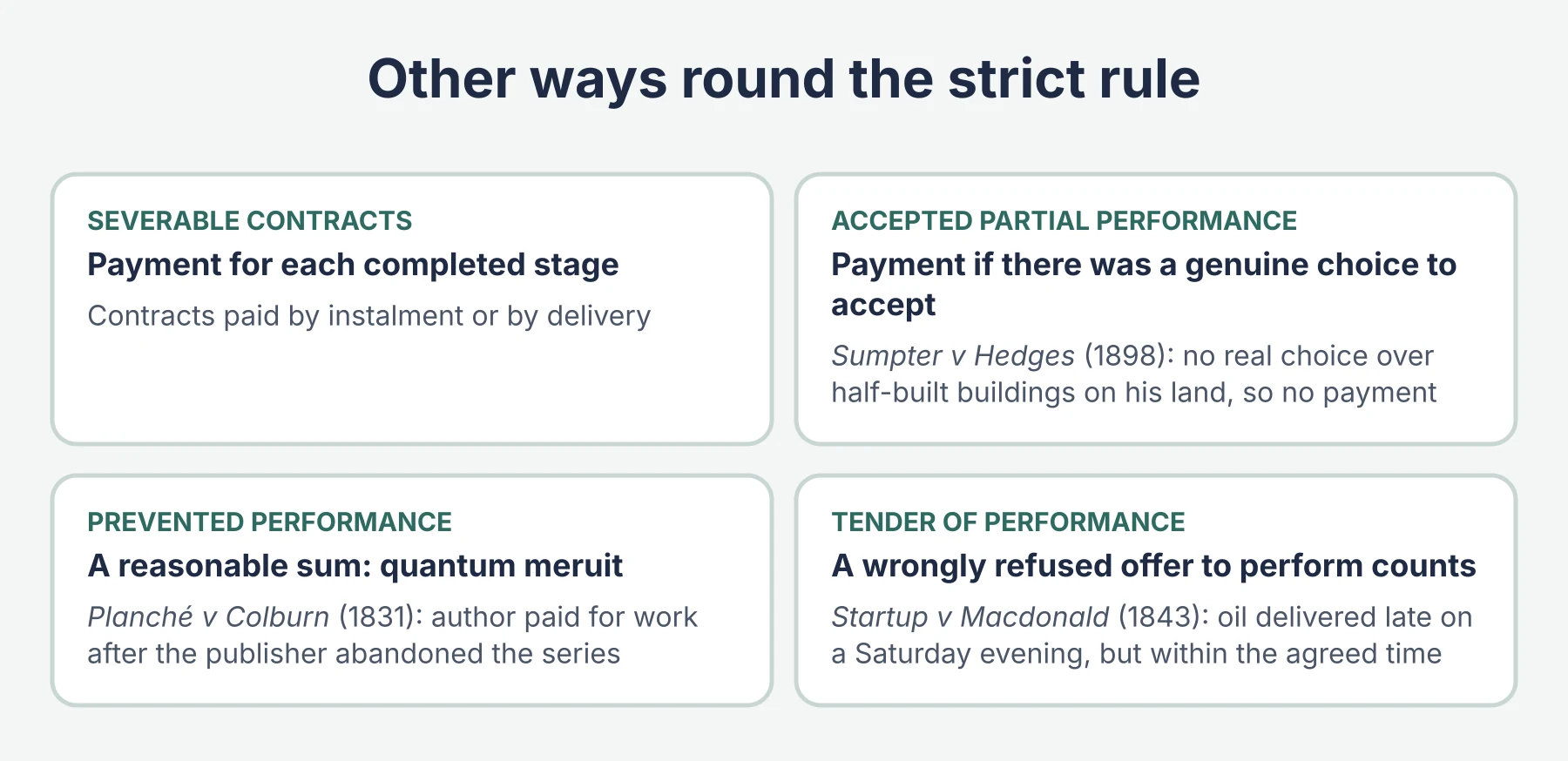
| Severable contract | — | Payment due for each completed part |
| Accepted partial performance | Sumpter v Hedges (1898) | Must be a genuine choice to accept; no payment for half-built buildings left on land |
| Prevented performance | Planché v Colburn (1831) | Quantum meruit for work done before the other party abandoned the contract |
| Tender of performance | Startup v Macdonald (1843) | Valid offer to perform, wrongly refused, counts as performance |
Breach
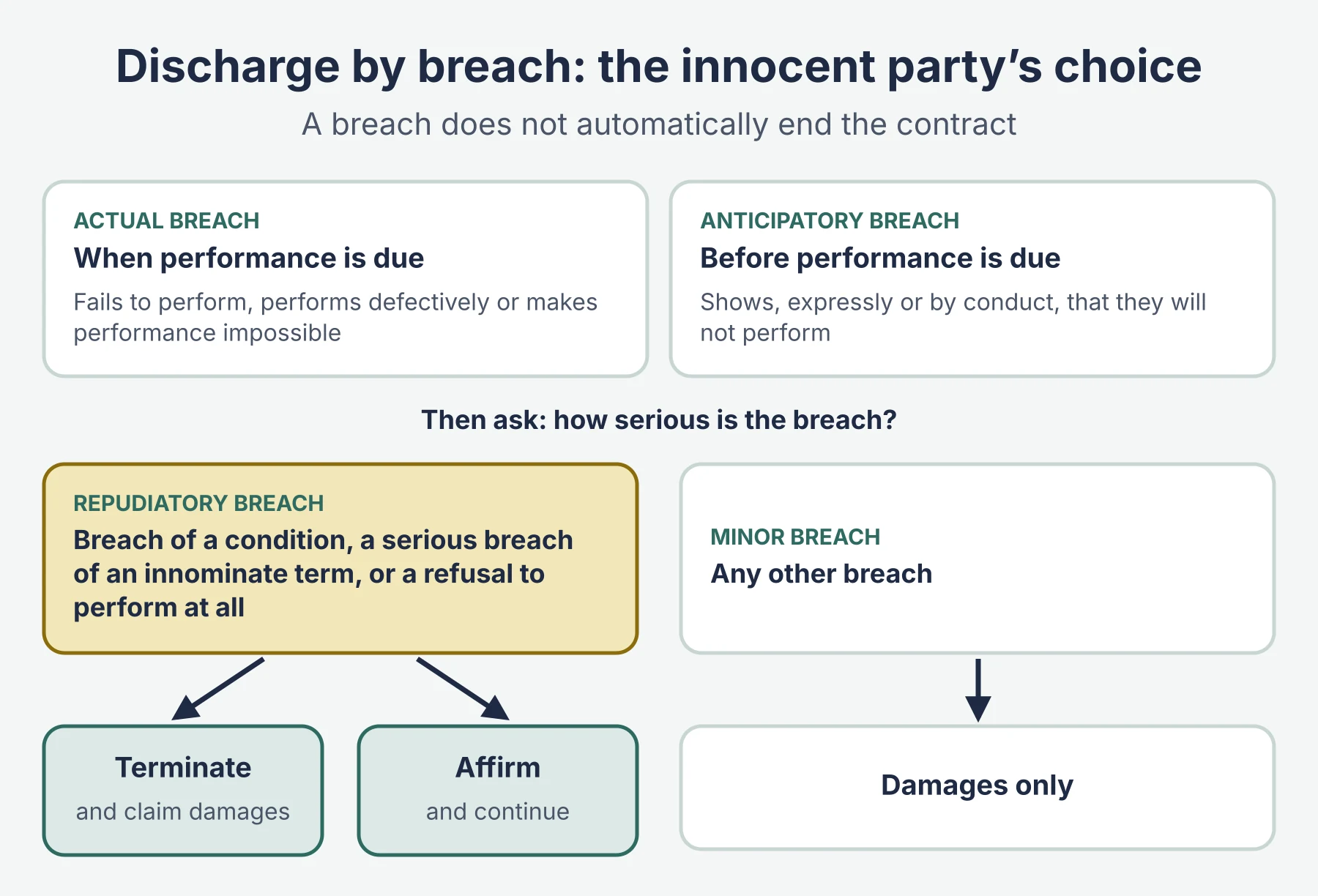
- Actual breach: failure to perform when due, defective performance, or making performance impossible.
- Anticipatory breach: before performance is due, a party shows it will not perform.
- Repudiatory breach (breach of condition, serious innominate breach, renunciation) gives a choice: terminate and sue, or affirm. A minor breach gives damages only.
| Case | Point |
|---|---|
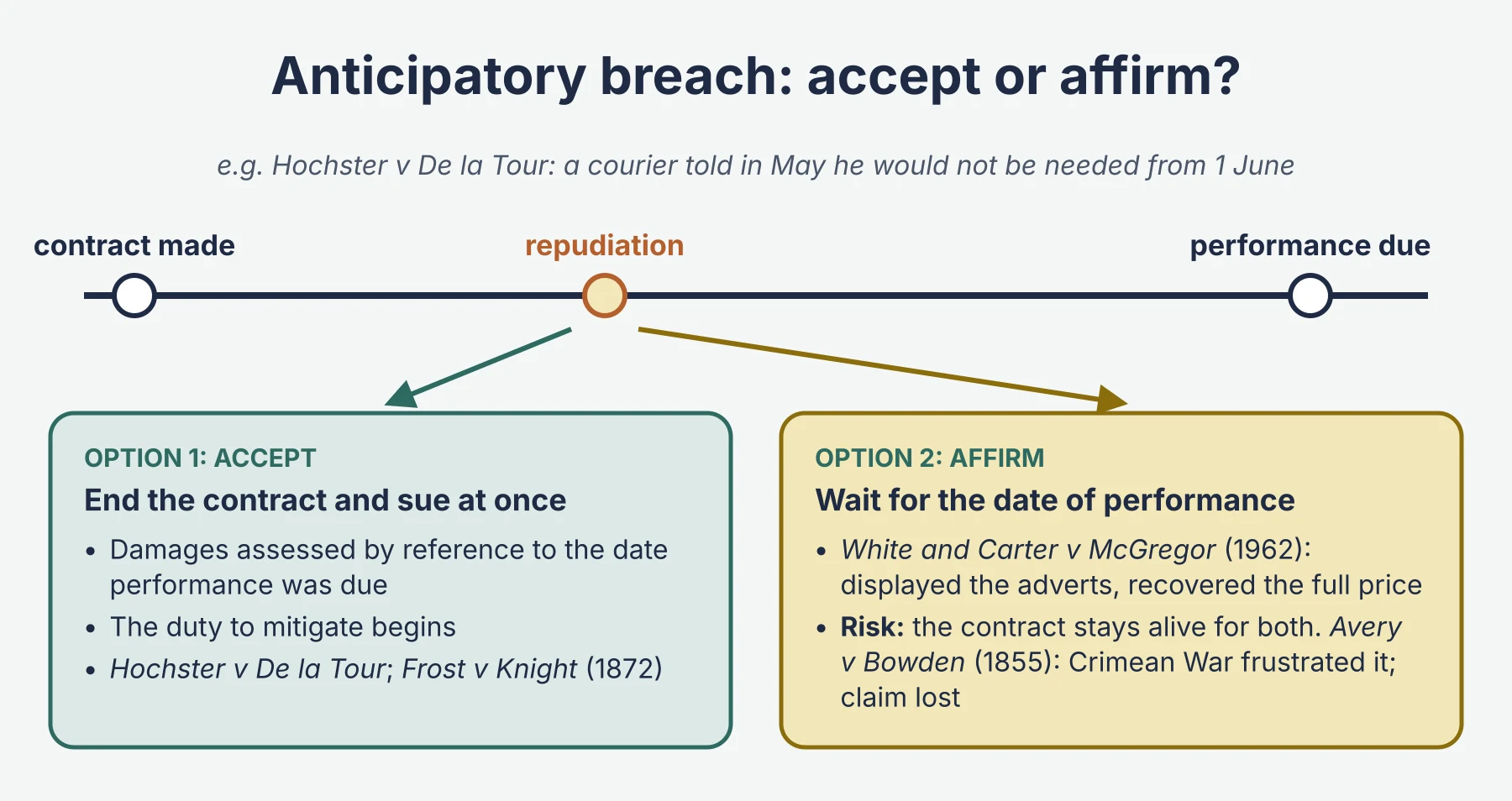
| Hochster v De la Tour (1853) | Courier told in May he would not be needed in June; could sue at once |
| Frost v Knight (1872) | Engagement broken off before the agreed condition occurred; immediate claim |
| White and Carter v McGregor (1962) | Innocent party may affirm, perform and claim the price |
| Avery v Bowden (1855) | Affirming keeps the contract alive; later frustration by war removed the claim |
Frustration
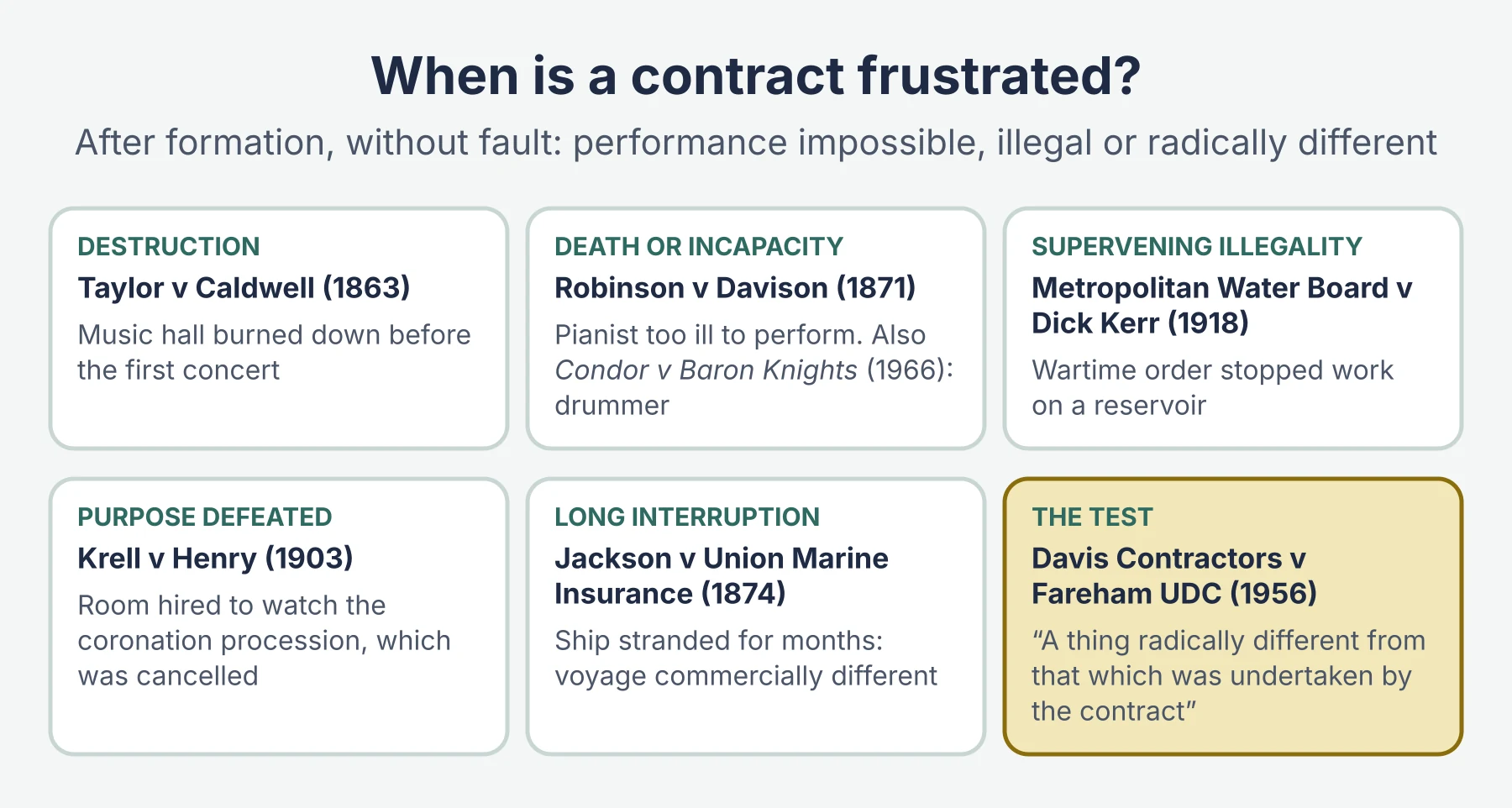
Test: an event after formation, without fault, makes performance impossible, illegal or radically different (Lord Radcliffe, Davis Contractors v Fareham UDC, 1956).
| Applies | Case |
|---|---|
| Subject matter destroyed | Taylor v Caldwell (1863): music hall burned down |
| Personal contract, illness | Robinson v Davison (1871): pianist; Condor v Baron Knights (1966): drummer |
| Supervening illegality | Metropolitan Water Board v Dick Kerr (1918) |
| Purpose defeated | Krell v Henry (1903): coronation procession cancelled |
| Long interruption | Jackson v Union Marine Insurance (1874) |
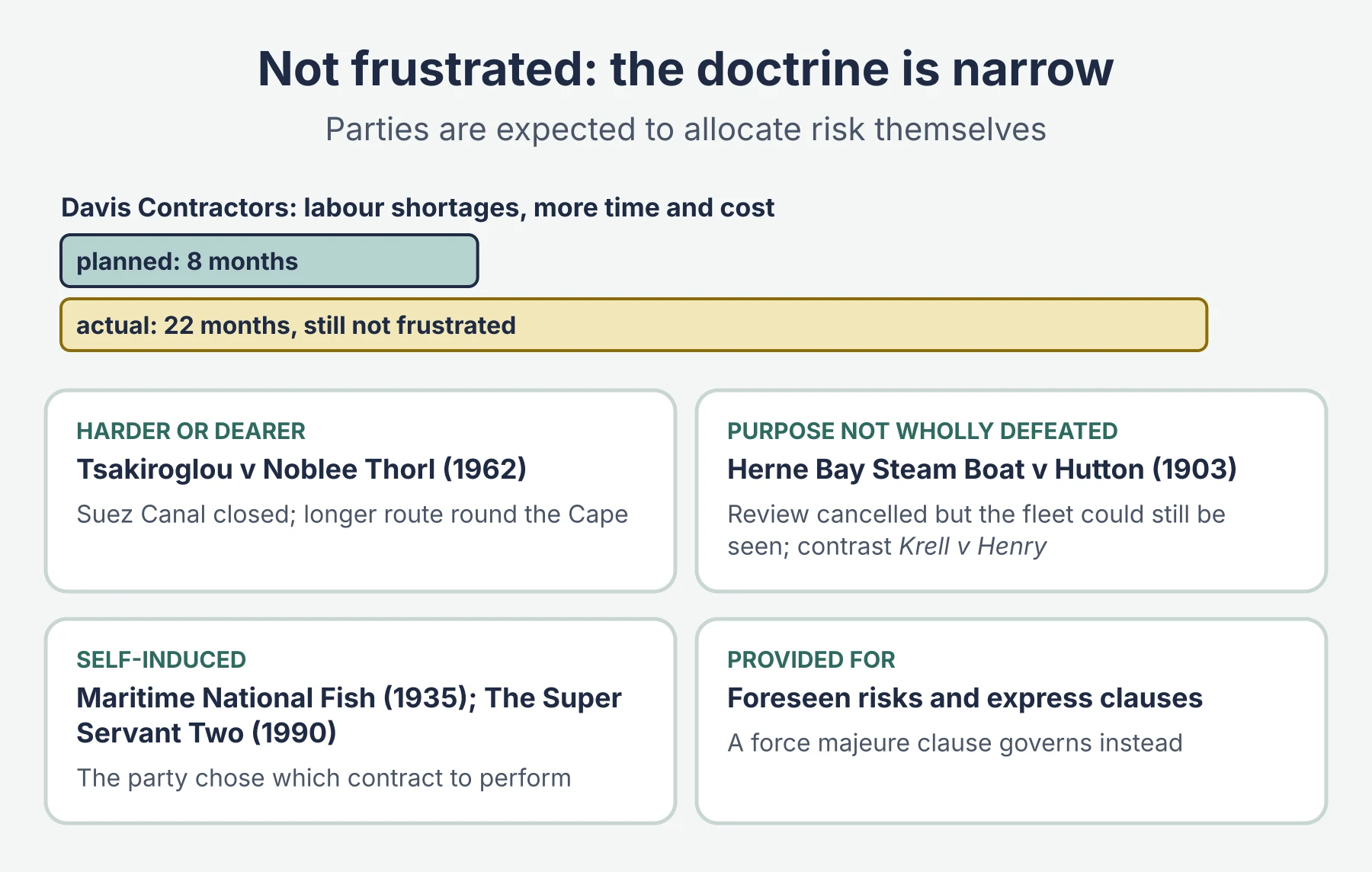
| Does not apply | Case |
|---|---|
| More expensive or slower | Davis Contractors (1956): 22 months instead of 8 |
| Longer route | Tsakiroglou v Noblee Thorl (1962): Suez Canal closure |
| Purpose only partly defeated | Herne Bay Steam Boat v Hutton (1903): fleet still visible |
| Self-induced | Maritime National Fish (1935); The Super Servant Two (1990) |
| Risk provided for | Force majeure or other express clause governs |
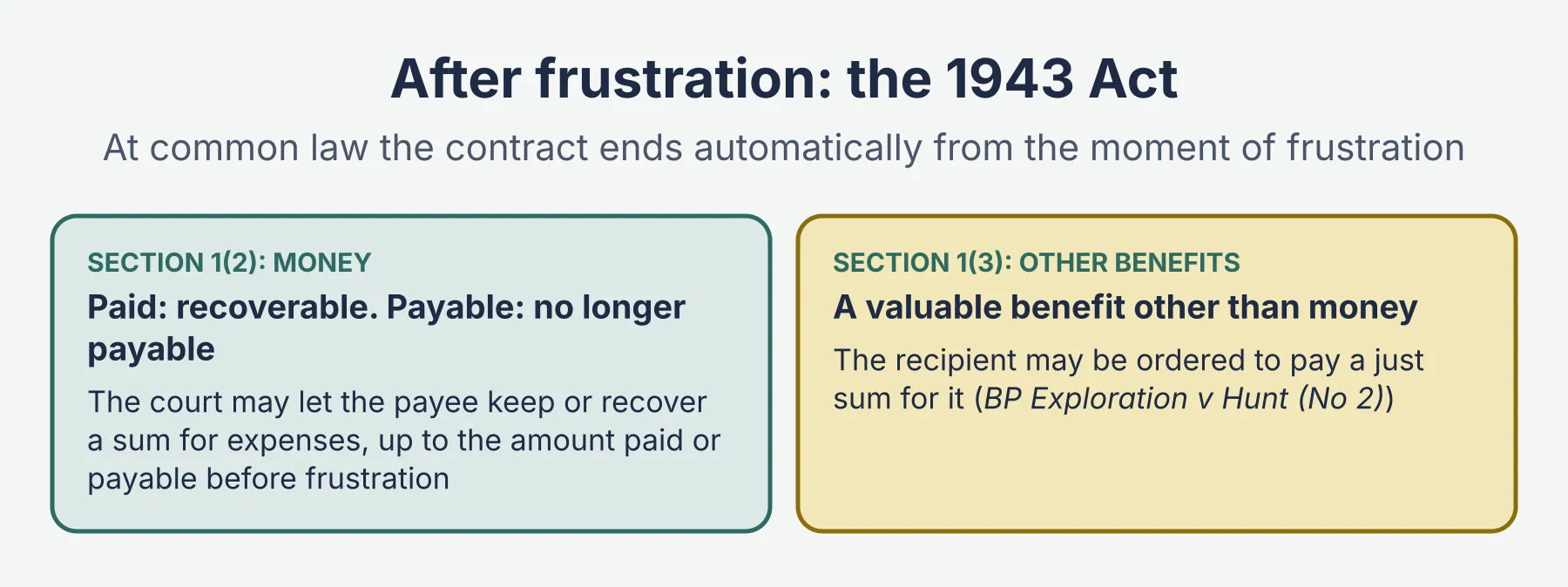
Effects: contract ends automatically at the time of frustration. Law Reform (Frustrated Contracts) Act 1943:
- s1(2): money paid is recoverable; money payable ceases to be payable; court may allow expenses up to the sum paid or payable before frustration.
- s1(3): just sum for a valuable benefit (other than money) received before frustration (BP Exploration v Hunt (No 2)).
Key terms
| Term | Meaning |
|---|---|
| Discharge | Release of the parties from future obligations |
| Entire contract | One requiring complete performance before payment is due |
| Substantial performance | Performance complete apart from minor defects |
| Quantum meruit | A reasonable sum for work done |
| Repudiatory breach | A breach serious enough to give the right to terminate |
| Anticipatory breach | A refusal to perform shown before performance is due |
| Affirmation | Election to continue the contract after a repudiatory breach |
| Frustration | Discharge by a later event, without fault, that makes performance radically different |
| Self-induced frustration | Where a party’s own choice causes the event; no frustration |
Exam traps
- Saying breach automatically ends the contract; the innocent party elects.
- Forgetting that affirmation keeps the contract alive for both sides (Avery v Bowden).
- Treating a price rise or delay as frustration.
- Missing a choice by the defendant that makes the frustration self-induced.
- Leaving out recovery of money under s1(2) of the 1943 Act.
- Confusing substantial performance with acceptance of partial performance; the second needs a genuine choice to accept.
Self-test
- What was the effect of the entire contract in Cutter v Powell?
- Why could the buyers reject the goods in Re Moore and Landauer?
- How did Hoenig v Isaacs differ from Bolton v Mahadeva?
- Why did the builder recover nothing in Sumpter v Hedges?
- What is anticipatory breach, and which case allows an immediate claim?
- What are the innocent party’s two options after a repudiatory breach?
- What risk of affirming does Avery v Bowden show?
- State Lord Radcliffe’s test for frustration.
- Why was the contract in Krell v Henry frustrated but not in Herne Bay Steam Boat v Hutton?
- Why was Davis Contractors v Fareham UDC not a case of frustration?
- What is self-induced frustration? Give a case.
- What does s1(2) of the Law Reform (Frustrated Contracts) Act 1943 provide?
Answers: 1. The sailor’s widow recovered nothing because the voyage was not completed. 2. Tins were packed 24 to a case instead of 30, so performance was not exact. 3. In Hoenig the defects were minor, so there was substantial performance; in Bolton the heating system was seriously defective, so there was not. 4. The landowner had no genuine choice about accepting half-built buildings on his land. 5. A refusal to perform shown before performance is due; Hochster v De la Tour. 6. Terminate and claim damages, or affirm and continue. 7. The contract stays alive for both parties, so a later frustrating event can remove the claim. 8. Performance would be “a thing radically different from that which was undertaken by the contract”. 9. In Krell the sole purpose was to watch the procession; in Herne Bay the fleet could still be viewed, so the purpose was not wholly defeated. 10. The work only took longer and cost more, which is not radically different performance. 11. Where a party’s own choice causes the event; Maritime National Fish v Ocean Trawlers (1935) or The Super Servant Two (1990). 12. Money paid before frustration is recoverable, sums payable cease to be payable, and the court may allow the payee expenses up to the amount paid or payable.
More resources on this topic
Discharge of a contract study guide | Discharge of a contract practice questions | Law of contract revision notes
Related resources
-
Study guides
AQA A Level Law (7162): Essential Requirements of Contract
Offer, acceptance, termination of offers, consideration, privity and intention to create legal relations, with a worked formation problem, for AQA Law 7162.
Law · AQA · A Level
Read guide -
Practice questions
AQA A Level Law (7162): Essential Requirements of Contract – Practice Questions
Original practice questions with mark-scheme answers on offer, acceptance, consideration, privity and intention to create legal relations, AQA A Level Law 7162.
Law · AQA · A Level
Try questions -
Revision notes
AQA A Level Law (7162): Essential Requirements of Contract – Revision Notes
Recall notes on offers, invitations to treat, termination, acceptance rules, consideration, privity and intention to create legal relations for AQA Law 7162.
Law · AQA · A Level
Revise topic
Get free revision emails (optional)
Occasional emails with practice questions, worked explanations and links to free resources for the qualification and subjects you choose. No spam, and you can unsubscribe from any email. The free tools on this site never need an email.