
Study Guides
AQA A Level Law (7162): Essential Requirements of Contract
Offer, acceptance, termination of offers, consideration, privity and intention to create legal relations, with a worked formation problem, for AQA Law 7162.
- Subject
- Law
- Level
- A LEVELS
- Topic
- Topic 4: Law of contract
- Author
- Marlbridge Academic Team
- Updated
- Reviewed by
- Aizaz Raoof Ali (what this means)
Aligned to AQA A Level Law (7162), For teaching from September 2017 onwards, A-level exams 2019 onwards. Official specification .
Syllabus page (what it covers and how it is assessed): AQA A Level Law.
Syllabus points this page covers
7162
- Essential requirements of contract
Found an error? Report a correction.
Need help with this topic? Request a free trial class for A Level Law (7162).
This guide covers the section 3.4 row Essential requirements of contract in AQA A-level Law (7162). The specification names three statements: “Offer and acceptance”, “Consideration (including privity of contract)” and “Intention to create legal relations”. Together they decide whether a contract exists at all. The Law of contract study guide gives the headline cases; this page goes further into the rules that problem questions test most often: whether a statement is an offer, how offers end, when acceptance takes effect, what counts as consideration, who can enforce a contract, and when agreements are binding.
Offer
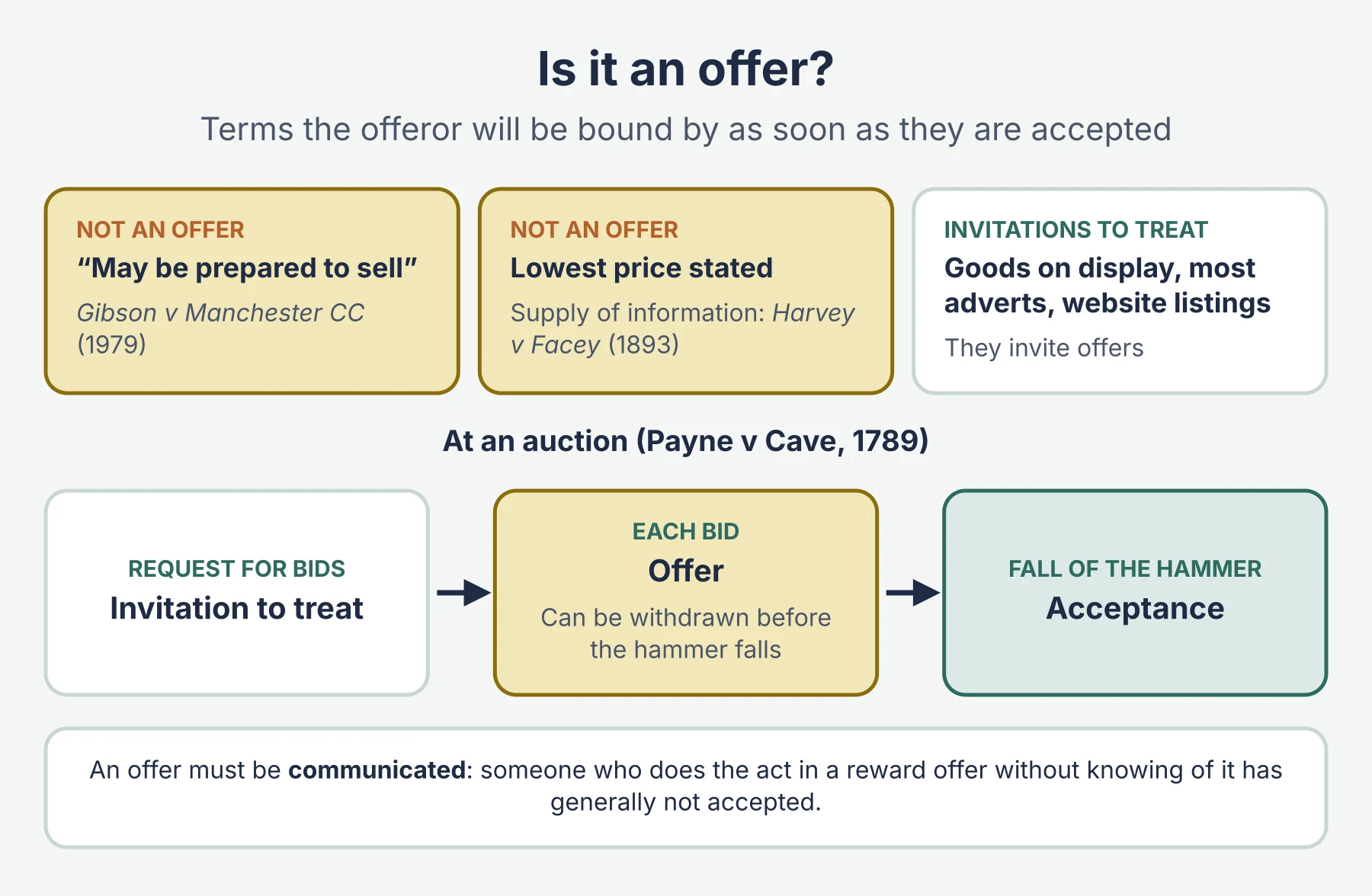
An offer is a statement of the terms on which the offeror is willing to be bound, made with the intention that it will become binding as soon as it is accepted.
Offer or something less? Words matter. In Gibson v Manchester City Council (1979) a council letter saying it “may be prepared to sell” a house was not an offer, so no contract arose when the tenant replied. In Harvey v Facey (1893) a telegram stating the lowest price for which the defendant would sell was a supply of information, not an offer.
Invitations to treat include goods on display, most advertisements and, by analogy, website listings. Auctions follow the same pattern: the auctioneer’s request for bids is an invitation to treat, each bid is an offer, and the fall of the hammer is acceptance (Payne v Cave, 1789, where a bidder could withdraw before the hammer fell).
Communication. An offer must be communicated to the offeree. A person who performs the act requested in a reward offer without knowing of the offer is generally treated as not having accepted it.
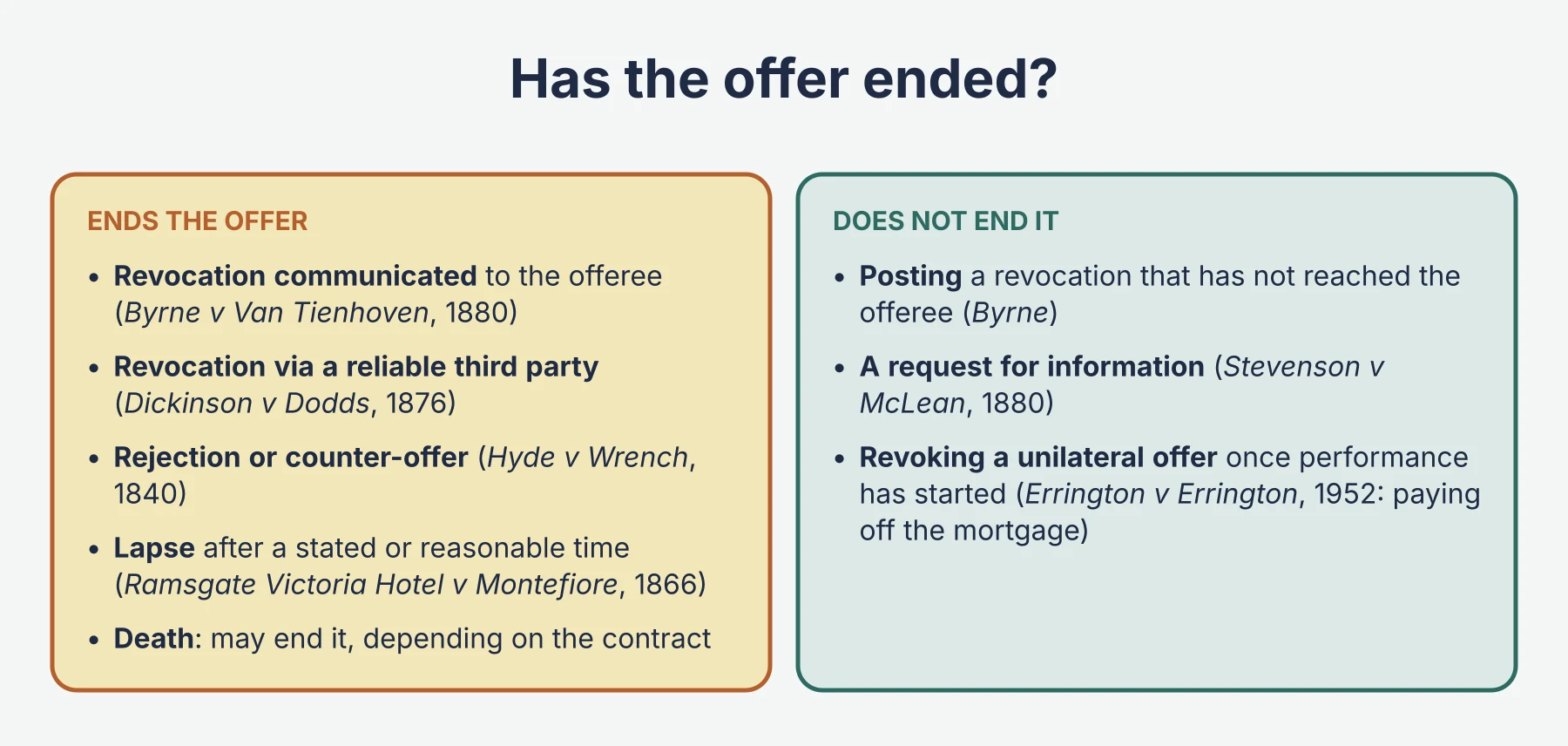
How an offer ends
| Method | Rule | Authority |
|---|---|---|
| Revocation | Effective only when communicated to the offeree; posting a revocation is not enough | Byrne v Van Tienhoven (1880) |
| Revocation through a third party | Valid if the offeree learns of it from a reliable source | Dickinson v Dodds (1876) |
| Rejection or counter-offer | Ends the original offer | Hyde v Wrench (1840) |
| Request for information | Does not end the offer | Stevenson v McLean (1880) |
| Lapse of time | Offer lapses after a stated or reasonable time | Ramsgate Victoria Hotel v Montefiore (1866) |
| Death | May end the offer, depending on the contract | General rule |
Revoking a unilateral offer. Once the offeree has started performing, the offeror cannot revoke. In Errington v Errington (1952) a father promised his son and daughter-in-law that the house would be theirs if they paid off the mortgage; while they continued paying, the promise could not be withdrawn.
Acceptance
Acceptance is a final and unqualified agreement to all the terms of the offer.
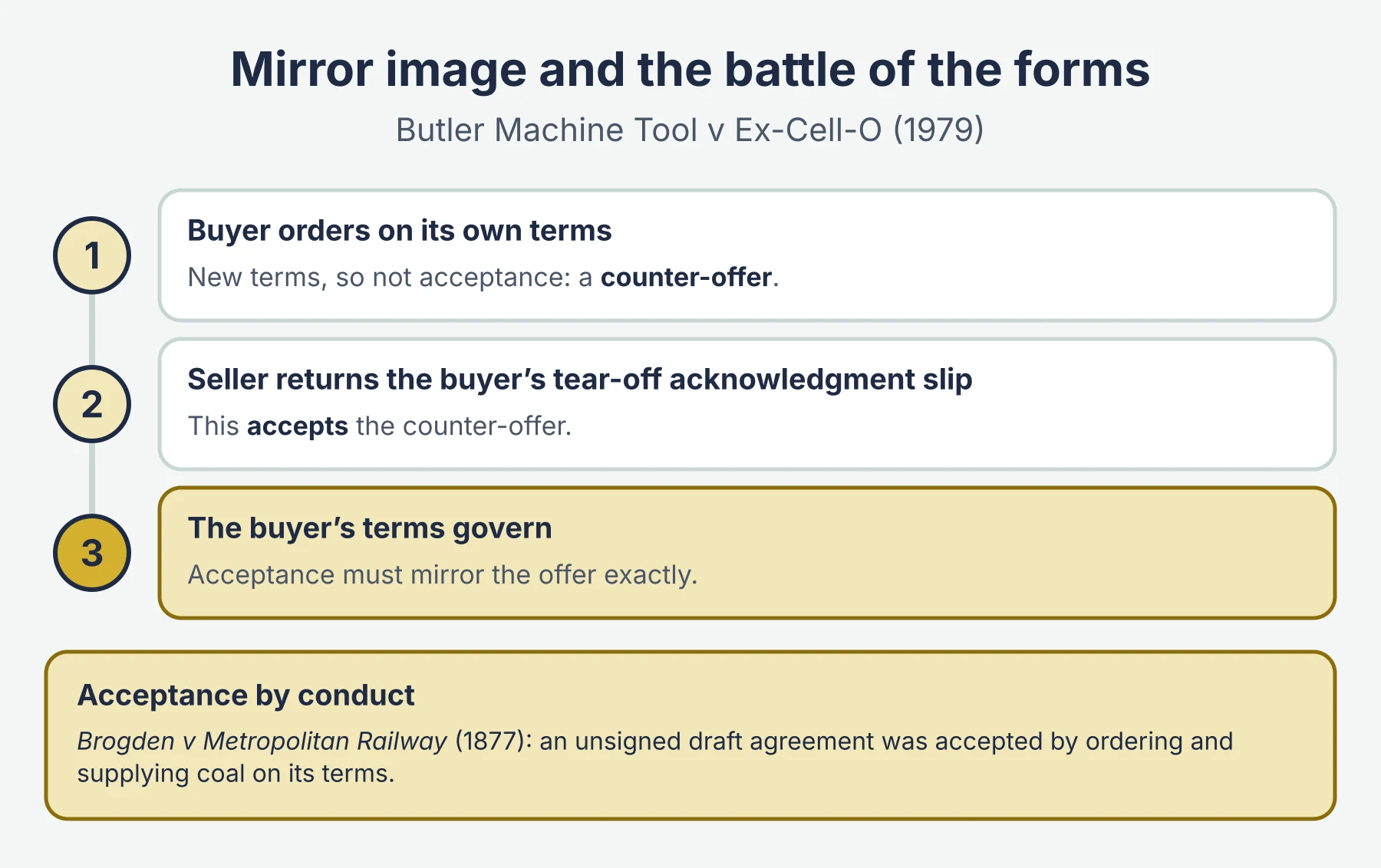
Mirror image. Acceptance must match the offer exactly; new terms make it a counter-offer. In business, competing standard forms create a “battle of the forms”. In Butler Machine Tool v Ex-Cell-O (1979) the buyer’s order on its own terms was a counter-offer, and the seller’s return of the buyer’s tear-off acknowledgment slip accepted it, so the buyer’s terms governed.
Conduct. Acceptance can be by conduct. In Brogden v Metropolitan Railway (1877) the parties had never signed a draft agreement, but by ordering and supplying coal on its terms they had accepted it.
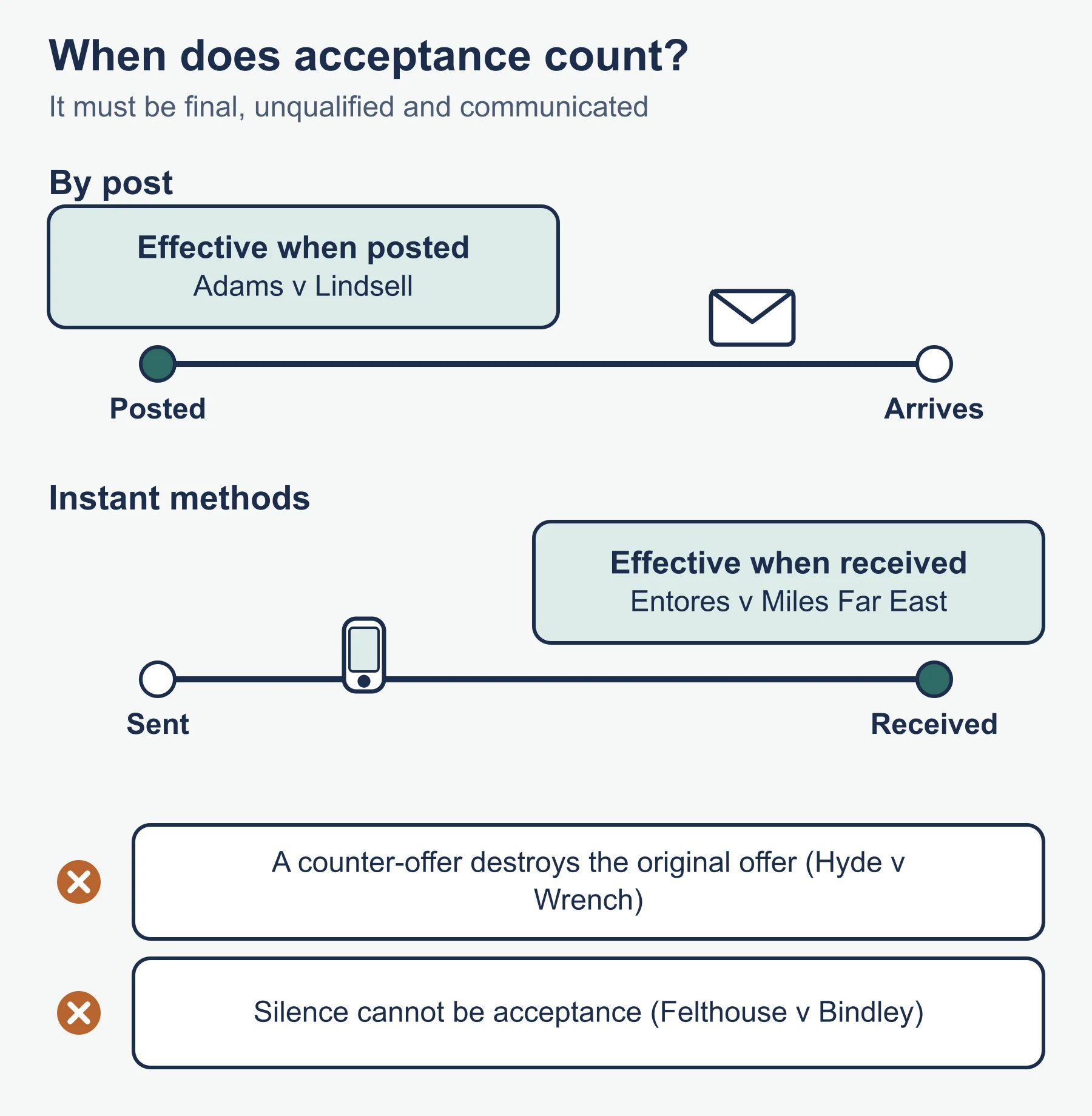
Communication. Acceptance must generally be communicated; silence is not acceptance (Felthouse v Bindley, 1862). Exceptions and timing:
| Method | When effective | Authority |
|---|---|---|
| Post (where reasonable to use) | When posted | Adams v Lindsell (1818); Henthorn v Fraser (1892) |
| Instant methods | When received | Entores v Miles Far East (1955) |
| Telex or similar to a business | When received, or when it would reasonably be read in office hours | The Brimnes (1975); Brinkibon (1983) |
| Unilateral contract | By performance; no need to communicate | Carlill (1893) |
Consideration
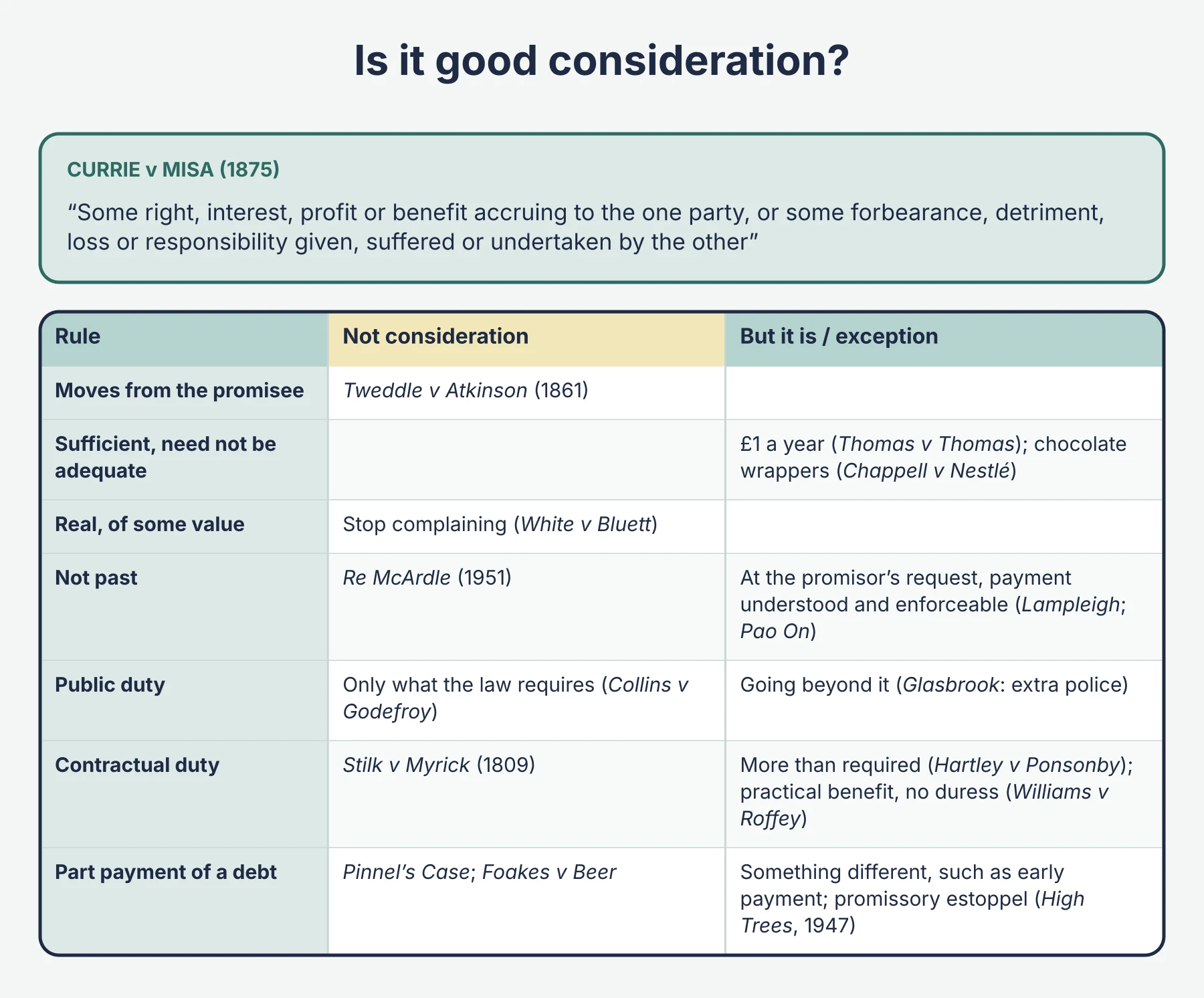
Definition. “Some right, interest, profit or benefit accruing to the one party, or some forbearance, detriment, loss or responsibility given, suffered or undertaken by the other” (Currie v Misa, 1875). Each side must give something in return for the other’s promise.
Rules and authorities.
- Must move from the promisee: only a person who has given consideration can enforce the promise (Tweddle v Atkinson, 1861).
- Sufficient but need not be adequate: a rent of £1 a year was good consideration in Thomas v Thomas (1842), and chocolate wrappers in Chappell v Nestlé (1960).
- Must be real and of some value: in White v Bluett (1853) a son’s promise to stop complaining was not consideration.
- Must not be past: work already done before a promise to pay is not consideration (Re McArdle, 1951). But if the act was done at the promisor’s request, both parties understood it would be paid for, and payment would have been legally enforceable, it can be (Lampleigh v Braithwait, 1615; Pao On v Lau Yiu Long, 1980).
- Existing public duty: doing only what the law already requires is not consideration (Collins v Godefroy, 1831), but going beyond it is (Glasbrook Bros v Glamorgan CC, 1925, extra police protection at a mine).
- Existing contractual duty: not consideration (Stilk v Myrick, 1809), unless the promisee does more than the contract requires (Hartley v Ponsonby, 1857, where so many crew had deserted that the remaining sailors’ duties changed) or the promisor obtains a practical benefit without duress (Williams v Roffey Bros, 1991).
- Part payment of a debt: not consideration for a promise to forgive the rest (Pinnel’s Case, 1602; Foakes v Beer, 1884), unless something different is given, such as early payment or a different item. Promissory estoppel may prevent the creditor going back on the promise where the debtor relied on it: Central London Property Trust v High Trees House (1947), where wartime rent reductions were binding for the war years.
Privity of contract
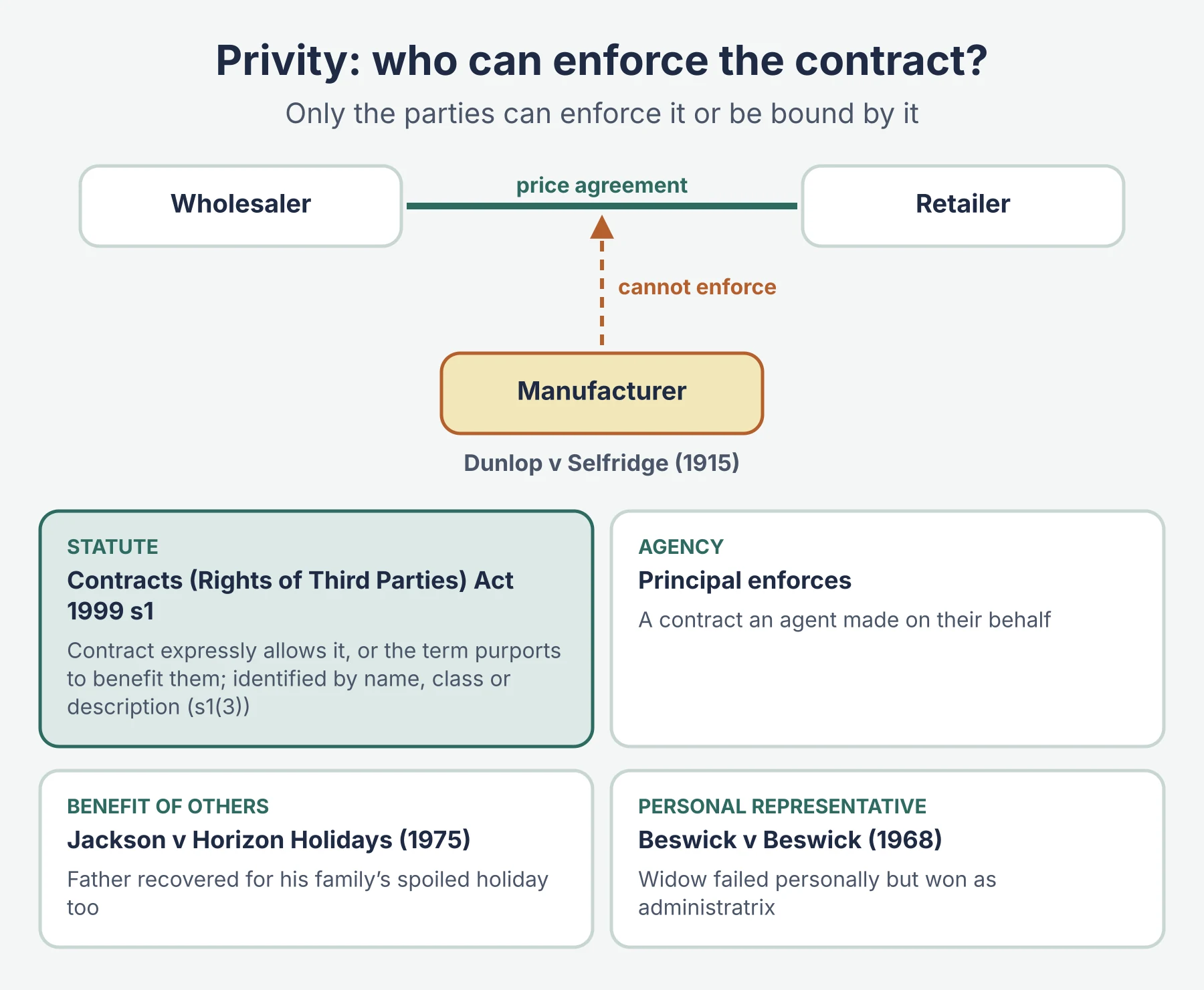
Only the parties to a contract can enforce it or be bound by it (Dunlop v Selfridge, 1915, where a manufacturer could not enforce a price agreement between a wholesaler and a retailer).
Exceptions and reform.
- Contracts (Rights of Third Parties) Act 1999, s1: a third party may enforce a term if the contract expressly provides that they may, or the term purports to confer a benefit on them, unless it appears the parties did not intend the term to be enforceable by them. The third party must be identified by name, class or description (s1(3)).
- Agency: a principal can enforce a contract made by an agent on their behalf.
- Contracts for the benefit of others: in Jackson v Horizon Holidays (1975) a father recovered damages for his family’s spoiled holiday as well as his own.
- Beswick v Beswick (1968): the widow could not sue personally, but succeeded as administratrix of her husband’s estate.
Intention to create legal relations
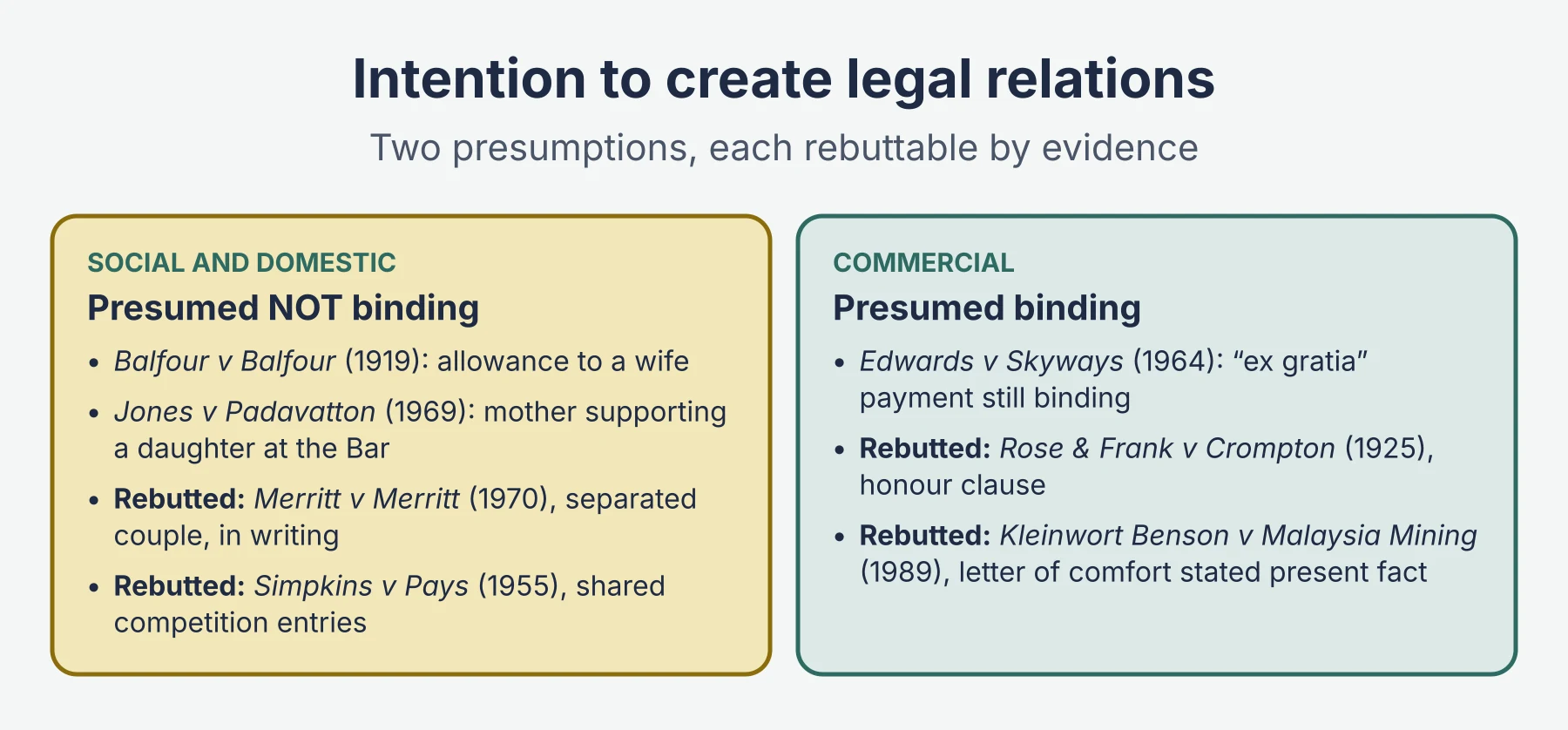
The courts use presumptions, which can be rebutted by evidence.
Social and domestic agreements: presumed not binding.
- Balfour v Balfour (1919): a husband’s promise of an allowance to his wife was not binding.
- Merritt v Merritt (1970): rebutted where a separated couple put their agreement in writing.
- Jones v Padavatton (1969): a mother’s arrangement to support her daughter studying for the Bar was not binding.
- Simpkins v Pays (1955): rebutted where three people in a house shared competition entries and agreed to share winnings.
Commercial agreements: presumed binding.
- Edwards v Skyways (1964): an “ex gratia” redundancy payment promised to a pilot was binding; the words did not rebut the presumption.
- Rose & Frank v Crompton (1925): rebutted by an “honour clause” stating the agreement was not a formal legal agreement.
- Kleinwort Benson v Malaysia Mining Corporation (1989): a “letter of comfort” stating a company’s policy was a statement of present fact, not a contractual promise.
Worked problem
On Monday Rhys emails Bea offering to sell his drum kit for £500, “offer open until Friday”. On Tuesday Bea replies, “Would you take £400?” Rhys does not answer. On Wednesday Bea’s friend tells her Rhys has sold the kit to Cal. On Thursday Bea emails, “I accept your £500 offer.”
Offer:        Rhys's email - definite terms, intention to be bound. Offer.
Tuesday:      "Would you take £400?" - a request or a counter-offer? It is
              phrased as an inquiry, so arguably a request for information
              (Stevenson v McLean); but if read as a counter-offer it ends
              the original offer (Hyde v Wrench).
Wednesday:    Revocation communicated via a reliable third party
              (Dickinson v Dodds). A promise to keep the offer open until
              Friday is not binding without consideration.
Thursday:     Acceptance comes after revocation, so it is too late.
Conclusion:   No contract between Rhys and Bea, whichever view is taken of
              Tuesday's email.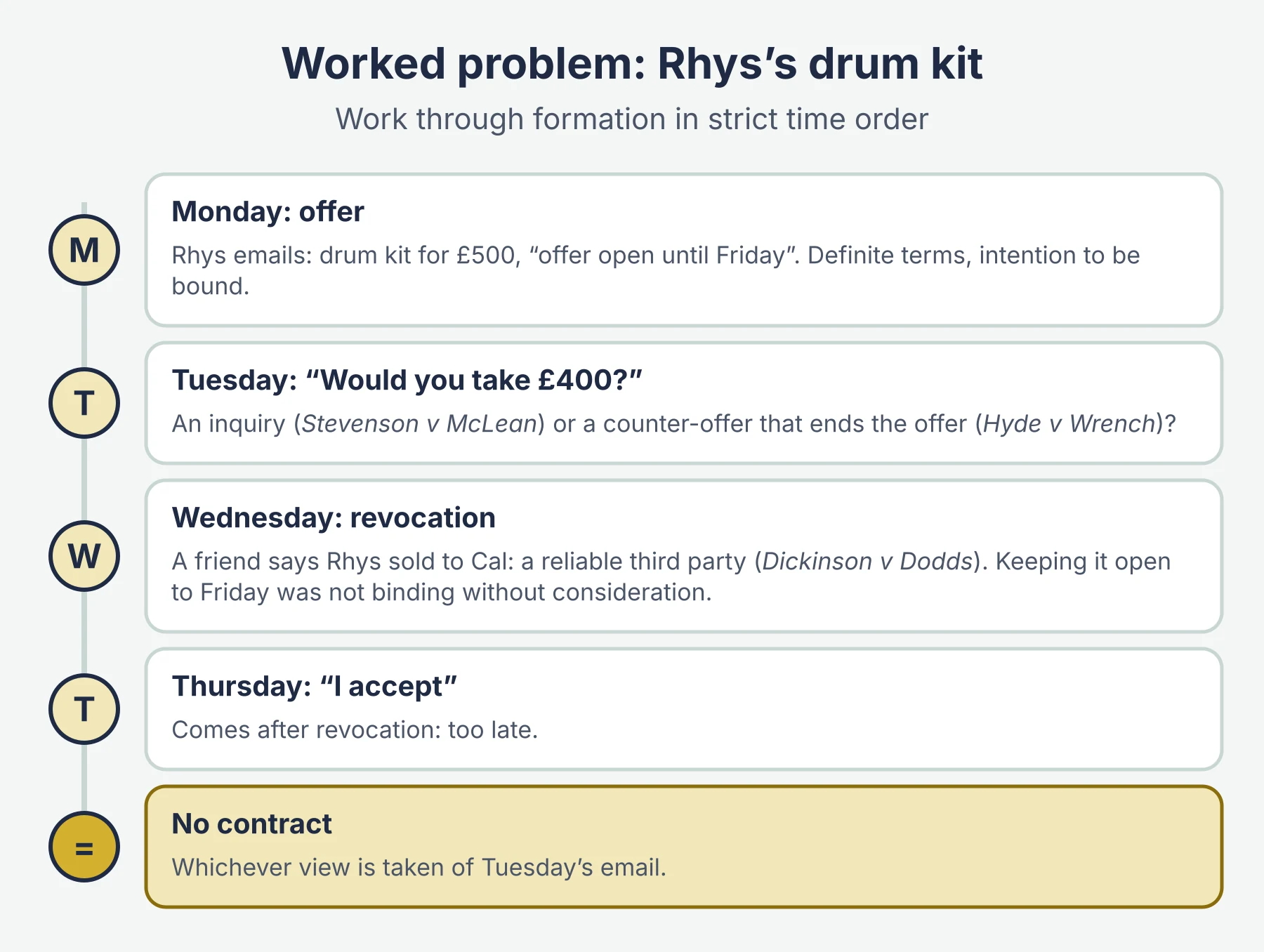
Common mistakes
- Treating a price statement or “may be prepared to sell” as an offer.
- Applying the postal rule to revocation (Byrne v Van Tienhoven).
- Saying any promise to keep an offer open is binding: without consideration it is not.
- Confusing adequacy (not required) with sufficiency (required).
- Forgetting the 1999 Act when a third party is named in the contract.
Exam technique
Work through formation in strict time order: identify each communication, classify it (offer, invitation, counter-offer, inquiry, revocation, acceptance) with an authority, and decide when it took effect. For consideration and intention, state the general rule, then whether an exception applies.
More resources on this topic
Essential requirements of contract revision notes | Essential requirements of contract practice questions | Theory of contract law study guide
Related resources
-
Practice questions
AQA A Level Law (7162): Essential Requirements of Contract – Practice Questions
Original practice questions with mark-scheme answers on offer, acceptance, consideration, privity and intention to create legal relations, AQA A Level Law 7162.
Law · AQA · A Level
Try questions -
Revision notes
AQA A Level Law (7162): Essential Requirements of Contract – Revision Notes
Recall notes on offers, invitations to treat, termination, acceptance rules, consideration, privity and intention to create legal relations for AQA Law 7162.
Law · AQA · A Level
Revise topic -
Study guides
AQA A Level Law (7162): Remedies (Law of contract)
Contract remedies for AQA A Level Law 7162: recoverable loss, causation, remoteness and mitigation, specific performance, rescission and termination for breach.
Law · AQA · A Level
Read guide
Get free revision emails (optional)
Occasional emails with practice questions, worked explanations and links to free resources for the qualification and subjects you choose. No spam, and you can unsubscribe from any email. The free tools on this site never need an email.