
Revision Notes
AQA A Level Law (7162): Essential Requirements of Contract – Revision Notes
Recall notes on offers, invitations to treat, termination, acceptance rules, consideration, privity and intention to create legal relations for AQA Law 7162.
- Subject
- Law
- Level
- A LEVELS
- Topic
- Topic 4: Law of contract
- Author
- Marlbridge Academic Team
- Updated
- Reviewed by
- Aizaz Raoof Ali (what this means)
Aligned to AQA A Level Law (7162), For teaching from September 2017 onwards, A-level exams 2019 onwards. Official specification .
Syllabus page (what it covers and how it is assessed): AQA A Level Law.
Syllabus points this page covers
7162
- Essential requirements of contract
Found an error? Report a correction.
Need help with this topic? Request a free trial class for A Level Law (7162).
Condensed notes for the section 3.4 row Essential requirements of contract: “Offer and acceptance”, “Consideration (including privity of contract)” and “Intention to create legal relations”. For explanation and a worked formation problem, use the essential requirements of contract study guide.
Formation checklist
OFFER  ->  still open?  ->  ACCEPTANCE (mirror image, communicated)
   +  CONSIDERATION from each side
   +  INTENTION to create legal relations
   =  CONTRACT
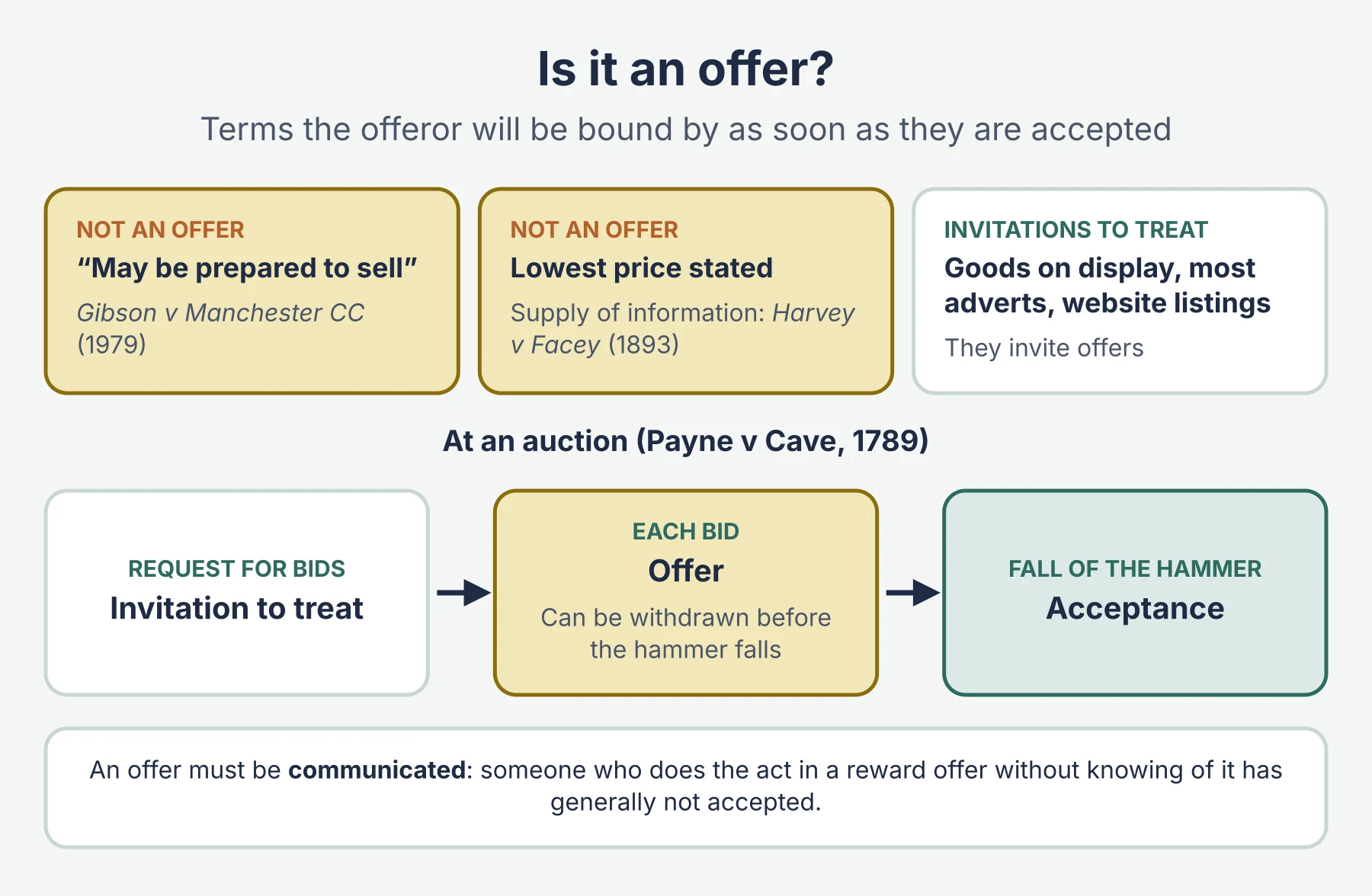
Offer
| Point | Authority |
|---|---|
| “May be prepared to sell” not an offer | Gibson v Manchester CC (1979) |
| Statement of lowest price is information | Harvey v Facey (1893) |
| Goods displayed: invitation to treat | Pharmaceutical Society v Boots (1953); Fisher v Bell (1961) |
| Advertisements usually invitations | Partridge v Crittenden (1968) |
| Unilateral offer to the world | Carlill v Carbolic Smoke Ball Co (1893) |
| Auctions: bid is offer; hammer is acceptance | Payne v Cave (1789) |
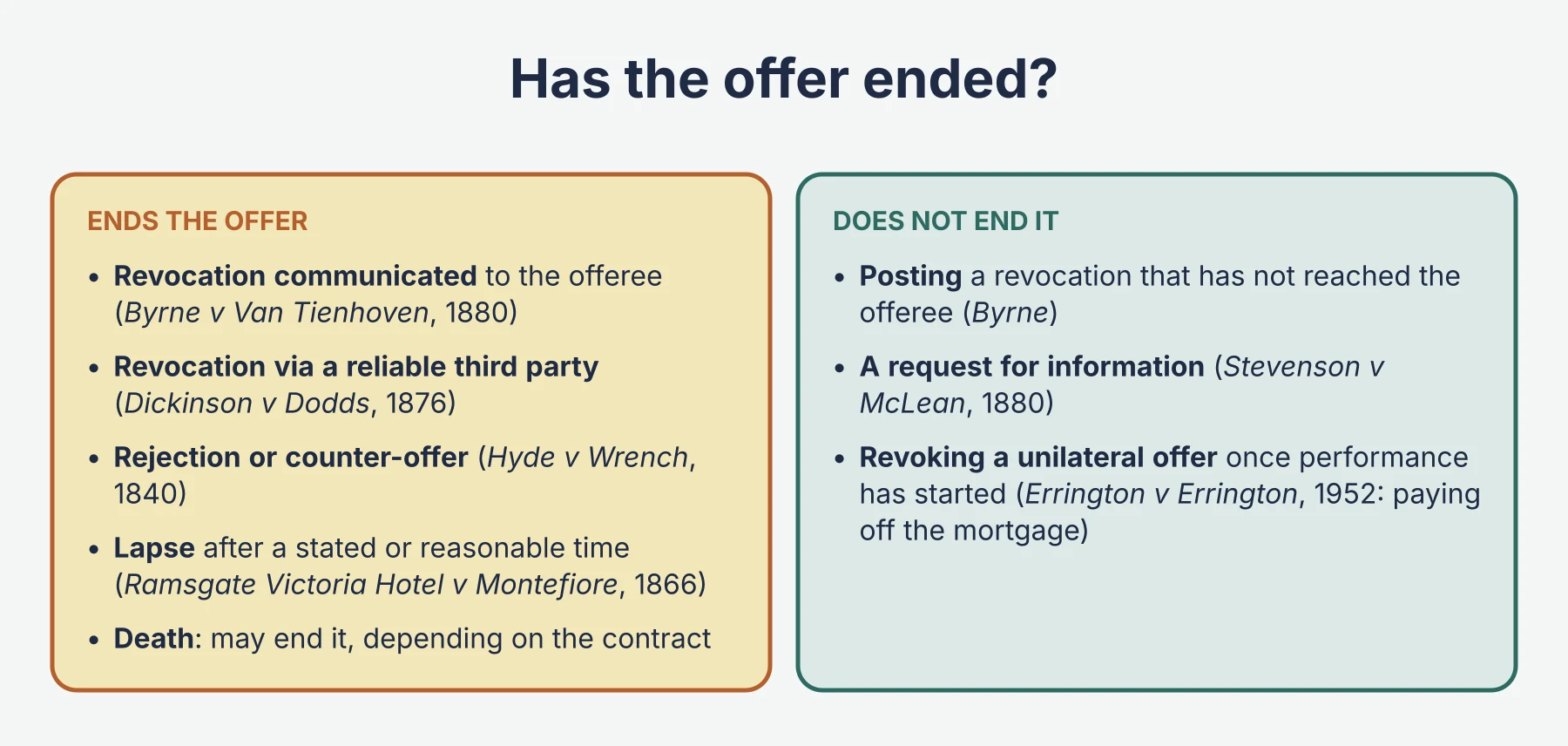
Termination of offer
| Method | Rule | Authority |
|---|---|---|
| Revocation | Must be communicated; not on posting | Byrne v Van Tienhoven (1880) |
| Via third party | Valid if reliable | Dickinson v Dodds (1876) |
| Counter-offer | Ends offer | Hyde v Wrench (1840) |
| Request for information | Does not end offer | Stevenson v McLean (1880) |
| Lapse | After stated or reasonable time | Ramsgate Victoria Hotel v Montefiore (1866) |
| Unilateral offer | Cannot revoke once performance begun | Errington v Errington (1952) |
Promise to keep an offer open: not binding without consideration.
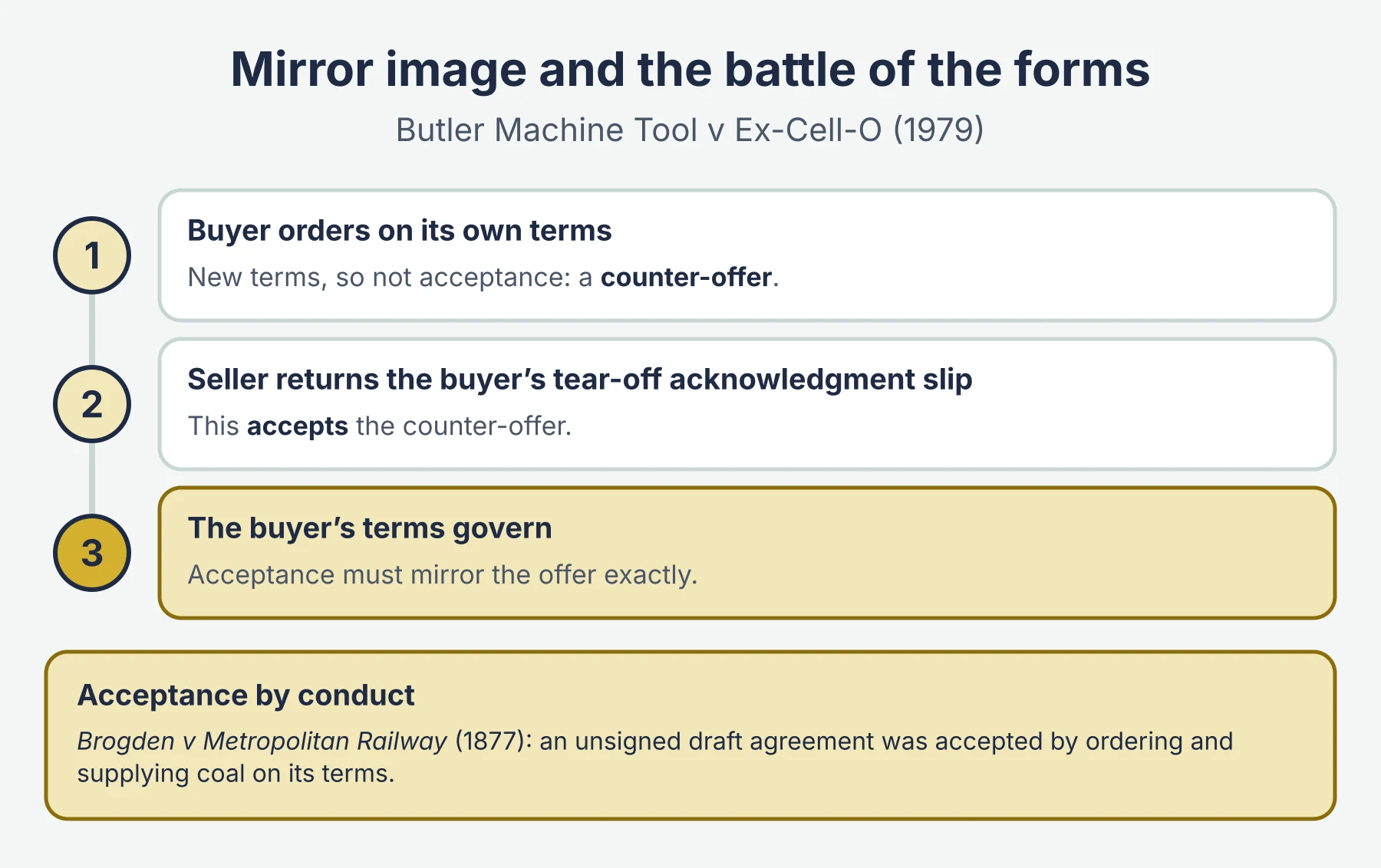
Acceptance
- Final, unqualified, mirror image: new terms = counter-offer.
- Battle of the forms: Butler Machine Tool v Ex-Cell-O (1979).
- By conduct: Brogden v Metropolitan Railway (1877).
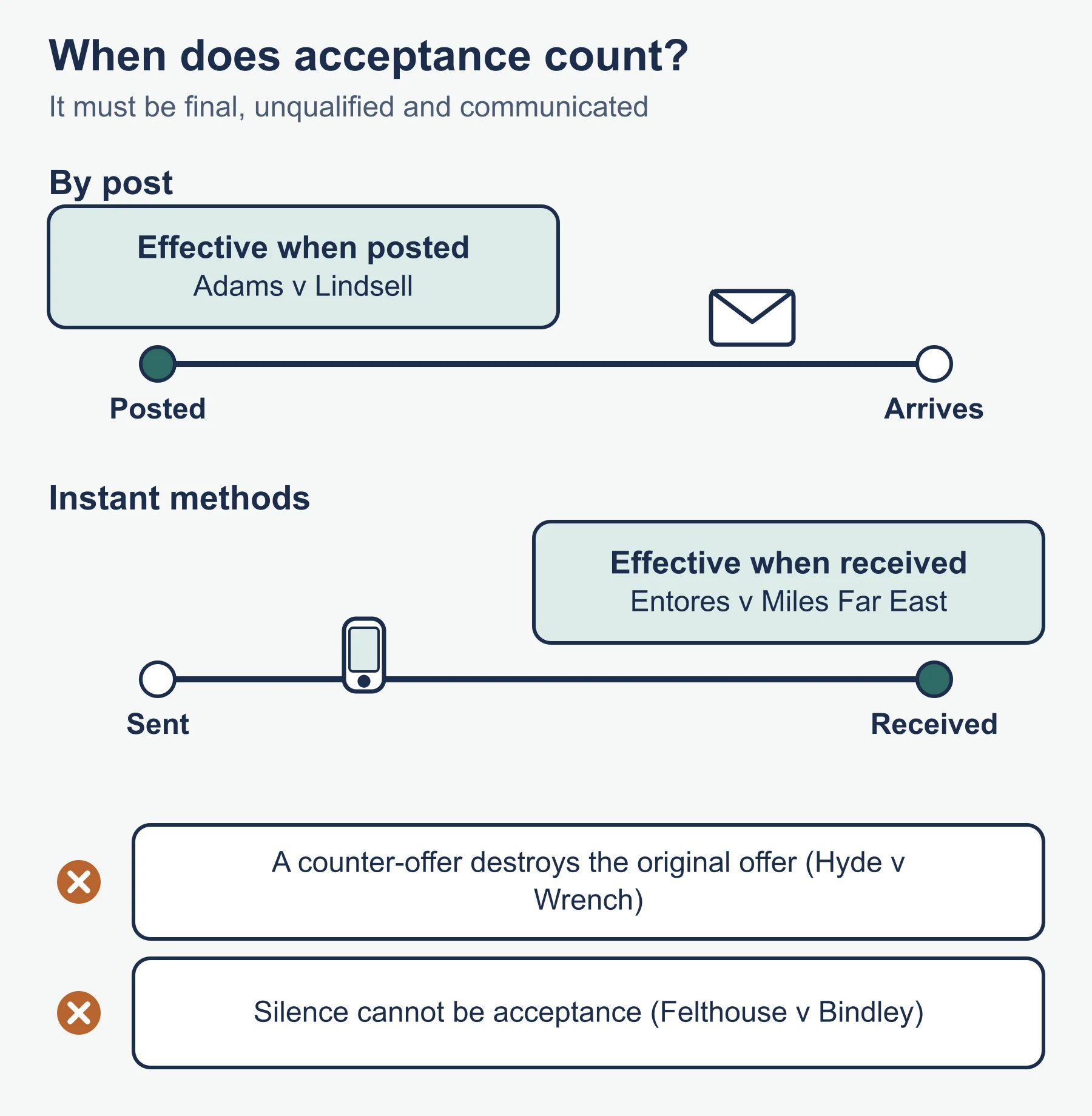
- Silence is not acceptance: Felthouse v Bindley (1862).
| Method | Effective | Authority |
|---|---|---|
| Post | On posting (if reasonable to use) | Adams v Lindsell (1818); Henthorn v Fraser (1892) |
| Instant | On receipt | Entores (1955) |
| Telex/similar to business | When received or would be read in office hours | The Brimnes (1975); Brinkibon (1983) |
| Unilateral | By performance | Carlill (1893) |
Consideration
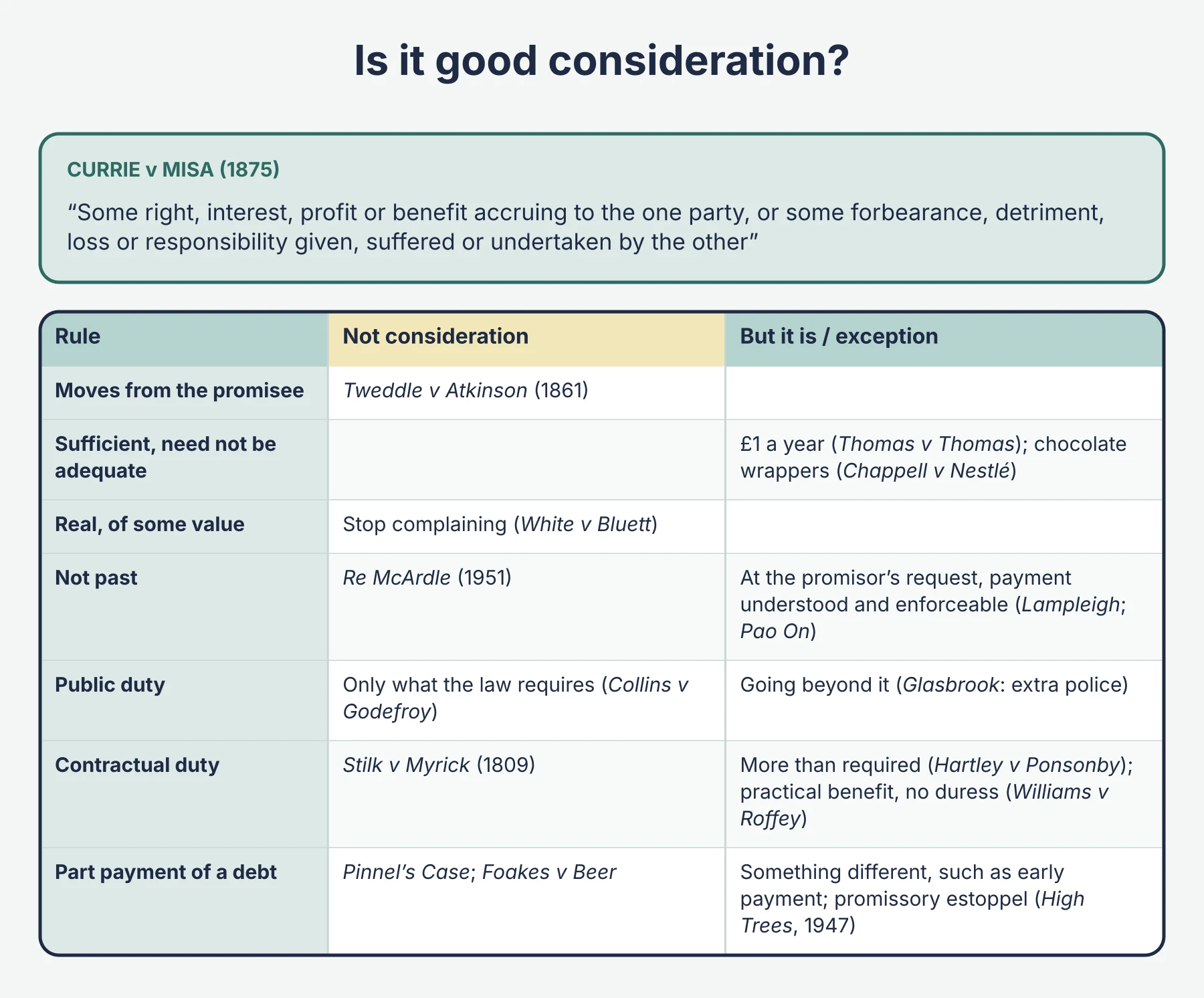
Definition: Currie v Misa (1875): benefit to one party or detriment to the other.
| Rule | Authority |
|---|---|
| Must move from promisee | Tweddle v Atkinson (1861) |
| Need not be adequate | Thomas v Thomas (1842); Chappell v Nestlé (1960) |
| Must have some value | White v Bluett (1853) |
| Past consideration not good | Re McArdle (1951) |
| Exception: requested, payment expected | Lampleigh v Braithwait (1615); Pao On v Lau Yiu Long (1980) |
| Existing public duty not enough | Collins v Godefroy (1831) |
| Exceeding public duty is | Glasbrook Bros v Glamorgan CC (1925) |
| Existing contractual duty not enough | Stilk v Myrick (1809) |
| Exceeding contractual duty is | Hartley v Ponsonby (1857) |
| Practical benefit, no duress | Williams v Roffey Bros (1991) |
| Part payment of debt not enough | Pinnel’s Case (1602); Foakes v Beer (1884) |
| Promissory estoppel | Central London Property Trust v High Trees (1947) |
Privity
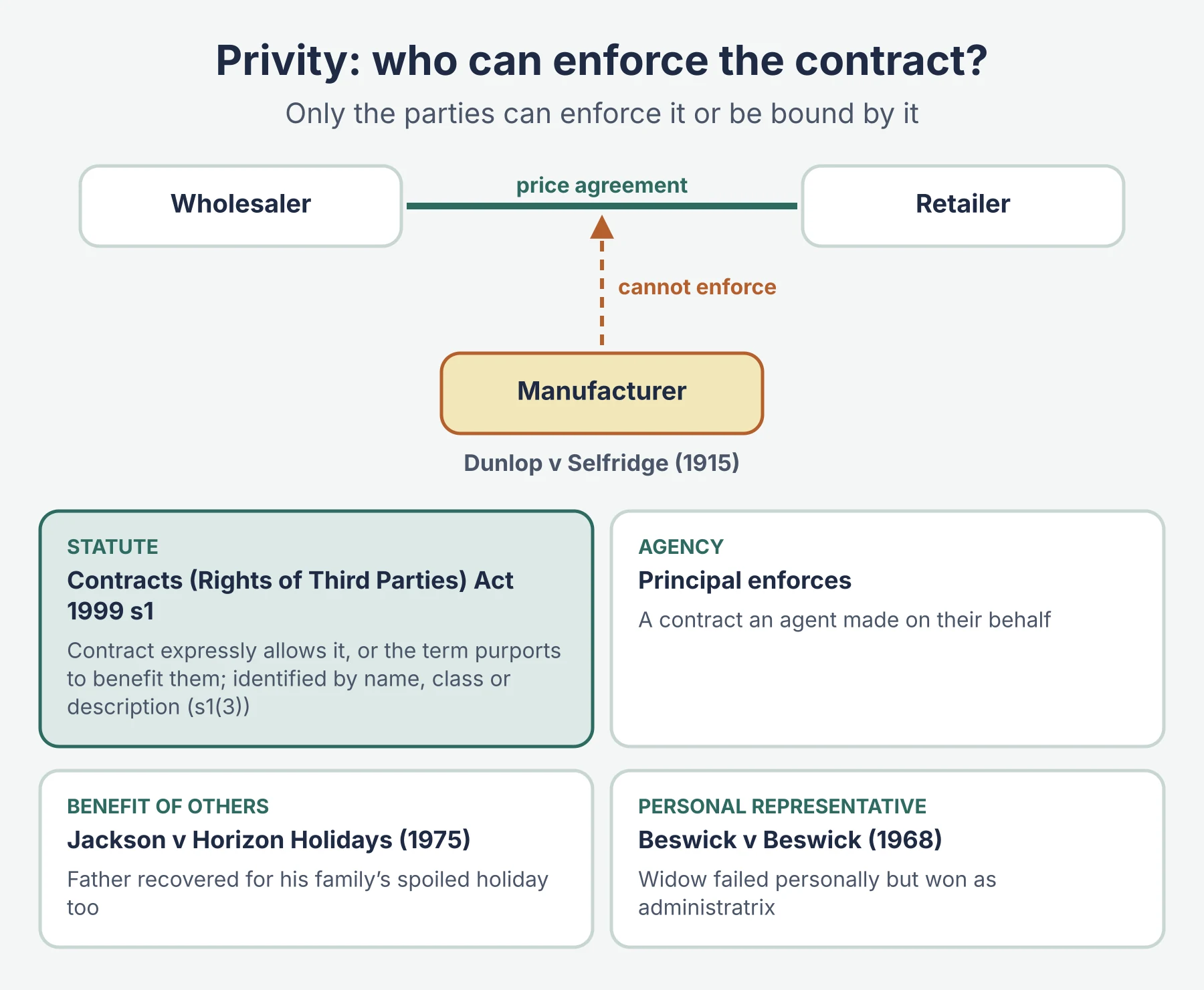
- Only parties can sue or be sued: Dunlop v Selfridge (1915).
- 1999 Act s1: third party may enforce if expressly allowed, or term purports to benefit them (unless contrary intention); identified by name, class or description (s1(3)).
- Agency; Jackson v Horizon Holidays (1975); Beswick v Beswick (1968).
Intention to create legal relations
| Context | Presumption | For | Rebutted |
|---|---|---|---|
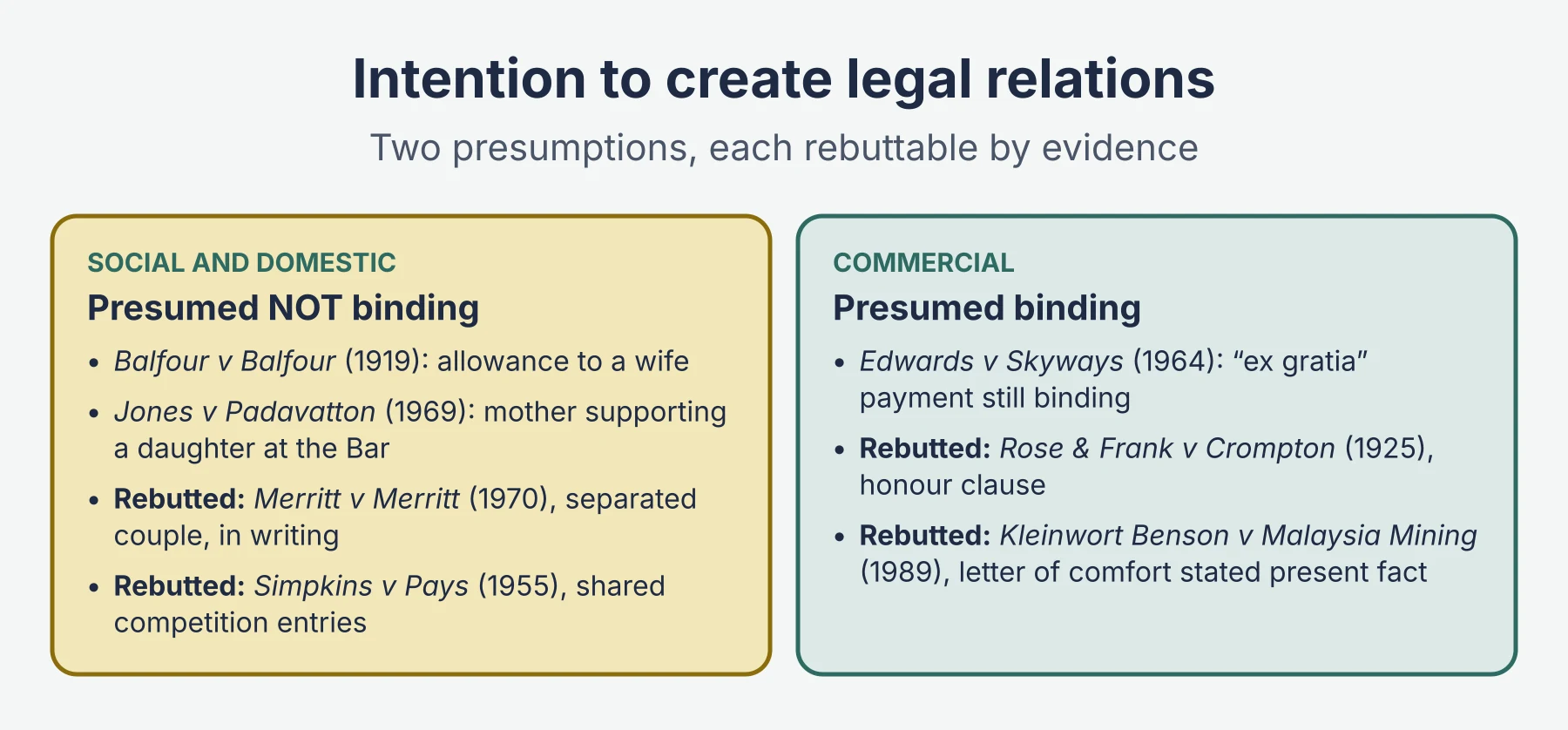
| Social / domestic | Not binding | Balfour v Balfour (1919); Jones v Padavatton (1969) | Merritt v Merritt (1970); Simpkins v Pays (1955) |
| Commercial | Binding | Edwards v Skyways (1964) | Rose & Frank v Crompton (1925); Kleinwort Benson v Malaysia Mining (1989) |
Key terms
| Term | Meaning |
|---|---|
| Offer | Statement of terms with intention to be bound on acceptance |
| Invitation to treat | Invitation to others to make offers |
| Counter-offer | Reply with new terms, ending the original offer |
| Revocation | Withdrawal of an offer before acceptance |
| Postal rule | Acceptance effective on posting |
| Consideration | Something of value given in return for a promise |
| Past consideration | Act done before the promise was made |
| Promissory estoppel | Equitable doctrine stopping a party going back on a promise relied on |
| Privity | Only parties to a contract can enforce it |
| Honour clause | Term showing the parties do not intend legal relations |
Exam traps
- Revocation is never effective on posting.
- A request for information does not kill the offer; a counter-offer does.
- Adequacy is irrelevant; sufficiency is required.
- Part payment of a debt: Foakes v Beer still applies; Williams v Roffey does not extend to it.
- Social presumptions can be rebutted by writing or by separation (Merritt).
Self-test
- Why was there no contract in Gibson? “May be prepared to sell” was not an offer.
- When is a revocation effective? When communicated to the offeree (Byrne v Van Tienhoven).
- What did Dickinson v Dodds decide? Revocation via a reliable third party is effective.
- Does a request for information end an offer? No (Stevenson v McLean).
- Can a unilateral offer be revoked once performance has started? No (Errington v Errington).
- Whose terms won in Butler v Ex-Cell-O? The buyer’s: the seller accepted the counter-offer by returning the slip.
- When is a posted acceptance effective? On posting, where post is a reasonable method.
- Give the Currie v Misa definition of consideration. A benefit to one party or a detriment to the other.
- When can past consideration be good? Where the act was requested, payment was expected and would have been enforceable (Pao On).
- Why was there consideration in Glasbrook? The police provided more protection than their public duty required.
- What did High Trees decide? A promise to accept less rent, relied on, was binding for the wartime period.
- What does s1 of the 1999 Act allow? A third party to enforce a term expressly allowing it or purporting to benefit them.
More resources on this topic
Essential requirements of contract practice questions | Law of contract revision notes
Related resources
-
Study guides
AQA A Level Law (7162): Remedies (Law of contract)
Contract remedies for AQA A Level Law 7162: recoverable loss, causation, remoteness and mitigation, specific performance, rescission and termination for breach.
Law · AQA · A Level
Read guide -
Practice questions
AQA A Level Law (7162): Remedies (Law of contract) – Practice Questions
Original practice on contract remedies for AQA A Level Law 7162 with mark-scheme answers on damages, remoteness, mitigation, equitable remedies and termination.
Law · AQA · A Level
Try questions -
Revision notes
AQA A Level Law (7162): Remedies (Law of contract) – Revision Notes
Condensed recall on contract remedies for AQA A Level Law 7162: loss, causation, remoteness, mitigation, specific performance, rescission and termination.
Law · AQA · A Level
Revise topic
Get free revision emails (optional)
Occasional emails with practice questions, worked explanations and links to free resources for the qualification and subjects you choose. No spam, and you can unsubscribe from any email. The free tools on this site never need an email.