
Revision Notes
AQA A Level Law (7162): Remedies (Law of contract) – Revision Notes
Condensed recall on contract remedies for AQA A Level Law 7162: loss, causation, remoteness, mitigation, specific performance, rescission and termination.
- Subject
- Law
- Level
- A LEVELS
- Topic
- Topic 4: Law of contract
- Author
- Marlbridge Academic Team
- Updated
- Reviewed by
- Aizaz Raoof Ali (what this means)
Aligned to AQA A Level Law (7162), For teaching from September 2017 onwards, A-level exams 2019 onwards. Official specification .
Syllabus page (what it covers and how it is assessed): AQA A Level Law.
Syllabus points this page covers
7162
- Remedies
Found an error? Report a correction.
Need help with this topic? Request a free trial class for A Level Law (7162).
Condensed notes on the remedies for breach of contract named in the specification. For full explanation and a worked scenario, use the remedies in contract study guide.
The answer route in one line
Breach → terminate or affirm? → loss (which category?) → causation → remoteness (time of contracting) → mitigation → amount → equitable remedy if damages inadequate.
Compensatory damages
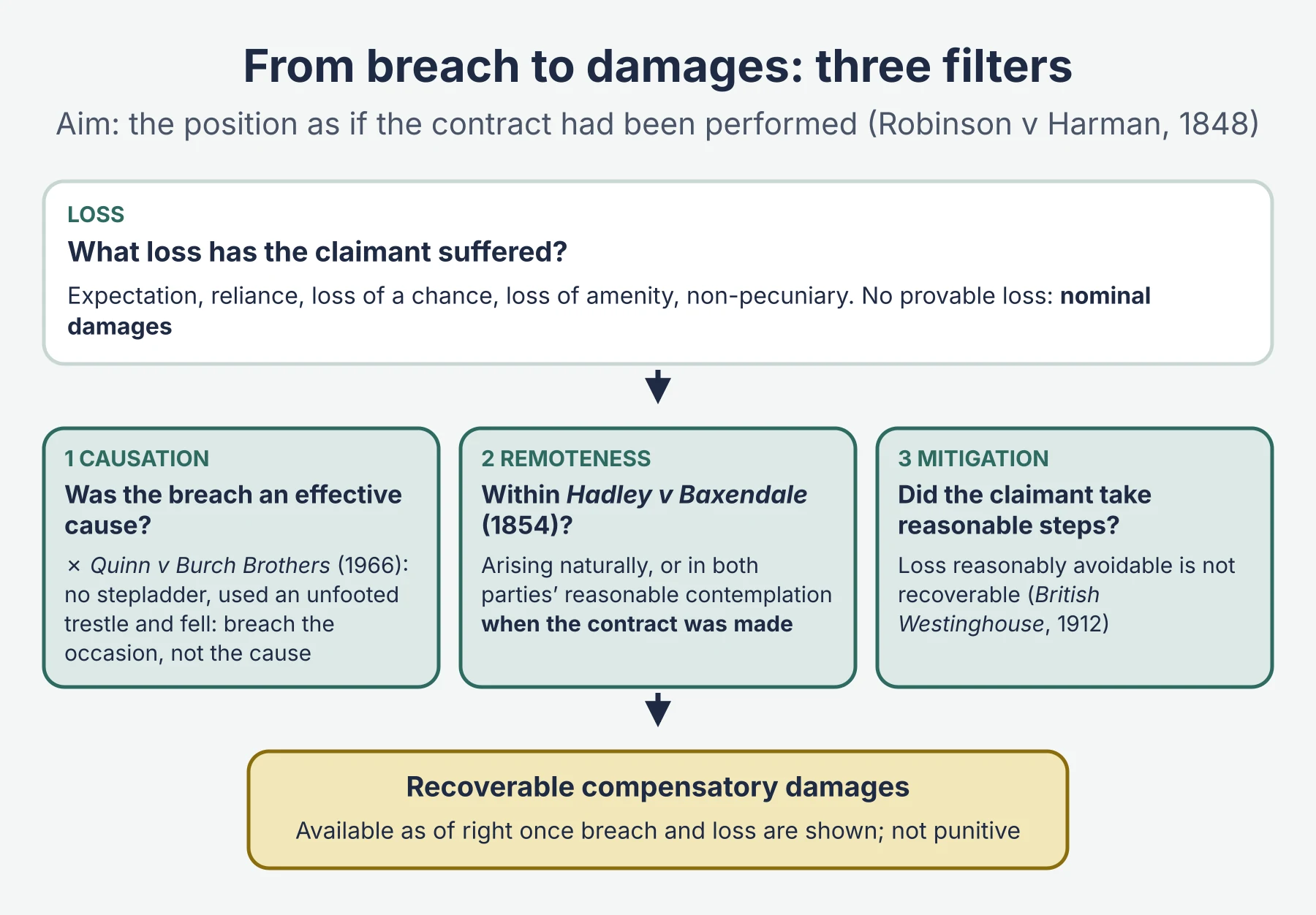
- Aim: put the claimant in the position as if the contract had been performed (Robinson v Harman, 1848).
- Available as of right; not punitive. Nominal damages where breach but no provable loss.
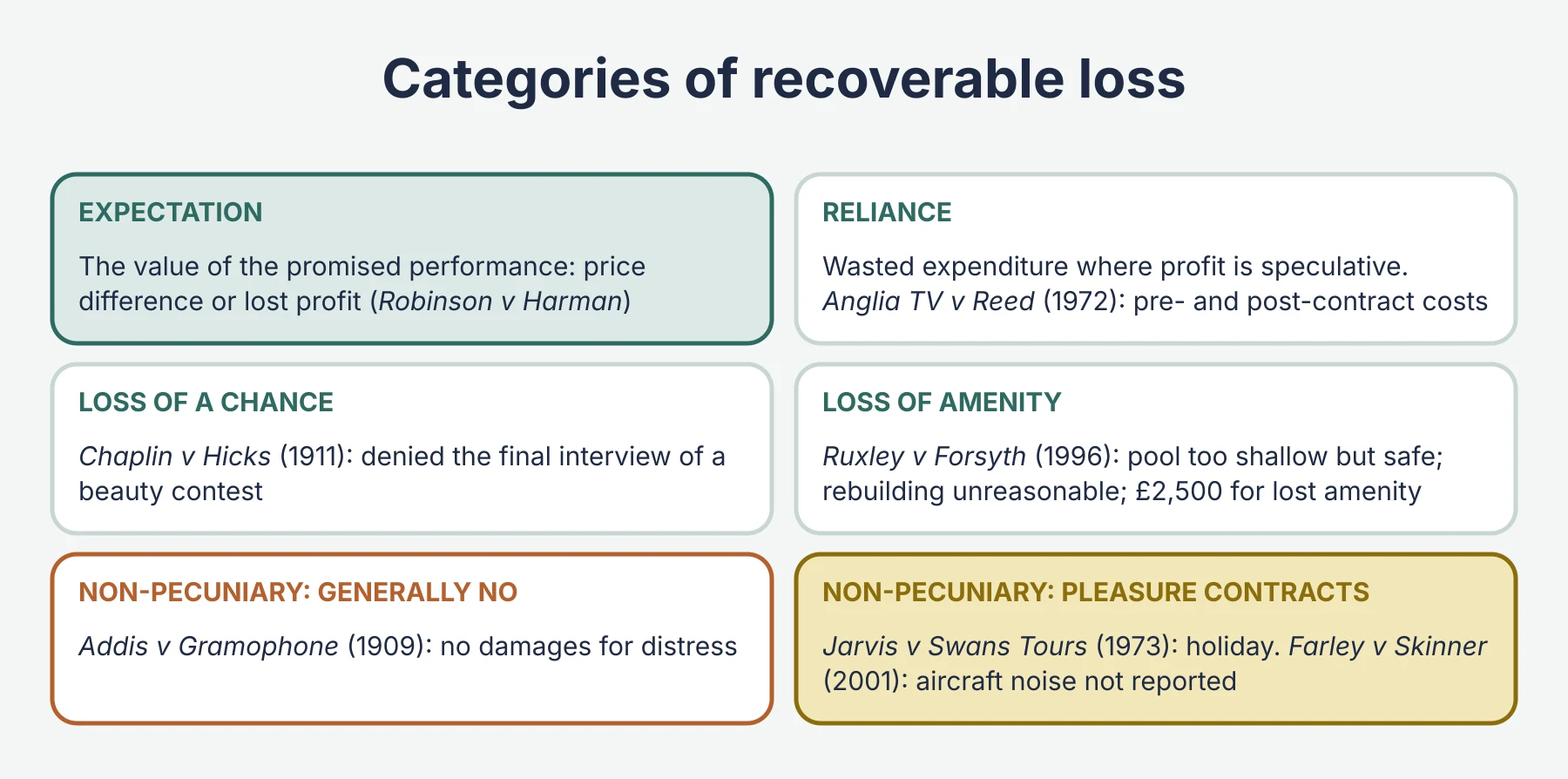
| Category | Case | Point |
|---|---|---|
| Expectation | Robinson v Harman (1848) | Value of promised performance |
| Reliance | Anglia Television v Reed (1972) | Wasted expenditure, including pre-contract costs, where profit is speculative |
| Loss of a chance | Chaplin v Hicks (1911) | Lost chance of selection in a contest |
| Loss of amenity | Ruxley Electronics v Forsyth (1996) | Pool too shallow; cost of rebuilding unreasonable; £2,500 for loss of amenity |
| Distress: general rule | Addis v Gramophone (1909) | No damages for injured feelings |
| Distress: exception | Jarvis v Swans Tours (1973); Farley v Skinner (2001) | Where a major object of the contract is pleasure or peace of mind |
Causation
The breach must be an effective cause of the loss. Quinn v Burch Brothers (1966): failure to supply a stepladder was the occasion of the fall, not its cause, when the claimant chose to use an unfooted trestle.
Remoteness
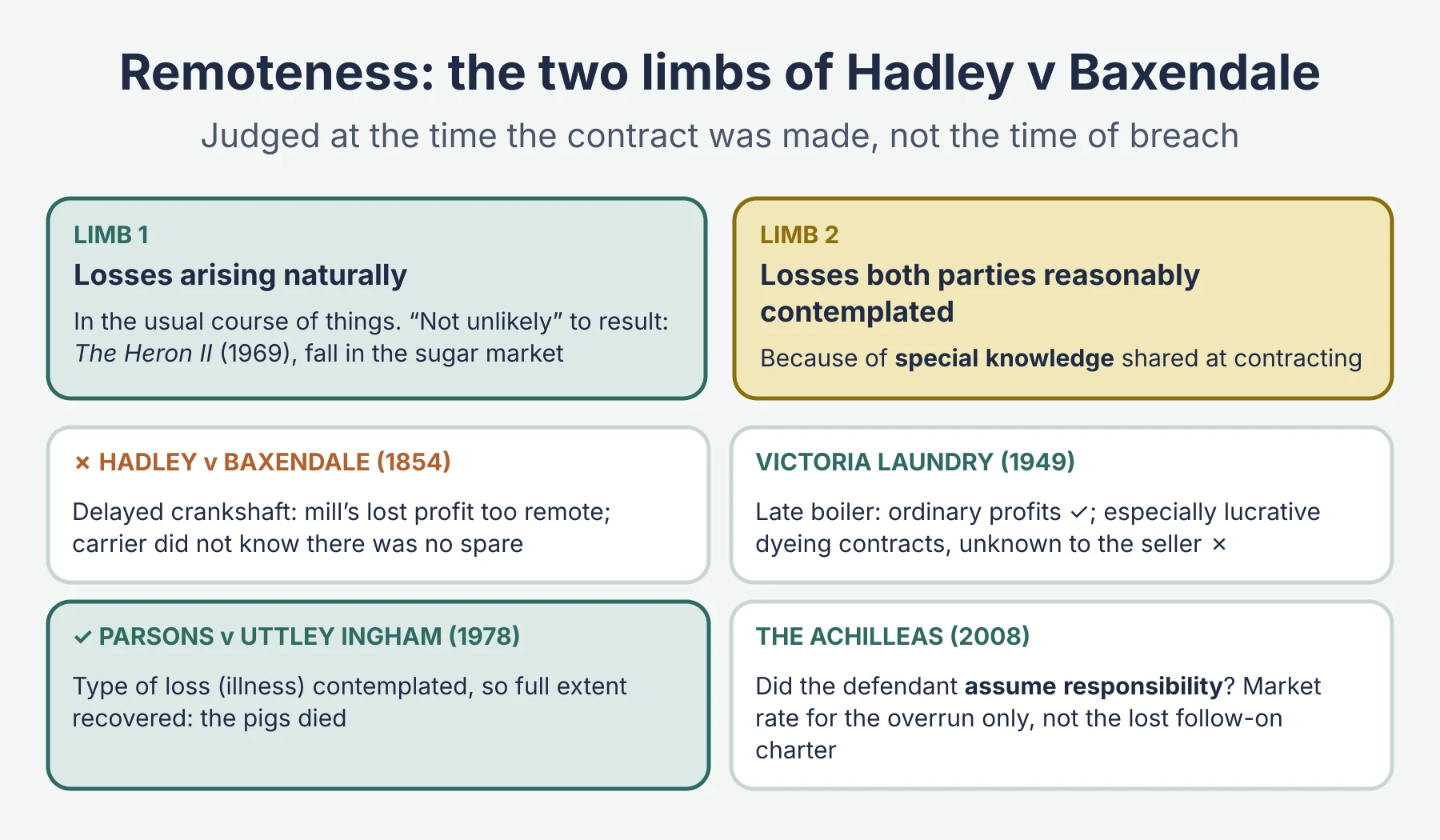
Hadley v Baxendale (1854): recoverable if (1) arising naturally from the breach, or (2) in the reasonable contemplation of both parties at the time of contracting because of special knowledge.
| Case | Point |
|---|---|
| Hadley v Baxendale (1854) | Mill’s lost profit too remote; carrier did not know there was no spare crankshaft |
| Victoria Laundry v Newman (1949) | Ordinary profits recoverable; exceptionally lucrative contracts too remote |
| The Heron II (1969) | First limb: loss “not unlikely” to result |
| Parsons v Uttley Ingham (1978) | If the type of loss is contemplated, the full extent is recoverable |
| The Achilleas (2008) | Also whether the defendant assumed responsibility for that type of loss |
Mitigation
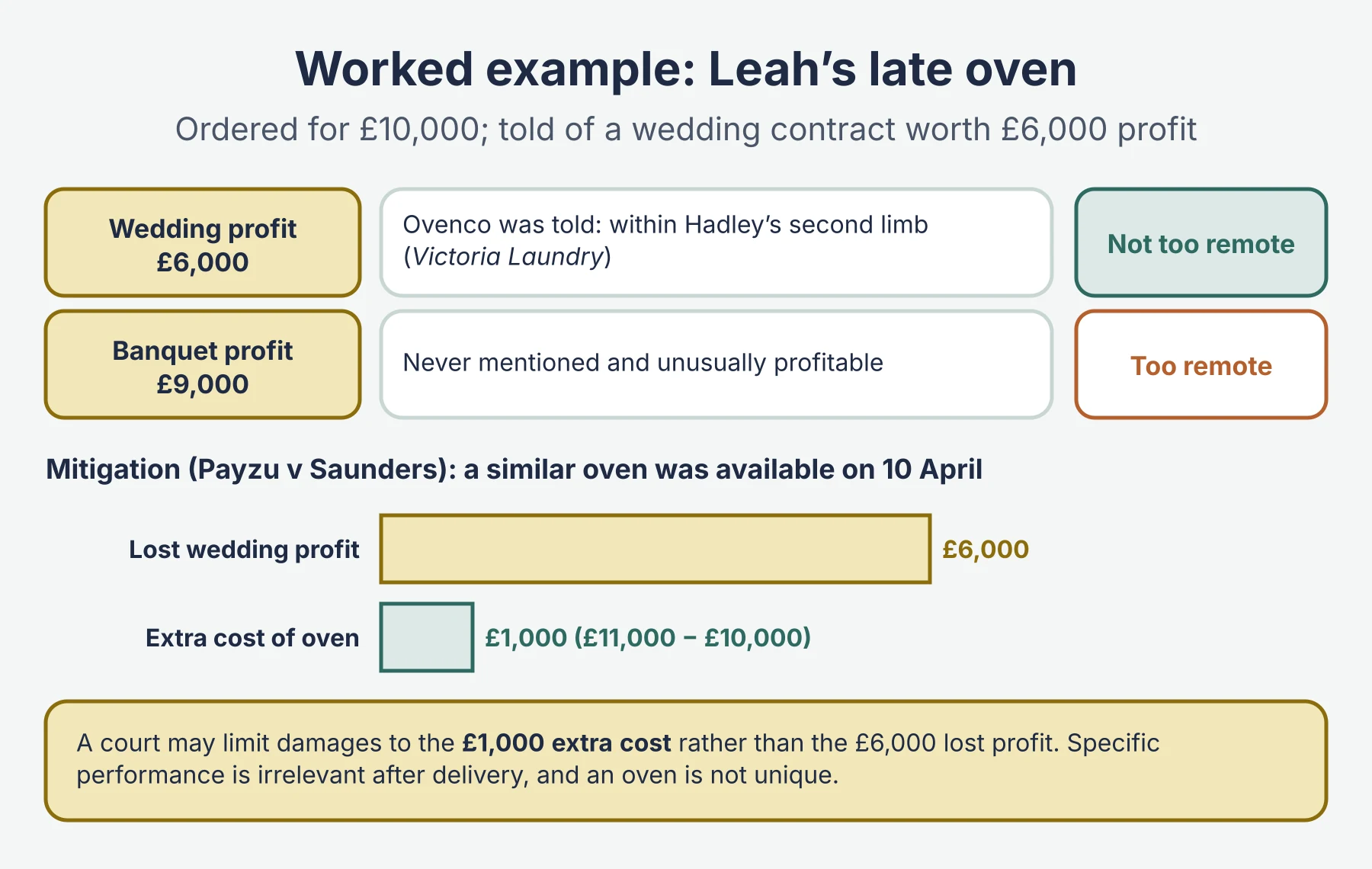
- Claimant must take reasonable steps to reduce loss (British Westinghouse, 1912).
- Payzu v Saunders (1919): should have accepted the offer to supply for cash.
- Brace v Calder (1895): refusing re-employment on the same terms gave only nominal damages.
- The standard is reasonableness, not perfection; reasonable costs of mitigating are recoverable.
Equitable remedies
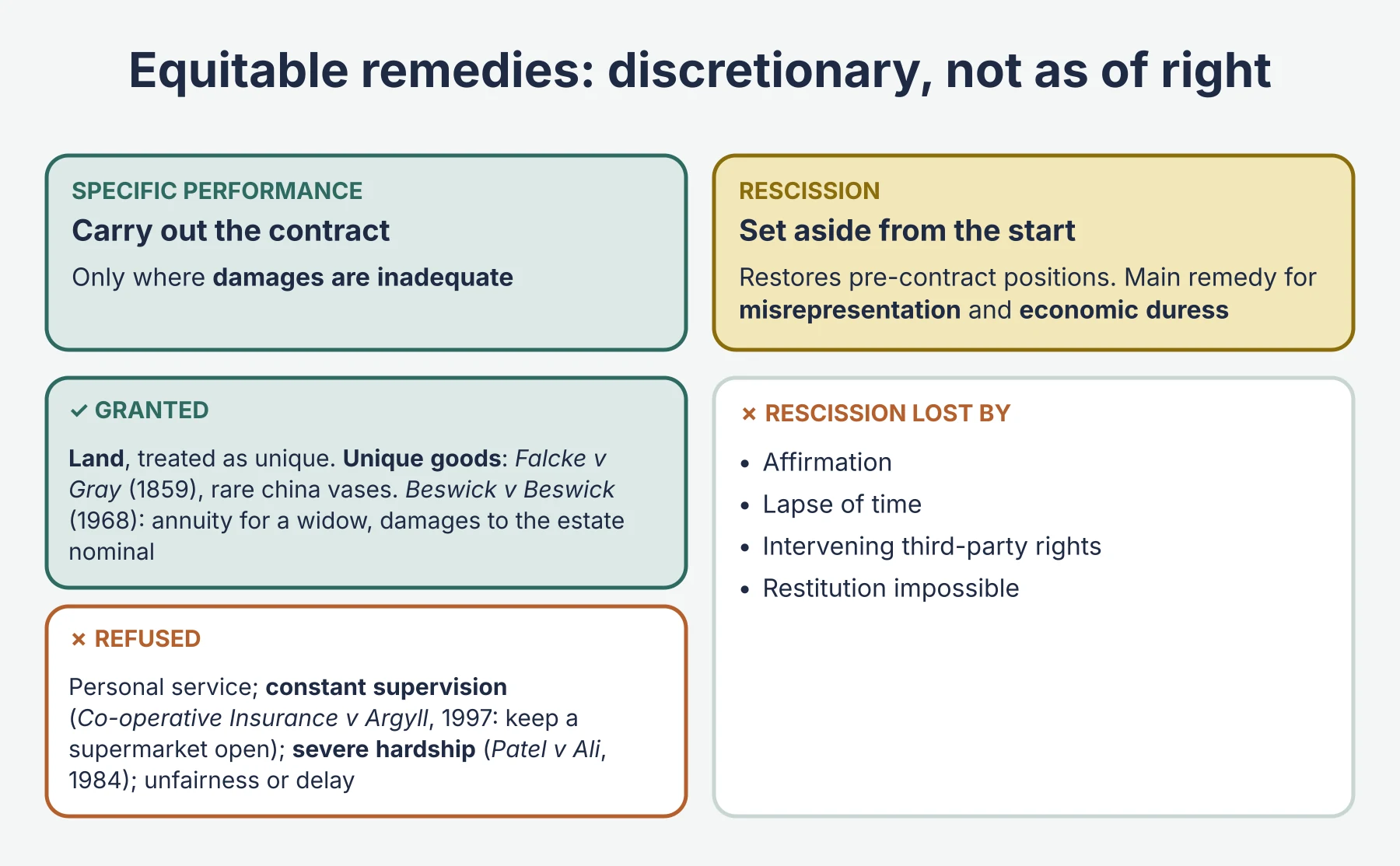
Discretionary; may be refused even where breach is proved.
Specific performance: order to perform; only where damages are inadequate.
| Granted | Refused |
|---|---|
| Land (treated as unique) | Personal service contracts |
| Unique goods (Falcke v Gray, 1859, accepted in principle) | Constant supervision (Co-operative Insurance v Argyll Stores, 1997) |
| Damages nominal (Beswick v Beswick, 1968) | Severe hardship (Patel v Ali, 1984); claimant’s unfairness or delay |
Rescission: sets the contract aside from the start, restoring the parties. Main remedy for misrepresentation and economic duress. Barred by affirmation, lapse of time, third-party rights or impossibility of restitution.
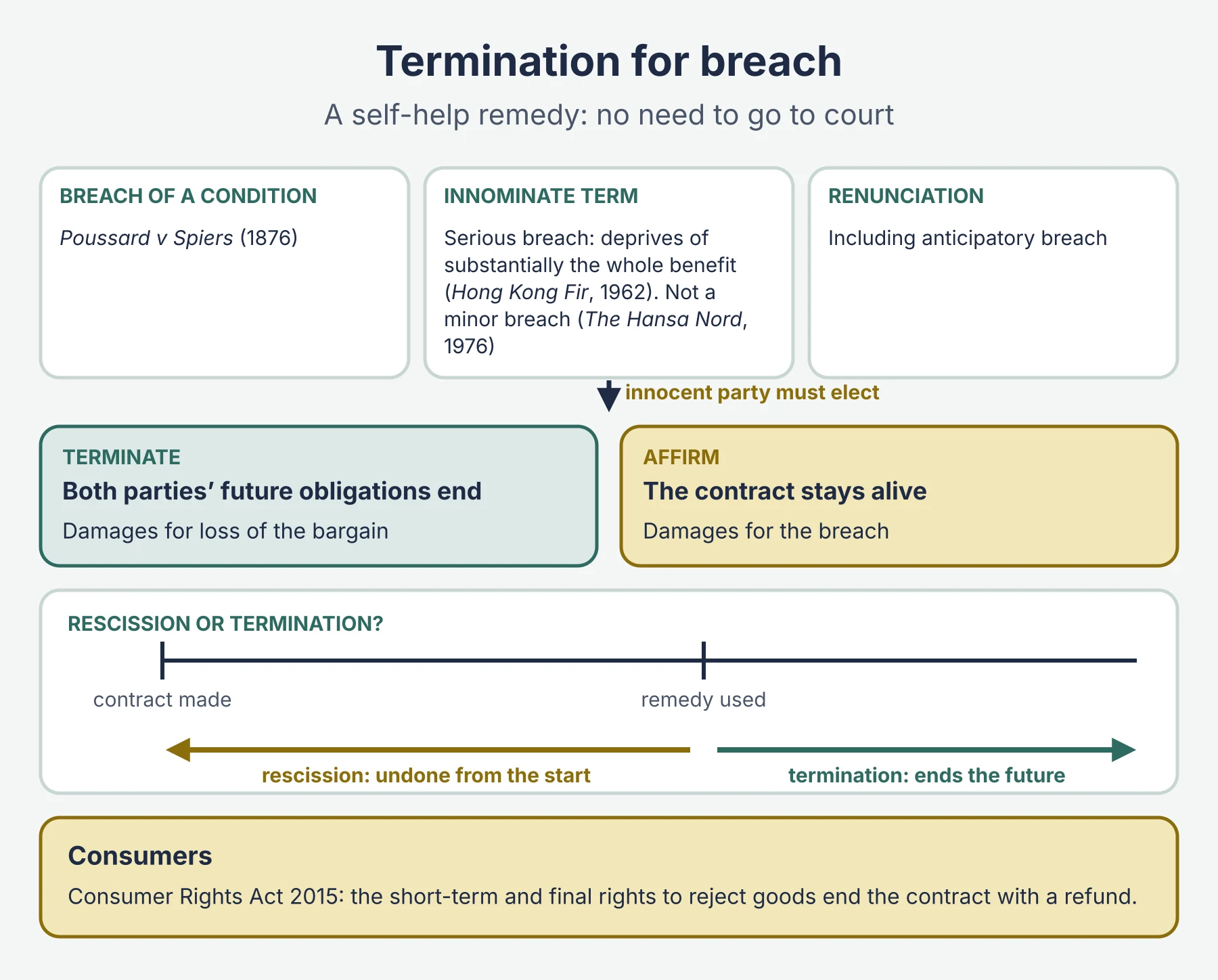
Termination for breach
- Self-help: no court order needed.
- Available for breach of a condition (Poussard v Spiers, 1876), a serious innominate breach (Hong Kong Fir, 1962; contrast The Hansa Nord, 1976) and renunciation, including anticipatory breach.
- Innocent party must elect: terminate (ends future obligations, damages for loss of bargain) or affirm.
- Wrongful termination is itself a repudiation.
- Consumers: CRA 2015 rights to reject are a statutory form of termination with a refund.
Key terms
| Term | Meaning |
|---|---|
| Expectation loss | Loss of the benefit the claimant would have received on performance |
| Reliance loss | Expenditure wasted in reliance on the contract |
| Remoteness | Limit on recoverable loss to what was within the parties’ contemplation |
| Mitigation | Duty to take reasonable steps to reduce loss |
| Nominal damages | Small sum marking a breach where no loss is proved |
| Specific performance | Equitable order to carry out the contract |
| Rescission | Setting the contract aside and restoring the parties |
| Termination | Innocent party’s election to end future obligations after a repudiatory breach |
Exam traps
- Calling damages a punishment.
- Judging remoteness at the time of breach; it is the time of contracting.
- Using Parsons to recover a different type of loss; it covers greater extent of a contemplated type.
- Forgetting mitigation when the facts mention an alternative supplier or offer.
- Treating specific performance as available whenever the claimant wants it.
- Using “rescind” for termination after breach; rescission undoes the contract from the start.
Self-test
- What is the aim of compensatory damages in contract?
- When will a claimant claim reliance loss instead of expectation loss? Give a case.
- What did Ruxley Electronics v Forsyth decide?
- When can damages for distress be recovered?
- Why did the claim for injury fail in Quinn v Burch Brothers?
- State the two limbs of Hadley v Baxendale.
- Why were some profits too remote in Victoria Laundry?
- What principle comes from Parsons v Uttley Ingham?
- What does the duty to mitigate require, and which case illustrates it?
- When will specific performance be granted?
- Why was specific performance refused in Co-operative Insurance v Argyll Stores?
- What is the difference between rescission and termination for breach?
Answers: 1. To put the claimant in the position they would have been in if the contract had been performed. 2. Where expected profit is too speculative to prove; Anglia Television v Reed (1972). 3. Where the cost of cure is out of all proportion to the benefit, damages may be for loss of amenity instead; £2,500 was awarded. 4. Where a major object of the contract is pleasure, relaxation or peace of mind (Jarvis v Swans Tours; Farley v Skinner). 5. The breach was only the occasion of the injury; the claimant’s choice to use an unfooted trestle caused it. 6. Losses arising naturally from the breach, and losses in the reasonable contemplation of both parties when contracting because of special knowledge. 7. The seller did not know of the exceptionally lucrative contracts. 8. If the type of loss was within contemplation, the full extent is recoverable even if greater than expected. 9. Reasonable steps to reduce the loss; Payzu v Saunders (1919) or Brace v Calder (1895). 10. At the court’s discretion, where damages are inadequate, as with land or unique goods. 11. It would have required constant supervision of running a supermarket. 12. Rescission sets the contract aside from the start; termination ends future obligations after a repudiatory breach and allows damages.
More resources on this topic
Remedies in contract study guide | Remedies in contract practice questions | Law of contract revision notes
Related resources
-
Study guides
AQA A Level Law (7162): The Rules of Contract Law
Where contract rules come from, the objective approach, consumer and business contracts, void and voidable contracts and a problem method, AQA Law 7162.
Law · AQA · A Level
Read guide -
Practice questions
AQA A Level Law (7162): The Rules of Contract Law – Practice Questions
Original practice questions with mark-scheme answers on contract rule sources, the objective approach, consumer contracts and voidable status, AQA 7162.
Law · AQA · A Level
Try questions -
Revision notes
AQA A Level Law (7162): The Rules of Contract Law – Revision Notes
Recall notes on the sources of contract rules, the objective approach, consumer and business contracts, contract status and a problem method, AQA Law 7162.
Law · AQA · A Level
Revise topic
Get free revision emails (optional)
Occasional emails with practice questions, worked explanations and links to free resources for the qualification and subjects you choose. No spam, and you can unsubscribe from any email. The free tools on this site never need an email.