
Study Guides
AQA A Level Law (7162): Remedies (Law of contract)
Contract remedies for AQA A Level Law 7162: recoverable loss, causation, remoteness and mitigation, specific performance, rescission and termination for breach.
- Subject
- Law
- Level
- A LEVELS
- Topic
- Topic 4: Law of contract
- Author
- Marlbridge Academic Team
- Updated
- Reviewed by
- Aizaz Raoof Ali (what this means)
Aligned to AQA A Level Law (7162), For teaching from September 2017 onwards, A-level exams 2019 onwards. Official specification .
Syllabus page (what it covers and how it is assessed): AQA A Level Law.
Syllabus points this page covers
7162
- Remedies
Found an error? Report a correction.
Need help with this topic? Request a free trial class for A Level Law (7162).
This guide covers remedies in section 3.4 Law of contract of AQA A-level Law (7162). The specification names “Compensatory damages (including categories of recoverable loss, causation, remoteness and mitigation)”, “Equitable remedies of specific performance and rescission” and “Termination of contract for breach”. The theory section also asks about “the nature and effectiveness of remedies including specifically consumer remedies”. For the contract option in outline, start with the Law of contract study guide.
Compensatory damages
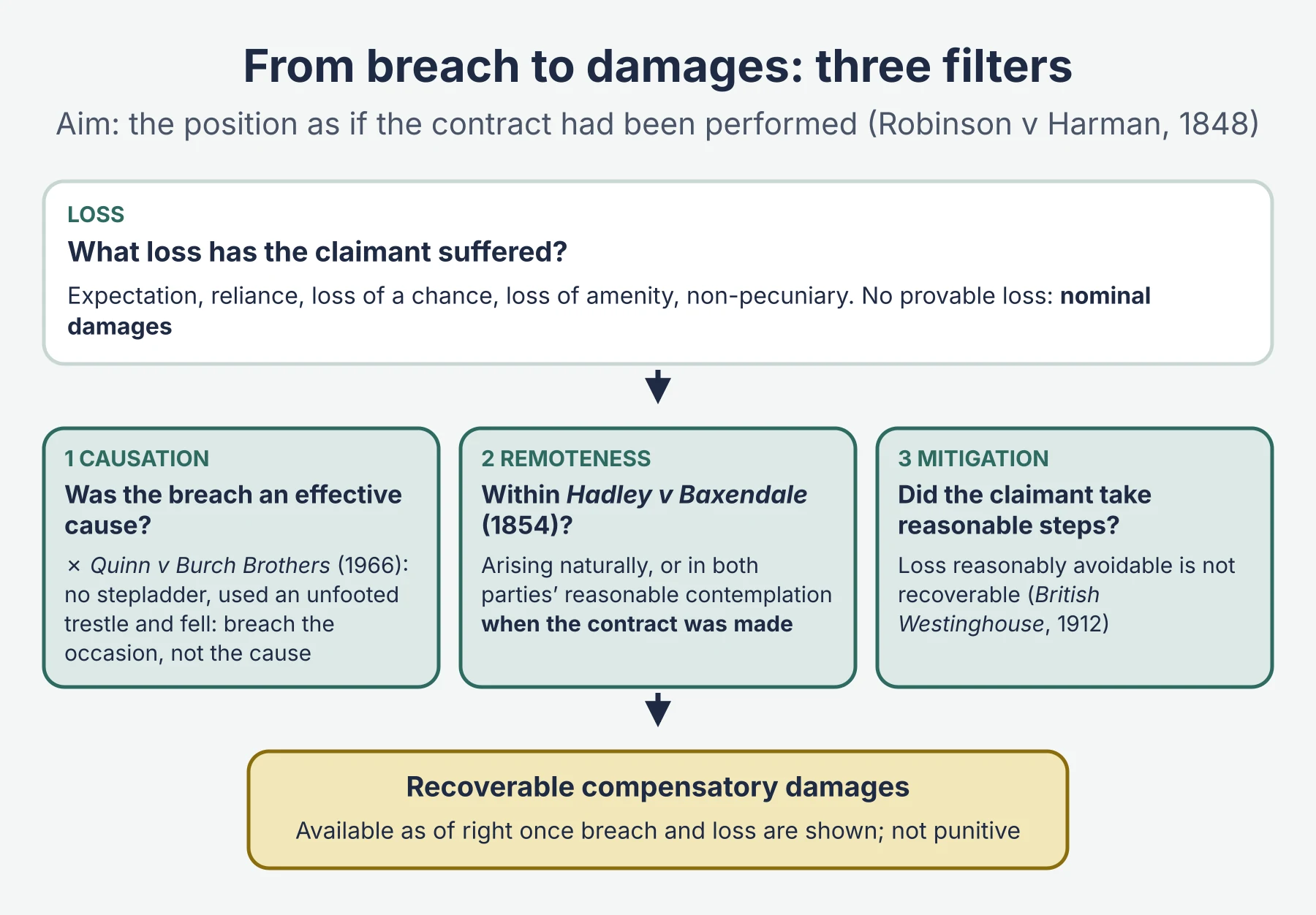
Damages for breach of contract are compensatory, not punitive. They are available as of right once breach and loss are shown. The aim is to put the claimant, so far as money can, in the position they would have been in if the contract had been performed (Robinson v Harman, 1848).
Categories of recoverable loss
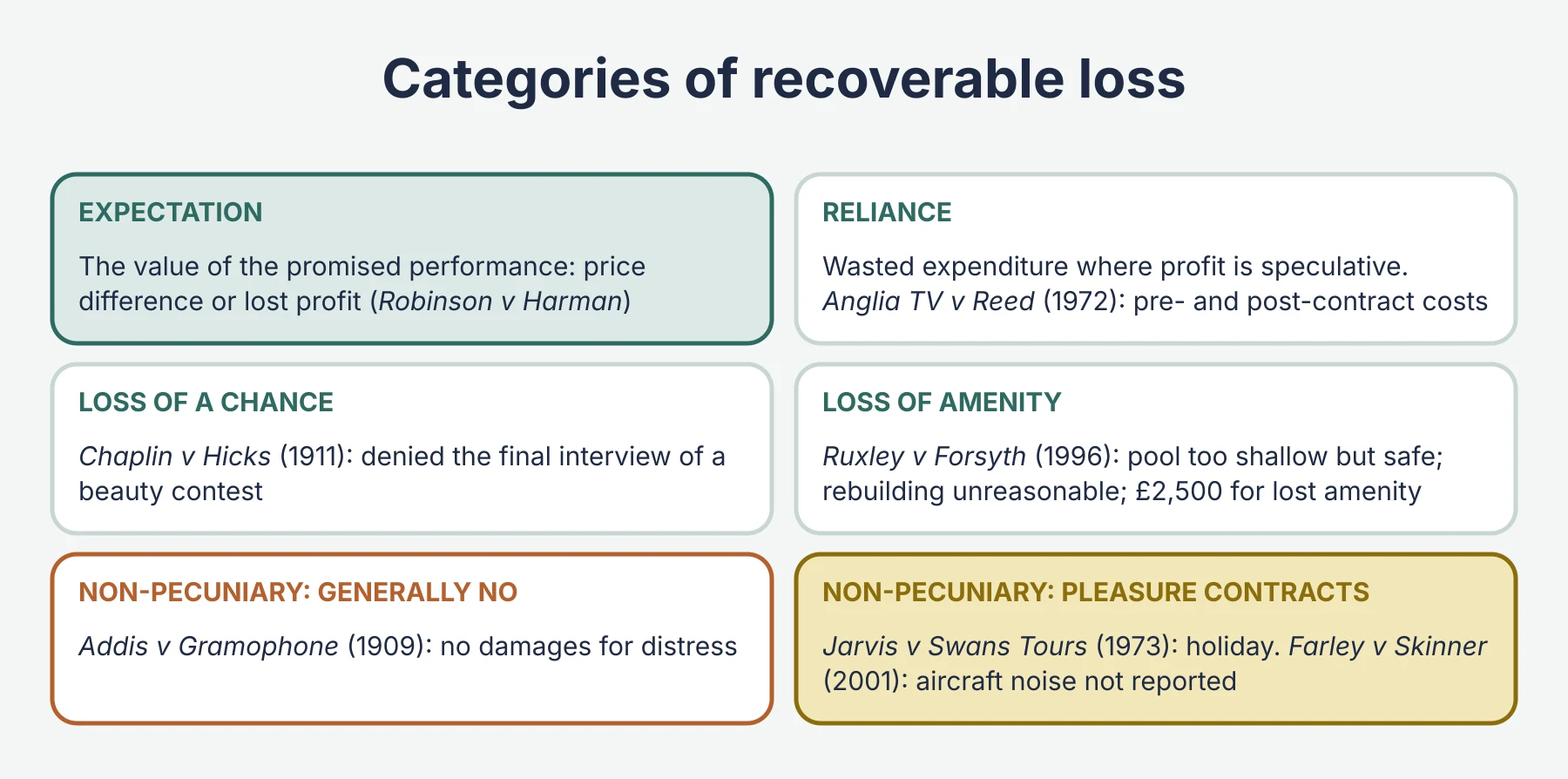
| Category | Meaning | Authority |
|---|---|---|
| Expectation loss | The value of the performance promised, such as the difference between contract price and market price, or lost profit | Robinson v Harman (1848) |
| Reliance loss | Wasted expenditure incurred in reliance on the contract, claimed where profit is too speculative | Anglia Television v Reed (1972): an actor’s withdrawal; the company recovered its wasted pre-contract and post-contract preparation costs |
| Loss of a chance | Loss of a real chance of a benefit | Chaplin v Hicks (1911): a contestant wrongly denied the chance to attend the final interview of a beauty contest recovered for the lost chance |
| Cost of cure or loss of amenity | Where cost of cure is out of all proportion to the benefit, damages may reflect lost amenity instead | Ruxley Electronics v Forsyth (1996): a swimming pool built shallower than agreed but still safe; rebuilding was unreasonable, and £2,500 for loss of amenity was awarded |
| Non-pecuniary loss | Generally not recoverable for distress (Addis v Gramophone, 1909), but recoverable where a major object of the contract is pleasure, relaxation or peace of mind | Jarvis v Swans Tours (1973): disappointing holiday; Farley v Skinner (2001): surveyor failed to report aircraft noise as specifically asked |
Nominal damages are awarded where there is a breach but no provable loss.
Causation
The breach must be an effective cause of the loss. A claimant’s own unreasonable act, or that of a third party, may break the chain. In Quinn v Burch Brothers (Builders) (1966) the defendants failed to supply a stepladder, and the claimant used an unfooted trestle instead and fell. The breach gave the occasion for the injury but did not cause it, so the claim for the injury failed.
Remoteness
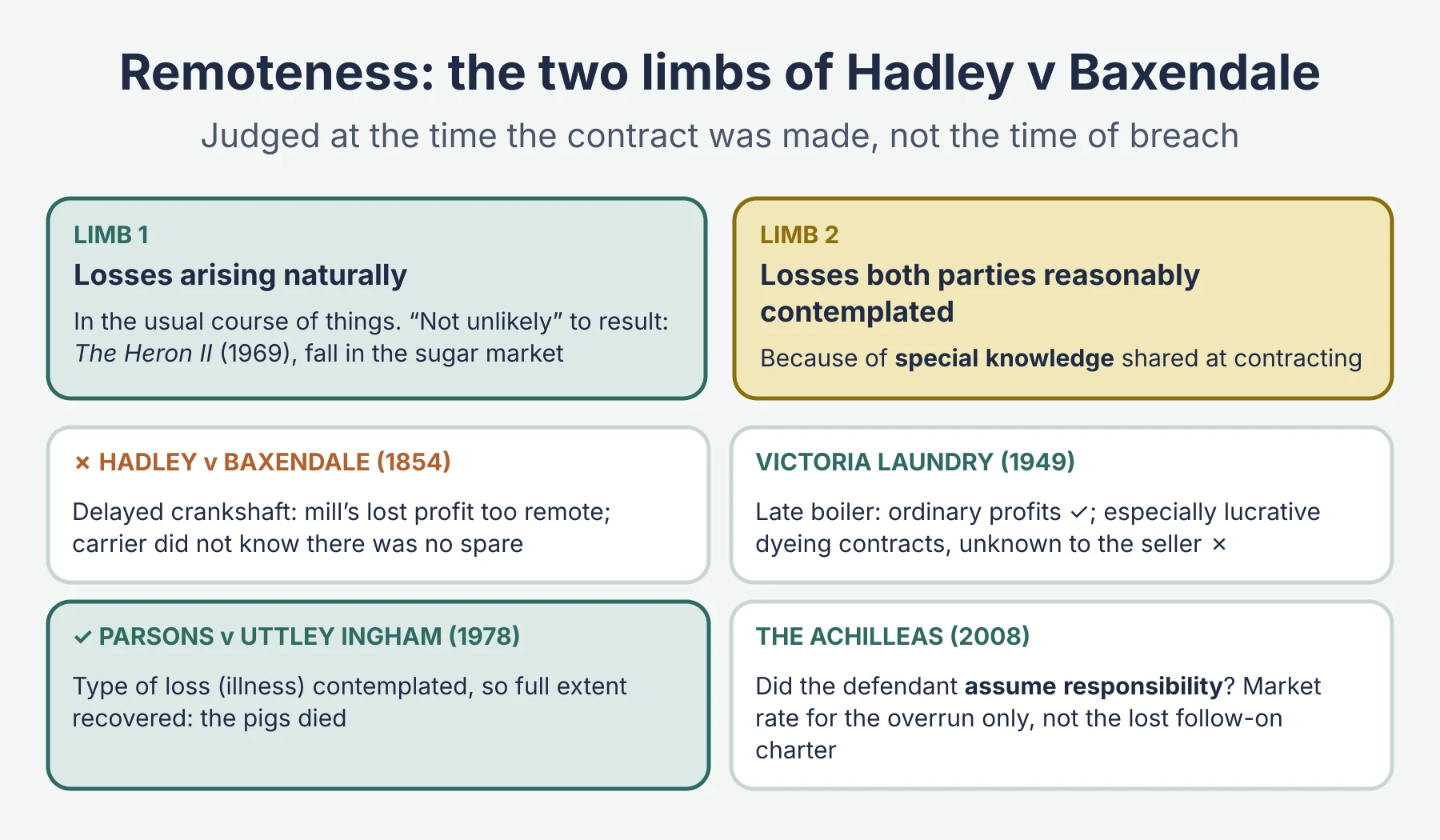
Even if caused by the breach, a loss is recoverable only if it is not too remote. Hadley v Baxendale (1854) set two limbs:
- losses arising naturally, in the usual course of things, from the breach; and
- losses that both parties reasonably contemplated when the contract was made, as the probable result of breach, because of special knowledge.
In Hadley, a carrier delayed returning a broken crankshaft; the mill’s lost profits were not recoverable because the carrier did not know the mill had no spare.
- Victoria Laundry v Newman Industries (1949): delivery of a boiler was late. Ordinary lost profits were recoverable, but the especially lucrative dyeing contracts, which the seller did not know about, were too remote.
- The Heron II (Koufos v C Czarnikow, 1969): a loss is within the first limb if it is “not unlikely” to result; a fall in the sugar market during a delayed voyage was recoverable.
- Parsons v Uttley Ingham (1978): if the type of loss was within contemplation, the full extent is recoverable, even if more serious than expected. Pig nuts went mouldy in a badly ventilated hopper and the pigs died; illness was within contemplation.
- Transfield Shipping v Mercator Shipping (The Achilleas, 2008): the House of Lords also asked whether the defendant had assumed responsibility for the type of loss; a charterer returning a ship late was liable only for the market rate for the overrun, not the loss of a lucrative follow-on charter.
Mitigation
The claimant must take reasonable steps to reduce the loss and cannot recover loss that could reasonably have been avoided (British Westinghouse v Underground Electric Railways, 1912).
- Payzu v Saunders (1919): a buyer refused the seller’s offer to continue supplying for cash, and could not recover losses that accepting the offer would have avoided.
- Brace v Calder (1895): a dismissed employee who refused re-employment on the same terms recovered only nominal damages.
The duty is to act reasonably, not perfectly. Reasonable costs of mitigation can be recovered.
Equitable remedies
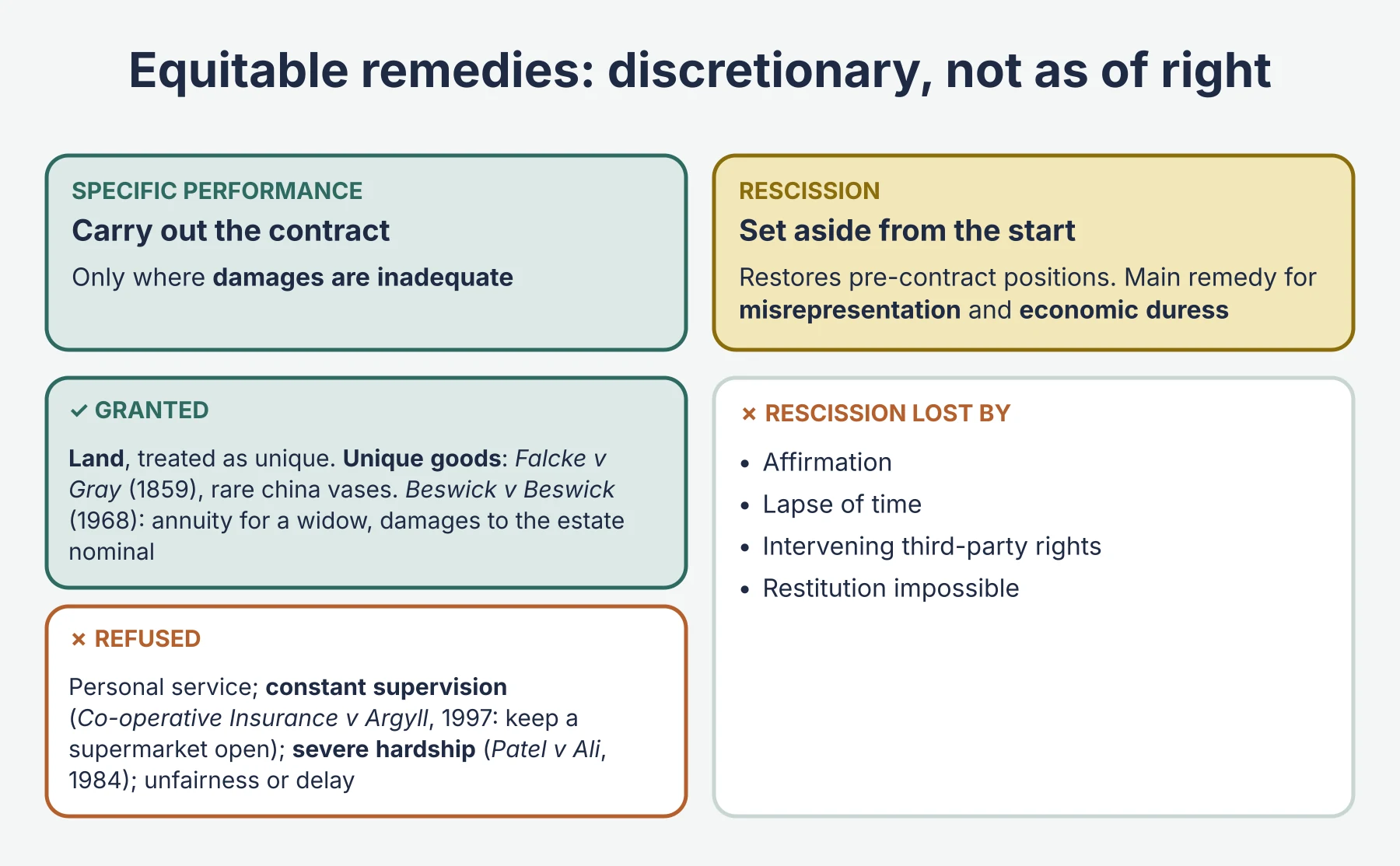
Equitable remedies are discretionary: the court may refuse them even where a breach is proved.
Specific performance
Specific performance orders the defendant to carry out the contract. It is granted only where damages are inadequate.
- Land is treated as unique, so specific performance is commonly ordered for contracts to buy land.
- Unique goods: in Falcke v Gray (1859) the court accepted that specific performance can be ordered for rare items such as unusual china vases, though it was refused on other grounds.
- Beswick v Beswick (1968): specific performance was ordered so that a widow, as administratrix, could enforce a promise to pay her an annuity, because damages to the estate would be nominal.
It will normally be refused for personal service contracts, contracts that would need constant supervision (Co-operative Insurance v Argyll Stores, 1997: an order to keep a supermarket open was refused), where it would cause severe hardship (Patel v Ali, 1984), and where the claimant has acted unfairly or delayed.
Rescission
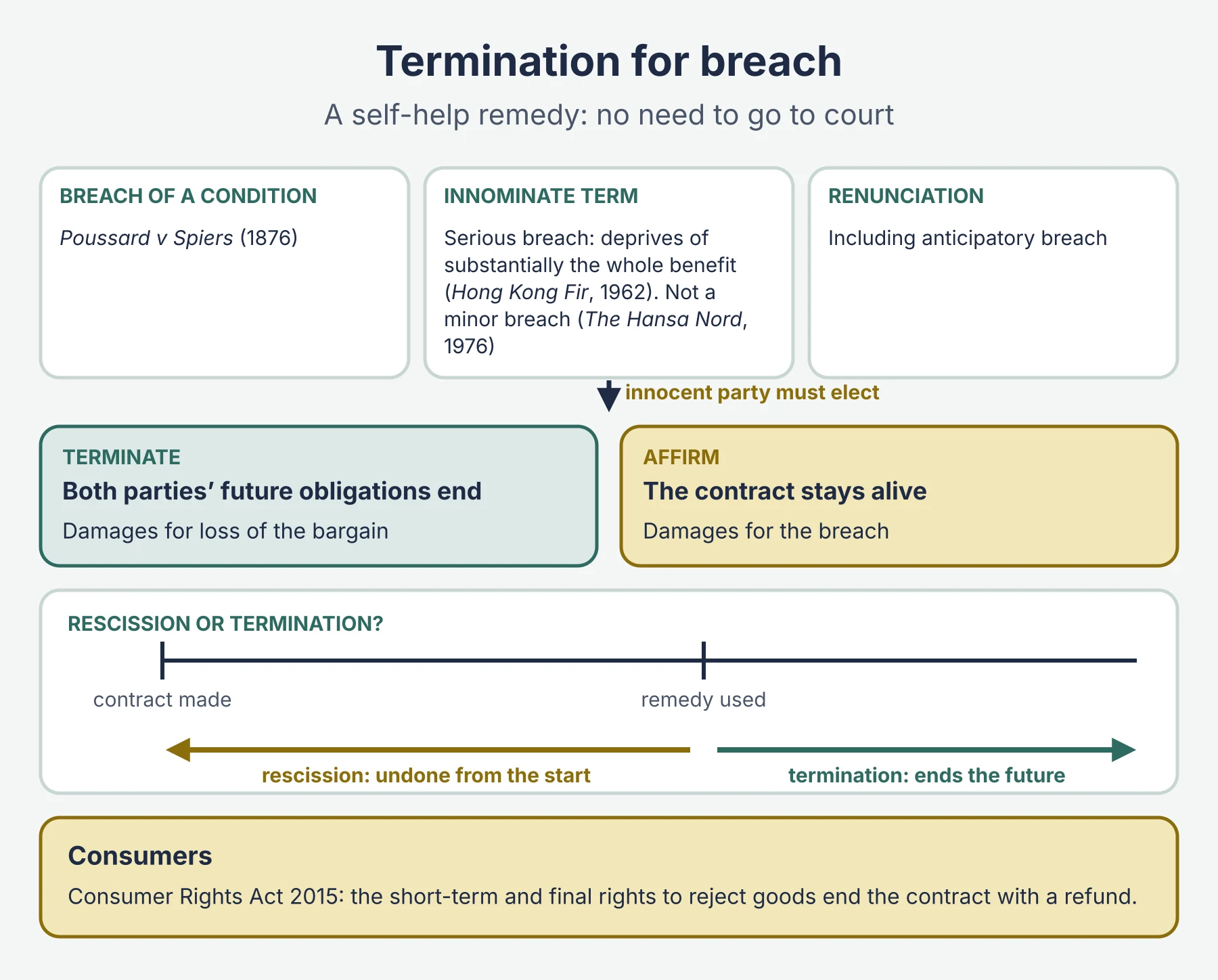
Rescission sets the contract aside and restores the parties to their pre-contract positions. It is the main remedy for misrepresentation and economic duress, which make a contract voidable. It is lost by affirmation, lapse of time, intervening third-party rights or where restitution is impossible. Rescission undoes the contract from the start; termination for breach, below, ends it for the future.
Termination of contract for breach
Termination is a self-help remedy: the innocent party can treat itself as discharged from future performance without going to court. It is available for:
- breach of a condition (Poussard v Spiers, 1876);
- a serious breach of an innominate term, judged by whether it deprives the innocent party of substantially the whole benefit of the contract (Hong Kong Fir Shipping v Kawasaki, 1962; in Cehave v Bremer (The Hansa Nord, 1976) a minor breach of an innominate term did not justify termination); and
- renunciation, including anticipatory breach.
The innocent party must elect. Terminating ends both parties’ future obligations and allows damages for loss of the bargain; affirming keeps the contract alive. Termination for a breach that is not repudiatory is itself a repudiation.
For consumers, the Consumer Rights Act 2015 gives a statutory version: the short-term and final rights to reject goods end the contract with a refund.
Worked example
Facts: Leah, a caterer, agrees to buy a commercial oven from Ovenco for £10,000, telling Ovenco she needs it for a wedding contract starting on 1 May worth £6,000 profit. On 5 April Ovenco tells her delivery will be late; it arrives on 20 May. A similar oven was available elsewhere for £11,000 from 10 April, but Leah did not buy one. She also lost an unusually profitable banquet worth £9,000 that she never mentioned.
Breach:        Late delivery, announced in advance. If time was a condition,
               Leah could terminate; she accepted the oven, so she claims
               damages.
Loss:          Expectation loss: the profit she would have made.
Remoteness:    Wedding profit – within the second limb of Hadley, as Ovenco
               was told (Victoria Laundry). Banquet profit – not mentioned
               and unusually lucrative, so too remote.
Mitigation:    She could have bought an oven for £11,000 on 10 April, an
               extra £1,000, and kept the wedding contract. A court may say
               she should have done so (Payzu v Saunders), limiting damages
               to the £1,000 extra cost rather than £6,000 lost profit.
Equitable:     Specific performance is irrelevant after delivery, and an
               oven is not unique.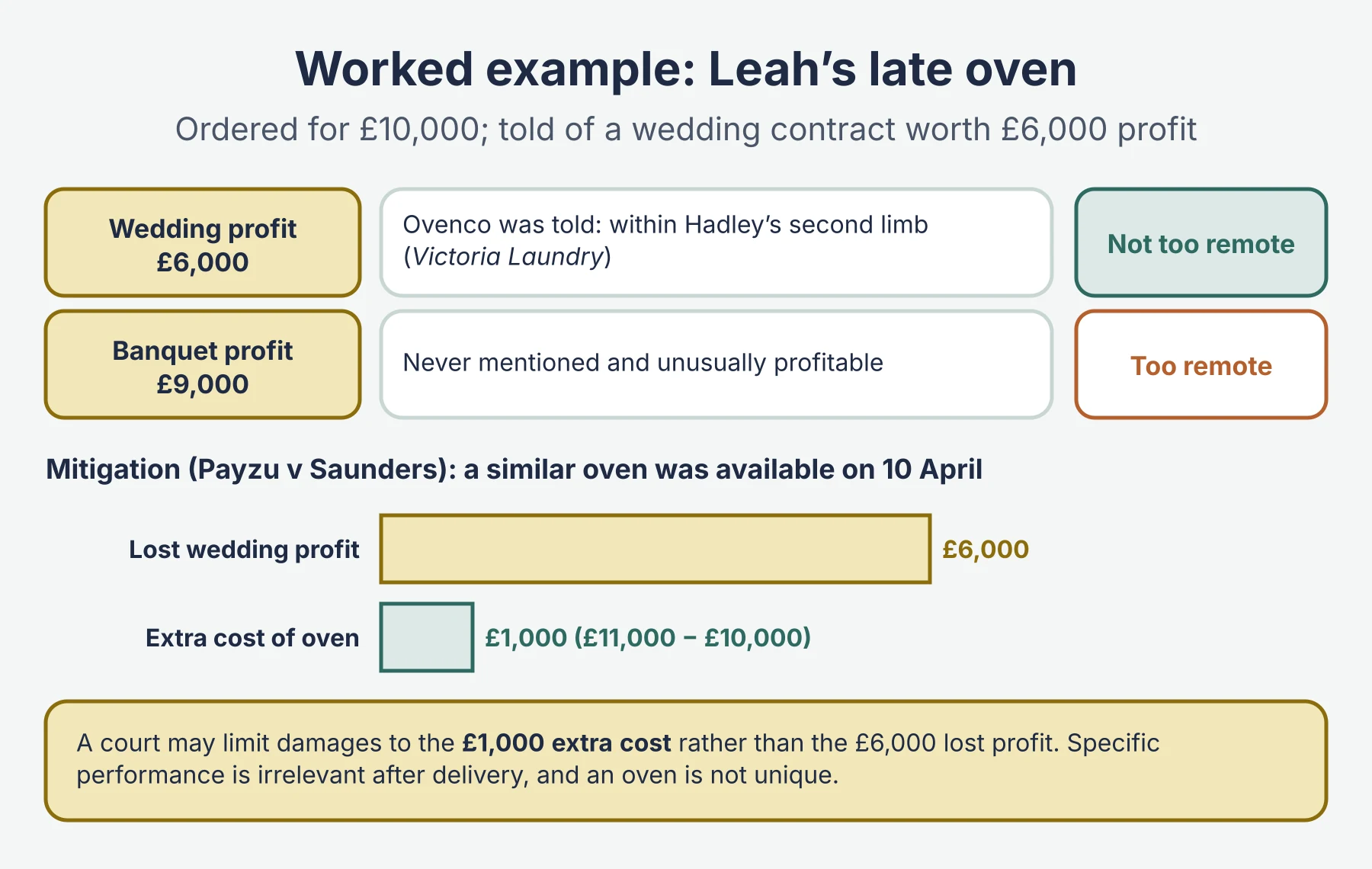
Common mistakes
- Describing damages as a punishment for breach.
- Applying the remoteness test at the time of breach instead of the time of contracting.
- Forgetting that the claimant cannot recover loss that reasonable mitigation would have avoided.
- Claiming specific performance as of right; it is discretionary and needs damages to be inadequate.
- Confusing rescission (setting aside from the start) with termination (ending future obligations).
Exam technique
- Explain questions: state each rule with its leading case, as in the tables above.
- Suggest and Advise questions: identify the breach, the loss, then work through causation, remoteness and mitigation, calculating any figures, before considering equitable remedies.
- Consider questions: weigh borderline points, such as whether a loss was within the parties’ contemplation.
- Discuss questions: evaluate whether remedies achieve full compensation, whether limits such as Addis are justified, and how effective consumer remedies are.
More resources on this topic
Remedies in contract revision notes | Remedies in contract practice questions | Discharge of a contract study guide
Related resources
-
Practice questions
AQA A Level Law (7162): Remedies (Law of contract) – Practice Questions
Original practice on contract remedies for AQA A Level Law 7162 with mark-scheme answers on damages, remoteness, mitigation, equitable remedies and termination.
Law · AQA · A Level
Try questions -
Revision notes
AQA A Level Law (7162): Remedies (Law of contract) – Revision Notes
Condensed recall on contract remedies for AQA A Level Law 7162: loss, causation, remoteness, mitigation, specific performance, rescission and termination.
Law · AQA · A Level
Revise topic -
Study guides
AQA A Level Law (7162): The Rules of Contract Law
Where contract rules come from, the objective approach, consumer and business contracts, void and voidable contracts and a problem method, AQA Law 7162.
Law · AQA · A Level
Read guide
Get free revision emails (optional)
Occasional emails with practice questions, worked explanations and links to free resources for the qualification and subjects you choose. No spam, and you can unsubscribe from any email. The free tools on this site never need an email.