
Study Guides
AQA A Level Law (7162): Contract Terms: General
Terms or representations, express and implied terms, and conditions, warranties and innominate terms with the effect of breach, for AQA A Level Law 7162.
- Subject
- Law
- Level
- A LEVELS
- Topic
- Topic 4: Law of contract
- Author
- Marlbridge Academic Team
- Updated
- Reviewed by
- Aizaz Raoof Ali (what this means)
Aligned to AQA A Level Law (7162), For teaching from September 2017 onwards, A-level exams 2019 onwards. Official specification .
Syllabus page (what it covers and how it is assessed): AQA A Level Law.
Syllabus points this page covers
7162
- Contract terms: general
Found an error? Report a correction.
Need help with this topic? Request a free trial class for A Level Law (7162).
This guide covers the section 3.4 row Contract terms: general in AQA A-level Law (7162). The specification names two statements: “Express and implied terms” and “Conditions, warranties and innominate terms.” The first decides what the parties are bound to do; the second decides what happens when one of those obligations is broken. Statutory consumer terms and exclusion clauses have their own rows. The Law of contract study guide introduces the leading cases; this page adds the further authorities and a method for problem questions.
Part 1: express terms
Term or representation?
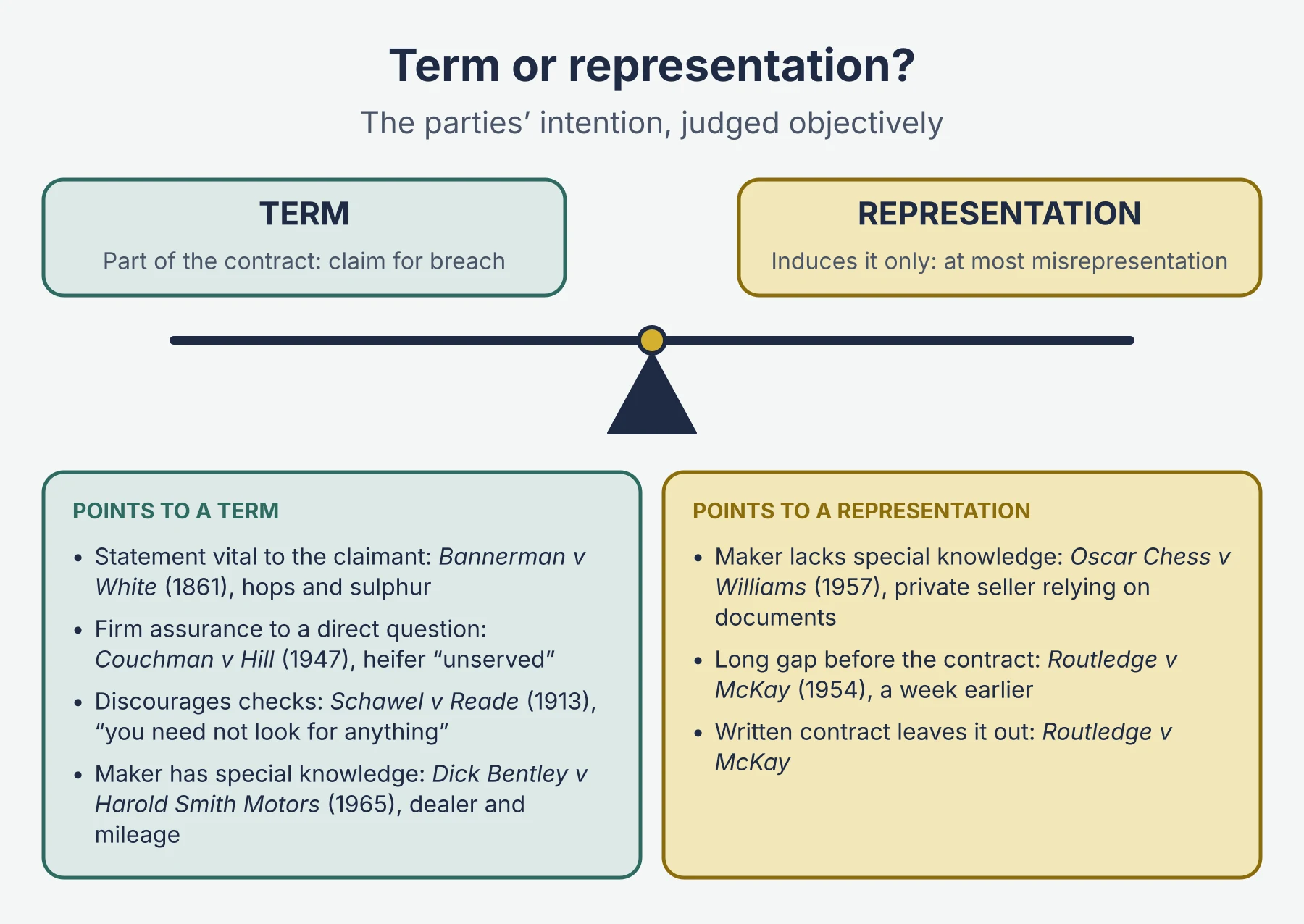
Statements made during negotiations are either terms, which form part of the contract and give a claim for breach, or representations, which induce the contract but are not part of it and give, at most, a claim for misrepresentation. The test is the parties’ intention, judged objectively. The courts use several guides:
| Factor | Points towards a term | Authority |
|---|---|---|
| Importance of the statement | The claimant made clear they would not contract without it | Bannerman v White (1861): buyer said he would not buy hops treated with sulphur |
| Specific assurance overriding written terms | A direct question answered with a firm assurance | Couchman v Hill (1947): heifer assured “unserved” at auction |
| Strong statement discouraging checks | Maker tells the other they need not verify | Schawel v Reade (1913): “you need not look for anything; the horse is perfectly sound” |
| Maker’s special knowledge | Statement by the party with expertise | Dick Bentley v Harold Smith Motors (1965): dealer’s statement about mileage was a term |
| Lack of special knowledge | Private seller relying on documents | Oscar Chess v Williams (1957): private seller’s statement of a car’s age was a representation |
| Time between statement and contract | A long gap suggests a representation | Routledge v McKay (1954): motorcycle’s date given a week before the written contract |
| Written contract omits the statement | Suggests it was not meant as a term | Routledge v McKay (1954) |
The parol evidence rule and collateral contracts
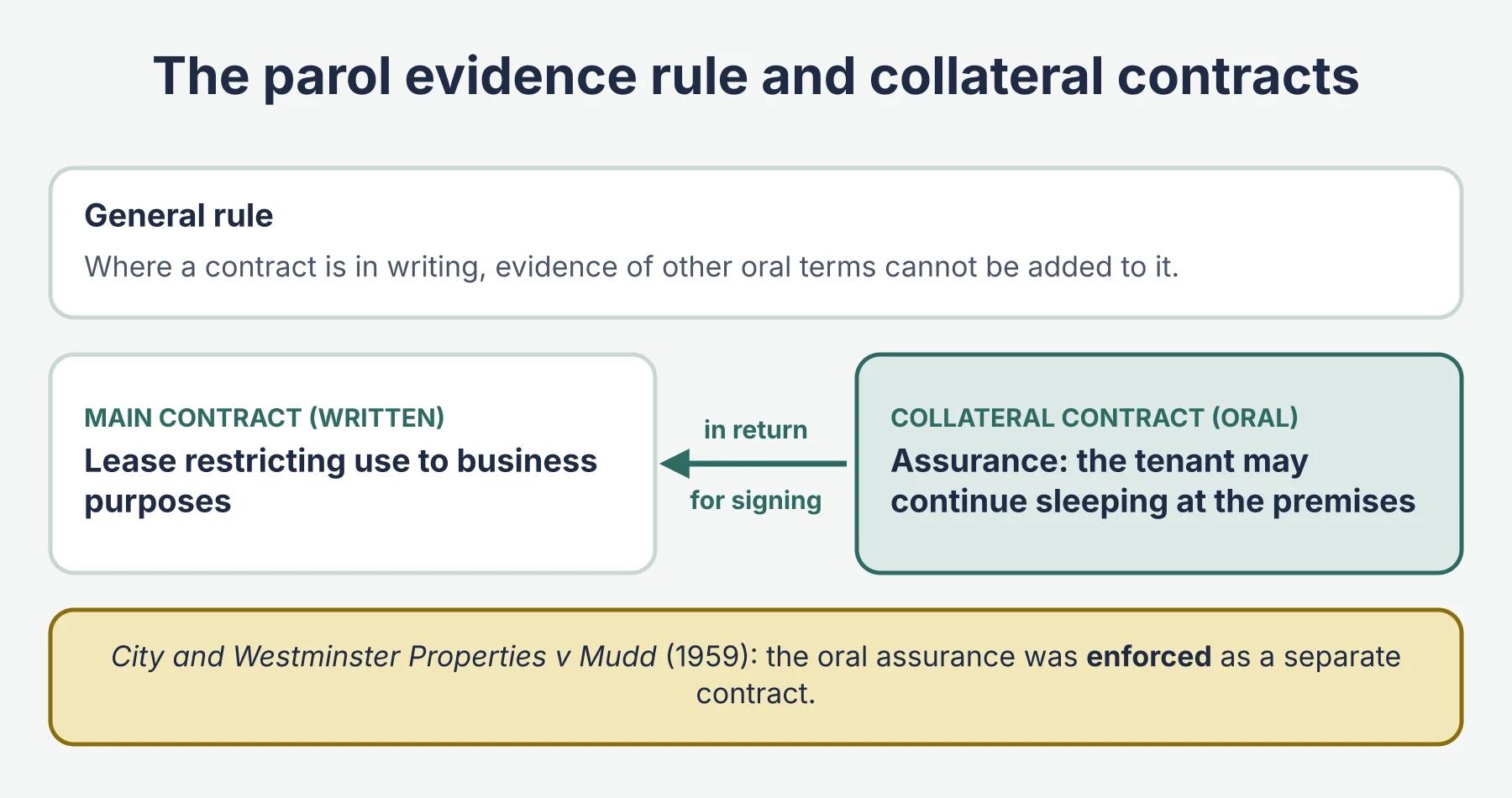
Where a contract is in writing, the general rule is that evidence of other oral terms cannot be added to it. The courts avoid harsh results through exceptions, especially the collateral contract: an oral promise given in return for entering the main contract can be enforced as a separate contract. In City and Westminster Properties v Mudd (1959) a tenant was assured he could continue sleeping at the premises if he signed a lease restricting use to business purposes; the assurance was enforced.
Part 2: implied terms
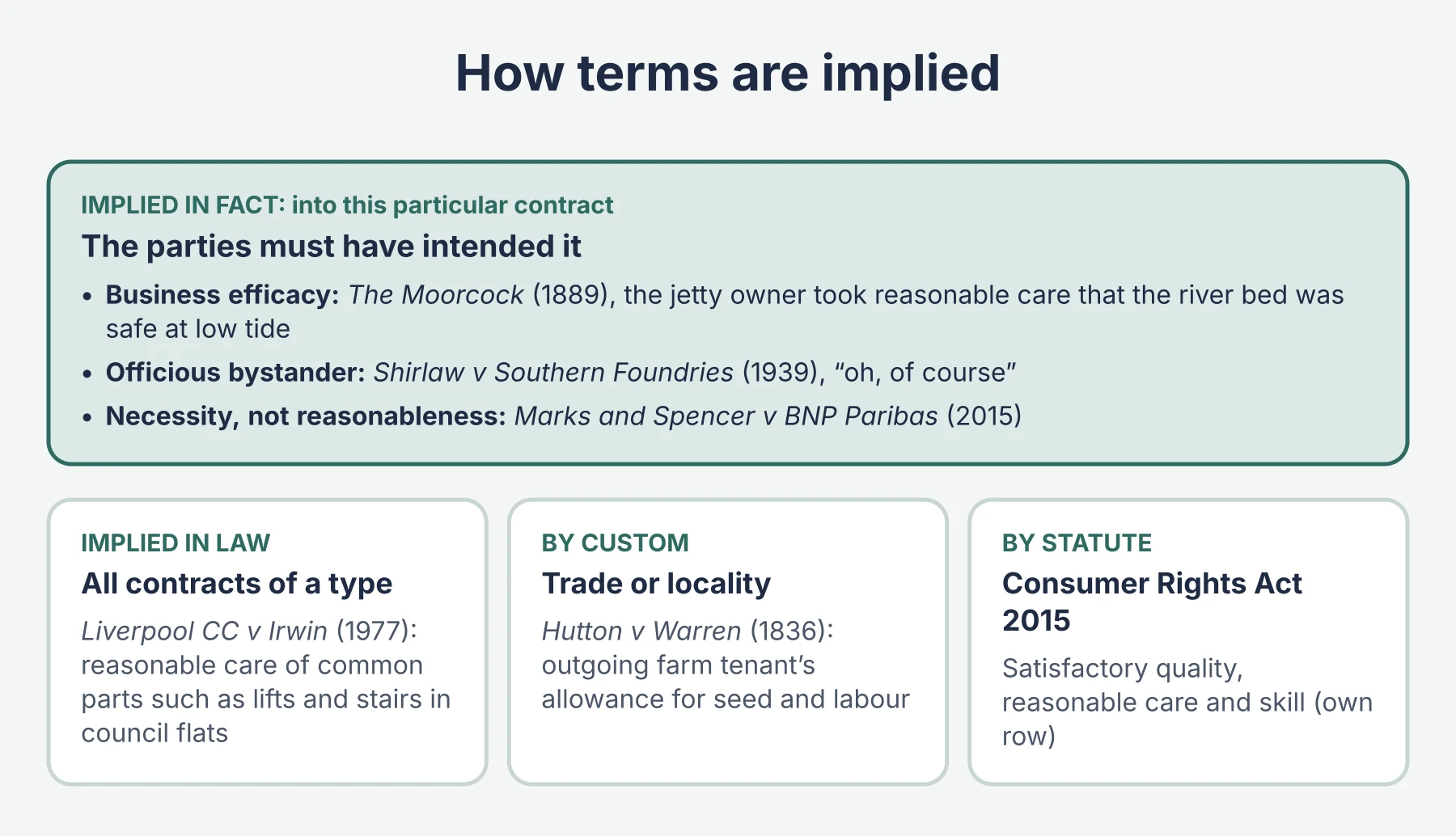
Terms are implied in three main ways.
Implied in fact
A term is implied into the particular contract because the parties must have intended it.
- Business efficacy: in The Moorcock (1889) a term was implied that a jetty owner had taken reasonable care to ensure the river bed at the jetty was safe for a ship to lie on at low tide, because without it the contract made no commercial sense.
- Officious bystander: in Shirlaw v Southern Foundries (1939) MacKinnon LJ said a term is implied if it is so obvious that, had a bystander suggested it, the parties would have testily replied “oh, of course”.
- Necessity, not reasonableness: in Marks and Spencer v BNP Paribas (2015) the Supreme Court held a term will be implied only if it is necessary for business efficacy or so obvious it goes without saying; it is not enough that it would be fair or reasonable.
Implied in law
A term is implied into all contracts of a particular type as a matter of law. In Liverpool City Council v Irwin (1977) the House of Lords implied into tenancies of flats in a council tower block a term that the landlord would take reasonable care to maintain the common parts, such as lifts and stairs.
Implied by custom
A term may be implied from an established custom of a trade or locality. In Hutton v Warren (1836) a local custom entitled an outgoing farm tenant to an allowance for seed and labour.
Implied by statute
Statute implies terms into many contracts. For consumer contracts, the Consumer Rights Act 2015 implies terms such as satisfactory quality and reasonable care and skill; these are covered in their own row.
Part 3: conditions, warranties and innominate terms
The three categories
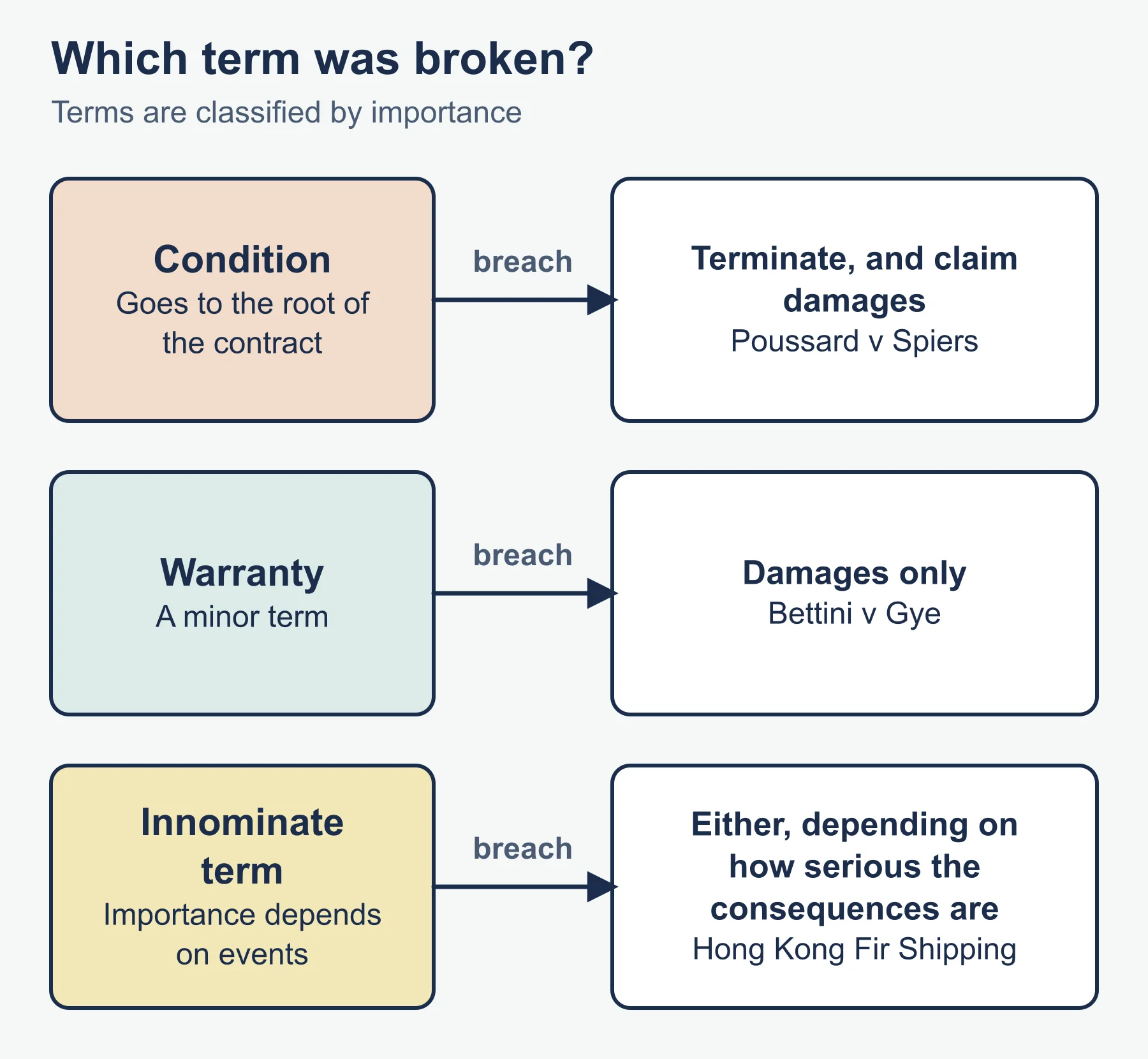
| Type | Nature | Remedy for breach | Authority |
|---|---|---|---|
| Condition | Goes to the root of the contract | Innocent party may terminate or affirm, and claim damages | Poussard v Spiers (1876): singer missed the opening nights |
| Warranty | Minor, subsidiary term | Damages only | Bettini v Gye (1876): singer missed rehearsals |
| Innominate term | Can be broken in serious or trivial ways | Depends on the consequences of the breach | Hong Kong Fir Shipping v Kawasaki (1962) |
How a term is classified
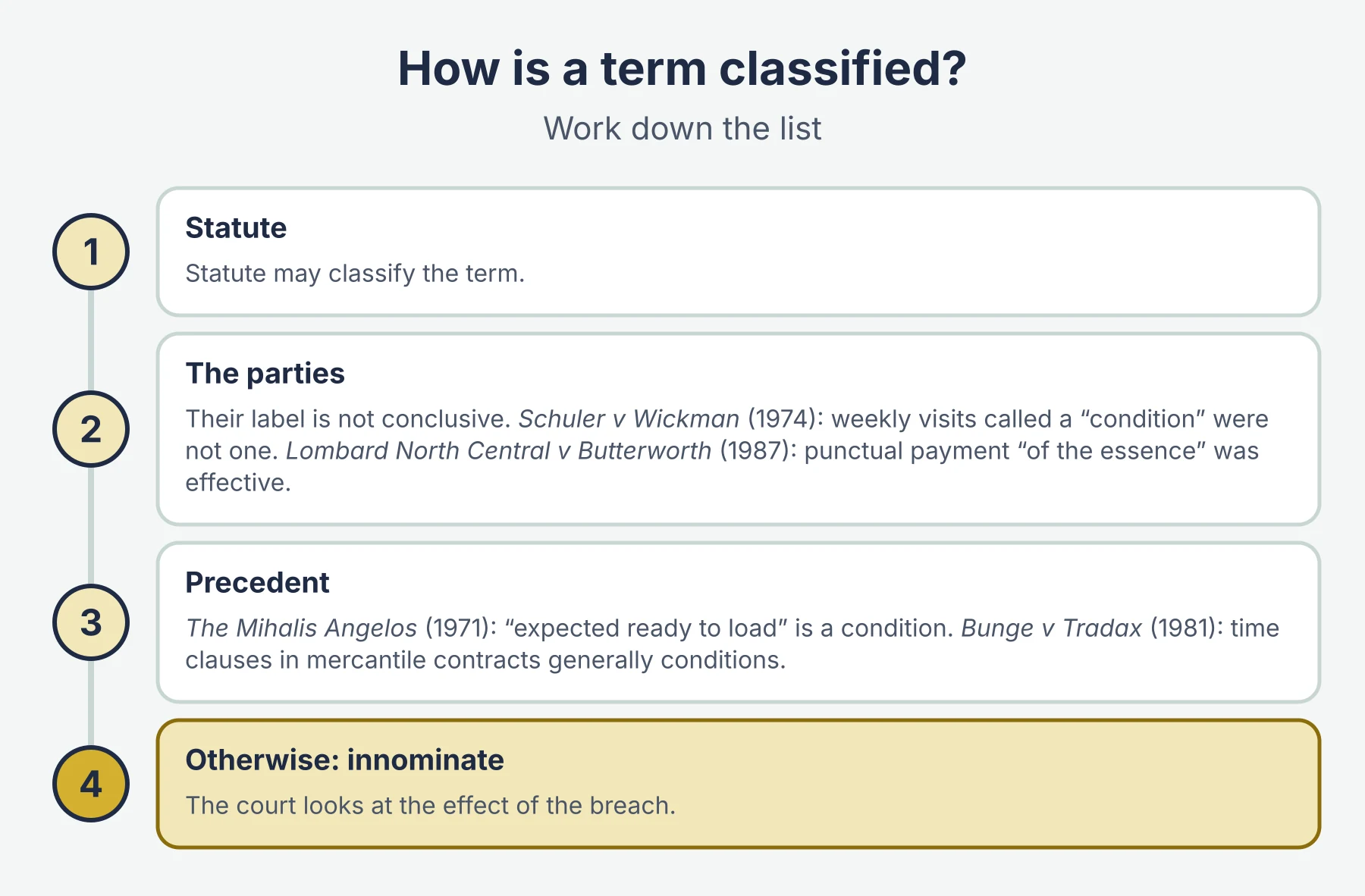
- Statute may classify a term.
- The parties may classify it, but the label is not conclusive. In Schuler v Wickman Machine Tool Sales (1974) a clause calling weekly sales visits a “condition” was not treated as one, because the parties could not have intended that missing a single visit would justify termination. In contrast, in Lombard North Central v Butterworth (1987) a clause making punctual payment “of the essence” was effective, so a late payment allowed termination.
- Precedent may have classified a type of term. In The Mihalis Angelos (1971) an “expected ready to load” clause in a charterparty was held to be a condition. In Bunge v Tradax (1981) time clauses in mercantile contracts were generally treated as conditions, because certainty matters in commercial dealing.
- Otherwise, the court treats the term as innominate and looks at the effect of the breach.
The innominate term approach
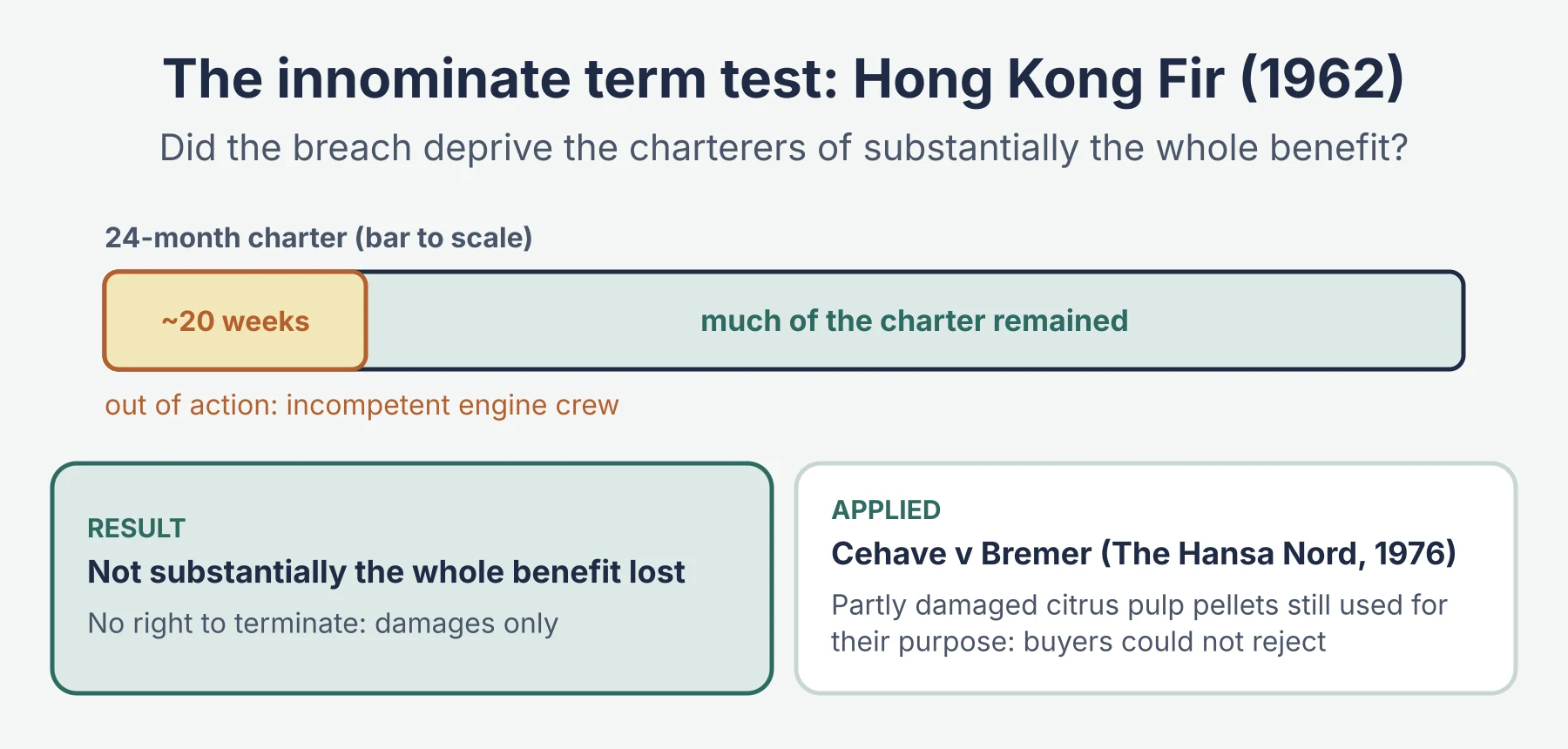
In Hong Kong Fir a ship was chartered for 24 months and was “in every way fitted for ordinary cargo service”. Its engine crew were incompetent and it was out of action for about 20 weeks. Diplock LJ asked whether the breach deprived the charterers of substantially the whole benefit they were intended to obtain; it did not, since much of the charter remained, so the charterers were not entitled to terminate and were limited to damages. In Cehave v Bremer (The Hansa Nord, 1976) citrus pulp pellets that were partly damaged were still used for their purpose, and the buyers could not reject them.
Strictness and its criticism
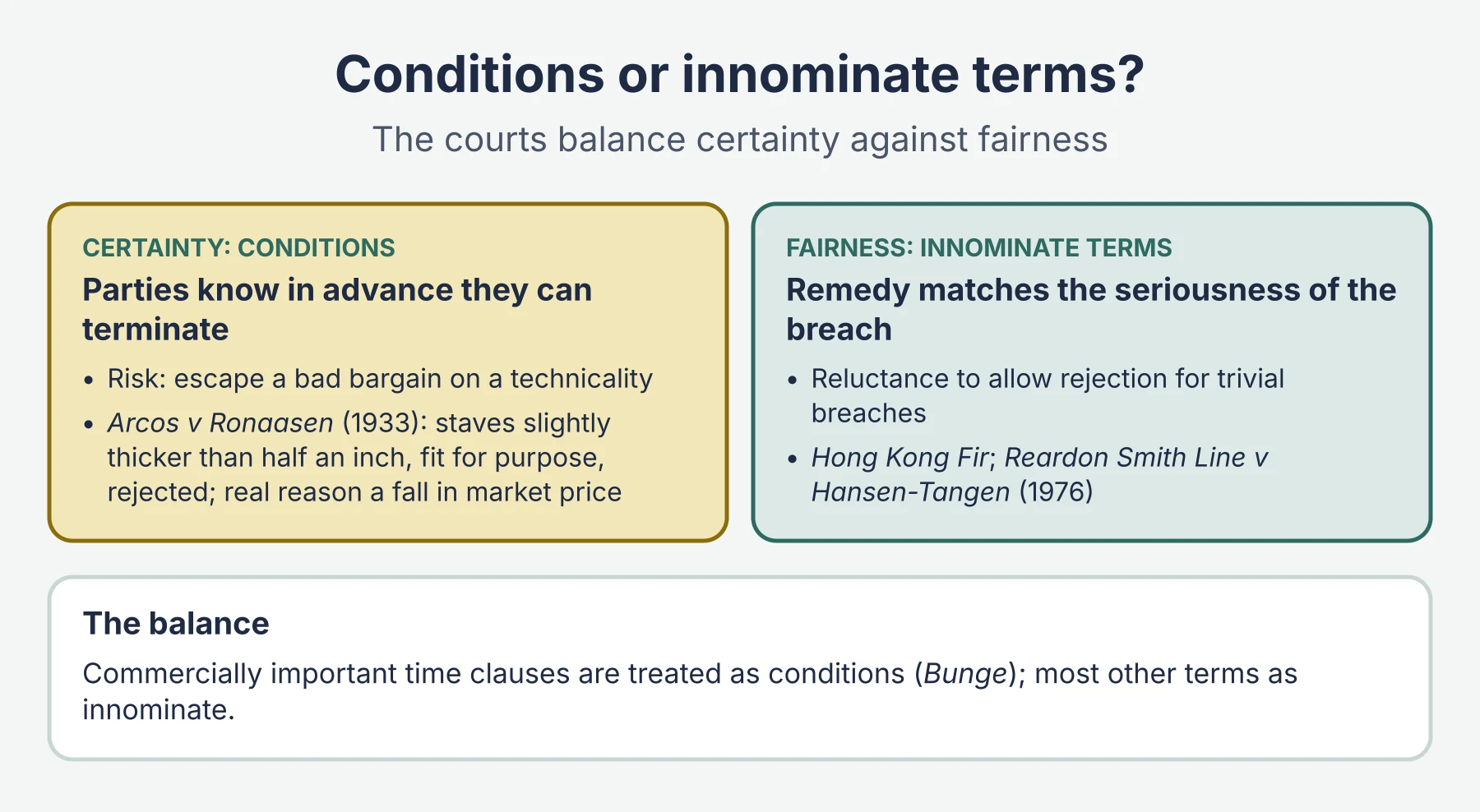
Classification as a condition can let a party escape a bad bargain on a technicality. In Arcos v Ronaasen (1933) timber staves were ordered at half an inch thick; most were slightly thicker but fit for purpose. The buyer was allowed to reject them because they did not match the description, even though its real reason was a fall in the market price. The innominate approach and Reardon Smith Line v Hansen-Tangen (1976) reflect judicial reluctance to allow rejection for trivial breaches.
Evaluation. Conditions give certainty: parties know in advance that they can terminate. Innominate terms give fairness: the remedy matches the seriousness of the breach. The courts balance the two by treating commercially important time clauses as conditions (Bunge) and most other terms as innominate.
Worked problem
Kofi agrees to supply 1,000 printed T-shirts to Ink Ltd for a festival on 1 July, “delivery by 20 June”. The written contract also says “colours to match sample”. Kofi delivers on 24 June. The shade of blue is slightly lighter than the sample, but the shirts are usable. Ink wants to terminate.
Delivery date: time clauses in commercial contracts are usually treated
               as conditions (Bunge v Tradax). Delivery four days late, but
               before the festival. If a condition, Ink may terminate even
               though little harm was caused.
Colour clause: not labelled a condition; likely innominate. The slight
               difference does not deprive Ink of substantially the whole
               benefit (Hong Kong Fir; Hansa Nord): damages only, if any loss.
Advice:        Ink's strongest ground for termination is the late delivery
               if it is a condition; otherwise it must accept the goods and
               claim damages.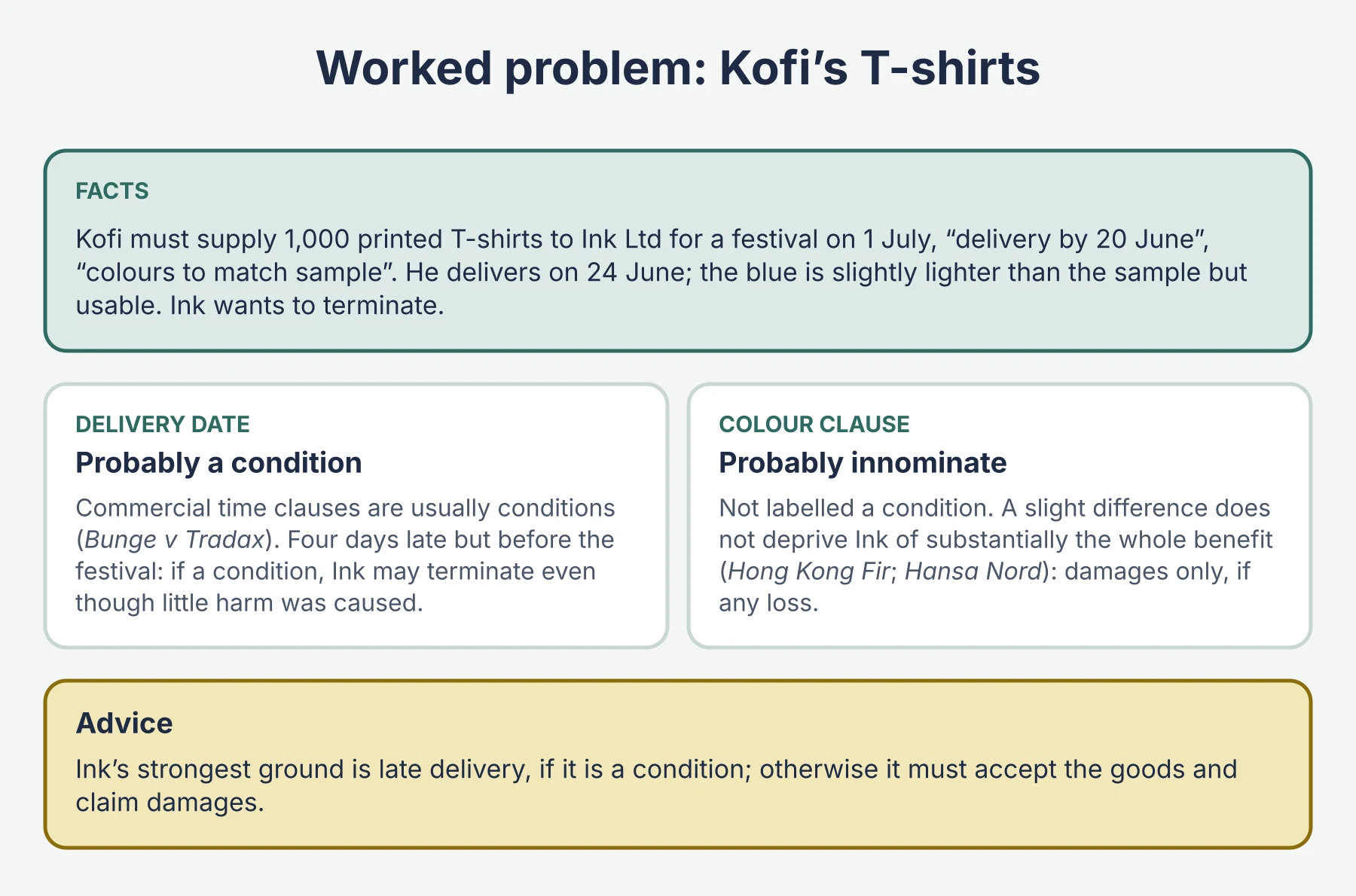
Common mistakes
- Calling every important-sounding term a condition without considering Schuler or the innominate approach.
- Treating a representation as a term because it turned out false.
- Implying a term because it would be “reasonable” after Marks and Spencer v BNP Paribas.
- Forgetting that the innocent party may affirm after breach of a condition.
Exam technique
In problem questions, first identify each statement and decide whether it is a term (with factor-based reasoning), then classify the term, then state the remedy. For evaluation, discuss certainty against flexibility and use Arcos and Hong Kong Fir as contrasting examples.
More resources on this topic
Contract terms: general revision notes | Contract terms: general practice questions | Essential requirements of contract study guide
Related resources
-
Practice questions
AQA A Level Law (7162): Contract Terms: General – Practice Questions
Original practice questions with mark-scheme answers on terms and representations, implied terms, and conditions, warranties and innominate terms, AQA Law 7162.
Law · AQA · A Level
Try questions -
Revision notes
AQA A Level Law (7162): Contract Terms: General – Revision Notes
Recall notes on terms and representations, express and implied terms, and conditions, warranties and innominate terms, for AQA A Level Law 7162 contract.
Law · AQA · A Level
Revise topic -
Study guides
AQA A Level Law (7162): Contract terms: specific terms implied by statute law in relation to consumer contracts
Consumer Rights Act 2015 for AQA A Level Law 7162: terms implied by ss9, 10, 11, 49 and 52, and the remedies in ss20, 23, 24, 55 and 56, applied to scenarios.
Law · AQA · A Level
Read guide
Get free revision emails (optional)
Occasional emails with practice questions, worked explanations and links to free resources for the qualification and subjects you choose. No spam, and you can unsubscribe from any email. The free tools on this site never need an email.