
Revision Notes
AQA A Level Law (7162): Contract terms: specific terms implied by statute law in relation to consumer contracts – Revision Notes
Condensed recall on Consumer Rights Act 2015 implied terms for AQA A Level Law 7162: ss9 to 11, 49 and 52, the tiered goods remedies and services remedies.
- Subject
- Law
- Level
- A LEVELS
- Topic
- Topic 4: Law of contract
- Author
- Marlbridge Academic Team
- Updated
- Reviewed by
- Aizaz Raoof Ali (what this means)
Aligned to AQA A Level Law (7162), For teaching from September 2017 onwards, A-level exams 2019 onwards. Official specification .
Syllabus page (what it covers and how it is assessed): AQA A Level Law.
Syllabus points this page covers
7162
- Contract terms: specific terms implied by statute law in relation to consumer contracts
Found an error? Report a correction.
Need help with this topic? Request a free trial class for A Level Law (7162).
Condensed notes on the terms the Consumer Rights Act 2015 implies into consumer contracts and the remedies for their breach. For full explanation and a worked scenario, use the consumer contract implied terms study guide.
The answer route in one line
Trader–consumer contract? (s2) → goods or services? → which implied term is broken? → when did the fault appear? → which remedy tier applies? → any further damages?
Who is covered
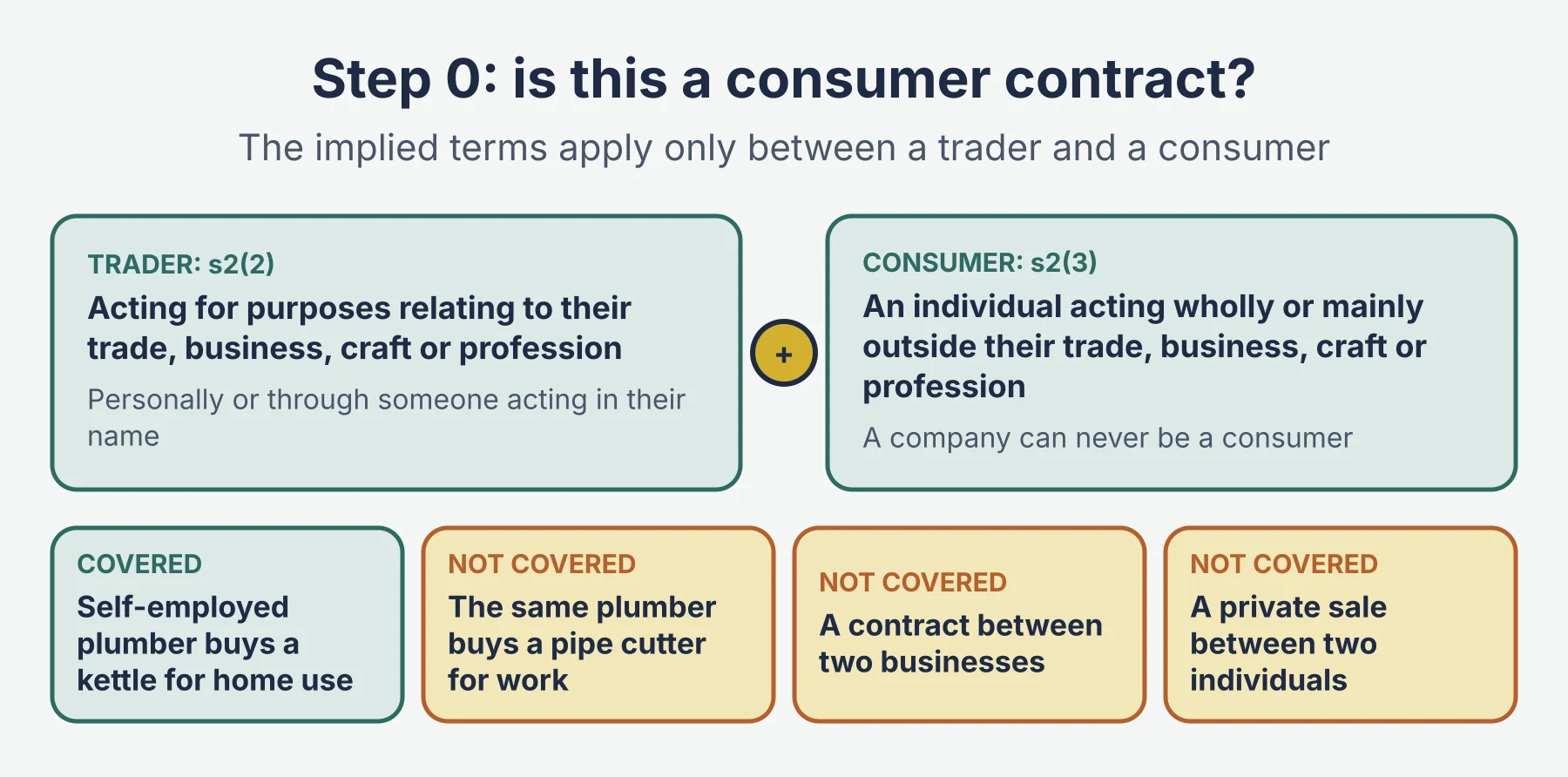
- Consumer (s2(3)): an individual acting wholly or mainly outside their trade, business, craft or profession. Companies are never consumers.
- Trader (s2(2)): a person acting for purposes relating to their trade, business, craft or profession.
- Not covered: private sales between individuals; business-to-business contracts.
- The implied terms cannot be excluded against a consumer (see the exclusion clauses notes on s31 and s57).
Goods: the three implied terms
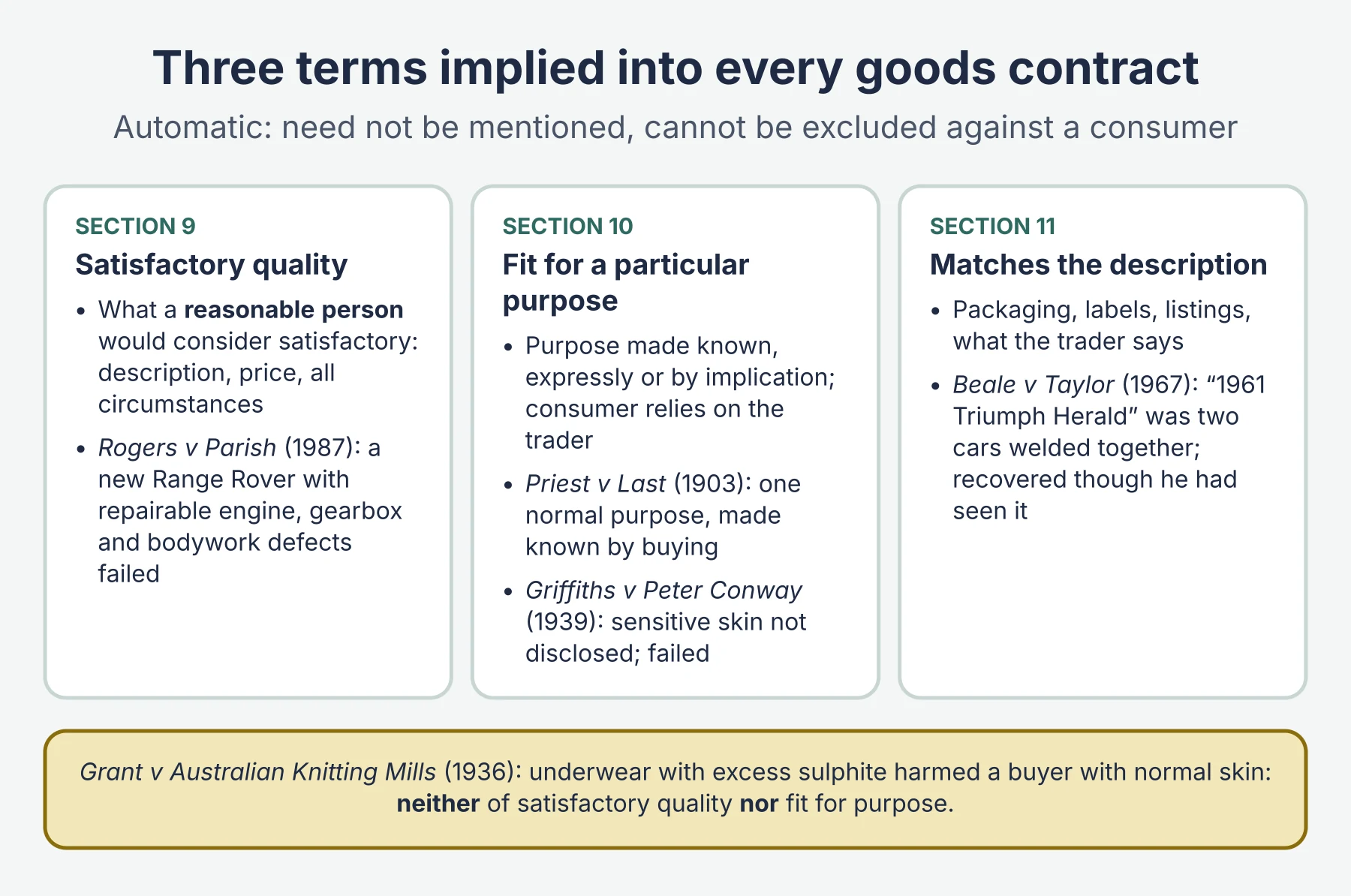
| Section | Term | Test and limits | Illustration |
|---|---|---|---|
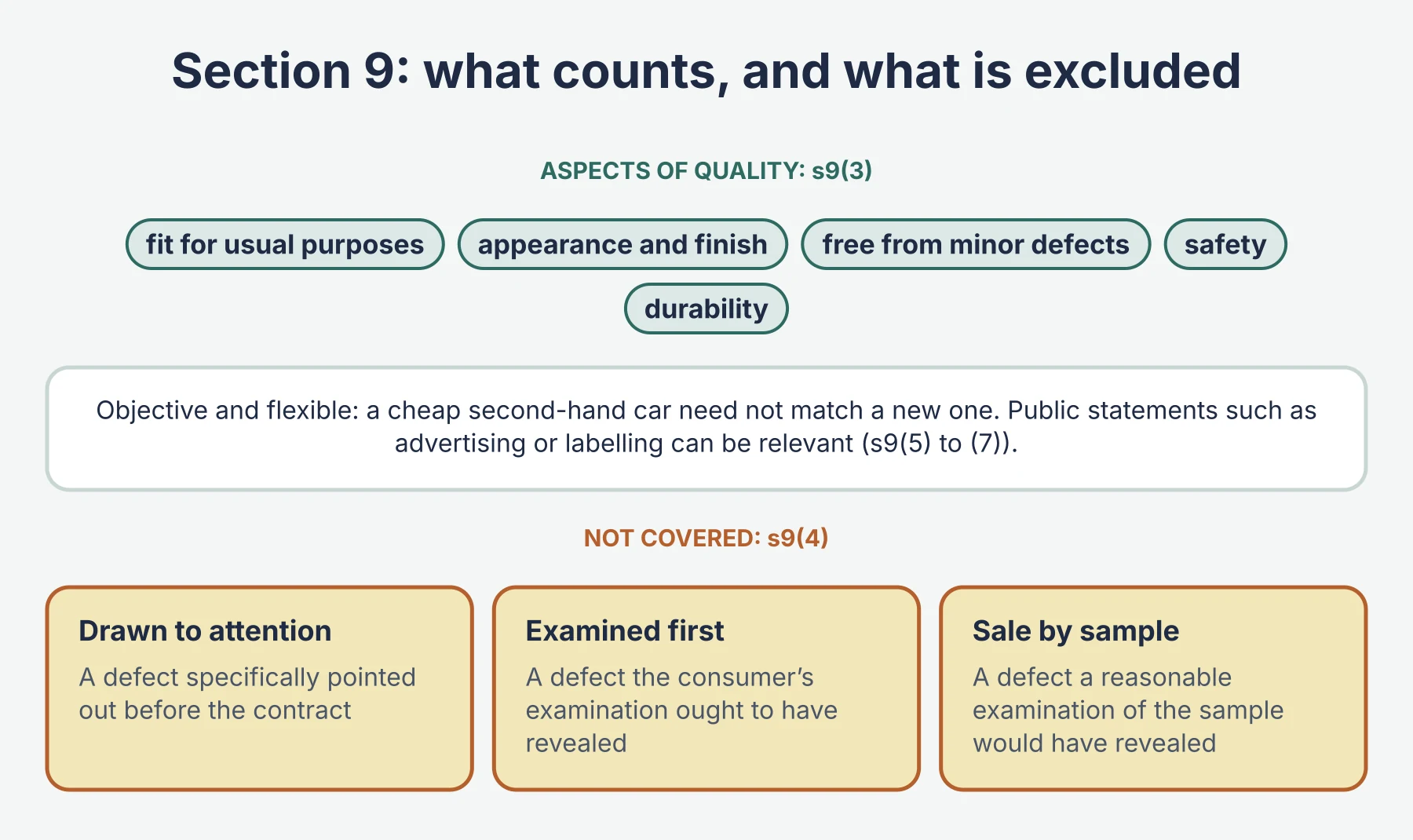
| s9 | Satisfactory quality | What a reasonable person would consider satisfactory, given description, price and other circumstances. Aspects (s9(3)): usual purposes, appearance and finish, minor defects, safety, durability | Rogers v Parish (1987): new Range Rover with engine, gearbox and bodywork defects not acceptable |
| s9(4) | Exceptions | Defect specifically pointed out; defect an actual examination ought to reveal; defect a reasonable examination of a sample would reveal | A scratch shown to the buyer before sale |
| s10 | Fit for a particular purpose | Purpose made known expressly or impliedly; not if consumer did not rely, or reliance on trader’s skill was unreasonable (s10(4)) | Priest v Last (1903): one obvious purpose is made known by buying; Griffiths v Peter Conway (1939): undisclosed sensitive skin, no breach |
| s11 | Match description | Words on labels, listings or said by trader; by sample and description, must match both | Beale v Taylor (1967): “1961 Herald” was two cars welded together |
Grant v Australian Knitting Mills (1936): underwear with excess sulphite causing dermatitis in a normal buyer was neither of the required quality nor fit for purpose.
Goods: the remedy tiers
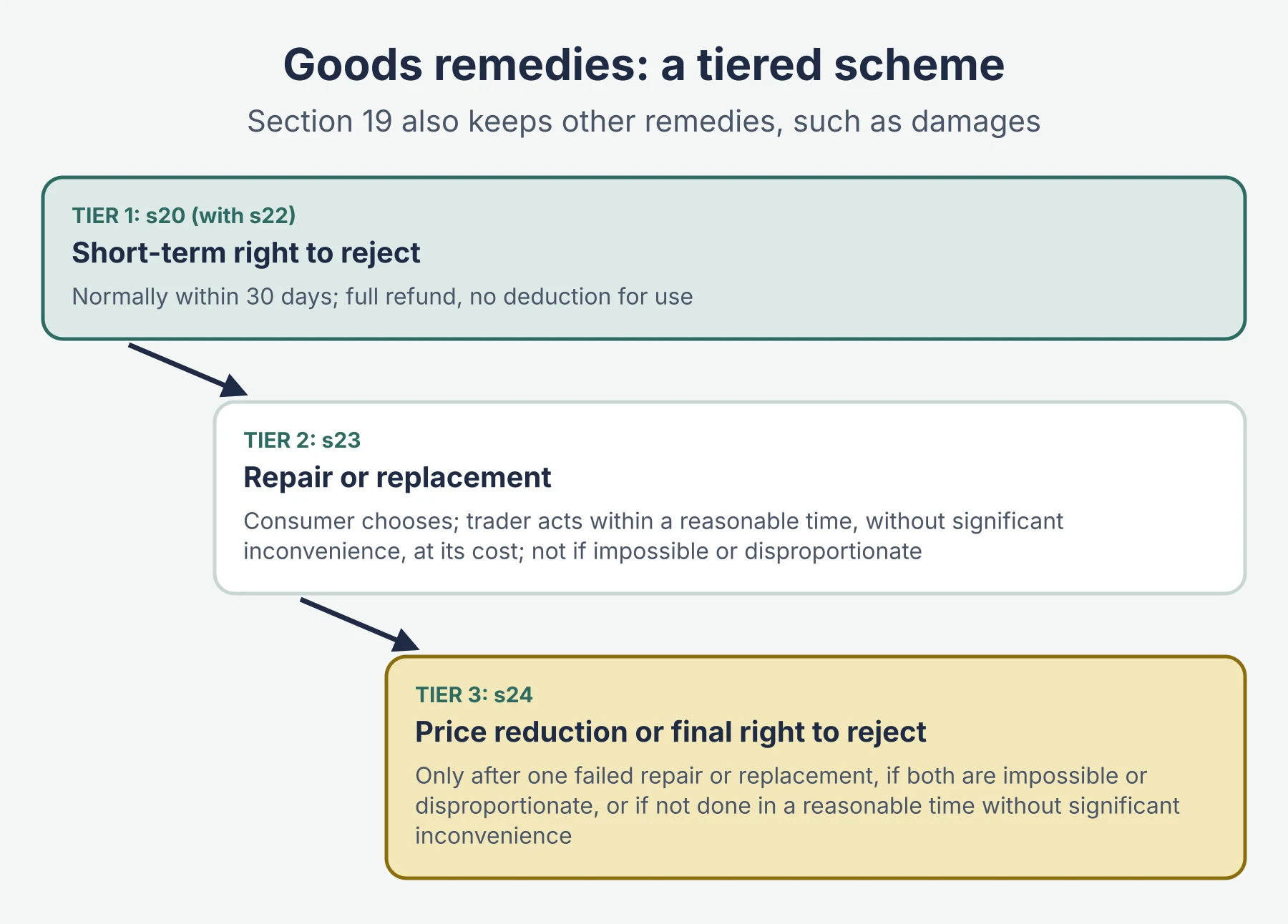
| Tier | Remedy | Section | Conditions to remember |
|---|---|---|---|
| 1 | Short-term right to reject | s20, time limit s22 | 30 days from the later of ownership or possession, delivery and installation; perishables only as long as they could be expected to last; full refund, no deduction |
| 2 | Repair or replacement | s23 | Consumer’s choice; reasonable time, no significant inconvenience, trader pays; refused if impossible or disproportionate compared with the other |
| 3 | Price reduction or final right to reject | s24 | After one failed repair or one failed replacement, or if tier 2 is impossible, or the trader failed to repair or replace properly |
Extra rules
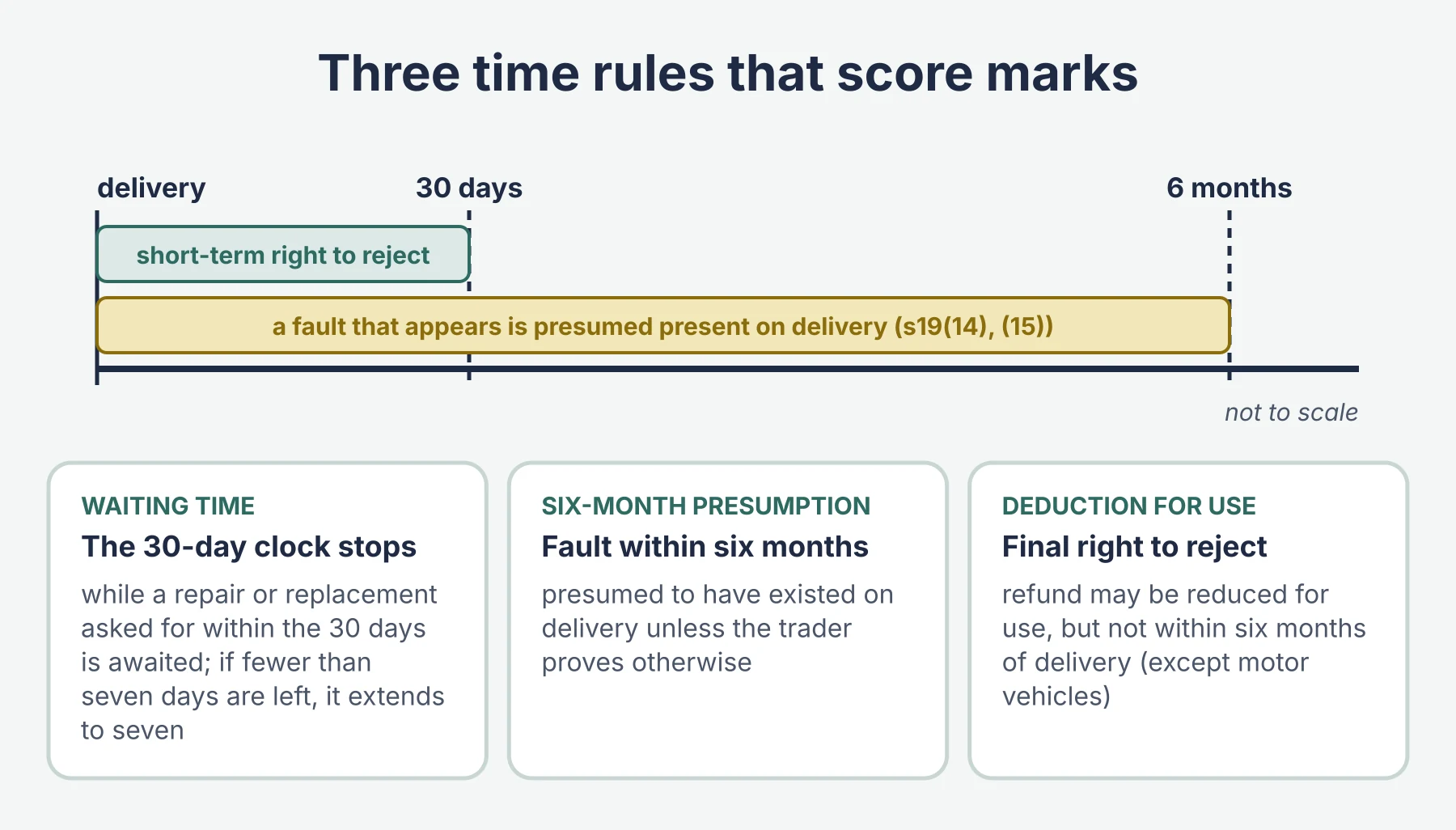
- Waiting for a repair stops the 30-day clock; at least seven days remain once the goods come back.
- Six-month presumption (s19(14) and (15)): a fault appearing within six months of delivery is presumed present at delivery unless the trader proves otherwise.
- Deduction for use on final rejection, but none within six months of delivery, except for motor vehicles.
- Damages for consequential loss remain available alongside these remedies.
Services: terms and remedies
| Section | Content |
|---|---|
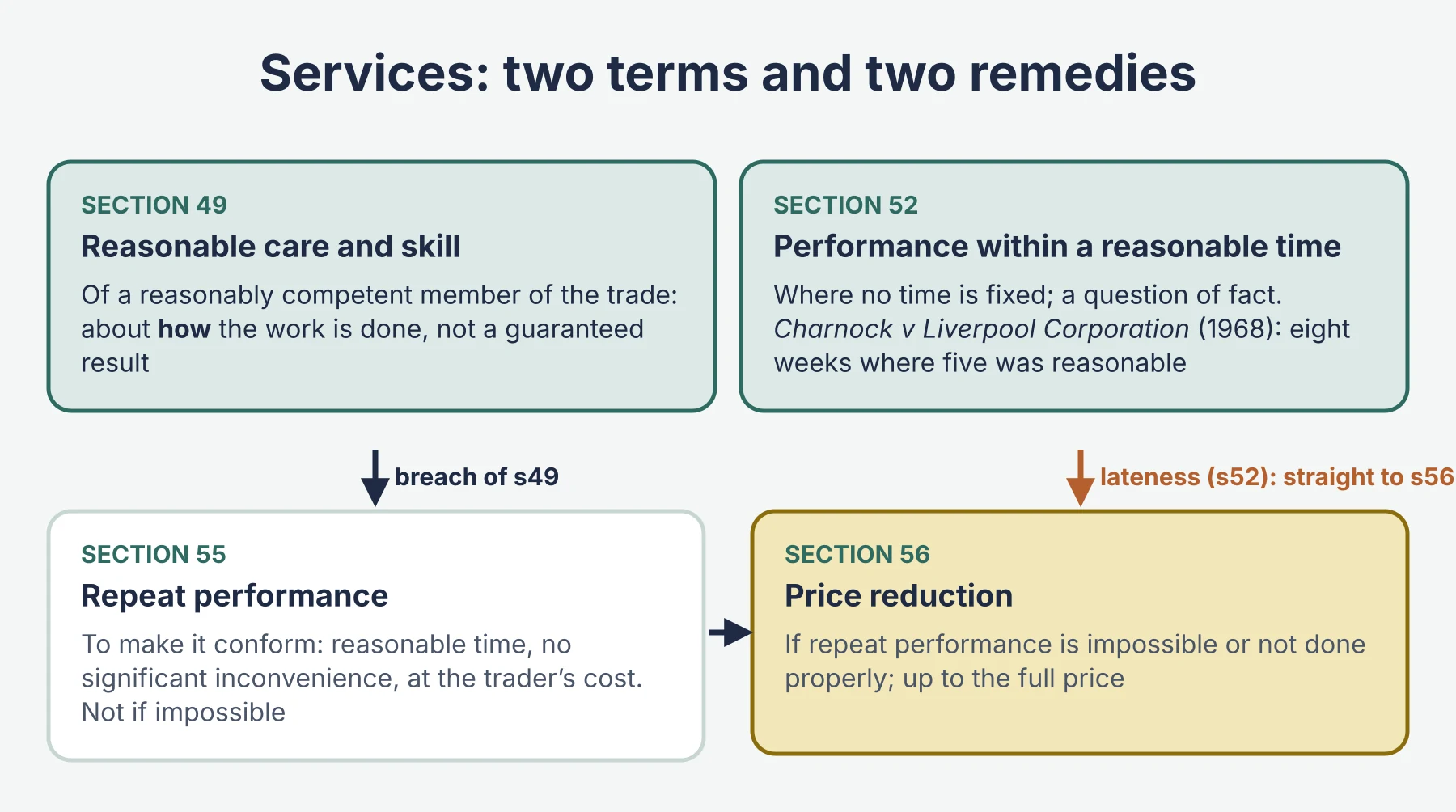
| s49 | Service performed with reasonable care and skill: the standard of a reasonably competent member of the trade; about method, not result |
| s52 | Where no time is fixed, performance within a reasonable time: a question of fact. Charnock v Liverpool Corporation (1968): eight weeks for a repair that should take five was too long |
| s55 | Repeat performance: redo the work to the extent needed, within a reasonable time, without significant inconvenience, at the trader’s cost; not if impossible |
| s56 | Price reduction, up to the full price: where repeat performance is impossible or not done properly; the remedy for breach of s52 |
Key terms
| Term | Meaning |
|---|---|
| Implied term | A term included in the contract by law, whether or not the parties mention it |
| Satisfactory quality | Objective standard of a reasonable person, judged on description, price and circumstances |
| Particular purpose | A use the consumer makes known to the trader, expressly or by implication |
| Short-term right to reject | Right to end the contract and receive a full refund within the s22 period |
| Final right to reject | Right to reject after repair or replacement has failed, subject to deduction for use |
| Disproportionate | A remedy imposing unreasonable costs on the trader compared with the alternative |
| Repeat performance | The trader’s duty to redo a non-conforming service at its own cost |
Exam traps
- Skipping the trader–consumer check, then applying the Act to a private sale.
- Allowing a refund under s20 after 30 days without asking whether the clock was paused.
- Jumping to the final right to reject before any repair or replacement has been tried.
- Saying a consumer can demand repair when it is disproportionate to replacement.
- Treating a poor result as automatically a breach of s49; the question is whether the method fell below the reasonable trader’s standard.
- Using repeat performance for lateness under s52; the remedy is a price reduction under s56.
Self-test
- Can a limited company be a consumer under the Act?
- Name the five aspects of quality listed in section 9(3).
- Give one situation in which section 9 does not cover a defect.
- What did Griffiths v Peter Conway (1939) decide?
- Which section deals with goods matching their description, and which case illustrates it?
- How long is the normal short-term right to reject, and from when does it run?
- When can a consumer use the remedies in section 24?
- What is the six-month presumption?
- When is no deduction for use made under the final right to reject?
- What standard does section 49 impose?
- Which section applies when a service takes too long, and what is the remedy?
- What are the three conditions the trader must meet when carrying out repeat performance?
Answers: 1. No; a consumer must be an individual. 2. Fitness for usual purposes, appearance and finish, freedom from minor defects, safety and durability. 3. Any of: a defect specifically drawn to the consumer’s attention; a defect the consumer’s examination ought to have revealed; a defect a reasonable examination of a sample would have revealed. 4. A buyer who did not disclose unusually sensitive skin could not claim the coat was unfit for her purpose. 5. Section 11; Beale v Taylor (1967). 6. Thirty days, from the day after the latest of ownership or possession passing, delivery and installation. 7. After one failed repair or one failed replacement, where repair and replacement are impossible or disproportionate, or where the trader has not repaired or replaced within a reasonable time and without significant inconvenience. 8. A fault appearing within six months of delivery is presumed to have existed at delivery unless the trader proves otherwise. 9. When the right is exercised within six months of delivery, unless the goods are a motor vehicle. 10. Reasonable care and skill, judged by a reasonably competent member of the trade. 11. Section 52; a price reduction under section 56. 12. Within a reasonable time, without significant inconvenience to the consumer, and at the trader’s cost.
More resources on this topic
Consumer contract implied terms study guide | Consumer contract implied terms practice questions | Law of contract revision notes
Related resources
-
Study guides
AQA A Level Law (7162): Discharge of a contract
Discharge by performance, breach and frustration for AQA A Level Law 7162: entire obligations, anticipatory breach, limits on frustration and the 1943 Act.
Law · AQA · A Level
Read guide -
Practice questions
AQA A Level Law (7162): Discharge of a contract – Practice Questions
Original practice on discharge for AQA A Level Law 7162 with mark-scheme answers on performance, actual and anticipatory breach, frustration and the 1943 Act.
Law · AQA · A Level
Try questions -
Revision notes
AQA A Level Law (7162): Discharge of a contract – Revision Notes
Condensed recall on discharge for AQA A Level Law 7162: exact and substantial performance, actual and anticipatory breach, frustration and the 1943 Act.
Law · AQA · A Level
Revise topic
Get free revision emails (optional)
Occasional emails with practice questions, worked explanations and links to free resources for the qualification and subjects you choose. No spam, and you can unsubscribe from any email. The free tools on this site never need an email.