
Study Guides
AQA A Level Law (7162): The Rules of Criminal Law
Where criminal rules come from, burdens of proof, specific and basic intent, judge and jury roles and a method for applying rules, for AQA A Level Law 7162.
- Subject
- Law
- Level
- A LEVELS
- Topic
- Criminal law
- Author
- Marlbridge Academic Team
- Updated
- Reviewed by
- Aizaz Raoof Ali (what this means)
Aligned to AQA A Level Law (7162), For teaching from September 2017 onwards, A-level exams 2019 onwards. Official specification .
Syllabus page (what it covers and how it is assessed): AQA A Level Law.
Syllabus points this page covers
7162
- The rules of criminal law
Found an error? Report a correction.
Need help with this topic? Request a free trial class for A Level Law (7162).
This guide covers the opening row of AQA A-level Law (7162) section 3.2, The rules of criminal law. The specification describes it as “rules and principles concerning general elements of criminal liability and liability for offences against the person, property offences and attempt”. In other words, this row is about the rules as a working system: where they come from, who has to prove what, how the pieces fit together, and how to apply them to a set of facts. Each offence and defence has its own page; this guide gives you the framework that sits underneath all of them. For the topic as a whole, see the Criminal Offences and Defences study guide.
Where the rules come from
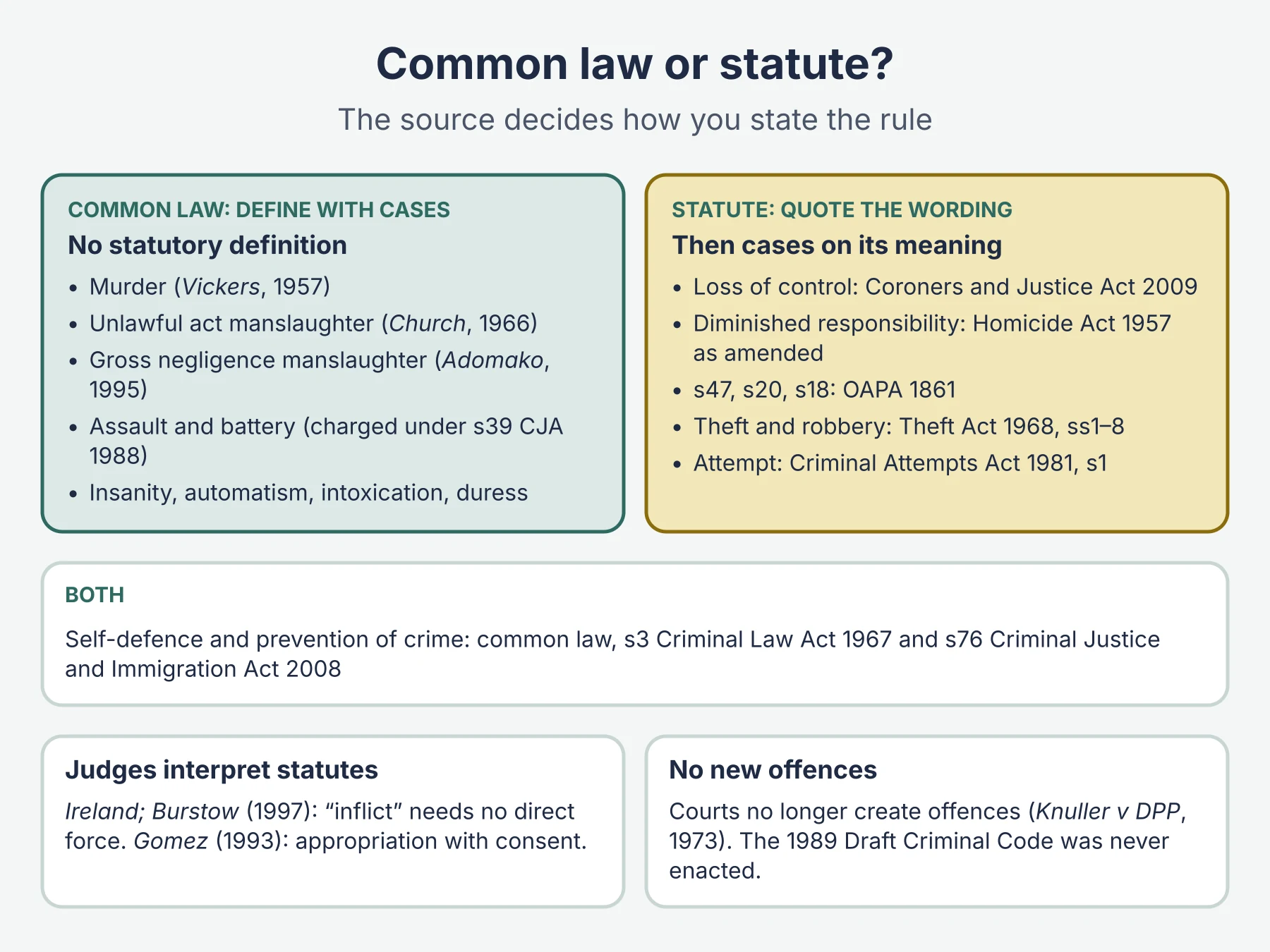
Criminal rules in the specification come from two sources, and the source affects how you state them in an answer.
| Rule | Source | What that means in an answer |
|---|---|---|
| Murder; unlawful act and gross negligence manslaughter | Common law | Define using cases: Vickers (1957), Church (1966), Adomako (1995) |
| Loss of control; diminished responsibility | Statute: Coroners and Justice Act 2009; Homicide Act 1957 as amended | Quote the statutory elements, then cases on their meaning |
| Assault and battery | Common law offences, charged under s39 Criminal Justice Act 1988 | Define using cases; statute gives only the charge and penalty |
| s47, s20, s18 | Offences Against the Person Act 1861 | Use the section wording; cases explain words such as “inflict” and “wound” |
| Theft and robbery | Theft Act 1968, ss1–8 | Work through the statutory definitions section by section |
| Attempt | Criminal Attempts Act 1981, s1 | Quote “more than merely preparatory” and apply the cases |
| Insanity, automatism, intoxication, duress | Common law | State the case-based test |
| Self-defence and prevention of crime | Common law, s3 Criminal Law Act 1967 and s76 Criminal Justice and Immigration Act 2008 | Combine the common law test with the statutory clarifications |
Two points follow. First, judges develop the rules even where there is a statute: the House of Lords decided in R v Ireland; R v Burstow (1997) that “inflict” in s20 does not require a direct application of force, and in R v Gomez (1993) that an appropriation can occur with the owner’s consent. Second, the common law can be changed only by later cases or by Parliament, and the courts no longer create entirely new offences (Knuller v DPP, 1973). There is no single criminal code: the Law Commission published a Draft Criminal Code in 1989, but it was never enacted.
Who has to prove what
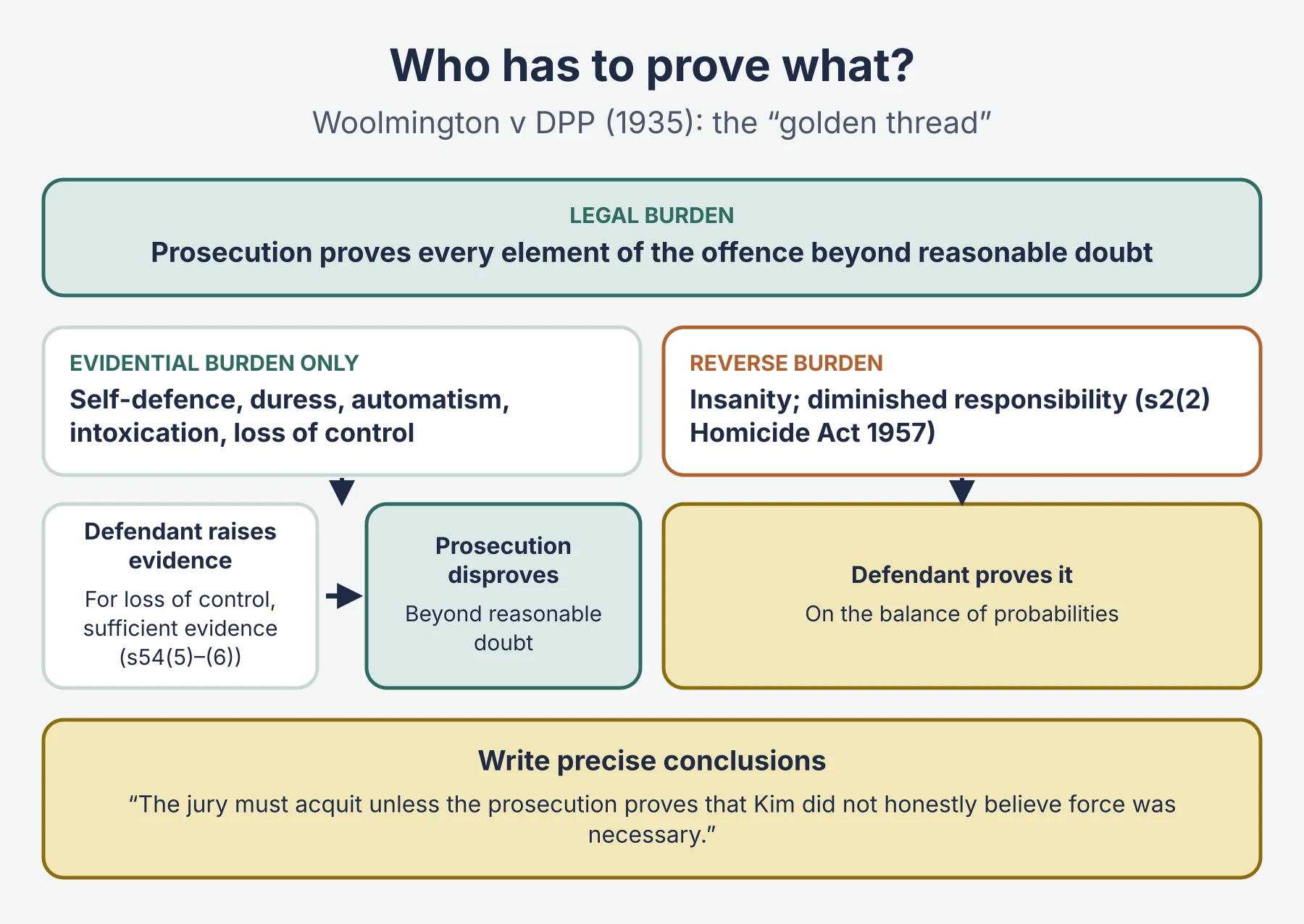
The legal burden. The prosecution must prove every element of the offence beyond reasonable doubt. In Woolmington v DPP (1935) Viscount Sankey called this the “golden thread” of English criminal law.
Defences. For most defences the defendant bears only an evidential burden: there must be some evidence of the defence before the jury can consider it. Once raised, the prosecution must disprove it beyond reasonable doubt.
| Defence | Who proves it | Standard |
|---|---|---|
| Self-defence, duress, automatism, intoxication | Defendant raises evidence; prosecution disproves | Beyond reasonable doubt |
| Loss of control | Defendant raises sufficient evidence; prosecution must then disprove it (s54(5)–(6)) | Beyond reasonable doubt |
| Insanity | Defendant | Balance of probabilities |
| Diminished responsibility | Defendant (s2(2) Homicide Act 1957) | Balance of probabilities |
Knowing these burdens lets you write precise conclusions: “the jury must acquit unless the prosecution proves that Kim did not honestly believe force was necessary” is a stronger sentence than “Kim can claim self-defence”.
Judge and jury
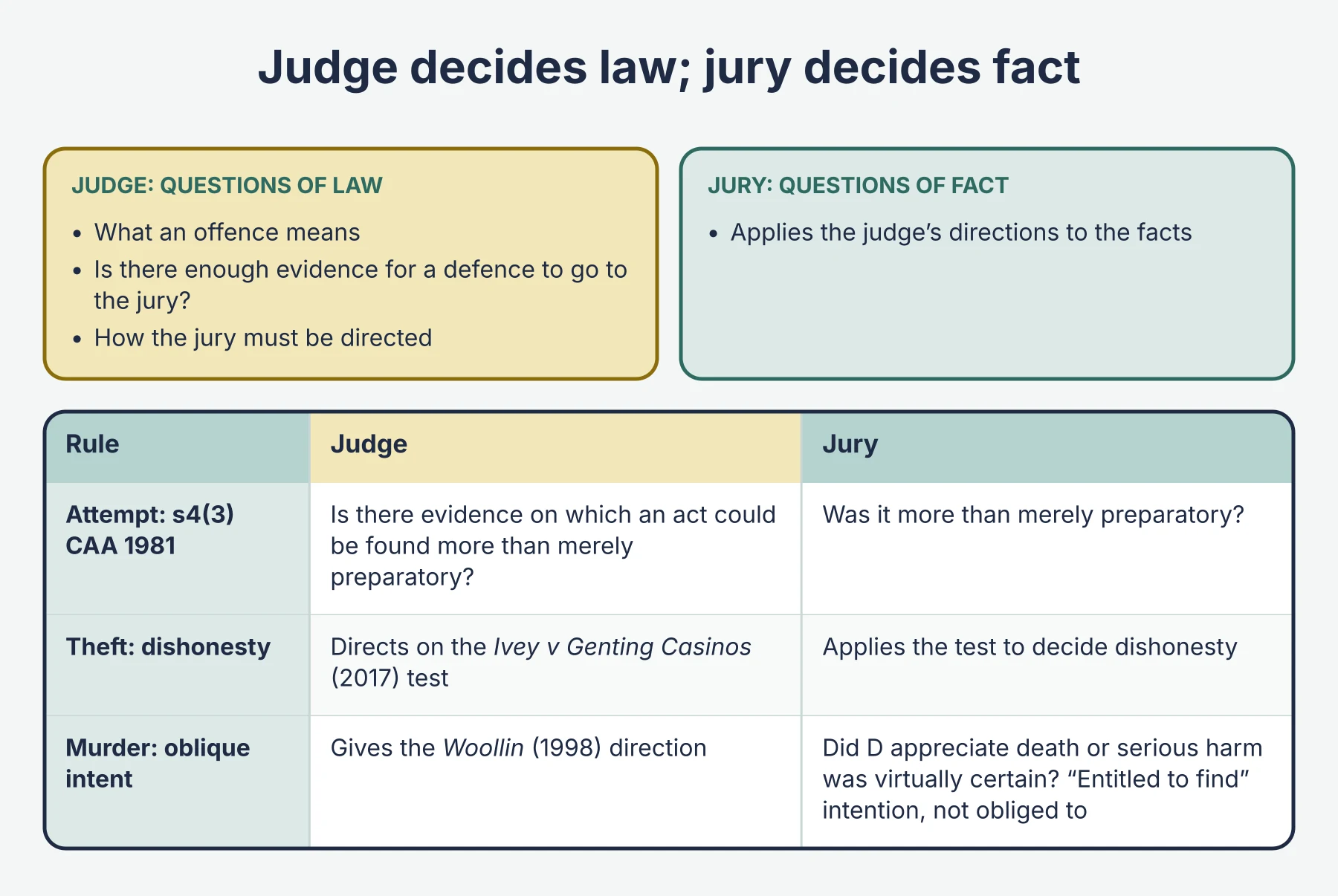
The judge decides questions of law: what an offence means, whether there is enough evidence for a defence to go to the jury, and how the jury must be directed. The jury decides questions of fact by applying those directions. Some rules state the split expressly. In attempt, s4(3) Criminal Attempts Act 1981 leaves to the judge whether there is evidence on which an act could be found more than merely preparatory, and to the jury whether it was. In theft, dishonesty is a question for the jury applying the Ivey v Genting Casinos (2017) test. In murder, whether a defendant appreciated that death or serious harm was virtually certain is for the jury, and Woollin (1998) means the jury is “entitled to find” intention, not obliged to.
How the pieces fit together
Elements. Every offence is a combination of actus reus elements (conduct, circumstances, consequences, causation) and mens rea elements (intention, recklessness, or none for strict liability). The general rules on these apply to every specific offence, which is why the specification puts them first.
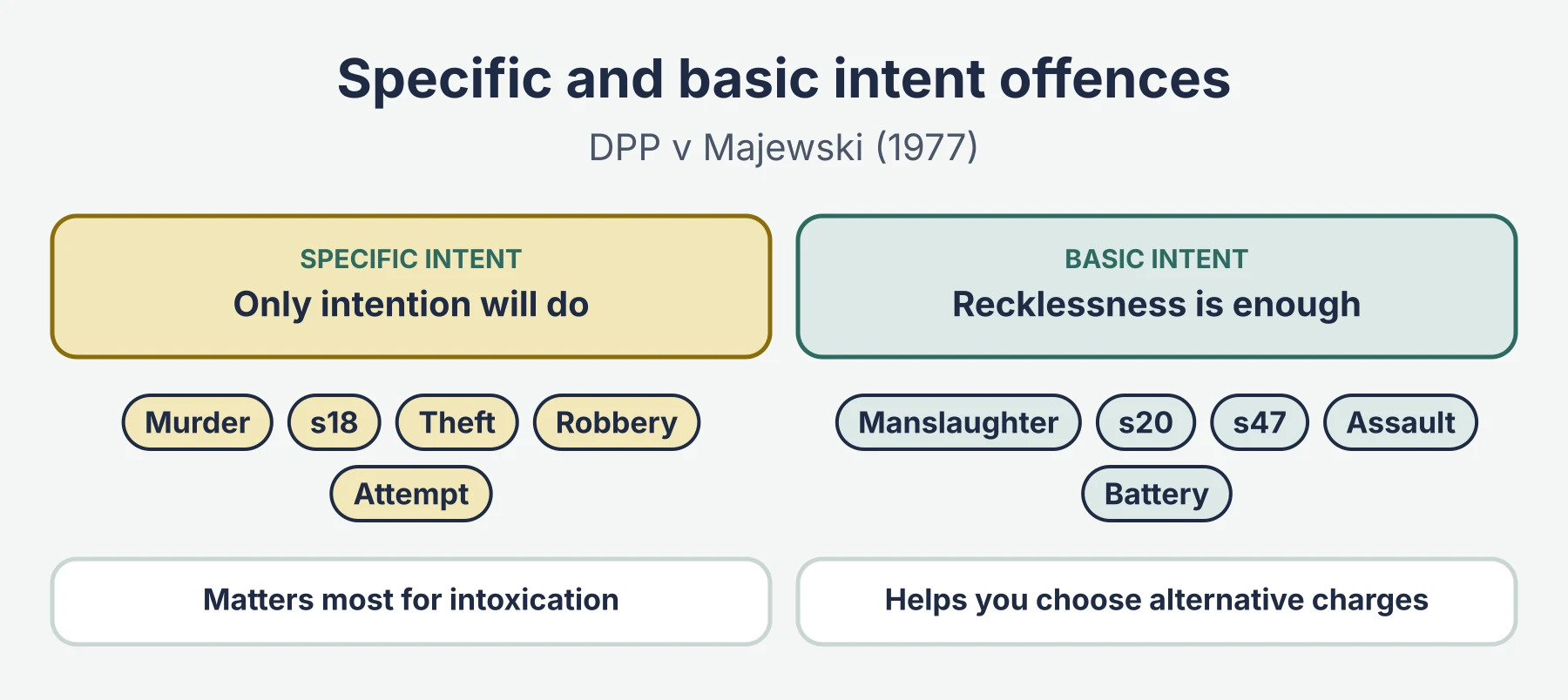
Specific and basic intent. Offences divide into specific intent offences, where only intention will do (murder, s18, theft, robbery, attempt), and basic intent offences, where recklessness is enough (manslaughter, s20, s47, assault, battery). The distinction comes from DPP v Majewski (1977) and matters most for intoxication, but it also helps you choose alternative charges.
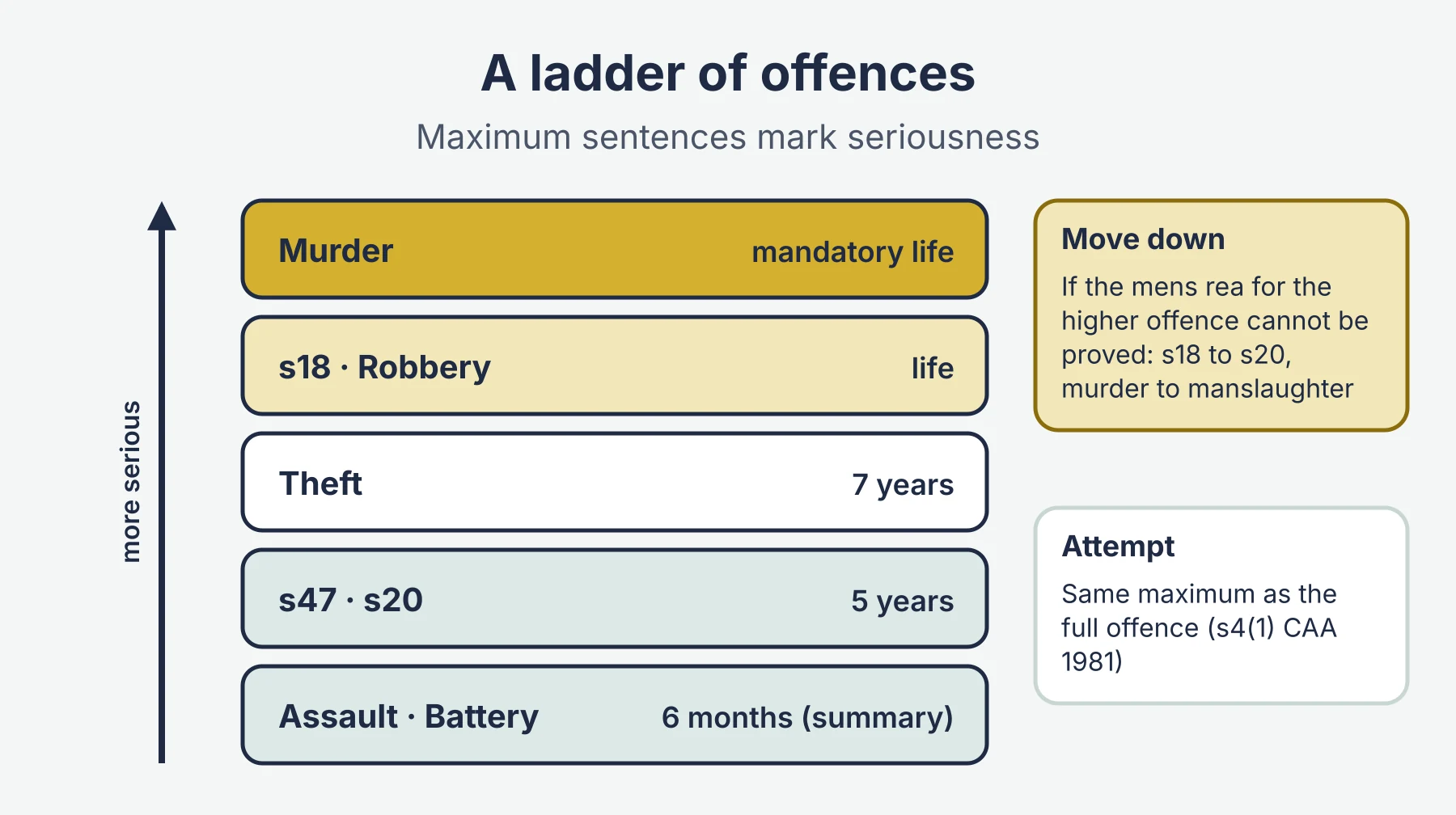
A ladder of offences. Offences against the person form a ladder by harm and fault. If the prosecution cannot prove the mens rea for the higher offence, you move down: s18 to s20, murder to manslaughter. A jury can often convict of a lesser offence than the one charged where its elements are included in the charge.
Maximum sentences mark seriousness. Assault and battery are summary offences with a maximum of six months; s47 and s20 carry five years; theft seven years; s18, robbery and murder life (murder mandatory). Attempt carries the same maximum as the full offence (s4(1) Criminal Attempts Act 1981).
Applying the rules: a method for problem questions
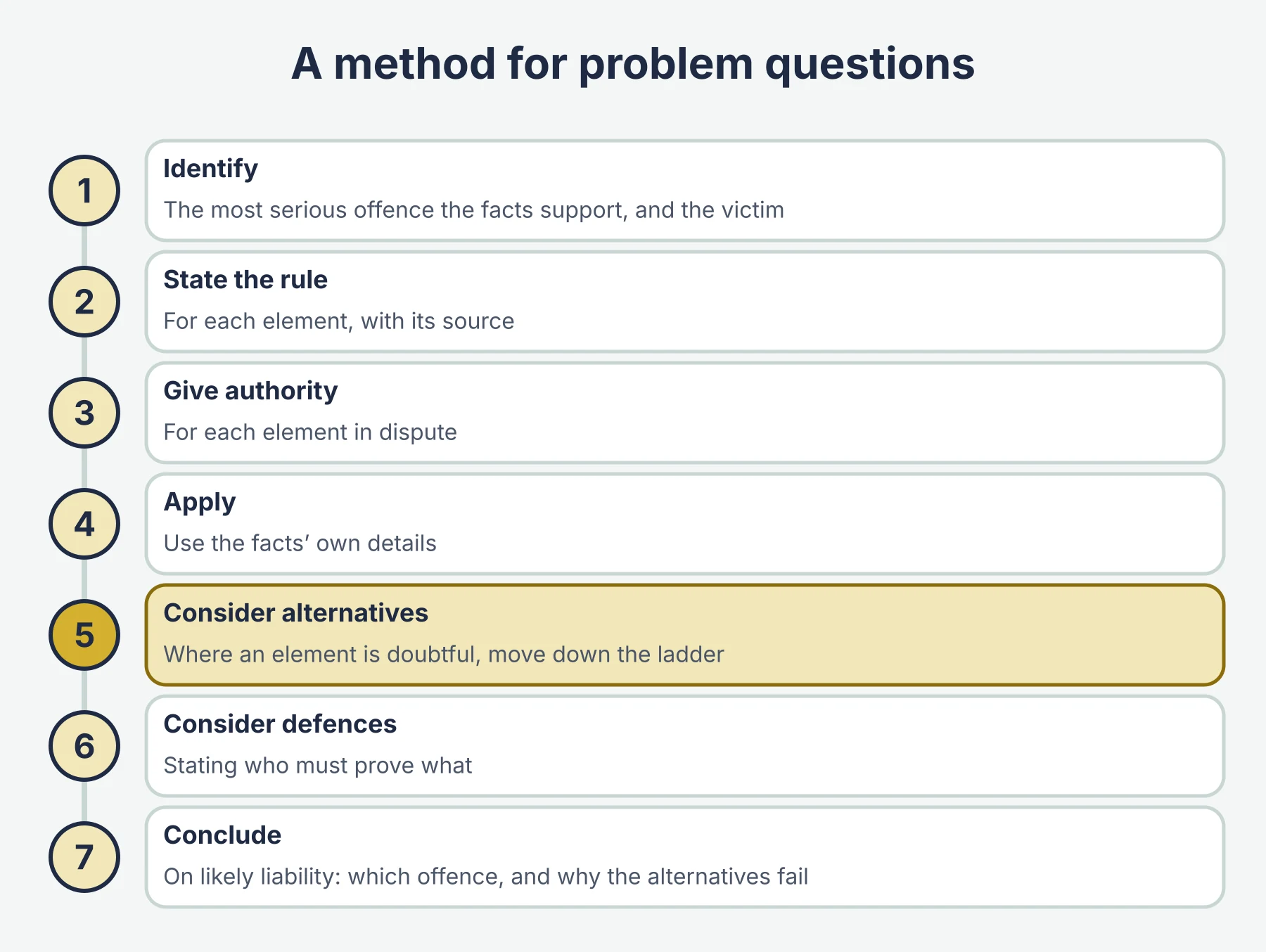
AQA’s criminal law problem questions reward a consistent sequence:
- Identify the most serious offence the facts support, and the victim.
- State the rule for each element, with its source.
- Give authority for each element in dispute.
- Apply the rule to the facts, using the facts’ own details.
- Consider alternatives where an element is doubtful (move down the ladder).
- Consider defences, stating who must prove what.
- Conclude on likely liability.
Worked example
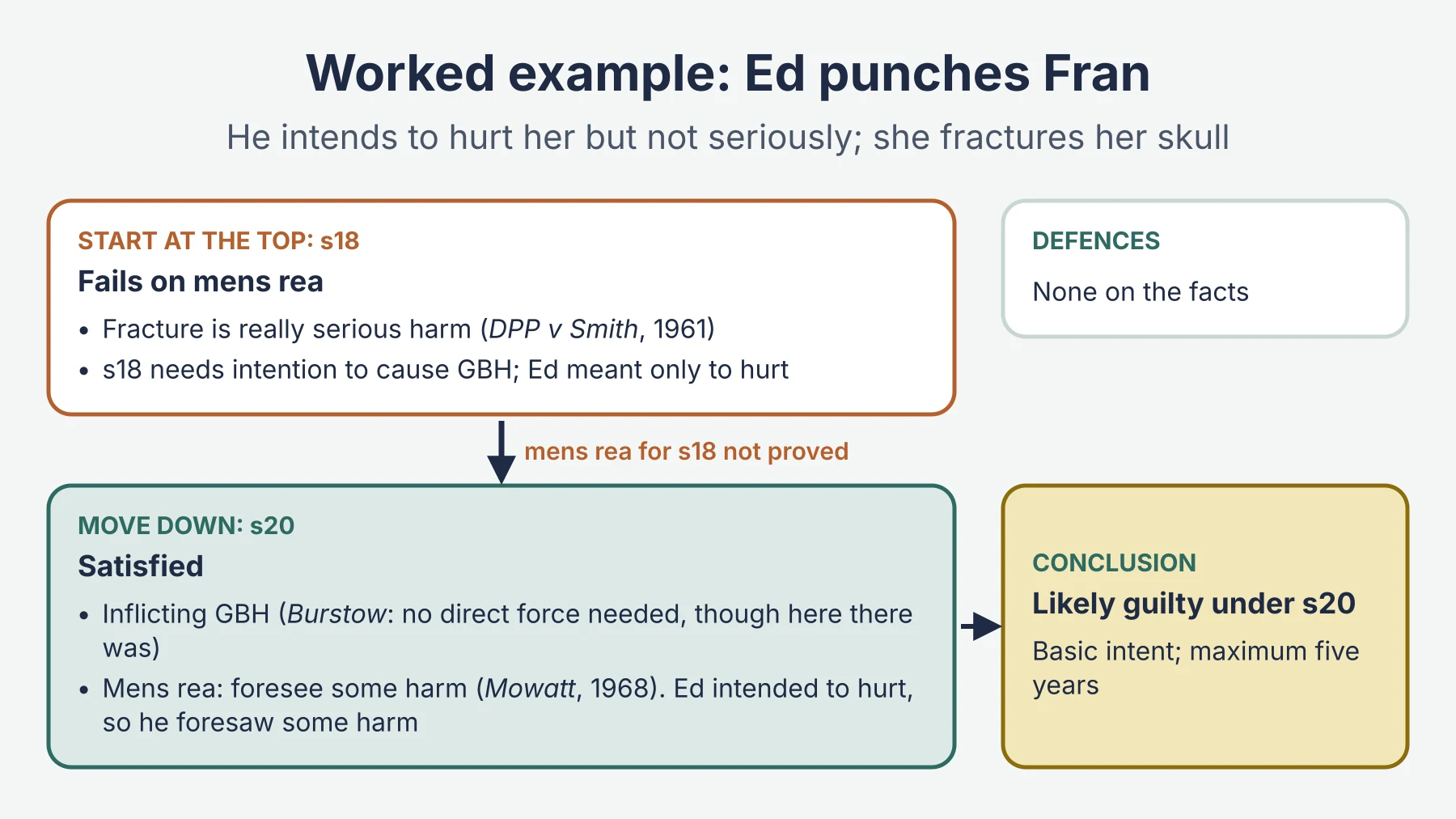
Ed punches Fran in a car park, intending to hurt her but not seriously. She falls, hits her head and suffers a fractured skull.
Offence:    Start with s18 (GBH caused). Fracture is really serious harm
            (DPP v Smith, 1961). s18 needs intention to cause GBH - Ed meant
            only to hurt, so s18 fails.
Move down:  s20 - inflicting GBH (Burstow: no direct force needed, though
            here there was). Mens rea: foresee some harm (Mowatt, 1968).
            Ed intended to hurt, so he foresaw some harm.
Defences:   none on the facts.
Conclusion: Ed is likely to be guilty under s20, a basic intent offence with
            a maximum of five years.
The answer is short because each step does one job. Note that it starts at the top of the ladder and explains why it moves down, rather than guessing the offence.
Common mistakes
- Stating a common law offence as though it were in a statute (murder has no statutory definition).
- Saying the defendant must prove self-defence or duress: the defendant raises it; the prosecution disproves it.
- Forgetting the reverse burden for insanity and diminished responsibility.
- Choosing an offence by instinct instead of testing the elements from the top down.
- Concluding “guilty” without saying which offence and why the alternatives fail.
Exam technique
Short “explain” questions on this row often ask about the burden of proof, the source of an offence, or the difference between specific and basic intent: give a definition, an authority and an example. In problem questions, the rules here are not a separate section of your answer but the skeleton for it: source, element, authority, application, conclusion.
More resources on this topic
Rules of criminal law revision notes | Rules of criminal law practice questions | General elements of liability study guide
Related resources
-
Practice questions
AQA A Level Law (7162): The Rules of Criminal Law – Practice Questions
Original practice questions with mark-scheme answers on criminal rule sources, burdens of proof, judge and jury and intent types for AQA Law 7162.
Law · AQA · A Level
Try questions -
Revision notes
AQA A Level Law (7162): The Rules of Criminal Law – Revision Notes
Recall notes on the sources of criminal rules, burdens of proof, judge and jury, specific and basic intent and the offence ladder for AQA A Level Law 7162.
Law · AQA · A Level
Revise topic -
Study guides
AQA A Level Law (7162): Theory in Criminal Law
Harm, autonomy, fault and responsibility, and fair labelling, correspondence, certainty and non-retrospectivity applied to cases, for AQA A Level Law 7162.
Law · AQA · A Level
Read guide
Get free revision emails (optional)
Occasional emails with practice questions, worked explanations and links to free resources for the qualification and subjects you choose. No spam, and you can unsubscribe from any email. The free tools on this site never need an email.