
Revision Notes
AQA A Level Law (7162): The Rules of Criminal Law – Revision Notes
Recall notes on the sources of criminal rules, burdens of proof, judge and jury, specific and basic intent and the offence ladder for AQA A Level Law 7162.
- Subject
- Law
- Level
- A LEVELS
- Topic
- Criminal law
- Author
- Marlbridge Academic Team
- Updated
- Reviewed by
- Aizaz Raoof Ali (what this means)
Aligned to AQA A Level Law (7162), For teaching from September 2017 onwards, A-level exams 2019 onwards. Official specification .
Syllabus page (what it covers and how it is assessed): AQA A Level Law.
Syllabus points this page covers
7162
- The rules of criminal law
Found an error? Report a correction.
Need help with this topic? Request a free trial class for A Level Law (7162).
Condensed notes for the section 3.2 row The rules of criminal law: “rules and principles concerning general elements of criminal liability and liability for offences against the person, property offences and attempt”. These notes cover the framework for using those rules; the elements of each offence are in their own notes. For explanation and a worked example, use the rules of criminal law study guide.
Sources at a glance
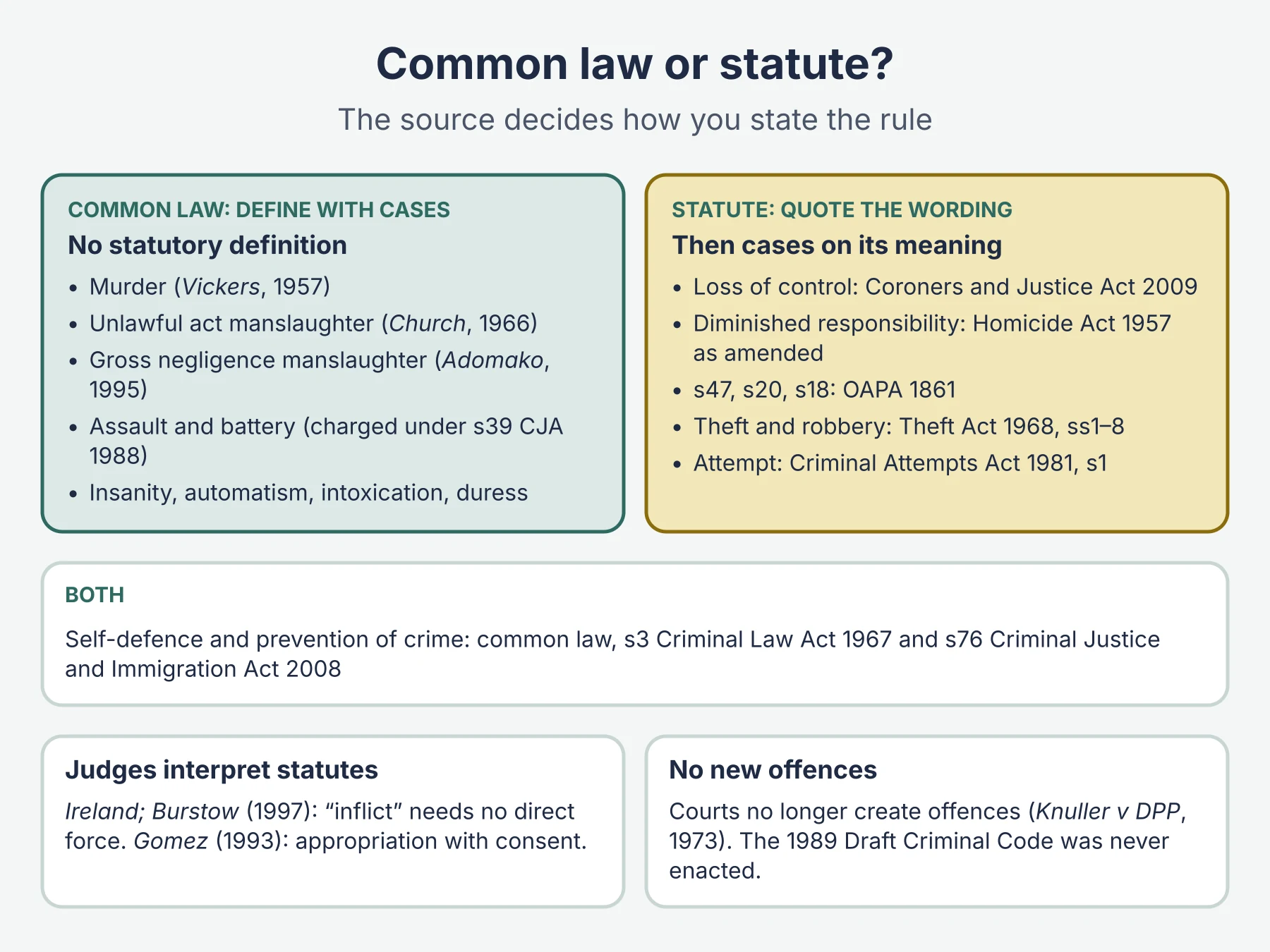
Common law: murder; unlawful act manslaughter; gross negligence manslaughter; assault; battery; insanity; automatism; intoxication; duress; duress of circumstances; self-defence (alongside statute).
Statute:
- Homicide Act 1957 s2 (diminished responsibility, as amended by the Coroners and Justice Act 2009).
- Coroners and Justice Act 2009 ss54–55 (loss of control).
- Offences Against the Person Act 1861 ss18, 20, 47.
- Criminal Justice Act 1988 s39 (charge and penalty for assault and battery).
- Theft Act 1968 ss1–8.
- Criminal Attempts Act 1981 s1.
- Criminal Law Act 1967 s3 and Criminal Justice and Immigration Act 2008 s76 (force in self-defence and prevention of crime).
Judicial development of statutes: Ireland; Burstow (1997) on “inflict”; Gomez (1993) on “appropriation”.
No new common law offences: Knuller v DPP (1973). No code: the Draft Criminal Code (1989) was never enacted.
Burden and standard of proof
Prosecution ---- every element of the offence ---- beyond reasonable doubt
                 (Woolmington v DPP, 1935: the "golden thread")

Most defences:   D raises evidence  ->  prosecution disproves beyond reasonable doubt
                 (self-defence, duress, automatism, loss of control)

Reverse burden:  D proves on the balance of probabilities
                 (insanity; diminished responsibility, s2(2) HA 1957)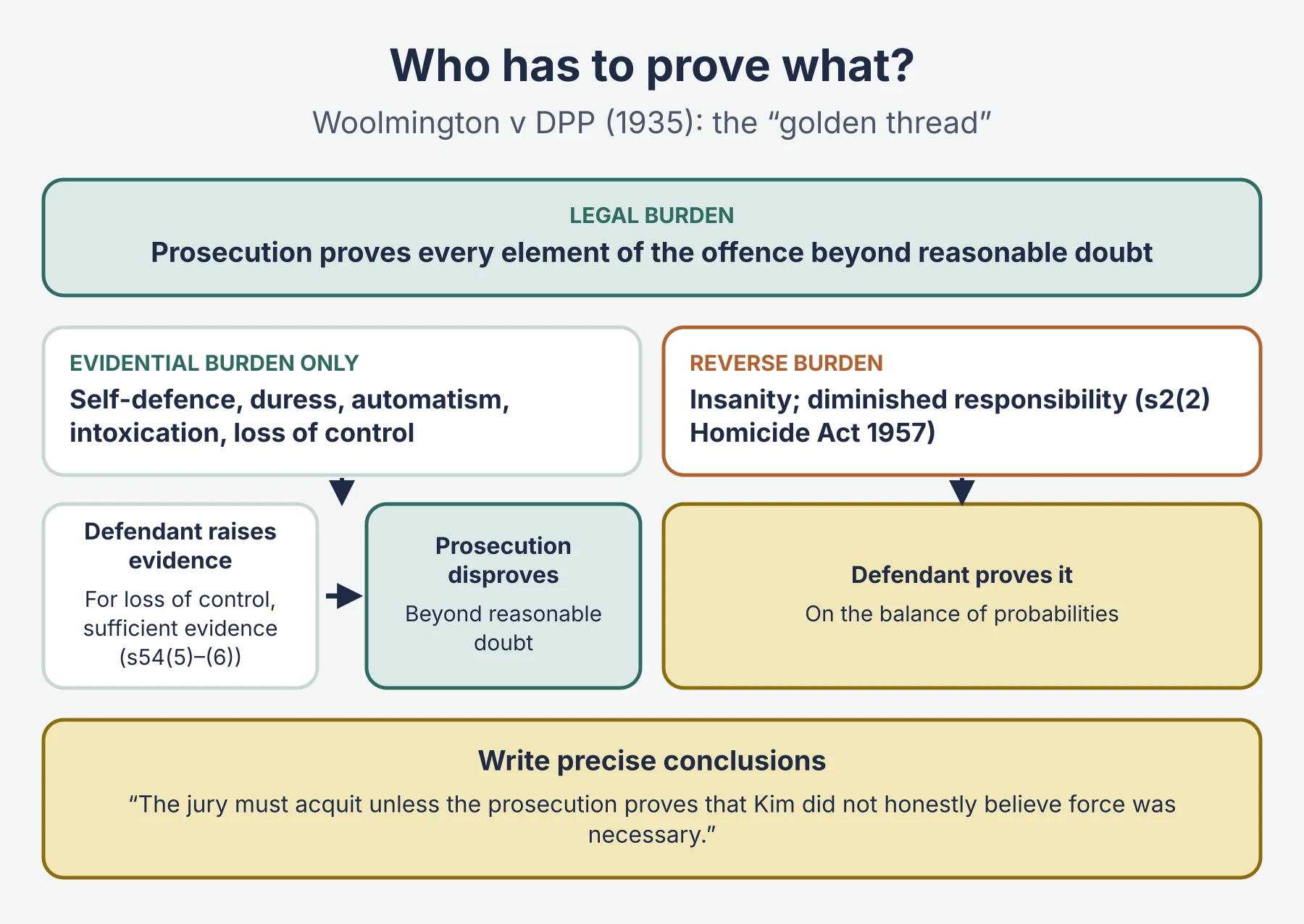
Judge or jury?
| Question | Decided by |
|---|---|
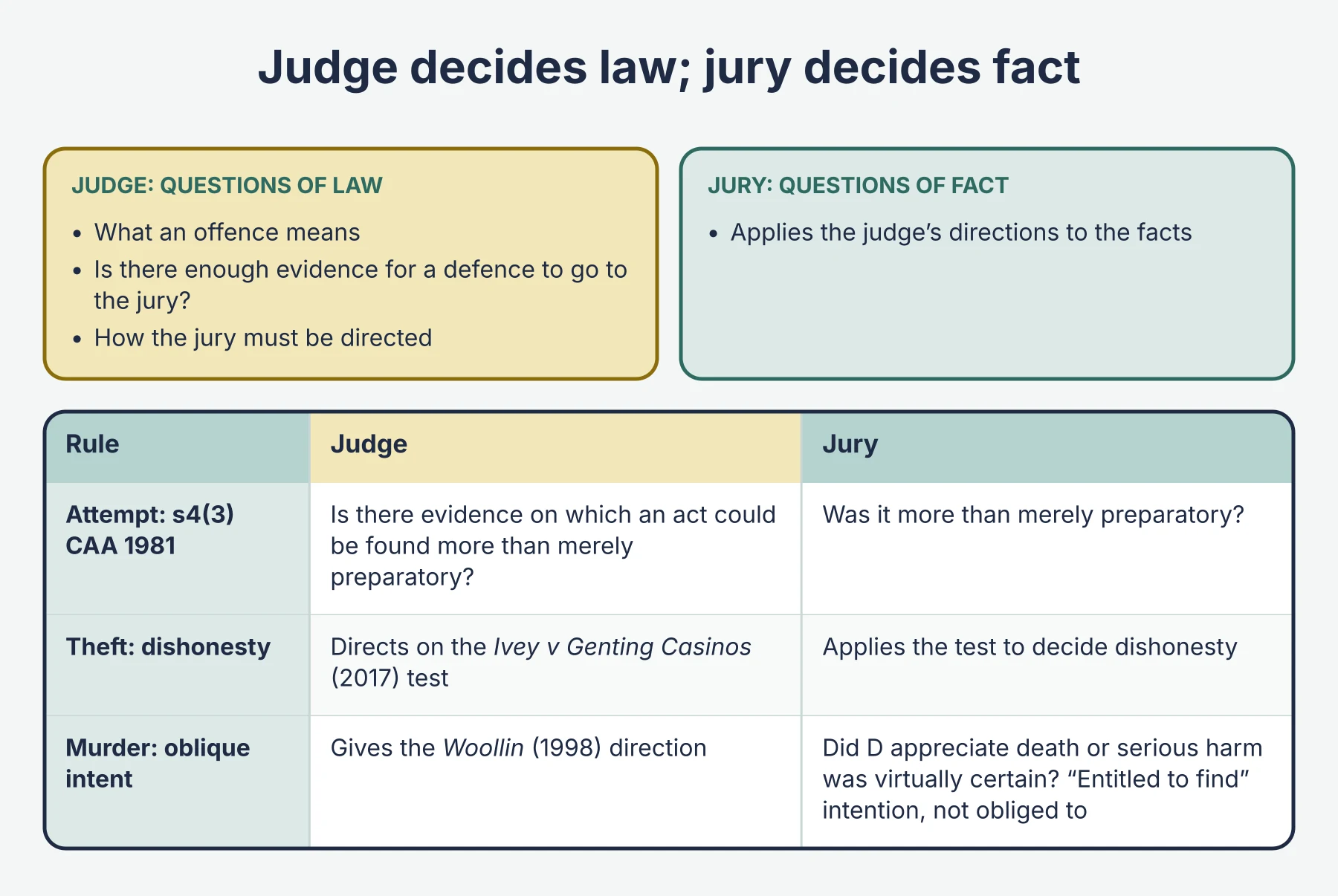
| What the offence means; how to direct the jury | Judge |
| Whether there is enough evidence for a defence to be left to the jury | Judge |
| Whether evidence could show an act more than merely preparatory | Judge (s4(3) CAA 1981) |
| Whether the act was more than merely preparatory | Jury |
| Whether D was dishonest (Ivey) | Jury |
| Whether to find intention from foresight of virtual certainty (Woollin) | Jury |
Specific and basic intent
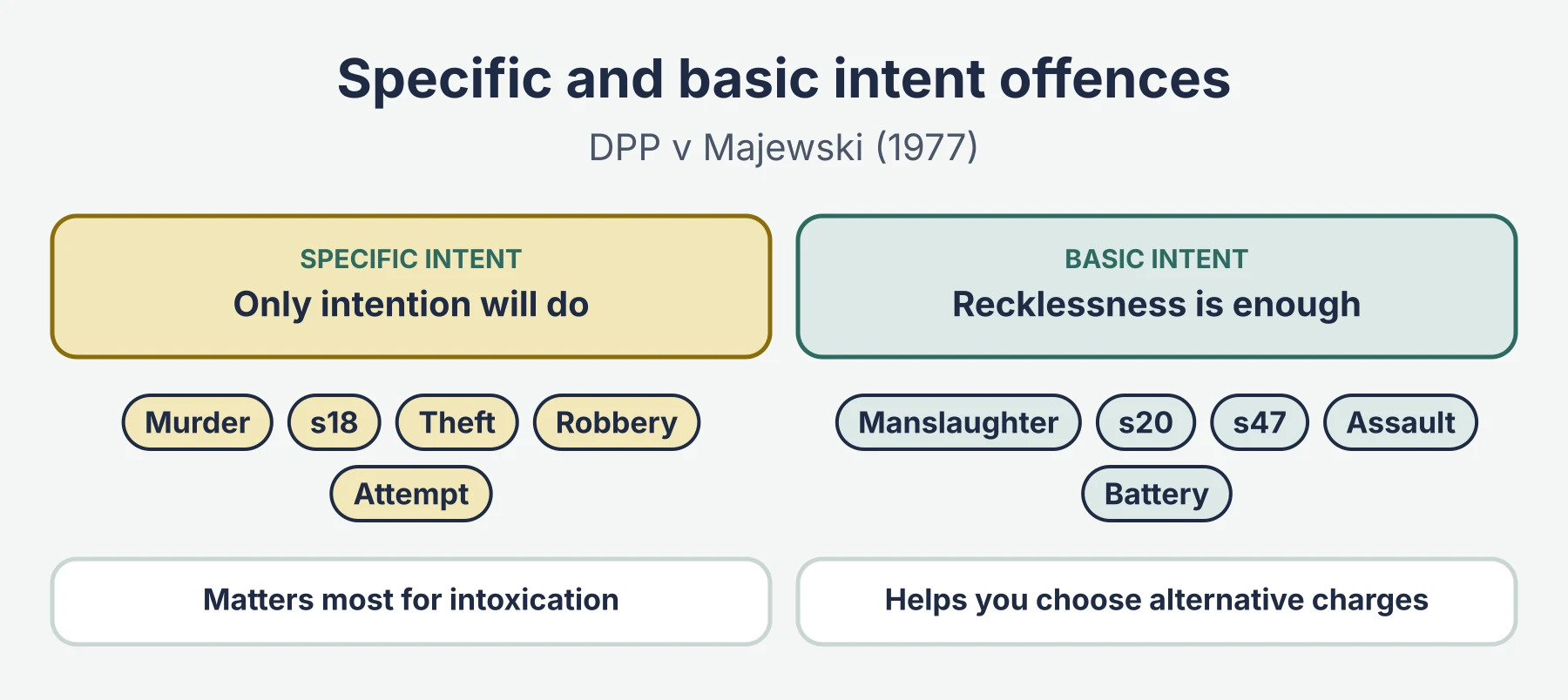
| Specific intent (intention only) | Basic intent (recklessness enough) |
|---|---|
| Murder | Manslaughter |
| s18 | s20 |
| Theft | s47 |
| Robbery | Assault |
| Attempt | Battery |
Source: DPP v Majewski (1977). Main use: voluntary intoxication can negate specific intent but is no defence to basic intent.
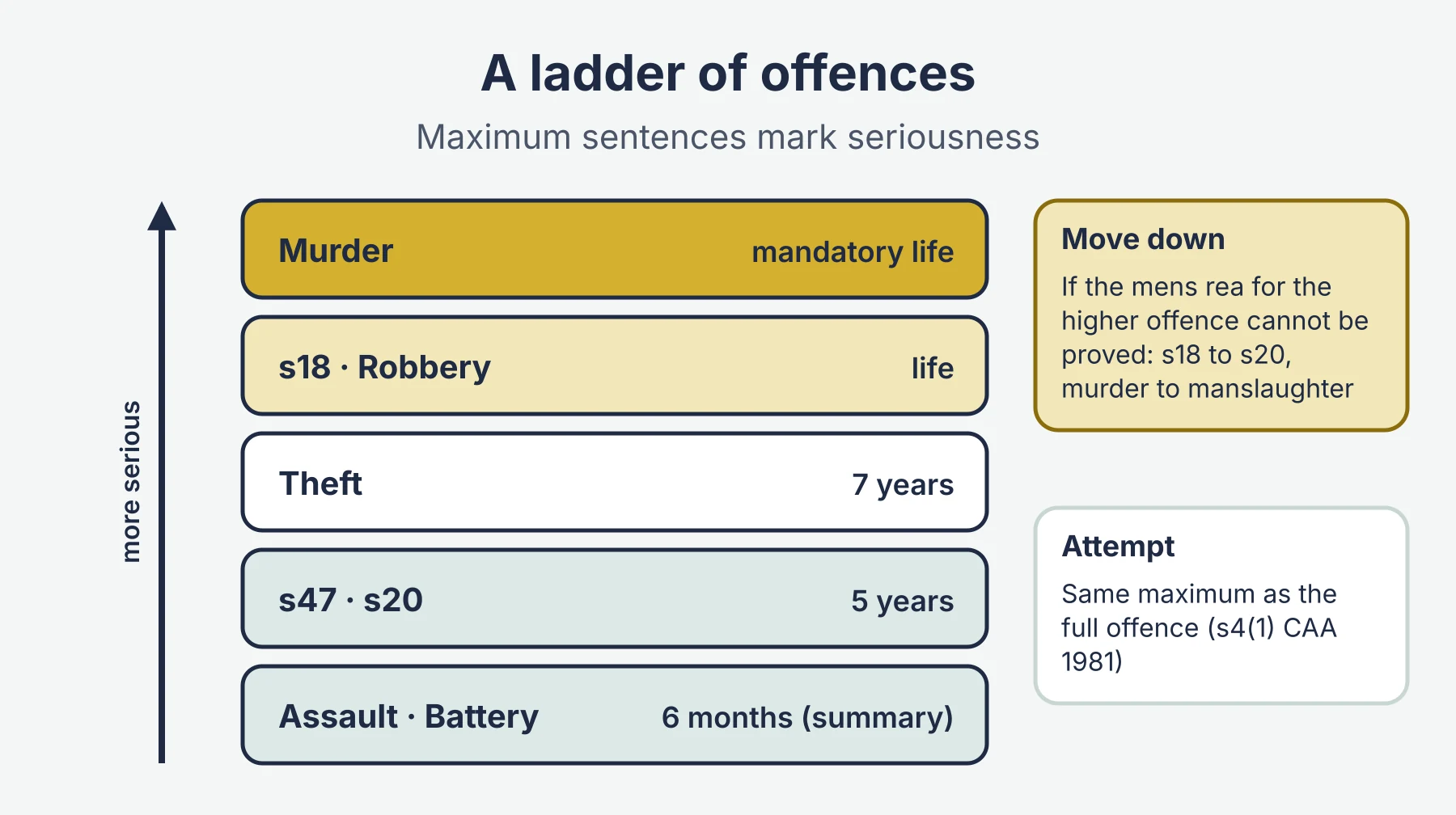
The ladders
Offences against the person:
Murder (life, mandatory)  ->  Voluntary manslaughter (partial defence)  ->  Involuntary manslaughter
s18 (life)  ->  s20 (5 years)  ->  s47 (5 years)  ->  battery / assault (6 months)
Property: robbery (life) -> theft (7 years).
Attempt: same maximum as the full offence (s4(1) CAA 1981).
Problem-answer method
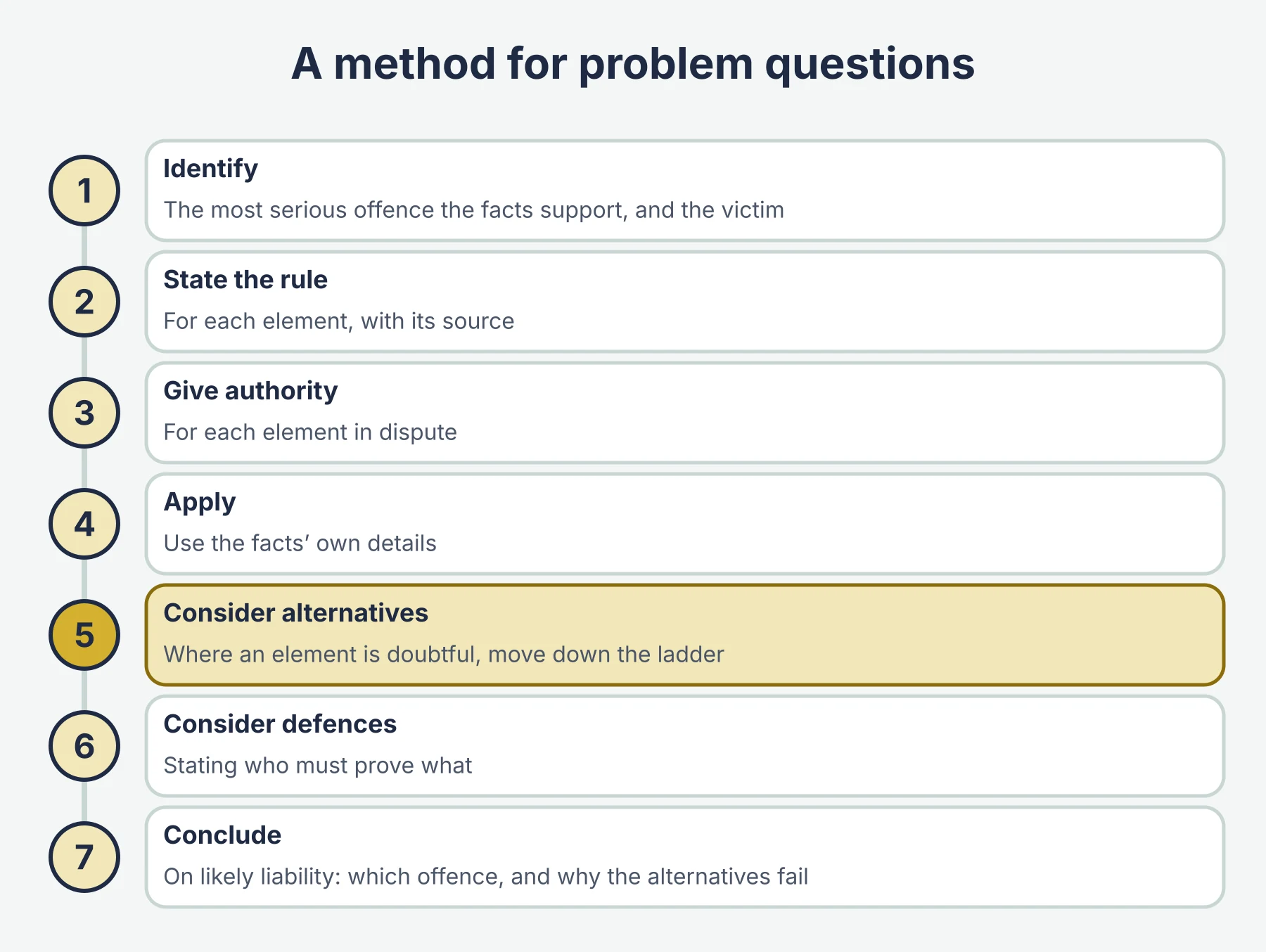
- Identify the most serious offence and the victim.
- State the rule and its source.
- Give an authority for each disputed element.
- Apply to the facts.
- Move down the ladder if an element fails.
- Consider defences and who must prove what.
- Conclude.
Stating a rule well
| Weak | Strong |
|---|---|
| “Murder is killing someone on purpose.” | “Murder is the unlawful killing of a human being under the King’s peace with intention to kill or cause GBH (Vickers, 1957).” |
| “Theft is stealing.” | “Theft is dishonestly appropriating property belonging to another with intention to permanently deprive (s1 Theft Act 1968).” |
| “He can say it was self-defence.” | “If there is evidence of self-defence, the prosecution must disprove it beyond reasonable doubt.” |
A strong statement names the source, gives every element and, where relevant, says who must prove it.
Key terms
| Term | Meaning |
|---|---|
| Common law offence | An offence defined by judges in case law, not by statute |
| Legal burden | The duty to prove a matter to the required standard |
| Evidential burden | The duty to raise enough evidence for an issue to be left to the jury |
| Reverse burden | A legal burden placed on the defendant |
| Beyond reasonable doubt | The criminal standard, so that the jury is sure |
| Balance of probabilities | More likely than not; used where the defendant bears a legal burden |
| Specific intent | An offence that can be committed only intentionally |
| Basic intent | An offence that can be committed recklessly |
| Lesser included offence | An offence whose elements are contained within the offence charged |
Exam traps
- Calling murder a statutory offence.
- Writing “the defendant must prove self-defence”.
- Forgetting the balance-of-probabilities burden for insanity and diminished responsibility.
- Calling s20 a specific intent offence.
- Picking the offence by instinct instead of testing from the top down.
- Concluding without naming the offence.
Self-test
- Name two common law offences and two statutory offences in the specification.
- What did Woolmington v DPP decide?
- What is an evidential burden?
- Name two defences where the defendant bears the legal burden.
- To what standard must the defendant prove those defences?
- Who decides whether an act was more than merely preparatory?
- Which case created the specific and basic intent distinction?
- Is theft an offence of specific or basic intent?
- What is the maximum sentence for s20?
- What is the maximum sentence for attempted theft?
- Which case held that “inflict” does not need direct force?
- Which case stops the courts creating new offences?
Answers: 1. Common law: murder, battery; statutory: theft, s18. 2. The prosecution must prove guilt beyond reasonable doubt: the “golden thread”. 3. The duty to raise enough evidence for an issue to be left to the jury. 4. Insanity and diminished responsibility. 5. On the balance of probabilities. 6. The jury, once the judge decides there is evidence on which it could be so found (s4(3) CAA 1981). 7. DPP v Majewski (1977). 8. Specific intent. 9. Five years. 10. Seven years, the same as theft. 11. R v Burstow (1997). 12. Knuller v DPP (1973).
Test yourself further with the rules of criminal law practice questions.
Related resources
-
Study guides
AQA A Level Law (7162): Theory in Criminal Law
Harm, autonomy, fault and responsibility, and fair labelling, correspondence, certainty and non-retrospectivity applied to cases, for AQA A Level Law 7162.
Law · AQA · A Level
Read guide -
Practice questions
AQA A Level Law (7162): Theory in Criminal Law – Practice Questions
Original practice questions with mark-scheme answers on harm, autonomy, fault and the four principles of criminal law for AQA A Level Law 7162 Paper 1.
Law · AQA · A Level
Try questions -
Revision notes
AQA A Level Law (7162): Theory in Criminal Law – Revision Notes
Recall notes on harm, autonomy, fault, responsibility and the four principles of criminal law with the cases that test them, for AQA A Level Law 7162.
Law · AQA · A Level
Revise topic
Get free revision emails (optional)
Occasional emails with practice questions, worked explanations and links to free resources for the qualification and subjects you choose. No spam, and you can unsubscribe from any email. The free tools on this site never need an email.