
Study Guides
AQA A Level Law (7162): Theory in Criminal Law
Harm, autonomy, fault and responsibility, and fair labelling, correspondence, certainty and non-retrospectivity applied to cases, for AQA A Level Law 7162.
- Subject
- Law
- Level
- A LEVELS
- Topic
- Criminal law
- Author
- Marlbridge Academic Team
- Updated
- Reviewed by
- Aizaz Raoof Ali (what this means)
Aligned to AQA A Level Law (7162), For teaching from September 2017 onwards, A-level exams 2019 onwards. Official specification .
Syllabus page (what it covers and how it is assessed): AQA A Level Law.
Syllabus points this page covers
7162
- Theory in criminal law
Found an error? Report a correction.
Need help with this topic? Request a free trial class for A Level Law (7162).
This guide covers the section 3.2 row Theory in criminal law in AQA A-level Law (7162). The specification lists three things: “harm as the basis for criminalising conduct”; “autonomy, fault and individual responsibility”; and four “principles in formulating rules of criminal law”: fair labelling, correspondence, maximum certainty and no retrospective liability. Theory is rarely examined on its own. It is the evaluative toolkit for every offence and defence: when a question asks you to evaluate the law on s47, attempt or duress, these ideas supply the criteria. For the topic as a whole, see the Criminal Offences and Defences study guide.
Harm as the basis for criminalising conduct
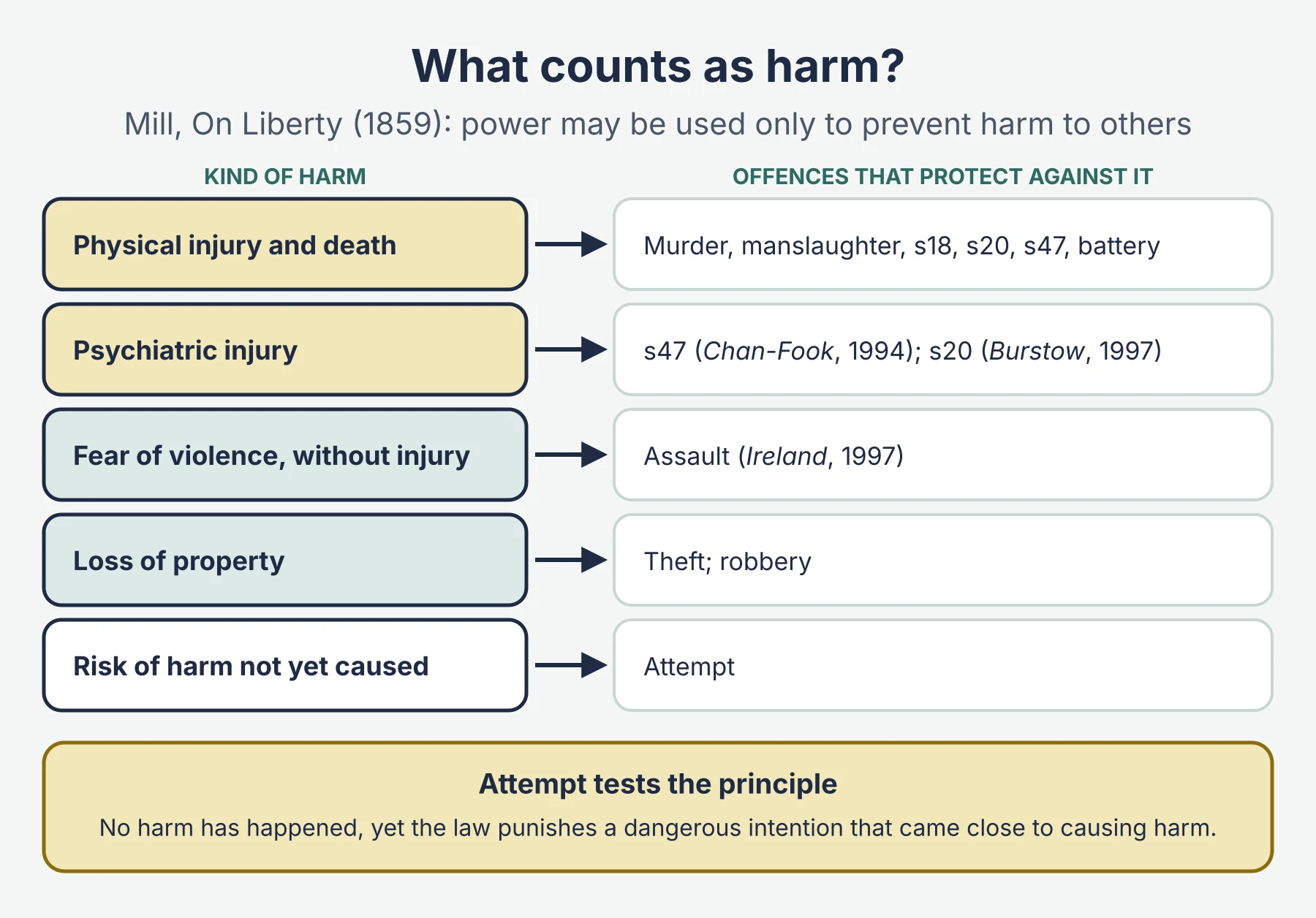
The harm principle. John Stuart Mill argued in On Liberty (1859) that “the only purpose for which power can be rightfully exercised over any member of a civilised community, against his will, is to prevent harm to others”. On this view the state may criminalise conduct that harms other people, but not conduct that harms only the actor or that others merely dislike.
What counts as harm? The criminal law recognises several kinds, and the specification’s offences show each:
| Kind of harm | Offences that protect against it |
|---|---|
| Physical injury and death | Murder, manslaughter, s18, s20, s47, battery |
| Psychiatric injury | s47 (Chan-Fook, 1994); s20 (Burstow, 1997) |
| Fear of violence, without injury | Assault (Ireland, 1997) |
| Loss of property | Theft; robbery |
| Risk of harm not yet caused | Attempt |
Attempt is a good test of the principle: no harm has happened, yet the law punishes because the defendant has shown a dangerous intention and come close to causing harm.
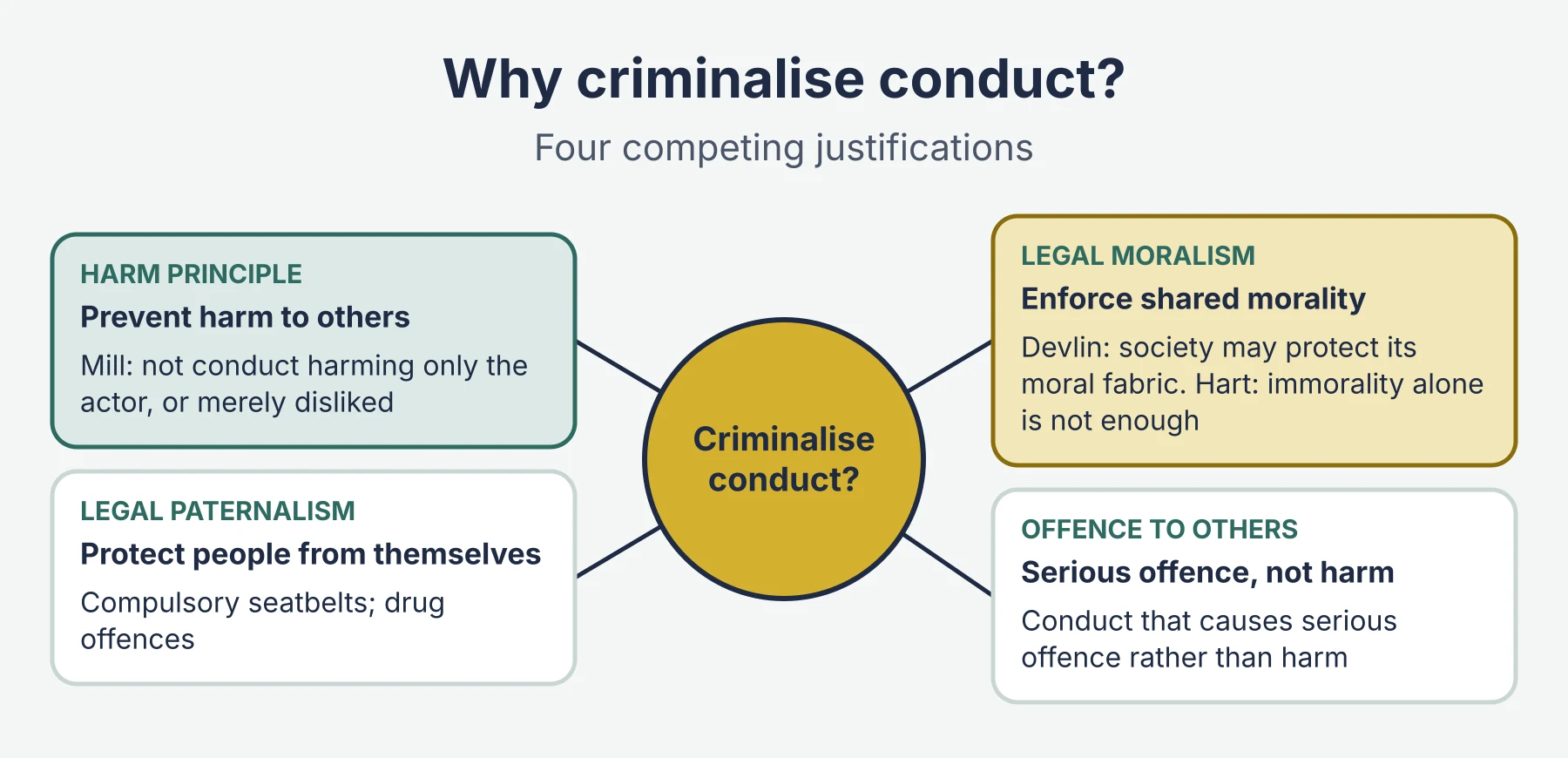
Beyond harm to others. Three other justifications compete with Mill’s principle:
- Legal paternalism: protecting people from themselves, such as compulsory seatbelts or drug offences.
- Legal moralism: enforcing shared morality. Lord Devlin argued that society may protect its moral fabric; H.L.A. Hart replied, following Mill, that immorality alone is not enough.
- Offence to others: conduct that causes serious offence rather than harm.
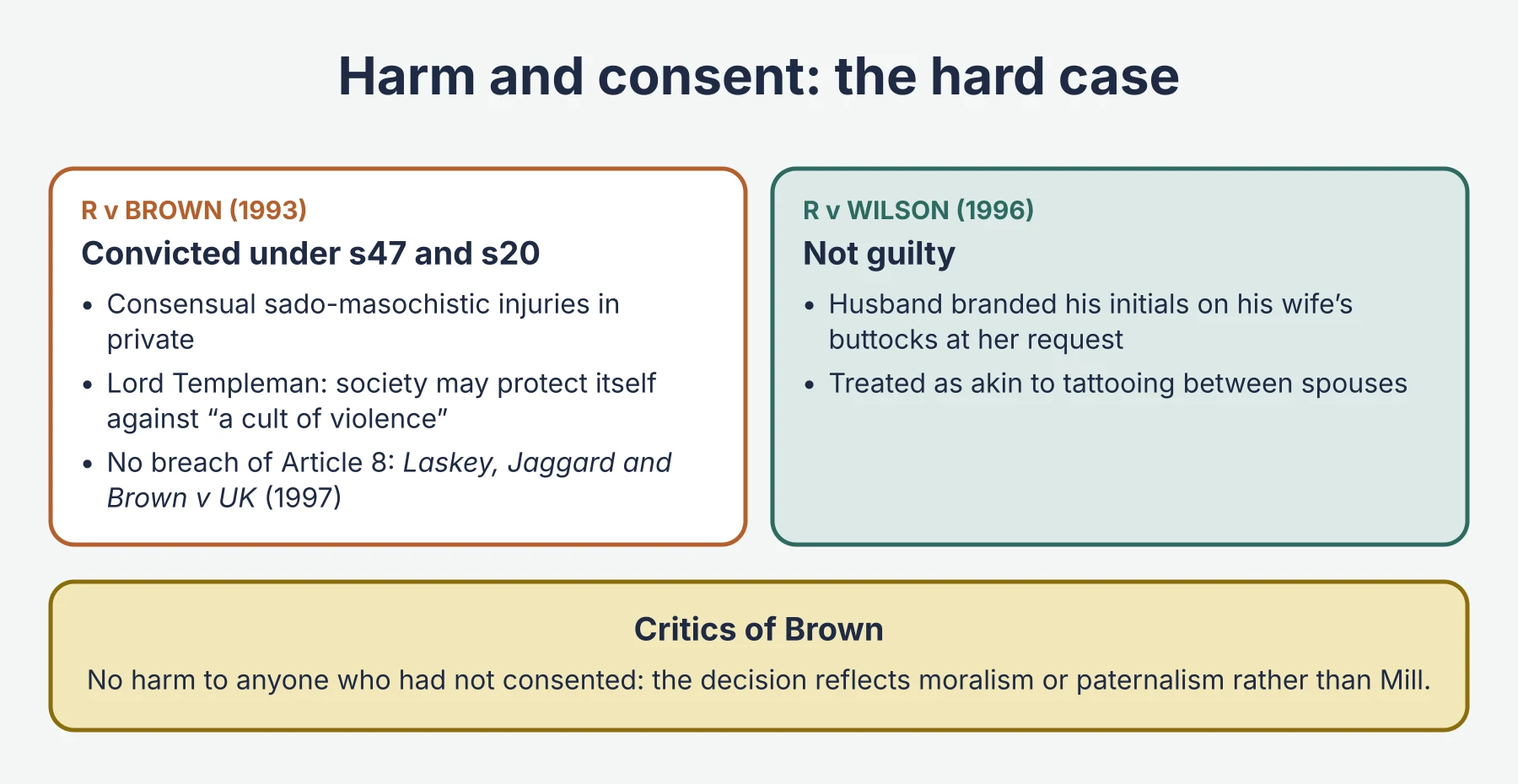
Harm and consent: the hard case. In R v Brown (1993) the House of Lords upheld s47 and s20 convictions of men who consented to sado-masochistic injuries in private; Lord Templeman said that society is entitled to protect itself against “a cult of violence”. Critics argue there was no harm to anyone who had not consented, so the decision reflects moralism or paternalism rather than Mill. Compare R v Wilson (1996), where a husband who branded his initials on his wife’s buttocks at her request was not guilty: the court treated it as akin to tattooing between spouses. The European Court of Human Rights found no breach of Article 8 in Laskey, Jaggard and Brown v UK (1997).
Autonomy, fault and individual responsibility
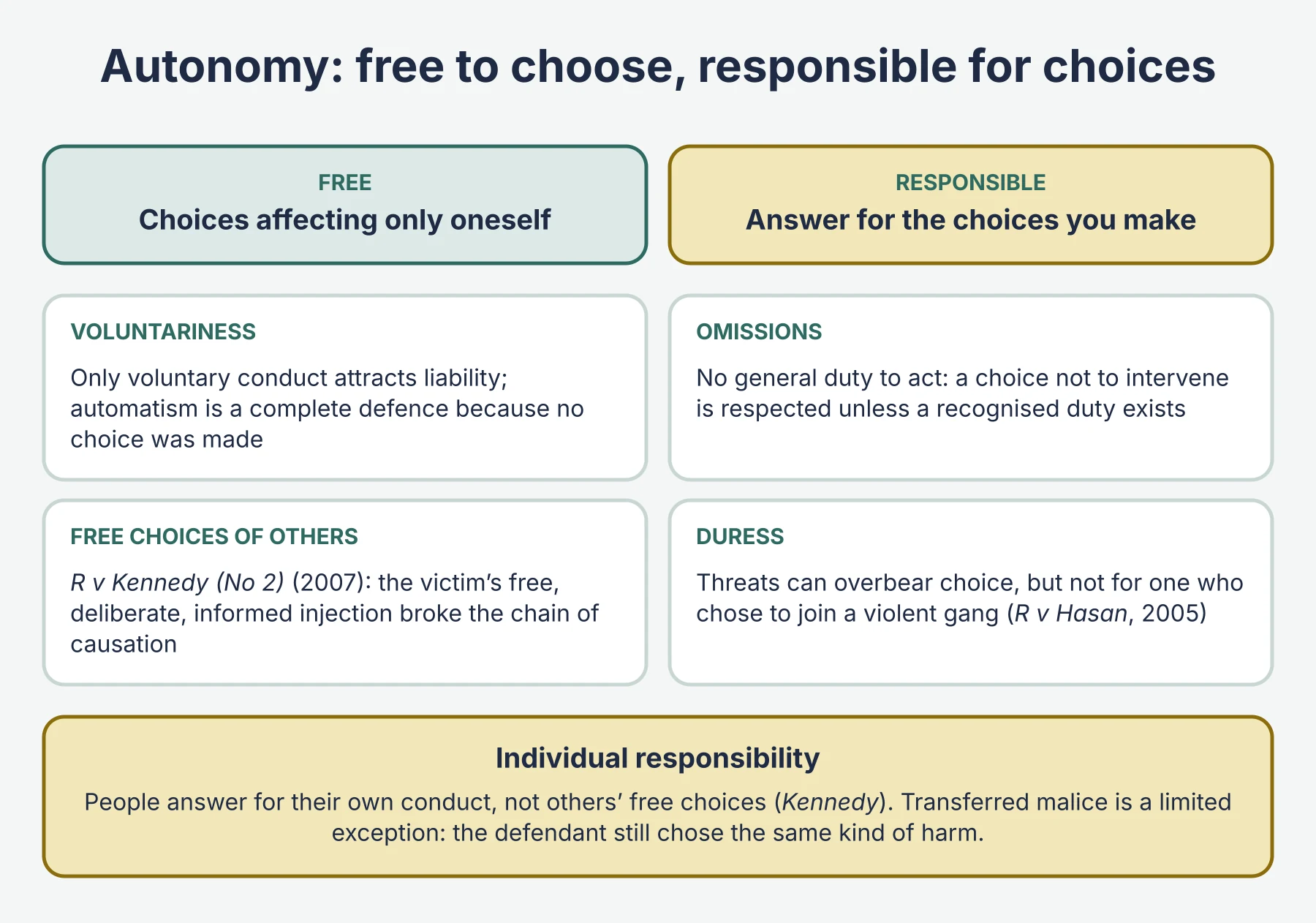
Autonomy means treating people as free, rational agents who choose how to act. It has two sides in criminal law: people should be free to make choices that affect only themselves, and people should be held responsible for the choices they make.
How autonomy shapes the rules
- Voluntariness. Only voluntary conduct attracts liability; automatism is a complete defence because the defendant made no choice at all.
- Omissions. There is no general duty to act, so the law respects a person’s choice not to intervene unless a recognised duty exists.
- Free choices of others. In R v Kennedy (No 2) (2007) a dealer who supplied heroin was not guilty of manslaughter when the adult victim injected himself: the victim’s free, deliberate and informed act broke the chain of causation.
- Duress. The defence recognises that threats can overbear choice, but limits it where the defendant chose to join a violent gang (R v Hasan, 2005).
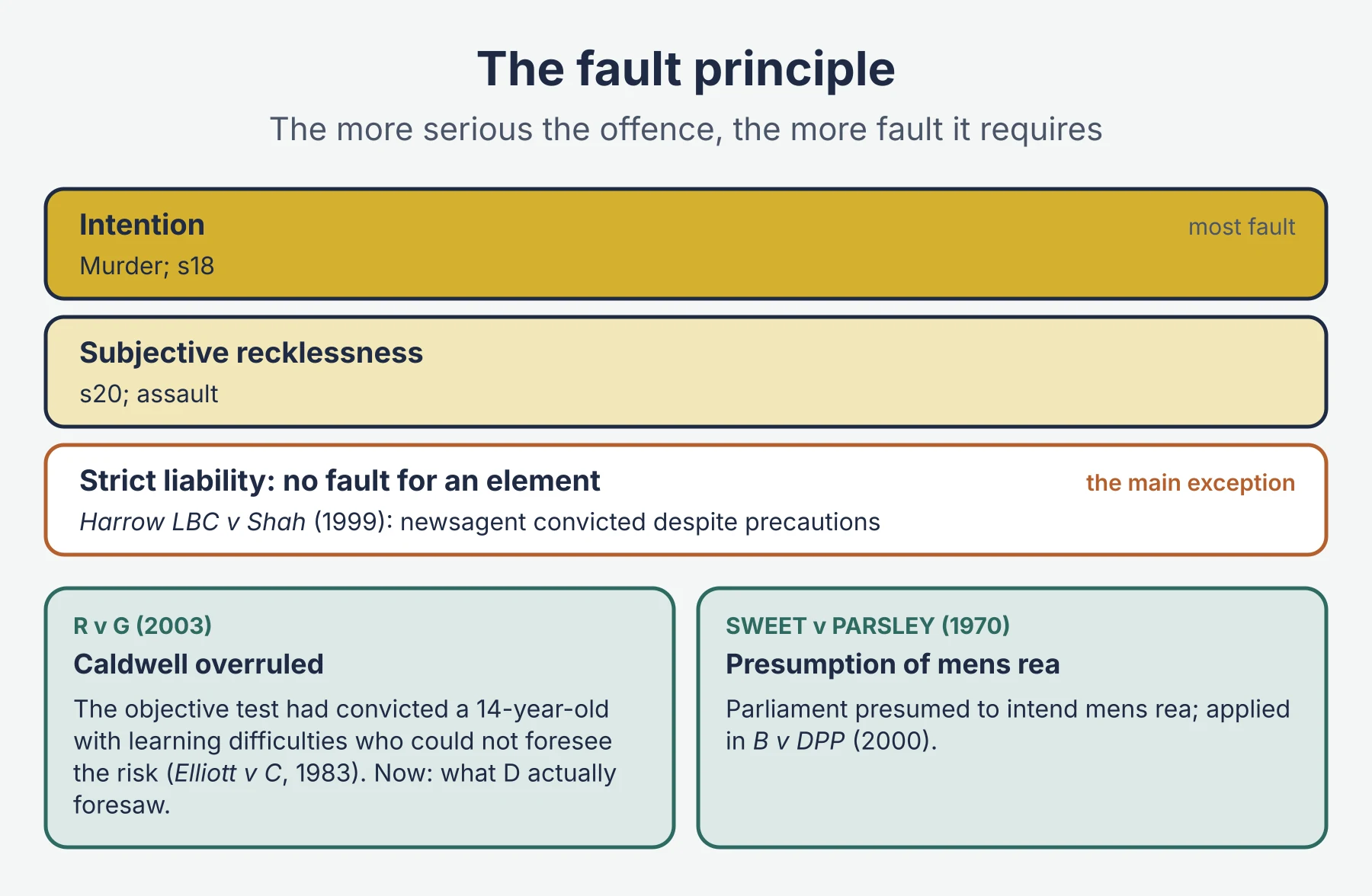
Fault links liability to blameworthiness. The general rule is that the more serious the offence, the more fault it requires: intention for murder and s18; subjective recklessness for s20 and assault. Two developments show the fault principle at work:
- In R v G (2003) the House of Lords overruled the objective Caldwell test of recklessness, partly because it had convicted a 14-year-old girl with learning difficulties who could not have foreseen the risk (Elliott v C, 1983). Liability is now based on what the defendant actually foresaw.
- In Sweet v Parsley (1970) the House of Lords held there is a presumption that Parliament intends mens rea to be required; B v DPP (2000) applied it.
Strict liability is the main exception to the fault principle. It is justified as protecting the public in regulatory areas, but criticised for punishing people who took all reasonable care, as in Harrow LBC v Shah (1999), where a newsagent was convicted when an employee sold a lottery ticket to a boy under 16 despite the shop’s precautions.
Individual responsibility means people answer for their own conduct, not for what others freely choose to do. Kennedy is the clearest example; transferred malice is a limited exception, justified because the defendant still chose to cause the same kind of harm.
The four principles
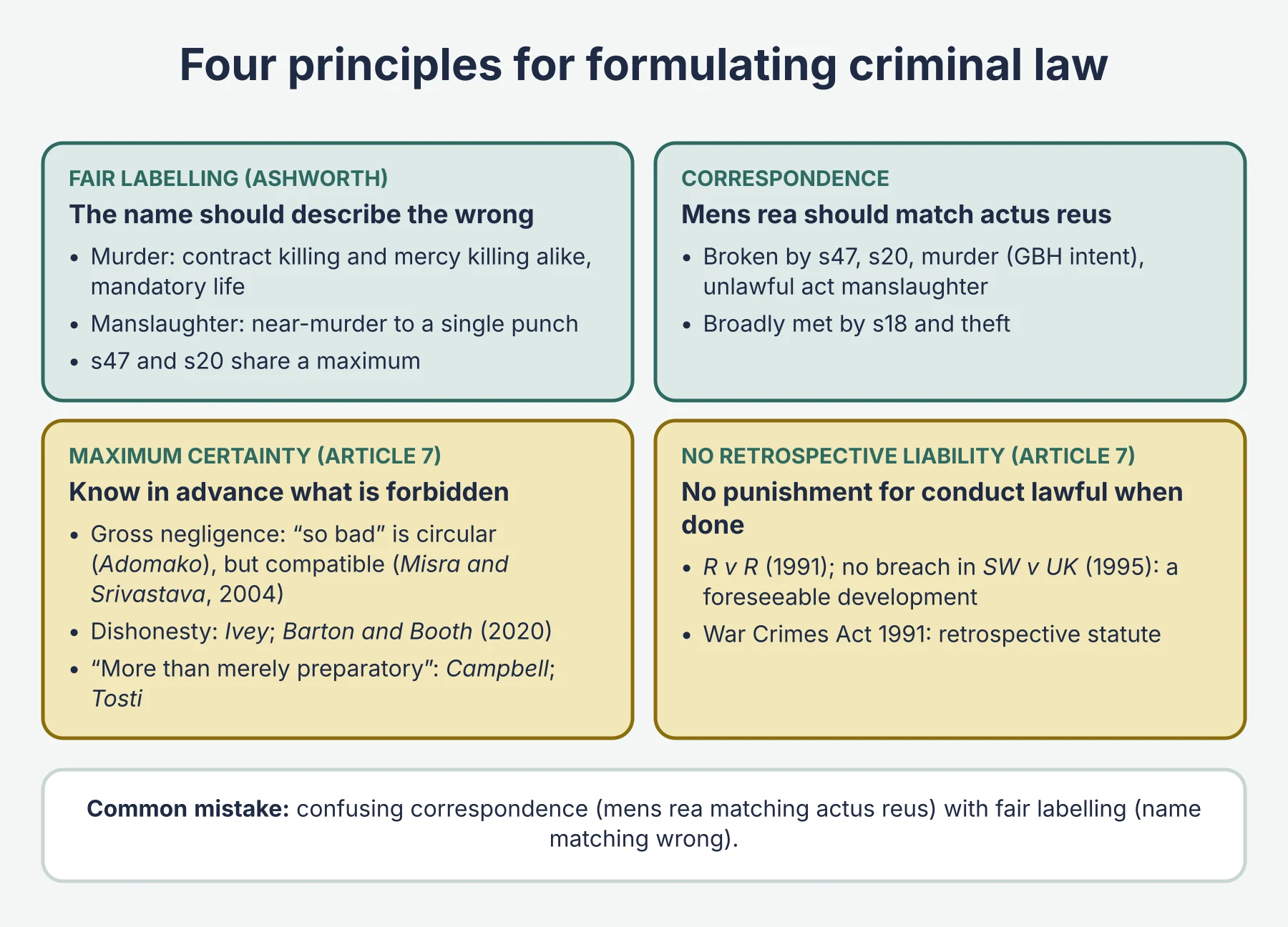
Fair labelling. The name of an offence should fairly describe the wrongdoing, so that the label tells the public, the court and future employers what the defendant did. The idea is associated particularly with Andrew Ashworth. Problems in the specification’s offences:
- Murder covers both a contract killing and a mercy killing by a loving relative, with the same mandatory life sentence.
- Manslaughter covers killings ranging from near-murder (loss of control) to a single punch causing an unforeseeable death.
- s47 and s20 share the same maximum sentence despite different harms.
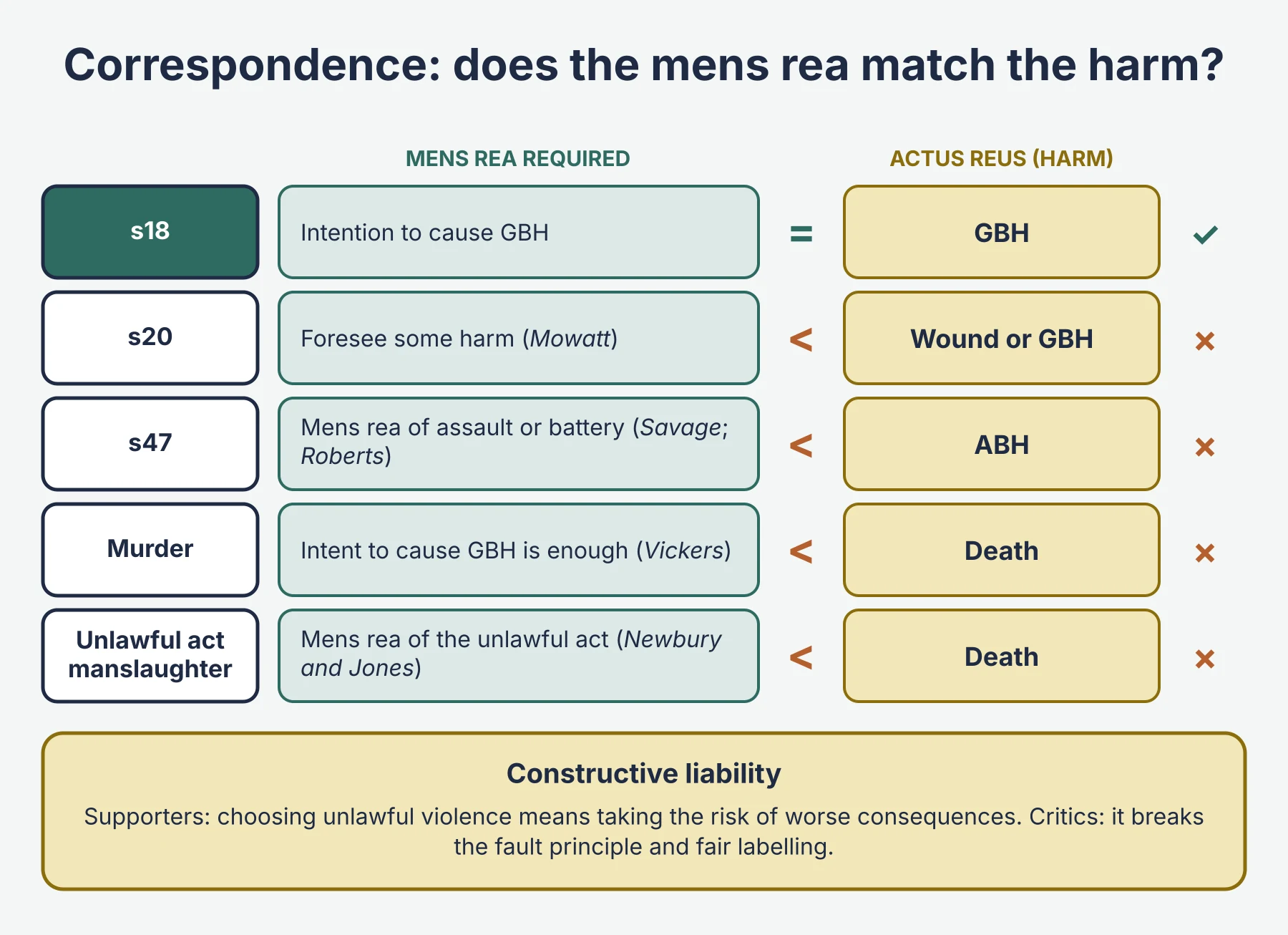
Correspondence. The mens rea should match the actus reus: a defendant should be liable for a harm only if they intended or foresaw that harm. Breaches are sometimes called constructive liability:
- s47 requires only the mens rea of assault or battery, with no foresight of harm (R v Savage, 1991; R v Roberts, 1971).
- s20 requires foresight of only “some harm”, although the actus reus is a wound or GBH (R v Mowatt, 1968).
- Murder can be committed with intent to cause GBH (R v Vickers, 1957), without any foresight of death.
- Unlawful act manslaughter needs only the mens rea of the unlawful act and an objectively dangerous act (DPP v Newbury and Jones, 1977).
By contrast, s18 (intention to cause GBH) and theft broadly comply.
Maximum certainty. Criminal law should be clear enough for people to know in advance what is forbidden, which also reflects Article 7 ECHR. Problems include:
- Gross negligence manslaughter: the jury decides whether negligence was “so bad” as to be criminal (R v Adomako, 1995), which is criticised as circular. In R v Misra and Srivastava (2004) the Court of Appeal held the offence nonetheless compatible with Article 7.
- Dishonesty: after Ivey v Genting Casinos (2017), confirmed for criminal law in R v Barton and Booth (2020), the standard is that of ordinary decent people, which different juries may apply differently.
- “More than merely preparatory” in attempt, which has produced hard-to-reconcile outcomes in Campbell (1991) and Tosti (1997).
No retrospective liability. No one should be punished for conduct that was not criminal when it was done (Article 7 ECHR). In R v R (1991) the House of Lords abolished the marital rape exemption and upheld the husband’s conviction for conduct before the ruling. The European Court of Human Rights held in SW v UK (1995) that there was no breach, because the change was a reasonably foreseeable development of the law. Parliament has occasionally legislated retrospectively, as in the War Crimes Act 1991.
Worked example: using theory to evaluate
Evaluate whether the law on non-fatal offences complies with the principle of correspondence.
Define:    correspondence = mens rea should match actus reus.
Comply:    assault and battery - intention/recklessness as to the very conduct.
           s18 - intention to cause the GBH actually caused.
Breach:    s47 - no foresight of ABH needed (Savage; Roberts).
           s20 - foresee some harm, actus reus is GBH or a wound (Mowatt).
Debate:    Supporters: a person who chooses unlawful violence takes the risk
           of worse consequences. Critics: this breaks fault and fair labelling.
Reform:    the Law Commission recommended replacing the 1861 Act (2015).
Judge:     the law complies at the extremes but not in the middle offences.
Common mistakes
- Defining a principle but never applying it to an offence or case.
- Treating Brown as an application of Mill’s harm principle without explaining why it is contested.
- Confusing correspondence (mens rea matching actus reus) with fair labelling (name matching wrong).
- Using “certainty” loosely: name the vague test and the case.
- Forgetting that theory can also be used to support the law, not only to criticise it.
Exam technique
When an evaluation question names a principle, define it, give at least two examples where the law complies or fails, use cases for each, consider the counter-argument and conclude. When a question does not name a principle, choose one or two that fit the area: correspondence for non-fatal offences, certainty for gross negligence and dishonesty, fair labelling for murder.
More resources on this topic
Theory in criminal law revision notes | Theory in criminal law practice questions
Related resources
-
Practice questions
AQA A Level Law (7162): Theory in Criminal Law – Practice Questions
Original practice questions with mark-scheme answers on harm, autonomy, fault and the four principles of criminal law for AQA A Level Law 7162 Paper 1.
Law · AQA · A Level
Try questions -
Revision notes
AQA A Level Law (7162): Theory in Criminal Law – Revision Notes
Recall notes on harm, autonomy, fault, responsibility and the four principles of criminal law with the cases that test them, for AQA A Level Law 7162.
Law · AQA · A Level
Revise topic -
Practice questions
AQA A Level Law: General Elements of Criminal Liability — Practice Questions
Original practice questions with worked answers on actus reus, mens rea, causation, omissions, transferred malice and strict liability for AQA A Level Law 7162.
Law · AQA · A Level
Try questions
Get free revision emails (optional)
Occasional emails with practice questions, worked explanations and links to free resources for the qualification and subjects you choose. No spam, and you can unsubscribe from any email. The free tools on this site never need an email.