
Revision Notes
AQA A Level Law (7162): Theory in Criminal Law – Revision Notes
Recall notes on harm, autonomy, fault, responsibility and the four principles of criminal law with the cases that test them, for AQA A Level Law 7162.
- Subject
- Law
- Level
- A LEVELS
- Topic
- Criminal law
- Author
- Marlbridge Academic Team
- Updated
- Reviewed by
- Aizaz Raoof Ali (what this means)
Aligned to AQA A Level Law (7162), For teaching from September 2017 onwards, A-level exams 2019 onwards. Official specification .
Syllabus page (what it covers and how it is assessed): AQA A Level Law.
Syllabus points this page covers
7162
- Theory in criminal law
Found an error? Report a correction.
Need help with this topic? Request a free trial class for A Level Law (7162).
Condensed notes for the section 3.2 row Theory in criminal law: harm as the basis for criminalising conduct; autonomy, fault and individual responsibility; and the principles of fair labelling, correspondence, maximum certainty and no retrospective liability. For explanation and a worked evaluation, use the theory in criminal law study guide.
Harm
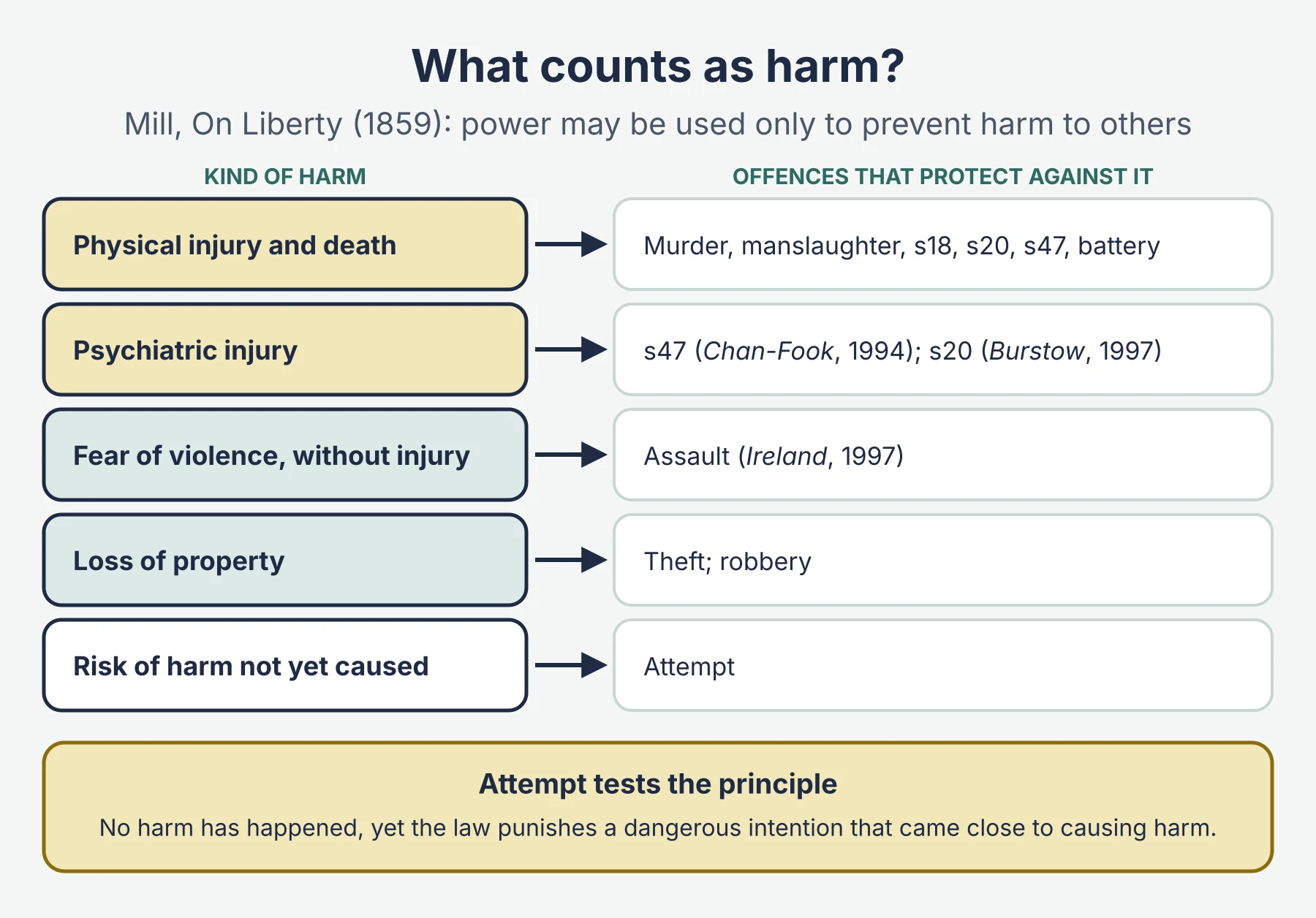
- Mill, On Liberty (1859): power may rightfully be exercised over a person against their will only to prevent harm to others.
- Kinds of harm protected: death and injury; psychiatric injury (Chan-Fook; Burstow); fear of violence (assault, Ireland); property (theft, robbery); risk of harm (attempt).
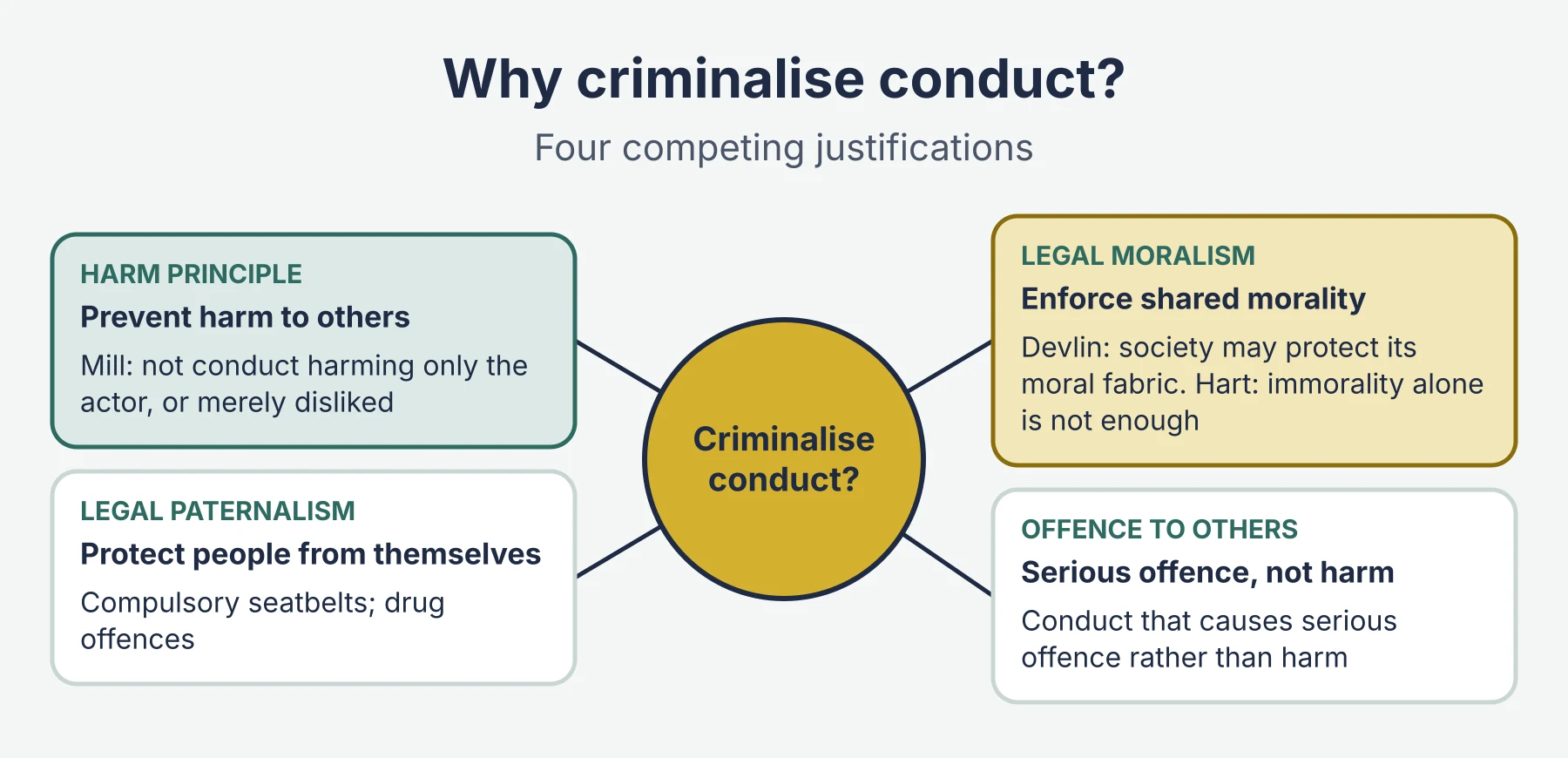
- Rival justifications: paternalism (protecting people from themselves); moralism (Devlin v Hart); offence to others.
Consent and harm
| Case | Outcome | Theory point |
|---|---|---|
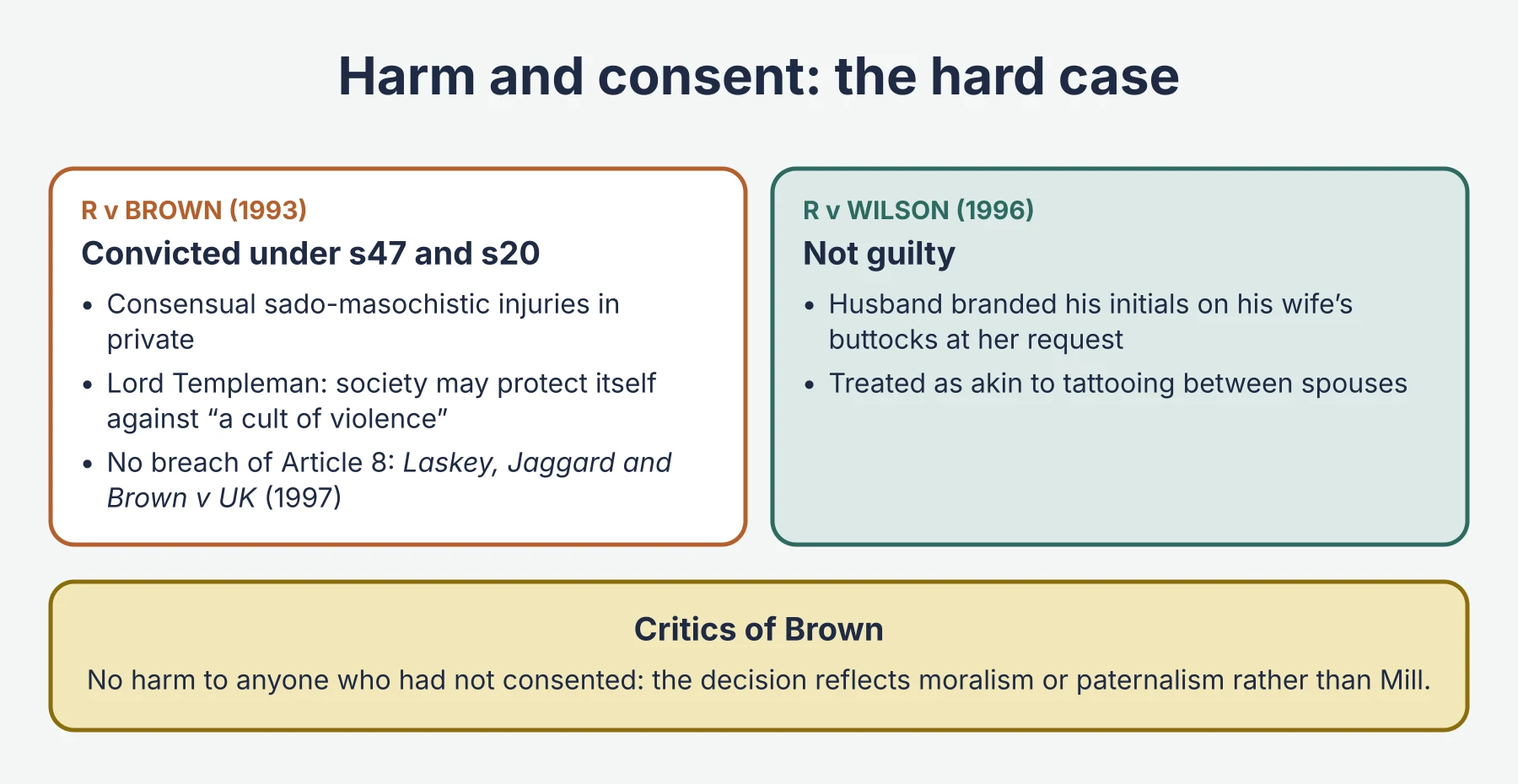
| R v Brown (1993) | Consent no defence to ABH or worse in sado-masochism | Moralism or paternalism over autonomy; “cult of violence” (Lord Templeman) |
| R v Wilson (1996) | Consensual branding between spouses not criminal | Autonomy and privacy respected |
| Laskey, Jaggard and Brown v UK (1997) | No breach of Article 8 | State may regulate harm even in private |
Autonomy, fault and responsibility
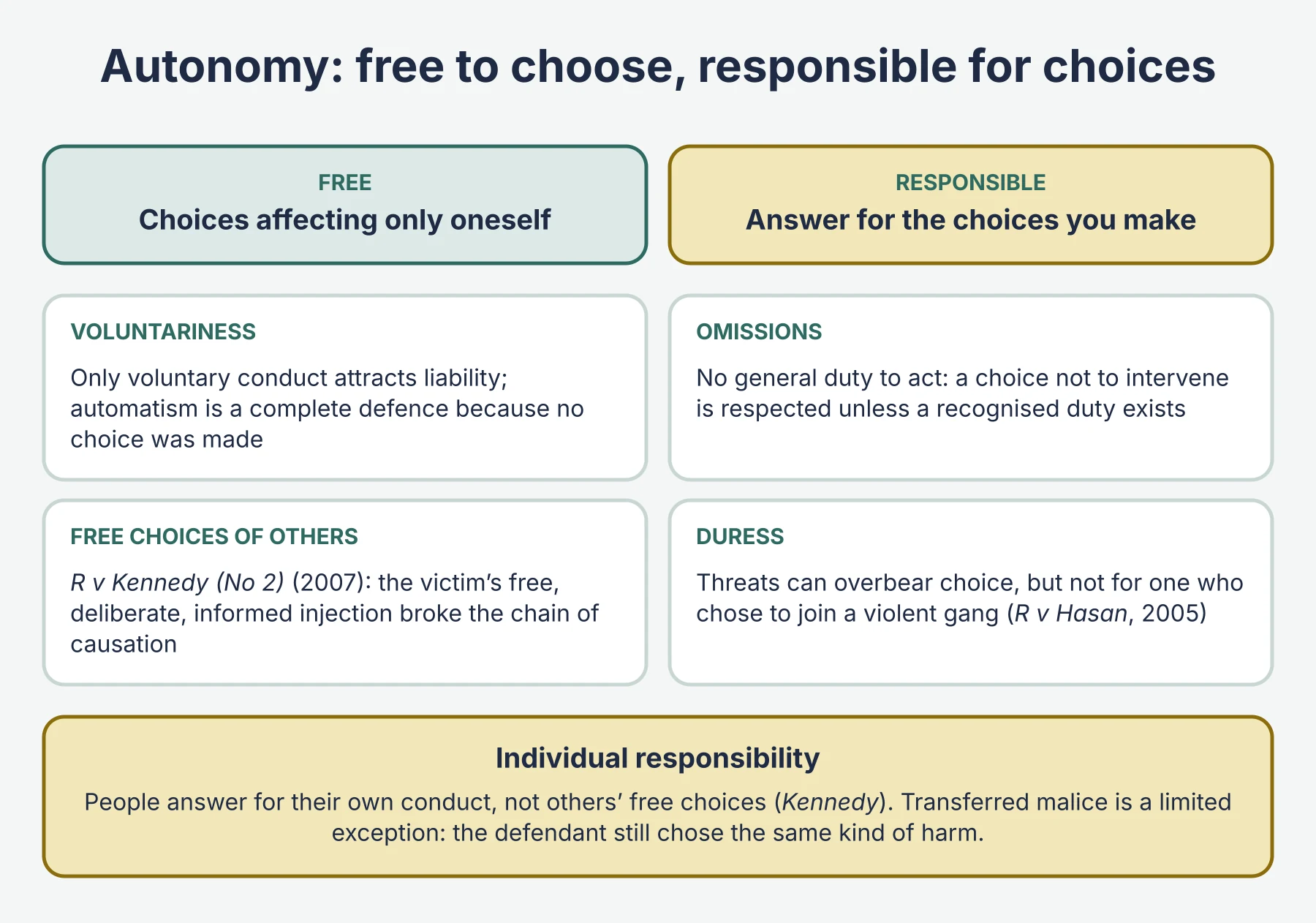
Autonomy: freedom to choose, and responsibility for choices.
| Rule | How it reflects autonomy |
|---|---|
| Voluntariness; automatism | No choice, no liability |
| No general duty to act | Respects choice not to intervene |
| R v Kennedy (No 2) (2007) | Victim’s free, deliberate, informed act breaks the chain |
| Duress; Hasan (2005) | Threats overbear choice, but voluntary association with violent criminals defeats the defence |
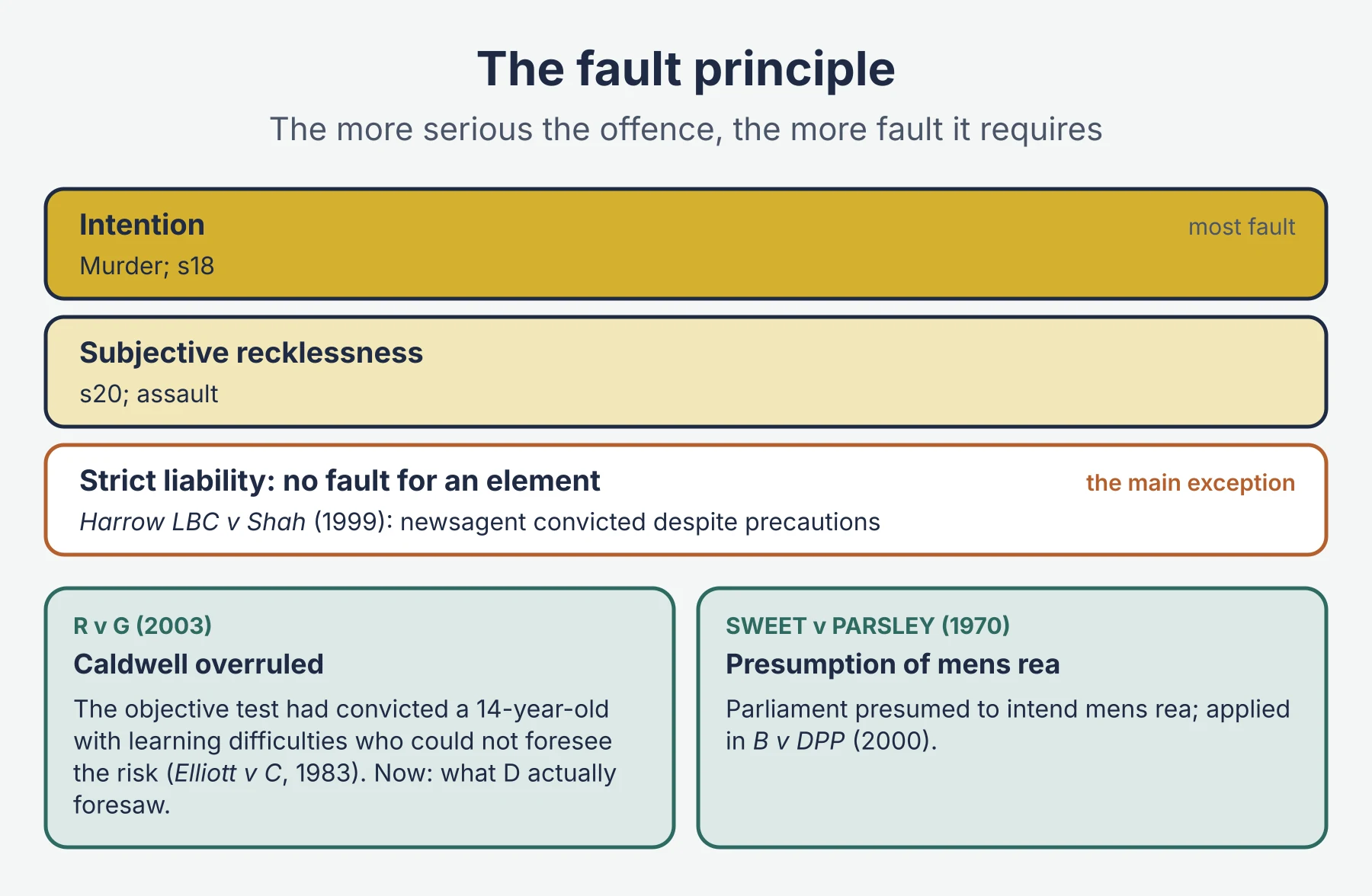
Fault: more serious offences require more fault.
- R v G (2003) overruled objective Caldwell recklessness; Elliott v C (1983) shows why.
- Sweet v Parsley (1970); B v DPP (2000): presumption of mens rea.
- Strict liability as the exception: Harrow LBC v Shah (1999).
Individual responsibility: answer for your own conduct (Kennedy); transferred malice as a limited exception.
The four principles
| Principle | Meaning | Complies | Breached or strained |
|---|---|---|---|
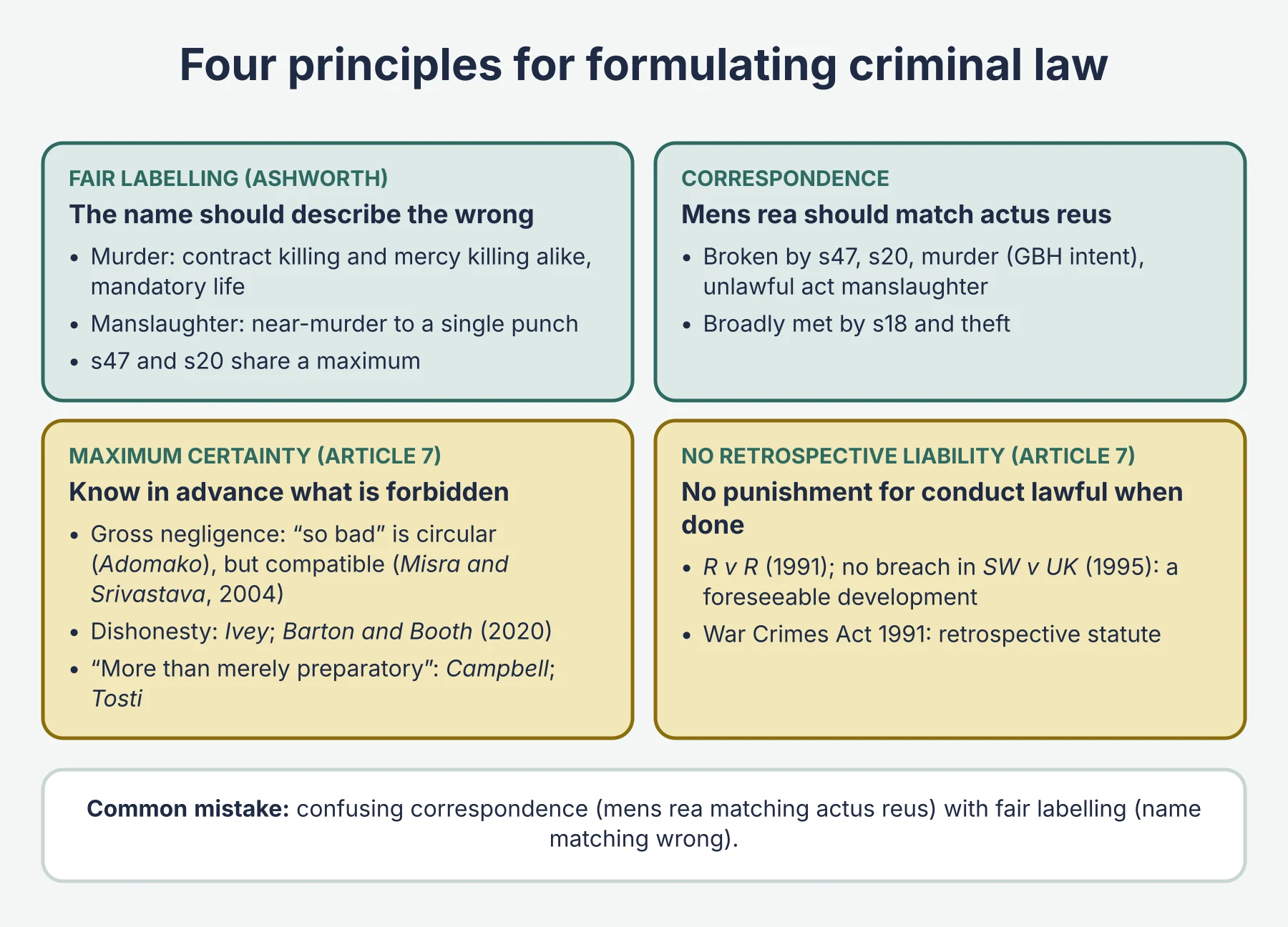
| Fair labelling | Name of offence describes the wrong | s18 “with intent”; robbery distinguished from theft | Murder covers mercy and contract killings; manslaughter’s huge range; s47 and s20 share a maximum |
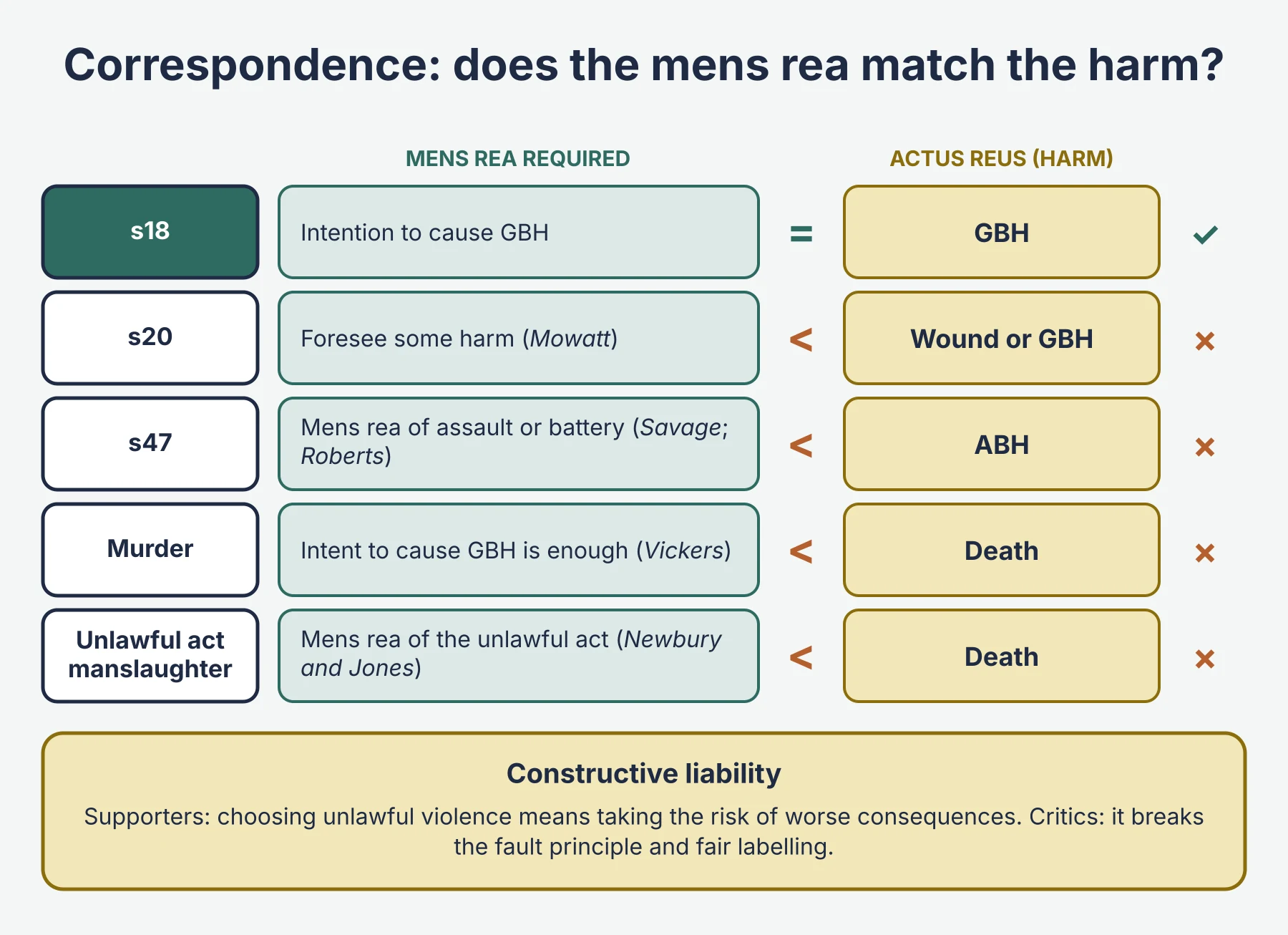
| Correspondence | Mens rea matches actus reus | Assault; battery; s18 | s47 (Savage; Roberts); s20 (Mowatt); murder via GBH intent (Vickers); unlawful act manslaughter (Newbury and Jones) |
| Maximum certainty | Law clear in advance; Article 7 ECHR | Statutory definitions in the Theft Act 1968 | Gross negligence “so bad” test (Adomako; upheld in Misra and Srivastava, 2004); dishonesty (Ivey; Barton and Booth); “more than merely preparatory” (compare Campbell and Tosti) |
| No retrospective liability | No punishment for conduct lawful when done | Courts cannot create new offences (Knuller, 1973) | R v R (1991), upheld in SW v UK (1995); War Crimes Act 1991 |
Key terms
| Term | Meaning |
|---|---|
| Harm principle | Only harm to others justifies criminalisation (Mill) |
| Legal paternalism | Criminalising to protect people from themselves |
| Legal moralism | Criminalising to enforce shared morality (Devlin) |
| Autonomy | Treating people as free agents responsible for their choices |
| Constructive liability | Liability for a consequence beyond what the defendant intended or foresaw |
| Fair labelling | Offence names should reflect the nature and seriousness of the wrong |
| Correspondence | Mens rea should correspond to the actus reus |
| Maximum certainty | Offences should be defined clearly enough to guide conduct |
| Non-retrospectivity | No liability for acts that were lawful when done |
Which principle for which question?
- Non-fatal offences: correspondence first, then fair labelling.
- Murder: fair labelling (mandatory life) and correspondence (GBH intent).
- Unlawful act manslaughter: correspondence (objective danger, no foresight of death).
- Gross negligence manslaughter: maximum certainty.
- Theft: certainty (dishonesty); fault (subjective first stage of Ivey).
- Attempt: harm (no harm caused) and certainty (“more than merely preparatory”).
- Duress and intoxication: autonomy and individual responsibility.
Exam traps
- Defining principles without applying them to specific offences.
- Confusing correspondence with fair labelling.
- Citing Brown as straightforward harm-principle reasoning.
- Forgetting that SW v UK found no breach of Article 7.
- Arguing only one side: the “risk of worse consequences” argument supports constructive liability.
Self-test
- State Mill’s harm principle.
- How does attempt test the harm principle?
- What did R v Brown decide?
- How does R v Wilson differ from Brown?
- What did R v Kennedy (No 2) decide, and which theory does it reflect?
- Why was Caldwell recklessness overruled in R v G?
- Define correspondence and give one offence that breaches it.
- Define fair labelling and give one example of a problem.
- Which offence’s test is criticised as circular, and which case held it compatible with Article 7?
- What did SW v UK decide?
- Which case presumes that mens rea is required in statutory offences?
- Give one argument in favour of constructive liability.
Answers: 1. Power may rightfully be exercised over a person against their will only to prevent harm to others. 2. It punishes conduct before any harm occurs. 3. Consent is no defence to ABH or more serious harm inflicted in sado-masochistic encounters. 4. Consensual branding between spouses was not criminal, treated as similar to tattooing. 5. A free, deliberate and informed act of self-injection by the victim broke the chain of causation; autonomy and individual responsibility. 6. It was objective and convicted people who could not foresee the risk, such as the girl in Elliott v C; liability should reflect actual foresight. 7. Mens rea should match actus reus; s47 (no foresight of harm needed). 8. The name should describe the wrong; murder covers mercy killings and contract killings alike. 9. Gross negligence manslaughter; R v Misra and Srivastava (2004). 10. The retrospective abolition of the marital rape exemption in R v R did not breach Article 7, as it was a foreseeable development. 11. Sweet v Parsley (1970). 12. A person who chooses to use unlawful violence accepts the risk of worse consequences than intended.
Test yourself further with the theory in criminal law practice questions.
Related resources
-
Practice questions
AQA A Level Law: General Elements of Criminal Liability — Practice Questions
Original practice questions with worked answers on actus reus, mens rea, causation, omissions, transferred malice and strict liability for AQA A Level Law 7162.
Law · AQA · A Level
Try questions -
Revision notes
AQA A-Level Law: General Elements of Criminal Liability — Revision Notes
Condensed recall notes on actus reus, mens rea, causation, transferred malice and strict liability for AQA A-Level Law (7162), General Elements of Liability.
Law · AQA · A Level
Revise topic -
Practice questions
AQA A-Level Law: Criminal Offences and Defences — Practice Questions
Original practice questions with mark-scheme answers on homicide, assaults, theft, robbery, attempt and criminal defences for AQA A-Level Law 7162 Paper 1.
Law · AQA · A Level
Try questions
Get free revision emails (optional)
Occasional emails with practice questions, worked explanations and links to free resources for the qualification and subjects you choose. No spam, and you can unsubscribe from any email. The free tools on this site never need an email.