
Study Guides
AQA A Level Law (7162): Fatal Offences Against the Person
Murder, loss of control, diminished responsibility, unlawful act and gross negligence manslaughter, with cases and a worked problem, for AQA A Level Law 7162.
- Subject
- Law
- Level
- A LEVELS
- Topic
- Criminal law
- Author
- Marlbridge Academic Team
- Updated
- Reviewed by
- Aizaz Raoof Ali (what this means)
Aligned to AQA A Level Law (7162), For teaching from September 2017 onwards, A-level exams 2019 onwards. Official specification .
Syllabus page (what it covers and how it is assessed): AQA A Level Law.
Syllabus points this page covers
7162
- Fatal offences against the person
Found an error? Report a correction.
Need help with this topic? Request a free trial class for A Level Law (7162).
This guide covers the section 3.2 row Fatal offences against the person in AQA A-level Law (7162). The specification lists the “common law offence of murder”; “voluntary manslaughter”: loss of control (s54 Coroners and Justice Act 2009) and diminished responsibility (s2 Homicide Act 1957 as amended); and the “common law offence of involuntary manslaughter”: unlawful act manslaughter and gross negligence manslaughter. Homicide is the most heavily weighted area of Paper 1 problem questions, because one scenario can raise murder, a partial defence and an involuntary manslaughter alternative. For an overview of all the offences, see the Criminal Offences and Defences study guide.
Murder
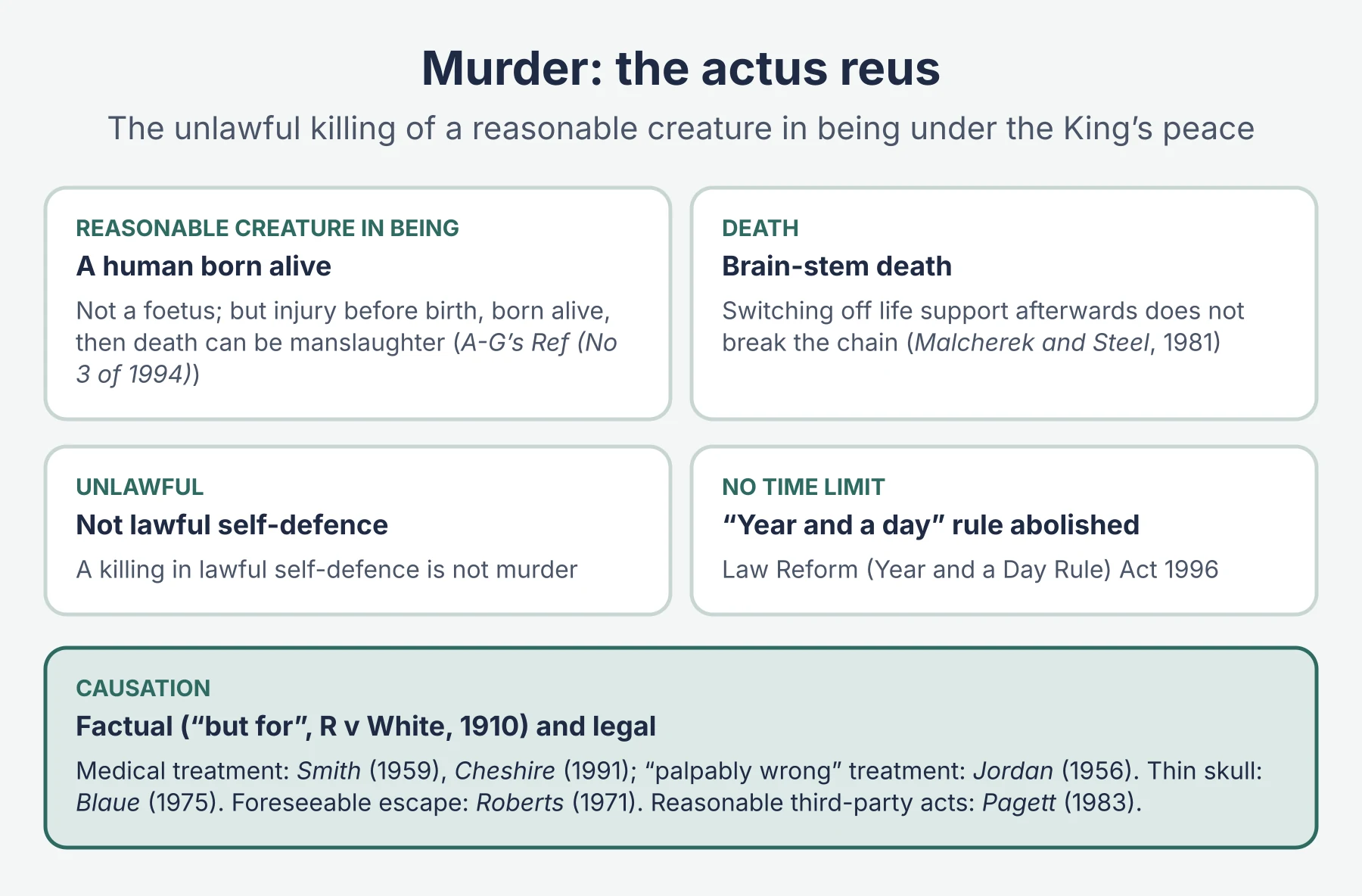
Definition. Murder is the unlawful killing of a reasonable creature in being under the King’s peace with malice aforethought, express or implied. It has no statutory definition and carries a mandatory life sentence; the judge sets the minimum term.
Actus reus points
- Reasonable creature in being: a human being born alive. A foetus is not, though a child injured before birth who is born alive and then dies can be the victim of manslaughter (Attorney-General’s Reference (No 3 of 1994), 1997).
- Death: brain-stem death. Switching off a life-support machine after brain-stem death does not break the chain of causation (R v Malcherek and Steel, 1981).
- Unlawful: a killing in lawful self-defence is not murder.
- No time limit: the “year and a day” rule was abolished by the Law Reform (Year and a Day Rule) Act 1996.
- Causation: factual (“but for”, R v White, 1910) and legal. Key cases on legal causation: R v Smith (1959) and R v Cheshire (1991) on medical treatment; R v Jordan (1956) where treatment was “palpably wrong”; R v Blaue (1975) on the thin skull rule; R v Roberts (1971) on the victim’s foreseeable escape; R v Pagett (1983) on reasonable acts of third parties.
Mens rea: malice aforethought
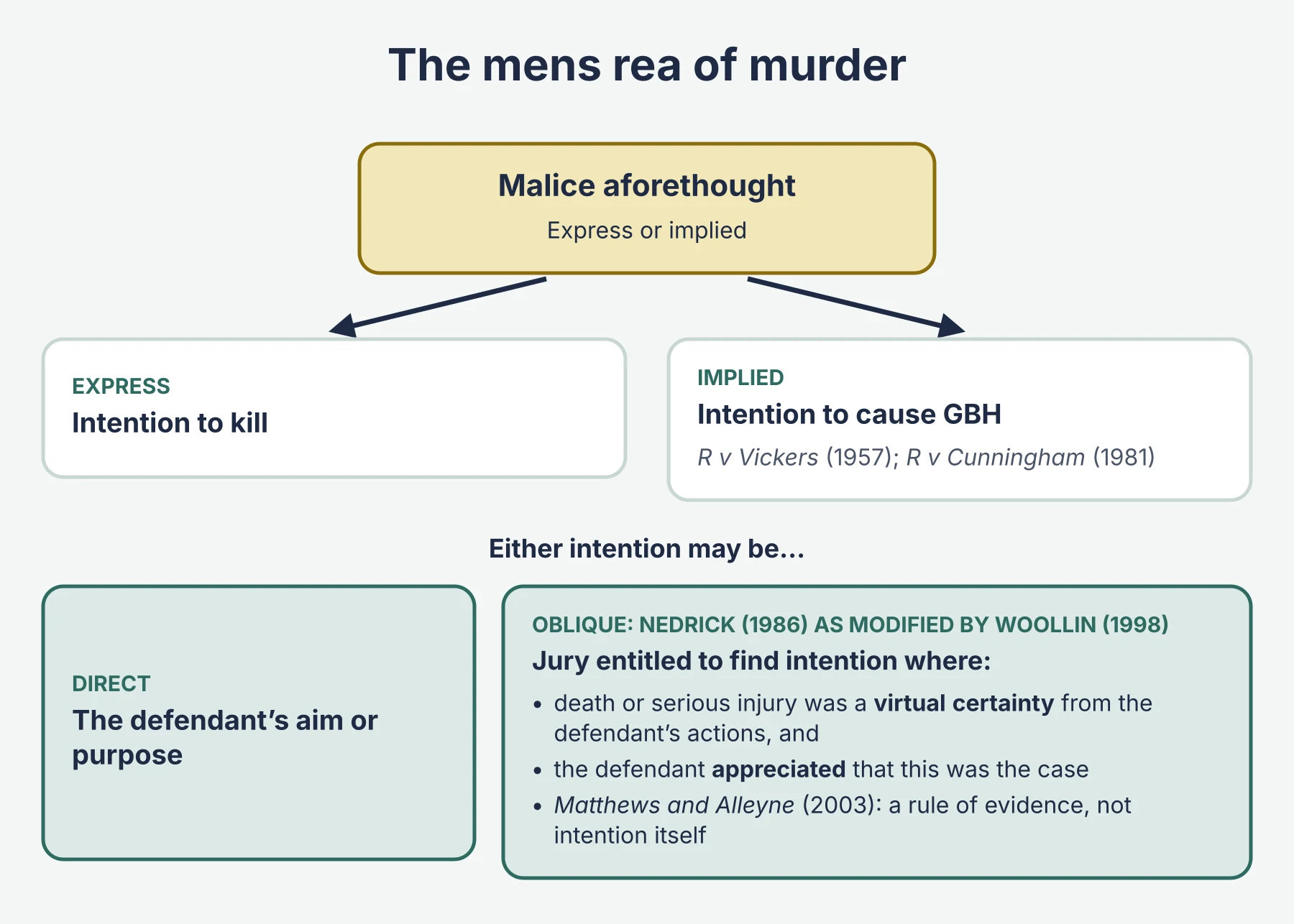
- Express malice: intention to kill.
- Implied malice: intention to cause GBH (R v Vickers, 1957, confirmed in R v Cunningham, 1981).
- Direct intention: the defendant’s aim or purpose.
- Oblique intention: the jury is entitled to find intention where death or serious injury was a virtual certainty as a result of the defendant’s actions and the defendant appreciated that this was the case (R v Nedrick, 1986, as modified by R v Woollin, 1998). In R v Matthews and Alleyne (2003) the Court of Appeal treated this as a rule of evidence: foresight of virtual certainty is evidence from which intention may be found, not intention itself.
Voluntary manslaughter: the partial defences
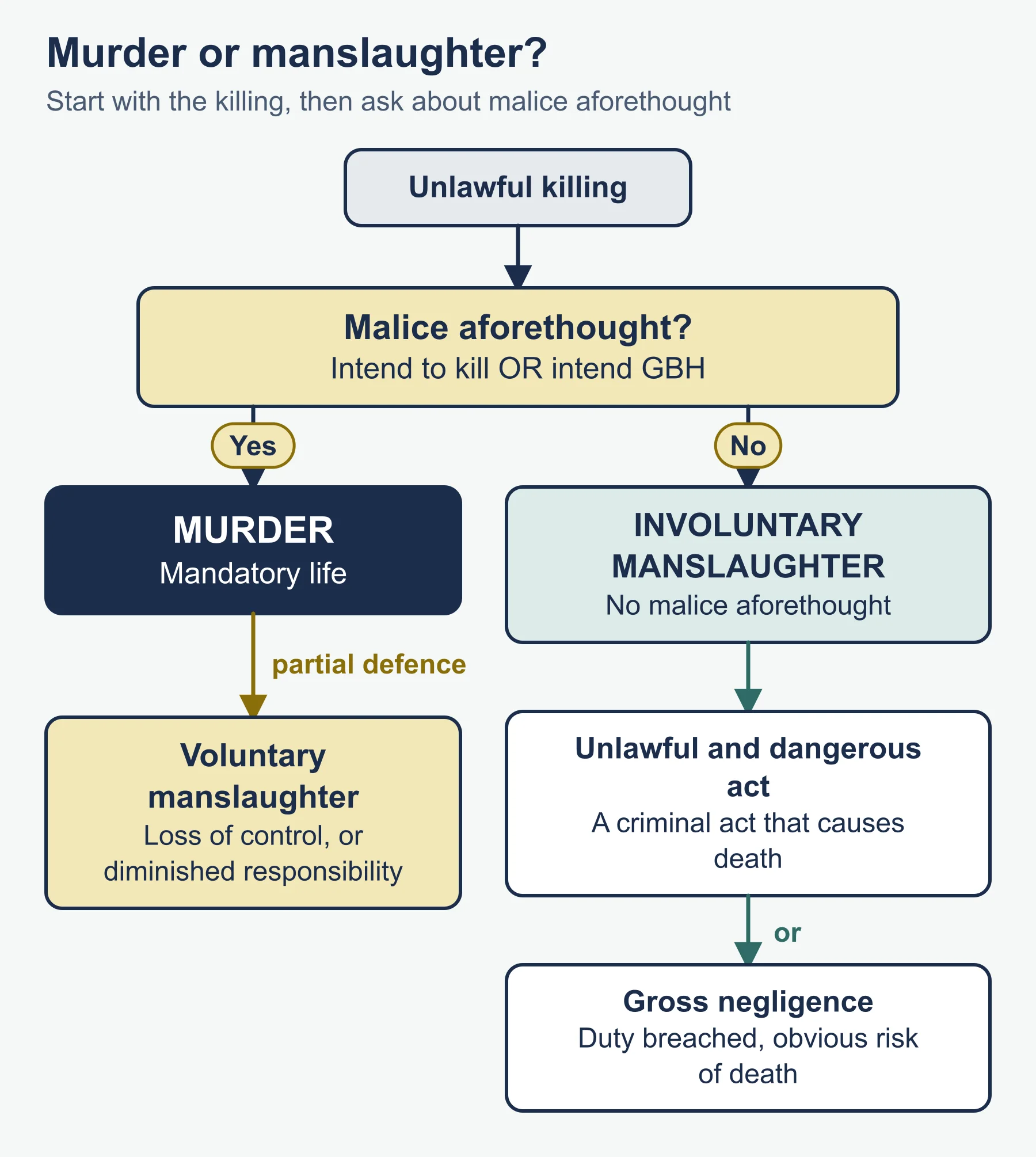
Both are partial defences to murder only. If successful, the defendant is convicted of manslaughter, and the judge has discretion over the sentence.
Loss of control (ss54–56 Coroners and Justice Act 2009)
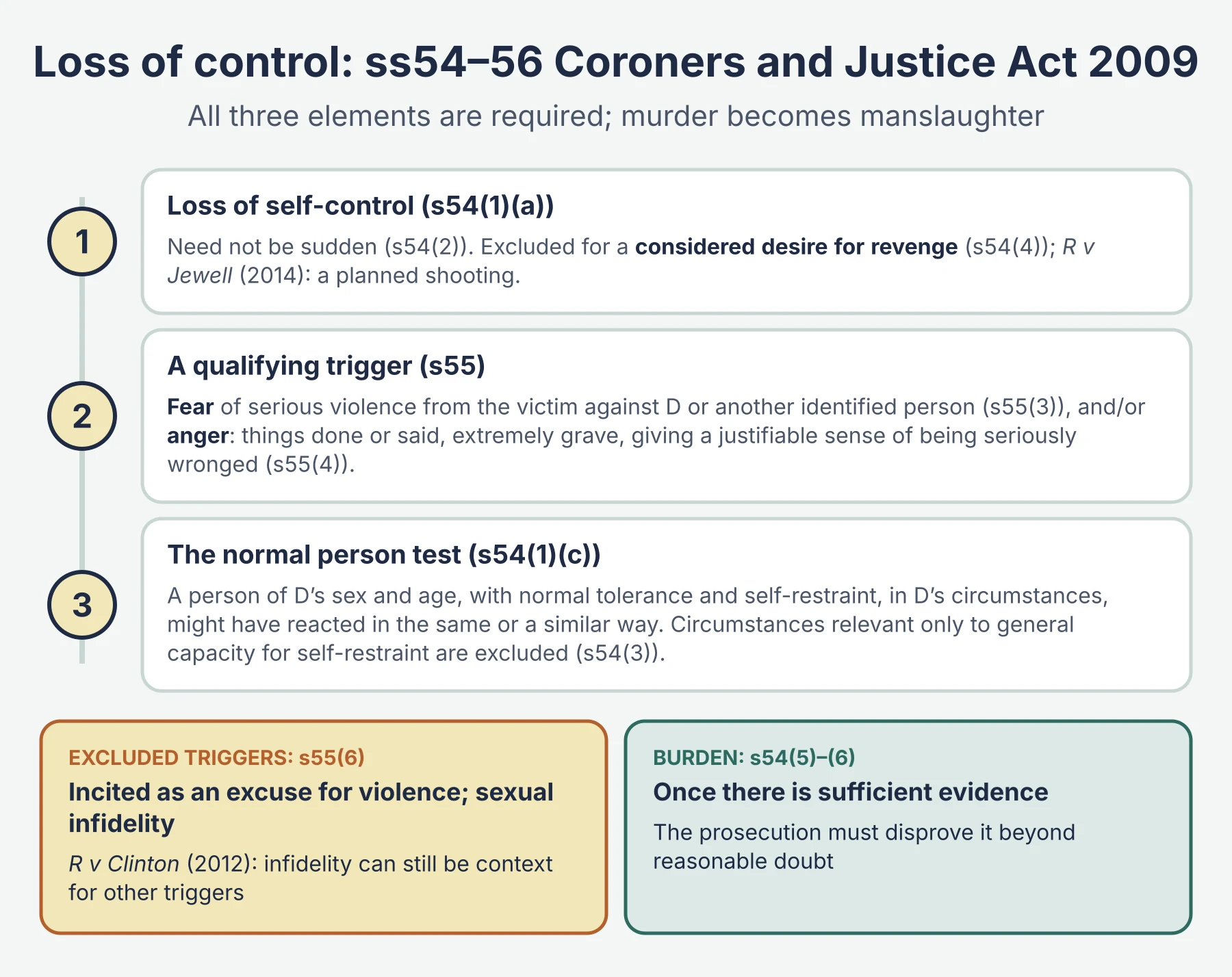
This replaced the common law defence of provocation. Three elements, all required:
- Loss of self-control (s54(1)(a)). It need not be sudden (s54(2)), but the defence is excluded if the defendant acted in a considered desire for revenge (s54(4)). In R v Jewell (2014) a planned shooting showed no loss of control.
- A qualifying trigger (s55):
- Fear trigger (s55(3)): fear of serious violence from the victim against the defendant or another identified person.
- Anger trigger (s55(4)): things done or said, or both, which constituted circumstances of an extremely grave character and caused the defendant to have a justifiable sense of being seriously wronged.
- Exclusions (s55(6)): a trigger the defendant incited as an excuse to use violence; and sexual infidelity, which is disregarded as a trigger, although R v Clinton (2012) allows it to be considered as part of the context of other triggering words or conduct.
- The normal person test (s54(1)(c)): a person of the defendant’s sex and age, with a normal degree of tolerance and self-restraint and in the defendant’s circumstances, might have reacted in the same or a similar way. Circumstances whose only relevance is to the defendant’s general capacity for tolerance or self-restraint are excluded (s54(3)).
Burden: if sufficient evidence is adduced, the jury must assume the defence is satisfied unless the prosecution proves beyond reasonable doubt that it is not (s54(5)–(6)).
Diminished responsibility (s2 Homicide Act 1957, as amended by s52 Coroners and Justice Act 2009)
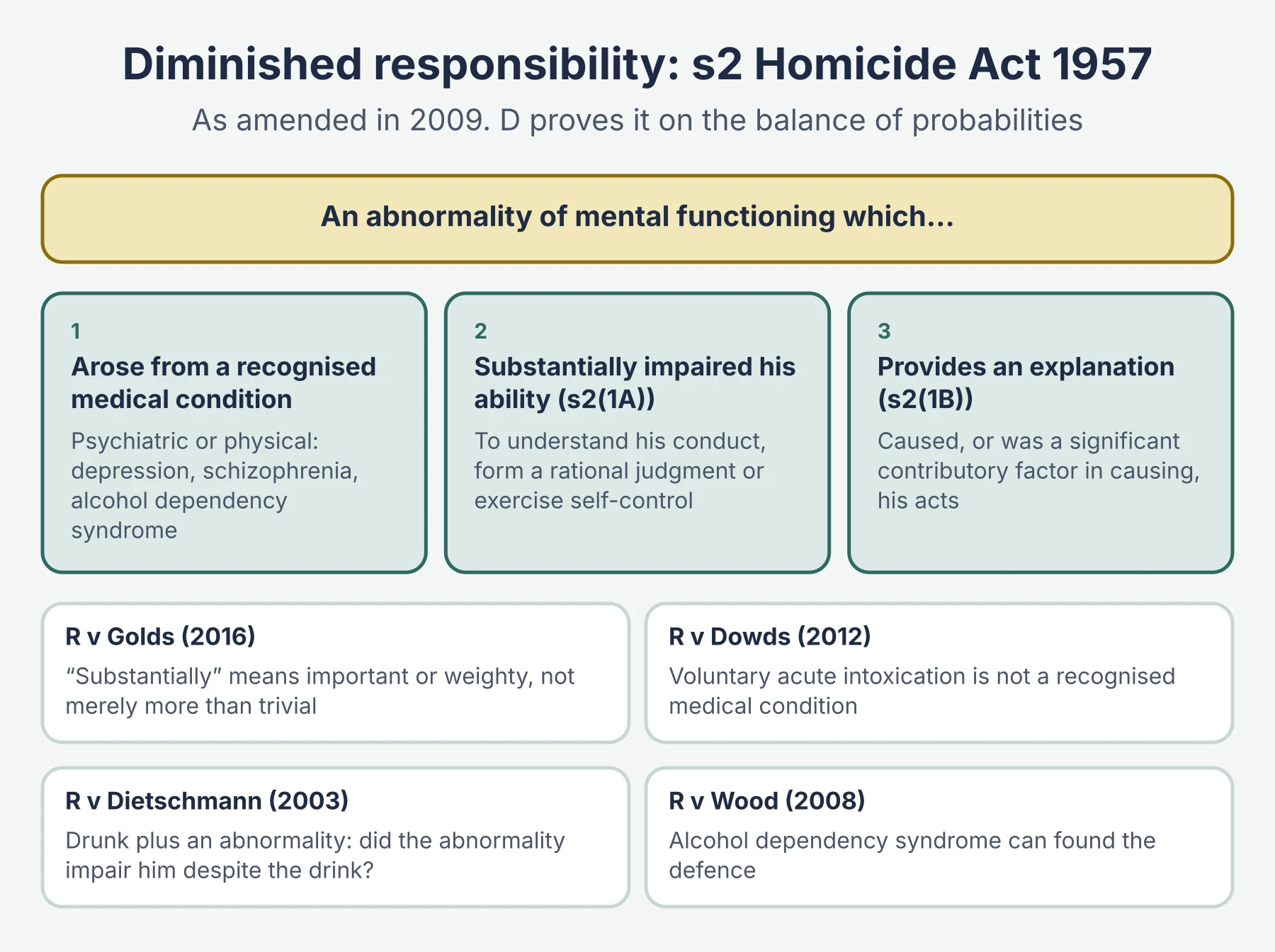
The defendant must prove, on the balance of probabilities (s2(2)), that he was suffering from an abnormality of mental functioning which:
- arose from a recognised medical condition (psychiatric or physical, such as depression, schizophrenia or alcohol dependency syndrome);
- substantially impaired his ability to understand the nature of his conduct, form a rational judgment, or exercise self-control (s2(1A)); and
- provides an explanation for his acts, meaning it caused or was a significant contributory factor in causing them (s2(1B)).
Key cases
- R v Golds (2016): the Supreme Court held that “substantially” means important or weighty, not merely more than trivial.
- R v Dowds (2012): voluntary acute intoxication is not a recognised medical condition.
- R v Dietschmann (2003): where the defendant was drunk and also had an abnormality, the jury asks whether the abnormality substantially impaired him despite the drink.
- R v Wood (2008): alcohol dependency syndrome can found the defence.
Involuntary manslaughter
Involuntary manslaughter is an unlawful killing without malice aforethought. It has no fixed sentence; the maximum is life.
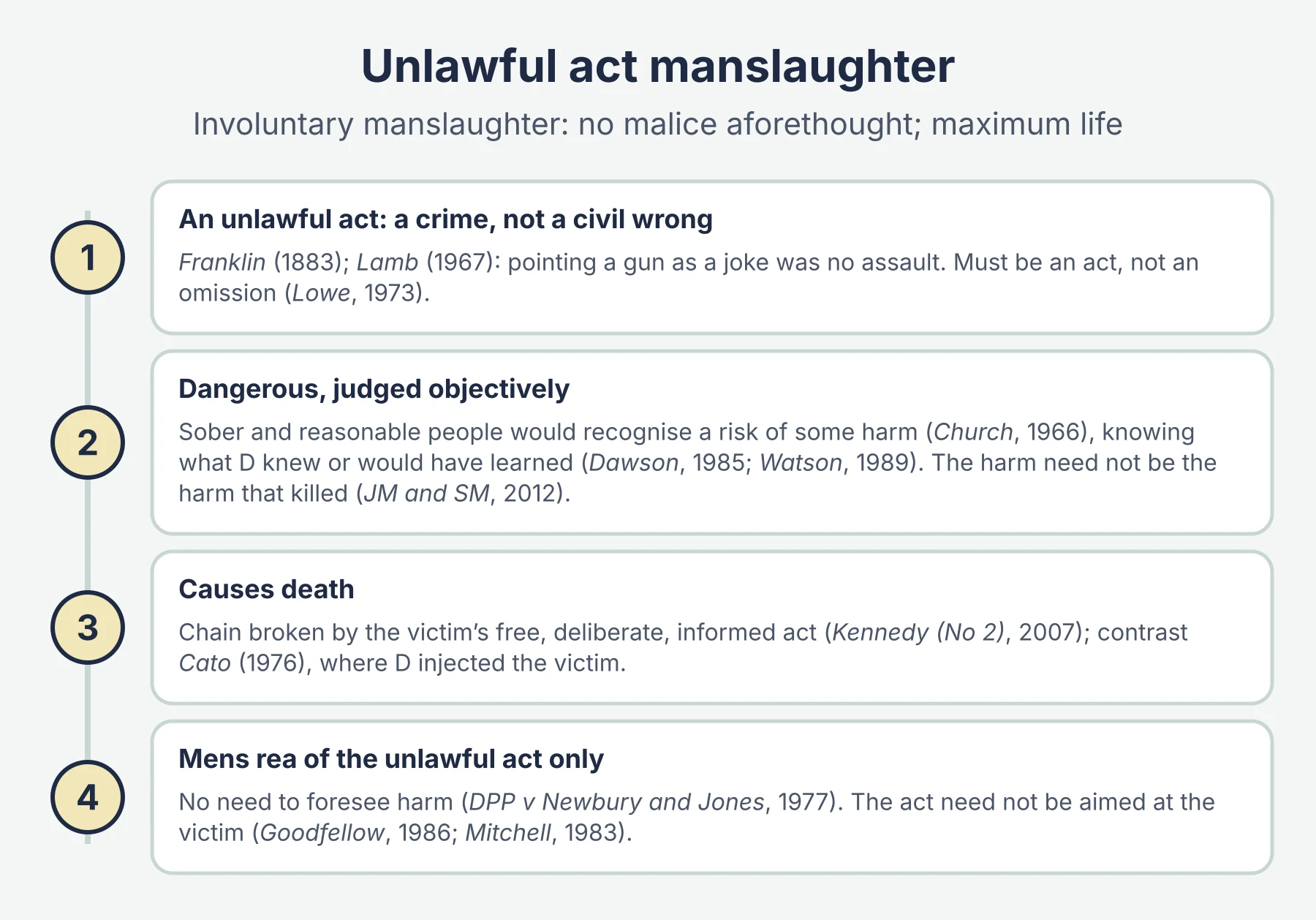
Unlawful act manslaughter (also called constructive manslaughter)
| Element | Rule | Cases |
|---|---|---|
| Unlawful act | Must be a criminal offence, not merely a civil wrong | R v Franklin (1883); R v Lamb (1967): pointing a gun as a joke, with no assault, was no unlawful act |
| An act, not an omission | A failure to act cannot found this offence | R v Lowe (1973) |
| Dangerous | Objectively: all sober and reasonable people would inevitably recognise it must subject the victim to the risk of some harm, albeit not serious harm | R v Church (1966) |
| Knowledge of the reasonable person | The reasonable person knows what the defendant knew or would have learned during the act | R v Dawson (1985): hidden heart condition, not dangerous; R v Watson (1989): frailty of an elderly householder would have been obvious |
| Type of harm | The foreseeable harm need not be the harm that killed | R v JM and SM (2012) |
| Causes death | Ordinary causation rules; a free, deliberate and informed act of the victim breaks the chain | R v Kennedy (No 2) (2007); contrast R v Cato (1976), where the defendant injected the victim |
| Mens rea | Only the mens rea of the unlawful act; no need to foresee harm | DPP v Newbury and Jones (1977) |
The unlawful act need not be aimed at the victim (R v Goodfellow, 1986: arson of a council house), and it can be directed at one person and kill another (R v Mitchell, 1983).
Gross negligence manslaughter
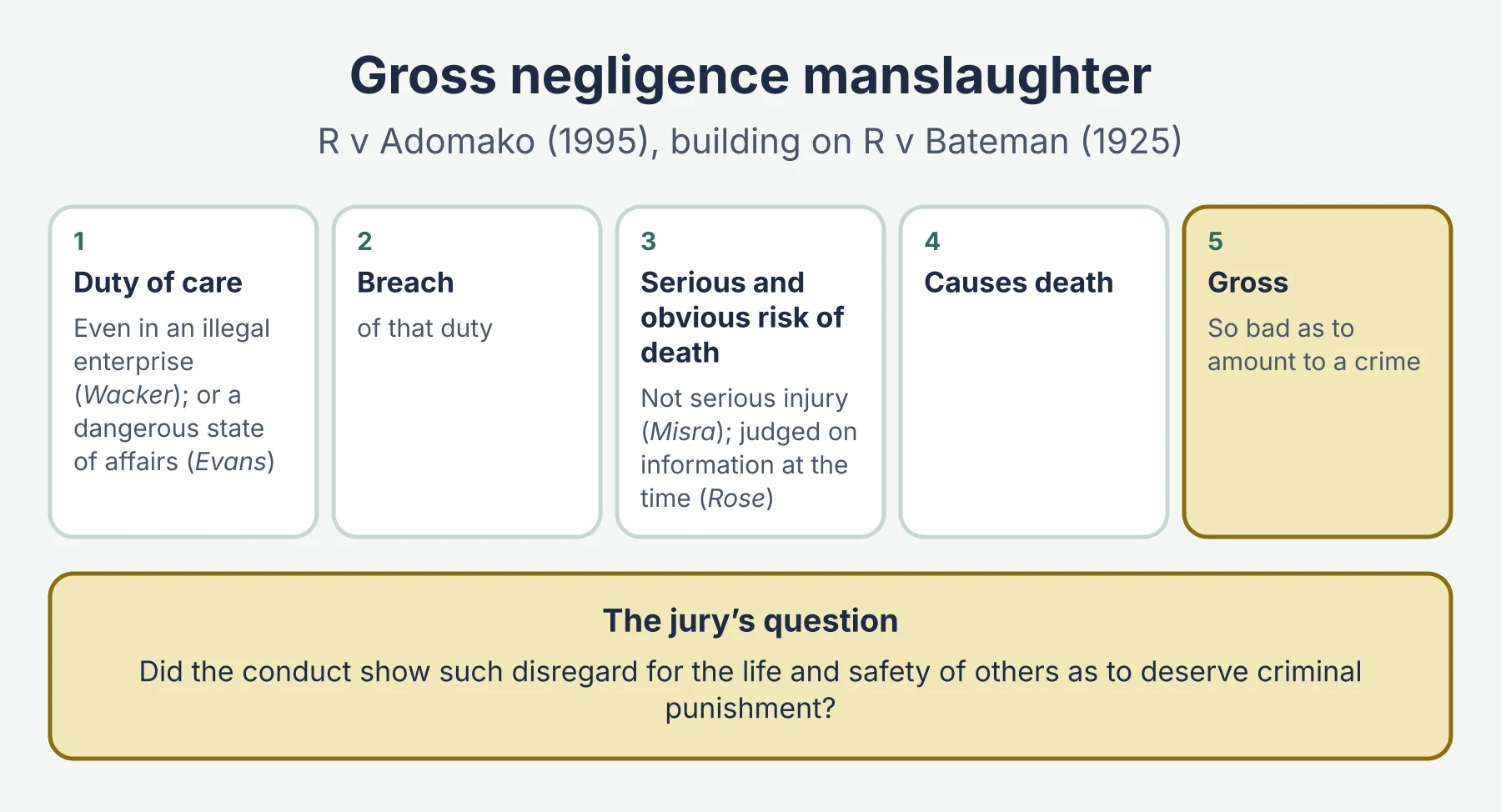
The test comes from R v Adomako (1995), building on R v Bateman (1925): the jury asks whether the defendant’s conduct showed such disregard for the life and safety of others as to deserve criminal punishment.
- Duty of care, using ordinary negligence principles. It can arise even between people engaged in an illegal enterprise (R v Wacker, 2003) and where the defendant creates or contributes to a dangerous state of affairs (R v Evans, 2009).
- Breach of that duty.
- A serious and obvious risk of death, reasonably foreseeable at the time of breach. Risk of serious injury is not enough (R v Misra and Srivastava, 2004); foreseeability is judged on the information available at the time, not what the defendant would have known had he done his duty (R v Rose, 2017).
- Causation of death.
- Gross negligence: so bad, in all the circumstances, as to amount to a crime.
Worked example
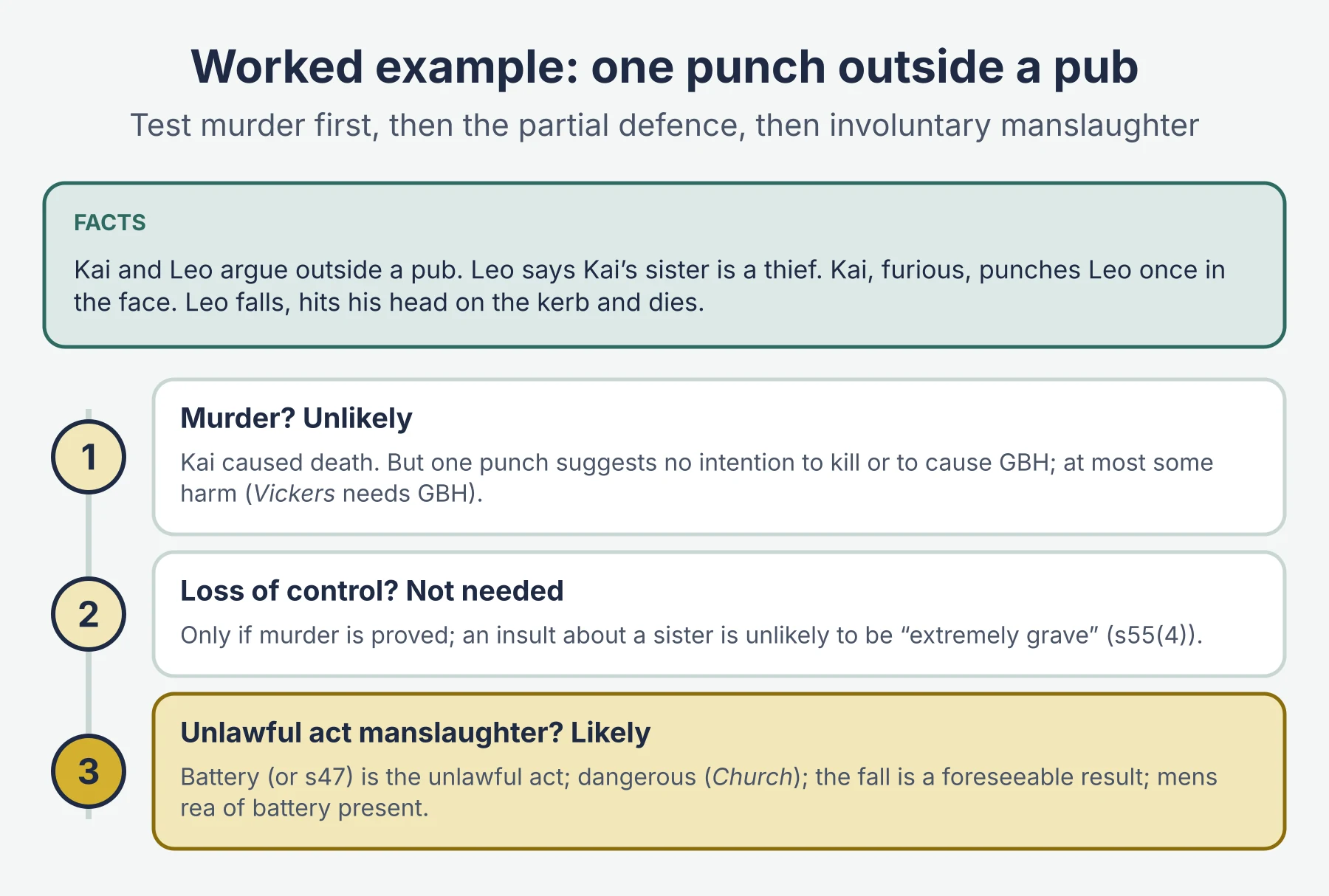
Kai and Leo argue outside a pub. Leo says Kai’s sister is a thief. Kai, furious, punches Leo once in the face. Leo falls, hits his head on the kerb and dies.
Murder:    Kai caused death (but for; operating cause). Intention to kill? No.
           Intention to cause GBH? A single punch suggests not; at most an
           intention to cause some harm. Murder unlikely (Vickers needs GBH).
Loss of    Not needed unless murder is proved; in any case an insult about a
control:   sister is unlikely to be "extremely grave" (s55(4)).
UAM:       Unlawful act = battery (or s47). Dangerous - sober and reasonable
           people would recognise risk of some harm from a punch (Church).
           Caused death - the fall is a foreseeable result. Mens rea of
           battery present.
Conclusion: Kai is likely to be guilty of unlawful act manslaughter.
The order matters: test murder first, then the partial defence if murder is made out, then involuntary manslaughter.
Common mistakes
- Forgetting implied malice (intention to cause GBH) as murder’s alternative mens rea.
- Requiring loss of control to be sudden.
- Treating sexual infidelity as a trigger on its own.
- Giving diminished responsibility without the “recognised medical condition” step.
- Using an omission as the unlawful act.
- Saying gross negligence manslaughter needs a risk of serious injury rather than of death.
Exam technique
In problem questions, apply each element to the facts and conclude on each offence before moving to the next. In evaluation questions, the most-used criticisms are the mandatory life sentence and the breadth of murder, the correspondence problem in unlawful act manslaughter, and the circular test in gross negligence manslaughter.
More resources on this topic
Fatal offences revision notes | Fatal offences practice questions
Related resources
-
Practice questions
AQA A Level Law (7162): Fatal Offences Against the Person – Practice Questions
Original practice questions with mark-scheme answers on murder, loss of control, diminished responsibility and manslaughter for AQA A Level Law 7162.
Law · AQA · A Level
Try questions -
Revision notes
AQA A Level Law (7162): Fatal Offences Against the Person – Revision Notes
Recall notes on murder, loss of control, diminished responsibility, unlawful act and gross negligence manslaughter with key cases, for AQA A Level Law 7162.
Law · AQA · A Level
Revise topic -
Study guides
AQA A Level Law (7162): Necessity Defences
Self-defence and prevention of crime, duress by threats and duress of circumstances: tests, s76 CJIA 2008 and leading cases, for AQA A Level Law 7162.
Law · AQA · A Level
Read guide
Get free revision emails (optional)
Occasional emails with practice questions, worked explanations and links to free resources for the qualification and subjects you choose. No spam, and you can unsubscribe from any email. The free tools on this site never need an email.