
Revision Notes
AQA A Level Law (7162): Fatal Offences Against the Person – Revision Notes
Recall notes on murder, loss of control, diminished responsibility, unlawful act and gross negligence manslaughter with key cases, for AQA A Level Law 7162.
- Subject
- Law
- Level
- A LEVELS
- Topic
- Criminal law
- Author
- Marlbridge Academic Team
- Updated
- Reviewed by
- Aizaz Raoof Ali (what this means)
Aligned to AQA A Level Law (7162), For teaching from September 2017 onwards, A-level exams 2019 onwards. Official specification .
Syllabus page (what it covers and how it is assessed): AQA A Level Law.
Syllabus points this page covers
7162
- Fatal offences against the person
Found an error? Report a correction.
Need help with this topic? Request a free trial class for A Level Law (7162).
Condensed notes for the section 3.2 row Fatal offences against the person: murder; voluntary manslaughter (loss of control and diminished responsibility); and involuntary manslaughter (unlawful act and gross negligence). For explanation and a worked problem, use the fatal offences study guide.
The homicide map
Unlawful killing
  |- with malice aforethought ............ MURDER (mandatory life)
  |     |- + loss of control  ............ VOLUNTARY MANSLAUGHTER
  |     |- + diminished responsibility ... VOLUNTARY MANSLAUGHTER
  |- without malice aforethought
        |- dangerous unlawful act ........ UNLAWFUL ACT MANSLAUGHTER
        |- gross breach of duty ........... GROSS NEGLIGENCE MANSLAUGHTER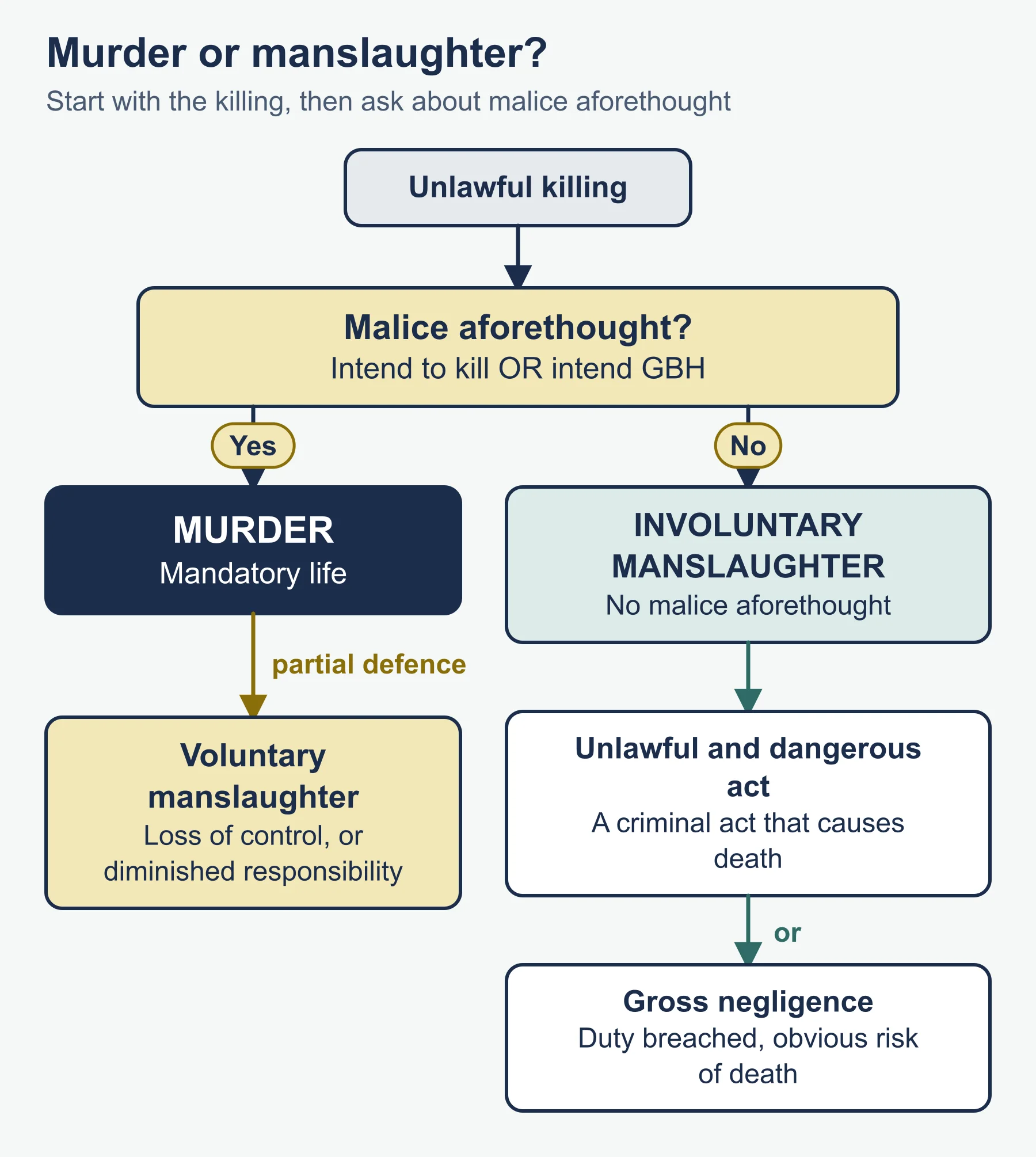
Murder
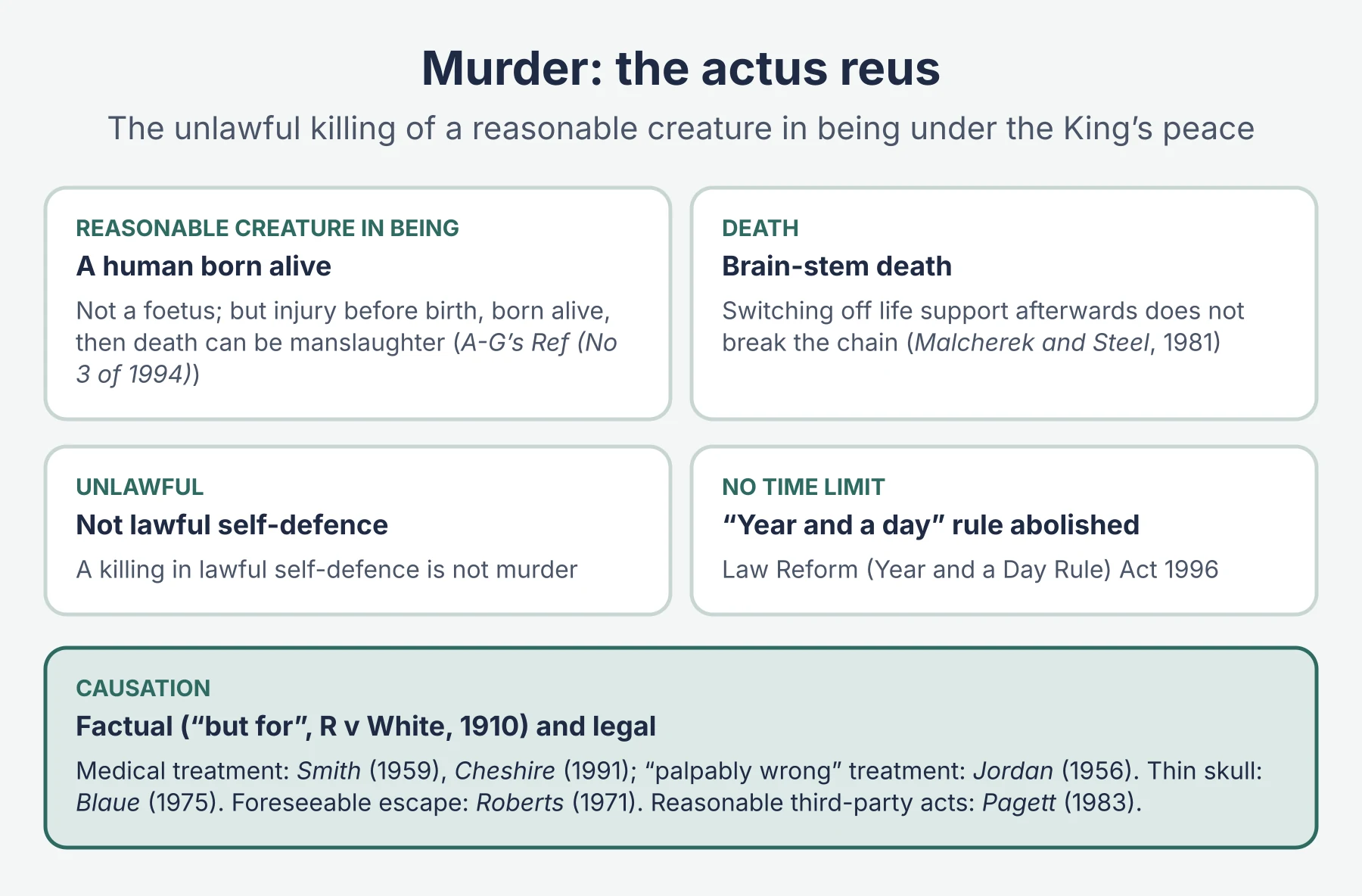
Actus reus: unlawful killing of a human being under the King’s peace.
| Point | Authority |
|---|---|
| Foetus is not a “creature in being” | A-G’s Ref (No 3 of 1994) (1997) |
| Switching off life support after brain-stem death does not break the chain | Malcherek and Steel (1981) |
| Year and a day rule abolished | Law Reform (Year and a Day Rule) Act 1996 |
| Factual causation | White (1910) |
| Medical treatment rarely breaks the chain | Smith (1959); Cheshire (1991); contrast Jordan (1956) |
| Thin skull rule | Blaue (1975) |
| Foreseeable escape by victim | Roberts (1971) |
| Reasonable act of a third party | Pagett (1983) |
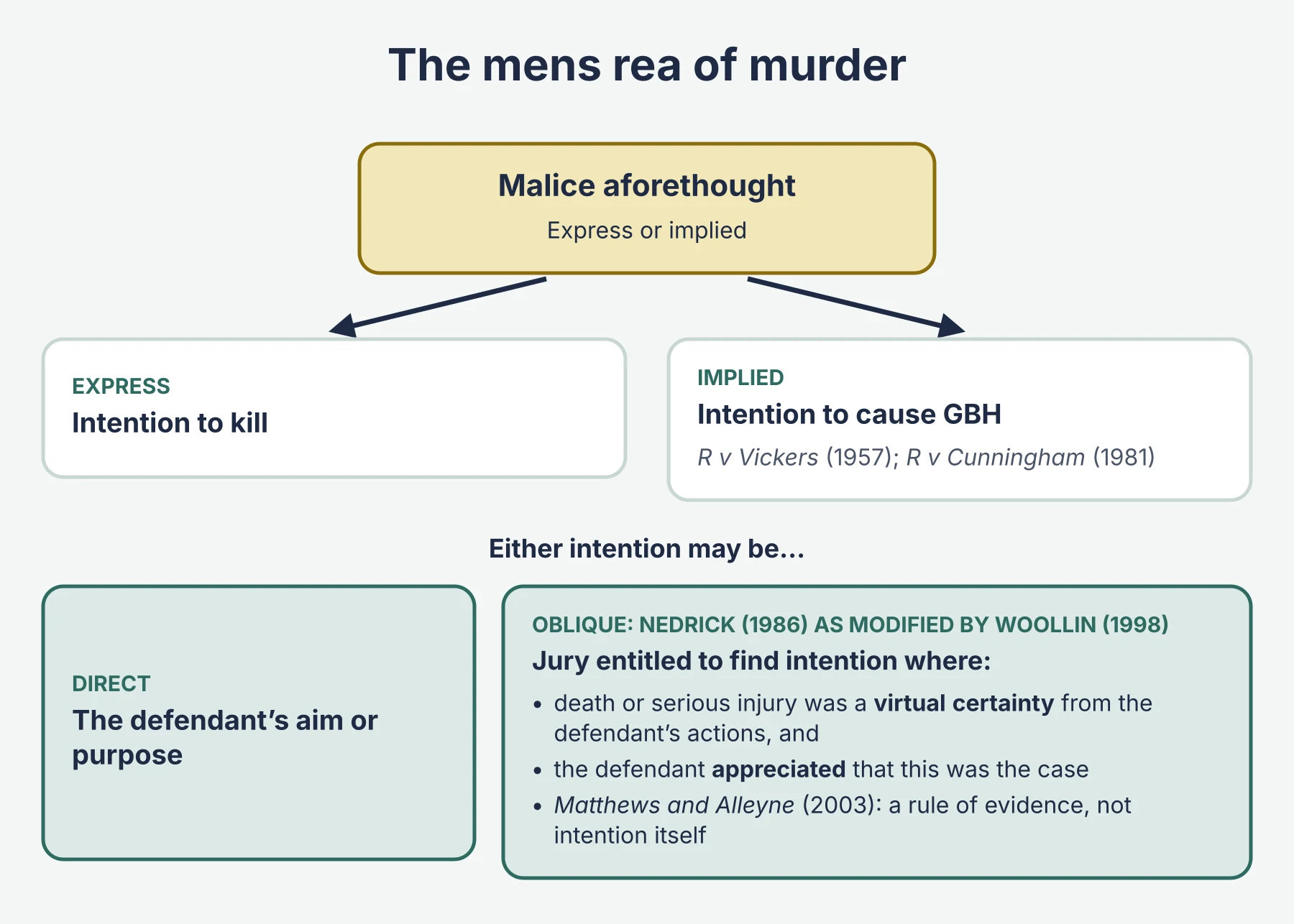
Mens rea: intention to kill (express malice) or to cause GBH (implied malice: Vickers, 1957; Cunningham, 1981).
Oblique intention: virtual certainty + defendant’s appreciation; jury entitled to find intention (Nedrick, 1986; Woollin, 1998); a rule of evidence (Matthews and Alleyne, 2003).
Loss of control (CJA 2009)
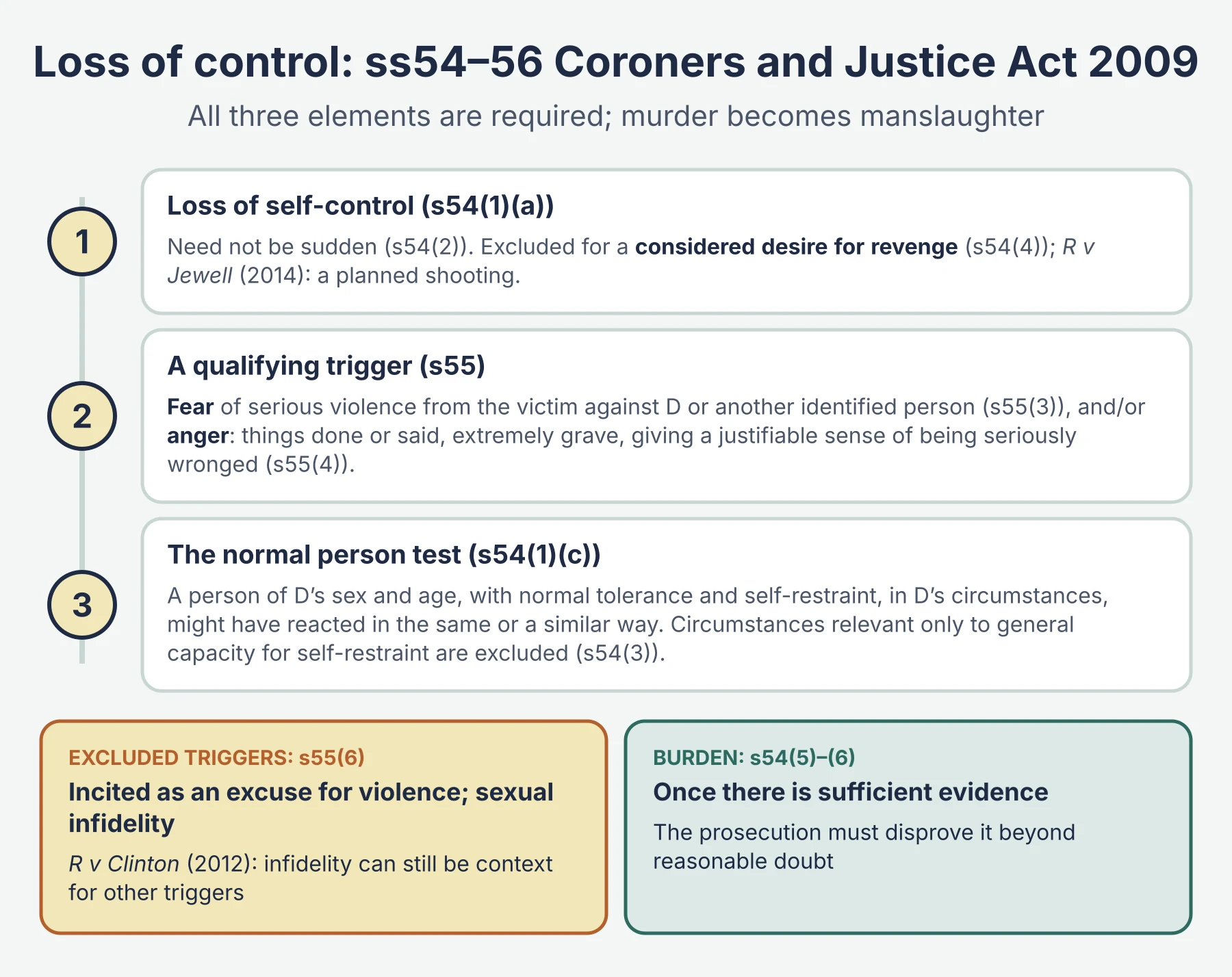
| Element | Section | Notes |
|---|---|---|
| Loss of self-control | s54(1)(a) | Need not be sudden (s54(2)); not if considered desire for revenge (s54(4)); Jewell (2014) |
| Fear trigger | s55(3) | Fear of serious violence from V against D or another identified person |
| Anger trigger | s55(4) | Circumstances of extremely grave character; justifiable sense of being seriously wronged |
| Exclusions | s55(6) | Incited trigger; sexual infidelity disregarded (but context: Clinton, 2012) |
| Normal person test | s54(1)(c), s54(3) | Same sex and age, normal tolerance and self-restraint, in D’s circumstances |
| Burden | s54(5)–(6) | Once sufficient evidence, prosecution must disprove |
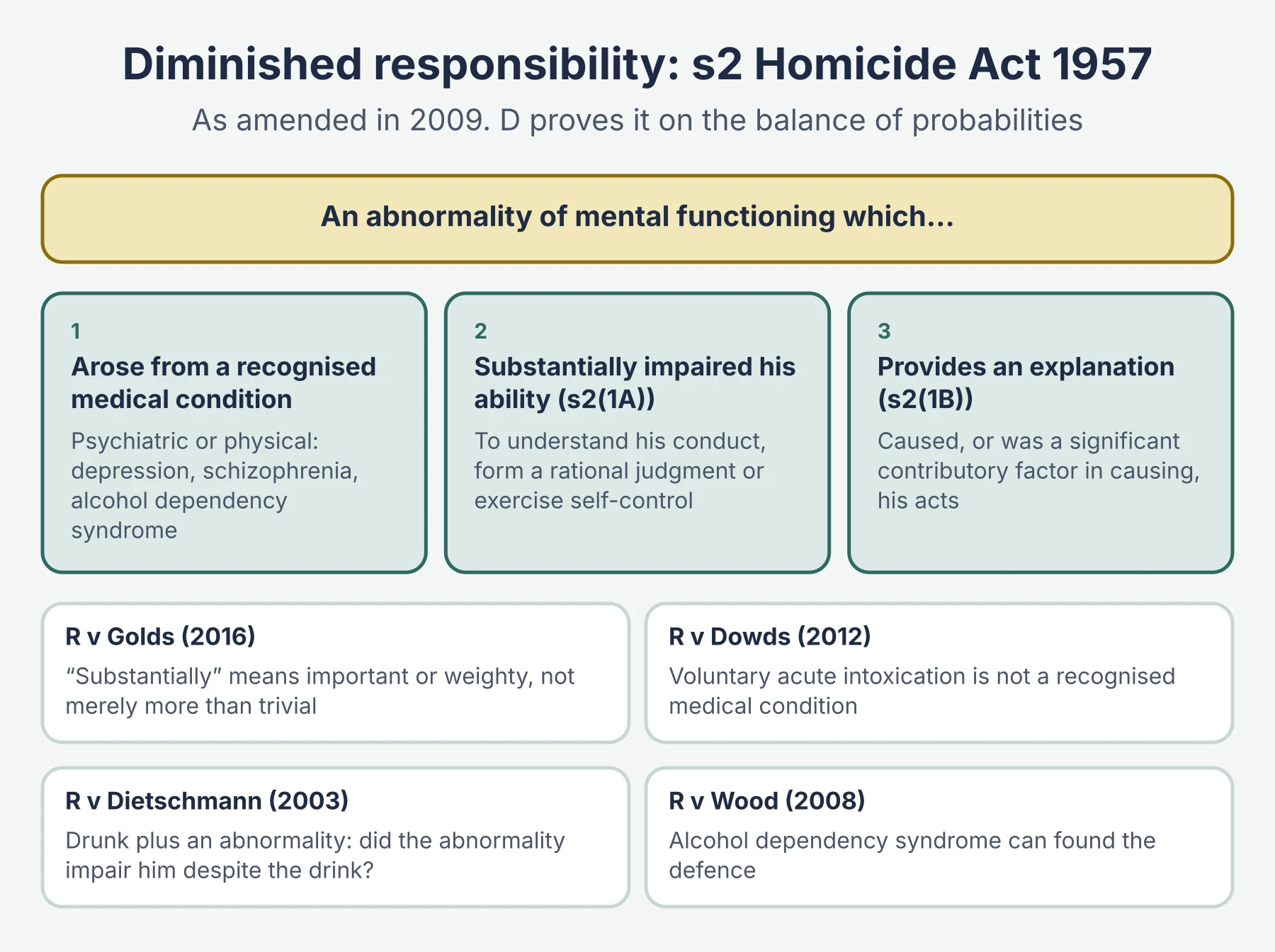
Diminished responsibility (s2 HA 1957, as amended)
D proves on the balance of probabilities:
- Abnormality of mental functioning;
- from a recognised medical condition;
- substantially impairing ability to understand conduct, form rational judgment or exercise self-control;
- providing an explanation (cause or significant contributory factor).
Cases: Golds (2016) “substantially” = important or weighty; Dowds (2012) acute voluntary intoxication not a recognised condition; Dietschmann (2003) abnormality plus drink; Wood (2008) alcohol dependency syndrome.
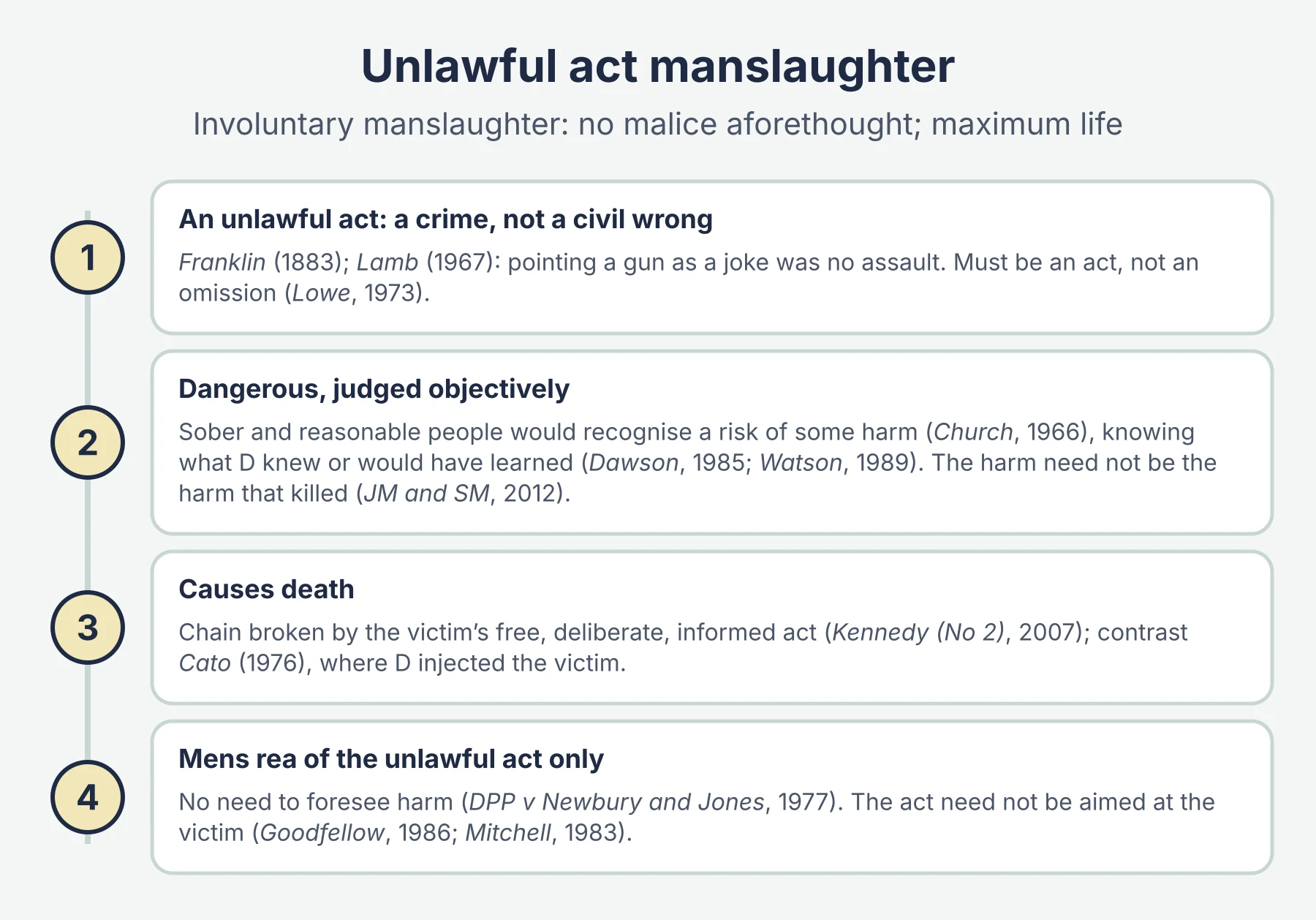
Unlawful act manslaughter
| Element | Authority |
|---|---|
| Criminal unlawful act | Franklin (1883); Lamb (1967) |
| Act not omission | Lowe (1973) |
| Objectively dangerous: risk of some harm | Church (1966) |
| Reasonable person knows what D knew or would learn | Dawson (1985); Watson (1989) |
| Harm foreseen need not be harm that killed | JM and SM (2012) |
| Need not be aimed at victim | Goodfellow (1986); Mitchell (1983) |
| Causation; victim’s free act breaks chain | Kennedy (No 2) (2007); contrast Cato (1976) |
| Mens rea of unlawful act only | Newbury and Jones (1977) |
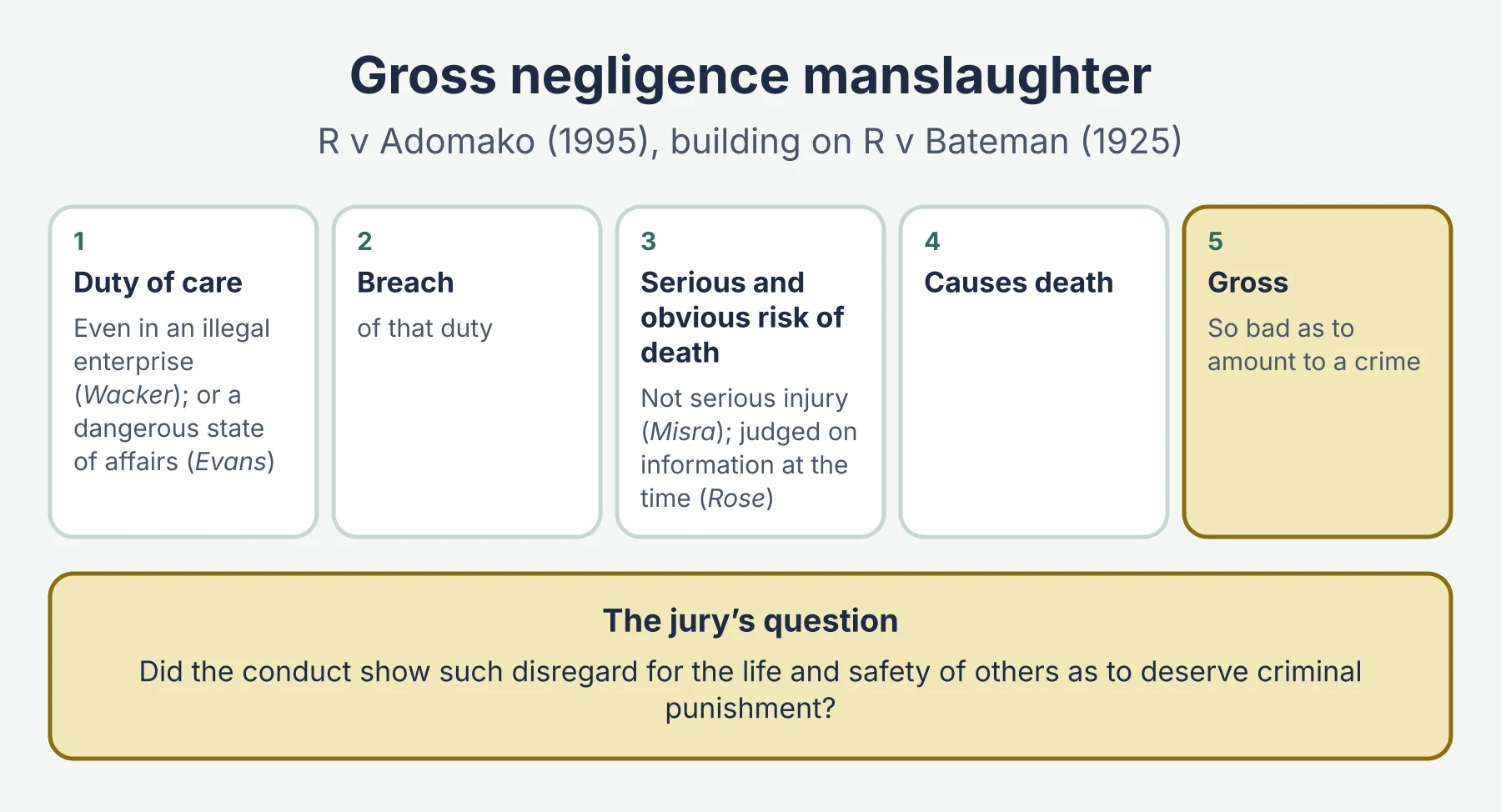
Gross negligence manslaughter
Adomako (1995), following Bateman (1925):
- Duty of care (Wacker, 2003; Evans, 2009).
- Breach.
- Serious and obvious risk of death (Misra and Srivastava, 2004), foreseeable at the time on information then available (Rose, 2017).
- Causation.
- Gross negligence: so bad as to be criminal.
Key terms
| Term | Meaning |
|---|---|
| Malice aforethought | Intention to kill or to cause GBH |
| Express malice | Intention to kill |
| Implied malice | Intention to cause GBH |
| Oblique intention | Intention found from foresight of virtual certainty |
| Partial defence | Reduces murder to manslaughter; not a full acquittal |
| Qualifying trigger | Fear or anger trigger under s55 |
| Recognised medical condition | A condition accepted in medical classification |
| Constructive manslaughter | Another name for unlawful act manslaughter |
| Gross negligence | Breach so bad as to deserve criminal punishment |
Exam traps
- Missing implied malice.
- Requiring a sudden loss of control, or using sexual infidelity as a trigger by itself.
- Forgetting that diminished responsibility is for the defendant to prove.
- Using a civil wrong or an omission as the unlawful act.
- Setting the gross negligence risk at serious injury rather than death.
- Concluding with “manslaughter” without saying which type.
Self-test
- What is implied malice and which case confirms it?
- State the Woollin direction on oblique intention.
- Which case says switching off life support does not break the chain?
- Name the two qualifying triggers for loss of control.
- What did R v Clinton decide about sexual infidelity?
- Who bears the burden of proof for loss of control?
- List the four elements of diminished responsibility.
- What did R v Golds decide?
- State the Church test of dangerousness.
- Why was there no unlawful act in R v Lamb?
- What must be risked for gross negligence manslaughter?
- Which case says foreseeability of risk is judged on information available at the time of breach?
Answers: 1. Intention to cause GBH; Vickers (1957). 2. The jury is entitled to find intention if death or serious injury was a virtual certainty and the defendant appreciated this. 3. Malcherek and Steel (1981). 4. Fear of serious violence; things said or done amounting to circumstances of an extremely grave character causing a justifiable sense of being seriously wronged. 5. It cannot be a trigger on its own but can be considered as context. 6. Once sufficient evidence is raised, the prosecution must disprove it beyond reasonable doubt. 7. Abnormality of mental functioning; recognised medical condition; substantial impairment of one of the listed abilities; provides an explanation. 8. “Substantially” means important or weighty. 9. All sober and reasonable people would inevitably recognise the act must subject the victim to the risk of some harm, albeit not serious harm. 10. The victim did not fear force, so there was no assault, and there was no other criminal act. 11. Death. 12. R v Rose (2017).
Test yourself further with the fatal offences practice questions.
Related resources
-
Study guides
AQA A Level Law (7162): Necessity Defences
Self-defence and prevention of crime, duress by threats and duress of circumstances: tests, s76 CJIA 2008 and leading cases, for AQA A Level Law 7162.
Law · AQA · A Level
Read guide -
Practice questions
AQA A Level Law (7162): Necessity Defences – Practice Questions
Original practice questions with mark-scheme answers on self-defence, prevention of crime, duress and duress of circumstances for AQA A Level Law 7162 Paper 1.
Law · AQA · A Level
Try questions -
Revision notes
AQA A Level Law (7162): Necessity Defences – Revision Notes
Recall notes on self-defence and prevention of crime under s76 CJIA 2008, duress and duress of circumstances, with key cases, for AQA A Level Law 7162.
Law · AQA · A Level
Revise topic
Get free revision emails (optional)
Occasional emails with practice questions, worked explanations and links to free resources for the qualification and subjects you choose. No spam, and you can unsubscribe from any email. The free tools on this site never need an email.