
Study Guides
AQA A Level Law (7162): Non-Fatal Offences Against the Person
Assault, battery and ss47, 20 and 18 of the 1861 Act, element by element with cases, a worked problem and reform points, for AQA A Level Law 7162 Paper 1.
- Subject
- Law
- Level
- A LEVELS
- Topic
- Criminal law
- Author
- Marlbridge Academic Team
- Updated
- Reviewed by
- Aizaz Raoof Ali (what this means)
Aligned to AQA A Level Law (7162), For teaching from September 2017 onwards, A-level exams 2019 onwards. Official specification .
Syllabus page (what it covers and how it is assessed): AQA A Level Law.
Syllabus points this page covers
7162
- Non-fatal offences against the person
Found an error? Report a correction.
Need help with this topic? Request a free trial class for A Level Law (7162).
This guide covers the section 3.2 row Non-fatal offences against the person in AQA A-level Law (7162). The specification lists common assault (assault and battery) and three offences under the Offences Against the Person Act 1861: “s47 assault/battery occasioning actual bodily harm”, “s20 unlawful and malicious wounding or inflicting grievous bodily harm”, and “s18 unlawful and malicious wounding or causing grievous bodily harm with intent to cause grievous bodily harm”. These offences appear in almost every Paper 1 problem question, often alongside a defence or a fatal offence. For an overview of all the offences, see the Criminal Offences and Defences study guide.
Common assault: assault and battery
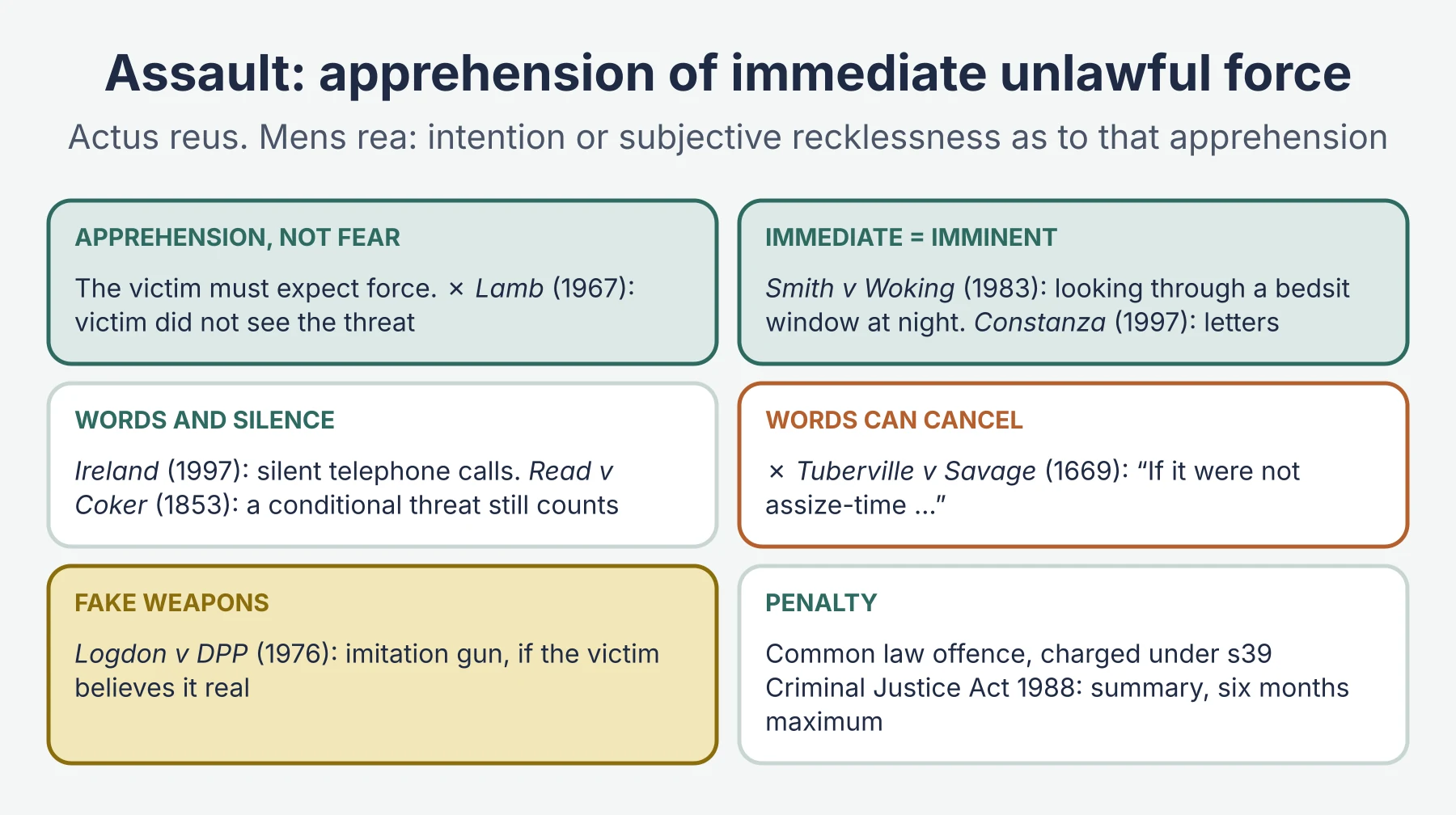
Assault and battery are separate common law offences, charged under s39 Criminal Justice Act 1988 as summary offences with a maximum of six months’ imprisonment.
Assault
Actus reus: causing the victim to apprehend immediate unlawful force.
- Apprehension, not fear. The victim must expect force; a victim who does not see the threat is not assaulted (R v Lamb, 1967).
- Immediate means imminent rather than instantaneous. Looking through a bedsit window at night was enough in Smith v Chief Superintendent of Woking Police Station (1983), because the victim feared what the defendant might do next. Letters can be enough if they cause fear of violence at some time not excluding the immediate future (R v Constanza, 1997).
- Words and silence. Silent telephone calls can be an assault (R v Ireland, 1997). Words can also cancel a threat: “If it were not assize-time, I would not take such language from you” meant there was no assault (Tuberville v Savage, 1669). A conditional threat (“hand over the money or I’ll hit you”) can still be an assault (Read v Coker, 1853).
- Fake weapons. Pointing an imitation gun is an assault if the victim believes it is real (Logdon v DPP, 1976).
Battery
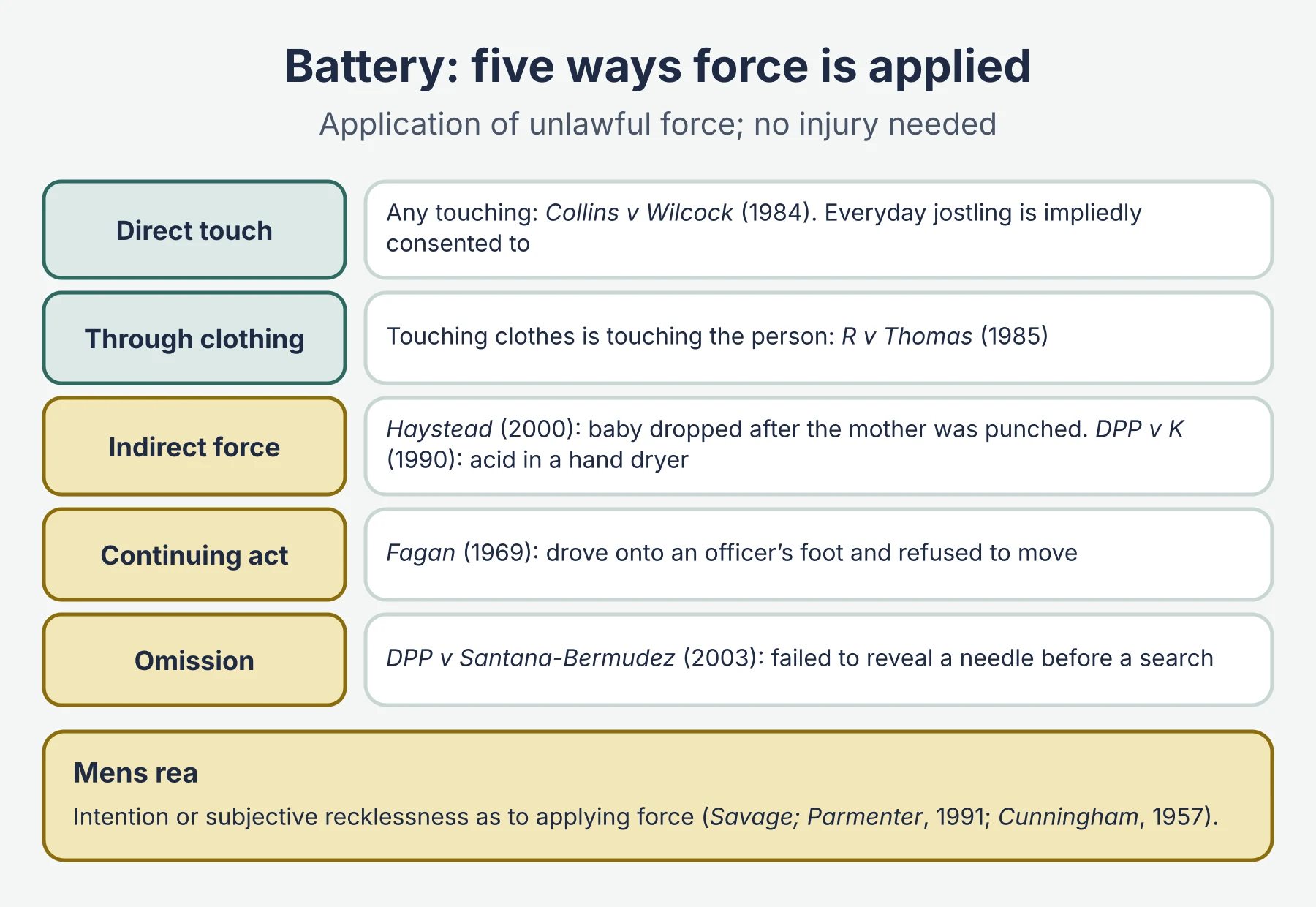
Actus reus: the application of unlawful force to another.
- Any touching can be force; there is no need for injury (Collins v Wilcock, 1984). Everyday contact, such as jostling in a crowd, is impliedly consented to.
- Through clothing: touching clothes is touching the person (R v Thomas, 1985).
- Indirect force: punching a woman so that she dropped her baby was a battery on the baby (Haystead v Chief Constable of Derbyshire, 2000); putting acid in a hand dryer was a battery on the next user (DPP v K, 1990).
- Continuing act: driving onto a police officer’s foot and refusing to move was a battery (Fagan v Metropolitan Police Commissioner, 1969).
- Omission: failing to reveal a needle in a pocket before a search was a battery when the officer was injured (DPP v Santana-Bermudez, 2003).
Mens rea (both): intention or subjective recklessness as to causing apprehension (assault) or applying force (battery) (R v Savage; R v Parmenter, 1991; recklessness as defined in R v Cunningham, 1957).
s47: assault occasioning actual bodily harm
Actus reus: an assault or battery that occasions (causes) actual bodily harm. Maximum five years; triable either way.
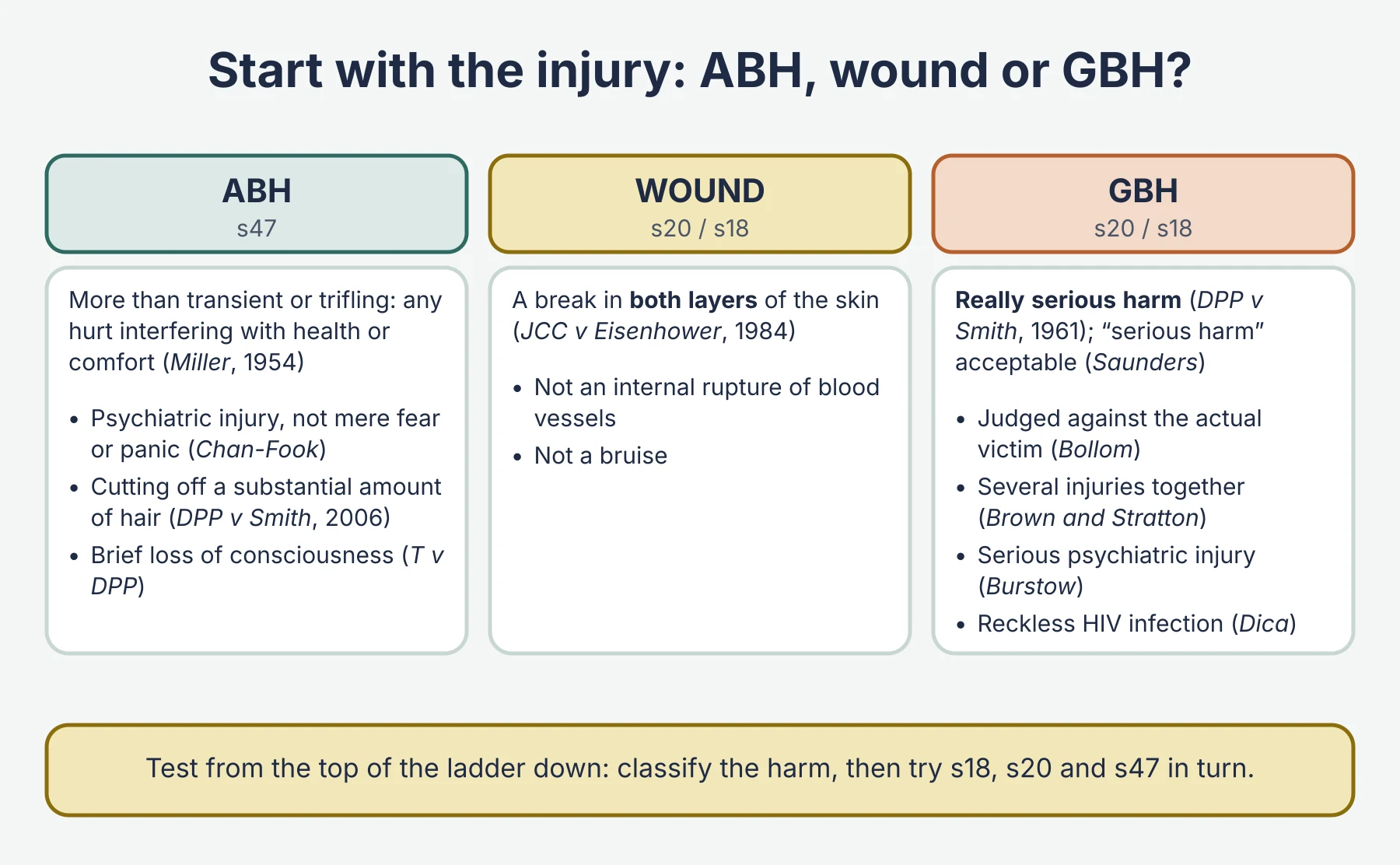
- ABH is “any hurt or injury calculated to interfere with the health or comfort” of the victim, more than transient or trifling (R v Miller, 1954).
- It includes psychiatric injury, but not mere emotions such as fear or panic (R v Chan-Fook, 1994).
- Cutting off a substantial amount of hair can be ABH (DPP v Smith, 2006); so can a brief loss of consciousness (T v DPP, 2003).
- Occasioning: ordinary causation. In R v Roberts (1971) a passenger who jumped from a moving car after unwanted advances suffered ABH occasioned by the defendant’s assault, because her reaction was foreseeable.
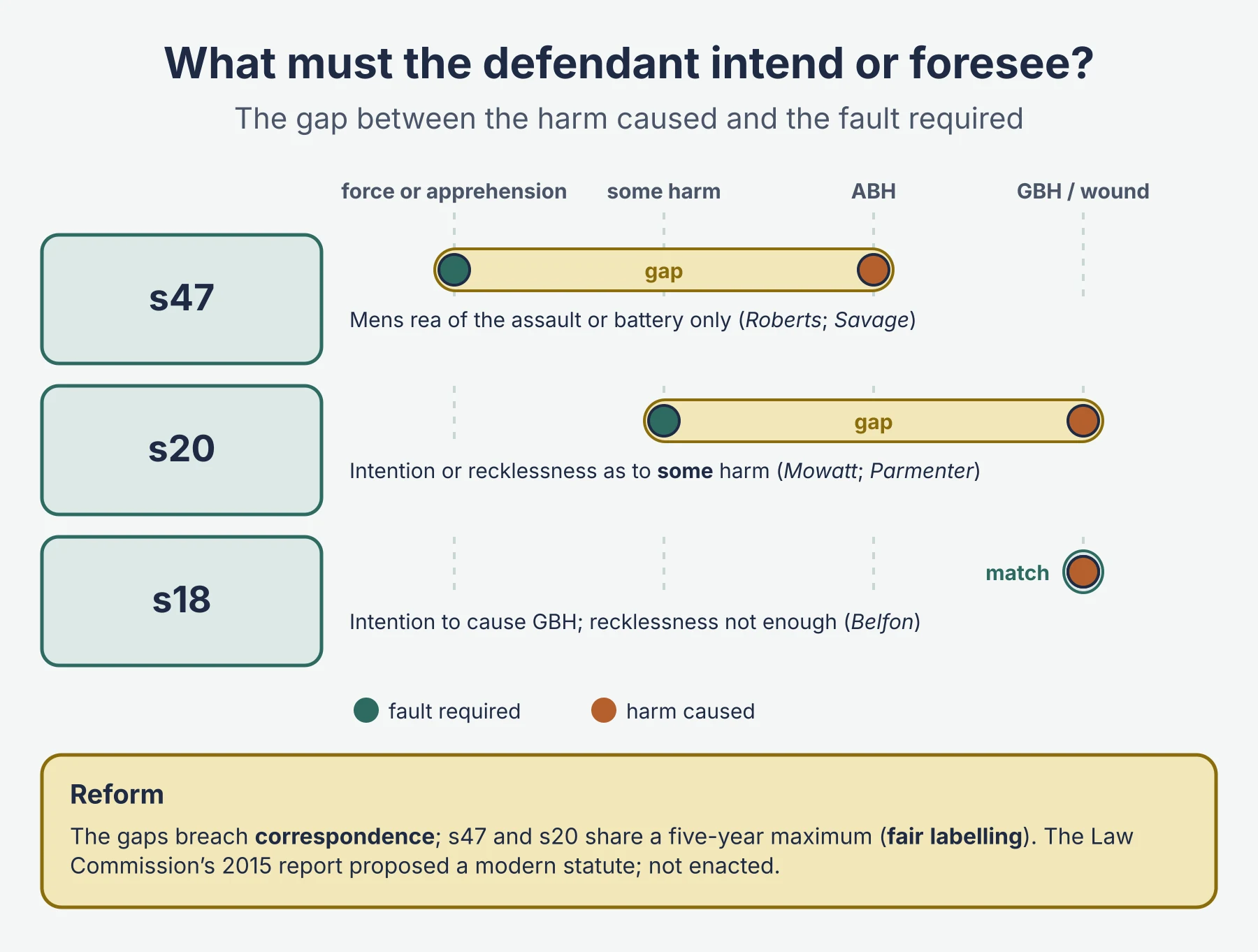
Mens rea: only the mens rea of the assault or battery. There is no need to intend or foresee any harm (Roberts; Savage, 1991).
s20: unlawful and malicious wounding or inflicting GBH
Actus reus: wounding or inflicting grievous bodily harm. Maximum five years.
- Wound: a break in both layers of the skin (JCC v Eisenhower, 1984); an internal rupture of blood vessels is not enough.
- GBH: “really serious harm” (DPP v Smith, 1961), though “serious harm” is an acceptable direction (R v Saunders, 1985). Seriousness is judged against the actual victim, taking into account age and health (R v Bollom, 2003). Several injuries may together amount to GBH (R v Brown and Stratton, 1998). Serious psychiatric injury can be GBH (R v Burstow, 1997), and so can recklessly infecting someone with HIV (R v Dica, 2004).
- Inflict does not require an application of force (Burstow), so “inflict” and “cause” now have essentially the same effect.
Mens rea: “maliciously” means intention or subjective recklessness (Cunningham) as to causing some harm, not necessarily serious harm (R v Mowatt, 1968; Parmenter).
s18: wounding or causing GBH with intent
Actus reus: wounding or causing GBH (same meanings as s20). Maximum life; indictable only.
Mens rea: specific intent, either:
- an intention to cause GBH (recklessness is not enough: R v Belfon, 1976), including oblique intention under Woollin; or
- an intention to resist or prevent lawful arrest, with at least recklessness as to causing some harm (R v Morrison, 1989).
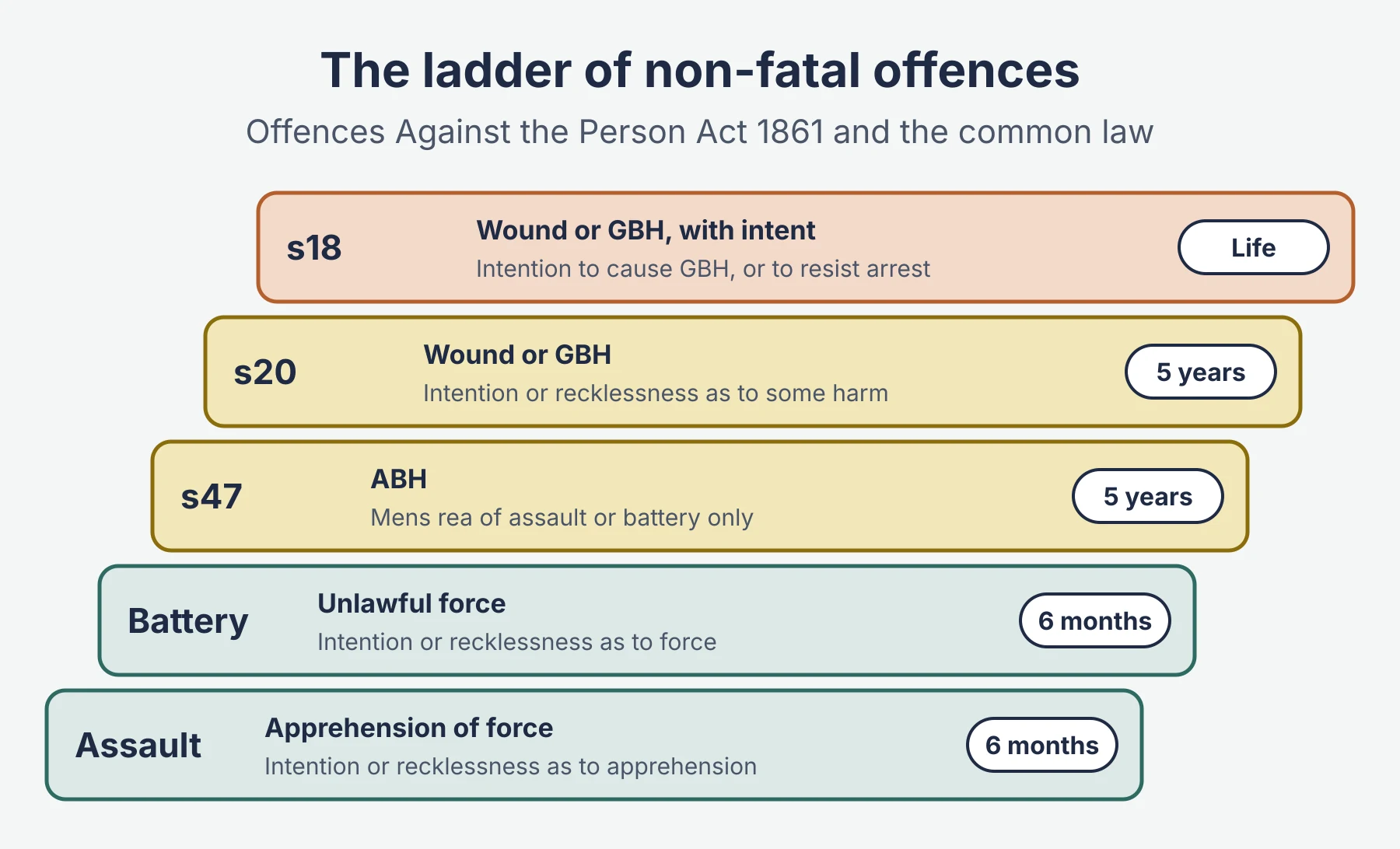
The offences side by side
| Offence | Harm | Mens rea | Maximum |
|---|---|---|---|
| Assault | Apprehension of force | Intention/recklessness as to apprehension | 6 months |
| Battery | Unlawful force | Intention/recklessness as to force | 6 months |
| s47 | ABH | Mens rea of assault or battery only | 5 years |
| s20 | Wound or GBH | Intention/recklessness as to some harm | 5 years |
| s18 | Wound or GBH | Intention to cause GBH, or to resist arrest | Life |
Worked example
Zara pushes Yusuf away during an argument at a bus stop. He stumbles back, cuts his hand on a broken bottle, needing stitches, and suffers a sprained wrist.
Harm:       Cut needing stitches - both layers of skin broken = wound
            (Eisenhower). So s18/s20 are possible.
s18:        Intention to cause GBH? A push - no. s18 fails.
s20:        Wound - yes. "Inflict" - yes, the push set off the injury.
            Mens rea - did Zara foresee some harm (Mowatt)? Pushing someone
            near broken glass, possibly; a question for the jury.
s47:        Fallback. Battery (the push) occasioning ABH (the cut and sprain,
            Miller). Mens rea of battery: she intended to push. Satisfied.
Conclusion: s20 if foresight of some harm is proved; otherwise s47.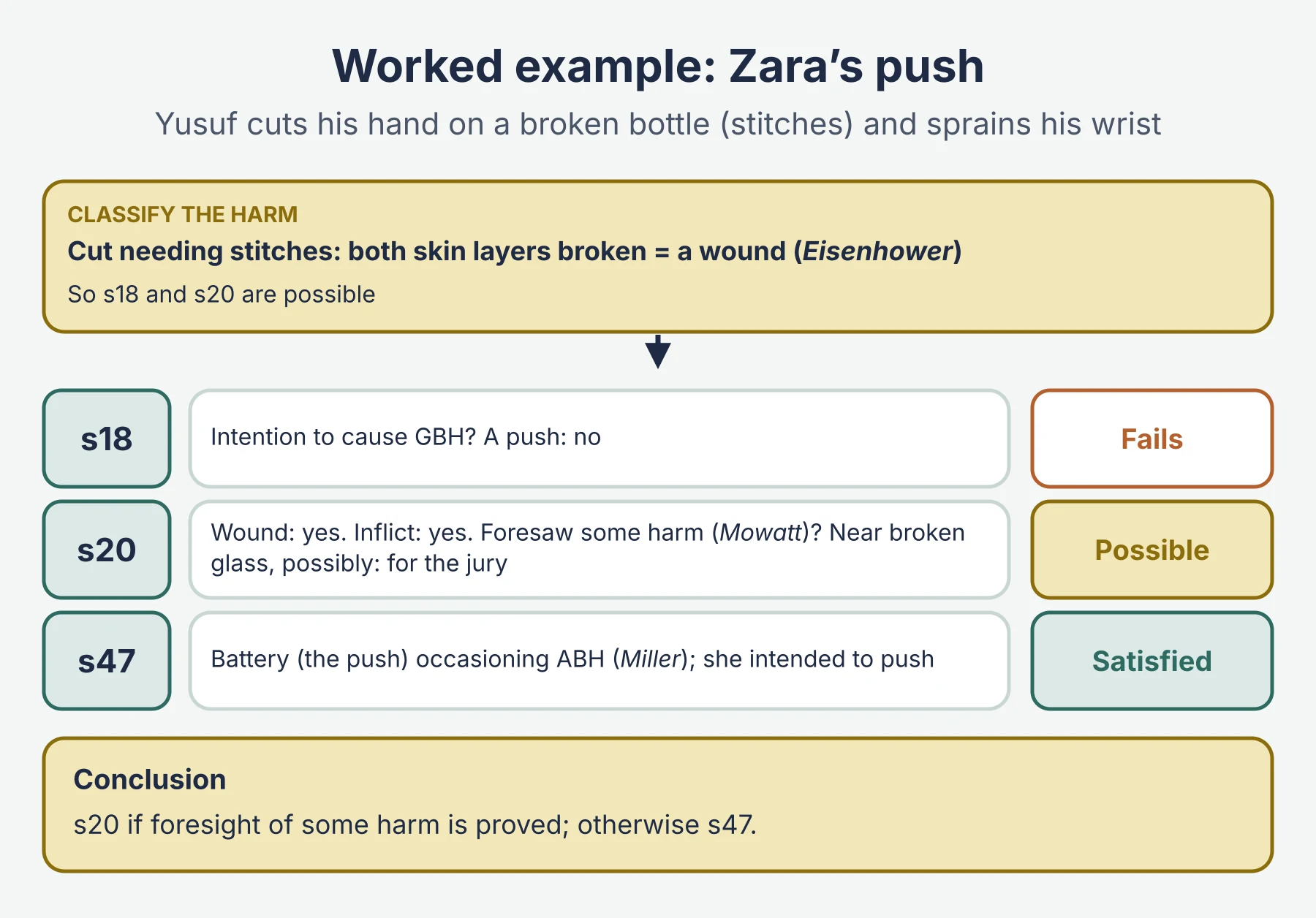
Reform and evaluation
The 1861 Act is criticised for outdated language (“maliciously”, “grievous”), for inconsistent use of “inflict” and “cause”, and for breaching correspondence in s47 and s20. Section 47 and s20 carry the same maximum despite the difference in harm, which raises fair labelling concerns. The Law Commission’s 2015 report on offences against the person recommended replacing the Act with a modern statute containing offences that match fault to harm, but it has not been enacted.
Common mistakes
- Saying assault requires the victim to be afraid, or that a battery requires injury.
- Requiring foresight of harm for s47.
- Requiring foresight of serious harm for s20.
- Calling a bruise or internal bleeding a “wound”.
- Saying recklessness is enough for s18.
- Starting with battery and never testing the more serious offences.
Exam technique
Start with the injury: classify it as ABH, wound or GBH, then test offences from the top of the ladder down. For each, give the actus reus, the mens rea and an authority, apply to the facts and conclude before moving on. For evaluation, use correspondence and fair labelling with case examples, and refer to the Law Commission proposals.
More resources on this topic
Non-fatal offences revision notes | Non-fatal offences practice questions
Related resources
-
Practice questions
AQA A Level Law (7162): Non-Fatal Offences Against the Person – Practice Questions
Original practice questions with mark-scheme answers on assault, battery, s47, s20 and s18 problems and evaluation for AQA A Level Law 7162 Paper 1.
Law · AQA · A Level
Try questions -
Revision notes
AQA A Level Law (7162): Non-Fatal Offences Against the Person – Revision Notes
Recall notes on assault, battery and ss47, 20 and 18 with injury classification, mens rea and leading cases, for AQA A Level Law 7162 Paper 1.
Law · AQA · A Level
Revise topic -
Study guides
AQA A Level Law (7162): Preliminary Offence – Attempt
Attempt under s1 Criminal Attempts Act 1981: more than merely preparatory acts, intention, impossibility and evaluation, with cases, for AQA A Level Law 7162.
Law · AQA · A Level
Read guide
Get free revision emails (optional)
Occasional emails with practice questions, worked explanations and links to free resources for the qualification and subjects you choose. No spam, and you can unsubscribe from any email. The free tools on this site never need an email.