
Study Guides
AQA A Level Law (7162): Preliminary Offence – Attempt
Attempt under s1 Criminal Attempts Act 1981: more than merely preparatory acts, intention, impossibility and evaluation, with cases, for AQA A Level Law 7162.
- Subject
- Law
- Level
- A LEVELS
- Topic
- Criminal law
- Author
- Marlbridge Academic Team
- Updated
- Reviewed by
- Aizaz Raoof Ali (what this means)
Aligned to AQA A Level Law (7162), For teaching from September 2017 onwards, A-level exams 2019 onwards. Official specification .
Syllabus page (what it covers and how it is assessed): AQA A Level Law.
Syllabus points this page covers
7162
- Preliminary offence
Found an error? Report a correction.
Need help with this topic? Request a free trial class for A Level Law (7162).
This guide covers the section 3.2 row Preliminary offence in AQA A-level Law (7162). The specification names one offence: attempt (s1 Criminal Attempts Act 1981). Attempt is a “preliminary” or “inchoate” offence because the defendant is punished for trying to commit a crime that is never completed. In Paper 1 it usually appears inside a problem question where the main offence (murder, s18, theft or robbery) has not been completed. For an overview of all the offences, see the Criminal Offences and Defences study guide.
Why punish attempts?
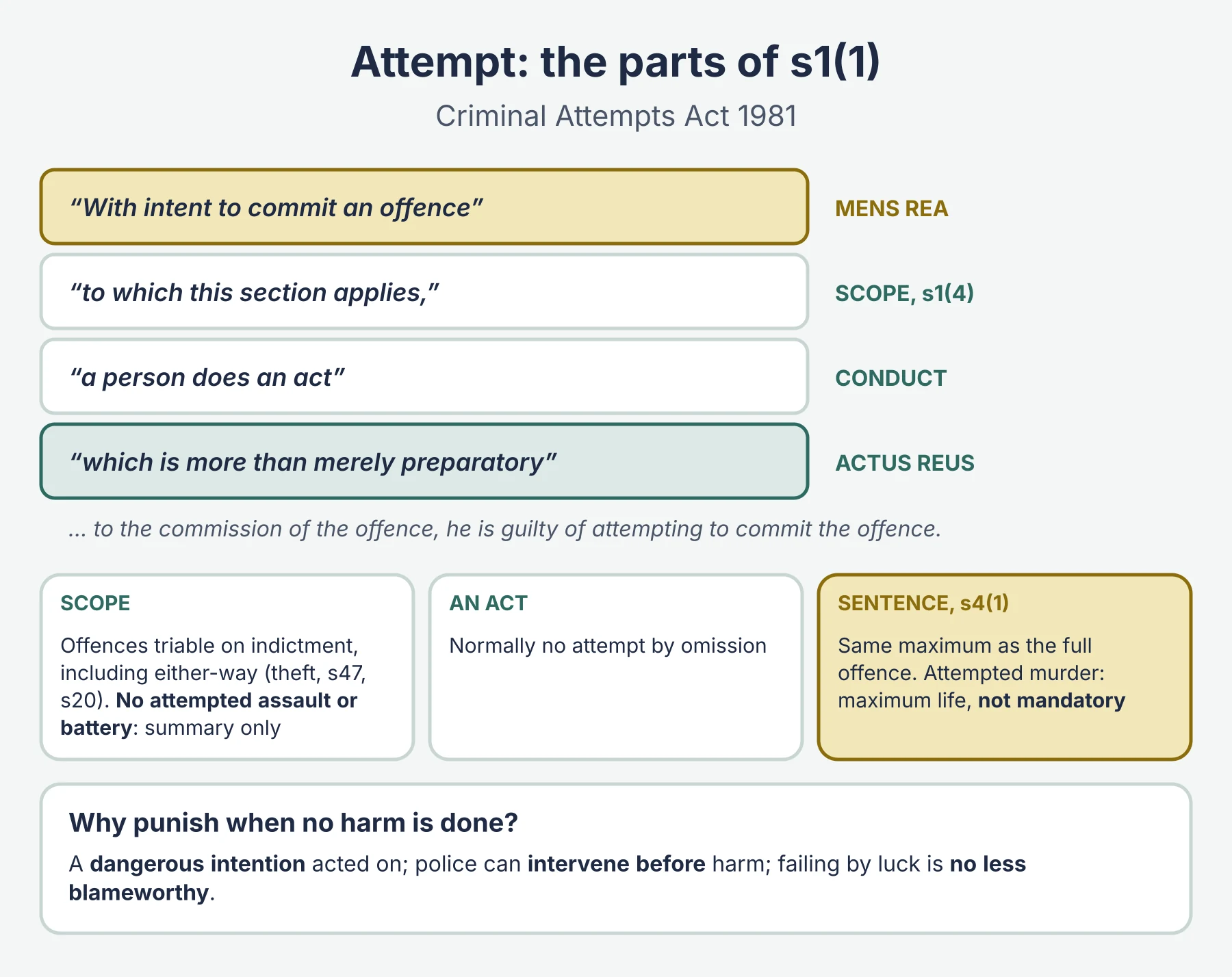
No harm has occurred, so the harm principle does not obviously justify liability. The usual justifications are that the defendant has shown a dangerous intention and come close to acting on it; that the police should be able to intervene before harm is done; and that the defendant who fails by luck is no less blameworthy than one who succeeds. The maximum sentence for an attempt is the same as for the full offence (s4(1)), although sentences in practice are usually lower; attempted murder carries a maximum of life, not a mandatory life sentence.
The statutory definition
Section 1(1): “If, with intent to commit an offence to which this section applies, a person does an act which is more than merely preparatory to the commission of the offence, he is guilty of attempting to commit the offence.”
- Which offences? Section 1(4) applies the Act to offences triable on indictment, which includes either-way offences such as theft, s47 and s20, but not purely summary offences. There is no offence of attempting assault or battery.
- An act is required, so an attempt cannot normally be committed by omission.
Actus reus: “more than merely preparatory”
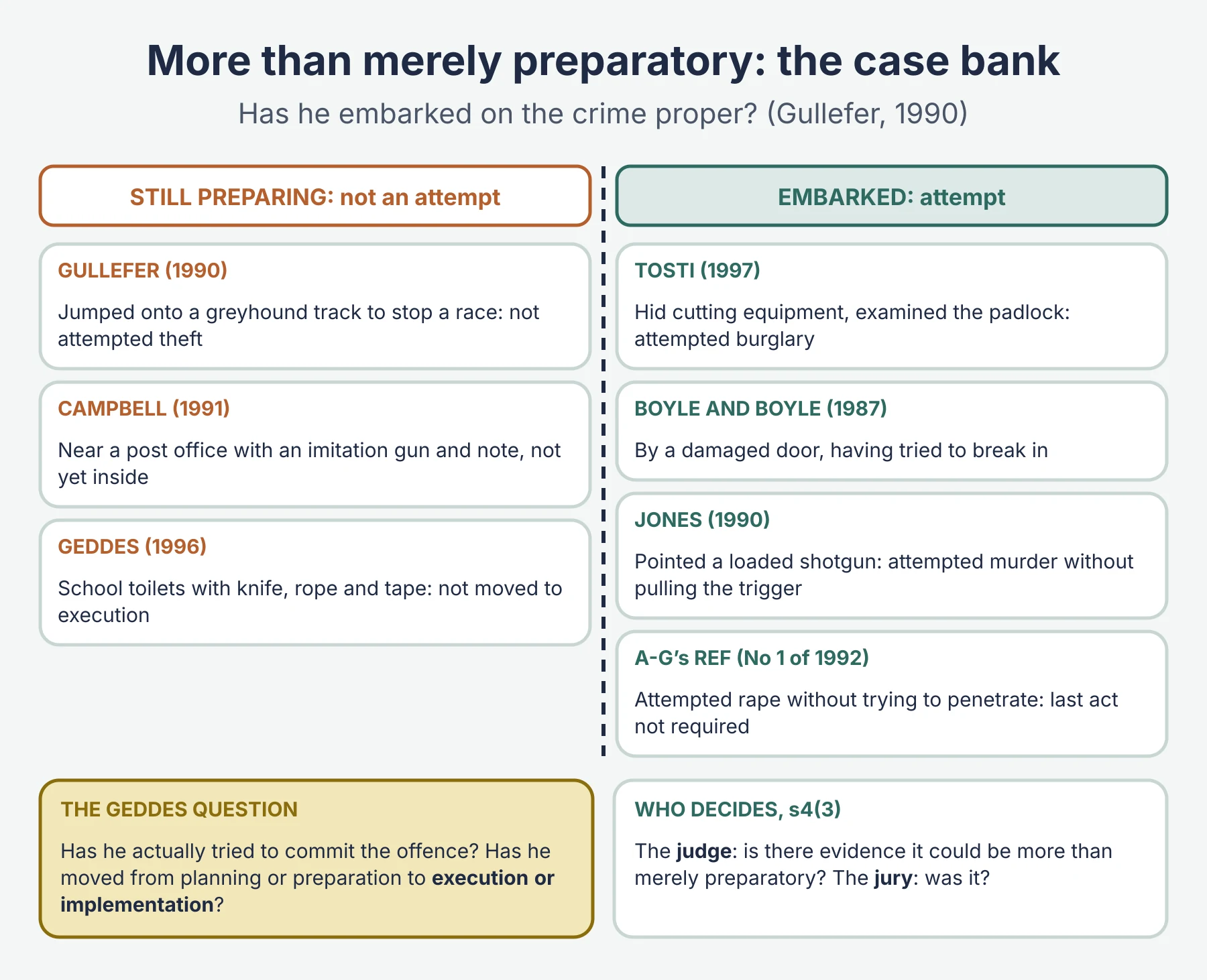
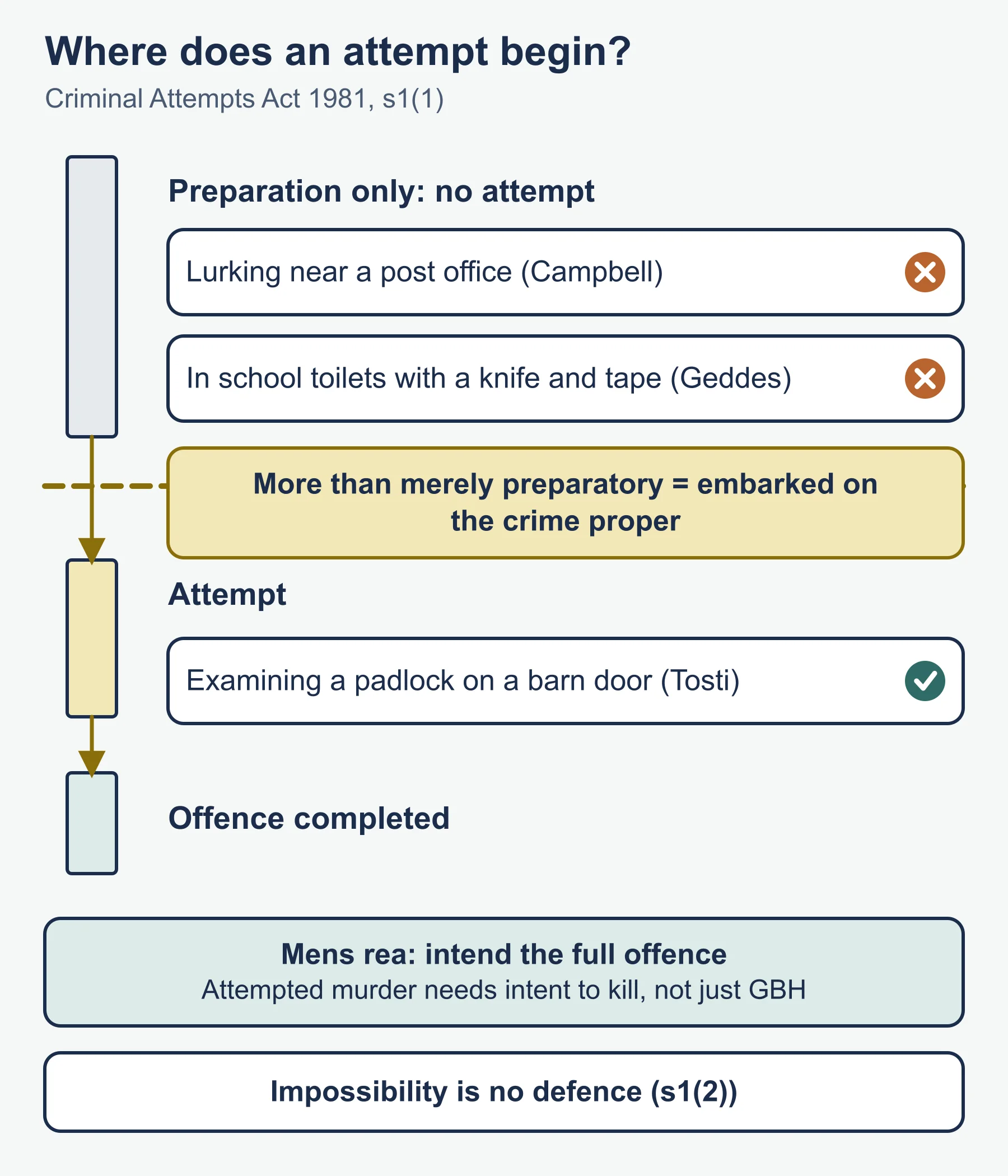
The 1981 Act replaced older tests (such as the “last act” and “proximity” tests) with a single phrase, and its meaning has been worked out case by case. The leading statement is Lord Lane CJ’s in R v Gullefer (1990): the attempt begins when the defendant embarks on the crime proper, which may be before the last act but must be beyond mere preparation.
| Case | Facts | Outcome |
|---|---|---|
| R v Gullefer (1990) | Jumped onto a greyhound track to stop a race, hoping to reclaim his stake | Not an attempt to steal: still preparing |
| R v Jones (1990) | Got into the victim’s car and pointed a loaded sawn-off shotgun at him | Attempted murder: no need for the last act (pulling the trigger) |
| R v Campbell (1991) | Arrested near a post office with an imitation gun and a threatening note, before going in | Not attempted robbery: had not entered |
| R v Geddes (1996) | Found in school toilets with a knife, rope and tape, intending to kidnap a child | Not attempted false imprisonment: had not moved from planning to execution |
| R v Tosti (1997) | Hid cutting equipment near a barn and examined the padlock | Attempted burglary: had begun the crime |
| R v Boyle and Boyle (1987) | Found by a damaged door, having tried to break in | Attempted burglary |
| Attorney-General’s Reference (No 1 of 1992) (1993) | Attempted rape where the defendant had not tried to penetrate | Could be an attempt: the last act is not required |
Judge and jury. Under s4(3) the judge decides whether there is evidence on which the act could be found to be more than merely preparatory; if so, the jury decides whether it was.
The Geddes question. The Court of Appeal suggested asking whether the defendant had actually tried to commit the offence, and whether he had moved from planning or preparation to execution or implementation. It is a useful question to apply in an exam answer.
Mens rea: intention
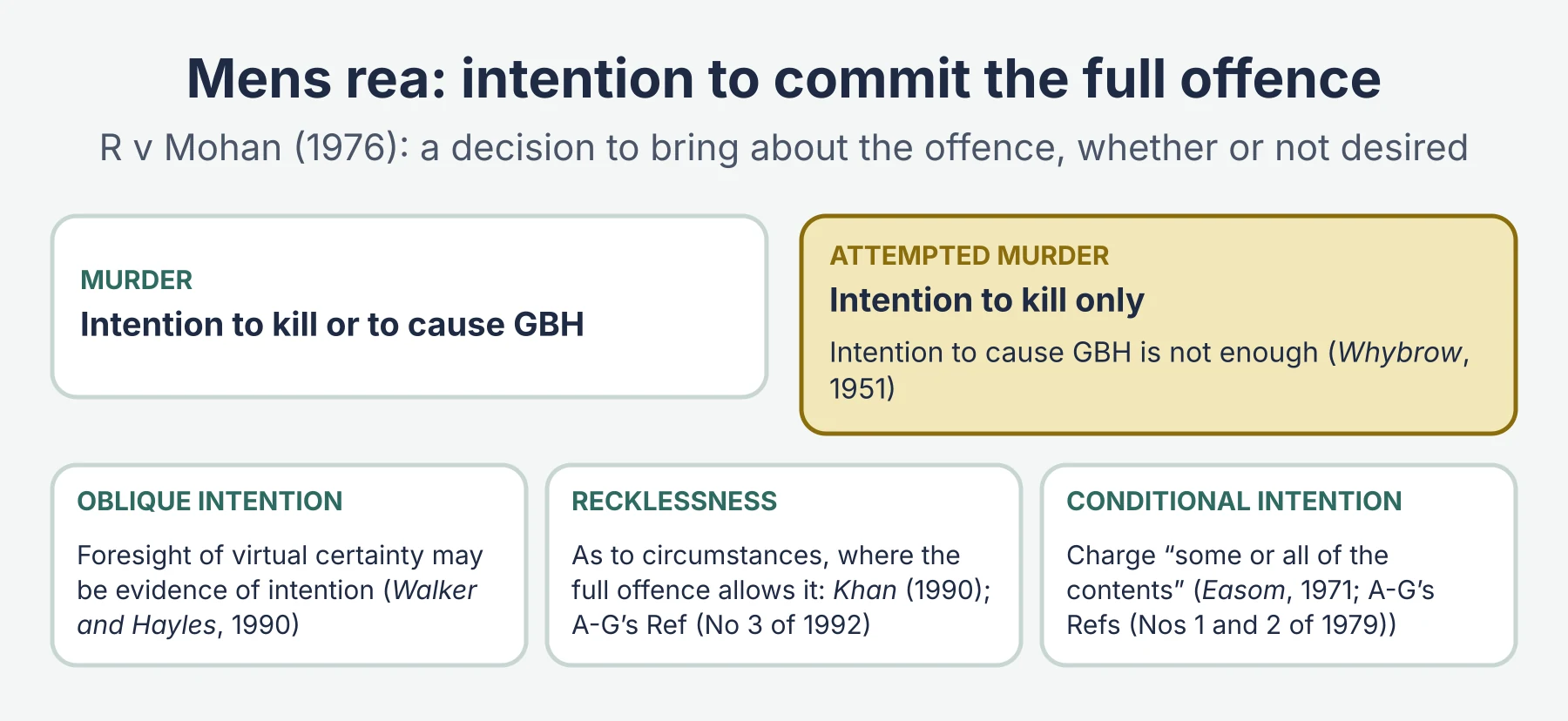
Intention as to the consequence. The defendant must intend to commit the full offence. Lord Justice James in R v Mohan (1976) described this as a decision to bring about the commission of the offence, so far as it lies within the defendant’s power, whether or not he desired that consequence.
- Attempted murder requires an intention to kill. Intention to cause GBH, enough for murder, is not enough for attempted murder (R v Whybrow, 1951).
- Oblique intention can apply: foresight of virtual certainty may be evidence of intention (R v Walker and Hayles, 1990).
Recklessness as to circumstances. Where the full offence can be committed recklessly as to a circumstance, recklessness as to that circumstance may be enough for the attempt (R v Khan, 1990, on consent in attempted rape; Attorney-General’s Reference (No 3 of 1992), 1994, on endangering life in attempted arson). Exam questions on this specification rarely need this point, but it explains why “intent” in s1(1) attaches mainly to the consequence.
Conditional intention. A defendant who intends to steal only if there is something worth stealing should be charged with attempting to steal “some or all of the contents”, since a charge naming particular items may fail where he never intended to take those items (R v Easom, 1971; Attorney-General’s References (Nos 1 and 2 of 1979), 1979).
Impossibility
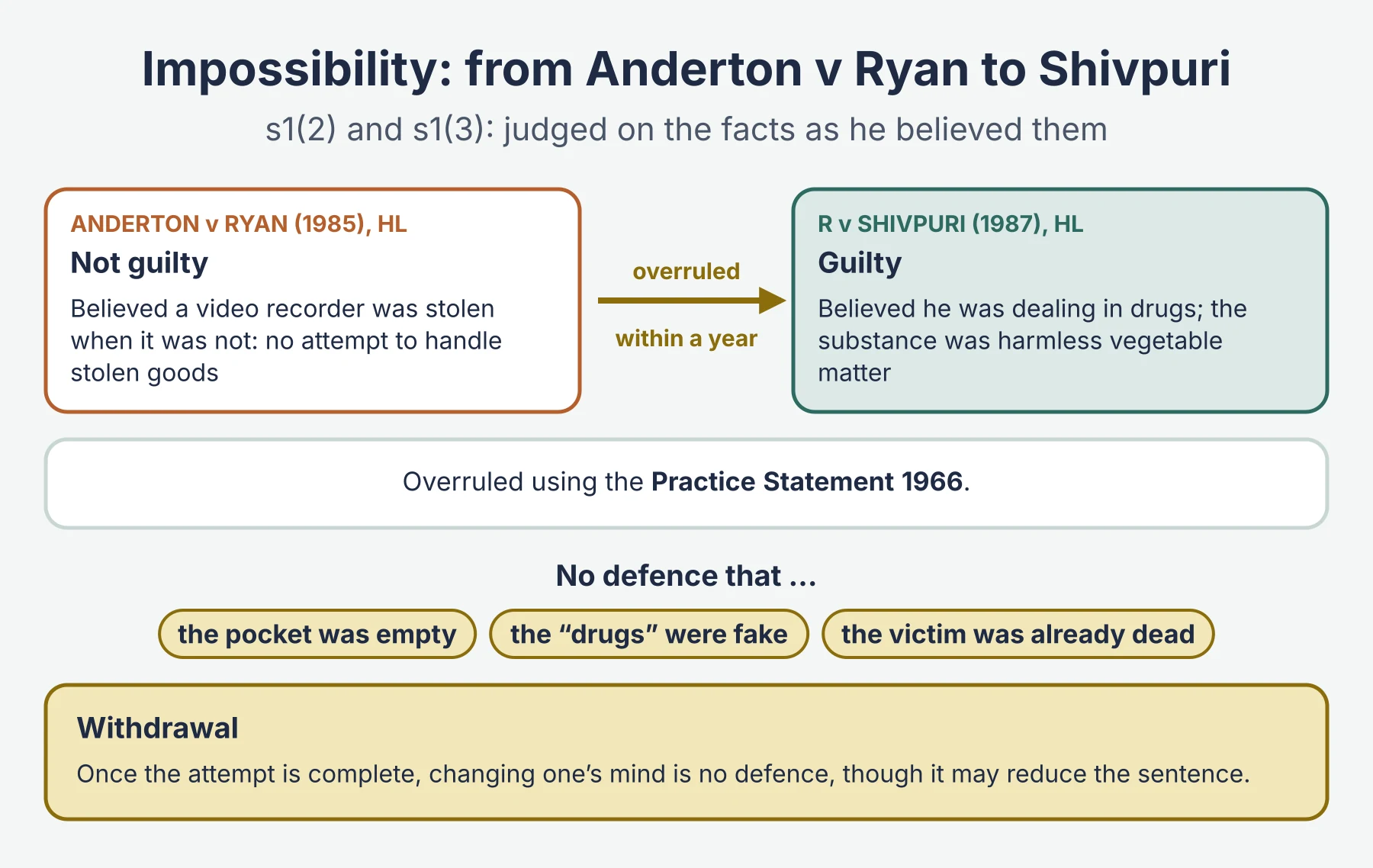
Section 1(2) provides that a person may be guilty of attempt “even though the facts are such that the commission of the offence is impossible”. Section 1(3) adds that the defendant is judged on the facts as he believed them to be.
- In Anderton v Ryan (1985) the House of Lords held that a woman who believed a video recorder was stolen, when it was not, could not be guilty of attempting to handle stolen goods.
- Less than a year later, in R v Shivpuri (1987), the House of Lords used the Practice Statement 1966 to overrule Anderton v Ryan. A man who believed he was dealing in drugs, when the substance was harmless vegetable matter, was guilty of attempting to commit the drug offence.
So it is no defence that the pocket was empty, the “drugs” were fake or the victim was already dead, as long as the defendant intended the offence and did an act more than merely preparatory to it on the facts as he believed them.
Withdrawal. Once the attempt is complete, changing one’s mind is not a defence, though it may reduce the sentence.
Evaluation
| Strengths | Weaknesses |
|---|---|
| A single test replaced several conflicting common law tests | “More than merely preparatory” is vague, so outcomes are hard to predict (Campbell and Geddes against Tosti) |
| Allows police to intervene before harm | Requiring the defendant to have “embarked on the crime proper” can force police to wait until victims are at risk, as in Geddes |
| Liability based on intention reflects subjective fault | Intention to kill for attempted murder is narrower than murder’s mens rea, which some see as inconsistent |
| Shivpuri prevents defendants escaping on technical impossibility | Punishing impossible attempts can look like punishing a guilty mind alone |
The Law Commission consulted in 2007 on reform, including a proposal to create a separate offence of criminal preparation, but the law on attempts has not been changed.
Worked example
Quinn plans to steal from an elderly neighbour’s house. He buys gloves, watches the house for a week, then is caught at the back door holding a crowbar against the frame.
Offence:   Attempted theft (or burglary, but burglary is not on this
           specification, so focus on theft as the full offence).
AR:        Buying gloves and watching the house = mere preparation
           (compare Geddes). Crowbar against the door frame = trying to
           commit the crime; embarked on the crime proper (Gullefer;
           compare Tosti; Boyle and Boyle).
MR:        Intention to steal (Mohan) - shown by his plan.
s4(3):     Judge decides there is evidence; jury decides.
Conclusion: Likely guilty of attempted theft.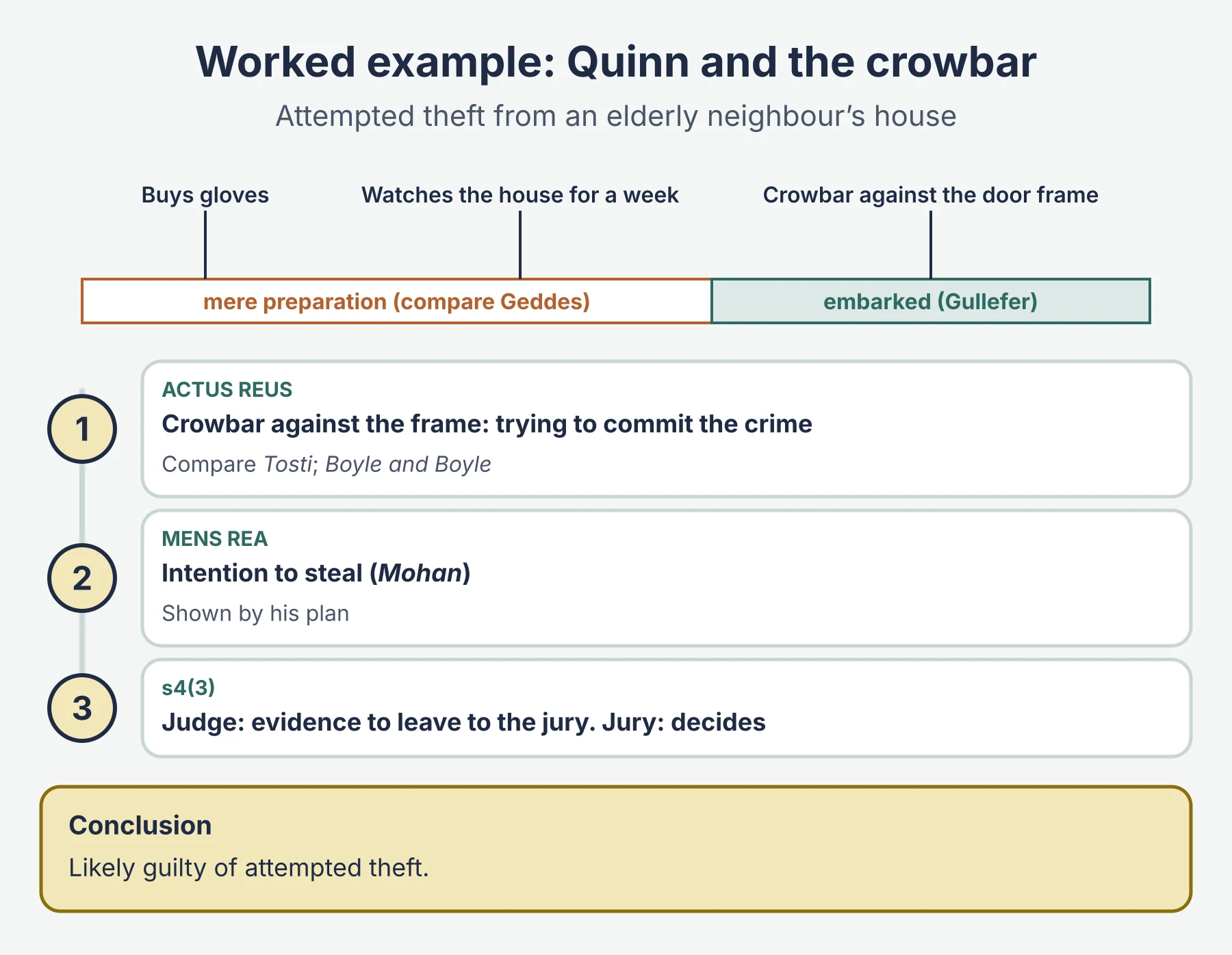
Common mistakes
- Saying an attempt requires the “last act” (Jones and A-G’s Reference (No 1 of 1992) say not).
- Using intention to cause GBH for attempted murder.
- Saying impossibility is a defence, or citing Anderton v Ryan as current law.
- Charging attempted assault or battery: these are summary offences.
- Forgetting the judge and jury split in s4(3).
Exam technique
State s1(1), apply “more than merely preparatory” using a comparable case, then intention for the specific full offence, then impossibility if the facts raise it. For evaluation, focus on the vagueness of the actus reus test and the policy problem of when police can intervene.
More resources on this topic
Related resources
-
Practice questions
AQA A Level Law (7162): Preliminary Offence – Practice Questions
Original practice questions with mark-scheme answers on attempt: preparatory acts, intention and impossibility, for AQA A Level Law 7162 Paper 1.
Law · AQA · A Level
Try questions -
Revision notes
AQA A Level Law (7162): Preliminary Offence – Revision Notes
Recall notes on attempt under s1 Criminal Attempts Act 1981: actus reus cases, intention, impossibility and evaluation points, for AQA A Level Law 7162 Paper 1.
Law · AQA · A Level
Revise topic -
Study guides
AQA A Level Law (7162): Property Offences
Theft under ss1-6 and robbery under s8 Theft Act 1968, section by section with leading cases and a worked problem, for AQA A Level Law 7162 Paper 1.
Law · AQA · A Level
Read guide
Get free revision emails (optional)
Occasional emails with practice questions, worked explanations and links to free resources for the qualification and subjects you choose. No spam, and you can unsubscribe from any email. The free tools on this site never need an email.